A View From the Room Where Melville Wrote Moby Dick (Plus a Free Celebrity Reading of the Novel)
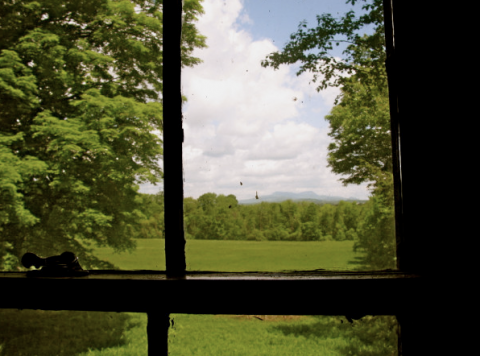 It’s in Pittsfield, Massachusetts, right in the midst of the Berkshires. Needless to say, not a drop of water in sight.
Now that I’ve got your attention, let me give you an update on The Moby Dick Big Read project. Since we highlighted the project last fall, all 135 chapters of the great American novel have been read by celebrities like Tilda Swinton, Stephen Fry, Mary Oliver, and Simon Callow. And now the complete set of audio recordings are online and ready for free download. Get them here: iTunes, Soundcloud, RSS Feed, or the Big Read web site itself.
We start you off with Tilda’s reading of Chapter 1 right below.
Photo above comes to us via @stevesilberman
Read More...William Shatner Sings Nearly Blasphemous Version of “Lucy in the Sky with Diamonds” (1968)
On a lazy summer weekend last year, we asked for a little help from our friends. We asked: “What are the worst Beatles’ covers you’ve ever heard — ones so bad, they’re good?” And boy did you deliver. You rattled off 15 cringe-inducing covers, including Bill Cosby singing “Sgt. Pepper’s Lonely Hearts Club Band;” Sean Connery talking his way through “In My Life;” Wing screeching “I Wanna Hold Your Hand;” Tiny Tim doing damage to “Nowhere Man;” and much more. Looking back, I’m still personally drawn (in a it’s-so-cheesy-it’s-great kind of way) to William Shatner’s version of “Lucy in the Sky with Diamonds.” Riding high on his Star Trek fame, Shatner recorded the song for his first music album, The Transformed Man, a 1968 concept album that juxtaposed classic literature with modern pop lyrics. For example, he put lines from Cyrano de Bergerac next to Bob Dylan’s “Mr. Tambourine Man.” Years later, in a 2001 interview, Paul McCartney laughingly gave props to Shatner’s performance.
When you’re done with this piece of work, I’d encourage to visit The 15 Worst Covers of Beatles Songs.
Read More...Artist Shepard Fairey Curates His Favorite YouTube Videos
In a video for MOCA, the “defining museum of contemporary art” in Los Angeles, Shepard Fairey, the graphic designer and illustrator best known for the Obama Hope poster of 2008, spent a few minutes rapping about the YouTube videos that have inspired him, both personally and professionally. He starts with one we’ve featured here before — Saul Bass’ Pitch for the Redesign of Ma Bell’s Logo. Read all about that fascinating 1969 project here.
Next up comes the 1981 music video for Blondie’s “Rapture” — momentous because it was the first rap video ever aired on MTV and because it features an appearance by graffiti artist Jean-Michel Basquiat, who stepped in for Grandmaster Flash when he inexplicably went MIA.
Now let’s roll George Clinton’s video for “Atomic Dog” (1982), an inspiration to Fairey because it layers 1980s-video game imagery on top of prison scenes, creating a “template for what a lot of gangster rappers would embrace later.” Call it the ur-gangsta rap video.
Finally, Shepard refers to videos by The Sex Pistols, the English punk band formed in 1975. But when it comes to selecting a particular clip, he leaves us hanging. So, given that curating YouTube videos is our everyday gig, hope you don’t mind if we lay some “God Save the Queen” on you. Enjoy.
via Boing Boing
Read More...
Ernest Hemingway Appears on Cuban TV in 1954; Talks About Winning The Nobel Prize
Ernest Hemingway lived in Cuba much longer than he lived in Paris or Key West. From 1939 until 1960–the year before his death–he lived on a farm outside Havana, in the village of San Francisco de Paula, called Finca Vigía, or “Lookout Farm.”
It was not the most fruitful period of Hemingway’s life as a writer. His 1950 novel, Across the River and Into the Trees, was savaged by the critics, and many were beginning to think he was finished. But in 1952 Hemingway came roaring back with The Old Man and the Sea, set in Cuba, an elemental story of a lonely old fisherman’s struggle to catch a big fish and bring it back to shore through shark-infested waters. With The Old Man and the Sea, William Faulkner said, Hemingway had found God. “Time may show it to be the best single piece of any of us,” said Faulkner,” I mean his and my contemporaries.”
In 1953 the novel was awarded the Pulitzer Prize, and in 1954 Hemingway received the Nobel Prize in Fiction. Shortly afterward he was visited at the Finca Vigía by reporter Juan Manuel Martínez and a cameraman from the Cuban television network CMQ. In a mixture of Castilian Spanish and Cuban vernacular, Hemingway tells Martínez that he is overjoyed at being the first Cubano sato, or “half-breed Cuban” to receive a Nobel Prize. “The use of the adjective ‘sato’ by Ernest Hemingway shows he had a deep relationship with ordinary Cubans,” writes Guiomar Venegas Delgado in a 2009 article in enVivo, the journal of Cuban radio and television, “and that as an artist he knew to listen and assimilate their idioms and slang.”
To hear Ernest Hemingway read his 1954 Nobel Prize acceptance speech from Cuba, see our July 2011 post, “Remembering Ernest Hemingway, Fifty Years After His Death.”
Related Content:
Seven Tips From Ernest Hemingway on How to Write Fiction
Ernest Hemingway Reads “In Harry’s Bar in Venice”
James Joyce in Paris: “Deal With Him, Hemingway!”
Read More...Alfred Hitchcock’s 7‑Minute Master Class on Film Editing
If you’ve made a film, you’ll remember when you realized that editing, more than any other stage of production, determines the audience’s final experience. “The first films ever made were shot in one take,” wrote the late, always editing-conscious Roger Ebert, reviewing Mike Figgis’ Time Code. “Just about everybody agrees that the introduction of editing was an improvement.” Figgis’ film tried to do without editing, successfully to my mind, not so successfully to Ebert’s. Later, the critic openly loathed Vincent Gallo’s traditionally edited The Brown Bunny, but his opinion turned almost 180 degrees when the director re-edited the movie, strategically cutting 26 minutes. “It is said that editing is the soul of the cinema,” Ebert wrote of the revision. “In the case of The Brown Bunny, it is its salvation.” Yet the impulse to create a wholly unedited film still occasionally grabs a major filmmaker, and not all of them wind up remaking Andy Warhol’s eight-hour still shot Empire.
Some of these pictures, thanks to well-placed cuts and clever camera movements, only look unedited. The best-known of these comes from no less a craftsman than Alfred Hitchcock, who built 1948’s Rope out of ten seemingly cut-free segments, each internal splice meticulously disguised. Twelve years later, he would make his most overt and memorable use of editing in Psycho. In the clip at the top of this post, Hitchcock himself explains the importance of editing — or, in his preferred term, assembly. He breaks down the structure of Psycho’s famous shower scene. “Now, as you know, you could not take the camera and just show a nude woman being stabbed to death. It had to be done impressionistically. It was done with little pieces of the film: the head, the hand, parts of the torso, shadow on the curtain, the shower itself. In that scene there were 78 pieces of film in about 45 seconds.” Say what you will about the content-restricting Hays Code; its limitations could sometimes drive to new heights the visual creativity of our best cinematic minds.
If you’d like to behold more of the editing prowess Hitchcock commanded, visit our collection of 20 Free Alfred Hitchcock Movies Online.
Related content:
François Truffaut’s Big Interview with Alfred Hitchcock (Free Audio)
Alfred Hitchcock: The Secret Sauce for Creating Suspense
Alfred Hitchcock: A Rare Look Into the Filmmaker’s Creative Mind
Alfred Hitchcock’s Rules for Watching Psycho (1960)
Colin Marshall hosts and produces Notebook on Cities and Culture and writes essays on literature, film, cities, Asia, and aesthetics. He’s at work on a book about Los Angeles, A Los Angeles Primer. Follow him on Twitter at @colinmarshall.
Read More...Fascinating Kodachrome Footage of “Victory over Japan Day” in Honolulu, 1945
When Field Marshal Wilhelm Keitel signed Nazi Germany’s unconditional surrender on May 8, 1945 in Berlin (footage here), the Second World War may have been over for Europe, but the war on the Pacific front waged on as Japan refused to surrender. Only after the fateful decision to drop atomic bombs on Hiroshima and Nagasaki, and after the Soviets invaded Japanese-held Manchuria, did Emperor Hirohito accept the hopelessness of the situation and agree to surrender on August 15. When the official radio announcement (recording here) was broadcast — due to time zone differences on August 14 in the U.S. — the news spread like wildfire and the day became known as “Victory over Japan Day”, or simply as “VJ Day.” Spontaneous celebrations erupted all over the United States, but especially on Hawaii, where the Japanese attacked Pearl Harbor on December 7, 1941 leading the US to officially enter World War II.
One of these spontaneous celebrations in Honolulu was captured on Kodachrome 16mm film and has been digitally restored. One commenter on Vimeo has identified all of the exact locations here.
By profession, Matthias Rascher teaches English and History at a High School in northern Bavaria, Germany. In his free time he scours the web for good links and posts the best finds on Twitter.
Read More...The Personality of Parisian Neighborhoods Expressed Through Typography
?si=cnM2vJhNobyTr0am
Havas Worlwide Paris, a global design agency, reawakened fond memories of my days living in Paris. They did it by creating this artistic video that captures the character of Parisian neighborhoods/metro stops through typography. The Marais, Latin Quarter, Montmartre, Père Lachaise, Bastille — they all get a creative nod.
The video was originally created as a New Years Greeting card, and it comes to us via Pret-a-Porter.
Related Content:
Le Flaneur: Time Lapse Video of Paris Without the People
Names of Paris Métro Stops Acted Out: Photos by Janol Apin
It’s 5:46 A.M. and Paris Is Under Water
David Lynch Talks About His 99 Favorite Photographs at Paris Photo 2012
Read More...Italian Photographer Maurizio Galimberti Creates Cubist Polaroid Collages of Artists & Celebrities
Five years ago Polaroid announced that they would no longer make analog instamatic film. At that moment, if one listened carefully, one could almost hear some of the 20th century’s most famous artists wail in despair, even from the grave. Ansel Adams loved Polaroid and shot some of his famous Yosemite images in that format first.
But a technique with that kind of following doesn’t die off easily. Two ardent Polaroid fans—ardent enough to actually attend the closure of a Polaroid factory in the Netherlands—met and came up with a plan to save the factory and Polaroid instant film. They called their plan the Impossible Project. They leased one of the Dutch factory buildings and eventually fired up the machines again, turning out new instant film.
Lucky for us. Artists like David Hockney have long made beautiful use of Polaroid instant photos to construct cubist collages. One of the best at this is the Italian photographer Maurizio Galimberti who creates terrific celebrity portraits using a Polaroid.
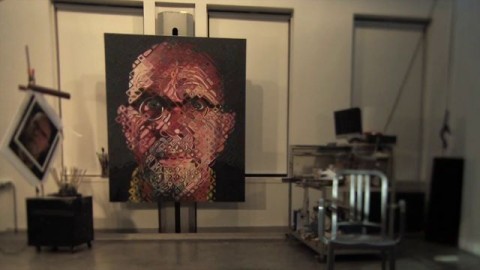
Galimberti considers himself a painter who uses a camera. Watching the video of his photo shoot with painter Chuck Close, it’s interesting to observe how similar Galimberti’s photo collage (above) is to Close’s own painted self-portraits.
Galimberti also has pretty good access to celebrities, having shot the portrait of Johnny Depp and this one of George Clooney at the 2003 Venice Film Festival.
Galimberti posts a number of more recent celebrity portraits on his website, where he also displays his abstract city photo collages.
Kate Rix writes about digital media and education. Visit her website: .
Read More...Room 237: New Documentary Explores Stanley Kubrick’s The Shining and Those It Obsesses
Young movie fans often discover the existence of auteurs through one auteur in particular: Stanley Kubrick. Often, they discover him through one film in particular: The Shining. Adapted — loosely adapted, to the point of reinvention — from Stephen King’s novel, Kubrick’s first picture of the eighties found itself marketed as a straight-on horror movie. Kids savor few experiences so richly as getting scared by a story, but when they sit down to get scared by The Shining, they don’t feel quite what they expected to. The movie may fill them with fear (I’ve personally experienced no greater disturbance than the stare of that 1920s fellow in the dog costume toward the end), but it also fills them with the sense that it doesn’t quite align with all the horror movies they’ve watched before. Some of these kids want to find out why. Sooner or later, they stumble upon Bill Blakemore’s well-known essay “The Family of Man,” which examines The Shining and finds it brimming with symbolism pertaining to Native American dispossession and slaughter. These kids surely all grow up to become cinephiles, but I like to think that some grew up to become the subjects of Room 237, Rodney Ascher’s new documentary about Shining obsessives, whose trailer you can watch above.
“In 1980 Stanley Kubrick released his masterpiece of modern horror The Shining,” reads the trailer’s crawl. “Over 30 years later, we’re still struggling to understand its hidden meanings.” John Powers’ NPR piece on the documentary can tell you more. “Where you may think it’s merely a horror story — remember that blood flooding out of the elevator? — these devotees argue that Kubrick’s movie is really about more than a writer going homicidally bonkers,” Powers says. “For one, it’s about the genocide against Native Americans; for another, it’s about the Holocaust; yet another says the film is Kubrick’s admission that he helped fake footage of the Apollo 11 moon landing. By way of evidence, these folks point to all sorts of ‘clues,’ from the presence in several shots of the Calumet Baking Powder logo — with its distinctive tribal chief in a feathered headdress — to apparent continuity errors involving misplaced chairs that, this being Kubrick, can’t possibly be mere errors.” Whether you credit Shining theories or not, you might consider prefacing your own Room 237 screening with a watch of The Shining Code, an hour-long video essay on Kubrick’s film that puts this mindset on display. Just promise us you won’t get involved with any moon hoax people.
Related content:
The Making of Stanley Kubrick’s The Shining (As Told by Those Who Helped Him Make It)
Terry Gilliam: The Difference Between Kubrick (Great Filmmaker) and Spielberg (Less So)
Dark Side of the Moon: A Mockumentary on Stanley Kubrick and the Moon Landing Hoax
Colin Marshall hosts and produces Notebook on Cities and Culture and writes essays on literature, film, cities, Asia, and aesthetics. He’s at work on a book about Los Angeles, A Los Angeles Primer. Follow him on Twitter at @colinmarshall.
Read More...Flashmob Recreates Rembrandt’s “The Night Watch” in a Dutch Shopping Mall
The European banking sector may still be on shaky footing. But it’s not stopping European banks from putting together a good flashmob. Last year, the Spanish bank, Banco Sabadell, brought together 100 professional musicians and singers to perform the anthem of the European Union — Beethoven’s “Ode to Joy” from his Symphony No. 9. And movingly so. It all happened in the Plaça de Sant Roc in Sabadell, Spain, a little north of Barcelona.
This year, we travel north to the city of Breda in Holland, where the Dutch multinational bank ING paid performers to recreate Rembrandt’s famous painting, The Night Watch, in a shopping center. The occasion? The re-opening of The Rijksmuseum in Amsterdam on April 13 after a long 10-year renovation.
via The Guardian
Related Content:
The Rijksmuseum Puts 125,000 Dutch Masterpieces Online, and Lets You Remix Its Art
Imagining Rembrandt’s Facebook Timeline
16th-Century Amsterdam Stunningly Visualized with 3D Animation
Google “Art Project” Brings Great Paintings & Museums to You
Read More...Support Us
We're hoping to rely on loyal readers, rather than erratic ads. Please click the Donate button and support Open Culture. You can use Paypal, Venmo, Patreon, even Crypto! We thank you!

About Us

Open Culture scours the web for the best educational media. We find the free courses and audio books you need, the language lessons & educational videos you want, and plenty of enlightenment in between.
Advertise With Us

FREE UPDATES!
GET OUR DAILY EMAIL
Get the best cultural and educational resources on the web curated for you in a daily email. We never spam. Unsubscribe at any time.
FOLLOW ON SOCIAL MEDIA

Open Culture editor Dan Colman scours the web for the best educational media. He finds the free courses and audio books you need, the language lessons & movies you want, and plenty of enlightenment in between.
Advertise With Us


