Try George Orwell’s Recipe for Christmas Pudding, from His Essay “British Cookery” (1945)
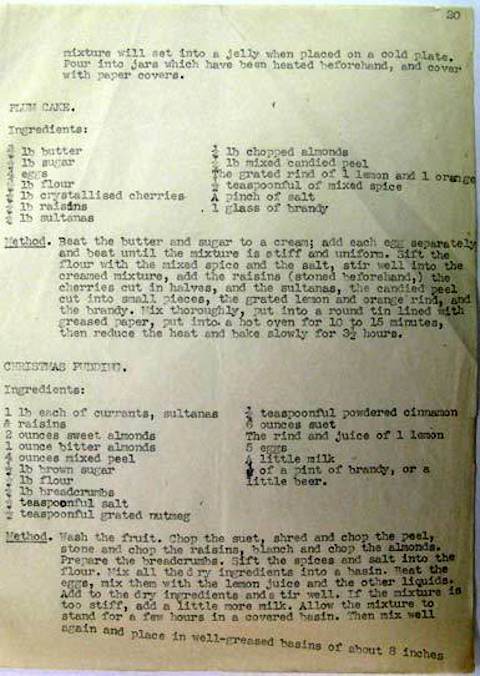
British cooking has been the butt of many jokes, and serious thought-pieces have been devoted to “why British food was so bad for so long.” While that article blames WWI for the decline of English Cuisine, the stigma long precedes the 20th century. In his unpublished essay “British Cookery,” for example, George Orwell opens with a quote from Voltaire, who wrote that Britain has “a hundred religions and only one sauce.” This, Orwell writes, “was untrue” and “is equally untrue today.” His “today” was 1945, before the best British cuisine was Indian. And though he does defend his country’s cooking, and did so in another essay published that year in the Evening Standard, Orwell also makes some critical comments that confirm some of the stereotypes, calling the British diet “a simple, rather heavy, perhaps slightly barbarous diet” and writing: “Cheap restaurants in Britain are almost invariably bad, while in expensive restaurants the cookery is almost always French, or imitation French.”
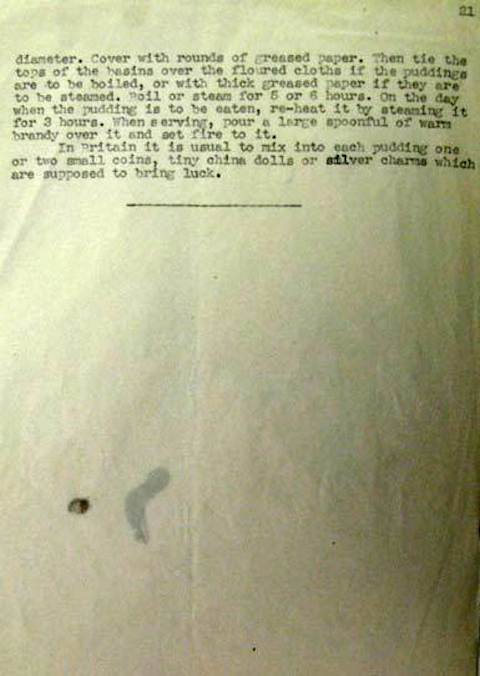
The essay is an exhaustive survey of the British palate of the time, and it concludes with some of Orwell’s own recipes for sweets, including treacle tart, orange marmalade, plum cake, and, lastly, Christmas pudding. You can see the stained typescript of the last two recipes above, and read the full transcript of Orwell’s “British Cookery” here (the recipes are at the end). Having no experience with the strange world of British sweets and pies, I’ll have to take The Guardian’s Alex Renton’s word when he tells us that “the Orwell Christmas pudding is nothing radical.” Nonetheless, I’m tempted to try this recipe more than any of the others Renton mentions, even if I may not get my hands on real suet or sultanas. Read a transcript of Orwell’s Christmas pudding recipe below.
CHRISTMAS PUDDING.
Ingredients:
1 lb each of currants, sultanas & raisins
2 ounces sweet almonds
1 ounces sweet almonds
1 ounces bitter almonds
4 ounces mixed peel
½ lb brown sugar
½ lb flour
¼ lb breadcrumbs
½ teaspoonful salt
½ teaspoonful grated nutmeg
¼ teaspoonful powdered cinnamon
6 ounces suet
The rind and juice of 1 lemon
5 eggs
A little milk
1/8 of a pint of brandy, or a little beer
Method. Wash the fruit. Chop the suet, shred and chop the peel, stone and chop the raisins, blanch and chop the almonds. Prepare the breadcrumbs. Sift the spices and salt into the flour. Mix all the dry ingredients into a basin. Heat the eggs, mix them with the lemon juice and the other liquids. Add to the dry ingredients and stir well. If the mixture is too stiff, add a little more milk. Allow the mixture to stand for a few hours in a covered basin. Then mix well again and place in well-greased basins of about 8 inches diameter. Cover with rounds of greased paper. Then tie the tops of the basins over the floured cloths if the puddings are to be boiled, or with thick greased paper if they are to be steamed. Boil or steam for 5 or 6 hours. On the day when the pudding is to be eaten, re-heat it by steaming it for 3 hours. When serving, pour a large spoonful of warm brandy over it and set fire to it.
In Britain it is unusual to mix into each pudding one or two small coins, tiny china dolls or silver charms which are supposed to bring luck.
via Biblioklept
Related Content:
George Orwell and Douglas Adams Explain How to Make a Proper Cup of Tea
The Recipes of Iconic Authors: Jane Austen, Sylvia Plath, Roald Dahl, the Marquis de Sade & More
Prepare Marilyn Monroe’s Personal, Handwritten Turkey-and-Stuffing Recipe on Thanksgiving
Josh Jones is a writer and musician based in Durham, NC. Follow him at @jdmagness
Read More...Neil Armstrong, Buzz Aldrin & Michael Collins Go Through Customs and Sign Immigration Form After the First Moon Landing (1969)

Click for larger image
I’m not saying Man of Steel depressed me, but I found myself pining for Richard Donner’s sense of humor recently as I watched Zack Snyder’s take on Superman for the first time. I thought of a scene—Superman has to go through immigration once he’s discovered. They won’t let him in. He’s too high-minded to resist, so he sleeps in an airport waiting room for six months. Plenty of dramatic potential there.
Less preposterous but still absurd is the story around the document above, signed by Neil Armstrong, Buzz Aldrin, and Michael Collins after they landed from the first manned trip to the moon. The three astronauts came down in the Pacific Ocean and were taken to Honolulu on July 24, 1969, where they supposedly signed the immigration form, declaring a cargo of moon rocks and dust.
The form, NASA spokesperson John Yembrick told Space.com, is authentic. And, he says, it was a joke. He does not, however, say exactly when the form was signed, either on the day the crew splashed down or sometime afterward. They did not actually arrive in Honolulu until the 26th. After their return,
The astronauts were trapped inside a NASA trailer as part of a quarantine effort just in case they brought back any germs or disease from the moon. They even wore special biological containment suits when they walked out on the deck of the USS Hornet after being retrieved.
NASA transported them to Houston, quarantine trailer and all, and they emerged from isolation three weeks later.
Astronauts these days mostly just need a shower when they touch down, although internet savvy International Space Station astronaut Chris Hadfield did recently tell some customs related stories on a Reddit AMA—maybe nothing so weird as the current space snorkeling up there, but still a pretty great read.
Related Content:
“Moon Hoax Not”: Short Film Explains Why It Was Impossible to Fake the Moon Landing
Dark Side of the Moon: A Mockumentary on Stanley Kubrick and the Moon Landing Hoax
Find Astronomy Courses in our Collection of 800 Free Courses Online
Josh Jones is a writer and musician based in Durham, NC. Follow him at @jdmagness
Read More...Short Film Shows What Happens When a Letter from World War II Finally Gets Delivered 69 Years Later
A few years ago, I stumbled upon a never-sent letter written to a friend when we were both in college. The contents weren’t heavy. Disorganization is the most likely explanation for why it never went in the mail. I cracked the envelope and had a look.
It was a time capsule, for sure, a cringe-inducing one. It wasn’t so much the life I was reporting on as how I framed it, self-aggrandizement straining to pass as nonchalance. Fortunately, an artist acquaintance happened to be running a project— send her your shreddable documents, and eventually, she’d send you a few sheets of handmade paper in which your mulched data mingled with that of others. Truly a beautiful way to dispose of the evidence.
But what happens when neither the writer, nor the intended recipient, is the finder of the lost letter? In February 2013, some mail posted by Lt. Joseph O. Matthews, a soldier stationed at a military training facility in Jacksonville, North Carolina, found its way to Abbi Jacobson, an actress (and coloring book author!) renting an apartment on MacDougal Street in New York City. Addressed to Matthew’s wife, the cancellation mark was dated December 2, 1944.
Jacobson opened the letter, the condition of the envelope having suggested that she would not be the first to breach its contents during the 69 years it had spent wandering in the wilderness. The words inside were romantic, a young officer informing the bride he’d left back home that he’d soon be shipping out to Okinawa. Eager to pull an Amélie by reuniting the letter with those to whom it would mean the most, Jacobson enlisted the help of her friend, documentary filmmaker Todd Bieber. Together they searched records at City Hall, looking for clues. When that approach proved fruitless, they created the Lost Letter Project, a web portal that invited the public to join in the search.
An avalanche of tweets, Facebook updates, and human interest pieces ensued. In no time at all, they had their man, or rather his descendants, Lt. Matthews having passed away in 1999, crushing Jacobson’s dreams of hand delivering the letter to “a little old man and a little old lady.” (I’m willing to bet Jacobson will one day wish there was a giant blender capable of turning digital statements like how cute would that be, my god, right? I love old people into handmade paper.)
Bieber’s video reveals what became of Lt. Matthews and his wife. Even more interesting is how the letter resonates with his grown children, particularly a certain theological reference at odds with the man they thought they knew.
Related Content:
In Touching Video, Artist Marina Abramović & Former Lover Ulay Reunite After 22 Years Apart
“Nothing Good Gets Away”: John Steinbeck Offers Love Advice in a Letter to His Son (1958)
Stephen King Writes A Letter to His 16-Year-Old Self: “Stay Away from Recreational Drugs”
Ayun Halliday is all for stuffing your stocking with a holiday gift subscription to the East Village Inky, her award winning hand-illustrated zine. Follow her @AyunHalliday
Read More...Hear Michel Foucault Deliver His Lecture on “Truth and Subjectivity” at UC Berkeley, In English (1980)
Michel Foucault first arrived at the University of California, Berkeley in 1975. By this time, he was already a celebrity in France. He had just published his enormously influential history and critique of the penal system, Discipline and Punish, and he occupied a position at the prestigious Collège de France as chair in the “history of systems of thought,” a position he created for himself. But when he arrived on the West Coast, writes Marcus Wohlsen, “few at Berkeley had heard of Michel Foucault.” Leo Bersani, then chairman of the French department, even had to call philosophy professor Hubert Dreyfus to help “come and fill out the ranks” for Foucault’s lectures.
After the publication of volume one of The History of Sexuality, Foucault would return to Berkeley in the fall of 1979, then again in 1980. By then, the scene had changed dramatically. Foucault was invited to deliver the Howison Lecture that year, a distinguished invitation previously extended to such thinkers as John Dewey, Willard V.O. Quine and, the year previous, John Rawls. By this time, Wohlsen writes, Foucault was, reluctantly, “an international academic superstar.” Filling the hall for his lectures would not be an issue. In fact, Wohlsen tells us,
Crowds crammed the 2,000-seat Zellerbach Hall so quickly that police had to bar the doors. Foucault fans milled around restlessly outside until [philosophy professor Hans] Sluga arranged for a live broadcast of the letures to Wheeler Hall. Its 760 seats filled almost immediately.
According to Sluga, Foucault, increasingly wary of his fame, intentionally titled his lecture—“Truth and Subjectivity: the Stoic Practice of Self Examination”—to sound “learned, abstract, remote” in order to deter a large crowd. That ploy clearly failed.
In the first part of the lecture (at top), the presenter who introduces Foucault begins by gesturing to the philosopher’s fame, then comments that Foucault’s prominent post at the Collège de France was “very paradoxical, since Michel Foucault, although prestigious, is not a typical kind of academic. He is suspicious of all titles and claims to disinterested truth that has been [sic] associated with academia.” After mentioning Foucault’s fierce criticism of every historical assumption and methodology (he was a guest of the History and French Departments), he breaks off his remarks to note that “there’s a mob of people all around, trying to get in.”
Foucault begins his lecture in French (at 8:08), then switches to English for the remainder (at 9:18). He quotes from a historical French psychiatrist’s account of a “cure” involving an “interrogation” and a coerced confession of madness. Foucault calls this one among many examples of “truth therapies,” and it serves—as do such vividly specific archival examples in his books—as a harrowing introduction to the policing of capital‑T Truth that is the essence of the humanist enterprise.
Despite the often profoundly unsettling nature of his investigations, and his attempt to scare off the crowd, Foucault is not dour or boring, nor does he seem at all unapproachable or forbidding. He is patient and self-deprecatingly funny: in a cutting, rueful reference to the growing dominance of analytic philosophy in British and American universities, he says, “I confess, with the appropriate chagrin, that I am not an analytical philosopher. Nobody is perfect.” Then he sums up his project succinctly: “I have tried to explore another direction. I have tried to get from a philosophy of subjectivity to a genealogy of the subject.”
Foucault is a very charming speaker, sprinkling his lecture with little jokes like “It goes without saying… but it goes better with saying…” and dropping in Americanisms like “Monday morning quarterbacking,” to the amusement of the crowd. He shows himself to be very much aware of his audience—these are deeply serious lectures, without a doubt, but Foucault never forgets that he’s facing living human beings, with their own domains of knowledge and subjectivities—and he seeks to reach them where they are while reporting on his disturbing discoveries as an archaeologist of Western humanist discourse.
Foucault returned to Berkeley again as a visiting professor in 1981 and again 1983, the year before his death. Alain Beaulieu, who has catalogued Foucault’s Berkeley archives, described his time in California as happy and productive, “while he remain[ed] critical of some features associated with the ‘Californian cult of the self.’” In fact, “Cult of the Self” was the title of three lectures Foucault delivered at Berkeley in 1983 (listen here), along with six lectures on “Discourse and Truth.” During his time at Berkeley in 1980, when he delivered the lecture above, graduate student Michael Bess interviewed the philosopher. Foucault spoke plainly and passionately about the impetus for his relentless critiques of institutional power and knowledge:
In a sense, I am a moralist, insofar as I believe that one of the tasks, one of the meanings of human existence—the source of human freedom—is never to accept anything as definitive, untouchable, obvious, or immobile. No aspect of reality should be allowed to become a definitive and inhuman law for us.
We have to rise up against all forms of power—but not just power in the narrow sense of the word, referring to the power of a government or of one social group over another: these are only a few particular instances of power.
Power is anything that tends to render immobile and untouchable those things that are offered to us as real, as true, as good.
Read the complete interview, first published in the November 10, 1980 Daily Californian, here.
Related Content:
Clash of the Titans: Noam Chomsky & Michel Foucault Debate Human Nature & Power on Dutch TV, 1971
Download Free Courses from Famous Philosophers: From Bertrand Russell to Michel Foucault
Michel Foucault: Free Lectures on Truth, Discourse & The Self
90 Free Philosophy Courses in our Collection of 800 Free Courses Online
Josh Jones is a writer and musician based in Durham, NC. Follow him at @jdmagness
Read More...The Power of Empathy: A Quick Animated Lesson That Can Make You a Better Person
Several years back, the RSA (Royal Society of the Arts) created a series of distinctive animated shorts where heavy-hitter intellectuals presented big ideas, and a talented artist rapidly illustrated them on a whiteboard. Some of those talks featured the likes of Slavoj Zizek, Steven Pinker and Barbara Ehrenreich. Now RSA presents a new video series created in an entirely different aesthetic. Above, you can watch what will hopefully be the first of many “espresso shots for the mind.” This clip features Dr. Brené Brown, a research professor at the University of Houston Graduate College of Social Work, providing some quick insights into the difference between sympathy and empathy, and explaining why empathy is much more meaningful. To learn more about The Power of Empathy, you can watch Brown’s complete RSA lecture here. You can also watch her very popular TED Talk on The Power of Vulnerability here.
If you would like to support the mission of Open Culture, consider making a donation to our site. It’s hard to rely 100% on ads, and your contributions will help us continue providing the best free cultural and educational materials to learners everywhere. You can contribute through PayPal, Patreon, and Venmo (@openculture). Thanks!
Related Content:
Free Online Psychology Courses (Part of our list of Free Online Courses)
Jacques Lacan’s Confrontation with a Young Rebel: Classic Moment, 1972
New Animation Explains Sherry Turkle’s Theories on Why Social Media Makes Us Lonely
Read More...
Filmmaker Kirby Ferguson Explains How Apple’s iPhone Was A Remixed Creation
In Everything is a Remix, digital filmmaker Kirby Ferguson has created a four-part serialized ode to remixing as innovation. Ferguson sees all artistic pursuits as derivative of their predecessors to some degree, and in parts 1 and 2, he methodically demonstrates how creative endeavors considered revolutionary in their fields are often highly reliant on the groundwork laid by their forerunners. It’s all about “standing on the shoulders of giants.” Heavy metal pioneers Led Zeppelin were thoroughly indebted to the blues, borrowing liberally from Howlin’ Wolf’s “Killing Floor” on “Lemon Song,” while Star Wars’ shots can be matched, with a surprisingly high degree of correspondence, to scenes from Flash Gordon and Akira Kurosawa films.
Ferguson believes that all creation is the result of copying, transformation, and combination, and the series’ third and fourth installments show Apple to be the ideal example of this process. Xerox had initially developed the scroll bar, pop-up menus, and the desktop-inspired interface. Apple, however, copied Xerox’s work, transformed the interface by simplifying the user experience, and combined the computer with the idea of a home appliance, yielding its iconic Macintosh model. It was Apple’s lower price point and focus on everyday usability that made the Macintosh vastly more popular.
In the most recent addition to the Everything is a Remix series, above, Ferguson returns to Apple, and uses its iPhone as a standalone case study in innovation. Apart from the sizeable engineering problem of creating a viable multi-touch screen, Apple was forced into uncharted waters in phone design by removing the iPhone’s keypad and replacing it with screen area. To make the novel device seem accessible to consumers, Apple incorporated elements of old technologies: users saw a reel to reel tape deck in the podcast app, heard typewriter clicks when they entered text, and flipped virtual pages in iBooks. Ferguson demonstrates that it is precisely the coupling of the iPhone’s peculiar new touch screen with familiar visuals and interfaces that allowed Apple to woo a leading share of customers to its phone.
The most interesting development arrived by 2010, when multi-touch screens had become a smartphone standard, and Apple was forced to innovate in different ways. No longer needing to familiarize users with the technology, the company was free to work solely within the medium, which allowed the latest iteration of its mobile operating system, iOS 7, to have dramatically fewer features grounded in real-world design. Instead of looking for material inspiration in tapes and typewriters, Apple assessed its competitors and integrated their phones’ best attributes into iOS 7. This new iOS borrowed its control center and pull-down notifications features from the Android operating system, while its multitasking paid homage to Windows, Android, and perhaps even Palm Pre phones. The visuals, too, were dramatically simpler, flatter, and less realistic, in line with a style that’s become largely associated with the Windows phone. All in all, just another example of remixing as innovation.
To watch Ferguson’s complete series on remixing as a form of creativity and innovation, as well as more of his work, head to our previous post Everything is a Remix.
Ilia Blinderman is a Montreal-based culture and science writer. Follow him at @iliablinderman.
Read More...Where Do Great Ideas Come From? Neil Gaiman Explains

Every creative writer gets asked the question at least once at a social event with non-writers: “Where do you get your ideas?” To the asker, writing is a dark art, full of mysteries only the initiated understand. To the writer—as Neil Gaiman tells us in an essay on his website—the question misses the point and misjudges the writer’s task. “Ideas aren’t the hard bit,” he says.
Creating believable people who do more or less what you tell them to is much harder. And hardest by far is the process of simply sitting down and putting one word after another to construct whatever it is you’re trying to build: making it interesting, making it new.
Sometimes hardest of all is the “simply sitting down” and writing when there’s nothing, no ideas. The work’s still got to get done, after all. Gaiman used to treat the question facetiously, answering with one of a few waggish and “not very funny” prepared answers. But people kept asking, including the seven-year-old classmates of his daughter, and he decided to tell them the truth, “I make them up, out of my head.” It’s not the answer most wanted to hear, but it’s the truth. As he inarguably shows, ideas are like opinions: “Everyone’s got an idea for a book, a movie, a story, a TV series.” And they can come from anywhere.
Gaiman, feeling that he owed his daughter’s classmates a thoughtful, detailed answer, responded with the below, which we’ve put into list form.
- Ideas come from daydreaming. “The only difference between writers and other people,” says Gaiman, “is that we notice when we’re doing it.”
- Ideas come from asking yourself simple questions, like “What if…?” (“you woke up with wings?… your sister turned into a mouse?.…), “If only…” (“a ghost would do my homework”) and “I wonder….” (“what she does when she’s alone”), etc…. These questions, in turn, generate other questions.
- Ideas are only starting points. You don’t have to figure out the plot. Plots “generate themselves” from “whatever the starting point is.”
- Ideas can be people (“There’s a boy who wants to know about magic”); places (“There’s a castle at the end of time, which is the only place there is”); images (“A woman, sifting in a dark room filled with empty faces.”)
- Ideas can come from two things “that haven’t come together before.” (“What would happen if a chair was bitten by a werewolf?)
Granted some of Gaiman’s examples may be more intriguing or fantastic than what you or I might propose, but anyone can do these exercises. The idea, however, is just the starting point. “All fiction,” he writes, “is a process of imagining.” So what comes next? “Well,” says Gaiman, “then you write.” Yes, it is that simple, and that hard.
Tell us, readers, do you find any of Gaiman’s idea sources helpful? Where do you get your ideas?
Related Content:
Rod Serling: Where Do Ideas Come From?
Neil Gaiman Gives Graduates 10 Essential Tips for Working in the Arts
Writing Tips by Henry Miller, Elmore Leonard, Margaret Atwood, Neil Gaiman & George Orwell
Read Neil Gaiman’s Free Short Stories Online
Josh Jones is a writer and musician based in Durham, NC. Follow him at @jdmagness
Read More...Hear King Edward VIII Explain Why He Abdicated The Crown For Love, 77 Years Ago Today
Seventy-seven years ago, in a move unprecedented since the Glorious Revolution of 1688, King-Emperor Edward VIII abdicated the throne. Today’s audiences will recognize the episode from The King’s Speech: less than a year after having ascended to the British kingship in January of 1936, Edward became romantically entangled with a yet-to-be-divorced American socialite named Wallis Simpson. As long as the King’s liaisons remained discreet, the couple was afforded a respectable amount of privacy by the royal family and the British media. Things grew more complicated, however, when Simpson divorced her second husband in October of 1936, and the pair decided to marry, come hell or high water.
A King of the United Kingdom of Great Britain and Northern Ireland being wedded to a twice-divorced American socialite would have caused a furor. As the head of the Church of England, Edward could not marry a divorced woman whose former husband (let alone husbands) remained alive. Simpson’s first divorce proved even more problematic—it was granted based on “emotional incompatibility,” and may not have been recognized under both Church and English law. The King’s marriage to Simpson also raised the possibility of an American Queen, a sacrilegious idea in the eyes of his subjects.
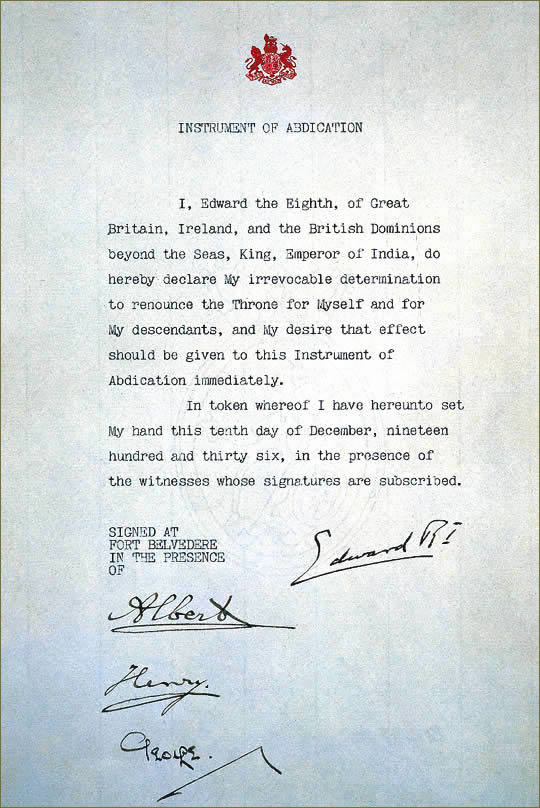
Faced with a choice between the crown and his love, Edward VIII chose to step down. On December 10, 1936, the King signed the following declaration of abdication:
In the audio clip at the top of the post, Edward VIII takes to the radio waves to declare his abdication on December 11. Brimming with hardly-contained emotion, Edward attempts to explain his reasons to the British people (read the full transcript here):
“You all know the reasons which have impelled me to renounce the Throne. But I want you to understand that in making up my mind I did not forget the country or the Empire which as Prince of Wales, and lately as King, I have for twenty-five years tried to serve. But you must believe me when I tell you that I have found it impossible to carry the heavy burden of responsibility and to discharge my duties as King as I would wish to do without the help and support of the woman I love.”
For those who had doubts about Simpson’s true feelings for the King (some suspected her of caring only about the king’s money), the next 35 years would provide sufficient proof. The pair remained married until Edward’s death in 1972.
Ilia Blinderman is a Montreal-based culture and science writer. Follow him at @iliablinderman.
Read More...The Clash Mauls a Teddy Bear and Plays Two Songs on The Tom Snyder Show (1981)
The Clash’s Sandinista!, their fourth and penultimate studio album (let’s not talk about Cut the Crap) inspired critical rhapsodies and rose to the top of lists everywhere in 1981. When I encountered it almost ten years later as a young fan, I didn’t give it much of a chance, except for a song with the same name as my beleaguered hometown’s NBA team. In hindsight, it was my loss, but it’s also true that nearly every generation of Clash fans, including the very first, has put their finger on the band’s moment of either “selling out” or sharply declining. Maybe for me it was what a Rolling Stone review called Sandinista!’s “mainstream moves” and “studio sophistication.” Maybe it was the “whiff of grandeur” of the triple album. I think it also had to do with what Tom Snyder, in his 1981 interview with the band above, says of them in his introduction: they preferred to be identified “not so much as a Rock and Roll group but as a ‘News-giving group.’”
It was hardly news when I heard it, and I didn’t much care for topical songs anyway. But I’ve always admired Joe Strummer’s sincerity and sense of political urgency. I don’t know how seriously Strummer takes Snyder’s “News-giving” open, but he rolls with it, and the band turns on the charm offensive, alternately cuddling and abusing a teddy bear (against Snyder’s protestations), professing their sincere loyalty to their fans, and covering the host with merchandise. It’s a fun eight and half minutes. Then they do two songs, “The Magnificent Seven” (above), from Sandinista!, and “This is Radio Clash” (below), which doesn’t appear on any of their studio albums. Behind Mick Jones’ wall of amps, pioneering graffiti artist Futura 2000 spray-paints some unidentifiable words, and beneath the whole affair is what Dangerous Minds calls “an undercurrent of controlled mayhem.” This kind of TV just doesn’t happen anymore.
Related Content:
Mick Jones Plays Three Classics by The Clash at the Public Library
The Clash: Westway to the World (The 2002 Grammy Winning Film)
The Clash Live in Tokyo, 1982: Watch the Complete Concert
Josh Jones is a writer and musician based in Durham, NC. Follow him at @jdmagness
Read More...Join Clive James on His Classic Television Trips to Paris, LA, Tokyo, Rio, Cairo & Beyond
After a morning’s girlwatching in Paris, Clive James goes for a leisurely yet harrowing drive with Bonjour Tristesse author Françoise Sagan at the wheel, walks out on the opera, pays respects to the graves of Oscar Wilde, Edith Piaf, and Marcel Proust, seeks the definition of a “fashion victim,” denounces I.M. Pei’s pyramid atop the Louvre, and descends into the dance clubs beneath the streets. On the coast of Los Angeles, he endures a celebrity-grade workout, commissions a toupee from Beverly Hills stylist José Eber and his most trusted “hair unit” craftsman, undergoes a plastic surgery consultation, and meets the most cheerful (and no doubt most successful) car-parker alive. At the height of Japan’s economic bubble, he does battle with his own chopsticks, loses himself in Shunjuku despite meaning to lose himself in the Ginza, beds down unsuccessfully in a love hotel, holds in his breath as he wedges himself into a commuter train, struggles to accept hospitality from robots, puts himself at the utter mercy of a game show, and gets drunk amidst junior geisha.
Why, you might ask, would a respected man of letters like James – author, most recently, of a new translation of Dante’s Divine Comedy — do all this pratfall-intensive globetrotting, much less on the BBC for all to see? I would submit, as a longtime follower of the man’s work, that it has to do with his twin drives to, with his wisecrackingly illuminating turns of phrase, keep his audiences laughing as well as thinking, no matter the medium in which he works. He fills the role of the entertainer, certainly, but simultaneously fills the role of the intellectual. An untiringly curious polyglot, not that you’d know it by the exaggerated ineptitude with which he asks for directions in Tokyo or interviews French starlets, James plays both low and high at all times, and you can see it in all these televisual journeys to Cairo, Rome, Miami, Rio, Chicago, Berlin, Shanghai, New York, Bombay, Hong Kong, and even the Sydney of James’ native Australia. You can also see it in James’ travel pieces for the Observer that served as their templates, all freely available on his web site.
Related Content:
Pan Am’s 1960s and 70s Travel Films: Visit 11 Places, in 7 Languages
Mashup Artist “Kutiman” Travels to Tokyo and Creates an Incredible Musical Postcard
Five Cultural Tours of Los Angeles
Al Jazeera Travel Show Explores World Cities Through Their Street Food
Colin Marshall hosts and produces Notebook on Cities and Culture and writes essays on cities, Asia, film, literature, and aesthetics. He’s at work on a book about Los Angeles, A Los Angeles Primer. Follow him on Twitter at @colinmarshall or on his brand new Facebook page.
Read More...Support Us
We're hoping to rely on loyal readers, rather than erratic ads. Please click the Donate button and support Open Culture. You can use Paypal, Venmo, Patreon, even Crypto! We thank you!

About Us

Open Culture scours the web for the best educational media. We find the free courses and audio books you need, the language lessons & educational videos you want, and plenty of enlightenment in between.
Advertise With Us

FREE UPDATES!
GET OUR DAILY EMAIL
Get the best cultural and educational resources on the web curated for you in a daily email. We never spam. Unsubscribe at any time.
FOLLOW ON SOCIAL MEDIA

Open Culture editor Dan Colman scours the web for the best educational media. He finds the free courses and audio books you need, the language lessons & movies you want, and plenty of enlightenment in between.
Advertise With Us

