Watch the Rolling Stones Write “Sympathy for the Devil”: Scenes from Jean-Luc Godard’s ’68 Film One Plus One
After the Rolling Stones’ partly misguided, partly inspired attempt at psychedelia, Their Satanic Majesties Request, the band found its footing again in the familiar territory of the Delta Blues. But with the 1968 recording of Beggar’s Banquet, they also retained some of the previous album’s experimentation, taken in a more sinister direction on the infamous “Sympathy for the Devil.” In the studio, with the band during those recording sessions, was none other than radical French New Wave director Jean-Luc Godard, who brought his own experimental sensibilities to a project he would call One Plus One, a document of the Stones’ late sixties incarnation—including an increasingly reclusive Brian Jones. Godard punctuates the fascinating studio scenes of the Stones with what Andrew Hussey of The Guardian calls “a series of set pieces—an incoherent stew of Situationism and other Sixties stuff”:
Black Panthers in a disused car park execute white virgins; a bookseller reads aloud from Mein Kampf to Maoist hippies; in the final scene the bloodied corpse of a female urban guerrilla is raised to the Stones’ soundtrack as Godard himself darts about like a demented Jacques Tati waving Red and Black flags. You just don’t find this sort of thing at the local multiplex anymore.
For all of its heavy use of leftist Sixties iconography, its anarchic attempt to fuse “art, power and revolution,” and its fascinating portraiture of rock and roll genius at work, the film crash landed in France, earning the contempt of arch Situationist theorist Guy Debord, who called it “the work of cretins.”
Critics and audiences apparently expected more from Godard in the wake of the abortive May ‘68 student uprising in Paris, and the general neglect of the film meant that Godard missed his chance to, as he put it, “subvert, ruin and destroy all civilised values.”
The film’s producer, Iain Quarrier, also found it disappointing. Without the director’s permission, Quarrier decided to retitle One Plus One with the more commercially-minded Sympathy for the Devil and tack a completed version of that song to the last reel, a move that provoked Godard to punch Quarrier in the face. But not everyone found Godard’s effort off-putting. In a 1970 review, the New York Times’ Roger Greenspun called it “heavily didactic, even instructional…. [T]he prospective text of some ultimate, infinitely complex collectivism.” Greenspun also decried Quarrier’s unauthorized interventions.
In his retrospective take, Andrew Hussey admits that Godard’s political posturing is “bollocks,” but then concludes that One Plus One is “great stuff: a snapshot of a far-off, lost world where rock music is still a redemptive and revolutionary force.” And it’s both—ridiculous and sublime, a powerful crystallization of a moment in time when all the Western world seemed poised to crack open and release something strange and new. Watch the trailer and scenes from Godard’s film above. You can also pick up a copy of the 2018 restoration of the film here.
Related Content:
Jefferson Airplane Wakes Up New York; Jean-Luc Godard Captures It (1968)
Meetin’ WA: Jean-Luc Godard Meets Woody Allen in 26 Minute Film
Jean-Luc Godard’s After-Shave Commercial for Schick
Josh Jones is a writer and musician based in Durham, NC. Follow him at @jdmagness
Read More...F. Scott Fitzgerald’s 13 Tips for What to Do with Your Leftover Thanksgiving Turkey
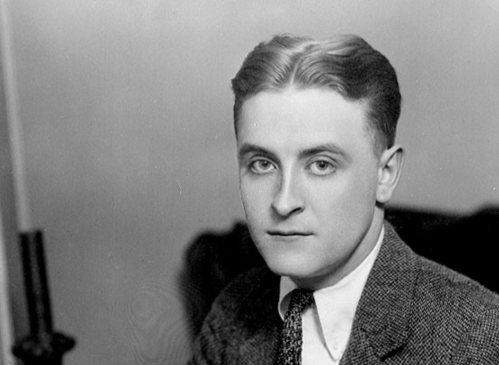
Image by “The World’s Work” via Wikimedia Commons
“At this post holiday season, the refrigerators of the nation are overstuffed with large masses of turkey, the sight of which is calculated to give an adult an attack of dizziness. It seems, therefore, an appropriate time to give the owners the benefit of my experience as an old gourmet, in using this surplus material.” There writes no less a legend of American letters than F. Scott Fitzgerald, author of The Great Gatsby and Tender is the Night (both available in our Free eBooks collection). His words quoted here, from “Turkey Remains and How to Inter Them with Numerous Scarce Recipes,” a column found in the Fitzgerald miscellany collection The Crack-Up, hold just as true this day-after-Thanksgiving as they did during those his lifetime. Lists of Note offers the full piece, which itself offers thirteen potential uses for your leftover bird, some of which, Fitzgerald writes, “have been in my family for generations”:
1. Turkey Cocktail: To one large turkey add one gallon of vermouth and a demijohn of angostura bitters. Shake.
2. Turkey à la Francais: Take a large ripe turkey, prepare as for basting and stuff with old watches and chains and monkey meat. Proceed as with cottage pudding.
3. Turkey and Water: Take one turkey and one pan of water. Heat the latter to the boiling point and then put in the refrigerator. When it has jelled, drown the turkey in it. Eat. In preparing this recipe it is best to have a few ham sandwiches around in case things go wrong.
4. Turkey Mongole: Take three butts of salami and a large turkey skeleton, from which the feathers and natural stuffing have been removed. Lay them out on the table and call up some Mongole in the neighborhood to tell you how to proceed from there.
5. Turkey Mousse: Seed a large prone turkey, being careful to remove the bones, flesh, fins, gravy, etc. Blow up with a bicycle pump. Mount in becoming style and hang in the front hall.
6. Stolen Turkey: Walk quickly from the market, and, if accosted, remark with a laugh that it had just flown into your arms and you hadn’t noticed it. Then drop the turkey with the white of one egg—well, anyhow, beat it.
7. Turkey à la Crême: Prepare the crême a day in advance. Deluge the turkey with it and cook for six days over a blast furnace. Wrap in fly paper and serve.
8. Turkey Hash: This is the delight of all connoisseurs of the holiday beast, but few understand how really to prepare it. Like a lobster, it must be plunged alive into boiling water, until it becomes bright red or purple or something, and then before the color fades, placed quickly in a washing machine and allowed to stew in its own gore as it is whirled around. Only then is it ready for hash. To hash, take a large sharp tool like a nail-file or, if none is handy, a bayonet will serve the purpose—and then get at it! Hash it well! Bind the remains with dental floss and serve.
9. Feathered Turkey: To prepare this, a turkey is necessary and a one pounder cannon to compel anyone to eat it. Broil the feathers and stuff with sage-brush, old clothes, almost anything you can dig up. Then sit down and simmer. The feathers are to be eaten like artichokes (and this is not to be confused with the old Roman custom of tickling the throat.)
10. Turkey à la Maryland: Take a plump turkey to a barber’s and have him shaved, or if a female bird, given a facial and a water wave. Then, before killing him, stuff with old newspapers and put him to roost. He can then be served hot or raw, usually with a thick gravy of mineral oil and rubbing alcohol. (Note: This recipe was given me by an old black mammy.)
11. Turkey Remnant: This is one of the most useful recipes for, though not, “chic,” it tells what to do with the turkey after the holiday, and how to extract the most value from it. Take the remants, or, if they have been consumed, take the various plates on which the turkey or its parts have rested and stew them for two hours in milk of magnesia. Stuff with moth-balls.
12. Turkey with Whiskey Sauce: This recipe is for a party of four. Obtain a gallon of whiskey, and allow it to age for several hours. Then serve, allowing one quart for each guest. The next day the turkey should be added, little by little, constantly stirring and basting.
13. For Weddings or Funerals: Obtain a gross of small white boxes such as are used for bride’s cake. Cut the turkey into small squares, roast, stuff, kill, boil, bake and allow to skewer. Now we are ready to begin. Fill each box with a quantity of soup stock and pile in a handy place. As the liquid elapses, the prepared turkey is added until the guests arrive. The boxes delicately tied with white ribbons are then placed in the handbags of the ladies, or in the men’s side pockets.
What, you expected recipes more… followable than these? And perhaps recipes with less alcohol involved? These all make much more sense if you bear in mind Fitzgerald’s formidable creativity, his even more formidable penchant for the drink, and his mordant sense of humor about it all. “I guess that’s enough turkey talk,” concludes this literary icon of my Thanksgiving-celebrating nation. “I hope I’ll never see or hear of another until—well, until next year.” If you haven’t had enough, and indeed feel like getting the jump on next year, see also the Airship’s list of twelve Thanksgiving recipes from favorite authors, including Jonathan Franzen’s pasta with kale, Alice Munro’s rosemary bread pudding, and Ralph Ellison’s sweet yams.
via Lists of Note
Related Content:
The Recipes of Iconic Authors: Jane Austen, Sylvia Plath, Roald Dahl, the Marquis de Sade & More
Prepare Marilyn Monroe’s Personal, Handwritten Turkey-and-Stuffing Recipe on Thanksgiving
Colin Marshall hosts and produces Notebook on Cities and Culture and writes essays on cities, Asia, film, literature, and aesthetics. He’s at work on a book about Los Angeles, A Los Angeles Primer. Follow him on Twitter at @colinmarshall or on his brand new Facebook page.
Read More...A Young Björk Deconstructs (Physically & Theoretically) a Television in a Delightful Retro Video
Björk’s first international hit, “Human Behaviour” (1993) received scant radio play in North America. Rather, the Icelandic singer’s fame only grew as a result of MTV’s heavy rotation of the surrealist music video that accompanied the song, directed by Academy Award winner Michel Gondry. Despite the debt of celebrity she owed to television, Björk was not always a fan.
In the undated video above, Björk expounds on her Christmastime TV-watching habits. Immediately, the video takes an odd—or, I suppose, characteristically Björk-esque—turn when the young singer decides to take her TV apart:
But now I’m curious. I’ve switched the TV off and now I want to see how it operates. How it can make, put me into all those weird situations. So… It’s about time.
The various components prove fascinating, and Björk proceeds to describe the television’s hardware in her whimsical, otherworldly manner:
This is what it looks like. Look at this. This looks like a city. Like a little model of a city. The houses, which are here, and streets. This is maybe an elevator to go up there. And here are all the wires. These wires, they really take care of all the electrons when they come through there. They take care that they are powerful enough to get all the way through to here. I read that in a Danish book. This morning.
The most puzzling part of the video comes when Björk mentions that her cavalier approach to television is relatively new. Until recently, she had been guarded about her viewing habits:
I remember being very scared because an Icelandic poet told me that not like in cinemas, where the thing that throws the picture from it just sends light on the screen, but this is different. This is millions and millions of little screens that send light, some sort of electric light, I’m not really sure… Your head is very busy all the time to calculate and put it all together into one picture. And then because you’re so busy doing that, you don’t watch very carefully what the program you are watching is really about. So you become hypnotized.
Thanks to the wisdom contained within an unnamed Danish book, however, Björk has grown more at ease with the potential of television’s being used for mind control and hypnosis. At the end of the clip, she offers a final pearl of wisdom:
You shouldn’t let poets lie to you.
via The Atlantic
Related Content:
Björk and Sir David Attenborough Team Up in a New Documentary About Music and Technology
Ilia Blinderman is a Montreal-based culture and science writer. Follow him at @iliablinderman.
Read More...Listen to a New Album Featuring Tom Waits Songs in Hebrew (2013)
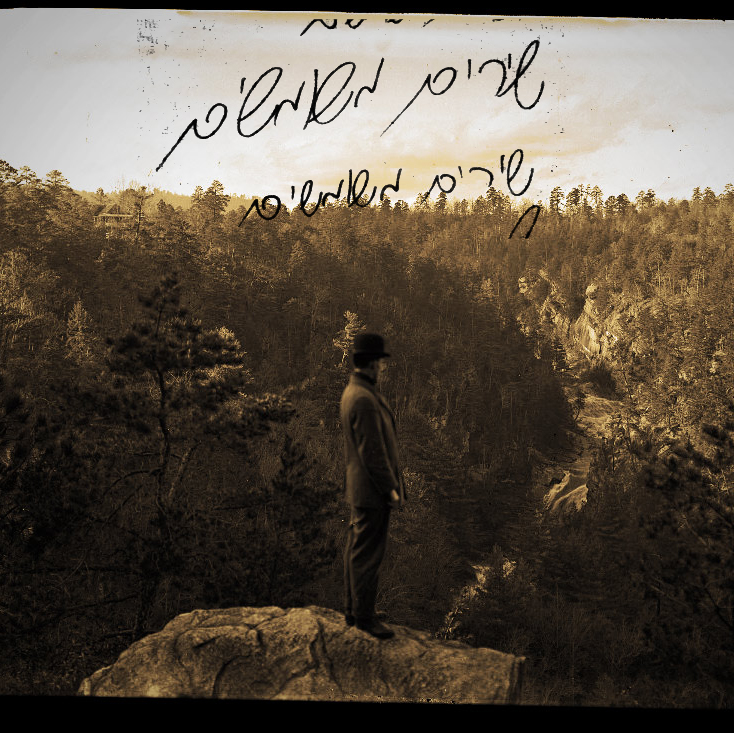 Tom Waits is a rare breed of performer, having attained vast commercial success without having had to pander to a mass audience. His gruff voice—the vocal equivalent of too many late nights, strong scotch, and a pack-an-hour habit—has become the hallmark of a sort of grimy, outsider cool favored by Jim Jarmusch and John Lurie. His career, which has spanned four decades and includes theatre, film, and the iconic interview that inspired the character of The Joker in The Dark Knight, is the envy of most musicians. It was only fitting, considering his prodigious output, that Waits would become the subject of a cover album. Unsurprisingly, it comes with a twist—it’s in Hebrew.
Heeb Magazine recently posted a link to “Shirim Meshumashim” (“Used Songs”), producer Guy Hajjaj’s four-year project where Israeli musicians recreate Tom Waits’ back catalog. The 22-song album draws widely from Waits’ career, including songs from classic albums such as Raindogs (1985) as well as the more recent Orphans: Brawlers, Bawlers & Bastards (2006) and Glitter and Doom Live (2009). While more zealous fans will undoubtedly claim that Waits’ original delivery can never be matched, those with an open mind will likely find a number of gems. Some of our favorites include “Clap Hands,” ideally suited to Hebrew’s harsh, gravelly sounds, and the lighter, yet unmistakably Waits-written, “Dirt in The Ground.”
You can stream the album above, or buy the album (downloadable on a pay-what-you-wish basis) here.
Via Heeb Magazine
Related Content:
Tom Waits’ Classic Appearance on Australian TV, 1979
Tom Waits Reads Charles Bukowski
Ilia Blinderman is a Montreal-based culture and science writer. Follow him at @iliablinderman.
Read More...The 100 Best Novels: A Literary Critic Creates a List in 1898
 Book lists, despite what younger readers born into Buzzfeed’s ruthless listsicle monopoly may think, have always been popular. Some, like David Bowie’s Top 100 Books, give us a sense of the artist’s development. Others, like Joseph Brodsky’s List of 84 Books for Basic Conversation, provide a Nobel prize-winning benchmark for knowledge. Even though the books are within the reach of most readers, systematically digesting such lists often tries one’s patience. Despite the lack of will or interest in working through someone else’s literary education, however, glancing through such personal anthologies provides us with a glimpse into the maker’s life—be it their private tastes, or their social mores.
In late October, The Times Literary Supplement’s Michael Caines unearthed another Top 100 list; this one, however, has the distinction of hailing from 1898. At the turn of the 20th century, a journalist and author of numerous books on the Brontë sisters named Clement K. Shorter tried his hand at compiling the 100 Best Novels for a journal called The Bookman. The ground rules were simple: the list could feature only one novel per novelist, and living authors were excluded. Today, Shorter’s compendium looks somewhat hit-or-miss. There are some indisputable classics (many of which can be found in our Free eBooks and Free Audio Books collections) and some other texts that have faded into oblivion. Still—one can’t help but experience a certain historical frisson at a 19th century listsicle. Here it goes:
1. Don Quixote — 1604 — Miguel de Cervantes
2. The Holy War — 1682 — John Bunyan
3. Gil Blas — 1715 — Alain René le Sage
4. Robinson Crusoe — 1719 — Daniel Defoe
5. Gulliver’s Travels — 1726 — Jonathan Swift
6. Roderick Random — 1748 — Tobias Smollett
7. Clarissa — 1749 — Samuel Richardson
8. Tom Jones — 1749 — Henry Fielding
9. Candide — 1756 — Françoise de Voltaire
10. Rasselas — 1759 — Samuel Johnson
11. The Castle of Otranto — 1764 — Horace Walpole
12. The Vicar of Wakefield — 1766 — Oliver Goldsmith
13. The Old English Baron — 1777 — Clara Reeve
14. Evelina — 1778 — Fanny Burney
15. Vathek — 1787 — William Beckford
16. The Mysteries of Udolpho — 1794 — Ann Radcliffe
17. Caleb Williams — 1794 — William Godwin
18. The Wild Irish Girl — 1806 — Lady Morgan
19. Corinne — 1810 — Madame de Stael
20. The Scottish Chiefs — 1810 — Jane Porter
21. The Absentee — 1812 — Maria Edgeworth
22. Pride and Prejudice — 1813 — Jane Austen
23. Headlong Hall — 1816 — Thomas Love Peacock
24. Frankenstein — 1818 — Mary Shelley
25. Marriage — 1818 — Susan Ferrier
26. The Ayrshire Legatees — 1820 — John Galt
27. Valerius — 1821 — John Gibson Lockhart
28. Wilhelm Meister — 1821 — Johann Wolfgang von Goethe
29. Kenilworth — 1821 — Sir Walter Scott
30. Bracebridge Hall — 1822 — Washington Irving
31. The Epicurean — 1822 — Thomas Moore
32. The Adventures of Hajji Baba — 1824 — James Morier (“usually reckoned his best”)
33. The Betrothed — 1825 — Alessandro Manzoni
34. Lichtenstein — 1826 — Wilhelm Hauff
35. The Last of the Mohicans — 1826 — Fenimore Cooper
36. The Collegians — 1828 — Gerald Griffin
37. The Autobiography of Mansie Wauch — 1828 — David M. Moir
38. Richelieu — 1829 — G. P. R. James (the “first and best” novel by the “doyen of historical novelists”)
39. Tom Cringle’s Log — 1833 — Michael Scott
40. Mr. Midshipman Easy — 1834 — Frederick Marryat
41. Le Père Goriot — 1835 — Honoré de Balzac
42. Rory O’More — 1836 — Samuel Lover (another first novel, inspired by one of the author’s own ballads)
43. Jack Brag — 1837 — Theodore Hook
44. Fardorougha the Miser — 1839 — William Carleton (“a grim study of avarice and Catholic family life. Critics consider it the author’s finest achievement”)
45. Valentine Vox — 1840 — Henry Cockton (yet another first novel)
46. Old St. Paul’s — 1841 — Harrison Ainsworth
47. Ten Thousand a Year — 1841 — Samuel Warren (“immensely successful”)
48. Susan Hopley — 1841 — Catherine Crowe (“the story of a resourceful servant who solves a mysterious crime”)
49. Charles O’Malley — 1841 — Charles Lever
50. The Last of the Barons — 1843 — Bulwer Lytton
51. Consuelo — 1844 — George Sand
52. Amy Herbert — 1844 — Elizabeth Sewell
53. Adventures of Mr. Ledbury — 1844 — Elizabeth Sewell
54. Sybil — 1845 — Lord Beaconsfield (a. k. a. Benjamin Disraeli)
55. The Three Musketeers — 1845 — Alexandre Dumas
56. The Wandering Jew — 1845 — Eugène Sue
57. Emilia Wyndham — 1846 — Anne Marsh
58. The Romance of War — 1846 — James Grant (“the narrative of the 92nd Highlanders’ contribution from the Peninsular campaign to Waterloo”)
59. Vanity Fair — 1847 — W. M. Thackeray
60. Jane Eyre — 1847 — Charlotte Brontë
61. Wuthering Heights — 1847 — Emily Brontë
62. The Vale of Cedars — 1848 — Grace Aguilar
63. David Copperfield — 1849 — Charles Dickens
64. The Maiden and Married Life of Mary Powell — 1850 — Anne Manning (“written in a pastiche seventeenth-century style and printed with the old-fashioned typography and page layout for which there was a vogue at the period …”)
65. The Scarlet Letter — 1850 — Nathaniel Hawthorne
66. Frank Fairleigh — 1850 — Francis Smedley (“Smedley specialised in fiction that is hearty and active, with a strong line in boisterous college escapades and adventurous esquestrian exploits”)
67. Uncle Tom’s Cabin — 1851 — H. B. Stowe
68. The Wide Wide World — 1851 — Susan Warner (Elizabeth Wetherell)
69. Nathalie — 1851 — Julia Kavanagh
70. Ruth — 1853 — Elizabeth Gaskell
71. The Lamplighter — 1854 — Maria Susanna Cummins
72. Dr. Antonio — 1855 — Giovanni Ruffini
73. Westward Ho! — 1855 — Charles Kingsley
74. Debit and Credit (Soll und Haben) — 1855 — Gustav Freytag
75. Tom Brown’s School-Days — 1856 — Thomas Hughes
76. Barchester Towers — 1857 — Anthony Trollope
77. John Halifax, Gentleman — 1857 — Dinah Mulock (a. k. a. Dinah Craik; “the best-known Victorian fable of Smilesian self-improvement”)
78. Ekkehard — 1857 — Viktor von Scheffel
79. Elsie Venner — 1859 — O. W. Holmes
80. The Woman in White — 1860 — Wilkie Collins
81. The Cloister and the Hearth — 1861 — Charles Reade
82. Ravenshoe — 1861 — Henry Kingsley (“There is much confusion in the plot to do with changelings and frustrated inheritance” in this successful novel by Charles Kingsley’s younger brother, the “black sheep” of a “highly respectable” family)
83. Fathers and Sons — 1861 — Ivan Turgenieff
84. Silas Marner — 1861 — George Eliot
85. Les Misérables — 1862 — Victor Hugo
86. Salammbô — 1862 — Gustave Flaubert
87. Salem Chapel — 1862 — Margaret Oliphant
88. The Channings — 1862 — Ellen Wood (a. k. a. Mrs Henry Wood)
89. Lost and Saved — 1863 — The Hon. Mrs. Norton
90. The Schönberg-Cotta Family — 1863 — Elizabeth Charles
91. Uncle Silas — 1864 — Joseph Sheridan Le Fanu
92. Barbara’s History — 1864 — Amelia B. Edwards (“Confusingly for bibliographers, she was related to Matilda Betham-Edwards and possibly to Annie Edward(e)s …”)
93. Sweet Anne Page — 1868 — Mortimer Collins
94. Crime and Punishment — 1868 — Feodor Dostoieffsky
95. Fromont Junior — 1874 — Alphonse Daudet
96. Marmorne — 1877 — P. G. Hamerton (“written under the pseudonym Adolphus Segrave”)
97. Black but Comely — 1879 — G. J. Whyte-Melville
98. The Master of Ballantrae — 1889 — R. L. Stevenson
99. Reuben Sachs — 1889 — Amy Levy
100. News from Nowhere — 1891 — William Morris
In addition to the canon, Shorter—unable to heed his own cautious counsel and throwing the door open to the winds of literary passion—included 8 books by living novelists whom he called “writers whose reputations are too well established for their juniors to feel towards them any sentiments other than those of reverence and regard:”
An Egyptian Princess — 1864 — Georg Ebers
Rhoda Fleming — 1865 — George Meredith
Lorna Doone — 1869 — R. D. Blackmore
Anna Karenina — 1875 — Count Leo Tolstoi
The Return of the Native — 1878 — Thomas Hardy
Daisy Miller — 1878 — Henry James
Mark Rutherford — 1881 — W. Hale White
Le Rêve — 1889 — Emile Zola
via The Times Literary Supplement
Related Content:
David Bowie’s List of Top 100 Books
Christopher Hitchens Creates a Reading List for Eight-Year-Old Girl
See Nobel Laureate Joseph Brodsky’s Reading List For Having an Intelligent Conversation
Ilia Blinderman is a Montreal-based culture and science writer. Follow him at @iliablinderman
Read More...Watch Animated Sheet Music for Miles Davis’ “So What,” Charlie Parker’s “Confirmation” & Coltrane’s “Giant Steps”
Miles Davis’ Kind of Blue changed jazz. It changed music, period. So I take it very seriously. But when I see the animated sheet music of the first cut, “So What,” I can’t help but think of Charles Schultz’s Peanuts cartoons, and their Vince Guaraldi compositions. I mean no offense to Miles. His modal jazz swings, and it’s fun, as fun to listen to as it is to watch in rising and falling arpeggios. The YouTube uploader, Dan Cohen, gives us this on his channel Animated Sheet Music, with apologies to Jimmy Cobb for the lack of drum notation.
Also from Cohen’s channel, we have Charlie Parker’s music animated. Never one to keep up with his admin, Parker left his estate unable to recuperate royalties from compositions like “Confirmation” (above).
Nonetheless, everyone knows it’s Bird’s tune, and to see it animated above is to see Parker dance a very different step than Miles’ post-bop cool, one filled with complex melodic paragraphs instead of chordal phrases.
And above, we have John Coltrane’s massive “Giant Steps,” with its rapid-fire bursts of quarter notes, interrupted by half-note asides. Coltrane’s iconic 1960 composition displays what Ira Gitler called in a 1958 Downbeat piece, “sheets of sound.” Gitler has said the image he had in his head was of “bolts of cloth undulating as they unfurled,” but he might just as well have thought of sheets of rain, so multitude and heavy is Coltrane’s melodic attack.
See Cohen’s Animated Sheet Music channel for two more Charlie Parker pieces, “Au Privave” and “Bloomdido.”
If you would like to support the mission of Open Culture, consider making a donation to our site. It’s hard to rely 100% on ads, and your contributions will help us continue providing the best free cultural and educational materials to learners everywhere. You can contribute through PayPal, Patreon, and Venmo (@openculture). Thanks!
Related Content:
John Coltrane’s Handwritten Outline for His Masterpiece A Love Supreme
Josh Jones is a writer and musician based in Durham, NC. Follow him at @jdmagness
Read More...George Saunders’ Lectures on the Russian Greats Brought to Life in Student Sketches

Click for larger image
We’ve seen plenty of post-modern decay in writers before George Saunders—in Don DeLillo, J.G. Ballard—but never has it been filled with such puckish warmth, such whimsical detail, and such empathy, to use a word Saunders prizes. As a writer, Saunders draws readers in close to a very human world, albeit a fragmented, burned out, and frayed one, and it seems that he does so as a teacher as well. Since 1997, Saunders has taught creative writing at Syracuse University, where he received his M.A. in 1988, and where he remains, despite being awarded a MacArthur “Genius” Fellowship in 2006 and publishing steadily throughout the last decade and a half. To sit in a class with Saunders, according to his onetime student Rebecca Fishow, is to visit with a daring practitioner of the short form, one whose “words seem a lot like the transfer of secrets through a chain-link of writers.”

While attending one of Saunders’ semester-length writing seminars, writer and artist Fishow compiled the notes and sketches you see here (and several more at The Believer’s Logger site). In each sketch, Saunders teaches from one of his favorite classic Russian short story writers. At the top, see him expound on Turgenev’s method, proffering epiphanies, keen observations on craft, and writerly advice in word bubbles—“You are allowed to manipulate,” “Tecnician vs. Artist” [sic], “Instantaneous micro-re-evaluation (@end of story)”—while surrounded by a fringy aura. Above, Fishow reconstructs Saunders’ take on Chekhov’s “Lady with the Pet Dog” around a portrait of a pensive Saunders (looking a bit like Chekhov).
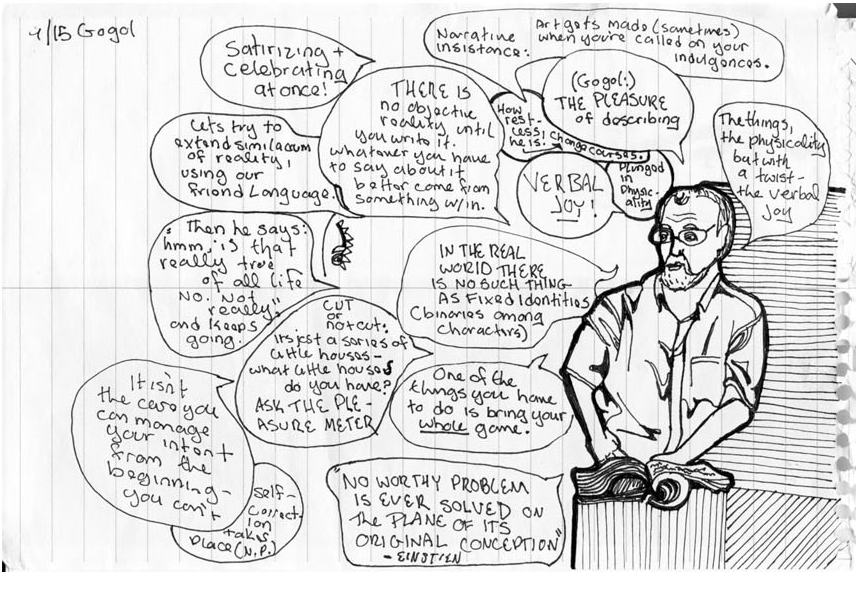
Fishow’s reconstructions are obviously very partial, and it’s not clear if she took them down on the spot or scribbled from memory (the misspellings make me think the former). In the sketch above, Saunders’ explicates Gogol, with phrases like “VERBAL JOY!” and an Einstein quote: “No worthy problem is ever solved on the plane of its original conception.” The latter is an interesting moment of Saunders’ scientific background slipping into his pedagogy. Before he was a MacAurthur winner and an enthusiastic teacher, Saunders worked as an environmental engineer. Of his science background, he has said:
…any claim I might make to originality in my fiction is really just the result of this odd background: basically, just me working inefficiently, with flawed tools, in a mode I don’t have sufficient background to really understand. Like if you put a welder to designing dresses.
As a teacher, at least in Fishow’s notes, Saunders celebrates “working inefficiently.” As she puts it: “His wisdom confirms that flaw and uncertainty and variety and empathy (especially empathy) are positive aspects of the writing process.” Fishow’s portraits go a long way toward conveying those qualities in Saunders as a presence in the classroom.
Find more sketches at The Believer’s Logger site.
Also Read 10 Free Stories by George Saunders Online.
Related Content:
George Saunders Extols the Virtues of Kindness in 2013 Speech to Syracuse University Grads
Vladimir Nabokov (Channelled by Christopher Plummer) Teaches Kafka at Cornell
James Joyce, With His Eyesight Failing, Draws a Sketch of Leopold Bloom (1926)
Josh Jones is a writer and musician based in Durham, NC. Follow him at @jdmagness
Read More...The Smithsonian Picks “101 Objects That Made America”

The Smithsonian’s 19 museums, 9 research centers, and 140-plus affiliates boast the world’s largest collection—137 million items, in addition to a staggering array of photos, documents, films, and recordings. Choosing which to include in The Smithsonian’s History of America in 101 Objects (published on October 29) from such a wealth of options was no easy task. (On the other hand, the Director of the British Museum Neil MacGregor did manage to encapsulate two million years of world history in one object less…)
Anthropologist Richard Kurin, the Smithsonian Institution’s Under Secretary for History, Art, and Culture, prioritized objects with vivid biographies. There may be no way for a museum to recreate the Civil War, as he notes, but a “hand-drawn battle map of the time, a bullet or gunnery shelf, a uniform bearing evidence of wounds, and broken metal shackles are all objects that, having been present at the event depicted, can speak to the larger story. The parts stand for the whole.”
Celebrity may have factored into the selection process, too. Not every entry is bespangled with a famous name, but one can’t overlook the vicarious thrill inherent in Cesar Chavez’s union jacket, Abraham Lincoln’s top hat, Helen Keller’s watch, or Marian Anderson’s mink coat. Who can say whether these resonances will lose their luster in the future. In his introduction, Kurin uses the steering wheel of the U.S.S. Maine, once an object of keen national interest due to its role in the Spanish-American War, to exemplify the descent into obscurity.
To celebrate the publication of The Smithsonian’s History of America in 101 Objects, the Smithsonian Channel will be profiling some of the items in a four-part series, Seriously Amazing™ Objects (love the trademark, guys).
In the meantime, have a browse through an online gallery featuring 50 of Kurin’s picks.
Or enjoy these three samples, selected by yours truly for their unifying roundness. (I could never accomplish anything on the order of Kurin’s feat, but encourage the Smithsonian to get in touch whenever they’re in the market for someone who could repackage their collection as board books for infants…)
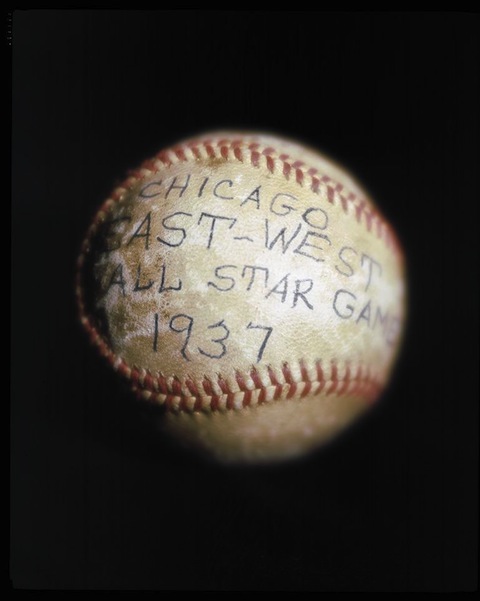
Negro League Baseball
1937, American History Museum
Sportswriter Frank Deford fulfills Kurin’s biographic requirements with an essay on the larger social implications behind this artifact, which scored a home run for Buck Leonard and the East lineup in the ’37 Comiskey All-Star game.
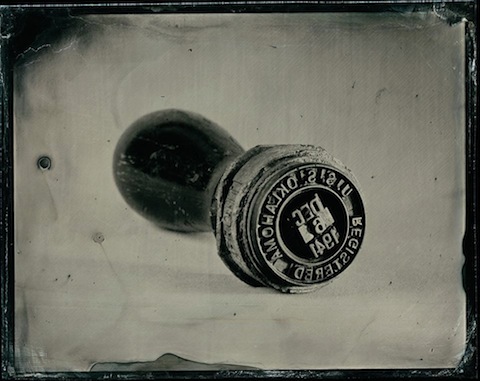
USS Oklahoma Stamp
1941, Postal Museum
“To record when a piece of mail was processed aboard ship, the Navy used wooden postmark stamps. This one bears an ominous date: Dec 6, 1941 PM. It was recovered from the battleship Oklahoma after it was hit by several torpedoes, listed to a 45-degree angle, capsized and sank in the attack on Pearl Harbor on December 7, 1941. The Oklahoma lost 429 sailors and Marines, a third of its crew.”
Wow.

The Pill
c. 1965 American History Museum
As Natalie Angier, author of Woman: An Intimate Geography pointed out in a recent article in Smithsonian magazine, “when people speak of the Pill, you know they don’t mean aspirin or Prozac but rather that mother of all blockbuster drugs, the birth control pill.” A pinnacle of both medical and feminist history, its significance extends well beyond the national borders.
How about you, readers? What item from a museum collection would you include in a book on American History?
Related Content:
Animated Version of Howard Zinn’s History of the American Empire
Pulitzer Prize Winner Picks Essential US History Books
Ayun Halliday remembers the amazement she felt seeing Archie and Edith’s chairs on an 8th grade field trip to Washington DC. Follow her @AyunHalliday
Read More...See the Homes and Studies of Wittgenstein, Schopenhauer, Nietzsche & Other Philosophers
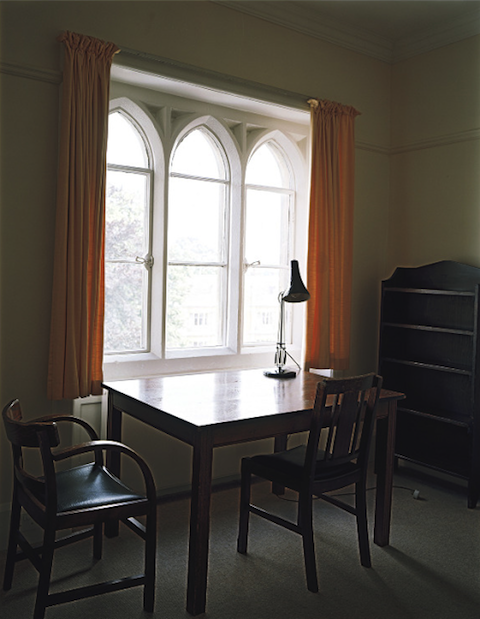
Philosophers are quirky creatures. Some become household names, in certain well-educated households, without anyone knowing a thing about their lives, their loves, their apartments. The life of the mind, after all, rarely makes for good theater (or TV). And prior to the creation of whole academic departments devoted to contemplation and regional conferences, a philosopher’s life could be a very lonely one. Or so it would seem to those who shun solitude. But for the bookish among us, the glimpses we have here into the well-kept homes and studies of several famous dead male European thinkers may elicit sighs of wonder, or envy even. It was so much easier to keep a room of one’s own neat before computer paraphernalia and tiny sheaves of Post-it notes cluttered everything up, no?

At the top of the post, we have an austere space for a severely austere thinker, Ludwig Wittgenstein. His desk in Cambridge faces a vaulted triptych of sunlit windows, but the bookshelf has clearly been emptied since his stay, unless Herr Wittgenstein preferred to work free of the distraction of other people’s published work. Above, another angle reveals comfortable seating near the fireplace, since blocked up with what appears to be an electric heater, an appliance the ultra-minimalist Wittgenstein may have found superfluous.

In addition to his philosophy, the German scion of a wealthy and eccentric family had an interest in photography and architecture, and he built his sister Margaret a house (above) that became known for “for its clarity, precision, and austerity—and served as a foil for his written work.” Wittgenstein’s eldest sister Hermione pronounced the house unlivable, as it “seemed indeed to be much more a dwelling for the gods than for a small mortal like me.”
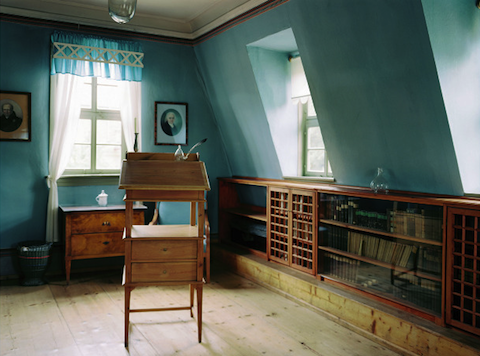
Another polymath, credited along with Goethe for a phase of German thought called Weimar Classicism, poet and philosopher Friedrich Schiller’s studio in his Weimar house above presents us with a light, airy space, a standing desk, and some surprisingly well-tended furnishings. Whether they are original or not I do not know, but the space befits the man who wrote Letters Upon the Aesthetic Education of Man, in which (Fordham University informs us) he “gives the philosophic basis for his doctrine of art, and indicates clearly and persuasively his view of the place of beauty in human life.” The entire house is a study in beauty. A much gloomier character, whose view of humankind’s capacity for rational development was far less optimistic than Schiller’s, Arthur Schopenhauer lived a solitary existence, surrounded by books—a life much more like the caricature of philosophy. Below, see Schopenhauer’s book collection lined up neatly and catalogued.

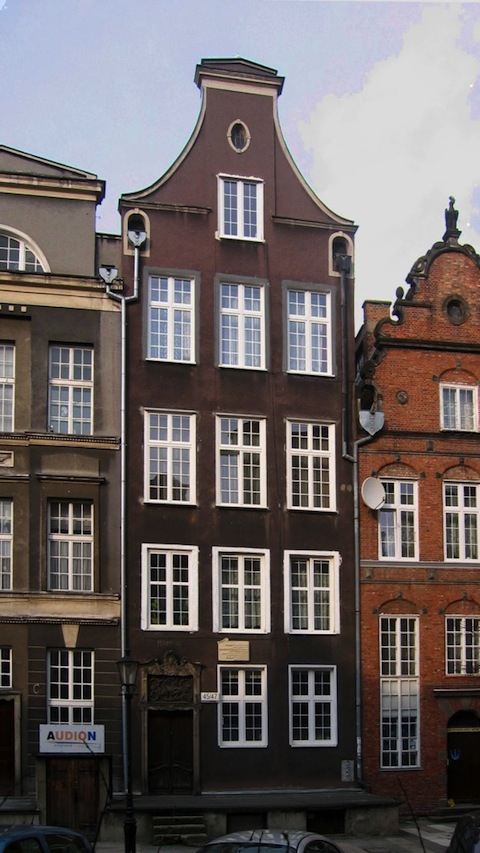
The façade of Schopenhauer’s birth house in Gdansk, below, doesn’t stand out much from its neighbors, none of whom could have guessed that the strange child inside would prepare the way for Nietzsche and other scourges of the good Christian bourgeoisie. No doubt little Arthur received his portion of ridicule as he shuffled in and out, an odd boy with an odd haircut. And if Schopenhauer didn’t actually write the words attributed to him about the “three stages of truth”—ridicule, violent opposition, and acceptance—he may have fully agreed with the sentiment.
Finally, speaking of Nietzsche, we have below the Nietzsche-Haus in Sils-Maria, Switzerland, where the lover of mountainous climes and hater of the vulgar rabble’s noise holed away to work in the summers of 1881, 1883, and 1888. The house now contains an open library, one of the world’s largest collections of books on Nietzsche. Trip Advisor gives the site four-and-a-half stars, a crowd-sourced score, of course, of which Nietzsche, I’m sure, would be proud.

See many more German (and some French) philosophers’ homes and studies at The Unemployed Philosophers Guild PhLog, A Piece of Monologue, and the excellent photography site of Patrick Lakey.
Related Content:
The Daily Habits of Highly Productive Philosophers: Nietzsche, Marx & Immanuel Kant
Philosopher Portraits: Famous Philosophers Painted in the Style of Influential Artists
Famous Philosophers Imagined as Action Figures: Plunderous Plato, Dangerous Descartes & More
Josh Jones is a writer and musician based in Durham, NC. Follow him at @jdmagness
Read More...Watch Rare Film of Richard Pryor Singing the Blues: No Joke, All Heart
With the possible exception of Beyonce as Etta James in Cadillac Records, no onscreen portrayal of a female jazz singer tops Diana Ross as Billie Holiday in Lady Sings the Blues. She is so mesmerizing, in fact, that it’s easy to forget, if you haven’t seen the movie recently, that Ross is flanked by two other excellent performers in Billy Dee Williams as Louis McKay, a composite stand-in for Holiday’s three husbands, and Richard Pryor as the “Piano Man,” Ross’s accompanist. It was a role that “propelled him into stardom” and kept Pryor out in front of an audience as a movie actor. Watch a clip from the film below, with Ross’s Holiday and Pryor’s surly Piano Man together at 3:39.
Odd as it seems that a dramatic role would be Pryor’s breakout performance, unexpected still perhaps is the video at the top of Pryor singing the blues himself. None of his raunchy or self-deprecating wit here, just a genuine, heartfelt rendition of Jimmy Cox’s 1924 “Nobody Knows You When You’re Down and Out.” According to eOne Music’s Eric Alper, Pryor not only started performing comedy after he moved to New York City in 1963, he also sang, opening for such soon-to-be-greats as Nina Simone and Bob Dylan. Pryor in fact got his start on the club circuit as a drummer, so “he was familiar with the scene.” Movies.com recounts a poignant story from Simone’s autobiography about Pryor’s intense stage fright before one of these early gigs:
He shook like he had malaria, he was so nervous. I couldn’t bear to watch him shiver so I put my arms around him there in the dark and rocked him like a baby until he calmed down. The next night was the same, and the next, and I rocked him each time.
As a singer, Pryor doesn’t channel and focus his anxiety so much as he slowly masters it, appearing a little stiff at first but eventually knocking it out with a surprisingly good performance that well deserves a listen. The provenance of the clip isn’t exactly clear, and some intro material marks it as part of a documentary, maybe. Please weigh in if you know or suspect the film clip’s source.
Related Content:
Richard Pryor Does Early Stand-Up Comedy Routine in New York, 1964
Nina Simone Performs Six Songs in 1968 TV Special, The Sound of Soul
Hear Zora Neale Hurston Sing the Bawdy Prison Blues Song “Uncle Bud” (1940)
Watch the Only Known Footage of the Legendary Bluesman Lead Belly (1935 and 1945)
Josh Jones is a writer and musician based in Durham, NC. Follow him at @jdmagness
Read More...Support Us
We're hoping to rely on loyal readers, rather than erratic ads. Please click the Donate button and support Open Culture. You can use Paypal, Venmo, Patreon, even Crypto! We thank you!

About Us

Open Culture scours the web for the best educational media. We find the free courses and audio books you need, the language lessons & educational videos you want, and plenty of enlightenment in between.
Advertise With Us

FREE UPDATES!
GET OUR DAILY EMAIL
Get the best cultural and educational resources on the web curated for you in a daily email. We never spam. Unsubscribe at any time.
FOLLOW ON SOCIAL MEDIA

Open Culture editor Dan Colman scours the web for the best educational media. He finds the free courses and audio books you need, the language lessons & movies you want, and plenty of enlightenment in between.
Advertise With Us


