Mark Twain Writes a “Gushing,” “Self-Deprecating” Wedding Announcement to His Family (1869)
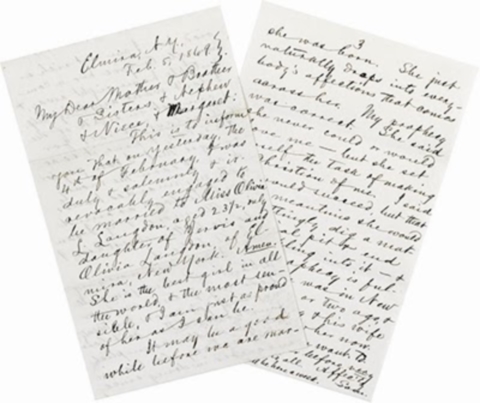
I am of the rather uncontroversial opinion that any marriage is what any two people make of it themselves. I’m also of the opinion that no matter how many people may publicly disagree with that idea, in private, people make their own rules. Nonetheless, the less outspoken among us often respond to moralists and scolds in our lives with the live-and-let live attitude expressed by a character in E.M. Forster’s Where Angels Fear to Tread: “Let Philip say what he likes, and he will let us do what we like.”
Such passive-aggressive arrangements can be alienating, an opinion Mark Twain seemed to hold when he announced to his family the upcoming nuptials to his future wife of 34 years, Olivia Langdon. In a display of what Booktryst calls “the sort of sentiment deeply appreciated by a prospective spouse,” Twain wrote his family in 1869 to tell them the news, and he tried to win them over. His announcement is a “gushing, self-deprecating declaration of intent.” One, moreover, that presumes his audience’s contrariness. The then 34-year-old Twain anticipates and addresses what seems his family’s primary objection to his marriage in general: he details his financial plans and expresses his intention to proceed “unaided.”
Twain then mounts his best persuasive case to sway his readers—Mother & Brother & Sisters & Nephew & Niece, & Margaret—in Langdon’s favor. He says that everyone who knows her “naturally” loves her. He also goes so far as to say that Langdon “set herself the task of making a Christian of me” and that “she would succeed.” Anyone who knows Twain’s attitudes toward religion, and Christianity in particular, may see some hyperbole, or even disingenuousness, here, but perhaps it’s a sincere expression of how far he was willing to go for the woman who stood by his side as he lost his fortune and hers in scheme after failed get-rich-quick scheme. As Booktryst nicely puts it, “Aside from pen & paper, the only investment that ever paid off for him was his effort to win the heart of Olivia Langdon.”
Read a full transcript of the letter below.
It may be a good while before we are married, for I am not rich enough to give her a comfortable home right away, & I don’t want anybody’s help. I can get an eighth of the Cleveland Herald for $25,000, & have it so arranged that I can pay for it as I earn the money with my unaided hands. I shall look around a little more, & if I can do no better elsewhere, I shall take it.
via Booktryst
Related Content:
Mark Twain Drafts the Ultimate Letter of Complaint (1905)
Mark Twain Wrote the First Book Ever Written With a Typewriter
Mark Twain Shirtless in 1883 Photo
Watch an Exuberant, Young Woody Allen Do Live Stand Up on British TV (1965)
In 1965, Woody Allen took time out from his first film What’s New Pussycat to tape a half-hour of stand up in front of a live television audience in the UK.
Exuberant and horny in an adorable, puppyish way, the 30-year-old comic seemed to relish this return to his nightclub act. The comedy is situational, observational, autobiographical — imagine Louis CK with a PG vocabulary, no kids, a necktie and a twinkle in his eye. Already ensconced on the Upper East Side, he paints a decidedly downtown vision of a New York populated by artists’ models, swinging Bennington girls, and women with pierced ears. Like Louis—or the young Brooklyn hipsters on Girls—he’s itching to score.
It does a body good to see him at this “childlike” stage of his career.
As he told journalist Eric Lax in Conversations with Woody Allen:
“…comics are childlike and they are suing for the approval of the adults. Something goes on in a theater when you’re fourteen years old and you want to get up onstage and make the audience laugh. You’re always the supplicant, wanting to please and to get warm laughs. Then what happens to comics — they make it and they become a thousand times more wealthy than their audience, more famous, more idolized, more traveled, more cultivated, more experienced, more sophisticated, and they’re no longer the supplicant. They can buy and sell their audience, they know so much more than their audience, they have lived and traveled around the world a hundred times, they’ve dined at Buckingham Palace and the White House, they have chauffeured cars and they’re rich and they’ve made love to the world’s most beautiful women — and suddenly it becomes difficult to play that loser character, because they don’t feel it. Being a supplicant has become much harder to sell. If you’re not careful, you can easily become less amusing, less funny. Many become pompous… A strange thing occurs: You go from court jester to king.”
Related Content:
Woody Allen Amuses Himself by Giving Untruthful Answers in Unaired 1971 TV Interview
Woody Allen Boxes a Kangaroo, 1966
Ayun Halliday wonders that she has yet to bump into this famous and curmudgeonly New Yorker. Follow her @AyunHalliday
Read More...Lorne Michaels Introduces Saturday Night Live and Its Brilliant First Cast for the Very First Time (1975)
Saturday Night Live, now in its 39th season, has become more notable lately for its takes on such unintentionally (and too often painfully) funny political figures as Sarah Palin and Michele Bachmann, rather than for its actual sketches. The show’s had some rough years, and though I can’t count myself among its current fans, for perhaps an eight-year period, from the late 80s to the mid 90s, I tried to catch every episode. Occasionally, I would have to endure what every fan of the long-running show must bear: a long nostalgic rant from my parents’ generation about how terrible the show had become and how it would never be as funny as it was in their day. But they may have just been right, since they watched it live in its infancy in the mid-seventies, when the show featured such comedic giants as Dan Aykroyd, Steve Martin, John Belushi, Bill Murray, and Gilda Radner. Although the topical humor of those early episodes is badly dated, the raw energy radiating from people who would go on to create such enduring classics as Animal House, The Blues Brothers, The Jerk, and Caddyshack sets the bar very high for everyone who followed.
Debuting on October 11, 1975, the brainchild of Lorne Michaels and Dick Ebersol was originally just called the show Saturday Night to differentiate it from an ABC show called Saturday Night Live with Howard Cosell. But from its inception, the hallmark elements were in place: the opening sketch ending in “Live from New York, it’s Saturday Night!” (originally uttered each time by Chevy Chase); the live studio audience; the celebrity guest host (pioneered by George Carlin in the first episode); and the live musical guests (the first were Billy Preston and Janis Ian). The original cast consisted of Chevy Chase, Dan Aykroyd, Jane Curtin, Garrett Morris, Gilda Radner, John Belushi, and Laraine Newman. In the video at the top you can see a very young Lorne Michaels introduce the eight original cast members before the first show aired in an interview on The Tomorrow Show with Tom Snyder. Asked by Snyder about the format of the show, Michaels jokingly replies, “we’ve got eight, and we’re hoping for two to really work. Not all of these people will become stars.” The cast laughs nervously. There’s no way any of them could have known how much the show would function as a star-making machine, but that is exactly what it became, even in its first season.
We are lucky to have screen tests from two of the first cast’s biggest stars-to-be, John Belushi (above) and Dan Aykroyd (below). In his audition, Belushi waggles his famous eyebrows, does a couple of brilliant Brando impressions, and generally hams it up. Aykroyd plays it straight, engaging in the smart satire of current events and pop culture that he did so well and pulling off a very credible Louisiana accent.
While some of the most famous comedians of season one, including Belushi and Aykroyd, are well known even to the raw youth of today, Lorne Michael’s first hire, the fabulous Gilda Radner, has sadly faded from pop culture memory, and there are precious few clips of her SNL work online. But Radner was a singular artist whose stand-up routines and Broadway shows are absolutely phenomenal, and still hold up today. You can see her below from her 1979 show “Gilda Live” doing a character called Candy Slice, her take on Patti Smith (who was never so wasted, I think). Notice a young Paul Schaeffer on the drums and SNL’s G.E. Smith, Radner’s first husband, on guitar. Radner’s tragic death from ovarian cancer in 1989 cast her late life in somber tones, but seeing her below, before her illness, offers but a glimpse of the tremendous physical energy and commitment she brought to her every memorable character on the show.
Related Content:
The Stunt That Got Elvis Costello Banned From Saturday Night Live
William S. Burroughs on Saturday Night Live, 1981
Tom Davis, Original Saturday Night Live Writer, “De-animates” at 59
Josh Jones is a writer and musician based in Durham, NC. Follow him at @jdmagness
Read More...Violinist Nigel Kennedy Joins Young Palestinian Musicians for an Exotic Version of Vivaldi’s The Four Seasons
You’ve heard it in shopping malls. You’ve heard it in elevators. No doubt you’ve even heard it on the telephone, while waiting on hold. But you’ve never heard Antonio Vivaldi’s The Four Seasons like this before.
On August 8, the flamboyant British violinist Nigel Kennedy and members of his Poland-based Orchestra of Life joined with the Palestine Strings ensemble at the Royal Albert Hall in London for a very unorthodox performance of the Baroque classic for a BBC Proms broadcast. With musicians drawn mostly from the West Bank and East Jerusalem, the Palestine Strings is an orchestra of the Edward Said National Conservatory of Music, a school founded in the Israeli-occupied territories in 1993 and named in 2004 for Said, the influential Palestinian-born writer, theorist and music aficionado who died the previous year.
The 17 members of the Palestine Strings who traveled to London ranged from 13 to 23 years old. They wore black-and-white checkered keffiyehs over their suits and dresses as a show of national pride. In the performance (shown above in its entirety), Kennedy and his collaborators followed the basic outline of Vivaldi’s four-concerto suite, but made frequent excursions into jazz and Arabic music. As Helen Wallace writes at BBC Music Magazine:
Into a basic rhythm section set-up — the irresistible bassist Yaron Stavi and Krzysztof Dziedzic on subtle percussion without drum kit, the gently agile pianist Gwilym Simcock providing a perfect continuo foil to Kennedy’s manic sawing — he wove spaces into which the young Palestinian soloists could stand and improvise in mesmerising Arabic style. These were especially successful in the apprehensive slow movement of Summer, where the shepherd boy fears the imminent storm: sinuous, silky-toned melismas from violin, viola and voice rang out, projecting like melancholy muezzin calls into the hall, and suiting perfectly Vivaldi’s open structure.
It wasn’t all good: “It Don’t Mean a Thing” cropped up in Summer apropos of nothing, while Spring opened with infuriating, Shirley Bassey-style crescendos on the final notes of every phrase. Kennedy’s own solos were pretty rough at times. At one point in Autumn he lost the thread completely and had to stop and ask the leader where they were. But he led the concertante episodes with such charm and wit, adding in birds at spring time, and delivering Winter’s aria like the purest folk air, you had to forgive the excesses.
Related content:
Fourteen-Year-Old Girl’s Blistering Heavy Metal Performance of Vivaldi
Read More...David Bowie’s Top 100 Books
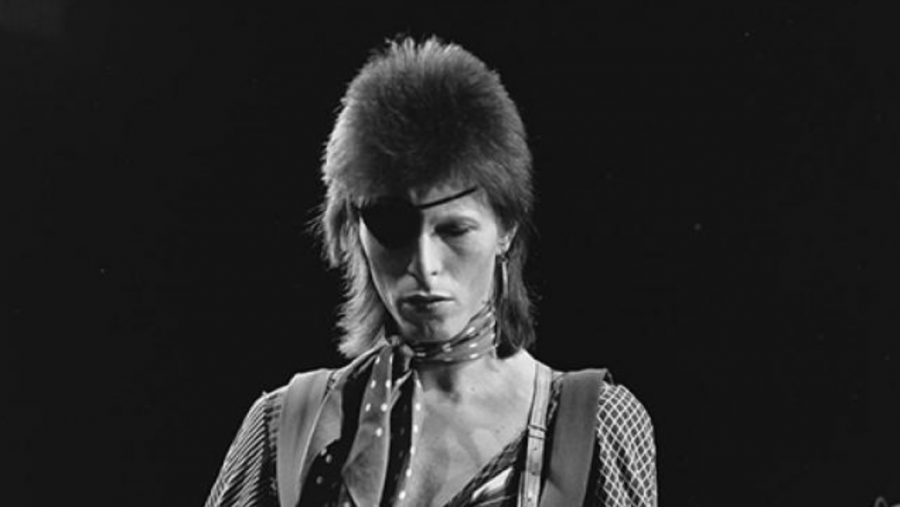
Image by Avro, via Wikimedia Commons
“David Bowie Is,” the extensive retrospective exhibit of the artist and his fabulous costumes, hit Toronto last Friday (see our post from earlier today), and as many people have reported, in addition to those costumes—and photos, instruments, set designs, lyric sheets, etc.—the show includes a list of Bowie’s favorite books. Described as a “voracious reader” by curator Geoffrey Marsh, Bowie’s top 100 book list spans decades, from Richard Wright’s raw 1945 memoir Black Boy to Susan Jacoby’s 2008 analysis of U.S. anti-intellectualism in The Age of American Unreason.
Bowie’s always had a complicated relationship with the U.S., but his list shows a lot of love to American writers, from the aforementioned to Truman Capote, Hubert Selby, Jr., Saul Bellow, Junot Diaz, Jack Kerouac and many more. He’s also very fond of fellow Brits George Orwell, Ian McEwan, and Julian Barnes and loves Mishima and Bulgakov. You can read the full list below or over at Open Book Toronto, who urges you to “grab one of these titles and settle in to read — and just think, somewhere, at some point, David Bowie (or, to be more accurate, the man behind David Bowie, David Jones) was doing the exact same thing.” If that sort of thing inspires you to pick up a good book, go for it. You could also peruse the list, then puzzle over the literate Bowie’s lyrics to “I Can’t Read.” You can also explore a new related book–Bowie’s Bookshelf: The Hundred Books that Changed David Bowie’s Life.
- Interviews With Francis Bacon by David Sylvester
- Billy Liar by Keith Waterhouse
- Room At The Top by John Braine
- On Having No Head by Douglass Harding
- Kafka Was The Rage by Anatole Broyard
- A Clockwork Orange by Anthony Burgess
- City Of Night by John Rechy
- The Brief Wondrous Life Of Oscar Wao by Junot Diaz
- Madame Bovary by Gustave Flaubert
- Iliad by Homer
- As I Lay Dying by William Faulkner
- Tadanori Yokoo by Tadanori Yokoo
- Berlin Alexanderplatz by Alfred Döblin
- Inside The Whale And Other Essays by George Orwell
- Mr. Norris Changes Trains by Christopher Isherwood
- Halls Dictionary Of Subjects And Symbols In Art by James A. Hall
- David Bomberg by Richard Cork
- Blast by Wyndham Lewis
- Passing by Nella Larson
- Beyond The Brillo Box by Arthur C. Danto
- The Origin Of Consciousness In The Breakdown Of The Bicameral Mind by Julian Jaynes
- In Bluebeard’s Castle by George Steiner
- Hawksmoor by Peter Ackroyd
- The Divided Self by R. D. Laing
- The Stranger by Albert Camus
- Infants Of The Spring by Wallace Thurman
- The Quest For Christa T by Christa Wolf
- The Songlines by Bruce Chatwin
- Nights At The Circus by Angela Carter
- The Master And Margarita by Mikhail Bulgakov
- The Prime Of Miss Jean Brodie by Muriel Spark
- Lolita by Vladimir Nabokov
- Herzog by Saul Bellow
- Puckoon by Spike Milligan
- Black Boy by Richard Wright
- The Great Gatsby by F. Scott Fitzgerald
- The Sailor Who Fell From Grace With The Sea by Yukio Mishima
- Darkness At Noon by Arthur Koestler
- The Waste Land by T.S. Elliot
- McTeague by Frank Norris
- Money by Martin Amis
- The Outsider by Colin Wilson
- Strange People by Frank Edwards
- English Journey by J.B. Priestley
- A Confederacy Of Dunces by John Kennedy Toole
- The Day Of The Locust by Nathanael West
- 1984 by George Orwell
- The Life And Times Of Little Richard by Charles White
- Awopbopaloobop Alopbamboom: The Golden Age of Rock by Nik Cohn
- Mystery Train by Greil Marcus
- Beano (comic, ’50s)
- Raw (comic, ’80s)
- White Noise by Don DeLillo
- Sweet Soul Music: Rhythm And Blues And The Southern Dream Of Freedom by Peter Guralnick
- Silence: Lectures And Writing by John Cage
- Writers At Work: The Paris Review Interviews edited by Malcolm Cowley
- The Sound Of The City: The Rise Of Rock And Roll by Charlie Gillette
- Octobriana And The Russian Underground by Peter Sadecky
- The Street by Ann Petry
- Wonder Boys by Michael Chabon
- Last Exit To Brooklyn By Hubert Selby, Jr.
- A People’s History Of The United States by Howard Zinn
- The Age Of American Unreason by Susan Jacoby
- Metropolitan Life by Fran Lebowitz
- The Coast Of Utopia by Tom Stoppard
- The Bridge by Hart Crane
- All The Emperor’s Horses by David Kidd
- Fingersmith by Sarah Waters
- Earthly Powers by Anthony Burgess
- The 42nd Parallel by John Dos Passos
- Tales Of Beatnik Glory by Ed Saunders
- The Bird Artist by Howard Norman
- Nowhere To Run The Story Of Soul Music by Gerri Hirshey
- Before The Deluge by Otto Friedrich
- Sexual Personae: Art And Decadence From Nefertiti To Emily Dickinson by Camille Paglia
- The American Way Of Death by Jessica Mitford
- In Cold Blood by Truman Capote
- Lady Chatterly’s Lover by D.H. Lawrence
- Teenage by Jon Savage
- Vile Bodies by Evelyn Waugh
- The Hidden Persuaders by Vance Packard
- The Fire Next Time by James Baldwin
- Viz (comic, early ’80s)
- Private Eye (satirical magazine, ’60s – ’80s)
- Selected Poems by Frank O’Hara
- The Trial Of Henry Kissinger by Christopher Hitchens
- Flaubert’s Parrot by Julian Barnes
- Maldoror by Comte de Lautréamont
- On The Road by Jack Kerouac
- Mr. Wilson’s Cabinet of Wonder by Lawrence Weschler
- Zanoni by Edward Bulwer-Lytton
- Transcendental Magic, Its Doctrine and Ritual by Eliphas Lévi
- The Gnostic Gospels by Elaine Pagels
- The Leopard by Giuseppe Di Lampedusa
- Inferno by Dante Alighieri
- A Grave For A Dolphin by Alberto Denti di Pirajno
- The Insult by Rupert Thomson
- In Between The Sheets by Ian McEwan
- A People’s Tragedy by Orlando Figes
- Journey Into The Whirlwind by Eugenia Ginzburg
If you would like to support the mission of Open Culture, consider making a donation to our site. It’s hard to rely 100% on ads, and your contributions will help us continue providing the best free cultural and educational materials to learners everywhere. You can contribute through PayPal, Patreon, and Venmo (@openculture). Thanks!
Related Content:
Bowie’s Bookshelf: A New Essay Collection on The 100 Books That Changed David Bowie’s Life
David Bowie Releases Vintage Videos of His Greatest Hits from the 1970s and 1980s
David Bowie Recalls the Strange Experience of Inventing the Character Ziggy Stardust (1977)
Josh Jones is a writer and musician based in Durham, NC. Follow him at @jdmagness
Read More...Hergé Draws Tintin in Vintage Footage (and What Explains the Character’s Enduring Appeal)
“Tintin addicts are a mixed bunch,” writes New Yorker critic Anthony Lane, profiling the beloved plus fours-clad, quiff-topped adventurer and thereby revealing himself as one of the afflicted. “Steven Spielberg and Peter Jackson [have] a three-picture deal to bring Tintin to the big screen. I once heard Hugh Grant declare on a radio program that if he could take only one book to a desert island it would be King Ottokar’s Sceptre (1939). [ … ] General de Gaulle declared that Tintin was his only international rival — he was envious, perhaps, not just of Tintin’s fame but of the defiantly positive attitude that he came to represent.” Despite coming from America, one of the few countries never to have taken wholeheartedly to the character, I too have read and re-read the 23 full-length comic books (or as we call them nowadays, graphic novels) in which he stars, and I too envy his qualities, especially the useful amorphousness of his identity: neither man nor boy; neither traditional nor modern; presumably Belgian, though for practical purposes stateless and apolitical; ostensibly a reporter, but no apparent need ever to file a story.
The late Harry Thompson surely ranks as a top Tintin addict. A radio and television producer, comedy writer, novelist, and creator of Have I Got News for You, he also greatly advanced the widespread avocation of English-language Tintinology with his book Tintin: Hergé and his Creation, published in 1991. Three years later, he would star in this episode of London Weekend Television’s documentary series Opening Shot on Tintin and his creator (part one at the top, click for two and three). His analysis swiftly assures any adult reader just how and why they should go about picking up and appreciating the truly painstaking craftsmanship of these comics they so relished in their youth. The broadcast also features commentary from Tintin’s English translators and, through archival footage, from Georges “Hergé” Remi himself (seen drawing Tintin just above, and his companion Captain Haddock below). Finally, we hear from more typical Tintin readers in man-on-the-street interviews — or rather, precocious-British-child-in-the-bookstore interviews: “My favorite character is Snowy, because he says really rude things.” “My favorite book is Tintin in America, because I like red Indians.” How many of these kids, nearly two decades on, can have resisted the siren song of Tintinology themselves?
Related Content:
The Inscrutable Imagination of the Late Comic Artist Mœbius
Colin Marshall hosts and produces Notebook on Cities and Culture and writes essays on literature, film, cities, Asia, and aesthetics. He’s at work on a book about Los Angeles, A Los Angeles Primer. Follow him on Twitter at @colinmarshall.
Read More...Trace Darwin’s Footsteps with Google’s New Virtual Tour of the Galapagos Islands
As famously studied as they are, the 18 Galapagos Islands haven’t been well mapped. And research in the Galapagos, situated more than 500 miles west of Ecuador, is expensive and difficult. Maybe that’s part of the islands’ allure—that and the stunning biodiversity.
In partnership with the Charles Darwin Foundation and Galapagos National Park, Google sent a team armed with Street View Trekker cameras to create an entirely new 360 degree Street View experience that makes three major islands, a fragile tortoise breeding area and coastal areas, available to visitors located anywhere with an Internet connection.
Darwin made his first expedition to the islands 178 years ago. This might have been his first view of San Cristobal Island.

After exploring San Cristobal’s rocky coast, Google trekkers made their way to Galapaguera, a giant tortoise breeding center, where they saw newly hatched babies and adults munching on leaves and stalks.
Off the coast of Floreana Island, trekkers went underwater and caught images of seals playing in the water. They also shot images inside the Charles Darwin Research Station’s vertebrate, invertebrate and plant collections.
Google does a good job of documenting its own process. Trekkers traveled to Galapagos in May and spent 10 days hiking, boating, and diving. It’s fun to watch them climb and scoot around the islands loaded with a geodesic camera backpack.
Scientists get really excited when they find new tools to do their work. And why shouldn’t they? These islands are amazing and are home to so many unique species, like the Marine Iguana. We landlubbers may not get there anytime soon, but this is the next best thing.
Related Content:
Read the Original Letters Where Charles Darwin Worked Out His Theory of Evolution
The Genius of Charles Darwin Revealed in Three-Part Series by Richard Dawkins
Darwin: A 1993 Film by Peter Greenaway
Kate Rix writes about education and digital media. Follow her on Twitter.
Read More...Sci-Fi Writer Robert Heinlein Imagines the Year 2000 in 1949, and Gets it Mostly Wrong
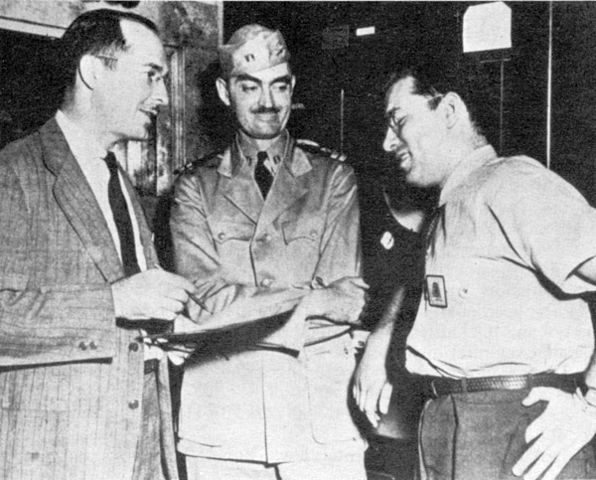
Image via Wikimedia Commons
Two giants of 20th century science fiction: Robert Heinlein and Isaac Asimov (see them together above, with L. Sprague de Camp in-between). Like every young sci-fi geek, I read them both assiduously, got lost in their dizzying universes that stretched across novels and significant teenage milestones. Even as an awkward kid, I could clearly identify an essential difference in tone between their forecasts of the future. Heinlein, the Navy man forcibly retired from service by tuberculosis, had the darker vision, in which the brute force of mass militarism continued to thrive and heroic men of action carried the day. Asimov, the practicing scientist—whose “Norby” series of kids books might be the cutest introduction to sci-fi ever written by an American—favored a future that, if still quite dangerous, was managed by robots and their creators, the technocrats.
As we can plainly see, we are no less a bellicose species than when these two authors wrote of the future, but Asimov seems to have had it right. The technocrats came out on top; too many battles are fought not by massed battalions but by deadly flying robots making (so we’re told) “surgical” strikes. A few weeks ago, we brought you a series of technocratic predictions of the year 2014 from Asimov, many of them surprisingly accurate. Today, we have a list of predictions from Heinlein, this time of the year 2000, and written in 1949 and published in 1952 in Galaxy magazine. How does his predictive ability stack up against his contemporary? Well, I’d say that 2 (stripped of some exaggeration), 8, and 11 either hit the mark or come pretty damn close. 19 is self-evidently true, and 15 is arguably not terribly far away, though it may not have seemed so in 2000. 4 is painfully ironic. The rest? Eh, not so much. Take a look and try to imagine yourself in Heinlein’s shoes in 1949. Not an easy task? Try to imagine what the world will look like in 2063. Which version of IOS will you be running then?
1. Interplanetary travel is waiting at your front door — C.O.D. It’s yours when you pay for it.
2. Contraception and control of disease is revising relations between the sexes to an extent that will change our entire social and economic structure.
3. The most important military fact of this century is that there is no way to repel an attack from outer space.
4. It is utterly impossible that the United States will start a “preventive war.” We will fight when attacked, either directly or in a territory we have guaranteed to defend.
5. In fifteen years the housing shortage will be solved by a “breakthrough” into new technologies which will make every house now standing as obsolete as privies.
6. We’ll all be getting a little hungry by and by.
7. The cult of the phony in art will disappear. So-called “modern art” will be discussed only by psychiatrists.
8. Freud will be classed as a pre-scientific, intuitive pioneer and psychoanalysis will be replaced by a growing, changing “operational psychology” based on measurement and prediction.
9. Cancer, the common cold, and tooth decay will all be conquered; the revolutionary new problem in medical research will be to accomplish “regeneration,” i.e., to enable a man to grow a new leg, rather than fit him with an artificial limb.
10. By the end of this century mankind will have explored this solar system, and the first ship intended to reach the nearest star will be a‑building.
11. Your personal telephone will be small enough to carry in your handbag. Your house telephone will record messages, answer simple inquiries, and transmit vision.
12. Intelligent life will be found on Mars.
13. A thousand miles an hour at a cent a mile will be commonplace; short hauls will be made in evacuated subways at extreme speed.
14. A major objective of applied physics will be to control gravity.
15. We will not achieve a “World State” in the predictable future. Nevertheless, Communism will vanish from this planet.
16. Increasing mobility will disenfranchise a majority of the population. About 1990 a constitutional amendment will do away with state lines while retaining the semblance.
17. All aircraft will be controlled by a giant radar net run on a continent-wide basis by a multiple electronic “brain.”
18. Fish and yeast will become our principal sources of proteins. Beef will be a luxury; lamb and mutton will disappear.
19. Mankind will not destroy itself, nor will “Civilization” be destroyed.
Here are things we won’t get soon, if ever:
– Travel through time
– Travel faster than the speed of light
– “Radio” transmission of matter.
– Manlike robots with manlike reactions
– Laboratory creation of life
– Real understanding of what “thought” is and how it is related to matter.
– Scientific proof of personal survival after death.
– Nor a permanent end to war.
Curiously, neither Heinlein nor Asimov foresaw that most terribly banal and ubiquitous phenomenon of reality TV, but really, what kind of monster could have imagined such a thing?
via Lists of Note/i09
Related Content:
Arthur C. Clarke Predicts the Future in 1964 … And Kind of Nails It
Walter Cronkite Imagines the Home of the 21st Century … Back in 1967
Marshall McLuhan Announces That The World is a Global Village
Josh Jones is a writer and musician based in Durham, NC. Follow him at @jdmagness
Read More...Bohemian Gravity: String Theory Explored With an A Cappella Version of Bohemian Rhapsody
This past spring, Timothy Blais wrote his masters thesis at McGill University in Montreal. Titled “A new quantization condition for parity-violating three-dimensional gravity,” the thesis clocks in at 74 pages and gets into some serious physics. The first line reads: “(2+1)-dimensional gravity with a negative cosmological constant is a topological theory with no local degrees of freedom.” I have to admit that Tim lost me right there. But he has made some amends with Bohemian Gravity, a potentially viral video that explores string theory with the help of an a cappella parody of Queen’s Bohemian Rhapsody. I have to admit that I don’t quite understand the substance of the video either. But I am thoroughly entertained and that counts for something.
Blais previously recorded “Rolling in the Higgs,” a scientific riff on Adele’s song. According to his Facebook page, these “science-parody creations are 100% originally recorded and made out of unaltered sounds from his mouth, throat and vocal cords.” Keep an eye on his YouTube Channel, acapellascience, for more videos (we hope) in the future.
H/T Robin/via I F’ing Love Science
Related Content:
Guitarist Brian May Explains the Making of Queen’s Classic Song, ‘Bohemian Rhapsody’
The Higgs Boson, AKA the God Particle, Explained with Animation
What’s Next for the Large Hadron Collider? PhD Comics Introduces the Search for Extra Dimensions
Read More...F. Scott Fitzgerald’s Handwritten Manuscripts for The Great Gatsby, This Side of Paradise & More
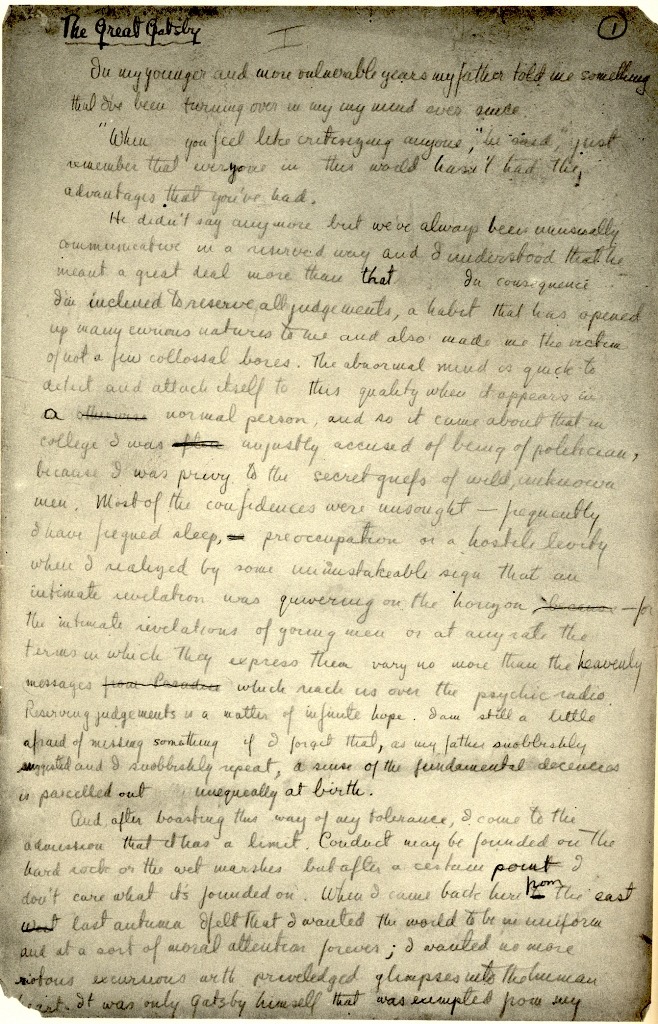
We rarely think about where F. Scott Fitzgerald’s hard-living, often tragic generation of American writers went to school. This year, however, Fitzgerald’s own almost-alma mater merits a note: the novelist began his studies at Princeton exactly one hundred years ago this fall, beginning classes on his birthday, September 24, 1913. To mark the occasion, that Ivy League institution has digitized their The Great Gatsby-writing alumnus’ manuscripts. Earlier this year, in fact, they completed the process on Fitzgerald’s manuscript, or manuscripts, of Gatsby itself. “We can see Fitzgerald at work on his third novel over a four-year period,” says the announcement from Princeton University Library’s Department of Rare Books and Special Collections (RBSC), which offers “Ur-Gatsby (2‑page fragment), the author’s abandoned effort, conceived in 1922 and written in 1923; The Great Gatsby autograph manuscript (302 pages), which he largely wrote in France and completed by September 1924;” and “corrected galleys of ‘Trimalchio,’ the novel’s working title when it was typeset by Charles Scribner’s Sons in 1924, only to be much reworked by the author early in 1925.”
You can find these online in the Princeton University Digital Library. There you can also, naturally, find papers associated with This Side of Paradise, the novel Fitzgerald began, under the working title The Romantic Egoist, while still at Princeton. The book, says the RBSC, “still stands as the most famous literary work about Princeton University. While Fitzgerald was not a good student and never graduated, dropping out in 1917 to join the U.S. Army during World War I, he began learning the craft of writing as an undergraduate and befriended other students who were aspiring authors, Edmund Wilson, Class of 1916, and John Peale Bishop, Class of 1917. Fitzgerald came to form a deep affection for Princeton that lasted until his untimely death in Hollywood.” They’ve digitized the corrected 1918 typescript of The Romantic Egoist, and the manuscript of This Side of Paradise. You can peruse all of these online in the PUDL’s Fitzgerald collection. Some regard Gatsby as a perfect novel; Edmund Wilson called Paradise “one of the most illiterate books of any merit every published.” (“Hastily written” and “somewhat disjointed,” says the RBSC itself.) But seeing how either became the Fitzgerald books we know today will prove instructive to readers and writers, academics and (like Fitzgerald, evidently) non-academics alike.
You can find Gatsby and This Side of Paradise in our collection of 500 Free eBooks.
via Paris Review
Related Content:
Read F. Scott Fitzgerald’s Story “May Day,” and Nearly All of His Other Work, Free Online
Seven Tips From F. Scott Fitzgerald on How to Write Fiction
The Evolution of F. Scott Fitzgerald’s Signature: From 5 Years Old to 21
Gertrude Stein Sends a “Review” of The Great Gatsby to F. Scott Fitzgerald (1925)
F. Scott Fitzgerald Creates a List of 22 Essential Books, 1936
Ernest Hemingway to F. Scott Fitzgerald: “Kiss My Ass”
Colin Marshall hosts and produces Notebook on Cities and Culture and writes essays on literature, film, cities, Asia, and aesthetics. He’s at work on a book about Los Angeles, A Los Angeles Primer. Follow him on Twitter at @colinmarshall.
Read More...Support Us
We're hoping to rely on loyal readers, rather than erratic ads. Please click the Donate button and support Open Culture. You can use Paypal, Venmo, Patreon, even Crypto! We thank you!

About Us

Open Culture scours the web for the best educational media. We find the free courses and audio books you need, the language lessons & educational videos you want, and plenty of enlightenment in between.
Advertise With Us

FREE UPDATES!
GET OUR DAILY EMAIL
Get the best cultural and educational resources on the web curated for you in a daily email. We never spam. Unsubscribe at any time.
FOLLOW ON SOCIAL MEDIA

Open Culture editor Dan Colman scours the web for the best educational media. He finds the free courses and audio books you need, the language lessons & movies you want, and plenty of enlightenment in between.
Advertise With Us


