Radical Thinkers: 5 Videos Profile Max Horkheimer, Alain Badiou & Other Radical Theorists
If you’ve ever considered drawing up a list of the most debased words, allow me to nominate radical. If you call someone a “radical thinker,” for instance, a great many listeners might assume you mean something along the lines of “cool thinker.” While we do tend to find thinkers cool here at Open Culture, more interesting usages exist. Some interpret the meaning of “radical thinker” as closer to “thinker of very different thoughts than everyone else,” and hit closer to the mark though they may, you can bet that someone else nearby has readied themselves to denounce the thinker in question as not nearly radical enough to qualify for the label. Like any complex word, phrase, or other element of language, we may have to define radical by looking at examples. Luckily, the Guardian and Verso Books have put together Radical Thinkers, a series of three-minute videos profiling exactly those.
In each video, a modern academic delivers a three-minute lecture on a radical thinker of choice, drawing on a book in Verso’s Radical Thinkers editions. “Ordinarily, we are more or less resigned to the world as it is,” says Peter Hallward of Kingston University, standing in London’s Housmans (“Radical Booksellers Since 1945”), summarizing Alan Badiou’s Ethics. “We adapt as best we can to the existing logic of the system, of the established order of things. We get a job, we go through life as best we can, we get by. What Badiou calls ethics is essentially the discipline and resources you need in order to resist those temptations to abandon or betray or give up on something.” Stella Stanford, also of Kingston, takes on Wilhelm Reich’s Sex-Pol in the Freud Museum. This radical thinker, she says, “argued against Freud’s view that sexual repression was the condition of possibility for all civilization. He used the same kind of anthropological work that Freud himself used to argue that sexual freedom and civilization were compatible.”
The Radical Thinkers series has three more videos: Esther Leslie in Camden Market on Max Horkheimer’s Critique of Instrumental Reason (above), an indictment of the Enlightenment’s failure to deliver a rational society.
Federico Campagna in his kitchen on Simon Critchley’s Infinitely Demanding, a look into the inevitably disappointed heart of modern liberal democracy.
And Nina Power on Ludwig Feuerbach’s Christianity-criticizing collection of writings The Fiery Brook.
Related Content:
Hear Theodor Adorno’s Avant-Garde Musical Compositions
Download 90 Free Philosophy Courses and Start Living the Examined Life
The History of Philosophy Without Any Gaps – Peter Adamson’s Podcast Still Going Strong
Take First-Class Philosophy Lectures Anywhere with Free Oxford Podcasts
Colin Marshall hosts and produces Notebook on Cities and Culture and writes essays on literature, film, cities, Asia, and aesthetics. He’s at work on a book about Los Angeles, A Los Angeles Primer. Follow him on Twitter at @colinmarshall.
Read More...Psychedelic Scenes of Pink Floyd’s Early Days with Syd Barrett, 1967
Roger Waters of Pink Floyd turns 70 years old today. Waters was the principal songwriter and dominant creative force during the band’s famous 1970s period, when it released a string of popular and influential concept albums such as Dark Side of the Moon, Wish You Were Here and The Wall. But today we thought it would be interesting to take you all the way back to 1967, when Waters was 23 years old and the band was led by his childhood friend Syd Barrett.
The video above is from a May 14, 1967 broadcast of the BBC program The Look of the Week. Pink Floyd hadn’t released an album yet. Only two nights earlier the band had staged its attention-getting “Games for May” concert at the Queen Elizabeth Hall. In the TV broadcast, Pink Floyd plays its early favorite “Astronomy Domine” before Waters and Barrett sit down for a rather tense interview with the classically trained musician and critic Hans Keller. It’s amusing to watch Keller’s face as he expresses his extreme irritation at the band’s loud, strange music. “My verdict is that its a little bit of a regression to childhood,” he says with a grimace. “But after all, why not?”
Waters and Barrett manage to hold their own during the interview. Barrett comes across as lucid and well-spoken, despite the fact that his heavy LSD use and mental instability would soon make him unable to function within the band. By December of 1967, Pink Floyd would add guitarist David Gilmour to the lineup to compensate for Barrett’s erratic behavior. By March of 1968 — only 10 months after the BBC broadcast — Barrett would quit the group.
We’ll close with an even earlier video of Pink Floyd onstage. Filmed on January 27, 1967 at the legendary UFO club in London, the clip is from the February 7, 1967 Granada TV documentary So Far Out It’s Straight Down. It shows the band playing another major song from its psychedelic era, “Interstellar Overdrive.”
Related Content:
Pink Floyd’s David Gilmour Sings Shakespeare’s Sonnet 18
Watch Pink Floyd Plays Live in the Ruins of Pompeii (1972)
Pink Floyd’s Roger Waters Performs The Wall at the Berlin Wall (1990)
Read More...Watch The Amazing 1912 Animation of Stop-Motion Pioneer Ladislas Starevich, Starring Dead Bugs
Last week we featured 1937’s The Tale of the Fox, the crowning glory of inventive Russian filmmaker Ladislas Starevich’s work in puppet animation. But he didn’t always shoot puppets as we know them; at the dawn of his career — and thus the dawn of Russian animation — he had to make use of what lay close at hand. Today we go back a couple decades further, to the time when Starevich (then known, before his immigration to Paris, as Władysław Starewicz) worked not as an animator but as the director of Kovno, Lithuania’s Museum of Natural History. Interested in filming nocturnal stag beetles but unable to get a performance out of them under film lights, he hit upon the idea of shooting not living insects but dead ones, their legs replaced with wire which he could reposition frame-by-frame. The result? Starevich’s early, still-entertaining shorts like 1911’s The Ant and the Grasshopper (also known as The Dragonfly and the Ant) at the top.
But you haven’t truly experienced dead-bug animation until you’ve seen The Cameraman’s Revenge, just above. Starevich made it in 1912, by which time his animation skills had developed to the point that each player moves in a manner both realistically buglike (some contemporary viewers mistook them for trained insects moving in real time) and parodically evocative of human characters. Slate’s Joan Newberger describes the plot of this “comic melodrama in meticulously detailed miniature sets” as follows: “We meet a beetle couple, Mr. and Mrs. Zhukov (zhuk means beetle in Russian), both of whom are carrying on extramarital affairs. Zhukov wins the affections of a dragonfly cabaret dancer, but flies into a rage when he comes home to discover his wife in the ‘arms’ of an artist (also played by a beetle).” But the plot thickens, and this seemingly simple (if obviously complex in craft, especially for the time) tale even uses a bit of cinema-within-cinema at its denouement. Starewicz made early stop-motion for sure, but he didn’t make the earliest. Smithsonian.com has a post on that, citing the 1902 Thomas Edison-produced Fun in a Bakery Shop as the first surviving example — but, alas, a bugless one.
Starevich’s films can be found in our collection, 4,000+ Free Movies Online: Great Classics, Indies, Noir, Westerns, Documentaries & More. Look under Animation.
Related Content:
The Mascot, Pioneering Stop Animation from Wladyslaw Starowicz
Colin Marshall hosts and produces Notebook on Cities and Culture and writes essays on literature, film, cities, Asia, and aesthetics. He’s at work on a book about Los Angeles, A Los Angeles Primer. Follow him on Twitter at @colinmarshall.
Read More...The Music of Queen Re-Imagined by “Extraordinary” Classical Pianist, Natalia Posnova
Queen’s conjunction of the highly theatrical with the musically virtuoso set the bar for rock opera as high as it will go. Freddie Mercury and Brian May were such extraordinarily talented musicians that it seems impossible for anyone to do their compositions justice in cover versions, and I can’t think of anyone who has. Until now, perhaps. Because now, I have seen pianist Natalia Posnova cover Queen’s 1980 movie theme song “Flash,” written for the, shall we say, less-than-memorable Flash Gordon film of the same year. The original song is an almost ridiculously cool operatic rock anthem, featuring everything we love about the classic Queen song: John Deacon’s tense, thumping bassline, Roger Taylor’s explosive drum fills, Brian May’s guitar arpeggios, and, of course, vocal harmonies the likes of which the Mormon Tabernacle Choir might envy.
Natalia Posnova’s version features none of these things. Only a piano, and in the video, her shiny red Flash Gordon-themed outfit. Nevertheless, she manages to completely capture the drama of the original in her version, titled “Flash Fantasy.” She certainly convinced Brian May, who writes on his blog, “THIS WOMAN IS EXTRAORDINARY! I just ‘discovered’ Natalia Posnova. She is an amazing pianist and interpreter of songs. And I do not use this term lightly. This video clip is worth a million hits. I hope it gets them … I have seriously, in all these years, never seen or heard anything like this. To see this amount of beauty, talent, innovation and pure bravura in one shot is astounding.” He hopes to see her live someday. Above, she tackles another theatrical Queen song, “Who Wants to Live Forever,” this time in suitable evening wear for the hyperdramatic ballad. Posnova’s renditions bring to the foreground the classical harmonies embedded in these songs. For more on Posnova’s interpretations of Queen, see Freddie Mercury’s friend Peter Freestone and Posnova herself discuss her approach in the video below, and enjoy her take on another lovely ballad, “Don’t Try So Hard.”
HT to OC reader, Dirk, for sending this along.
Related Content:
Guitarist Brian May Explains the Making of Queen’s Classic Song, ‘Bohemian Rhapsody’
Queen Documentary Pays Tribute to the Rock Band That Conquered the World
Josh Jones is a writer and musician based in Durham, NC. Follow him at @jdmagness
Read More...Lenny Kravitz Overhears High School Kids Playing His Music and Surprises Them by Joining In
One day Lenny Kravitz was sitting with some friends on a terrace in New Orleans when he heard a familiar sound. A group of high school students from a baptist church in Texas was performing his hit “Fly Away” on the steps across Decatur Street from Jackson Square in the French Quarter.
Kravitz decided he wanted to join in. One of his friends went down and asked the group’s director if that would be alright. He said yes, it would. So when the famous musician arrived, the group started playing the song again from the top. “It was one of the strangest things I’ve ever experienced,” Kelvin Reed, director of the Voice of Praise choir from the First Baptist Church in Lewisville, Texas, told the Dallas Morning News afterward. “All of my students said, ‘Kelvin, did you plan that?’ That was just one of those unique experiences.”
The incident happened on June 25, 2010. Back then, Kravitz owned a Creole cottage in the French Quarter and lived in New Orleans part-time. “It was probably one of the most incredible things that’s ever happened to me,” choir member and lead guitarist Michael Smeaton told the Morning News. “This is a famous musician. He just comes down and wants to jam with us. It makes you realize as a musician you have this sense of kinship, and you all come from the same experiences.”
via That Eric Alper
Related Content:
A Paul Simon Feelin’-Very-Groovy Moment
13,500 Sing “Hey Jude” in Trafalgar Square
Blind Guitarist Lives Out Dream at U2 Show
Read More...Watch The March, the Masterful, Digitally Restored Documentary on The Great March on Washington
The March on Washington for Jobs and Freedom, one of the largest human rights rallies in American history, took place 50 years ago today in Washington, D.C.. Martin Luther King Jr. spoke that day, delivering his famous “I Have a Dream” speech. Joan Baez sang “We Shall Overcome,” the anthem of the civil rights movement, while Bob Dylan performed “When the Ship Comes In” and Odetta sang “I’m On My Way.”
In 1964, the director James Blue released a documentary called The March. Produced under the auspices of the United States Information Agency, the film proved to be a “visually stunning, moving, and arresting documentary of the hope, determination, and camaraderie embodied by the demonstration.” And while the film initially sparked some controversy (read the account here), it has had a big impact on audiences inside and outside the US throughout the decades.
In 2008, The March was selected for preservation in the United States National Film Registry by the Library of Congress. To celebrate the 50th anniversary of the The March for Jobs and Freedom, the US National Archives has completed a full digital restoration of the film. You can watch it free above, or find it in the Free Documentaries section of our collection of 550 Free Movies Online.
Related Content:
James Baldwin Bests William F. Buckley in 1965 Debate at Cambridge University
Robert Penn Warren Archive Brings Early Civil Rights to Life
Read More...Virginia Woolf’s Handwritten Suicide Note: A Painful and Poignant Farewell (1941)
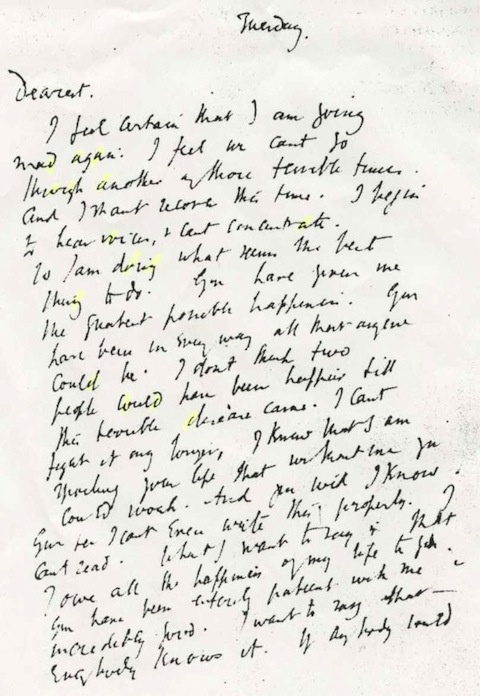
It seems like a very morbid and inhuman practice to treat the suicide note as a piece of literature, even if the author of said note is a writer as famous as Virginia Woolf. And yet, why not? I can anticipate all sorts of ethical objections having to do with decency, and I share some of those sentiments. Let us not forget, however, that death has often been a literary occasion: the long tradition of recorded last words ranges from deathbed confessions to the strangely theatrical genre of the gallows speech (see Socrates, Anne Boleyn, or John Brown). Like those unforgettable figures of history, Virginia Woolf’s last scripted words are pored over by lay readers and scholars alike (see, for example, pages on Woolf’s final words from Smith College and Yale).
Woolf’s death, in March of 1941, occasioned the third of her suicide letters, and yes, it feels unseemly to linger over her last piece of prose. Perhaps it is the mode of death, suicide still being a societal taboo, thought of as tragic even when it’s undertaken calmly and rationally by someone ready to leave this world. And in many cases, especially those involving mental illness, death seems so needless, so extreme. Such was the case with Woolf, who drowned herself after a long struggle with what would probably be called today bipolar disorder. Her suicide note, written to her husband Leonard, is a haunting and beautiful document, in all its unadorned sincerity behind which much turmoil and anguish lie. See a scan of the handwritten note at the top, and read the full transcript below. Directly above, you can hear a dramatic reading of Woolf’s note, such a wrenching missive because it is not a farewell to the world at large, but rather to a trusted friend and lover.
Dearest,
I feel certain I am going mad again. I feel we can’t go through another of those terrible times. And I shan’t recover this time. I begin to hear voices, and I can’t concentrate. So I am doing what seems the best thing to do. You have given me the greatest possible happiness. You have been in every way all that anyone could be. I don’t think two people could have been happier till this terrible disease came. I can’t fight any longer. I know that I am spoiling your life, that without me you could work. And you will I know. You see I can’t even write this properly. I can’t read. What I want to say is I owe all the happiness of my life to you. You have been entirely patient with me and incredibly good. I want to say that — everybody knows it. If anybody could have saved me it would have been you. Everything has gone from me but the certainty of your goodness. I can’t go on spoiling your life any longer.
I don’t think two people could have been happier than we have been.
Related Content:
“A Haunted House” by Virginia Woolf
Find Works by Virginia Woolf in Our Collections of Free Audio Books and Free eBooks.
Josh Jones is a writer and musician based in Durham, NC. Follow him at @jdmagness
Read More...Dexter Gordon Plays ‘Body and Soul’ in the Noted Film Round Midnight
In the acclaimed 1986 film Round Midnight, the great tenor saxophonist Dexter Gordon plays an aging American jazzman living in Paris in the late 1950s, struggling to control his addiction to alcohol so he can keep playing every night at the Blue Note in Saint-Germain-des-Prés.
The role came naturally to Gordon, whose own struggle with heroin addiction in the 1950s resulted in prison time and a loss of his New York City cabaret card. Unable to play in the clubs of New York, Gordon moved to Europe in the early 1960s and stayed there for 14 years. But while Dale Turner, his character in Round Midnight, is a worn-down man nearing death, Gordon’s European exile was a period of rebirth.
By the time the French film director and jazz enthusiast Bertrand Tavernier tracked Gordon down in 1984, though, the saxophone player had been back in America for a decade and was, after 40 years on the jazz circuit, becoming a bit worn down himself. The Dale Turner character is based partly on tenor saxophonist Lester Young, who was Gordon’s friend and mentor and a major influence in his life, and partly on pianist Bud Powell, whom Gordon knew and worked with in Paris. Tavernier was looking for authenticity and he found it in Gordon, a man with a direct link to the golden age of bebop. As the filmmaker told People in 1986, “I could not think of anyone else doing the part.”
Round Midnight was a critical success. Gordon received an Academy Award nomination for best actor in a leading role. The film was noted for “its lovely, elegiac pacing and its tremendous depth of feeling” by Janet Maslin of the New York Times. “No actor could do what the great jazz saxophonist Dexter Gordon does in ‘Round Midnight,’ ” writes Maslin, who describes Gordon’s screen presence as the very embodiment of the music itself. “It’s in his heavy-lidded eyes, in his hoarse, smoky voice, in the way his long, graceful fingers seem to be playing silent accompaniment to his conversation. It’s even in the way he habitually calls anyone or anything ‘Lady,’ as in ‘Well, Lady Sweets, are you ready for tonight?’ ”
Those are the words Turner addresses to his saxophone at the beginning of the scene above. The film then cuts to the Blue Note, where the musician’s young admirer Francis (played by François Cluzet) is transfixed as the old man gives a melancholy, world-weary performance of the Johnny Green standard “Body and Soul.” Like all of the music in the film, “Body and Soul” was recorded live on the set. Gordon is accompanied by Herbie Hancock on piano, John McLaughlin on guitar, Pierre Michelot on bass and Billy Higgins on drums.
For more on Dexter Gordon, including a film clip from a vintage performance at a Dutch nightclub, see our earlier article “Dexter Gordon’s Elegant Version of the Jazz Standard ‘What’s New,’ 1964.”
Read More...Inside the Rhapsody: A Short Documentary on the Making of Queen’s Classic Song, ‘Bohemian Rhapsody’ (2002)
“Bohemian Rhapsody” by Queen is one of the most audacious pop songs ever made. Part ballad, part opera, part heavy metal orgasm, the song has six distinct sections and took over a month to record. At just under six minutes, “Bohemian Rhapsody” was considered too long for pop radio. “The record company, in their infinite ignorance, of course immediately suggested that we cut it down,” said Queen drummer Roger Taylor, who stood by his bandmates and refused to let the song be cut. “It really was hit or miss. It was either going to be massive or it was going to be nothing.”
“Bohemian Rhapsody,” of course, went on to become one of the most popular songs in music history. It spent nine weeks at number one in the UK following its release in the fall of 1975, and went back to number one after the death of singer Freddie Mercury in 1991. In America the song peaked at number nine in 1976 and re-entered the charts at number two in 1992, when it was featured in the movie Wayne’s World. Last year, an ITV poll in Great Britain listed “Bohemian Rhapsody” as “The Nation’s Favorite Number One” song in 60 years of music.
Above, in the 3‑part mini documentary Inside the Rhapsody, Queen takes you inside the making of the song. And, along the way, guitarist Brian May goes back to the mixing board to explain the complexity of layers that went into realizing Mercury’s vision for the song. The original 24-track analogue recording system was far too limited, so the band used the ping-pong technique to “bounce” literally hundreds of overdubs into the mix. May explains how the operatic vocal layers were inspired by the “cascading strings” effect made famous by Annunzio Paolo Mantovani, a technique May first tried out in 1974 with the guitar solo on “Killer Queen.”
For more on the making of “Bohemian Rhapsody,” please see our post, “Listen to Freddie Mercury’s Wondrous Piano and Vocal Tracks for ‘Bohemian Rhapsody’ (1975).” And for a reminder of how it all came together, here’s the official video:
Inside the Rhapsody has been added to our collection, 285 Free Documentaries Online.
Related content:
Queen Documentary Pays Tribute to the Rock Band That Conquered the World
Read More...Documentary Viva Joe Strummer: The Story of the Clash Surveys the Career of Rock’s Beloved Frontman
I vividly remember learning the first song my high school garage band covered, The Clash’s “Clash City Rockers.” We spent hours deciphering the lyrics, and never got them right. This was, if you can believe it, a pre-Google age. While the exercise was frustrating, I never resented Joe Strummer’s slurred, gravelly vocals for making us work hard at getting his meaning. For one thing, I loved his voice, and as a student of the blues and Dylan, never really cared if rock singers could actually sing. For another, Strummer never seemed to care much himself if you could understand him, though his lyrics blasted through mountains of BS. This is not because he was an egotist but quite the opposite: he passionately hated rock clichés and wasn’t making pop records.
The first scene in the documentary above, Viva Joe Strummer (later released as Get Up, Stand Up), gives us The Clash frontman deconstructing the genre. “Well, hi everybody, ain’t it groovy,” he says to a cheering crowd, followed by, “ain’t you sick of hearing that for the last 150 years?” The documentary’s narrator describes Strummer as “the man who put credible rock and roll into the bastard cultural orphan that was called punk,” but this seems an inaccurate description.
For one thing, rock and roll is itself a bastard genre, something Strummer always recognized, and for another The Clash, fueled by Strummer’s ecumenical interest in world cultures, drew liberally from other kinds of music and stuck their middle fingers up at establishment rock and everything it came to represent.
Viva Joe Strummer gives us loads of concert footage and interviews with band members and close friends like the Sex Pistols’ Glen Matlock. The focus remains on Strummer, a frontman with tremendous charisma but also, paradoxically, with a tremendous amount of humility. One reviewer of the film says as much:
Joe Strummer always projected himself as a humble man. Even at the height of The Clash‘s megalomania, when he fired guitarist Mick Jones, Strummer came across like a better read, more worldly Bruce Springsteen. The everyman image has made eulogizing the singer difficult.
This suggests that Strummer’s everyman persona may have been part of his showmanship, but even so, he was respected and admired by nearly everyone who knew him. And his proletarian politics were genuine. As one interviewee says above, “he always had a corner to fight in. He always had someone to stick up for.”
The original DVD included a CD with interview clips from 1979 to 2001, such as the 1981 Tom Snyder Show interview above. Viva Joe Strummer lacks the powerful dramatic arc and tight direction of Julian Temple’s 2007 The Future is Unwritten, but it’s still well worth watching for interview footage you won’t see anywhere else. Despite the film’s original subtitle, The Story of The Clash, the documentary follows Strummer’s career all the way through the dissolution of the band that made him famous and through his successive musical endeavors with Joe Strummer and the Mescaleros. And it documents the reactions to his sudden, tragic death in 2002. I still remember getting the news. I happened, oddly enough, to be drinking at the bar where the Joe Strummer mural would go up in New York’s East Village in 2003. I walked outside and lit a cigarette, put on my headphones, cued up “Clash City Rockers,” and shed a tear for the punk rock everyman who everybody loved.
Related Content:
“Joe Strummer’s London Calling”: All Eight Episodes of Strummer’s UK Radio Show Free Online
Remembering The Clash’s Frontman Joe Strummer on His 60th Birthday
The Clash Live in Tokyo, 1982: Watch the Complete Concert
Josh Jones is a writer and musician based in Washington, DC. Follow him at @jdmagness
Read More...Support Us
We're hoping to rely on loyal readers, rather than erratic ads. Please click the Donate button and support Open Culture. You can use Paypal, Venmo, Patreon, even Crypto! We thank you!

About Us

Open Culture scours the web for the best educational media. We find the free courses and audio books you need, the language lessons & educational videos you want, and plenty of enlightenment in between.
Advertise With Us

FREE UPDATES!
GET OUR DAILY EMAIL
Get the best cultural and educational resources on the web curated for you in a daily email. We never spam. Unsubscribe at any time.
FOLLOW ON SOCIAL MEDIA

Open Culture editor Dan Colman scours the web for the best educational media. He finds the free courses and audio books you need, the language lessons & movies you want, and plenty of enlightenment in between.
Advertise With Us

