Against All Odds: A Gentle Introduction to Statistics Hosted by Harvard Geneticist Pardis Sabeti (Free Online Course)
Worth a quick mention: Dr. Pardis Sabeti, a media-savvy computational geneticist at Harvard, has teamed up with the Annenberg Foundation, to create a new introduction to statistics. In 31 nicely-produced videos, Against All Odds: Inside Statistics guides “viewers through the wide range of statistical applications used by scientists, business owners, and even Shakespeare scholars, in their work and daily lives.” It’s all about “real people working on real problems.”
The series starts with What Is Statistics?. And then, along the way, the course covers topics like Standard Deviation, Correlation, Samples and Surveys, and more. The clip above comes from the unit called Checking Assumption of Normality. And do note that each video module is complemented by a Student Guide and Faculty Guide specific to the unit.
Against All Odds: Inside Statistics has been added to our collection of Free Math Courses, a subset of our larger collection, 1,700 Free Online Courses from Top Universities.
If you would like to support the mission of Open Culture, consider making a donation to our site. It’s hard to rely 100% on ads, and your contributions will help us continue providing the best free cultural and educational materials to learners everywhere. You can contribute through PayPal, Patreon, and Venmo (@openculture). Thanks!
Related Content:
Statistics Explained Through Modern Dance: A New Way of Teaching a Tough Subject
Calculus Lifesaver: A Free Online Course from Princeton
Read More...Benjamin Bratton Explains “What’s Wrong with TED Talks?” and Why They’re a “Recipe for Civilizational Disaster”
TED Talks — they give your “discovery-seeking brain a little hit of dopamine;” make you “feel part of a curious, engaged, enlightened, and tech-savvy tribe;” almost giving you the sensation that you’re attending a “new Harvard.” That was the hype around TED Talks a few years ago. Since then, the buzz around TED has mercifully died down, and the organization has gone on, staging its conferences around the globe. It’s been a while since we’ve featured a TED Talk whose ideas seem worth spreading. But today we have one for you. Intriguingly, it’s called “What’s Wrong with TED Talks?” It was presented by Benjamin Bratton, Associate Professor of Visual Arts at UCSD, at none other than TEDxSanDiego 2013. Bratton makes his case (above) in 11 minutes — well within the 18 allotted minutes — by arguing that TED doesn’t just help popularize ideas. Instead, it changes and cheapens the agenda for science, philosophy and technology in America. He begins to frame the problem by telling a story:
I was at a presentation that a friend, an astrophysicist, gave to a potential donor. I thought the presentation was lucid and compelling.… After the talk the sponsor said to him, “you know what, I’m gonna pass because I just don’t feel inspired …you should be more like Malcolm Gladwell.”
Think about it: an actual scientist who produces actual knowledge should be more like a journalist who recycles fake insights! This is beyond popularization. This is taking something with value and substance and coring it out so that it can be swallowed without chewing. This is not the solution to our most frightening problems – rather this is one of our most frightening problems.
Bratton then concludes, “astrophysics run on the model of American Idol is a recipe for civilizational disaster.” If “our best and brightest waste their time – and the audience’s time – dancing like infomercial hosts,” the cost will be too high, and our most difficult problems won’t get solved.
In watching Bratton’s talk, I found myself agreeing with many things. Sure, TED Talks are often “a combination of epiphany and personal testimony … through which the speaker shares a personal journey of insight and realization, its triumphs and tribulations.” Yes, the talks offer viewers a predictably “vicarious insight, a fleeting moment of wonder, an inkling that maybe it’s all going to work out after all.” Maybe TED Talks sometimes provide nothing more than “middlebrow megachurch infotainment.” But is TED really changing the agenda for scientists, technologists and philosophers? Are scholars actually choosing their intellectual projects based on anything having to do with TED (or TED-inspired ways of thinking)? Is someone at the NIH doling out money based on whether a project will eventually yield 15 good minutes of diversion and entertainment? Short of empirical evidence that actually applies to TED (the anecdote above doesn’t), it feels like Bratton is giving TED way too much credit. Maybe TED matters on YouTube. But let’s get real, its pull largely starts and ends there. You can read a complete transcript of Bratton’s talk here.
via The Guardian
Don’t miss anything from Open Culture in 2014. Sign up for our Daily Email or RSS Feed. And we’ll send cultural curiosities your way, every day.
Read More...Cartoonist R. Crumb Assesses 21 Cultural Figures, from Dylan & Hitchcock, to Kafka & The Beatles
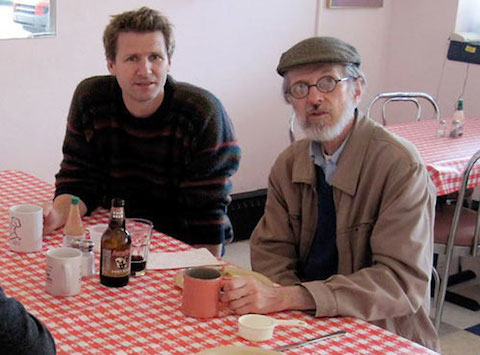
Any fan of “underground” comic artist Robert Crumb knows that the man has no shyness about his preferences: not in jazz music, not in politics, and certainly not in the female form. Alex Wood, co-operator of the official R. Crumb site (pictured with Crumb above), has discovered that the artist’s opinions offer a vivid window into the artist’s mind. “Over the years, talking with Robert about many different things, I’ve been surprised by some of the things he likes and dislikes,” Wood writes. “We all know he loves old music from the early part of the last century, and doesn’t like rock music. But then he says he likes Tommy James and the Shondells, and Sam the Sham and the Pharaohs? So in a discussion in May, 2011, I asked his opinion on a list of people in the news past and present.” This became part one of the series “Crumb on Others,” which has at this point grown to seven full pages.
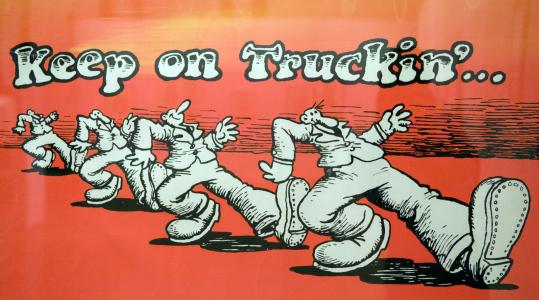
Below, we offer you a selection of the roughly 150 figures from music, film, visual art, and letters Crumb has so far assessed, his reactions ranging from high praise to outright dismissal to amusing anecdotes of his own encounters with the luminaries in question. With these, you can see how your notes on the likes of Bob Dylan, Alfred Hitchcock, Philip K. Dick, and Charles Darwin compare with those of the creator of Fritz the Cat and Mr. Natural, the hand that gave us “Keep on Truckin’,” and the leading light of of Zap Comix — a luminary who has generated no small amount of high praise, outright dismissal, and amusing anecdote himself. Here are the remaining parts. Part 2, Part 3, Part 4, Part 5, Part 6, and Part 7.
On Mark Twain: “Tom Sawyer and Huckleberry Finn don’t do that much for me. But his later stuff, he gets more cranky as he gets older. His critique gets more interesting. When I was 15, I read What Is Man? and it made a profound impression on me. It changed my life. It’s all about predestination versus freewill. He was a big believer in predestination. He didn’t think we had any free will.”
On Bob Dylan: “I hate his voice. I can’t stand to hear him sing. I thought some of the songs that he wrote in the mid-60s were kind of clever, with clever lyrics. But I just can’t stand to hear him or see him perform. And I think his heart is in the right place a lot of times, you know. Someone told me he was an aficionado of old 20s, old time music, and that he listens to the same kind of stuff I like.”
On Walt Disney: “When I was a little kid in the 50s, we were profoundly enthralled by Disney, and profoundly affected by the Disney vision. But to my taste, the whole thing starts to decline in the early 1950s. The last one that I think is a truly visionary work is Alice In Wonderland. Beginning with Peter Pan circa 1953 it starts to slide into something too corporate.”
On Janis Joplin: “Sad case, very sad case. She tried to act like she was hard and tough, but she wasn’t at all. She was soft and vulnerable. She drank a lot, and got a lot of bad advice. She was surrounded by vultures and vampires and scoundrels, and they just did her in. She finally ended up face-down in her own vomit alone in some hotel room; too much heroin and alcohol, 27 years old.”
On Alfred Hitchcock: “I talked to somebody who knew Kim Novak, some older woman, and Kim Novak told her shocking things about Alfred Hitchcock and his sexual proclivities. That kind of surprised me. I don’t know why. I guess when you look at Hitchcock you don’t see a guy with an aggressive sexual libido. Just goes to show you can never tell a book by its cover. I ought to know that by now.”
On The Beatles: “Some of the last stuff they did, you know, it kind of gets dark, and that’s more interesting to me, the last stuff they did before they broke up. Well, that and the music they did before they actually started recording under Brian Epstein. The only way you can hear that, I think, is to see the documentaries where it shows them playing in Hamburg and the Cavern Club. Before Brian Epstein got ahold of them and cleaned them up and made them over into those cute mop-tops and put them in those mod suits. Before that, they were greaser guys – leather jackets and greasy hair. And they just played this sort of driving, hard rock-a-billy music. And they were really good at that.”
On Pablo Picasso: “I once wrote that I envied Picasso, because he was the type of artist who didn’t let anything stand in the way of his art. He would just slam the door on his wives, his girlfriends, his children – anybody, when it was time to do his art. I always envied that about him. Also his powerful, penetrating, hypnotic way with women. I envied that about him too.”
On Franz Kafka: “Before I did that book on Kafka, I had never read him and didn’t know anything about him. But once I took that book project on, then I had to read all his stuff. And then I really got to like him. And while working on that project, I felt a very close kinship with Kafka. It was very strange. I started feeling deeply connected to Kafka somehow. Something I hadn’t expected at all.”
On Charles Bukowski: “Love ’im, love his writing. He was a very difficult guy to hang out with in person, but on paper he was great. One of the great American writers of the late 20th Century. [ … ] The last time I saw Bukowski, he came to this party in San Francisco, it was a poetry reading. And these two women that I knew they just kind of closed in on Bukowski. One was talking to him in one ear and the other was talking to him in his other ear. He was standing there with a beer bottle in each hand and getting drunk as fast as he could. And the last moment I saw him, they were leading him off to the bedroom.”
On William Burroughs: “He was a very eccentric character; very eccentric ideas and thoughts. He tried all kinds of strange, avant-garde psychotherapies. He was into psychic experimentation. He built himself an orgone box based upon the theories of Wilhelm Reich. He later got involved in Scientology and had this E‑meter and used it as a way to psychically clear himself. He said it was his electrical Ouija board. He tried other stuff too, like out of body experience. I can relate to all that stuff because I’m interested in all that fringe, psychic experimentation also. But he was very serious about that stuff.”
On Bettie Page: “She had the most perfect body and the cutest face of all in that pinup era of the 1940s and 1950s. She was the gold standard. There was nobody superior to her physically. And her poses, she always looked cheerful and wholesome, she never looked sleazy. It didn’t matter if she was posing in a sadomasochistic setup with those high heel boots and whips, it always looks like it’s just a funny game to her, you know? She could have a ball-gag in her mouth and she looks like the girl next door just having fun.”
On Woody Allen: “One of my favorite movies of his was Crimes and Misdemeanors. It was a great movie. In that movie, there was an esteemed ophthalmologist, very respected in his profession. He has this mistress, this neurotic woman and she’s threatening to expose him and the secret affair he’s having. She threatens to come over to his house and make a big scene and ruin his life. He also has a brother who’s involved in the crime syndicate. So he goes to the brother and the brother has her killed by a professional. All the main male characters in the movie, I’ve come to suspect that they’re all parts of Woody Allen’s personality. The respected ophthalmologist is part of him; this nerdy, idealistic documentary film-maker — that’s part of him. And there’s this really arrogant comedy writer/director played by Alan Alda who plays such a jerk, and that’s part of Woody Allen also; very interesting. And I suspect that movie is kind of — and I don’t even know how aware of it he was — a confession. It was right around the time that whole scandal with Mia Farrow’s daughter happened — maybe right before — because Mia Farrow was in it. But, the ophthalmologist gets away with it.”
On Philip K. Dick: “I’ve actually never read any of his books. All I ever read was interviews with him and that account he gave of his religious experience — his mystical experience. The whole experience… the way he described it, it was great. I should read his books but I never got around to it. I was never big on science fiction, but he was always more interesting and imaginative than a lot of science fiction writers.” (Crumb illustrated Dick’s “meeting with God.”)
On Charles Darwin: “I never really read Darwin or studied much about him. I have the most broad, general idea about his theories of natural selection and evolution. But I do know that when a lot of upper class English people started reading his books, and his theories began to be widely known in the 1870s, it created a huge change that hasn’t been widely recognized by historians, to my knowledge. People’s attitudes toward religion changed due to his book, particularly in the upper classes in England, they stopped considering it their absolute duty to go to church and be a good church-going person. A lot of the upper class dropped out, let their church membership lapse. Before that. they all went to church, for appearance sake if nothing else. But after Darwin, that all changed.”
On Jack Kerouac: “When I was 17, I read On The Road, and it sickened me, because my reaction was, ‘Oh God, these guys are out there having so much fun. I’m not having any fun at all. I’m just sitting here in my parents house. But them — the girls, the adventures, they’re just like having a fuckin’ lark On The Road.’ ”
On Jean-Paul Sartre: “A funny guy, Sarte’s a funny guy. You know, people don’t think of him as funny because he was so serious about existentialism and communism and stuff like that. [ … ] He wrote a book about his childhood that was pretty funny. It’s very self-deprecating, and he writes about what a little bourgeois, arrogant shit he was as a kid. Funny guy, I like Sarte.”
On Michelangelo: “The guy is just like glorifying the male body. It’s all about writhing, muscular male bodies. And even the women, they have male bodies with tits pasted on. The guy’s not into women, you can tell. He’s not into feminine at all. He’s not interested in the round, elliptical charms of the female form. No, he’s interested in the lumpy, muscular male body. And the whole [Sistine] Chapel is nothing but that.”
On Henry Miller: “Just like Kerouac, I was about nineteen when I read him, and again, I was devastated because he was having too much fucking fun. He was fucking so many women. He was so successful with women, it made me sick. He’d brag about how he came on to some woman on the street and ended up fucking her in the bushes. I thought, ‘God, how does he do that?’ It made me sick with envy. But trying to read him later, I thought he was way, way, too long-winded. I thought he needed serious editing.”
On Orson Welles: “I don’t understand why some people are so impressed by that guy. The most entertaining Orson Welles thing I’ve ever heard was some outtakes from a radio commercial that he was doing. And he’s really in a bad mood and he’s insulting the producers and technicians in the studio and telling them, ‘This is a lot of shit I hope you know.’ ”
On Hunter Thompson: “I met him a couple of times. He used to hang out at that Mitchell Brothers Theater on O’Farrell Street in San Francisco, which was a strip joint run by the Mitchell Brothers. There was this kind of like Irish-Journalist-Mafia that used to hang around there. He and these other Irish characters from San Francisco who were into journalism there, newspaper guys, they hung around there for some reason, I don’t know why. But Thompson did a lot of cocaine and drank, and then he would go on these long ‘cocaine raps,’ ranting and raving. But by the time I met him, y’ know, he was already well-advanced to being really fucking out of his mind.”
On Martin Scorsese: “I think Goodfellas is probably the best film about the modern American crime syndicates. Casino was kind of a follow-up to Goodfellas, and I didn’t think it was quite as good. Probably Goodfellas got so much praise it kind of went to his head so everybody got together and made this indulgent film. It had it’s good parts, it was good, it just wasn’t as good as Goodfellas. For one thing, there were too many close ups on DeNiro’s face. I just kept wanting the camera to back-off. OK, you think the guy’s great looking, but Jesus, OK, it’s enough, back-off!”
Related Content:
Record Cover Art by Underground Cartoonist Robert Crumb
A Short History of America, According to the Irreverent Comic Satirist Robert Crumb
Robert Crumb Illustrates Philip K. Dick’s Infamous, Hallucinatory Meeting with God (1974)
Colin Marshall hosts and produces Notebook on Cities and Culture and writes essays on cities, Asia, film, literature, and aesthetics. He’s at work on a book about Los Angeles, A Los Angeles Primer. Follow him on Twitter at @colinmarshall or on his brand new Facebook page.
Read More...Short Film “Syd Barrett’s First Trip” Reveals the Pink Floyd Founder’s Psychedelic Experimentation (1967)
Every musical era has its cautionary tales, and its visionaries. The sixties produced its share of them all, but also a handful of brilliant misfits who were inseparably both, all of them psychedelic pioneers. Skip Spence, for example—the brilliant founding member of Jefferson Airplane, then Moby Grape, who effectively ended his career attacking his bandmates with a fire axe. Then of course, there’s the founding singer/songwriter of Pink Floyd, Syd Barrett, whose decline found him onstage, almost catatonic, with a can of Brylcreem and a crushed bottle of pills called Mandrax dripping down his face. When Barrett passed away in 2006, most of the reaction—after the shock of learning he’d still been alive—centered on the sequence of psychotic breakdowns during 1967 that would leave Barrett changed forever. Spence and several other, more obscure figures, had similarly dramatic, and permanent, shifts in consciousness, and of all of them the same question gets asked: was it the drugs?
Of course we’re asking if the drugs created the mental illnesses or just exacerbated the inevitable, but we’re also asking if the drugs created the music. It’s a worthwhile, if somewhat uncomfortable, inquiry that’s probably impossible to answer. But I must admit, it’s difficult to imagine the first incarnation of Pink Floyd without Barrett’s heavy experimentation. The short film above implies a direct connection and takes us to Syd’s psychedelic inception. Simply titled Syd Barrett’s First Trip, the first part of the film, “Gog Magog Hills,” follows a clean-cut Barrett and several companions as they frolic in a field on LSD. As you probably gathered, it’s his first time. Then the film cuts abruptly to “Abbey Road Studios,” to footage documenting Pink Floyd in London after having just signed their first contract with EMI in 1967. It’s the beginning of the end for Barrett’s career and mental health, but the inauguration of the band as mass-market phenomenon.
According to the filmmaker, Nigel Lesmoir-Gordon, the film “just happened…. It is an unselfconscious film. It was not planned.” Of the ’66 footage, shot by his wife Jenny, he writes on the film’s IMDB page:
I shared the flat with some close friends from Cambridge, including Syd Barrett, who was busy becoming a rock star with Pink Floyd. A few hundred yards down the street at 101 Cromwell Road, our preternaturally cool friend Nigel was running the hipster equivalent of an arty salon. Between our place and his, there passed the cream of London alternative society–poets, painters, film-makers, charlatans, activists, bores and self-styled visionaries.
These are the characters in Syd’s entourage in this “raw, unedited footage,” which was originally silent, though many people have added music such as the new age‑y ambient soundscape in the version above. I happen to think it’s a nice complement, but if you find it intrusive, turn the volume off. The images, as the filmmaker admits, are still “stunning.”
Josh Jones is a writer and musician based in Durham, NC. Follow him at @jdmagness
Related Content:
Psychedelic Scenes of Pink Floyd’s Early Days with Syd Barrett, 1967
Artist Draws Nine Portraits on LSD During 1950s Research Experiment
Aldous Huxley’s LSD Death Trip
Read More...Free Fun: Play Donkey Kong, Pac Man, Frogger & Other Golden Age Video Games In Your Web Browser

While I was growing up in the 1990s, my parents’ refusal to purchase gaming consoles gave me no choice but to navigate the age of Nintendo 64 with a doddering, nearly decade-old PC. As my friends were enthralled by the then-dazzling graphics of Mario 64, I was using my lumbering mastodon of a 486/66 mhz computer as a way to re-experience some of the best console games of years past. Having downloaded programs that turned my computer into a keyboard-controlled Atari, Nintendo, Super Nintendo, or Sega Genesis, and having sought out the websites that hosted the game files, I was mollified by playing Pac Man (1980), Castlevania (1986), and Asteroids (1979), amongst dozens of others.
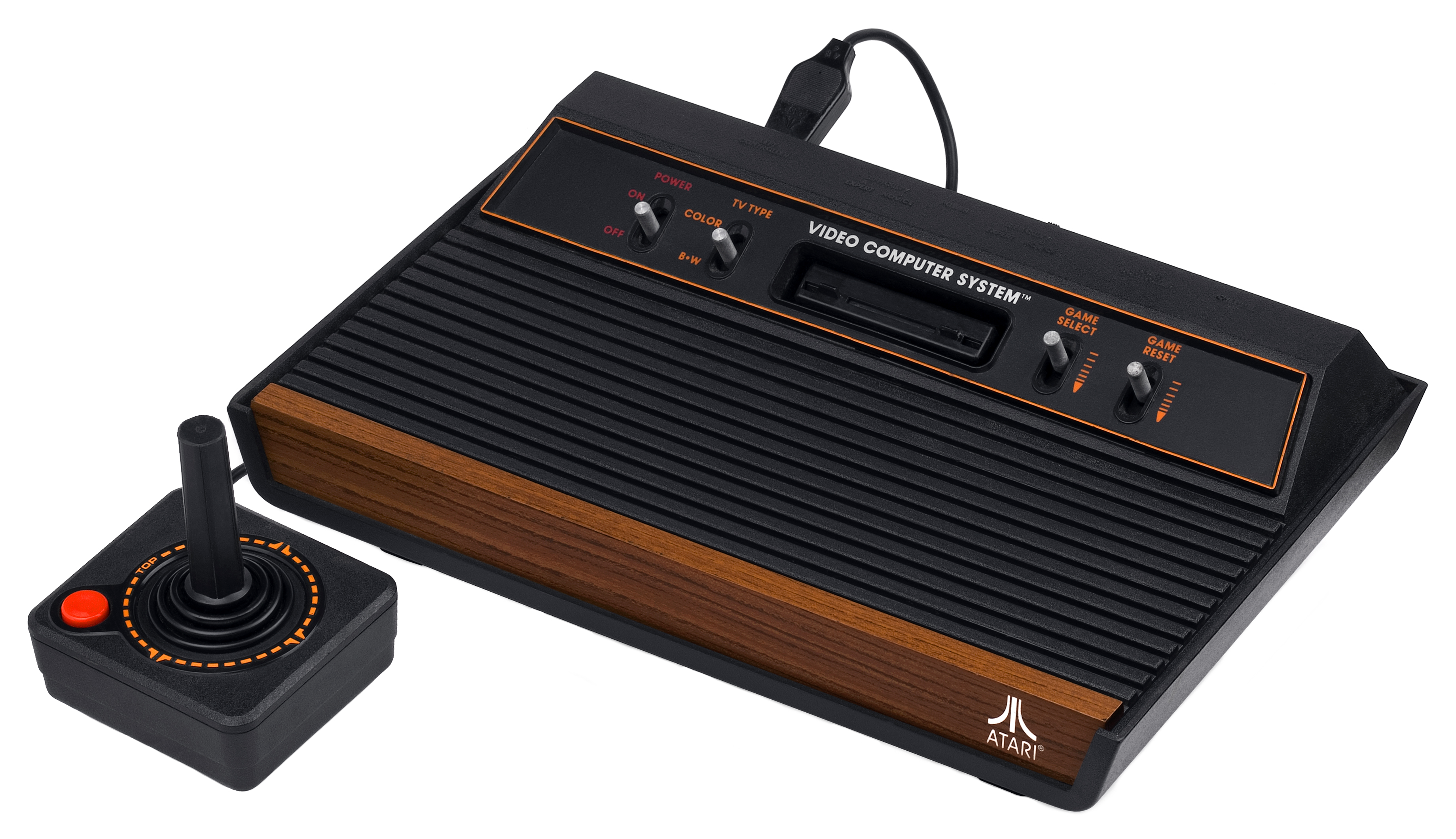
Earlier this year, the Internet Archive set aflame the hearts of nostalgic gamers everywhere by opening the Historical Software Collection, making classics such as Karateka (1984) and Akalabeth (1980) freely available and removing the need to download any additional software components. On Boxing Day, the generous souls at the Internet Archive announced a follow-up: the Console Living Room. For those wishing to relive the joys of early consoles, sourcing classic titles and downloading emulation programs to turn your computer into a virtual console is no longer necessary. Using nothing more than their browser (Firefox is recommended), users can enjoy the full (albeit temporarily soundless) experience of ‘70s and ‘80s classics and rarities on the Atari 2600, Atari 7800 ProSystem, ColecoVision, Magnavox Odyssey², and Astrocade consoles. Quick sessions of Donkey Kong (1981), Asteroids (1987), and Mario Bros. (1988) have never been easier.
For a full list of games, including Dig Dug (1984), Frogger (1982), and Pac Man (1983), head over to the Internet Archive’s Console Living Room. For further information, check out their initial announcement.
Ilia Blinderman is a Montreal-based culture and science writer. Follow him at @iliablinderman.
Related Content:
Long Live Glitch! The Art & Code from the Game Now Released into the Public Domain
Read More...Norman Rockwell’s Typewritten Recipe for His Favorite Oatmeal Cookies
Norman Rockwell, prolific painter and illustrator of 20th century Americana, often worked so single-mindedly that he missed his meals. In 1943, Rockwell exhausted himself to such a degree that, while completing the Franklin Delano Roosevelt-inspired series of paintings entitled Four Freedoms, he lost 15 pounds over the course of seven months. This drop in weight is, perhaps, all the more shocking when given some context: Rockwell was far from being a corpulent man. In fact, when the then 23-year-old artist attempted to enlist as a serviceman in the U. S. Navy during World War I, he was judged to be eight pounds underweight, standing at six feet and tipping the scales at 140 pounds. Rockwell, however, was not to be deterred by something so trivial as his bodily composition. He gorged himself on bananas and doughnuts when he came home that evening. The next day, Navy recruiters dully welcomed the sufficiently bloated Rockwell to the fold.
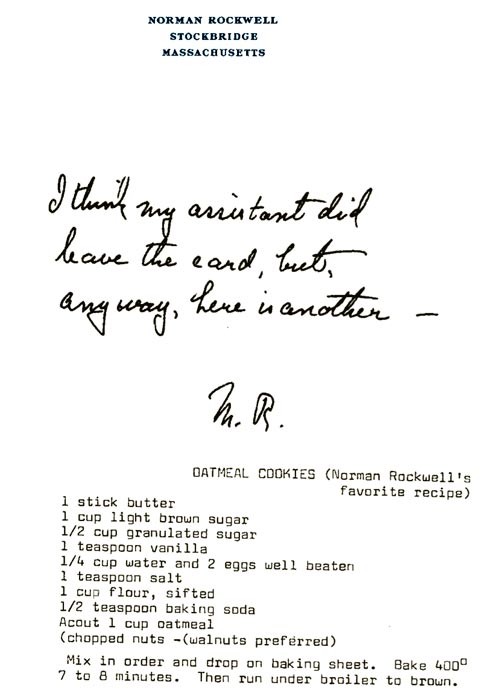
When Rockwell did eat, we know that he had a penchant for oatmeal cookies. At least two of the artist’s letters detailing instructions for making this choice snack are posted online. Although there is a 1966 iteration of the oatmeal cookie recipe available on Biblioklept.org, we’ve provided a later version, from the 1970s, found on The Saturday Evening Post website:
Ingredients
- 1 stick butter
- 1 cup light brown sugar
- 1/2 cup granulated sugar
- 1 teaspoon vanilla
- 1/4 cup water and 2 eggs well beaten
- 1 teaspoon salt
- 1 cup flour, sifted
- 1/2 teaspoon baking soda
- About 1 cup oatmeal
- Chopped nuts (walnuts preferred)
Directions
Mix in order and drop on baking sheet. Bake 400° 7 to 8 minutes. Then run under broiler to brown.
Related Content:
Ernest Hemingway’s Favorite Hamburger Recipe
David Lynch Teaches You to Cook His Quinoa Recipe in a Weird, Surrealist Video
Prepare Marilyn Monroe’s Personal, Handwritten Turkey-and-Stuffing Recipe on Thanksgiving
Read More...Every Appearance James Brown Ever Made On Soul Train. So Nice, So Nice!
Are you ready for some Super Brother Music for the Soul?
Yes? How fortuitous! We just happen to have 45 minutes worth of James Brown Soul Train appearances from the early-to-mid-’70s to share. Get down!
It’s worth noting that Brown’s band, the JBs, were the only ones in the history of the show who host Don Cornelius trusted to play live. The Godfather of Soul ran a tight ship, fining band members for sour notes and untidy costumes, and it shows. The dance show’s stage was tight, but the performances here are even tighter, as lean and mean as those funkadelic Curtis Gibson ensembles!
If your New Year’s Eve plans pale in comparison with the playlist below, cancel them and stay in. Feel good. So good. We got you.
Hot Pants
Get Up (I Feel Like A) Sex Machine 2:36
Get On The Good Foot 4:06
Soul Power 6:51
Make It Funky 9:53
Cold Sweat 11:07
Try Me 14:22
Please Please, Please 17:21
Say It Loud I’m Black and I’m Proud 17:57
Super Bad 23:53 (featuring Soul Train Gang dancer Damita Jo Freeman’s insane Robot)
Papa Don’t Take No Mess 26:18
My Thang 29:57
Hell 33:33 (the little girl sharing the stage is Brown’s daughter, Deanna)
The Payback 35:57
Damn Right, I Am Somebody 40:25 (with Fred Wesley & the JB’s)
via That Eric Alper
Related Content:
James Brown Gives You Dancing Lessons: From The Funky Chicken to The Boogaloo
James Brown Saves Boston After MLK’s Assassination, Calls for Peace Across America (1968)
James Brown Brings Down the House at the Paris Olympia, 1971
Ayun Halliday is the author of seven books, including No Touch Monkey! And Other Travel Lessons Learned Too Late and the Zinester’s Guide to NYC. Follow her @AyunHalliday
Read More...Read 9 Free Articles by Hunter S. Thompson That Span His Gonzo Journalist Career (1965–2005)
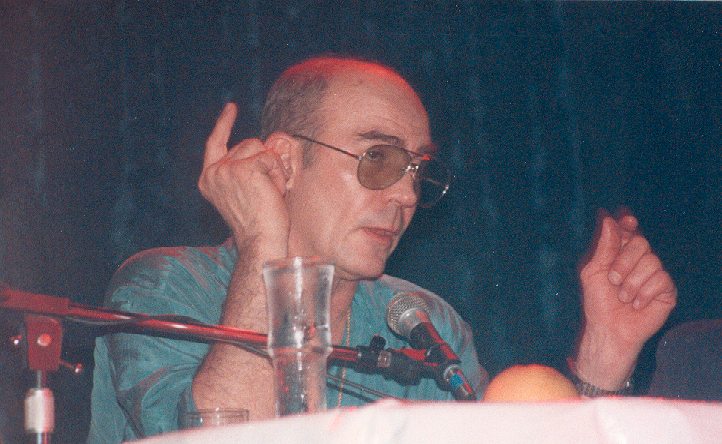
Image via Wikimedia Commons
Most readers know Hunter S. Thompson for his 1971 book Fear and Loathing in Las Vegas: A Savage Journey to the Heart of the American Dream. But in over 45 years of writing, this prolific observer of the American scene wrote voluminously, often hilariously, and usually with deceptively clear-eyed vitriol on sports, politics, media, and other viciously addictive pursuits. (“I hate to advocate drugs, alcohol, violence, or insanity to anyone,” he famously said, “but they’ve always worked for me.”) His distinctive style, often imitated but never replicated, all but forced the coining of the term “gonzo” journalism. But what could define it? One clue comes in Fear and Loathing in Las Vegas itself, when Thompson reflects on his experience in the city, ostensibly as a reporter: “What was the story? Nobody had bothered to say. So we would have to drum it up on our own. Free Enterprise. The American Dream. Horatio Alger gone mad on drugs in Las Vegas. Do it now: pure Gonzo journalism.”
You’ll find out more in the Paris Review’s interview with Thompson, in which he recounts once feeling that “journalism was just a ticket to ride out, that I was basically meant for higher things. Novels.” Sitting down to begin his proper literary career, Thompson took a quick job writing up the Hell’s Angels, which let him get over “the idea that journalism was a lower calling. Journalism is fun because it offers immediate work. You get hired and at least you can cover the f&cking City Hall. It’s exciting.” And then came the real epiphany, after he went to cover the Kentucky Derby for Scanlan’s: “Most depressing days of my life. I’d lie in my tub at the Royalton. I thought I had failed completely as a journalist. Finally, in desperation and embarrassment, I began to rip the pages out of my notebook and give them to a copyboy to take to a fax machine down the street. When I left I was a broken man, failed totally, and convinced I’d be exposed when the stuff came out.”
Indeed, the exposure came, but not in the way he expected. Below, we’ve collected ten of Thompson’s articles freely available online, from those early pieces on the Hell’s Angels and the Kentucky Derby to others on the 1972 Presidential race, the Honolulu Marathon, Richard Nixon, and wee-hour conversations with Bill Murray. But don’t take these subjects too literally; Thompson always had a way of finding something even more interesting in exactly the opposite direction from whatever he’d initially meant to write about. And that, perhaps, reveals more about the gonzo method than anything else.
“The Motorcycle Gangs: Losers and Outsiders” (The Nation, 1965) The article that would become the basis for Thompson’s first book, Hell’s Angels: The Strange and Terrible Saga of the Outlaw Motorcycle Gangs. “When you get in an argument with a group of outlaw motorcyclists, you can generally count your chances of emerging unmaimed by the number of heavy-handed allies you can muster in the time it takes to smash a beer bottle. In this league, sportsmanship is for old liberals and young fools.”
Fear and Loathing in Las Vegas (Rolling Stone, 1971) The Gonzo journalism classic first appeared as a two-part series in Rolling Stone magazine in November 1971, complete with illustrations from Ralph Steadman, before being published as a book in 1972. Rolling Stone has posted the original version on its web site.
“Fear and Loathing on the Campaign Trail in ’72″ (Rolling Stone, 1973) Excerpts from Thompson’s book of nearly the same name, an examination of Democratic Party candidate George McGovern’s unsuccessful bid for the Presidency that McGovern’s campaign manager Frank Mankiewicz called “the least factual, most accurate account” in print. “My own theory, which sounds like madness, is that McGovern would have been better off running against Nixon with the same kind of neo-‘radical’ campaign he ran in the primaries. Not radical in the left/right sense, but radical in a sense that he was coming on with a new… a different type of politician… a person who actually would grab the system by the ears and shake it.”
“The Curse of Lono” (Playboy, 1983) Thompson and Steadman’s assignment from Running magazine to cover the Honololu marathon turns into a characteristically “terrible misadventure,” this one even involving the old Hawaiian gods. “It was not easy for me, either, to accept the fact that I was born 1700 years ago in an ocean-going canoe somewhere off the Kona Coast of Hawaii, a prince of royal Polynesian blood, and lived my first life as King Lono, ruler of all the islands, god of excess, undefeated boxer. How’s that for roots?”
“He Was a Crook” (Rolling Stone, 1994) Thompson’s obituary of, and personal history of his hatred for, President Richard M. Nixon. “Some people will say that words like scum and rotten are wrong for Objective Journalism — which is true, but they miss the point. It was the built-in blind spots of the Objective rules and dogma that allowed Nixon to slither into the White House in the first place.
“Doomed Love at the Taco Stand” (Time, 2001) Thompson’s adventures in California, to which he has returned for the production of Terry Gilliam’s film adaptation of Fear and Loathing in Las Vegas starring Johnny Depp. “I had to settle for half of Depp’s trailer, along with his C4 Porsche and his wig, so I could look more like myself when I drove around Beverly Hills and stared at people when we rolled to a halt at stoplights on Rodeo Drive.”
“Fear & Loathing in America” (ESPN.com, 2001) In the immediate aftermath of 9/11, Thompson looks out onto the grim and paranoid future he sees ahead. “This is going to be a very expensive war, and Victory is not guaranteed — for anyone, and certainly not for anyone as baffled as George W. Bush.”
“Prisoner of Denver” (Vanity Fair, 2004) A chronicle of Thompson’s (posthumously successful) involvement in the case of Lisl Auman, a young woman he believed wrongfully imprisoned for the murder of a police officer. “ ‘We’ is the most powerful word in politics. Today it’s Lisl Auman, but tomorrow it could be you, me, us.”
“Shotgun Golf with Bill Murray” (ESPN.com, 2005) Thompson’s final piece of writing, in which he runs an idea for a new sport —combining golf, Japanese multistory driving ranges, and the discharging of shotguns — by the comedy legend at 3:30 in the morning. “It was Bill Murray who taught me how to mortify your opponents in any sporting contest, honest or otherwise. He taught me my humiliating PGA fadeaway shot, which has earned me a lot of money… after that, I taught him how to swim, and then I introduced him to the shooting arts, and now he wins everything he touches.”
Related Content:
Hunter S. Thompson’s Harrowing, Chemical-Filled Daily Routine
Hunter S. Thompson Calls Tech Support, Unleashes a Tirade Full of Fear and Loathing (NSFW)
Johnny Depp Reads Letters from Hunter S. Thompson (NSFW)
Hunter S. Thompson Remembers Jimmy Carter’s Captivating Bob Dylan Speech (1974)
Colin Marshall hosts and produces Notebook on Cities and Culture and writes essays on cities, Asia, film, literature, and aesthetics. He’s at work on a book about Los Angeles, A Los Angeles Primer. Follow him on Twitter at @colinmarshall or on his brand new Facebook page.
Read More...William Blake’s Hallucinatory Illustrations of John Milton’s Paradise Lost
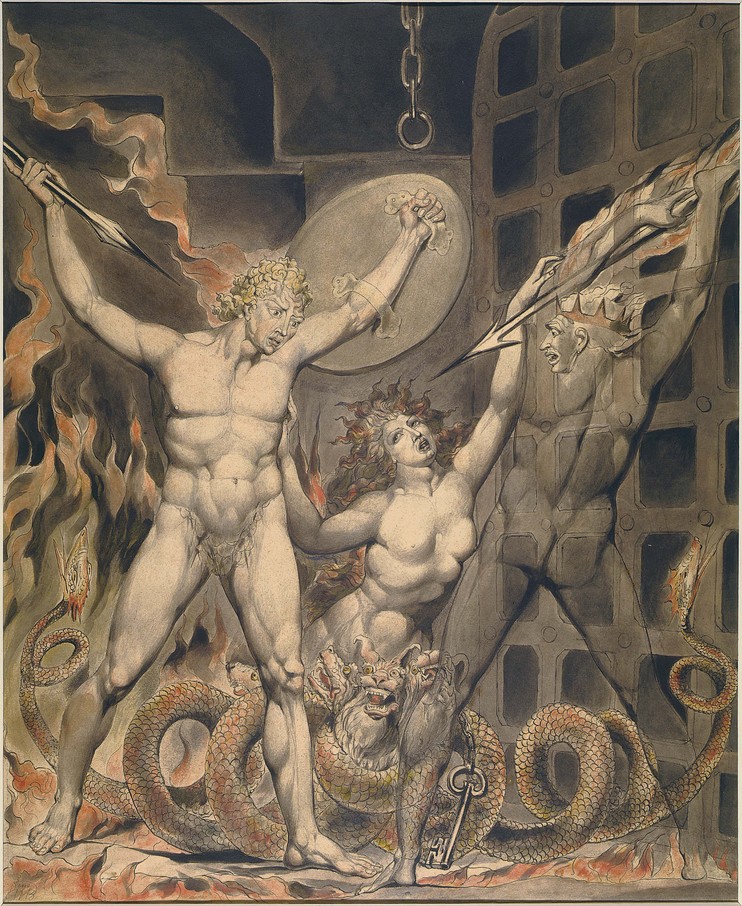
When I saw William Blake’s illustrations for the book of Job and for John Milton’s L’Allegro and Il Penseroso at the Morgan Library a few years ago, I was first struck by how small the intricate watercolors are. This should not have been surprising—these are book illustrations, after all. But William Blake (1757–1827) is such a tremendous force, his work so monumentally strange and beautiful, that one expects to be overpowered by it. In person, his drawings are indeed impressive, but they are equally so for their careful attention to design and composition as for their heavy, often quite terrifying subjects.
Look, for example, at the play of patterns behind the figures in the illustration above, from an edition of Milton’s Paradise Lost. The figure in the center depicts Milton’s grotesquely graphic allegorical construction of Sin. In Milton, this character “seemed woman to the waist, and fair,”
But ended foul in many a scaly fold
Voluminous and vast, a serpent armed
With mortal sting: about her middle round
A cry of hell hounds never ceasing barked
With wide Cerberian mouths full loud, and rung
A hideous peal: yet, when they list, would creep,
If ought disturbed their noise, into her womb,
And kennel there, yet there still barked and howled,
Within unseen.
Blake spares us the horror of the latter image—in fact he gets a little vague on the details of the creature’s netherparts, which were always difficult to imagine, and emphasizes the “fair” parts above (in the version below, the serpent/dog thing looks like a costume prop). Milton’s description always seemed to me one of the cruelest, most misogynistic renderings of the female body in literature. Blake’s portrait relieves Milton’s nastiness, making Sin sympathetic and, well, kinda hot, a Blakean feat for sure. The characters to her left and right are Satan and Death, respectively.
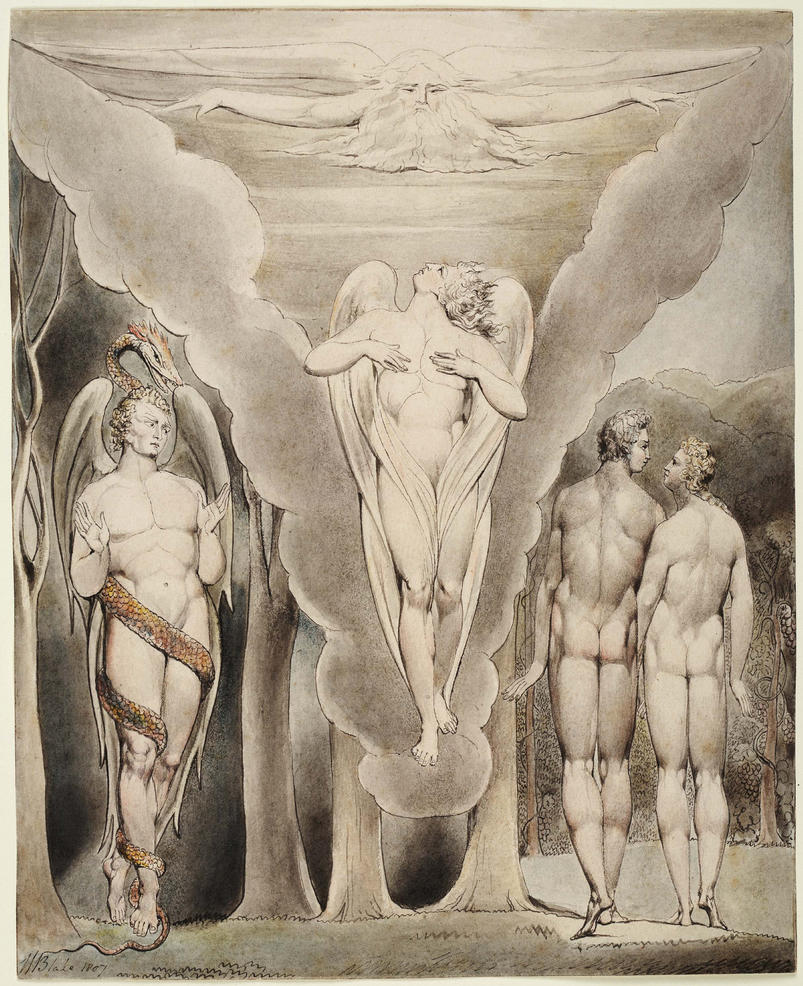
Blake loved Milton, and illustrated his work more than any other author. And he illustrated Paradise Lost more than any other Milton, in three separate commissions (peruse them all here). The first set dates from 1807, commissioned by Joseph Thomas. (The Satan, Sin, and Death scene above comes from the Thomas set.) The second set, from which the image at the top comes, was commissioned in 1808 by Thomas Butts. Blake patron John Linnell commissioned the third set of illustrations in 1822. Only three of the Linnell paintings survive—none of the scene above. In one of the 1822 illustrations (below), Satan spies on Adam and Eve as they canoodle in the garden.
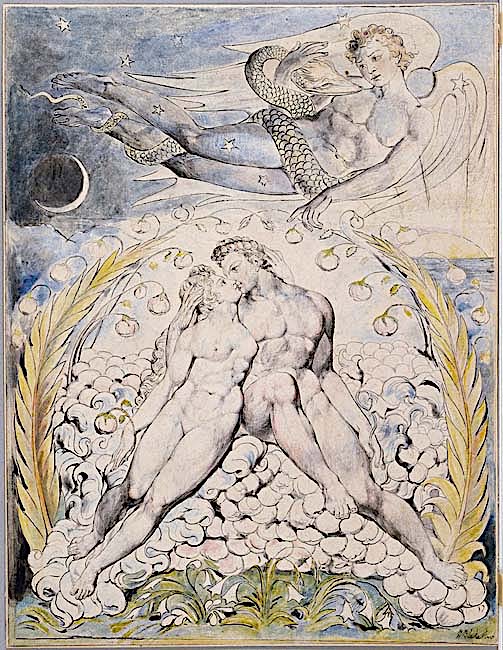
Blake’s obsession with Paradise Lost inspired his own cracked theological fable, Milton: a Poem in Two Books, with its bizarre preamble in which Blake promises to “buil[d] Jerusalem / In England’s green and pleasant land.” One writer calls Blake’s Milton “a lengthy and difficult apocalyptic poem with a fascinating hallucinatory quality.” The poem caused many of Blake’s contemporaries to conclude that “he was quite mad.” But I think his work shows us a man with all of his faculties, and maybe a few extra besides, although his paintings, like his weirder poetry, can also seem like crazed hallucinations. He meant his various Paradise Lost illustrations to correct earlier renderings by other artists, including a political satire by cartoonist James Gillray in 1792 and a 1740 painting by William Hogarth that today resembles the cover of a bad fantasy novel. See both of those earlier versions here.
via Bibliokept
Related Content:
Gustave Doré’s Dramatic Illustrations of Dante’s Divine Comedy
Alberto Martini’s Haunting Illustrations of Dante’s Divine Comedy (1901–1944)
Spenser and Milton (Free Course)
Find Works by Milton in our Free Audio Books and Free eBooks Collections
Josh Jones is a writer and musician based in Durham, NC. Follow him at @jdmagness
Read More...On the Air: Watch the 1950s Sitcom by David Lynch and His Twin Peaks Co-Creator Mark Frost
In “David Lynch Keeps His Head” (uncut version here), David Foster Wallace’s Premiere magazine report from the set of Lost Highway, Wallace rattles off the “entertainments David Lynch has created and/or directed” including “Eraserhead (1978), The Elephant Man (1980), Dune (1984), Blue Velvet (1986), Wild at Heart (1990), two televised seasons of Twin Peaks (1990–92), Twin Peaks: Fire Walk With Me (1992), and the mercifully ablated TV show On the Air (1992).” (To ablate, a verb Wallace uses again in the article in reference to a severed head, means “to remove or dissipate by melting, vaporization, erosion, etc.”) Even Lynch die-hards may never have caught a glimpse of On the Air, which Wallace later describes as “bottomlessly horrid” and “euthanatized by ABC after six very long-seeming weeks.” Clearly the author of Infinite Jest, despite greatly respecting Lynch’s unprecedentedly surreal primetime drama Twin Peaks (its first season, at least) and crediting Blue Velvet with revealing to him the very possibilities of art, couldn’t stomach this show. Now you can watch all seven episodes of On the Air on Youtube, three of which aired in the United States, and judge for yourself.
The series, which debuted and ended in the summer of 1992, takes place in 1957, peering behind the scenes at the fictional Zoblotnick Broadcasting Company, producers of the hapless variety program The Lester Guy Show. Lester Guy himself, an alcoholic silver-screen leading man who rose to fame by staying out of the Second World War, spends most episodes vying for popular supremacy against his cast’s blonde ingenue Betty Hudson, who may remind you of an even simpler version of Sandy Williams, the Laura Dern character in Blue Velvet. The series appeared as the second collaboration between Lynch and Mark Frost, co-creator of Twin Peaks, which brought their signature sensibility of intense vividness and vaguely haunting unreality to the detective genre. On the Air brings it to the classic goofball sitcom. Watch the first episode (ranked as #57 on TV Guide’s “100 Greatest TV Episodes of All Time” list) and, to experience either the utter genius or the utter trainwreck, you’ll want to watch the following six. “There was a lot of laughter on the set,” remembers Ian Buchanan, who played Lester Guy. “Maybe we were too happy. Everybody I knew on successful shows was miserable.”
(日本人 Lynch-heads, take note: each episode includes Japanese subtitles.)
Related Content:
David Lynch’s Surreal Commercials
David Lynch Presents the History of Surrealist Film (1987)
David Lynch Presents the History of Surrealist Film (1987)
4,000+ Free Movies Online: Great Classics, Indies, Noir, Westerns, Documentaries & MoreColin Marshall hosts and produces Notebook on Cities and Culture and writes essays on cities, Asia, film, literature, and aesthetics. He’s at work on a book about Los Angeles, A Los Angeles Primer. Follow him on Twitter at @colinmarshall or on his brand new Facebook page.
Read More...Support Us
We're hoping to rely on loyal readers, rather than erratic ads. Please click the Donate button and support Open Culture. You can use Paypal, Venmo, Patreon, even Crypto! We thank you!

About Us

Open Culture scours the web for the best educational media. We find the free courses and audio books you need, the language lessons & educational videos you want, and plenty of enlightenment in between.
Advertise With Us

FREE UPDATES!
GET OUR DAILY EMAIL
Get the best cultural and educational resources on the web curated for you in a daily email. We never spam. Unsubscribe at any time.
FOLLOW ON SOCIAL MEDIA

Open Culture editor Dan Colman scours the web for the best educational media. He finds the free courses and audio books you need, the language lessons & movies you want, and plenty of enlightenment in between.
Advertise With Us