Free Guided Meditations From UCLA: Boost Your Awareness & Ease Your Stress
Previously, we’ve written about a growing number of cultural figures who practice transcendental meditation, with Paul McCartney, David Lynch, Leonard Cohen, Ellen Degeneres, and Sheryl Crow being ardent supporters. Mindfulness meditation, while less known, has also steadily increased in popularity over the past half-decade. In part, there’s its inherent appeal: mindfulness cultivates an all-accepting awareness of the present moment, thereby dissolving anxieties about the future or preoccupations with thoughts of the past. There’s also the growing momentum of mindfulness research in the scientific community, with studies suggesting that mindfulness-based therapeutic approaches may benefit a host of psychological issues. Its use to alleviate anxiety, depression, and stress is particularly promising.
“Sounds tempting,” you say, “but where does one try this mindfulness meditation business, anyway? Can I try it without going anywhere?” You’re in luck, my friend! UCLA’s Mindful Awareness Research Center (MARC) has uploaded a set of mindfulness meditations to iTunesU, where the series is presently the #1 download. “I’m too busy,” you say, opening a Facebook tab. Not so fast! Most of the meditations are under 10 minutes long, with the complete series clocking in at two hours.
We’ve had trouble listening to the lectures on the UCLA site, so if you’re interested, head over to iTunesU to download Mindful Meditations. Otherwise, if you live within a reasonable distance of UCLA’s Hammer Museum, drop in for free weekly meditation sessions (recordings for most of these are available here).
Ilia Blinderman is a Montreal-based culture and science writer. Follow him at @iliablinderman, or read more of his writing at the Huffington Post.
Related Content:
Alan Watts Introduces America to Meditation & Eastern Philosophy (1960)
David Lynch Talks Meditation with Paul McCartney
David Lynch Explains How Meditation Enhances Our Creativity
Read More...Watch All of The Beatles’ Historic Appearances on The Ed Sullivan Show, 50 Years Ago
As you surely know by now, The Beatles invaded the U.S. by way of the Ed Sullivan Show fifty years ago yesterday. What you may not know is that they appeared for three consecutive Sunday night broadcasts that year, beginning on February 9, 1964. That performance garnered a record 73 million viewers and took place at the now historic Ed Sullivan Theater. The second show on February 16 was broadcast from Miami Beach where the then-Cassius Clay and Sonny Liston were promoting their famous bout on Feb. 25. The third broadcast, February 23, showed a performance taped earlier in the day of the original Feb. 9 appearance. Watch all three of those ’64 broadcasts above. (The band made a final live appearance on the show on August 14, 1965—watch “I Feel Fine” from that broadcast below.)
It seemed like everyone wanted a piece of The Beatles—the American press, the screaming hordes of teenage fans, even certain British politicians—but the first Sullivan appearance was a gamble, arranged by their very savvy manager Brian Epstein to break the band in the States. Sullivan stood behind the band’s initial headlining booking, despite his producer’s objections, later telling the New York Times, “I made up my mind that this was the same sort of mass hit hysteria that had characterized the Elvis Presley days.”
Sullivan, the legend goes, first noticed the crazed response the band inspired (see above) when he witnessed “more than 1,500 youngsters lin[ing] the rooftop gardens of the Queen’s Building and others congregated on the ground” at Heathrow airport after the group returned home from a trip to Stockholm in October, 1963. While the actual story of the first booking is a bit more complicated, writes Beatles’ historian Bruce Spizer, it still speaks to Sullivan’s impeccable instincts.
What was it like to be a viewer of that first broadcast as a young fan? Above, Dennis Mitchell, host of the “Breakfast with the Beatles” radio show, remembers the moment. “Everything changed after that,” he says. Although the Sullivan broadcasts are memorable for all sorts of historical reasons, “in the end, after it all,” says Mitchell, “it was the songs, it was the music.”
Seeing it on Ed Sullivan was overwhelming, and the start of it all, but then we took it into our bedrooms with the record players and got deeper into the music, because we knew that even though they’d done four or five songs on the Ed Sullivan show, there was more.
As the band evolved politically and stylistically, says Mitchell, their fans “were all along for the ride. And they genuinely, it was almost like a magic wand, changed things by changing themselves.” Could such a cultural moment happen again? “No,” says Mitchell, “not at the level that it did and not with the significance that it did.” In the fifty years since The Beatle’s arrival on U.S. shores, the world seems to have become both more fragmented and more closely drawn together, but we live in such a vastly different media landscape than the one that produced the Ed Sullivan Show—and the lasting fame of Elvis, The Supremes, and The Beatles. After fifty years of post-Beatles’ pop music, it’s impossible to imagine a television performance having such a widespread impact that it almost singlehandedly transforms an entire generation.
Related Content:
The Beatles’ Rooftop Concert: The Last Gig Filmed in January 1969
The Kinks’ Ray Davies Reviews the Beatles’ 1966 Album Revolver; Calls It “A Load of Rubbish”
A Short Film on the Famous Crosswalk From the Beatles’ Abbey Road Album Cover
Josh Jones is a writer and musician based in Durham, NC. Follow him at @jdmagness
Read More...Teddy Roosevelt’s 10 Rules For Reading: Seek Enjoyment, Spurn Fads, Read What You Like
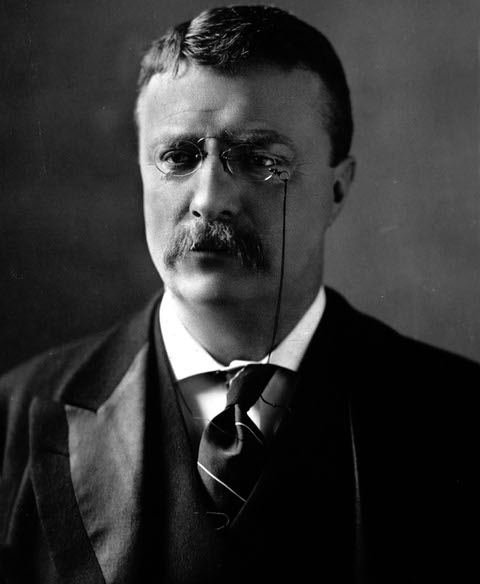
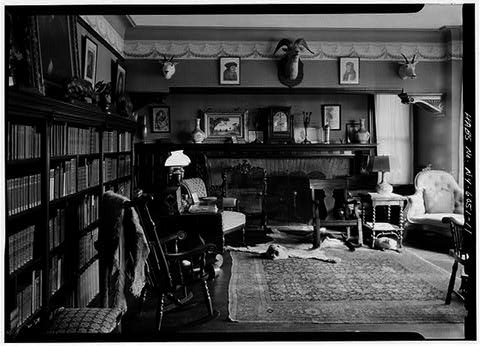
Teddy Roosevelt seems to us a paradox today, and did in his time as well: A man’s man hunter, cowboy, and war hero, who supposedly saved the game of football from extinction (Roosevelt worried that banning the game would produce “mollycoddles instead of vigorous men”); also, a Harvard-educated New York progressive and treehugging conservationist hero, who re-defined presidential style with Brooks Brothers three-piece suits and uniforms. And for all of his public heroics, Roosevelt was also a doting father who gave his nickname to the most universally cuddly species of bear. Perhaps some of the best representations of Roosevelt’s personal ethos are photographs of his combination library and gun room, hung with hunting trophies and skins in the home he built for his family in Oyster Bay, New York (below—see more at the appropriately named “Art of Manliness”).
One significant reason Roosevelt could embody seemingly widely divergent traits was that he was a devourer of books, reading tens of thousands in his lifetime, absorbing thousands of points of view from every possible source. But Roosevelt did not read the way we do today—rapidly taking in information for its own sake, with automated services compiling recommendations from the metadata (a phenomenon Susan Jacoby has indicted as part of our hyper-partisan, groupthink culture). He read according to his whim, putting pleasure ahead of profit and disdaining fads and rigid cultural norms. He was, literary site Book Riot supposes, “probably the most well-read president, and perhaps one of the most well-read men in all of history.”
Book Riot points us toward a few pages of Roosevelt’s autobiography, in which—amidst picaresque chapters like “In Cowboy Land” and heavy ones like “The Presidency; Making an Old Party Progressive”—Roosevelt pauses to detail his thoughts on reading in a particularly pragmatic chapter titled “Outdoors and Indoors.” Although Roosevelt does not present his contemplation as an easily digestible list of rules, as is the fashion now, Book Riot has seen fit to condense his thought. Below see the first five of their list, “Teddy Roosevelt’s 10 Rules for Reading.” I’d be willing to bet that if everyone followed Teddy’s advice, we could up the woeful national literacy quotient within a few short years.
1. “The room for choice is so limitless that to my mind it seems absurd to try to make catalogues which shall be supposed to appeal to all the best thinkers. This is why I have no sympathy whatever with writing lists of the One Hundred Best Books, or the Five-Foot Library [a reference to the Harvard Classics]. It is all right for a man to amuse himself by composing a list of a hundred very good books… But there is no such thing as a hundred books that are best for all men, or for the majority of men, or for one man at all times.”
2. “A book must be interesting to the particular reader at that particular time.”
3. “Personally, the books by which I have profited infinitely more than by any others have been those in which profit was a by-product of the pleasure; that is, I read them because I enjoyed them, because I liked reading them, and the profit came in as part of the enjoyment.”
4. “The reader, the booklover, must meet his own needs without paying too much attention to what his neighbors say those needs should be.”
5. “He must not hypocritically pretend to like what he does not like.”
Head over to Book Riot for the remaining five of Roosevelt’s “rules,” along with some witty commentary.
Related Content:
‘The Right of the People to Rule’: Listen to Theodore Roosevelt Speaking 100 Years Ago Today
Ernest Hemingway Creates a Reading List for a Young Writer, 1934
Josh Jones is a writer and musician based in Durham, NC. Follow him at @jdmagness
Read More...Learn Latin, Old English, Sanskrit, Classical Greek & Other Ancient Languages in 10 Lessons

I receive weekly reminders of my linguistic ignorance whenever I read anything by authors fluent in Latin. How could I not, whenever Clive James starts to pontificate on the greatness of, say, Tacitus?
“For students acquiring Latin in adult life, the language is most easily approached through those historians who really wrote chronicles — Cornelius Nepos, Sallust, Suetonius and Livy — but with the Histories of Tacitus you get the best reason for approaching it at all… What Sainte-Beuve said of Montaigne — that his prose is like one continuous epigram — is even more true of Tacitus.”
Fantastic! So, which translation should I read?
“There are innumerable translations but the original gives you [Tacitus]’ unrivalled powers of compression.”
As with Latin classics, so with other Indo-European language texts, including Beowulf, originally in Old English, Homer’s Iliad and Odyssey, in Classical Greek, and the ancient Vedic hymns of the Rigveda, in Sanskrit.
For those willing to take up the challenge of reading these canonic texts in their original form, the University of Texas’ Linguistics Research Center provides an excellent resource. In addition to hosting a multitude of Indo-European volumes in their entirety, the LRC has made 10-lesson crash courses, developed by several UT-Austin academics. Lessons include a brief guide to the alphabet, background knowledge on the language’s development, and a grammar guide, all available for the following languages:
- Albanian
- Armenian
- Baltic
- Old English
- Old French
- Gothic
- Greek (Classical)
- Greek (New Testament)
- Hittite
- Old Iranian
- Old Irish
- Latin
- Old Norse
- Old Russian
- Vedic Sanskrit
- Old Slavonic
- Tocharian
Best of all, lessons are based on seminal texts from each language: Latin lessons rely on Tacitus’ Germania, Livy’s History of Rome, and Virgil’s Aeneid, while Homer, Hesiod’s Works and Days, and Plato’s Republic feature prominently in the Classical Greek classes. Students progress through each lesson by reading the original passages, and using the provided guides to translate them to English.
Ilia Blinderman is a Montreal-based culture and science writer. Follow him at @iliablinderman.
Related Content:
What Ancient Greek Music Sounded Like: Hear a Reconstruction That is ‘100% Accurate’
Hear Homer’s Iliad Read in the Original Ancient Greek
Hear The Epic of Gilgamesh Read in the Original Akkadian, the Language of Mesopotamia
Read More...David Lynch’s Perfume Ads Based on the Works of Hemingway, F. Scott Fitzgerald & D.H. Lawrence
As we wrote last week, David Lynch is not only one of the great cinematic spelunkers of the unconscious, creating images and storylines that have disturbed moviegoers for almost four decades, but he’s also had a successful run as a commercial director, making ads for among other companies Alka-Seltzer, Barilla Pasta and Georgia Coffee.
In 1988, fresh off his success with Blue Velvet and just before he started production on his landmark TV series Twin Peaks, he made his first commercials — a quartet of advertisements for Calvin Klein’s perfume Obsession featuring passages from such literary titans as F. Scott Fitzgerald, D.H. Lawrence and Ernest Hemingway. (Lynch’s ad featuring Gustave Flaubert is mysteriously unavailable on Youtube.)
The commercials have all the pretension, the luscious black and white photography and the vacant-eyed beautiful people that you might expect from a Calvin Klein ad. Yet they also show glimmers of Lynch’s aesthetic – a noirish, dream-like tone, an oddly framed close up, a fondness for flashing lights. Lynch dialed down the weird to serve the text. The result is far more romantic and beautiful than you might expect from the director. If you’re hoping to see a David Lynch commercial that will give nightmares, check this one out instead.
The ad for F. Scott Fitzgerald, which you can see above, uses one of the more famous passages from The Great Gatsby.
He knew that when he kissed this girl, and forever wed his unutterable visions to her perishable breath, his mind would never romp again like the mind of God. So he waited, listening for a moment longer to the tuning-fork that had been struck upon a star. Then he kissed her. At his lips’ touch she blossomed for him like a flower and the incarnation was complete.
Sharp-eyed viewers might have caught that the ad stars future Oscar-winning actor Benicio Del Toro and Heather Graham, who would later appear in Twin Peaks. The commercial dissolves back and forth between Del Toro and Graham until the inevitable kiss when the ad cuts, with surprisingly literalness, to a blooming flower.
The D.H. Lawrence ad uses a quotation from Women in Love:
Her fingers went over the mould of his face, over his features. How perfect and foreign he was—ah how dangerous! Her soul thrilled with complete knowledge. This was the glistening, forbidden apple … She kissed him, putting her fingers over his face, his eyes, his nostrils, over his brows and his ears, to his neck, to know him, to gather him in by touch.
Lynch shows a blonde in a brocade dress looming over her improbably beautiful paramour who is lying on a divan. She paws at his chiseled features before leaning in for a kiss.
And finally, the Ernest Hemingway ad – the spookiest and most Lynchian of the bunch — features a passage from The Sun Also Rises:
I lay awake thinking and my mind jumping around. Then I couldn’t keep away from it, and I started to think about Brett. I was thinking about Brett and my mind started to go in sort of smooth waves. Then all of a sudden I started to cry. After a while it was better and I lay in bed and listened to the heavy trams go by.. and then I went to sleep.
This ad opens with a half-naked man lying awake in a darkened room filled with grotesque shadows. He’s haunted by the specter of an androgynous woman in a tank top. There’s a flash of lightening and then the woman kisses his cheek. Lynch closes up on his eye, which is welling up with a single tear.
As a side note: the half-naked guy in the ad is James Marshall who went on to star in Twin Peaks, as did Lara Flynn Boyle who appears in the missing Flaubert commericial. Lynch has a reputation of being very loyal to his actors.
The Obsession ads proved to be such a success that he started getting requests to do commercials for other luxury perfume companies like Giorgio Armani’s Gio and Yves Saint Laurent’s Opium.
As Lynch told Chris Rodley in Lynch on Lynch, he thinks of commercials as “little bitty films, and I always learn something by doing them.”
Jonathan Crow is a Los Angeles-based writer and filmmaker whose work has appeared in Yahoo!, The Hollywood Reporter, and other publications. You can follow him at @jonccrow.
Related Content:
David Lynch’s Unlikely Commercial for a Home Pregnancy Test (1997)
David Lynch Teaches You to Cook His Quinoa Recipe in a Weird, Surrealist Video
What David Lynch Can Do With a 100-Year-Old Camera and 52 Seconds of Film
“Exceptional, Spooky and Beautiful” Moments With Birds: Dennis Hlynsky’s Creepy Nature Videos
If, by some stretch of the imagination, the end timers have it right, I hope artist Dennis Hlynsky will consider setting up his tripod as demons spew forth from the earth’s crust.
His small brains en masse project has me convinced that he is the perfect person to capture such an event. Have a look at how he documents the comings and goings of birds.
I’ve never experienced a starling murmuration myself, outside of the famous, shot-on-the-fly footage (right above) of Sophie Windsor Clive and Liberty Smith, indie filmmakers who chanced to find themselves in the right canoe at the right time, ornithologically speaking. I admire these young women’s sang-froid. I would’ve been cowering and slashing at the air with my paddles. That funnel cloud of black wings is unnerving even from the safe remove of my living room, but a groovy soundtrack by Nomad Soul Collective encourages even the most bird-phobic amongst us (me) to see it as something gorgeous and awe-inspiring, too.
Hlynsky doesn’t attempt to lead the witness with reassuring sound cues. Instead, he amps up the creepy via “extruded time,” layering sequences of frames atop one another until the darkest pixels become tracers emphasizing flight paths. The combination of everyday sound and visual portent makes it dreadfully easy to imagine one’s truck breaking down at an intersection right around the 7 minute mark.
Perhaps I’ve seen too many zombie movies.
Or have I?
Hlynsky is obviously fascinated by nature, but he also states that “to some degree these videos are studies of mob behavior. Are these decisions instinctual or small thoughtful considerations? Does one leader guide the group or is there a common brain? Is a virus a single creature or a diffused body that we inhabit?”
Put another way, perhaps there’s a reason it’s called a murder of crows, as opposed to a brunch, hug or sweatshirt of crows. Hlynsky, who’s the type of guy to seek their company out, describes his time spent filming them to be among the most “exceptional, spooky and beautiful” moments of his life.
As for these New Jersey seagulls, “throw a french fry in the air and within 30 seconds the entire screech of birds will come.” Yikes. Here, extruded time conspires with the ambient sounds of a boardwalk amusement park, in a tour-de-force of avian-inspired psychic unrest.
Paging Tippi Hedren… I’m out of here!
Related Content:
The Falcon and the Murmuration: Nature’s Aerial Battle Above Rome
ParaHawking in Nepal: What It’s Really Like to Fly with Birds
Ayun Halliday wishes she had a cat instead of a mean, orange-striped owl. Follow her @AyunHalliday
Read More...Nietzsche Dispenses Dating Advice in a Short Screwball Film, My Friend Friedrich
My Friend Friedrich opens on awkward, bespectacled Columbia student Nate having a heart to heart on the phone with his mother. Then, in a philosophy class, he almost succeeds in landing a date by lobbing an illustrated invitation at his love interest, Emma. All goes awry when a taller, more confident, bespectacled Columbia student cuts him off at the knees. So far, so very New York student film, but a conceit arrives to distinguish this story of Ivy League dating woes: the ghost of Friedrich Nietzsche appears before Nate to guide him towards self-actualization.
In what “seems to have been a senior project at NYU’s Tisch School of the Arts,” according to Critical Theory (a Vimeo upload dates the film as “circa 2003), My Friend Friedrich gives us the typical undergraduate experience of the philosopher’s voice. Nietzsche instructs our young friend to regard the flashing lights, tall buildings, and “horseless carriages” of Times Square as meaningless. “Nihilism cares about nothing” he says and urges his pupil to will himself to power. It’s not too profound a portrayal of Nietzsche—though of course it’s only played for laughs—and seems to come mainly from a surface reading of his Will to Power, an unfinished manuscript published after the philosopher’s death. (His sister fraudulently pitched a mangled edition to the Nazis as Nietzsche’s underwriting of their ideology, cutting out all of her brother’s strong remarks against anti-Semitism.)
One could argue, if it’s worth explaining the humor, that this superficial take on Nietzsche is precisely the point, since it’s the diffident Nate’s slight reading of Will to Power at the outset that produces his hallucination-slash-visitation. Nietzsche helps Nate win an intellectual pissing contest by quoting Beyond Good and Evil chapter and verse, then goads him into some awkward outbursts and eventually overstays his welcome. The screwball conclusion is ripped right out of Wes Anderson.
It’s all in good fun, but if you find yourself eager for some more substantial Nietzsche resources, we’ve got them aplenty. You might begin with eminent Nietzsche scholar and Will to Power translator Walter Kaufmann’s lectures on Nietzsche, Kierkegaard and Sartre. In our list of free philosophy courses you’ll find Nietzsche courses by Leo Strauss, Rick Roderick, and others. Alain de Botton offers an introduction on Nietzsche as part of his Guide to Happiness, and BBC program Human, All Too Human presents Nietzsche’s life in a documentary series that also includes Sartre and Heidegger. Many works by Nietzsche can also be found in our Free eBooks and Free Audio Books collection.
And if it’s more Nietzsche humor you’re after, see this failed attempt to explain the philosopher to a group of 5‑year-olds.
via Critical Theory
Related Content:
The Daily Habits of Highly Productive Philosophers: Nietzsche, Marx & Immanuel Kant
Sartre, Heidegger, Nietzsche: Three Philosophers in Three Hours
Discover Friedrich Nietzsche’s Curious Typewriter, the “Malling-Hansen Writing Ball”
Walter Kaufmann’s Classic Lectures on Nietzsche, Kierkegaard and Sartre (1960)
Josh Jones is a writer and musician based in Durham, NC. Follow him at @jdmagness
Read More...An Undertaking: Woodworker Honors His Grandma with a Custom-Made Coffin
Good thing Austin-based designer Michael Yates studied abroad. Three months spent in the vicinity of Kyoto as a Texas A&M electrical engineering student ultimately inspired him to abandon the profession for which he had trained, in order to pursue woodworking. “…the sacredness of the process and attention to detail resonated with me in a way that nothing had before,” he recalls in an Apartment Therapy profile. “I’ve since learned in practice what I saw evidence of in the temples—that completely focusing on where you are will get you the best product at the end. Every step of the process is precious.”
Had he not changed horses in midstream, his grandmother would have likely stuck to the plan too, departing for the afterlife in a standard-issue coffin or urn, rather than asking Yates to build her something special. In his mind, it was a collaboration, a process documented above, at the behest of Whole Foods’ online magazine, Dark Rye. (Indicating, perhaps, that artisanal, upcycled coffins will soon be available for purchase beside bamboo cutting boards and locally sourced, grass-fed, beef jerky?)
Yate’s grandma placed her request pre-need, in the industry lingo, a move that afforded him plenty of time to study—and reject—the overly ornate vessels that have become a cultural norm. Luxurious details have no place, he feels, when the user can derive no enjoyment from them. (Guess he and Grandma weren’t considering going with the off-the-wall Ghana approach.)
The coffin is the most meaningful piece he’s ever created, even before it could be beta tested. It caused him to think deeply about our relationship with death and each other. The soundtrack hints that something very sad is about to happen, as do the photos of his grandmother as a vibrant, younger woman. (Such shots have become de rigeur for anyone mourning an older relative on Facebook.) Yates mentions that his grandmother, healthy when she hatched this scheme, has been diagnosed with cancer. I think we can assume where this is going, right?
At the risk of a spoiler, I’d like to commend the filmmakers for allowing some key scenes to occur off-camera. Yates remarks that after all that went into making the coffin, it would be “a terrible miss” if his grandmother did not get a chance to see it. He’s filmed loading it into his truck, but viewers are not privy to its delivery. Some things, it would seem, are still personal.

Related Content:
Carl Gustav Jung Ponders Death
Find Yale’s Course Death in our collection of 825 Free Online Courses
Leonard Cohen Narrates Film on The Tibetan Book of the Dead, Featuring the Dalai Lama (1994)
Ayun Halliday operates in the shadow of the South Brooklyn Casket Company. @AyunHalliday
Read More...Does God Exist?: William Lane Craig Debates Christopher Hitchens, Sam Harris & Richard Dawkins
Debates are modern gladiator contests—predicated on the blunt force of the opponents’ forensic stamina, charisma, and personal conviction. Speakers lacking in personality make for tedious debaters, and substance seems to matter little when partisans gather to cheer on their champion. Rarely do rhetorical spectacles sway the faithful. At least in our time, they tend to seem more like competing pep rallies. We’ve learned, for example, that such high profile events as U.S. presidential debates have little effect on the outcome of elections. But verbal contests over who will make the best Leader of the Free World can seem modest next to debates between theologians and philosophers over the existence of God. After all, we’ve heard more or less the same arguments for centuries now, and no one’s any closer to a “proof.” And though I’m not aware of anyone who argues thus, there is no way to disprove God’s existence either.
Nonetheless, with the rise of religious fervor worldwide, and rejection of the same by vociferous seculars, we’ve seen so-called “New Atheists” mount challenge after challenge to the authority and validity of religious institutions—primarily those representing the big three monotheisms. The philosophically inclined religious have their heavyweights as well. Biola University professor of philosophy and evangelical Christian William Lane Craig has taken on the mantle of defender not only of his particular brand of faith but of the existence of God generally. Craig is a skilled orator—his fans like to point out that he “wins” all of his debates, though what exactly that means is unclear. His critics call him everything from “dishonest” and “sleazy” to an apologist for genocide and religiously motivated pseudoscience. Whatever you think of Craig, he certainly does draw a crowd. But so do his most famous antagonists. Today, we bring you two such existence of God debates: at the top, see Craig debate the unflappable Christopher Hitchens on his home turf of Biola. And directly above, he takes on Sam Harris at Notre Dame.
You may be wondering, if you’ve followed these squabbles at all, whether the infamous evolutionary biologist Richard Dawkins has stepped into the ring with Craig. He has. Dawkins appeared with skeptical authors Michael Shermer and Matt Ridley in an intellectual wrestlemania of sorts at a Mexican conference called “Ciudad de las Ideas” (City of Ideas). On the other side of the stage sat Craig, his colleague Doug Geivett, and rabbi David Wolpe. You can see the event above—each speaker gets up and steps into a literal ring, complete with bright red ropes, and the result is less a debate than bewildering series of metaphysical sales pitches. Dawkins himself did not consider it a debate. Though he’s made plenty of enemies among atheists and believers alike, accused of intolerance, sloppy reasoning, sexism, and worse, Dawkins has won adherents for declaring a principled stand against appearing with Craig in a true debate format, citing Craig’s “dark side” as a “deplorable apologist for genocide.” As with all these attacks and ripostes, not to mention the universe-sized questions, you’ll simply have to make up your own mind.
via Metafilter
Related Content:
Christopher Hitchens: No Deathbed Conversion for Me, Thanks, But it was Good of You to Ask
Religion: Free Courses Online
Josh Jones is a writer and musician based in Durham, NC. Follow him at @jdmagness
Read More...The Curious Story of London’s First Coffeehouses (1650–1675)
 In his 1621 opusThe Anatomy of Melancholy, Robert Burton wrote, “The Turks have a drink called coffa (for they use no wine), so named of a berry as black as soot, and as bitter … which they sip still of, and sup as warm as they can suffer; they spend much time in those coffa-houses, which are somewhat like our alehouses or taverns…”
Several decades later, readers would require no such explanations: England would be awash in coffeehouses, numbering in the thousands. The curious story of how the British swapped much of their daily ale consumption for this “syrop of soot, or essence of old shoes,” is told by Matthew Green in “The Lost World of The London Coffee House,” on the Public Domain Review.
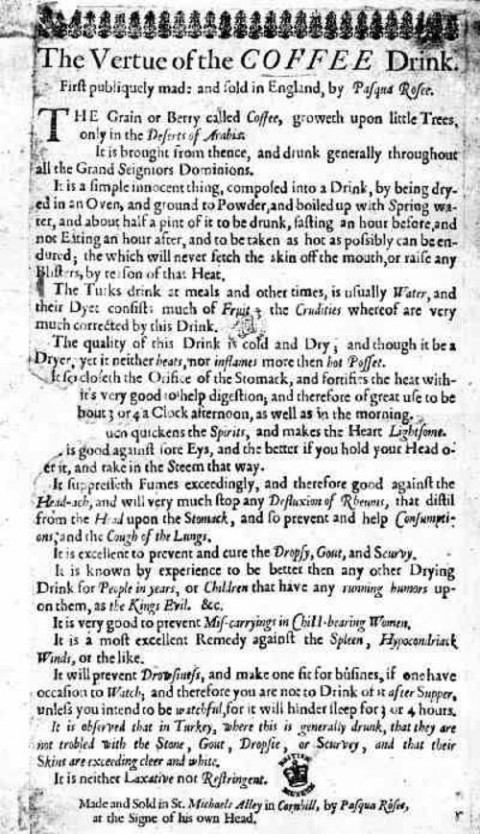
Prior to 1652, when Pasqua Rosée established a small coffeehouse in St. Michael’s Alley in London, coffee was virtually unknown in England. Rosée, a servant of a coffee-loving trader to the Levant, found tremendous success with his venture and, according to Green, was soon selling over 600 servings a day. Above, readers can view Rosée’s original handbill, where the entrepreneur advertised both the therapeutic and prophylactic effects of his wares on digestion, headaches, rheumatism, consumption, cough, dropsy, gout, scurvy, and miscarriages. It’s a wonder anyone ever drinking the stuff got sick.
Coffeehouses quickly became popular places for men to converse and congregate, and Green notes that women soon grew tired of their absence. This exasperation mounted until the 1674 Women’s Petition Against Coffee, which claimed that “Excessive use of that Newfangled, Abominable, Heathenish Liquor called COFFEE” led to England’s falling birthrate, making men “as unfruitful as the sandy deserts, from where that unhappy berry is said to be brought.” Men, as they are wont to do, expressed their disagreement, and stated in Men’s Answer to the Women’s Petition Against Coffee that coffee made “the erection more vigorous, the ejaculation more full, add[ing] a spiritual ascendency to the sperm.”
A year later, coffeehouses found more formidable opposition in the form of King Charles II, who issued the “Proclamation for the suppression of Coffee Houses” in 1675. Charles, however, was more interested in their political effects than the spiritual ascendency of his subjects’ sperm. Coffeehouses provided an opportunity for more mindful and serious conversations than did alehouses, and allowed anyone who paid the single penny entrance charge to participate in discussions — to Charles, these were the ideal circumstances for plotting sedition and treason among the populace. Despite the King’s proclamation, the coffeehouses, buoyed by a supportive public, prevailed.
To read Green’s fascinating essay in full, including a description of the coffeehouse frequented by Alexander Pope, Jonathan Swift, Joseph Addison, and Richard Steele, head over to the Public Domain Review.
Ilia Blinderman is a Montreal-based culture and science writer. Follow him at @iliablinderman.
Related Content:
Men In Commercials Being Jerks About Coffee: A Mashup of 1950s & 1960s TV Ads
The History of Coffee and How It Transformed Our World
Read More...Support Us
We're hoping to rely on loyal readers, rather than erratic ads. Please click the Donate button and support Open Culture. You can use Paypal, Venmo, Patreon, even Crypto! We thank you!

About Us

Open Culture scours the web for the best educational media. We find the free courses and audio books you need, the language lessons & educational videos you want, and plenty of enlightenment in between.
Advertise With Us

FREE UPDATES!
GET OUR DAILY EMAIL
Get the best cultural and educational resources on the web curated for you in a daily email. We never spam. Unsubscribe at any time.
FOLLOW ON SOCIAL MEDIA

Open Culture editor Dan Colman scours the web for the best educational media. He finds the free courses and audio books you need, the language lessons & movies you want, and plenty of enlightenment in between.
Advertise With Us

