Watch Alain Resnais’ Short, Evocative Film on the National Library of France (1956)
French New Wave filmmaker Alain Resnais, who died at the age of 91 last week, changed cinema forever with a string of intellectually rigorous, nonlinear masterpieces like Hiroshima Mon Amour (1959) and Last Year at Marienbad (1961). Both films are about Resnais’s two obsessions – time and memory. Hiroshima is about a doomed relationship between a French actress and a Japanese architect who are both haunted by the war. Marienbad is an enigmatic puzzle of a movie that sharply divided audiences – either you were mesmerized by the movie or you were bored and infuriated by it. For better or worse, Marienbad influenced generations of fashion photographers; Calvin Klein’s Obsession ads were directly influenced by the film.
Resnais got his start just after the war making short documentaries. His best known is Night and Fog (1955), a meditation on both the Holocaust and the memory of the Holocaust. And above you can see another one of his documentaries – his 1956 short Toute la mémoire du monde (All the World’s Memories). It was put online by Criterion.
While the movie beautifully shows off the labyrinthine expanse of the Bibliothèque nationale de France – its vast collection of books, manuscripts and documents along with herculean efforts to compile and organize all of its information – the film becomes a rumination on the lengths that humanity will go to keep from forgetting. The film features some gorgeous cinematography by Ghislain Cloquet and a soundtrack by Maurice Jarre. Check it out.
Toute la mémoire du monde will appear in our collection of 200 Free Documentaries Online, part of our larger collection, 4,000+ Free Movies Online: Great Classics, Indies, Noir, Westerns, Documentaries & More.
Related Content:
A Young Jean-Luc Godard Picks the 10 Best American Films Ever Made (1963)
Meetin’ WA: Jean-Luc Godard Meets Woody Allen in 26 Minute Film
The Filmmaking of Susan Sontag & Her 50 Favorite Films (1977)
Jonathan Crow is a Los Angeles-based writer and filmmaker whose work has appeared in Yahoo!, The Hollywood Reporter, and other publications. You can follow him at @jonccrow.
Read More...Louis Armstrong Plays Historic Cold War Concerts in East Berlin & Budapest (1965)
In its effort to undermine the Soviet Union’s claims to cultural supremacy during the Cold War, the CIA founded the Congress of Cultural Freedom (CCF), which sponsored literary journals, ballet and modernist musical performances, and modern art exhibitions. The CCF also sent jazz musicians like Benny Goodman, Dizzy Gillespie, Dave Brubeck, and Duke Ellington to Europe, Latin America, and Africa. Foremost among the “Goodwill Jazz Ambassadors” was Louis Armstrong.
From 1955 on, Armstrong traveled the world, performing with his All Stars in support of U.S. interests abroad. Armstrong and his All Stars began their tours in Europe, where he became known as “Ambassador Satch.” His popularity among soldiers and civilians on both sides of the Berlin wall was legendary: “No boundary was closed to Louis,” said bassist Arvell Shaw. In a 1955 interview, Armstrong recalled that during a concert in West Berlin fans “slipped over the Iron Curtain” to hear him play.
Armstrong and the All Stars returned to Berlin several times in the following years. Ten years after their first European tour, they appeared in East Berlin in March of 1965, playing two sets, including popular tunes like “Hello, Dolly,” “How High the Moon,” and “Mack the Knife.” Jazz historian Ricky Riccardi observes that this was “a historic tour as it marked the first—and only—time Louis cracked the Iron Curtain.” Riccardi also calls Armstrong’s ensemble “one of the finest editions of Armstrong’s All Stars.” See the full East Berlin performance at the top of the post.
That same year, Armstrong and band brought their jazz diplomacy to Budapest, contributing to the longstanding love of American jazz in the Hungarian city, which now hosts a Louis Armstrong Festival in the nearby town of Vác (and once had its own “Satchmo Jazz Café”). You can hear a recording of the Budapest concert in two parts, above and below.
Despite the lasting impression Armstrong left all over the world, his tours involved some controversy. He faced criticism from African-American press at home when, during his 1965 East Berlin appearance, he “refused to be drawn into a discussion of the race problem in the United States.” He is quoted as saying “I’ve got no grievances… I have been treated fine in the South.” The censure was perhaps a little unfair. According to Riccardi, Armstrong reacted angrily to the violent abuse of protesters in Selma earlier that month, making headlines with the comment “They would beat Jesus if he was black and marched.” Nevertheless, once on the other side of the wall, Armstrong stayed mum on racial conflict in the Deep South.
Armstrong also took a very pointed stand for civil rights a few years earlier. In 1957, furious over Arkansas governor Orval Faubus’ use of National Guard troops to block the integration of Central High School in Little Rock, Armstrong famously canceled a tour to the Soviet Union and only resumed his ambassador tours after Eisenhower intervened. At first, learning of events in Little Rock, Armstrong told Larry Lubenow, a 21-year-old journalism student, “it’s getting almost so bad a colored man hasn’t got any country.” Eisenhower, he said, was “two faced” and had “no guts.”
It was in part this protest—and the hypocritical U.S. deployment of black performers abroad as representatives of rights they were denied at home—that inspired Dave Brubeck and his wife Iola to write a satirical jazz musical called The Real Ambassadors, featuring Louis Armstrong as a performer and main character of the drama (hear an excerpt above). In the musical “Pops,” Armstrong’s nickname in the business, travels to a fictional African country to spread the gospel of American democracy, well aware of the irony of his situation: “though he represents the government, the government don’t represent him.” Armstrong saw the musical—which had only one live performance, at the Monterey Jazz Festival in 1962—as an opportunity to address the complex racial issues surrounding his role as an ambassador for a segregated nation.
The setting of the Brubecks’ musical—where “Pops” the character is made “king or a day”—came from Armstrong’s tours in Africa, particularly his 1956 trip to Ghana as a guest of Kwame Nkrumah. As you can see in the film above—shot by CBS and Edward R. Murrow—Armstrong was indeed treated like a king on his arrival to the newly-independent West African country. Audiences, including Prime Minister Nkrumah, to whom Armstrong dedicates “Black and Blue,” sit rapt as the All Stars perform at the Opera House in Accra.
On his flight home after the tour, Armstrong rubbed elbows with another world leader, then-vice president Richard Nixon. Nixon, writes KCRW’s Tom Schnabel, “was a big fan, and chatted with Satchmo throughout the flight back.” Other versions of the story have Nixon meeting Armstrong at Dulles Airport, and some say the two met in Paris. In each version, however, Armstrong—who “loved marijuana and smoked it everyday”—gets Nixon to unwittingly carry a trumpet case full of “fine Ghanaian weed” through customs. The story may well be apocryphal, but it speaks to Armstrong’s canny, subversive role as America’s foremost “goodwill jazz ambassador.”
Related Content:
Dizzy Gillespie Runs for US President, 1964. Promises to Make Miles Davis Head of the CIA
How the CIA Secretly Funded Abstract Expressionism During the Cold War
Josh Jones is a writer and musician based in Durham, NC. Follow him at @jdmagness
Read More...Rare Audio: William Faulkner Names His Best Novel, And the First Faulkner Novel You Should Read
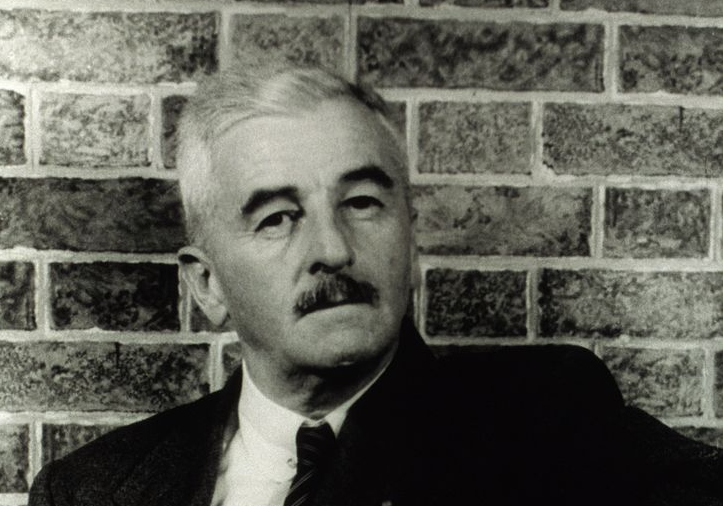
Image by Carl Van Vechten, via Wikimedia Commons
My two favorite William Faulkner novels are, without a doubt, Absalom, Absalom! and The Sound and The Fury. After readers get thrust into the narrators’ dizzying streams of consciousness, both books mount in tension to a frightful, almost unbearable pitch, before reaching their grim, cathartic climaxes. I’ve always felt that the white-hot intensity of the novels meant that, somehow, they had meant more to Faulkner than his other writings. According to an audio recording of Faulkner himself, it turns out that I was half right.
In 1957 and 1958, Faulkner served as the Writer-in-Residence at the University of Virginia at Charlottesville, and today the school retains what is likely to be the largest Faulkner archive in the world. In addition to Faulkner’s private library, original manuscripts, letters, and personal effects, the archive also contains hours upon hours of Faulkner’s Q & A sessions, speeches, and readings. In April of 1957, during a class lecture, a student asked Faulkner about his favorite novel. Listen to the audio clip here:
Unidentified participant: Mr. Faulkner, what do you consider your best book?
William Faulkner: The one that—that failed the most tragically and the most splendidly. That was The Sound and the Fury—the one I worked at the longest, the hardest, that was to me the—the most passionate and moving idea, and made the most splendid failure. That’s the one that’s my—I consider the best, not—well, best is the wrong word—that’s the one that I love the most.
The recordings themselves are a fascinating resource, with Faulkner commenting widely on his novels and stories. Where else could one hear, for example, what the author considered the best book to start with when reading him? Listen here.
Unidentified participant: Do you think that there’s a particular order in which your works should be read […]? Many people have offered a sequence. Do you think there’s a particular sequence that your books should be read in?
William Faulkner: Probably to begin with a book called Sartoris. That has the germ of my apocrypha in it. A lot of the characters are postulated in that book. I’d say that’s a good one to begin with.
For those interested in learning more about Faulkner and his writing, the Southeast Missouri State University’s Center for Faulkner Studies is offering a promising MOOC called Faulkner 101, led by the Center’s founder, Dr. Robert Hamblin, as well as its current director, Dr. Chris Rieger. You can sign up now. Or find countless other MOOCs in our big, ever-expanding list of MOOCs.
Ilia Blinderman is a Montreal-based culture and science writer. Follow him at @iliablinderman, or read more of his writing at the Huffington Post.
Related Content:
William Faulkner Reads from As I Lay Dying
William Faulkner Audio Archive Goes Online
The Art of William Faulkner: Drawings from 1916–1925
Read More...George Washington’s 110 Rules for Civility and Decent Behavior
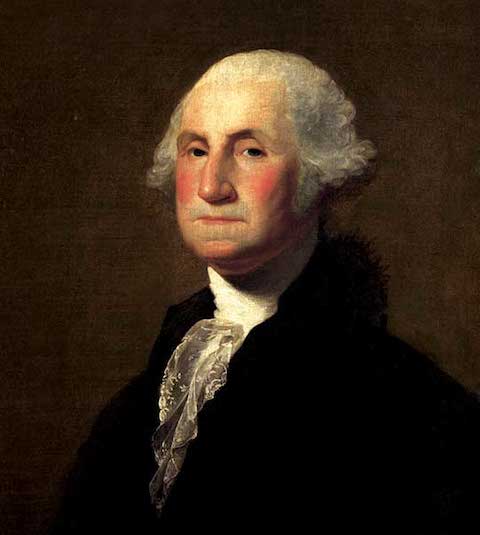
In “George Washington’s Extreme Makeover,” novelist Douglas Coupland imagines the first President of the United States of America science-fictionally transported “from atop his horse somewhere in the Virginia countryside into a Level 3 clean room 500ft beneath that exact same spot some 230-odd years later, circa 2014” where “a crew of doctors, dentists and exodontists wearing hazmat suits” would heal his every 18th-century ailment and replace his every failing 18th-century body part. All of Washington’s military and political accomplishments sound even more impressive in light of his lifetime of severe bodily (and especially dental, though not involving wood) discomfort, but even if his admirers can’t yet pull him ahead in time for such thorough physical adjustments, they can, right here and now, pay the best-known founding father tribute by following his recommended behavioral adjustments, codified in his rules of civility.
“As a young schoolboy in Virginia,” says an NPR feature on the subject, “George Washington took his first steps toward greatness by copying out by hand a list of 110 ‘Rules of Civility & Decent Behavior in Company and Conversation.’ Based on a 16th-century set of precepts compiled for young gentlemen by Jesuit instructors, the Rules of Civility were one of the earliest and most powerful forces to shape America’s first president, says historian Richard Brookhiser.” Brookhiser’s book Rules of Civility: The 110 Precepts That Guided Our First President in War and Peace appeared a decade ago, but you can still read the rules themselves (“for ease of reading, punctuation and spelling have been modernized”) below:
1. Every action done in company ought to be with some sign of respect to those that are present.
2. When in company, put not your hands to any part of the body not usually discovered.
3. Show nothing to your friend that may affright him.
4. In the presence of others, sing not to yourself with a humming voice, or drum with your fingers or feet.
5. If you cough, sneeze, sigh or yawn, do it not loud but privately, and speak not in your yawning, but put your handkerchief or hand before your face and turn aside.
6. Sleep not when others speak, sit not when others stand, speak not when you should hold your peace, walk not on when others stop.
7. Put not off your clothes in the presence of others, nor go out of your chamber half dressed.
8. At play and attire, it’s good manners to give place to the last comer, and affect not to speak louder than ordinary.
9. Spit not into the fire, nor stoop low before it; neither put your hands into the flames to warm them, nor set your feet upon the fire, especially if there be meat before it.
10. When you sit down, keep your feet firm and even, without putting one on the other or crossing them.
11. Shift not yourself in the sight of others, nor gnaw your nails.
12. Shake not the head, feet, or legs; roll not the eyes; lift not one eyebrow higher than the other, wry not the mouth, and bedew no man’s face with your spittle by approaching too near him when you speak.
13. Kill no vermin, or fleas, lice, ticks, etc. in the sight of others; if you see any filth or thick spittle put your foot dexterously upon it; if it be upon the clothes of your companions, put it off privately, and if it be upon your own clothes, return thanks to him who puts it off.
14. Turn not your back to others, especially in speaking; jog not the table or desk on which another reads or writes; lean not upon anyone.
15. Keep your nails clean and short, also your hands and teeth clean, yet without showing any great concern for them.
16. Do not puff up the cheeks, loll not out the tongue with the hands or beard, thrust out the lips or bite them, or keep the lips too open or too close.
17. Be no flatterer, neither play with any that delight not to be played withal.
18. Read no letter, books, or papers in company, but when there is a necessity for the doing of it, you must ask leave; come not near the books or writtings of another so as to read them unless desired, or give your opinion of them unasked. Also look not nigh when another is writing a letter.
19. Let your countenance be pleasant but in serious matters somewhat grave.
20. The gestures of the body must be suited to the discourse you are upon.
21. Reproach none for the infirmities of nature, nor delight to put them that have in mind of thereof.
22. Show not yourself glad at the misfortune of another though he were your enemy.
23. When you see a crime punished, you may be inwardly pleased; but always show pity to the suffering offender.
24. Do not laugh too loud or too much at any public spectacle.
25. Superfluous compliments and all affectation of ceremonies are to be avoided, yet where due they are not to be neglected.
26. In putting off your hat to persons of distinction, as noblemen, justices, churchmen, etc., make a reverence, bowing more or less according to the custom of the better bred, and quality of the persons. Among your equals expect not always that they should begin with you first, but to pull off the hat when there is no need is affectation. In the manner of saluting and resaluting in words, keep to the most usual custom.
27. ‘Tis ill manners to bid one more eminent than yourself be covered, as well as not to do it to whom it is due. Likewise he that makes too much haste to put on his hat does not well, yet he ought to put it on at the first, or at most the second time of being asked. Now what is herein spoken, of qualification in behavior in saluting, ought also to be observed in taking of place and sitting down, for ceremonies without bounds are troublesome.
28. If any one come to speak to you while you are are sitting stand up, though he be your inferior, and when you present seats, let it be to everyone according to his degree.
29. When you meet with one of greater quality than yourself, stop and retire, especially if it be at a door or any straight place, to give way for him to pass.
30. In walking, the highest place in most countries seems to be on the right hand; therefore, place yourself on the left of him whom you desire to honor. But if three walk together the middest place is the most honorable; the wall is usally given to the most worthy if two walk together.
31. If anyone far surpasses others, either in age, estate, or merit, yet would give place to a meaner than himself in his own lodging or elsewhere, the one ought not to except it. So he on the other part should not use much earnestness nor offer it above once or twice.
32. To one that is your equal, or not much inferior, you are to give the chief place in your lodging, and he to whom it is offered ought at the first to refuse it, but at the second to accept though not without acknowledging his own unworthiness.
33. They that are in dignity or in office have in all places precedency, but whilst they are young, they ought to respect those that are their equals in birth or other qualities, though they have no public charge.
34. It is good manners to prefer them to whom we speak before ourselves, especially if they be above us, with whom in no sort we ought to begin.
35. Let your discourse with men of business be short and comprehensive.
36. Artificers and persons of low degree ought not to use many ceremonies to lords or others of high degree, but respect and highly honor then, and those of high degree ought to treat them with affability and courtesy, without arrogance.
37. In speaking to men of quality do not lean nor look them full in the face, nor approach too near them at left. Keep a full pace from them.
38. In visiting the sick, do not presently play the physician if you be not knowing therein.
39. In writing or speaking, give to every person his due title according to his degree and the custom of the place.
40. Strive not with your superior in argument, but always submit your judgment to others with modesty.
41. Undertake not to teach your equal in the art himself professes; it savors of arrogancy.
42. Let your ceremonies in courtesy be proper to the dignity of his place with whom you converse, for it is absurd to act the same with a clown and a prince.
43. Do not express joy before one sick in pain, for that contrary passion will aggravate his misery.
44. When a man does all he can, though it succeed not well, blame not him that did it.
45. Being to advise or reprehend any one, consider whether it ought to be in public or in private, and presently or at some other time; in what terms to do it; and in reproving show no signs of cholor but do it with all sweetness and mildness.
46. Take all admonitions thankfully in what time or place soever given, but afterwards not being culpable take a time and place convenient to let him know it that gave them.
47. Mock not nor jest at any thing of importance. Break no jests that are sharp, biting, and if you deliver any thing witty and pleasant, abstain from laughing thereat yourself.
48. Wherein you reprove another be unblameable yourself, for example is more prevalent than precepts.
49. Use no reproachful language against any one; neither curse nor revile.
50. Be not hasty to believe flying reports to the disparagement of any.
51. Wear not your clothes foul, or ripped, or dusty, but see they be brushed once every day at least and take heed that you approach not to any uncleaness.
52. In your apparel be modest and endeavor to accommodate nature, rather than to procure admiration; keep to the fashion of your equals, such as are civil and orderly with respect to time and places.
53. Run not in the streets, neither go too slowly, nor with mouth open; go not shaking of arms, nor upon the toes, kick not the earth with your feet, go not upon the toes, nor in a dancing fashion.
54. Play not the peacock, looking every where about you, to see if you be well decked, if your shoes fit well, if your stockings sit neatly and clothes handsomely.
55. Eat not in the streets, nor in the house, out of season.
56. Associate yourself with men of good quality if you esteem your own reputation; for ’tis better to be alone than in bad company.
57. In walking up and down in a house, only with one in company if he be greater than yourself, at the first give him the right hand and stop not till he does and be not the first that turns, and when you do turn let it be with your face towards him; if he be a man of great quality walk not with him cheek by jowl but somewhat behind him, but yet in such a manner that he may easily speak to you.
58. Let your conversation be without malice or envy, for ’tis a sign of a tractable and commendable nature, and in all causes of passion permit reason to govern.
59. Never express anything unbecoming, nor act against the rules moral before your inferiors.
60. Be not immodest in urging your friends to discover a secret.
61. Utter not base and frivolous things among grave and learned men, nor very difficult questions or subjects among the ignorant, or things hard to be believed; stuff not your discourse with sentences among your betters nor equals.
62. Speak not of doleful things in a time of mirth or at the table; speak not of melancholy things as death and wounds, and if others mention them, change if you can the discourse. Tell not your dreams, but to your intimate friend.
63. A man ought not to value himself of his achievements or rare qualities of wit; much less of his riches, virtue or kindred.
64. Break not a jest where none take pleasure in mirth; laugh not aloud, nor at all without occasion; deride no man’s misfortune though there seem to be some cause.
65. Speak not injurious words neither in jest nor earnest; scoff at none although they give occasion.
66. Be not froward but friendly and courteous, the first to salute, hear and answer; and be not pensive when it’s a time to converse.
67. Detract not from others, neither be excessive in commanding.
68. Go not thither, where you know not whether you shall be welcome or not; give not advice without being asked, and when desired do it briefly.
69. If two contend together take not the part of either unconstrained, and be not obstinate in your own opinion. In things indifferent be of the major side.
70. Reprehend not the imperfections of others, for that belongs to parents, masters and superiors.
71. Gaze not on the marks or blemishes of others and ask not how they came. What you may speak in secret to your friend, deliver not before others.
72. Speak not in an unknown tongue in company but in your own language and that as those of quality do and not as the vulgar. Sublime matters treat seriously.
73. Think before you speak, pronounce not imperfectly, nor bring out your words too hastily, but orderly and distinctly.
74. When another speaks, be attentive yourself and disturb not the audience. If any hesitate in his words, help him not nor prompt him without desired. Interrupt him not, nor answer him till his speech be ended.
75. In the midst of discourse ask not of what one treats, but if you perceive any stop because of your coming, you may well entreat him gently to proceed. If a person of quality comes in while you’re conversing, it’s handsome to repeat what was said before.
76. While you are talking, point not with your finger at him of whom you discourse, nor approach too near him to whom you talk, especially to his face.
77. Treat with men at fit times about business and whisper not in the company of others.
78. Make no comparisons and if any of the company be commended for any brave act of virtue, commend not another for the same.
79. Be not apt to relate news if you know not the truth thereof. In discoursing of things you have heard, name not your author. Always a secret discover not.
80. Be not tedious in discourse or in reading unless you find the company pleased therewith.
81. Be not curious to know the affairs of others, neither approach those that speak in private.
82. Undertake not what you cannot perform but be careful to keep your promise.
83. When you deliver a matter do it without passion and with discretion, however mean the person be you do it to.
84. When your superiors talk to anybody hearken not, neither speak nor laugh.
85. In company of those of higher quality than yourself, speak not ’til you are asked a question, then stand upright, put off your hat and answer in few words.
86. In disputes, be not so desirous to overcome as not to give liberty to each one to deliver his opinion and submit to the judgment of the major part, especially if they are judges of the dispute.
87. Let your carriage be such as becomes a man grave, settled and attentive to that which is spoken. Contradict not at every turn what others say.
88. Be not tedious in discourse, make not many digressions, nor repeat often the same manner of discourse.
89. Speak not evil of the absent, for it is unjust.
90. Being set at meat scratch not, neither spit, cough or blow your nose except there’s a necessity for it.
91. Make no show of taking great delight in your victuals. Feed not with greediness. Eat your bread with a knife. Lean not on the table, neither find fault with what you eat.
92. Take no salt or cut bread with your knife greasy.
93. Entertaining anyone at table it is decent to present him with meat. Undertake not to help others undesired by the master.
94. If you soak bread in the sauce, let it be no more than what you put in your mouth at a time, and blow not your broth at table but stay ’til it cools of itself.
95. Put not your meat to your mouth with your knife in your hand; neither spit forth the stones of any fruit pie upon a dish nor cast anything under the table.
96. It’s unbecoming to heap much to one’s mea. Keep your fingers clean and when foul wipe them on a corner of your table napkin.
97. Put not another bite into your mouth ’til the former be swallowed. Let not your morsels be too big for the jowls.
98. Drink not nor talk with your mouth full; neither gaze about you while you are drinking.
99. Drink not too leisurely nor yet too hastily. Before and after drinking wipe your lips. Breathe not then or ever with too great a noise, for it is uncivil.
100. Cleanse not your teeth with the tablecloth, napkin, fork or knife, but if others do it, let it be done with a pick tooth.
101. Rinse not your mouth in the presence of others.
102. It is out of use to call upon the company often to eat. Nor need you drink to others every time you drink.
103. In company of your betters be not longer in eating than they are. Lay not your arm but only your hand upon the table.
104. It belongs to the chiefest in company to unfold his napkin and fall to meat first. But he ought then to begin in time and to dispatch with dexterity that the slowest may have time allowed him.
105. Be not angry at table whatever happens and if you have reason to be so, show it not but on a cheerful countenance especially if there be strangers, for good humor makes one dish of meat a feast.
106. Set not yourself at the upper of the table but if it be your due, or that the master of the house will have it so. Contend not, lest you should trouble the company.
107. If others talk at table be attentive, but talk not with meat in your mouth.
108. When you speak of God or His attributes, let it be seriously and with reverence. Honor and obey your natural parents although they be poor.
109. Let your recreations be manful not sinful.
110. Labor to keep alive in your breast that little spark of celestial fire called conscience.
Related Content:
The Smithsonian Picks “101 Objects That Made America”
A Short History of America, According to the Irreverent Comic Satirist Robert Crumb
Colin Marshall hosts and produces Notebook on Cities and Culture and writes essays on cities, aesthetics, Asia, and men’s style. He’s at work on a book about Los Angeles, A Los Angeles Primer. Follow him on Twitter at @colinmarshall or on Facebook.
Read More...Enjoy a Bluegrass Performance of Elton John’s 1972 Hit, “Rocket Man”
Last fall, our readers loved watching Iron Horse, a bluegrass band from Alabama, performing a most unusual version of Metallica’s “Enter Sandman.” The band’s take on Metallica’s anthem was originally recorded on the 2003 album, Fade to Bluegrass: Tribute to Metallica, where Iron Horse — with Tony Robertson on mandolin, Vance Henry on guitar, Ricky Rogers on bass, and Anthony Richardson on banjo — played Metallica hits in bluegrass fashion — “or at least as bluegrass as it’s possible for Metallica songs to be.”
This January, the quartet released a new video, this time covering “Rocket Man.” Sung by Elton John in ’72, written by Bernie Taupin, and inspired by a Ray Bradbury story, Rocket Man has been covered/performed by Coldplay, Kate Bush, My Morning Jacket and many others. But, if you have a scorecard, you’ll almost certainly give Iron Horse top marks for creativity and originality. Hope you enjoy.
Related Content:
A Bluegrass Version of Metallica’s Heavy Metal Hit, “Enter Sandman”
Pakistani Musicians Play Amazing Version of Dave Brubeck’s Jazz Classic, “Take Five”
Read More...
The Postcards That Picasso Illustrated and Sent to Jean Cocteau, Apollinaire & Gertrude Stein
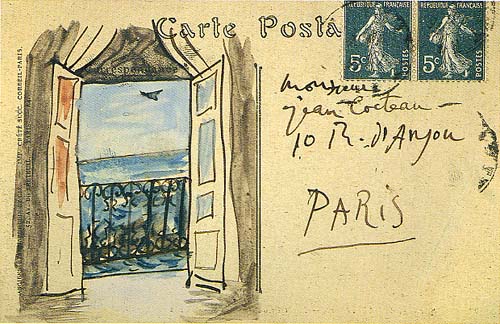
Pablo Picasso’s coterie of friends and collaborators was vast and glamorous. Following his move to France, Picasso befriended the flamboyant Russian ballet impresario Serge Diaghilev, whose Ballets Russes sets he went on to design, and whose prima ballerina Picasso went on to marry. Picasso also became friends with composers (such as Igor Stravinsky) and eminent painters, including his Cubist brother-in-arms Georges Braques, and his compatriot, Juan Gris.
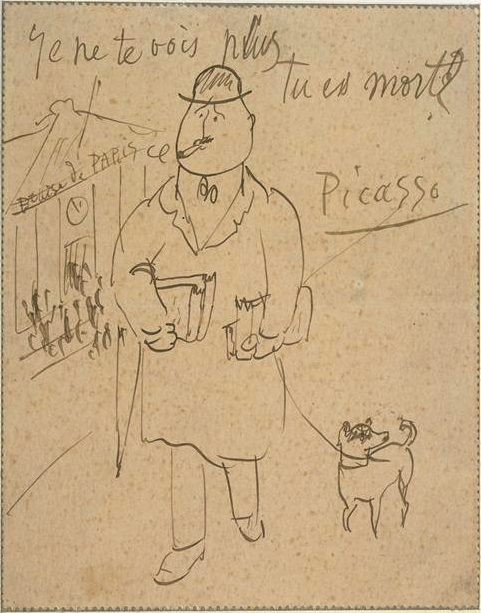
Today, we bring you a number of the postcards that Picasso sent to his friends, many of which he personally illustrated, quickly dashing off a note or a picture in a loose, wavy script. Above, you can view an image of Picasso’s postcard to his close friend and artist, Jean Cocteau, depicting the balcony at No. 10, Rue d’Anjou, where Cocteau’s mother had an apartment. Below, you can view a sketch Picasso sent off to the forefather of the Surrealist movement, his rotund friend and poet Guillaume Apollinaire. The message reads, bluntly, “I don’t see you anymore. Are you dead?”
In the lengthiest of the postcards, dating from 1919 and provided by Something Rich & Strange, Picasso writes to Gertrude Sein, perhaps describing a holiday:
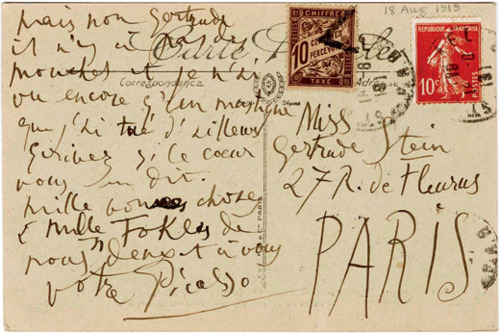
“Mais non Gertrude,
il n’y a pas des mouches et je n’ai vu encore qu’un moustique, que j’ai tué d’ailleurs. Ecrives si le couer vous dit. Milles bonnes choses de nous deux a vous [et mlle Toklas]
votre Picasso.
-
“No, Gertrude,
there are no flies, and I haven’t seen more than one mosquito, which I killed, anyway. Write me if the mood strikes. All the best to you and Ms. Toklas.
Yours, Picasso”
Interested readers may purchase a collection of Picasso’s postcards on Amazon.
Ilia Blinderman is a Montreal-based culture and science writer. Follow him at @iliablinderman, or read more of his writing at the Huffington Post.
Related Content:
Six Postcards From Famous Writers: Hemingway, Kafka, Kerouac & More
Read More...Guns N’ Roses “Sweet Child O’ Mine” Retooled as 1920s New Orleans Jazz
Thanks to the efforts of Scott Bradlee’s Postmodern Jukebox and singer Miche Braden, the world now knows how heavy metal rockers, Guns N’ Roses sound with their knees rouged up and their stockings down.
Their New Orleans jazz take on 1987’s “Sweet Child O’ Mine” replaces the preening rock god sensitivity of the original with a sort of mature, female swagger harkening all the way back Bessie Smith. (Braden’s stage credits include turns as Billie Holiday, Valaida Snow, and Ma Rainey.)
The backup musicians get in on the fun, too, retooling Slash’s guitar solo as a horn-driven cakewalk. I know which party I’d rather hit!
Over the years, “Sweet Child O’ Mine” has proved a remarkably study workhorse, withstanding attempts to make it over as electronica, a Gregorian Chant and Brazilian prog rock. Or how about this version played on the Guzheng, an ancient Chinese instrument. Postmodern Jukebox’s entry into this stakes is not without gimmick, but it’s a winning one.
If you would like to support the mission of Open Culture, consider making a donation to our site. It’s hard to rely 100% on ads, and your contributions will help us continue providing the best free cultural and educational materials to learners everywhere. You can contribute through PayPal, Patreon, and Venmo (@openculture). Thanks!
Related Content:
Radiohead’s “Creep” Performed in a Vintage Jazz-Age Style
Enjoy a Bluegrass Performance of Elton John’s 1972 Hit, “Rocket Man”
Pakistani Musicians Play Amazing Version of Dave Brubeck’s Jazz Classic, “Take Five”
A Middle-Eastern Version of Radiohead’s 1997 Hit “Karma Police”
Ayun Halliday is an author, illustrator, and Chief Primatologist of the long running zine, The East Village Inky. Follow her @AyunHalliday
Read More...Watch 13 Experimental Short Films by Tezuka Osamu, the Walt Disney of Japan
Tezuka Osamu (1928–1989) is known as “the God of manga” in Japan. He created classics for both children and adults in every genre – from horror to romance to action. The sheer amount of work produced in Osamu’s relatively short life is staggering; some estimates have it that he drew over 150,000 pages of comics.
While focusing just on manga would have been enough for most mortals, Osamu was also a trailblazer in animation. He created Astro-Boy, the hugely popular character that spawned comic books, TV shows, video games and a couple of movies. The visual style of Osamu’s animated work — Astro-Boy and others — proved to be very influential. Those trademark giant eyes on anime characters come straight from Osamu (who in turn was influenced by Walt Disney and Max Fleischer).
Osamu relentlessly challenged the limits of what manga and anime could do. He’s credited with making the first ever X‑Rated animated feature film, Cleopatra, Queen of Sex (1970) — imagine Disney doing that. He also made a series of experimental animated shorts, which showcase not only Osamu’s creativity and range but also his philosophy, which was heavily influenced by Buddhism.
His 1962 work Tale of Street Corner is a surprisingly moving short about the day-to-day life of a city street corner as seen through the eyes of some anthropomorphized mice and sentient street posters.
And if you want get a sense of Osamu’s versatility, check out his 1966 movie Pictures at an Exhibition. The work is an omnibus film featuring ten smaller shorts, all set to Mussorgsky’s famous suite. Osamu recreated each short in a completely different style from the others.
His 1984 short, Jumping is a technical tour-de-force told with admirable simplicity. Seen from a first person point of view, the movie is about a young child who is jumping down a country road. As each jump gets higher and longer, the camera passes through cities, fields and oceans and eventually into a warzone. The sharp-eyed viewer will see R2D2 and C‑3PO make a surprise cameo at around the 2:57 marker.
And finally, here is an interview with the master himself as he talks about making these movies. And you can see all 13 of the animated shorts here.
Related Content:
Destino: The Salvador Dalí – Disney Collaboration 57 Years in the Making
Kafka’s Nightmare Tale, ‘A Country Doctor,’ Told in Award-Winning Japanese Animation
Japanese Cartoons from the 1920s and 30s Reveal the Stylistic Roots of Anime
How to Make Instant Ramen Compliments of Japanese Animation Director Hayao Miyzaki
Jonathan Crow is a Los Angeles-based writer and filmmaker whose work has appeared in Yahoo!, The Hollywood Reporter, and other publications. You can follow him at @jonccrow.
Read More...Painters Painting: The Definitive Documentary Portrait of the New York Art World (1940–1970)
Emile de Antonio is one of those people who simply had a knack for being in the right place at the right time. He was a Harvard classmate of John F. Kennedy. He knew all of the core members of the Beat movement, even helping to distribute the seminal Beat movie Pull My Daisies. And De Antonio was a friend with virtually everyone in the New York art scene from Jasper Johns to Willem de Kooning. He once drank himself into a stupor for Andy Warhol’s experimental movie Drink. Warhol even famously praised De Antonio saying, “Everything I learned about painting, I learned from De.”
De Antonio was also a major voice of dissent during the Cold War. He directed a series of scathing documentaries including Point of Order (1964), about the McCarthy hearings; Rush to Judgment (1966), a staple among JFK assassination theorists; and the Oscar-nominated anti-Vietnam war movie In the Year of the Pig. (1968)
For his 1972 movie Painters Painting: The New York Art Scene 1940–1970, De Antonio managed to get artists like Warhol, Johns, and De Kooning along with Robert Rauschenberg, Frank Stella, Barnett Newman and Helen Frankenthaler to talk about their craft. It is the definitive documentary portrait of the New York art world.
De Antonio talked about Painters Painting in a 1988 interview:
I was probably the only filmmaker in the world who could [have made Painters Painting] because I knew all those people, from the time that they were poor, and unsuccessful and had no money. I knew Warhol and Rauschenberg and Jasper Johns and Stella before they ever sold a painting, and so it was interesting to [do the film about them]. They appeared in the film along with De Kooning, whom I knew very well, and Barnett Newman, who is now dead. They talked to me in a way that they would never have talked to anybody else because they knew I knew the subject.
The film, a tad grainy, appears above. A higher res version of the film can “rented” on Amazon. Amazon Prime member can watch it for free.
Related Content:
Watch Portrait of an Artist: Jackson Pollock, the 1987 Documentary Narrated by Melvyn Bragg
635 Free Movies Online: Great Classics, Indies, Noir, Westerns, etc.
Rauschenberg Erases De Kooning
Jonathan Crow is a Los Angeles-based writer and filmmaker whose work has appeared in Yahoo!, The Hollywood Reporter, and other publications. You can follow him at @jonccrow.
Read More...How a Book Thief Forged a Rare Edition of Galileo’s Scientific Work, and Almost Pulled it Off
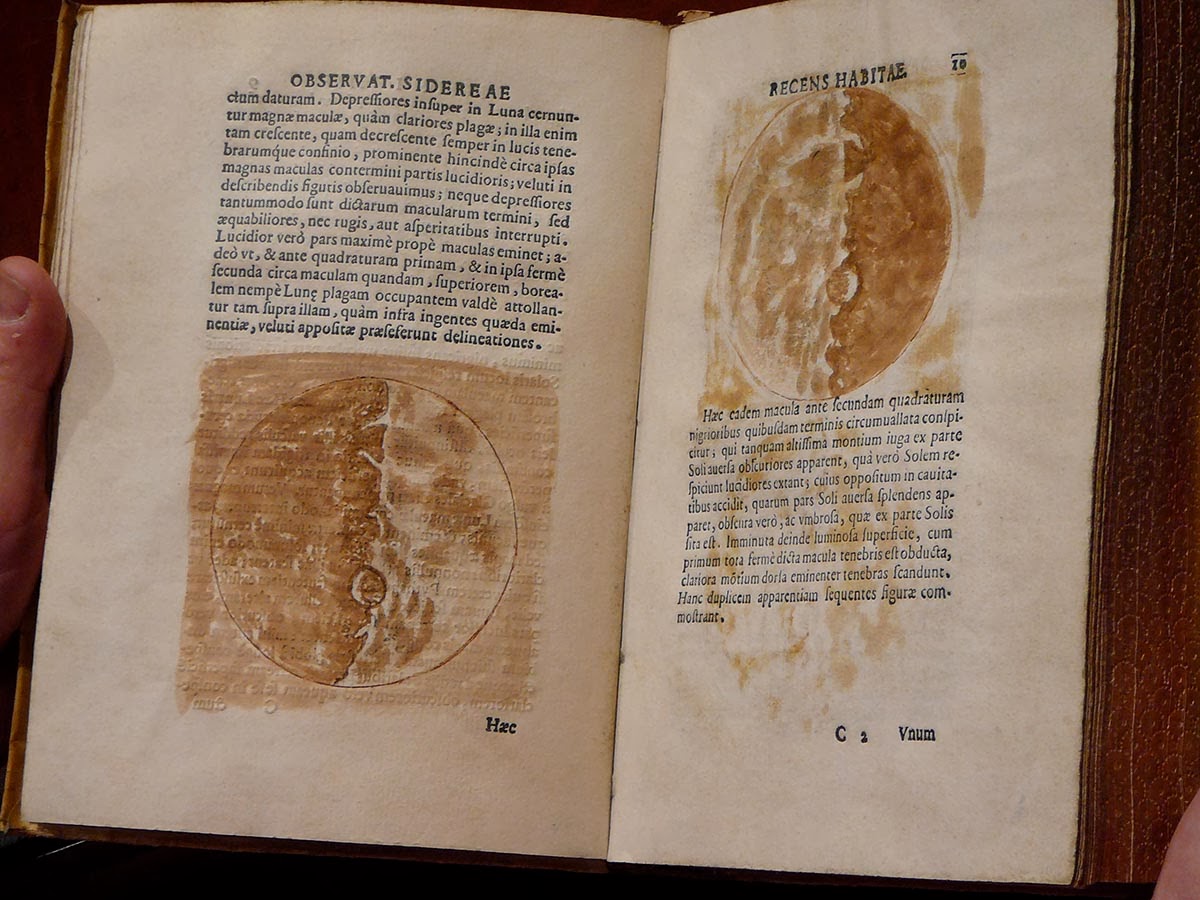
A couple of weeks ago, we published a post that featured Galileo’s Moon drawings, “the first realistic depictions of the moon in history.” As it turns out—some readers alerted us—some of the Moon illustrations attributed to Galileo are actually very convincing forgeries, so convincing, in fact that when the drawings surfaced in 2005, they initially swayed such experts as rare books dealer Richard Lan, Harvard professor of astronomy and history of science Owen Gingerich, and art historian Horst Bredekamp. All of these experts have since come to learn—partially through the investigations of Georgia State University historian Nick Wilding—that an unusual edition containing detailed watercolors, purportedly in Galileo’s own hand (above and below), was in fact created by forger, book thief, and former director of the State Library of Girolamini, Marino Massimo De Caro, who now stands accused of stealing thousands of volumes, including centuries-old editions of Aristotle, Descartes, Galileo and Machiavelli.
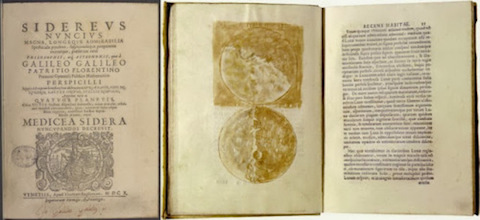
The drawings we featured at the top of our previous post—from a set of five inkwashes made in 1609, called “the Florence Sheet”—are genuine, as are the etchings in the original text of Galileo’s scientific treatise, Sidereus Nuncius. However, as investigative reporter Nicholas Schmidle documented in a lengthy article published in last December’s New Yorker, the edition pictured above—purchased for half a million dollars by Richard Lan of rare booksellers Martayan Lan and once valued at over ten million dollars for its unique rust-colored illustrations—is a fake, despite being authenticated by a team of scholars in 2007.
The story of how De Caro’s forgery came to fool nearly everyone who examined it (ending up in Time magazine and dozens of other publications and scholarly websites) is a long and winding tale. Like many forgers, De Caro acted out of a mixture of greed, envy, and a desire to prove himself to a field he felt did not recognize his talents (De Caro also forged a copy of Galileo’s 1606 Compasso to replace a stolen version). A college dropout, he “held an imperious grudge against people who had spent years studying in libraries,” writes Schmidle. Instead, De Caro had earned an honorary professorship by donating four Galileo editions (presumably genuine) and a chunk of meteorite to a private institution in Buenos Aires. More than just a story of fraud and theft, De Caro’s is one of academic imposture. In 2006, for example, he participated in a panel discussion on Galileo at Fordham University, and despite the skepticism of actual scholars, his expertise was trusted in the rare books and museum worlds until his discovery.
According to Schmidle, De Caro and an accomplice artist aged several bottles of nineteenth-century ink to create the Galileo drawings, using the Florence Sheet as a guide for the seventeenth-century astronomer’s hand. After opening a bottle of red wine, he had his accomplice trace the outline of the moons with the foot of his wineglass. Then they baked the pages in his home oven to age them. It’s hard to believe De Caro’s fake survived scrutiny for over five years, until Wilding began to express his doubts in 2011. Though facing several years in prison, De Caro hopes to work someday with the F.B.I., helping them discover forged and stolen books. He cites famous con man Frank Abagnale, played by Leonardo Di Caprio in the 2002 film Catch Me If You Can, as an inspiration. “I want to do for books what he did for checks,” says De Caro. “I can help them find all the black, offshore accounts of all the booksellers.” Read a facsimile of Schmidle’s article here. And for more on De Caro’s brazen crimes, see this detailed Examiner article.
Related Contents:
Galileo’s Moon Drawings, the First Realistic Depictions of the Moon in History (1609–1610)
Meet “Father Philanthropy”: America’s Most Prolific and Unlikely Master Art Forger
Josh Jones is a writer and musician based in Durham, NC. Follow him at @jdmagness
Read More...Support Us
We're hoping to rely on loyal readers, rather than erratic ads. Please click the Donate button and support Open Culture. You can use Paypal, Venmo, Patreon, even Crypto! We thank you!

About Us

Open Culture scours the web for the best educational media. We find the free courses and audio books you need, the language lessons & educational videos you want, and plenty of enlightenment in between.
Advertise With Us

FREE UPDATES!
GET OUR DAILY EMAIL
Get the best cultural and educational resources on the web curated for you in a daily email. We never spam. Unsubscribe at any time.
FOLLOW ON SOCIAL MEDIA

Open Culture editor Dan Colman scours the web for the best educational media. He finds the free courses and audio books you need, the language lessons & movies you want, and plenty of enlightenment in between.
Advertise With Us


