Hear Led Zeppelin’s First Recorded Concert Ever (1968)
It’s December, 1968. You’re a teenaged kid in Spokane, Washington, keen to see Vanilla Fudge—or “The Vanilla Fudge,” as the promoter calls them—at Gonzaga University’s Kennedy Pavilion, and… what’s this? The opening act is “Len Zefflin?” Who the hell is that?
Maybe you’re hip, like Bob Gallagher, who knew Jimmy Page from the Yardbirds and looked forward to catching his new band. Maybe not. Maybe, like Kerry Whitsitt, you’re hoping “the first band wouldn’t stay on stage too long.” You know how it is… opening bands….
But then Page, Plant, Bonham, and Jones take the stage, and like Jeff “Tor” Nadeau, you look around to find the house “universally mind-blown” by “the most stunning and awesome sound ever.” And like Kerry, you don’t “want them to leave the stage—ever!”

These then-teenage fans’ reminisces of this historic show, only the fifth of Led Zeppelin’s first U.S. tour, come courtesy of the Zeppelin website’s description of the mistakenly billed “Len Zefflin”’s earliest recorded concert, which you can hear in its entirety above, thanks to an enterprising young student who brought his tape recorder.
The band’s first album—Led Zeppelin—wouldn’t hit stores for another three weeks. The kids haven’t heard anything like this before: Bonham’s explosive fills, Plant’s high-pitched harmonizing to “Page’s pipe-wrench riffs.” By the time Zeppelin left the stage, Bob Gallagher and his buddies were “flabbergasted.” And “when Vanilla Fudge came on, they were so sleepy. It was like, after that, psychedelia was dead and heavy metal was born, all in a three-hour show.” Poor Vanilla Fudge.
The raw, two-track tape recording of that frigid winter show has circulated for thirty years in various bootleg forms, but it’s new to Youtube, new to me, and maybe new to you too. Listen to it and see if you can’t conjure some of those lucky audience-members’ awe in that moment of discovery, when heavy metal was born from the blues. The full tracklist of the show is below. For the full experience, see the Youtube page to read a transcription of Robert Plant’s between-song stage patter.
01 — Train Kept A Rollin’ [0:00]
02 — I Can’t Quit You [2:32]
03 — As Long As I Have You (incl Fresh Garbage / Shake / Hush) [9:15]
04 — Dazed And Confused [17:52]
05 — White Summer [27:43]
06 — How Many More Times (incl The Hunter) [34:31]
07 — Pat’s Delight [50:07]
Related Content:
Led Zeppelin Plays One of Its Earliest Concerts (Danish TV, 1969)
Josh Jones is a writer and musician based in Durham, NC. Follow him at @jdmagness.
Read More...German String Quartet Performs Vivaldi & Mozart in Delightfully Comical & Acrobatic Routine
Making the rounds on the internet is this performance by the German string quartet Salut Salon. Featuring Angelika Bachmann (violin), Iris Siegfried (violin and vocals), Anne-Monika von Twardowski (piano) and Sonja Lena Schmid (cello), the quartet knows “better than any other chamber music ensemble how to seduce their audience with passionate virtuosity, instrumental acrobatics, charm and a great sense of fun.” Above you can get your week started by watching them perform a mash-up of Vivaldi, Mozart, and Kurt Weill. And to keep your day going, you can always watch 2Cellos banging out a version of Guns N’ Roses “Welcome to the Jungle” and this 14-year-old girl playing a blistering heavy metal performance of Vivaldi. Enjoy.
If you would like to support the mission of Open Culture, consider making a donation to our site. It’s hard to rely 100% on ads, and your contributions will help us continue providing the best free cultural and educational materials to learners everywhere. You can contribute through PayPal, Patreon, and Venmo (@openculture). Thanks!
Related Content:
Download Free Music from 150+ Classical Composers, Courtesy of Musopen.org
A Big Bach Download: All of Bach’s Organ Works for Free
The Open Goldberg Variations: J.S. Bach’s Masterpiece Free to Download
The World Concert Hall: Listen To The Best Live Classical Music Concerts for Free
Read More...Slavoj Žižek: What Fulfils You Creatively Isn’t What Makes You Happy
While theorist and provocateur Slavoj Žižek tends to get characterized—especially in a recent, testy exchange with Noam Chomsky—as obscurantist and muddle-headed, I’ve always found him quite readable, especially when compared to his mentor, psychoanalytic philosopher Jacques Lacan. As an interpreter of Lacan’s theories, Žižek always does his reader the courtesy of providing specific, concrete examples to anchor the theoretical jargon (where Lacan gives us pseudo-mathematical symbols). In the short Big Think clip above, Žižek’s examples range from the history of physics to the Declaration of Independence to the familiar “male chauvinist” scenario of a man, his wife, and his mistress. Žižek’s point, the point of psychoanalysis, he alleges, is that “people do not really want or desire happiness.”
This seems counterintuitive. Happiness—our own and others—is after all the goal of our loftiest endeavors, no? This seems to be the pop-psych rendition of, say, Maslow’s theory of self-actualization. But no, says Zizek, happiness is an integral part of fantasy. Like the philanderer’s mistress, the object of desire must be kept at a distance, he says. Once it is achieved, we no longer want it: “We don’t really want what we think we desire.” And in keeping with Žižek’s example of infidelity—which may or may not involve the chauvinist killing his wife—he tells us that for him, “happiness is an unethical category.” I find this statement intriguing, and persuasive, though Žižek doesn’t elaborate on it above.
He does in much of his writing however—explaining in Lacanian terms in his essay collection Interrogating the Real that our desire for something we think will bring us happiness can be construed as a kind of envy: “I desire an object only insofar as it is desired by the Other.” Furthermore, he writes, “what I desire is determined by the symbolic network within which I articulate my subjective position.” In other words, what we think we want is determined by ideology—by the cultural products we consume, the soup of mass media and advertising in which we are permanently immersed, and the political ideals we are taught to revere. What does authentic “self-actualization” look like for Slavoj Žižek? He tells us above—it means being “ready to suffer” for the creative realization of a goal: “Happiness doesn’t enter into it.”
Žižek cites the example of nuclear scientists who willingly exposed themselves to radiation poisoning in pursuit of discovery, but he could just as well have pointed to artists and writers who sacrifice comfort and pleasure for lives of profound uncertainty, religious figures who practice all kinds of austerities, or athletes who push their bodies past all ordinary limits. While there are several degrees of pleasure involved in these endeavors, it seems shallow at best to describe the goals of such people as happiness. It seems that many, if not most, of the people we admire and strive to emulate lead lives characterized by great risk—by the willingness to suffer; lives often containing little in the way of actual happiness.
Whatever stock one puts in psychoanalytic theory, it seems to me that Žižek raises some vital questions: Do we really want what we think we want, or is the “pursuit of happiness” an unethical ideological fantasy? What do you think, readers?
Related Content:
Noam Chomsky Slams Žižek and Lacan: Empty ‘Posturing’
Slavoj Žižek Examines the Perverse Ideology of Beethoven’s Ode to Joy
Slavoj Žižek on the Feel-Good Ideology of Starbucks
In His Latest Film, Slavoj Žižek Claims “The Only Way to Be an Atheist is Through Christianity”
Josh Jones is a writer and musician based in Durham, NC. Follow him at @jdmagness.
Read More...
Close Personal Friend: Watch a 1996 Portrait of Gen‑X Definer Douglas Coupland
Whether we lived through them as kids or as grown-ups, few of us feel sure about whether we miss the 1990s. No generation did more to define the decade before last, at least in the West, than the unmoored, irony-loving, at once deeply cynical and deeply earnest “Generation X” that succeeded the wealthier, more influential Baby Boomers. No writer did more to define that generation than Douglas Coupland, the Canadian novelist, visual artist, and seer of the immediate future whose 1991 literary debut Generation X: Tales for an Accelerated Culture gave the cohort its name. There he wrote of the twentysomethings who lived through the 1990s definitely not as kids, yet, frustratingly, not quite as grown-ups, coming haplessly to grips in the margins of a human experience that an advanced civilization had already begun detaching from supposed expectations — jobs, houses, stability, tight connection between mind and body, unquestionably “real” lived experience — of generations before.
Coupland, also a prolific sculptor (next time you get to his hometown of Vancouver, do visit the somehow always striking Digital Orca), writer of the film Everything’s Gone Green, star of the documentary Souvenir of Canada, and now the developer of a snoring-assistance smartphone app, knows a thing or two about switching media. Five years after breaking out with Generation X, he also made Close Personal Friend, the not-quite-categorizable short about technology, memory, and identity at the top of the post. In what plays as a cross between a Chris Marker-style essay film and a middle-period MTV music video, Coupland continues his career-long rumination about our “accelerated culture” and the fascinatingly empowered yet compromised human beings to which it gives rise. What does it mean in this modern, hypermediated context, he wonders, that we now wonder whether we actually have lives? “Not having a life is so common,” he says. “It’s almost become the norm. […] People just aren’t getting their year’s worth of year anymore.”
Given our culture’s further acceleration since he spoke those words in 1996 — the world wide web as we know it having got its start just three years before — Coupland’s thoughts on the subject, whether expressed in fiction, through sculpture, or onscreen, still sound plenty relevant. Close Personal Friend, with its voidlike backdrops, video-blender editing, and scattered clips of wholesome midcentury Americana, bears the aesthetic mark of its era. Coupland’s faintly ominous talk of “FedEx, Prozac, microwave ovens, and fax machines” also time-stamps it technologically and culturally. But the observations have carried through, only growing sharper, to his latest work. Asked to imagine the “two dominant activities” of life twenty years hence, the Coupland of 1996 names “going shopping and going to jail,” pursuits he sees as now merged in his essay collection published last year, Shopping in Jail. Just above, we have a half-hour conversation between Coupland and Q host Jian Ghomeshi about his even newer book, a study of misanthropy in novel form called Worst. Person. Ever. In the talk, he cites “I miss my pre-internet brain,” a slogan he made up that has gained much traction in recent years. But does he really? “No,” he admits. “It was boring back then!” Close Personal Friend will be added to our collection of 675 Free Movies Online.
Related Content:
Watch Free Online: Richard Linklater’s Slacker, the Classic Gen‑X Indie Film
The Always-NSFW Kevin Smith and Jason Mewes Catch Up in Jay and Silent Bob Get Old Podcast
Colin Marshall hosts and produces Notebook on Cities and Culture and writes essays on cities, language, Asia, and men’s style. He’s at work on a book about Los Angeles, A Los Angeles Primer. Follow him on Twitter at @colinmarshall or on Facebook.
Read More...The Origins of Michael Jackson’s Moonwalk: Vintage Footage of Cab Calloway, Sammy Davis Jr., Fred Astaire & More
Michael Jackson took one giant leap for pop history on March 25, 1983 when he gave an adoring public their first taste of his signature moonwalk in honor of Motown Records’ 25th birthday. (See below)
Novelty-wise, it wasn’t quite a Neil Armstrong moment. Like many artists, Jackson had many precedents from which he could and did draw. He can be credited with bringing a certain attitude to the proceedings. The expert practitioners in the video above are more ebullient, tapping, sliding and proto-moonwalking themselves into a state of rapture that feeds off the audience’s pleasure.
The line-up includes artists lucky enough to have left lasting footprints—Cab Calloway, Sammy Davis Jr., Fred Astaire, as well as those we’d do well to rediscover: Rubberneck Holmes, Earl “Snakehips” Tucker, Buck and Bubbles.…
Lacking the Internet, however, it does seem unlikely that Jackson would’ve spent much time poring over the footwork of these masters. (He may have taken a sartorial cue from their socks.)
Instead, he invested a lot of time breaking down the street moves, what he referred to in his autobiography as “a ‘popping’ type of thing that black kids had created dancing on the street corners in the ghetto.”
Jackson’s sister, LaToya, identified former Soul Train and Solid Gold dancer Jeffrey Daniel, below, as her brother’s primary tutor in this endeavor. (He went on to co-choreograph Jackson’s videos for “Bad” and “Smooth Criminal”.) As to the story behind his moonwalk, or backslide as he called it before Jackson’s version obliterated the possibility of any other name, Daniel gave props to the same kids Jackson did.
For those of you who mentioned it on Twitter and in our comments, we’ve added Charlie Chaplin’s scene in Modern Times.
via Metafilter
Related Content:
Keeping Jacko in Perspective
James Brown Gives You Dancing Lessons: From The Funky Chicken to The Boogaloo
Ayun Halliday is the author of seven books, and creator of the award winning East Village Inky zine. Follow her @AyunHalliday
Read More...George R.R. Martin Releases a Free Chapter From The Winds of Winter: Read It Online

In recent days, George R.R. Martin published a blog post that begins, “Hiya kids, hiya hiya hiya. With season 4 of HBO’s GAME OF THRONES almost upon us, I thought the time was ripe for me to give my readers another taste of WINDS OF WINTER.” The new chapter, he tells us, “is actually an old chapter. But no, it’s not one I’ve published or posted before.” The chapter, called “Mercy,” opens with these words:
She woke with a gasp, not knowing who she was, or where.
The smell of blood was heavy in her nostrils… or was that her nightmare, lingering? She had dreamed of wolves again, of running through some dark pine forest with a great pack at her hells, hard on the scent of prey.
Half-light filled the room, grey and gloomy. Shivering, she sat up in bed and ran a hand across her scalp. Stubble bristled against her palm. I need to shave before Izembaro sees. Mercy, I’m Mercy, and tonight I’ll be raped and murdered. Her true name was Mercedene, but Mercy was all anyone ever called her…
Except in dreams. She took a breath to quiet the howling in her heart, trying to remember more of what she’d dreamt, but most of it had gone already. There had been blood in it, though, and a full moon overhead, and a tree that watched her as she ran.
You can read the chapter in full here. Martin notes that you can also enjoy a new Tyrion chapter, “that is live and available with the ICE & FIRE app.” It’s free on iTunes.
Related Content:
Neil Gaiman’s Free Short Stories
Download 33 Great Sci-Fi Stories by Philip K. Dick as Free Audio Books & Free eBooks
Free: Isaac Asimov’s Epic Foundation Trilogy Dramatized in Classic Audio
The Ware Tetralogy: Free SciFi Download
575 Free eBooks: Download Great Books for Free
Read More...Dizzy Gillespie Worries About Nuclear & Environmental Disaster in Vintage Animated Films
Dizzy Gillespie was one of the best jazz trumpet players of all time. His virtuosic playing, along with his tricked out trumpet and his freakishly elastic cheeks, turned him into a musical icon of the 20th century. But did you know that he lent his voice to an Oscar-winning movie?
The Hole (1962), which you can see above, is an experimental animated short about two construction workers engaged in an increasingly intense conversation about free will and the possibility of an accidental nuclear war. Gillespie improvised the dialogue opposite actor George Matthews, a giant of a man who was most famous for playing movie thugs. The style of the animation is loose, blotchy and rough – in other words, about as un-Disney as can be.
And that was by design. John Hubley, who directed the movie along with his wife Faith Hubley, got his start in animation by working on some of Disney’s most famous early films including Snow White and the Seven Dwarves, Bambi and Fantasia, but he found that his artistic ambitions lay beyond Uncle Walt’s vision. After the war, he helped found the United Productions of America and even created its most successful character – Mr. Magoo — only to be forced out of the company during the Red Scare.
After marrying Faith in 1955, Hubley founded Storyboard Studios to make visually adventurous, socially minded animated movies. (Fun fact: John and Faith Hubley’s daughter Georgia grew up to be the drummer for the indie band Yo La Tengo.) The Hole (1962) proved to be very successful for the studio; it won an Academy Award for Best Animated Short and in 2013, it was selected for the United States National Film Registry by the Library of Congress as being “culturally, historically, or aesthetically significant.”
Gillespie and the Hubleys continued to collaborate in two other movies The Hat, which co starred Dudley Moore, and the supremely groovy Voyage to Next (1974). In that latter film, above, Dizzy and Maureen Stapleton play Father Time and Mother Nature respectively. They watch in wonder, concern and eventually alarm as humanity evolves from communal villagers to greedy nationalists on the brink self-annihilation.
You can find both films listed in the Animation section of our collection, 4,000+ Free Movies Online: Great Classics, Indies, Noir, Westerns, Documentaries & More.
via Dangerous Minds and NPR
Related Content:
Dizzy Gillespie Runs for US President, 1964. Promises to Make Miles Davis Head of the CIA
Jonathan Crow is a Los Angeles-based writer and filmmaker whose work has appeared in Yahoo!, The Hollywood Reporter, and other publications. You can follow him at @jonccrow.
Read More...Billy Joel & Vanderbilt Student Perform Impromptu Duet of “New York State of Mind”
During a visit to Vanderbilt University last year, Billy Joel fielded a question from a freshman, Michel Pollack. To paraphrase: “My favorite song of yours is New York State of Mind. Can I play it for you on the piano while you sing?” To which Joel replied, “Ok.” And off they went. It’s a lovely impromptu moment. But it was a little too much for Pollack. A little overwhelmed by the whole experience, he got a 69 on his calculus exam the next day. But who could blame him. We have more impromptu musical moments below.
Related Content:
Lenny Kravitz Overhears High School Kids Playing His Music and Surprises Them by Joining In
A Paul Simon Feelin’-Very-Groovy Moment with a Fan
Blind Guitarist Lives Out Dream at U2 Show
Read More...The Only Drawing from Maurice Sendak’s Short-Lived Attempt to Illustrate The Hobbit
I envy nobody the clearly torturous task of interpreting the works of J.R.R. Tolkien, from Peter Jackson on down. With his three Lord of the Rings films in the early 2000s, New Zealand’s cinematic native son actually did an admirable job of deflecting much of the inevitable wrath of Tolkien’s enormous, highly detail-oriented, easily angered international fan base. One senses, however, that he stands on slightly less firm ground with his newer adaptation, and indeed expansion, of The Hobbit. The novel, which Tolkien wrote for children in 1937 and whose success led him to go the full distance with the Lord of the Rings books, now finds itself turning into its own trio of film spectacles, each installment of which gets the strongest possible marketing push (up to and including Middle-Earth-themed dishes at Denny’s) upon its theatrical release. It can seem an awfully grand treatment for a humble (if enduringly adventurous) book. To grant The Hobbit a separate visual dimension, then, wouldn’t we want a talent which, though formidable, tended toward subtlety and understatement — and, lest we forget the novel’s target audience, one who understands children?
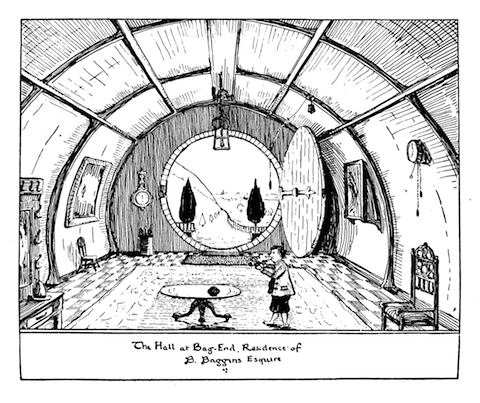
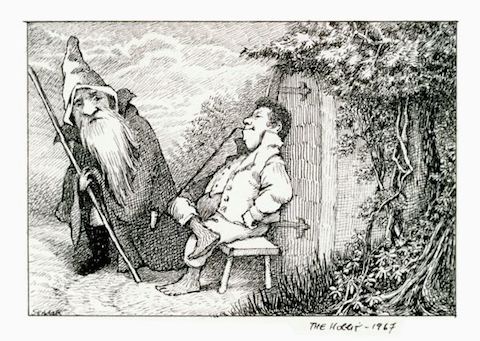
We nearly had one in Maurice Sendak, he of Where the Wild Things Are, who in the mid-1960s created sample artwork for The Hobbit’s proposed 30th-anniversary deluxe illustrated edition. For a variety of reasons, from Sendak’s reluctance to Tolkien’s crankiness to a labeling snafu by the publisher to a heart attack that took Sendak out of commission for a while, the promising concept never came to fruition. Specifics of the accounts conflict, though you can find one from Tony DiTerlizzi at the Los Angeles Times and another, proposing corrections to the former, at Too Many Books and Never Enough. Whatever the ultimate obstacle, Sendak completed just two drawings for the book; the only one that survives appears at the top of this post, showing us how he envisioned the hobbit hero Bilbo Baggins and the wizard Gandalf. Just above, we have Tolkien’s own drawing of Bilbo at home, proving him none too shabby an illustrator in his own right, and one who by definition gets the details right. Still, I grieve for never having seen the directions in which Sendak could have taken this bit of material from the beloved Tolkien canon — and, better yet, what minor heresies the irreverent artist could have slyly inflicted upon it.
Related Content:
An Animated Christmas Fable by Maurice Sendak (1977)
The Mind & Art of Maurice Sendak: A Video Sketch
Download Eight Free Lectures on The Hobbit by “The Tolkien Professor,” Corey Olsen
Listen to J.R.R. Tolkien Read a Lengthy Excerpt from The Hobbit (1952)
Discover J.R.R. Tolkien’s Personal Book Cover Designs for The Lord of the Rings Trilogy
Colin Marshall hosts and produces Notebook on Cities and Culture and writes essays on cities, language, Asia, and men’s style. He’s at work on a book about Los Angeles, A Los Angeles Primer. Follow him on Twitter at @colinmarshall or on Facebook.
Read More...Download Over 22,000 Golden & Silver Age Comic Books from the Comic Book Plus Archive
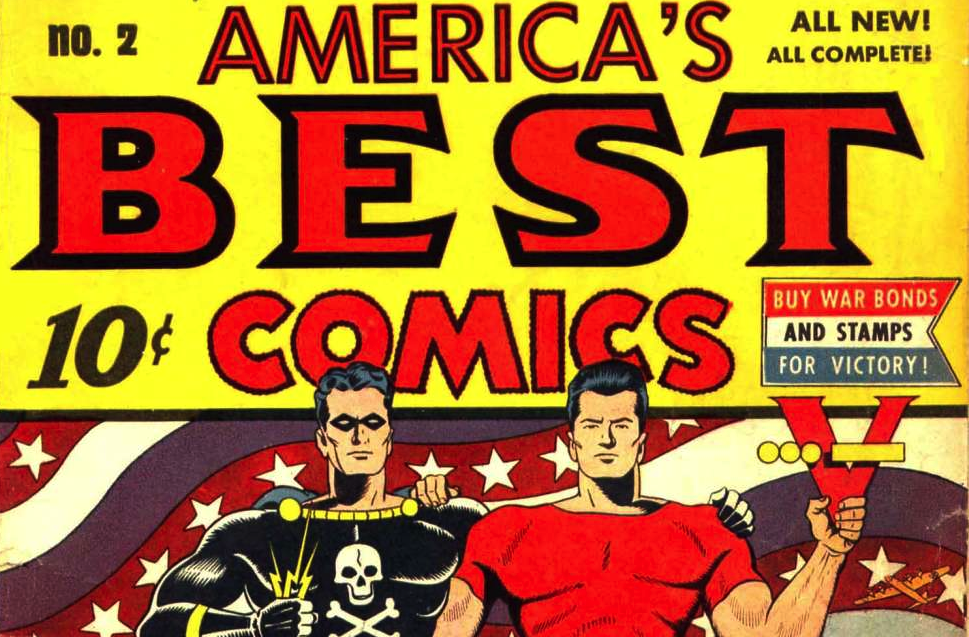
The decade beginning with the late 1930s is known as the Golden Age of comic books. Many of the superheroes from today’s blockbuster franchises, including Batman, Superman, and Captain America, emerged during this period, and the industry grew into a commercial powerhouse. Following a sales dip during the early 1950s that marked the end of the Golden Age, the Silver Age began (circa 1956) and lasted for some fifteen years.
During this era, superhero comic books initially lost steam — letting stories of horror, romance, and crime grow in popularity — before emerging triumphantly once more with characters like Spider-Man and The Flash. While copyright remains very much in effect for such titles, a slew of comic books from the same period, many of which have narrowly missed attaining such iconic status, are available online at Comic Book Plus.
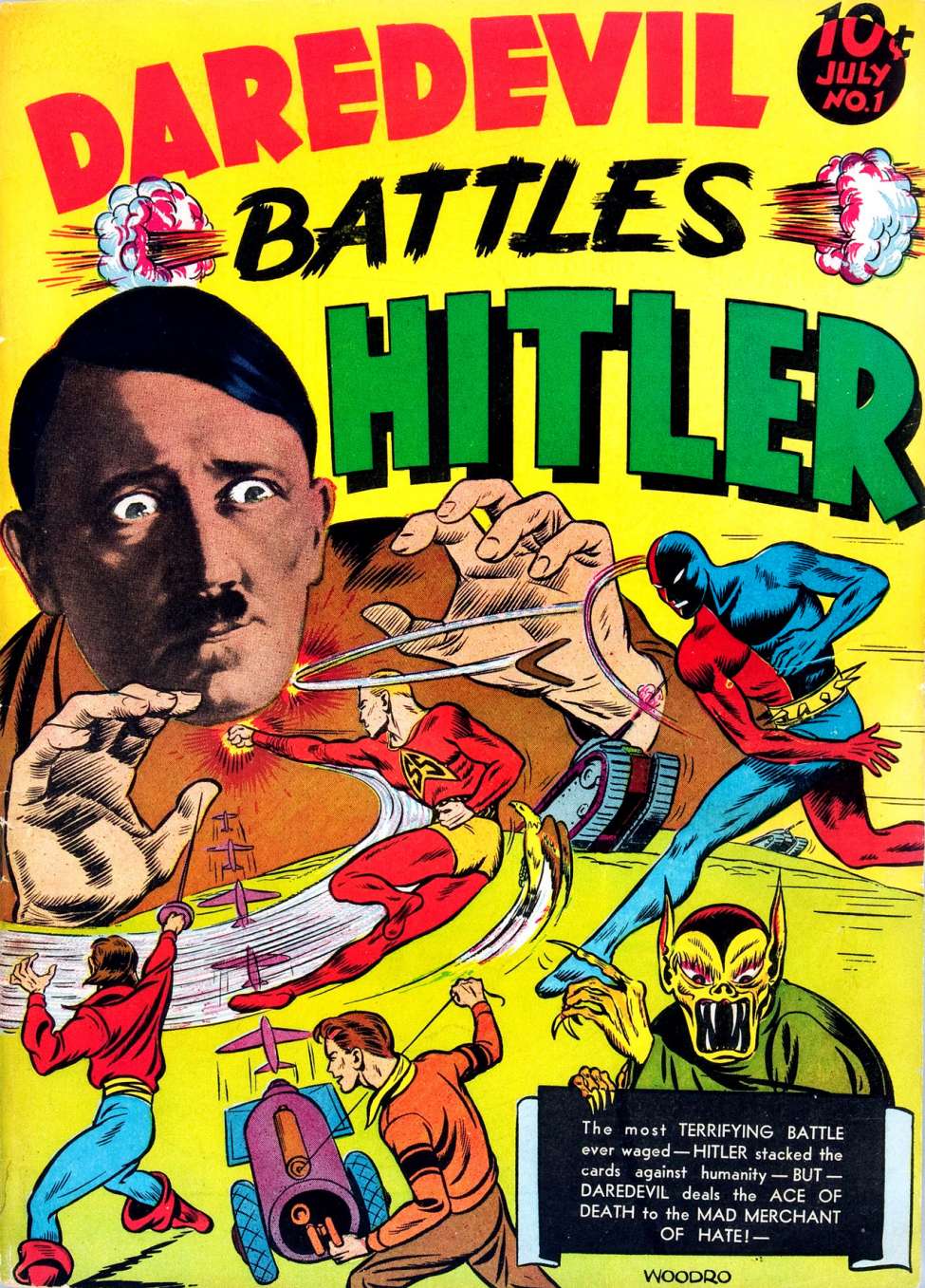
Similar to the Digital Comic Museum, which we wrote about last week, Comic Book Plus contains a near inexhaustible quantity of Golden and Silver Age comic books. The collection’s timespan ranges from the late 1930s through to the early 1960s, and includes many thousands of comic books in the Superhero, Sci-Fi, and Horror genres.
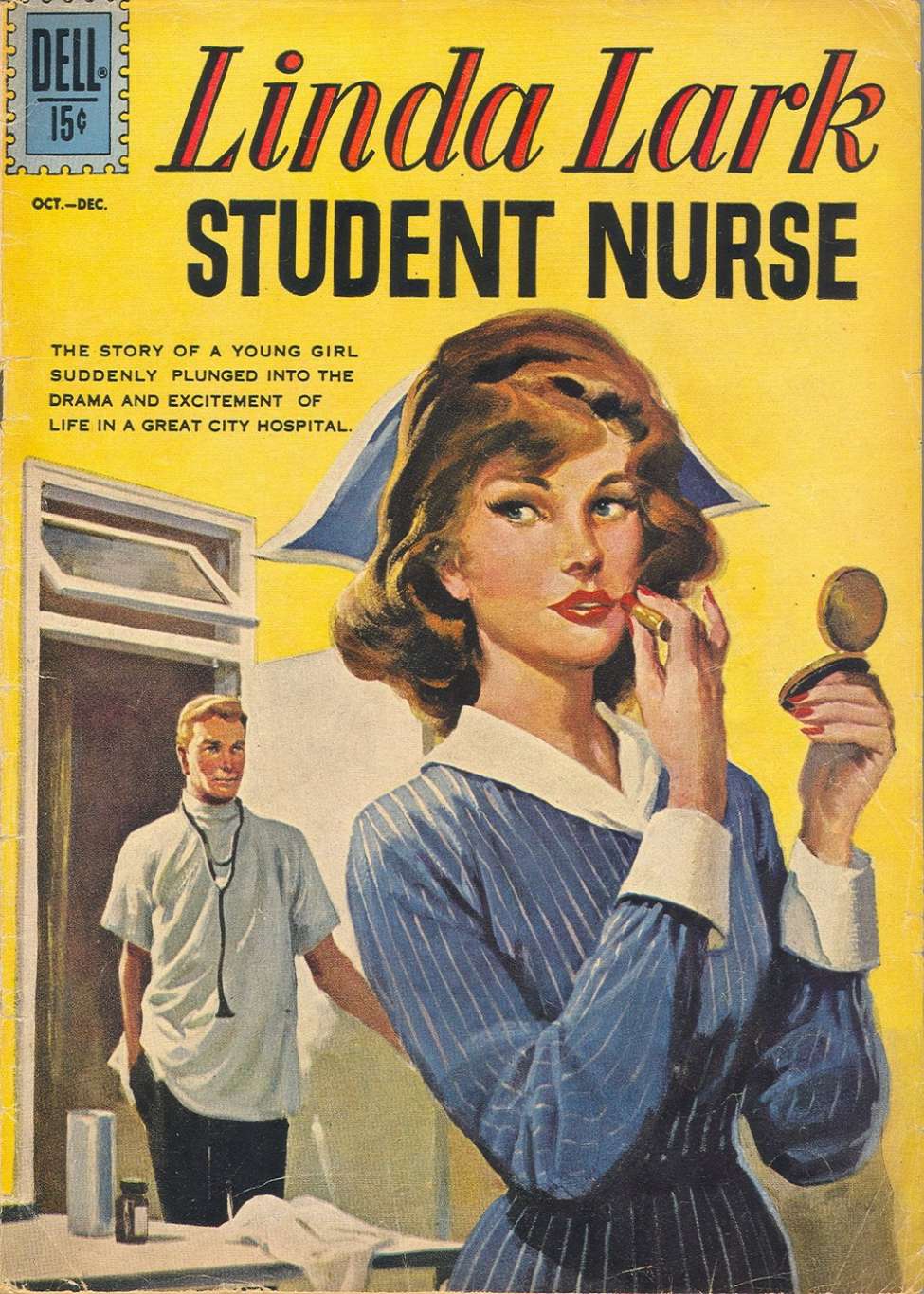
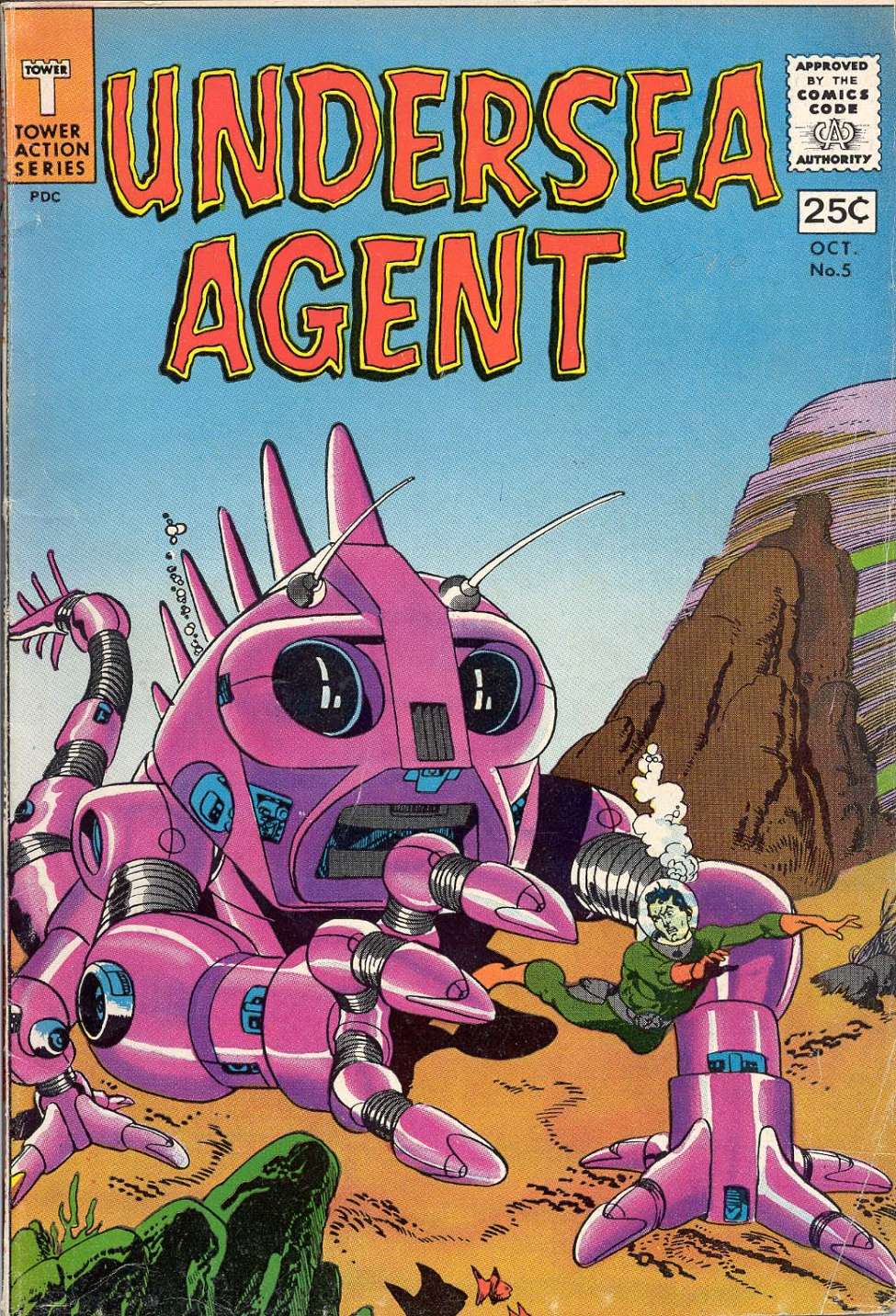
Those hankering for something a little more unusual will also be in luck. Desperate to read about a hospital romance? Why not give Linda Lark Student Nurse a read in the Medical Love category? Sick of landlubbers hogging all the attention in comic books? Head to the Water/Boats section, where you can read all about Davy Jones, the navy lieutenant who lives in Atlantis and does battle with the evil Dr. Fang, in Undersea Agent.
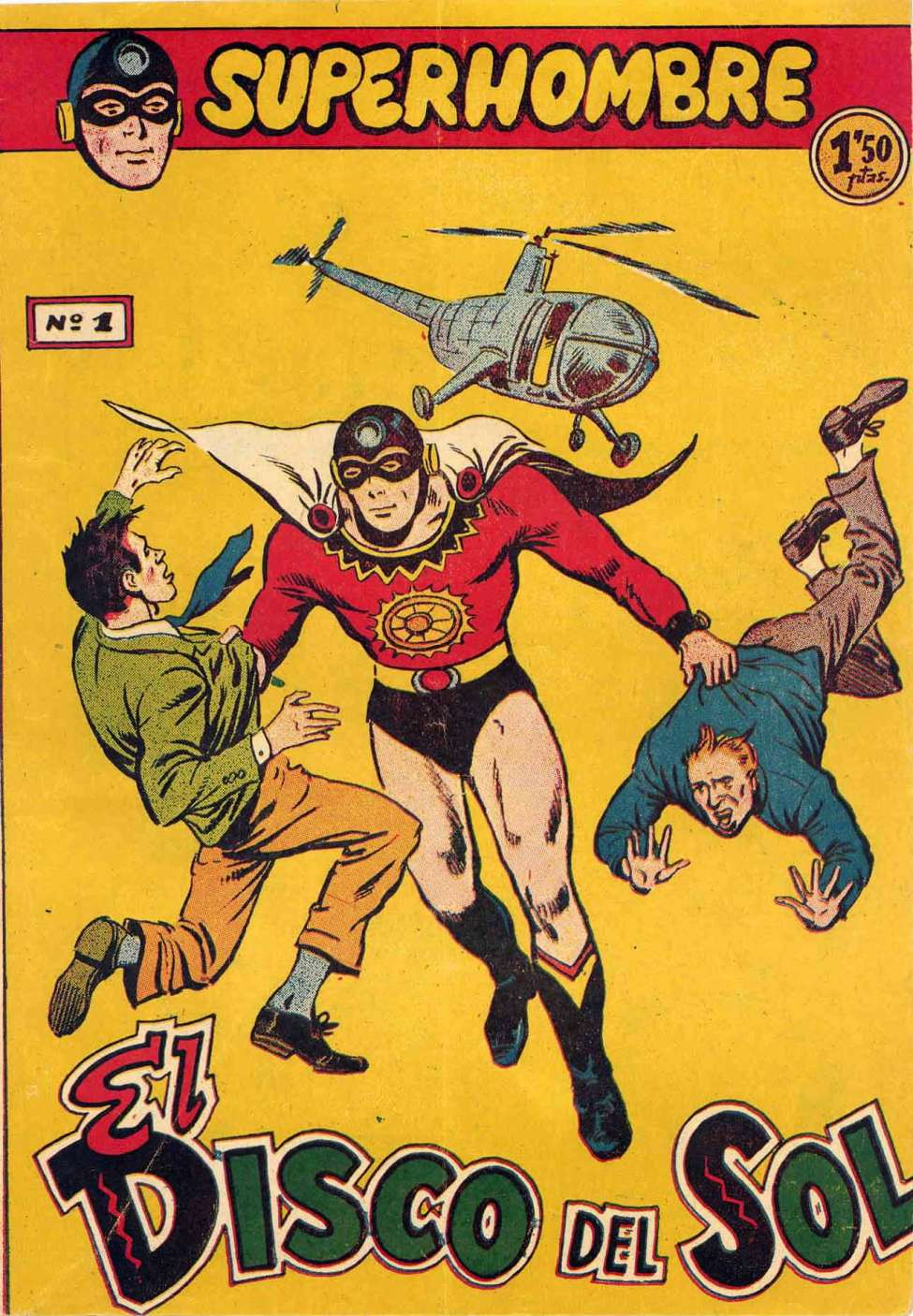
Comic Book Plus also has a terrific selection of foreign comic books, including impressive collections in German, Hindi, Italian, Portuguese, and Spanish. You can see Super Hombre here.
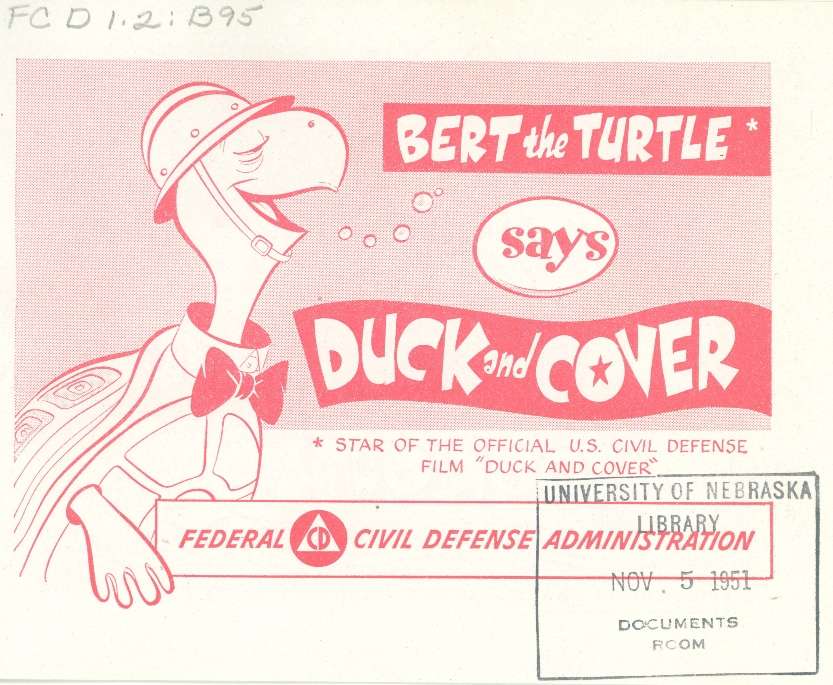
Finally, the site contains a number of U.S. government educational pamphlets, including Bert The Turtle Says Duck And Cover, a guide to surviving atomic bomb blasts.
For further reading, head on over to Comic Book Plus. You can preview all materials without registration. But you will need to register (for free) if you want to download the various comic books.
H/T to Yocitrus for making us aware of this archive.
Ilia Blinderman is a Montreal-based culture and science writer. Follow him at @iliablinderman, or read more of his writing at the Huffington Post.
Related Content:
Download 15,000+ Free Golden Age Comics from the Digital Comic Museum
Free Comic Books Turn Kids Onto Physics: Start with the Adventures of Nikola Tesla
Read More...Support Us
We're hoping to rely on loyal readers, rather than erratic ads. Please click the Donate button and support Open Culture. You can use Paypal, Venmo, Patreon, even Crypto! We thank you!

About Us

Open Culture scours the web for the best educational media. We find the free courses and audio books you need, the language lessons & educational videos you want, and plenty of enlightenment in between.
Advertise With Us

FREE UPDATES!
GET OUR DAILY EMAIL
Get the best cultural and educational resources on the web curated for you in a daily email. We never spam. Unsubscribe at any time.
FOLLOW ON SOCIAL MEDIA

Open Culture editor Dan Colman scours the web for the best educational media. He finds the free courses and audio books you need, the language lessons & movies you want, and plenty of enlightenment in between.
Advertise With Us


