19th-Century Japanese Woodblocks Illustrate the Lives of Western Inventors, Artists, and Scholars (1873)
For more than 200 years between the mid-17th and mid-19th century, Japan closed itself to the outside world. But when it finally opened again, it couldn’t get enough of the outside world. The American Navy commodore Matthew Perry arrived with his formidable “Black Ships” in 1853, demanding that Japan engage in trade. Five years later came the Meiji Restoration, which consolidated Japan’s political system under imperial rule and encouraged both industrialization and Westernization. Or rather, it encouraged the importation of Western technology and ideas for use in Japanese ways, a combination known as wakon-yōsai, meaning “Japanese spirit and Western techniques.”
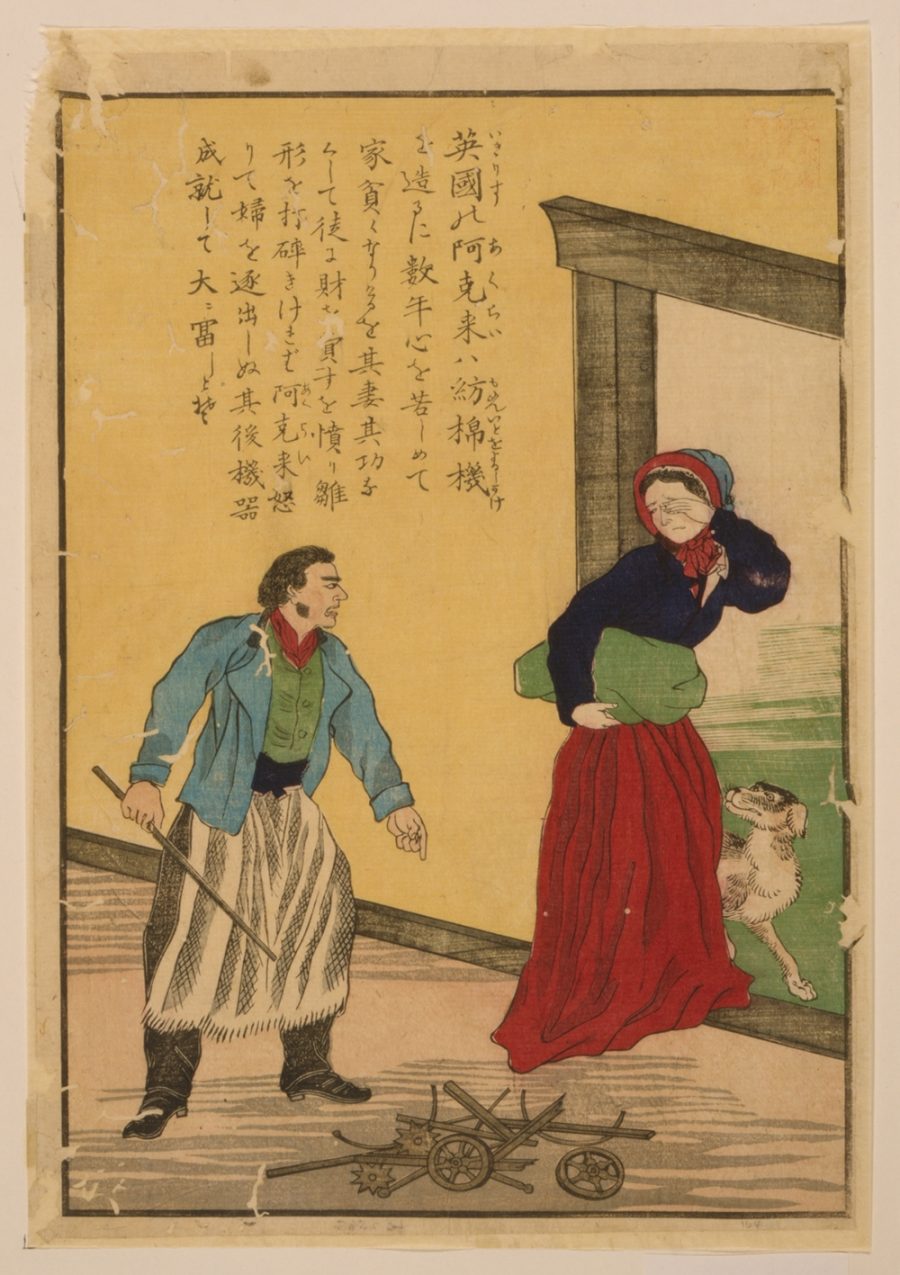
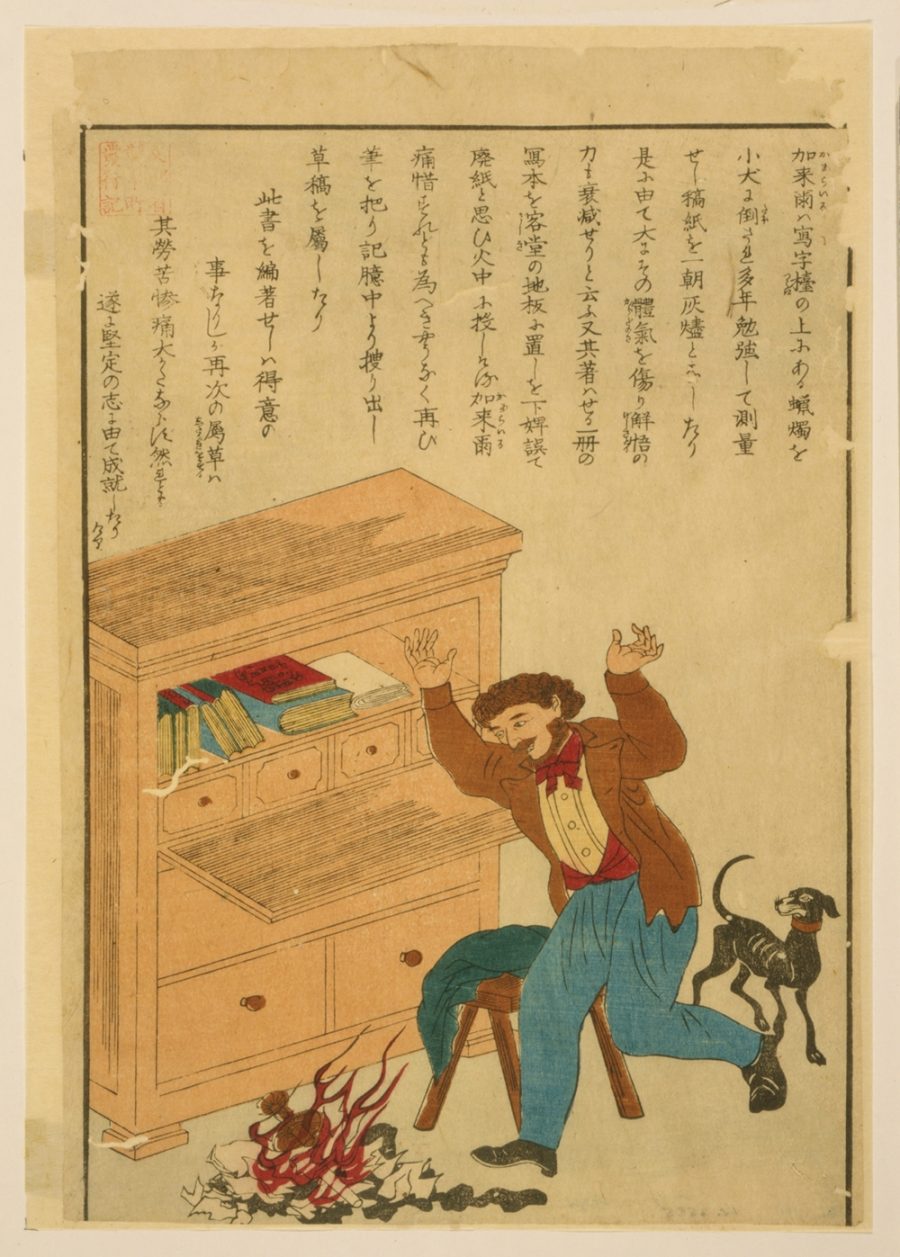
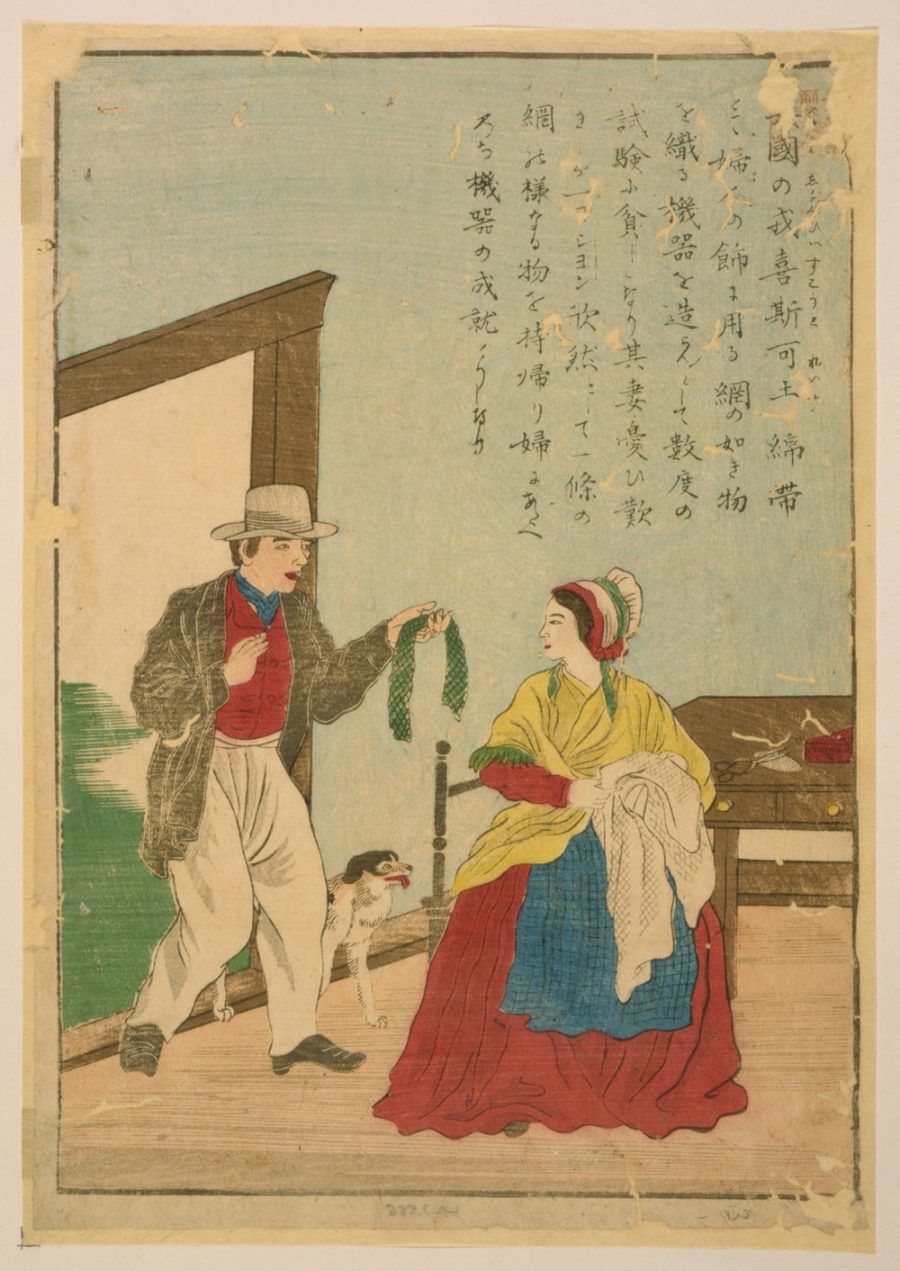
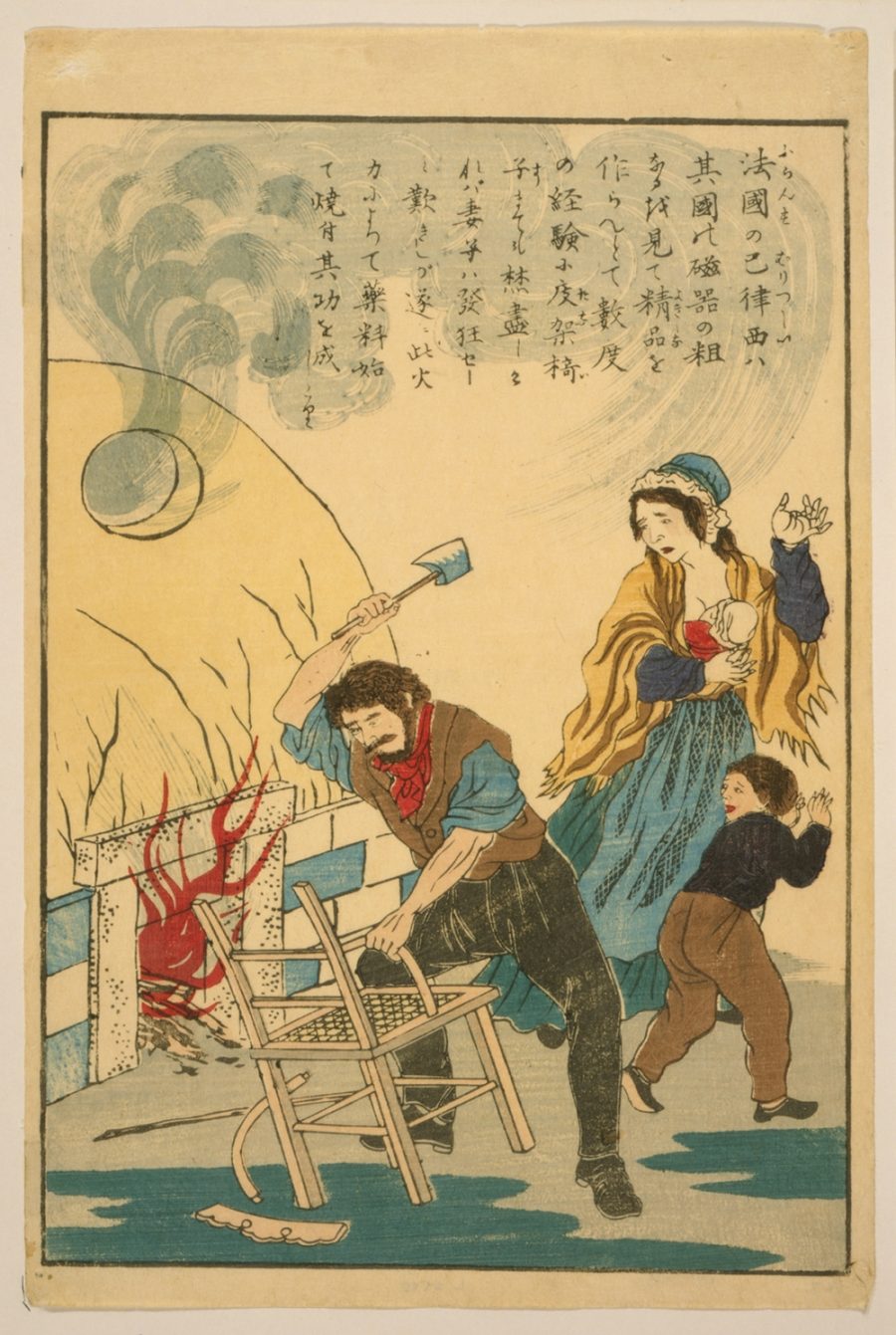
It is in the mindset of wakon-yōsai, says the Public Domain Review, that we should view these Japanese woodblock prints of Western inventors, scholars, and artists. Most likely dating from 1873 — a heady time for the mixture of Japanese spirit and Western techniques — they depict these figures facing a variety of challenges, some more plausible than others.
“The great naturalist John James Audubon battles with a mischievous rat who has eaten his work; the dog of historian and poet Thomas Carlyle has upset a lamp burning his papers; the wife of Richard Arkwright, inventor of the spinning-frame, smashes his creation; the developer of the Watt steam engine James Watt suffers the wrath of his impatient Aunt; pottery impresario Bernard Palissy has to burn his family’s furniture to keep his kiln’s fire going.”
Commissioned by the Japanese Department of Education, these schoolbook illustrations may bring to mind the 1861 Japanese history of America previously featured on Open Culture, with its tiger-punching George Washington and serpent-slaying John Adams. But the text that accompanies these mightily struggling Western luminaries, translations of which you can find along with the images at the Public Domain Review, “paints a slightly more positive picture, revealing the moral, something akin to ‘If at first you don’t succeed then try again,’ or ‘Perseverance prospers.’ ” In Japan’s case, perseverance would indeed make it one of the most prosperous nations in the world — if only after its defeat in World War II, by some of the very nations whose historical figures it had lionized less than a century before. Find more images at the Public Domain Review and the Library of Congress.
Related Content:
Download Hundreds of 19th-Century Japanese Woodblock Prints by Masters of the Tradition
Enter a Digital Archive of 213,000+ Beautiful Japanese Woodblock Prints
The 10 Commandments of Chindōgu, the Japanese Art of Creating Unusually Useless Inventions
Based in Seoul, Colin Marshall writes and broadcasts on cities, language, and culture. His projects include the book The Stateless City: a Walk through 21st-Century Los Angeles and the video series The City in Cinema. Follow him on Twitter at @colinmarshall, on Facebook, or on Instagram.
Read More...Central Park Bird Watcher Christian Cooper Writes DC Comics Graphic Novel: It’s Now Free Online

Write what you know.
It’s oft-cited advice for writers both beginning and established.
Thus, Jules, the teenage boy at the center of Christian Cooper’s It’s a Bird, the first entry in DC Comics’ digital-first anthology series Represent!, is a birdwatcher, like the author.
And the binoculars that were a 50th birthday gift from Cooper’s father, a Korean War vet and Civil Rights activist, serve as models for the ones Jules is none too thrilled to receive, despite his grandpa’s belief that they possess special powers.
Cooper, who was was Marvel’s first openly gay writer and editor, introducing a number of queer characters before devoting himself to science writing, also draws on recent personal history that is more fraught.
Although the location has shifted from New York City’s Central Park to a suburban green space bordered with large, well-kept homes, including Jules’, the young man’s encounter with an indignant white woman and her off-leash dog should ring any number of bells.
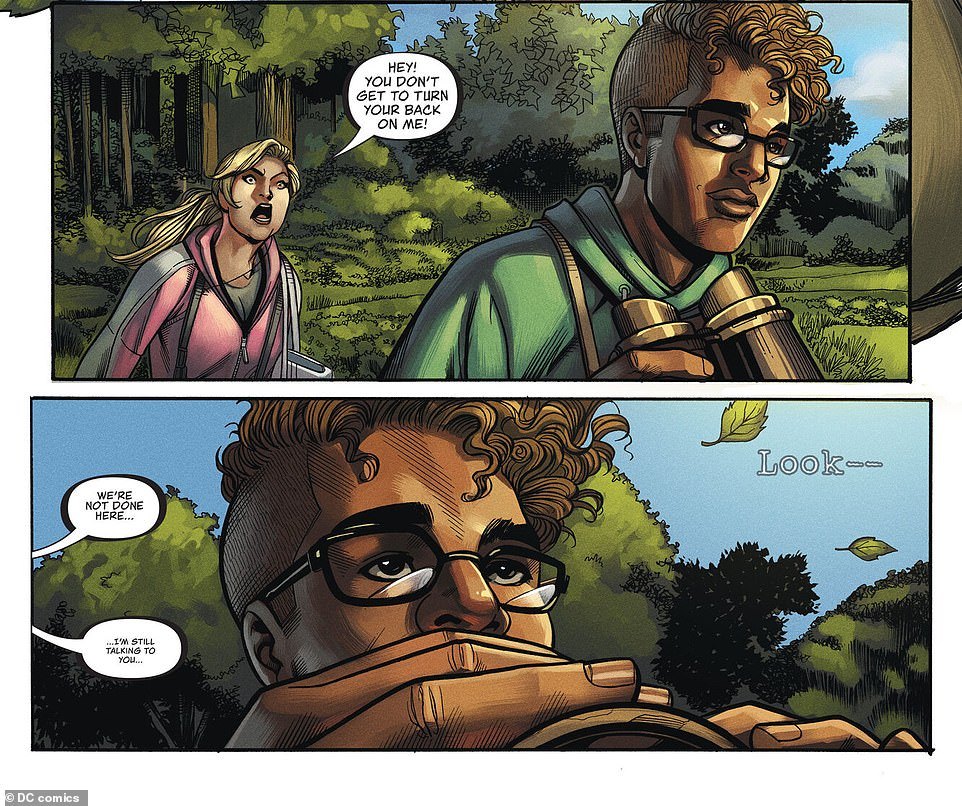
In late May, Cooper became the subject of national news, when he confronted Amy Cooper (no relation) over her violation of park rules, tired of the havoc uncontrolled dogs wreak on birds who call the park home. Ms. Cooper escalated things quickly by calling 911, claiming she was being threatened by an African-American man. Cooper recorded the incident as a matter of protocol, and his sister shared the video on social media later that day.
The same day that George Floyd was killed by police in Minneapolis, Minnesota.
What Jules sees through the lenses of his grandfather’s binoculars contains an element of fantasy, but is also deeply rooted in reality—the faces of Amidou Diallo, Breonna Taylor, Floyd, and other Black people who have died as a result of excessive, unwarranted police force.
When DC first approached him about tapping his experience for his first comic in over two decades, Cooper was reluctant:
I thought, “I don’t know, DC Comics? Superheroes? Not sure how that’s going to work.” We kicked around a couple of ideas. They said they had gotten the title, I’m not sure exactly from who, but somebody pretty high up in the DC food chain: “It’s a Bird.” It took me half a beat. “Oh…I get what you did there.” Once I had the title, the story wrote itself.
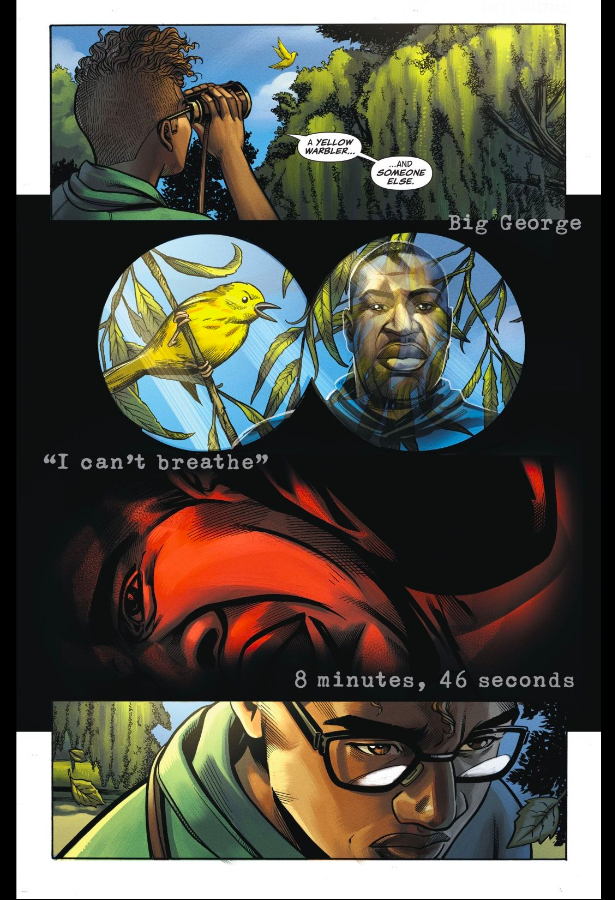
It’s a Bird artist Aletha E. Martinez, a pioneer whose 20-year career has included inking such superhero heavy hitters as the Black Panther, Iron Man, Batgirl, and X‑Men, also pulled from personal experience when rendering Jules’ expression after the binoculars reveal the circumstances of George Floyd’s death:
I saw that look on my son’s face three years ago after we left North Carolina, and we were coming home to New York. We were stopped going into the airport. We travel so often—cons, in and out of the country. These two security guards started to harass us. They wanted to take my purse. “Where are you from?” You hear my voice, there’s no accent in my voice. It ended up with them saying, “You should travel with your passport.” This is after backing us up in the corner, and why? I’m an American citizen born on this soil, so is my son. I don’t need a passport to travel within my country. This is our day and age.
I watched my son’s face change, and he never quite walked up again looking happy going to the airport. Now he has on armor. That face you see? That’s my kid.
It’s a Bird can be read for free on participating digital platforms (see links below), and Cooper is hopeful that it will inspire young people to find out more about some of the real life characters Jules spies through his binoculars. To that end, an appendix touches on some biographical details:
We not only give the bare bones details of how they died, but also a little bit about them, because they were people. They weren’t just want happened to them. I hope young people (are) inspired to keep the focus where it needs to be, which is on those we have lost and how we keep from losing more. There are people who are invested in distracting us right now, and there are people who want to distract us from their failures on so many other things. That’s not what this moment is about. This moment is about the ones we’ve lost, and how we’re going to keep from losing any more. And if you’re not talking about that, I don’t want to hear it.
Read Represent!: It’s a Bird for free on readdc.com, Comixology, Amazon Kindle, Apple Books, and other participating digital platforms.
Read an interview with Cooper and Martinez, from which the quotes in this post are drawn, on DC’s blog.
Related Content:
A New Digital Archive Preserves Black Lives Matter & COVID-19 Street Art
Batman Stars in an Unusual Cartoon Adaptation of Dostoyevsky’s Crime and Punishment
Ayun Halliday is an author, illustrator, theater maker and Chief Primatologist of the East Village Inky zine. Follow her @AyunHalliday.
Read More...William Blake’s Paintings Come to Life in Two Animations
The poet and painter William Blake toiled in obscurity, for the most part, and died in poverty.
Twenty some years after his death, his rebellious spirit gained traction with the Pre-Raphaelites.
By the dawning of the Age of Aquarius, Blake was ripe to be venerated as a counter-cultural hero, for having flown in the face of convention, while championing gender and racial equality, nature, and free love.
Reclining half-naked on a “a fabulous couch in Harlem,” poet Allen Ginsburg had a hallucinatory encounter wherein Blake recited to him “in earthen measure.”
Ditto poet Michael McClure, though in his case, Bob Dylan’s “Gates of Eden” served as something of a medium:
I had the idea that I was hallucinating, that it was William Blake’s voice coming out of the walls and I stood up and put my hands on the walls and they were vibrating.
Blake’s work (and world view) continues to exert enormous influence on graphic novelists, theatermakers, and creatives of every stripe.
He’s also a dab hand at animation, collaborating from beyond the grave.
The short above, a commission for a late ‘70s Blake exhibition at The Tate, envisions a roundtrip journey from Heaven to Hell. Animator Sheila Graber parked herself in the Sculpture Hall to create it in public view, pairing Blake’s line “Energy is Eternal delight” with a personal observation:
Whether we use it to create or destroy—it’s the same energy. The practice of art can turn a person from a vandal to a builder!
More recently, the Tate gave director Sam Gainsborough access to super high-res imagery of Blake’s original paintings, in order to create a promo for last year’s blockbuster exhibition.
Gainsborough and animator Renaldho Pelle worked together to bring the chosen works to life, frame by frame, against a series of London buildings and streets that were well known to Blake himself.
The film opens with Blake’s Ghost of a Flea emerging from the walls of Broadwick Street, where its creator was born, then stalking off, bowl in hand, ceding the screen to God, The Ancient of Days, whose reach spreads like ink across the gritty facade of a white brick edifice.
Seymour Milton’s original music and Jasmine Blackborow’s narration of excerpts from Blake’s poem “Auguries of Innocence” seem to anticipate the fraught current moment, as does the entire poem:
Auguries of Innocence
To see a World in a Grain of Sand
And a Heaven in a Wild Flower
Hold Infinity in the palm of your hand
And Eternity in an hour
A Robin Red breast in a Cage
Puts all Heaven in a Rage
A Dove house filld with Doves & Pigeons
Shudders Hell thr’ all its regions
A dog starvd at his Masters Gate
Predicts the ruin of the State
A Horse misusd upon the Road
Calls to Heaven for Human blood
Each outcry of the hunted Hare
A fibre from the Brain does tear
A Skylark wounded in the wing
A Cherubim does cease to sing
The Game Cock clipd & armd for fight
Does the Rising Sun affright
Every Wolfs & Lions howl
Raises from Hell a Human Soul
The wild deer, wandring here & there
Keeps the Human Soul from Care
The Lamb misusd breeds Public Strife
And yet forgives the Butchers knife
The Bat that flits at close of Eve
Has left the Brain that wont Believe
The Owl that calls upon the Night
Speaks the Unbelievers fright
He who shall hurt the little Wren
Shall never be belovd by Men
He who the Ox to wrath has movd
Shall never be by Woman lovd
The wanton Boy that kills the Fly
Shall feel the Spiders enmity
He who torments the Chafers Sprite
Weaves a Bower in endless Night
The Catterpiller on the Leaf
Repeats to thee thy Mothers grief
Kill not the Moth nor Butterfly
For the Last Judgment draweth nigh
He who shall train the Horse to War
Shall never pass the Polar Bar
The Beggars Dog & Widows Cat
Feed them & thou wilt grow fat
The Gnat that sings his Summers Song
Poison gets from Slanders tongue
The poison of the Snake & Newt
Is the sweat of Envys Foot
The poison of the Honey Bee
Is the Artists Jealousy
The Princes Robes & Beggars Rags
Are Toadstools on the Misers Bags
A Truth thats told with bad intent
Beats all the Lies you can invent
It is right it should be so
Man was made for Joy & Woe
And when this we rightly know
Thro the World we safely go
Joy & Woe are woven fine
A Clothing for the soul divine
Under every grief & pine
Runs a joy with silken twine
The Babe is more than swadling Bands
Throughout all these Human Lands
Tools were made & Born were hands
Every Farmer Understands
Every Tear from Every Eye
Becomes a Babe in Eternity
This is caught by Females bright
And returnd to its own delight
The Bleat the Bark Bellow & Roar
Are Waves that Beat on Heavens Shore
The Babe that weeps the Rod beneath
Writes Revenge in realms of Death
The Beggars Rags fluttering in Air
Does to Rags the Heavens tear
The Soldier armd with Sword & Gun
Palsied strikes the Summers Sun
The poor Mans Farthing is worth more
Than all the Gold on Africs Shore
One Mite wrung from the Labrers hands
Shall buy & sell the Misers Lands
Or if protected from on high
Does that whole Nation sell & buy
He who mocks the Infants Faith
Shall be mockd in Age & Death
He who shall teach the Child to Doubt
The rotting Grave shall neer get out
He who respects the Infants faith
Triumphs over Hell & Death
The Childs Toys & the Old Mans Reasons
Are the Fruits of the Two seasons
The Questioner who sits so sly
Shall never know how to Reply
He who replies to words of Doubt
Doth put the Light of Knowledge out
The Strongest Poison ever known
Came from Caesars Laurel Crown
Nought can Deform the Human Race
Like to the Armours iron brace
When Gold & Gems adorn the Plow
To peaceful Arts shall Envy Bow
A Riddle or the Crickets Cry
Is to Doubt a fit Reply
The Emmets Inch & Eagles Mile
Make Lame Philosophy to smile
He who Doubts from what he sees
Will neer Believe do what you Please
If the Sun & Moon should Doubt
Theyd immediately Go out
To be in a Passion you Good may Do
But no Good if a Passion is in you
The Whore & Gambler by the State
Licencd build that Nations Fate
The Harlots cry from Street to Street
Shall weave Old Englands winding Sheet
The Winners Shout the Losers Curse
Dance before dead Englands Hearse
Every Night & every Morn
Some to Misery are Born
Every Morn and every Night
Some are Born to sweet delight
Some are Born to sweet delight
Some are Born to Endless Night
We are led to Believe a Lie
When we see not Thro the Eye
Which was Born in a Night to perish in a Night
When the Soul Slept in Beams of Light
God Appears & God is Light
To those poor Souls who dwell in Night
But does a Human Form Display
To those who Dwell in Realms of day
Related Content:
William Blake’s Masterpiece Illustrations of the Book of Job (1793–1827)
Ayun Halliday is an author, illustrator, theater maker and Chief Primatologist of the East Village Inky zine. Follow her @AyunHalliday.
Read More...A Beautiful 1897 Illustrated Book Shows How Flowers Become Art Nouveau Designs
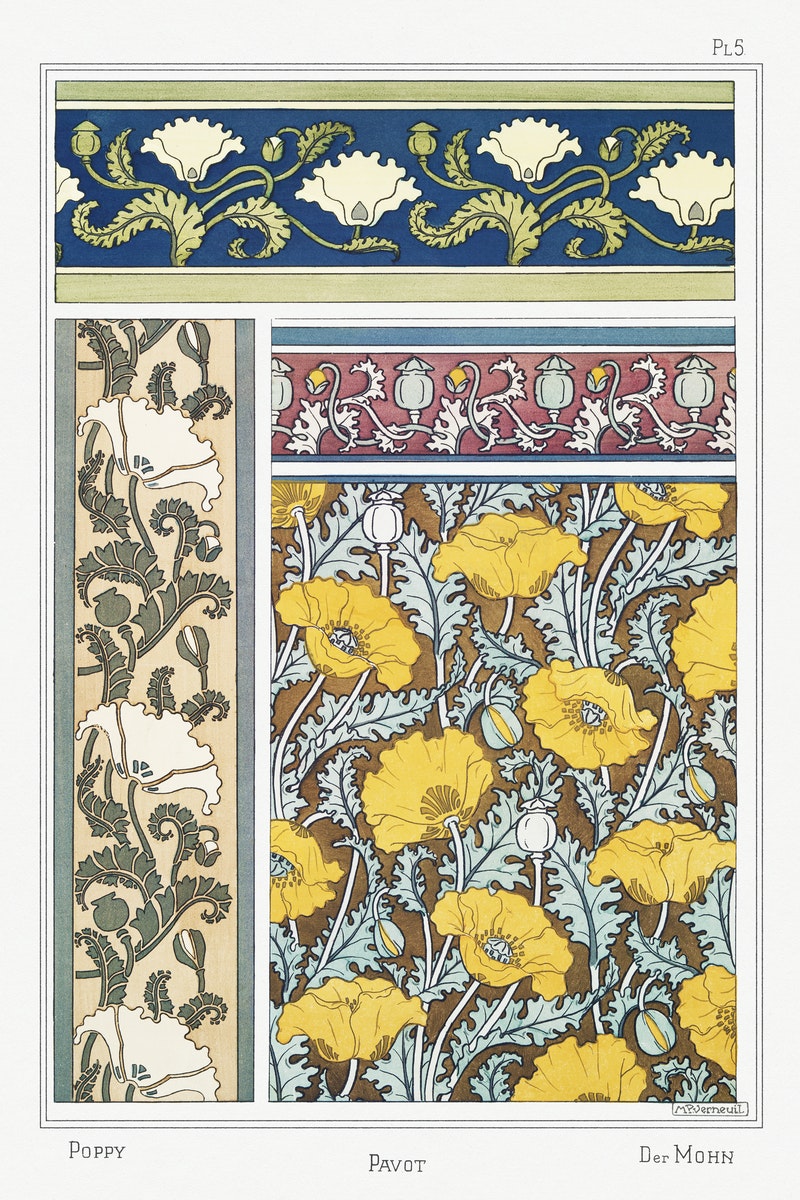
The art of drawing is not the art of observing forms and objects alone, it is not mere mimicry of these objects; it is the art of knowing how far and wherein, and with what just limitations, those forms and objects can be reproduced in a picture, or in a decorative work. — Eugène Grasset, 1896
Flowers loomed large in Art Nouveau, from the voluptuous floral headpieces that crowned Alphonse Mucha’s female figures to the stained glass roses favored by architect Charles Rennie Mackintosh.
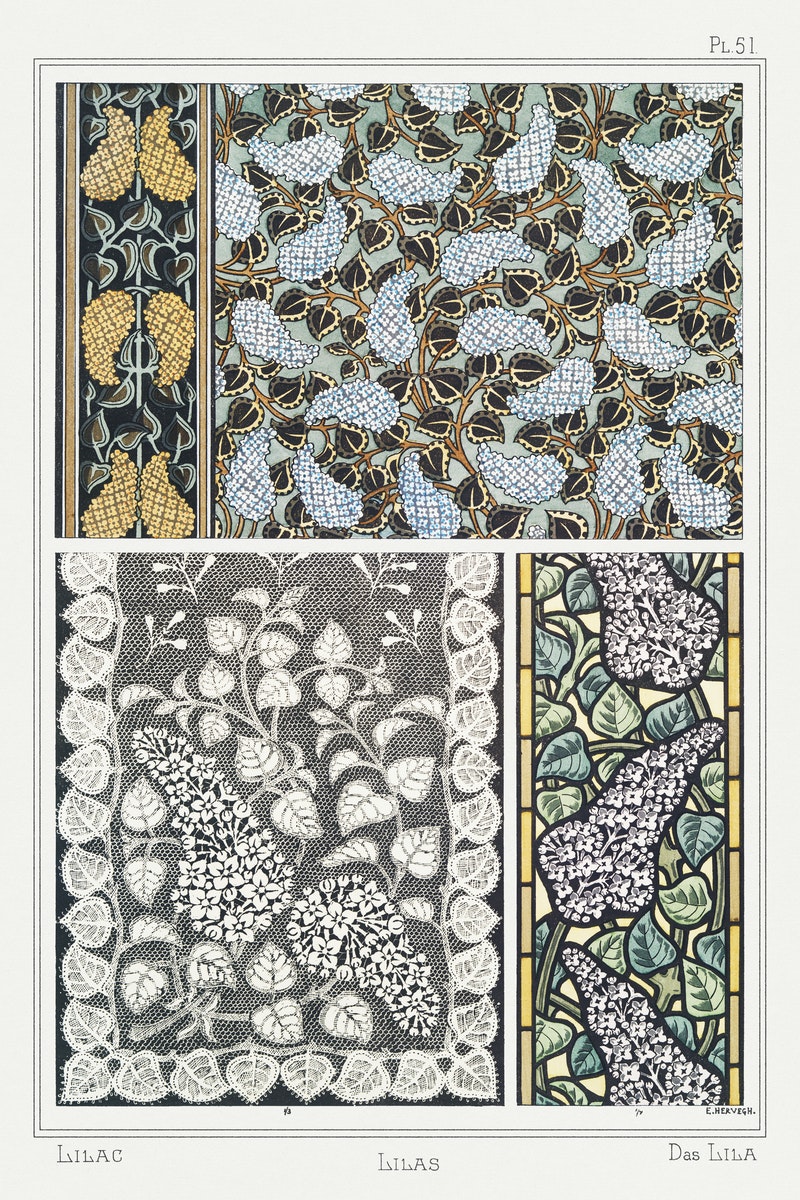
Graphic designer Eugène Grasset’s 1897 book, Plants and Their Application to Ornament, vividly demonstrates the ways in which nature was distilled into popular decorative motifs at the end of the 19th-century.
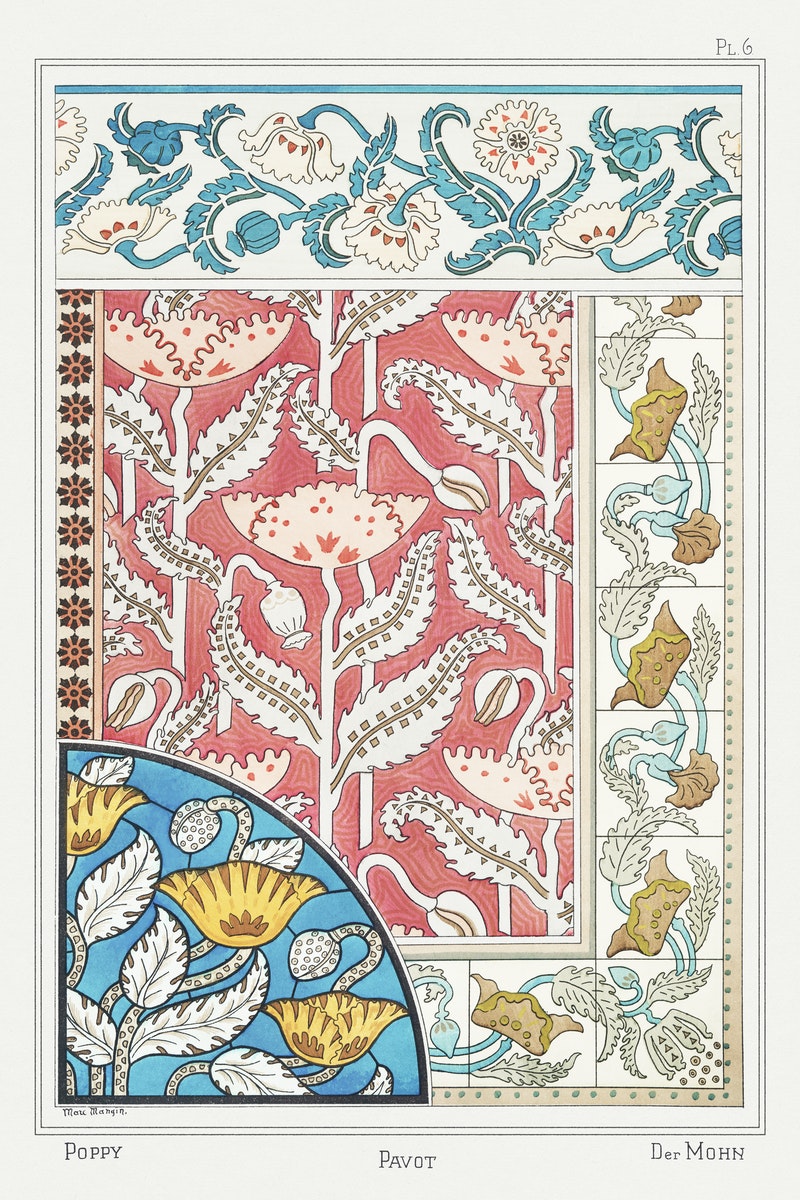
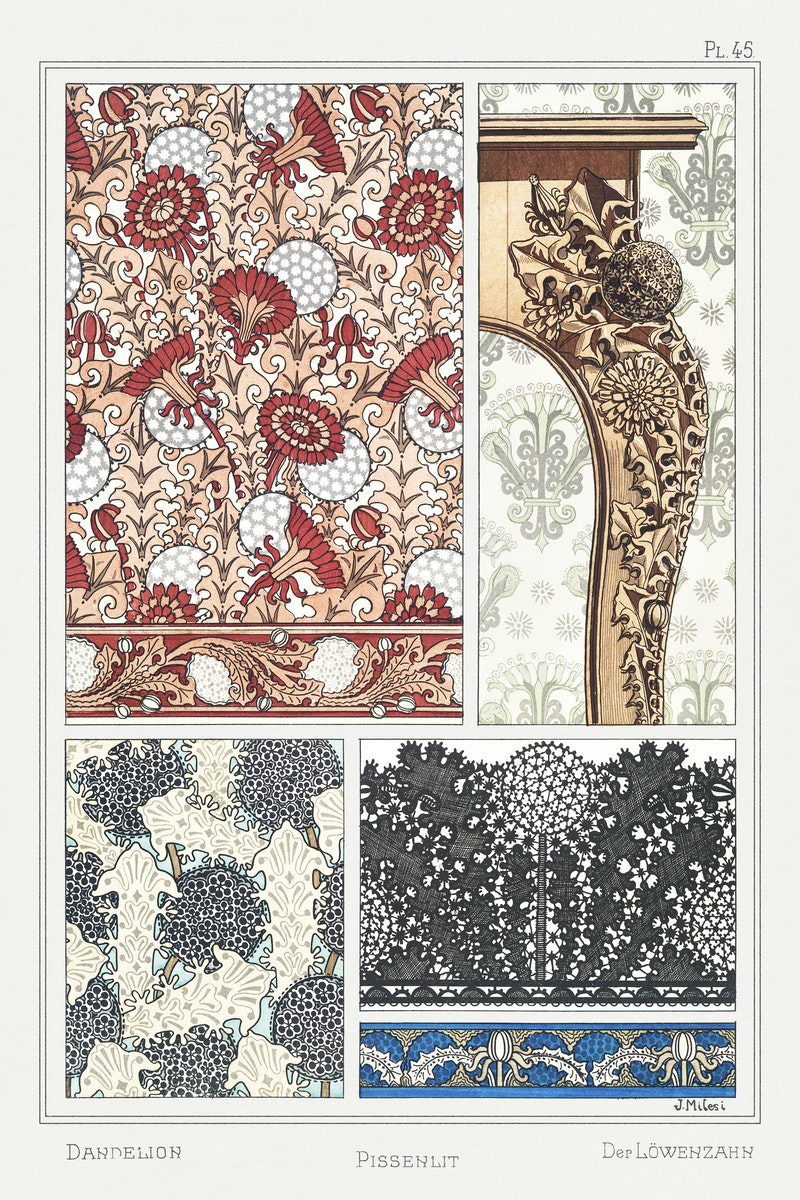
Twenty-four flowering plants were selected for consideration, from humble specimens like dandelions and thistle to such Art Nouveau heavy hitters as poppies and irises.
Each flower is represented by a realistic botanical study, with two additional color plates in which its form is flattened out and mined for its decorative, stylistic elements.
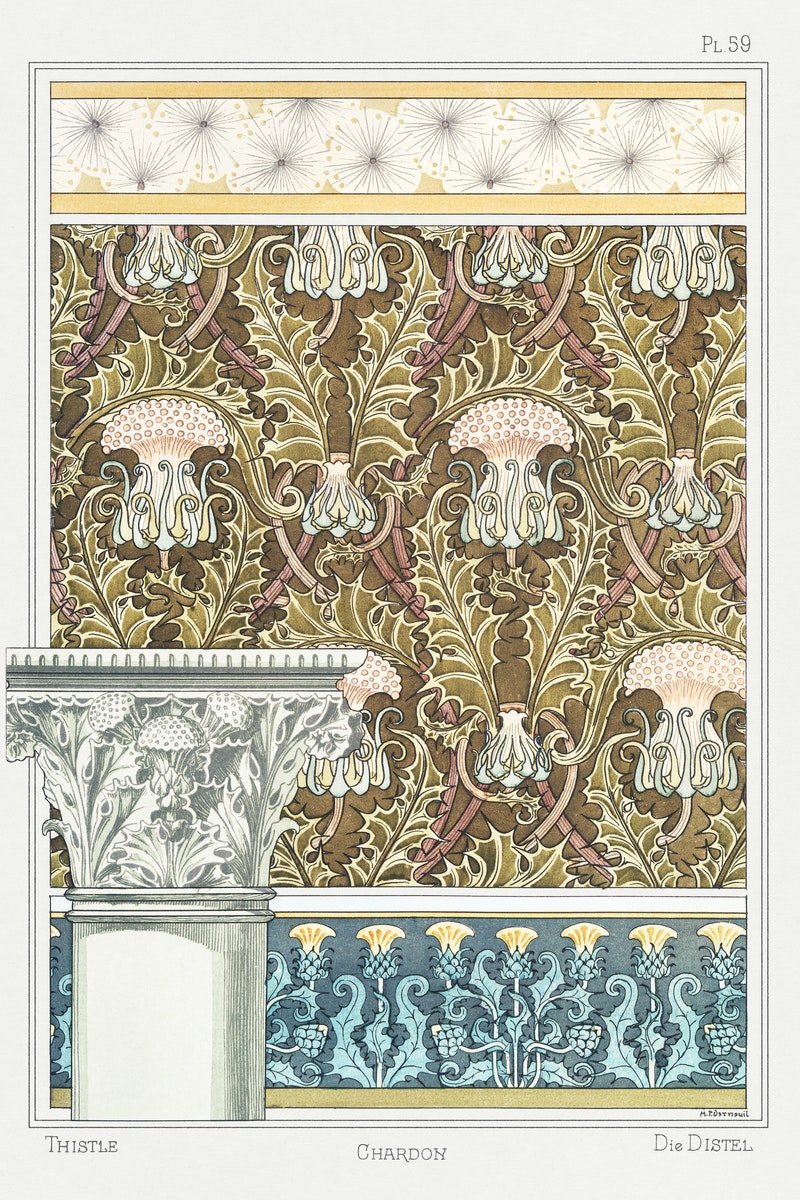
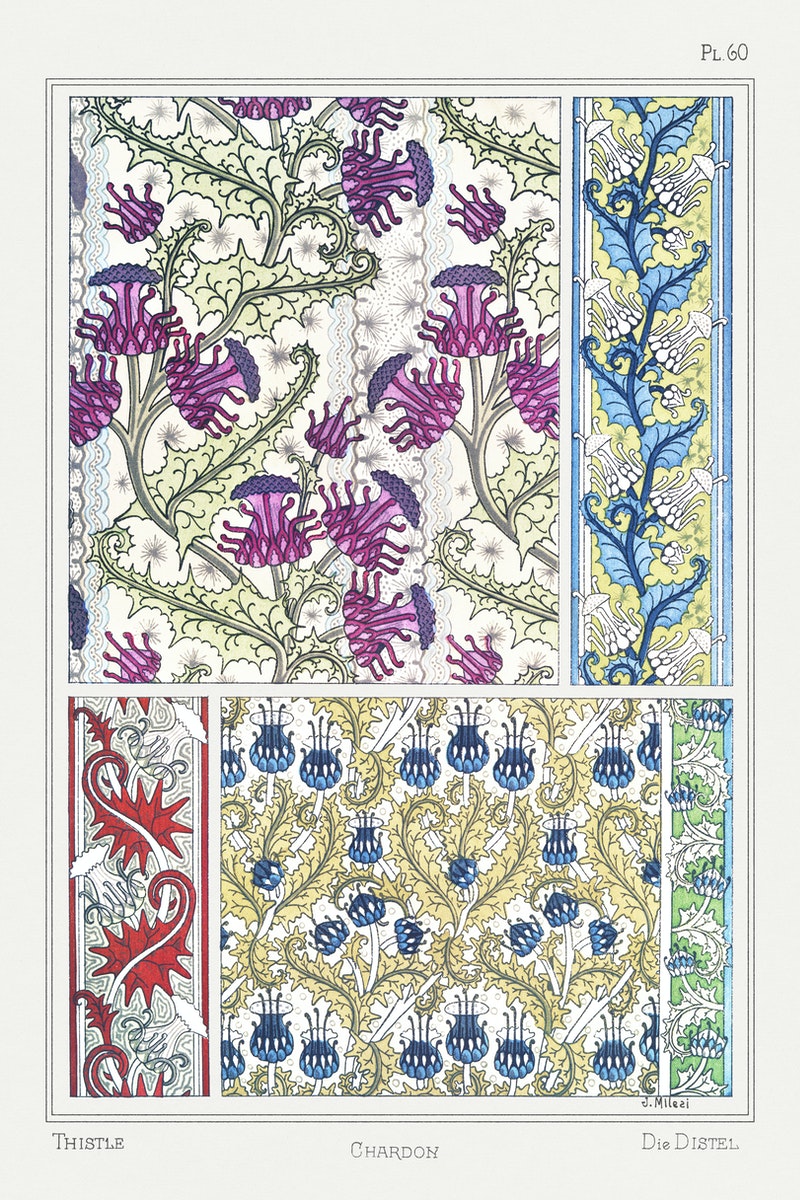
The plates were rendered by Grasset’s students at the École Guérin, young artists whom he had “forbidden to condescend to the art of base and servile imitation”:
The art of drawing is not the art of observing forms and objects alone, it is not mere mimicry of these objects; it is the art of knowing how far and wherein, and with what just limitations, those forms and objects can be reproduced in a picture, or in a decorative work.
He also expected students to hone their powers of observation through intense study of the organic structures that would provide their inspiration, becoming intimately acquainted with the character of petal, leaf, and stem:
Beautiful lines are the foundation of all beauty. In a work of art, whatever it be, apparent or hidden symmetry is the visible or secret cause of the pleasure we feel. Everything that is created must have some repetition in its parts to be understood, retained in the memory, and perceived as a whole
When it came to adorning household implements such as vases and plates, Grasset insisted that decorative elements exist in harmony with their hosts, sniping that any artist who would distort form with ill considered flourishes should make a bas-relief instead.

Thusly do chrysanthemum stems provide logical-looking ballast for a chandelier, and a dandelion’s curved leaves hug the contours of a table leg.

Grasset’s best known student, Maurice Pillard Verneuil, whose career spanned Art Nouveau to Art Deco, absorbed and articulated the master’s teachings:
It is no longer the nature (artists) see that they represent, that they transcribe, but the nature that they aspire to see; nature more perfect and more beautiful and of which they have the interior vision.
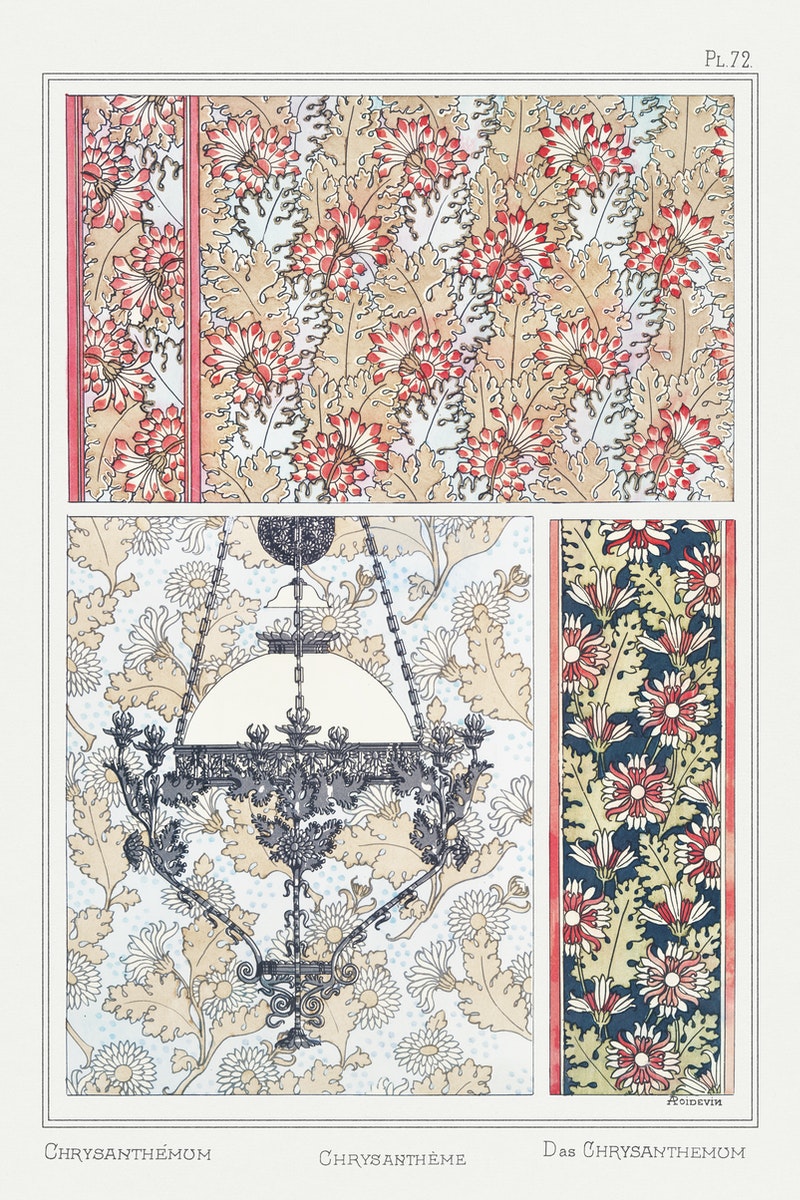
View Eugène Grasset’s Plants and Their Application to Ornament as part of the New York Public Library’s Digital Collections here. Or find illustrations at RawPixel.
Related Content:
Ayun Halliday is an author, illustrator, theater maker and Chief Primatologist of the East Village Inky zine. Follow her @AyunHalliday.
Read More...JamBase Launches a New Video Archive of 100,000 Streaming Concerts: Phish, Wilco, the Avett Brothers, Grateful Dead & Much More
People do not tend to answer the question, “do you like Phish?” with, “yeah, I guess they’re okay.” Those who like Phish, love Phish, devotedly and without reservation. And those who don’t like Phish, well….
For the purposes of maintaining objectivity, I shall pretend to remain agnostic on the question, but I do happen to think this kind of polarization is a mark of greatness, wherever one lands. Great art provokes. What could be more provocative than awesome riffs, 20-minute jams, and obscure in-jokes? There is, admittedly, a significant you-had-to-have-been-there quality to Phish fandom.…
Phish, and The Grateful Dead before them, have been instrumental in keeping live music—played at length and with abandon—relevant, not only through their constant touring but through the number of bands in their orbit who inspire their own devoted followings. Now the pandemic has made it impossible for fans of Phish, the String Cheese Incident, the Dave Matthews Band, Widespread Panic, or the Avett Brothers to make it out to shows.
To ease their pain, JamBase launched a Live Video Archive, a music aggregator that allows fans to search 100,000 free streaming concerts on YouTube. “Looking to find videos of Phish performing ‘Harry Hood’ in 2013? Enter ‘Harry Hood’ in the song filter and you’ll see a list of every version in our database,” Jambase explains.
“Use the ‘Event Year’ filter to pick 2013. You’ll then see many videos to choose from. Press ‘Play’ to watch in the player or press ‘queue’ to start a list of videos that will display in the order you selected to view at your leisure.”
Given their audience, JamBase’s catalogue skews heavily toward jam and jam-adjacent bands. But you’ll also find a huge archive of performances, over 14,000 clips, from Seattle independent radio station KEXP. “Performances from The Barr Brothers, Wilco, Jason Isbell and Yo La Tengo are just a few of the dozens of acts featured in KEXP videos on the JBLVA.”
JamBase’s own homepage is also full of great stuff for fans not only of jams and bluegrass bands but other genres as well, from Lucinda Williams’ gritty country folk to Emily King’s acoustic R&B, such as her latest single “See Me,” released in support of Black Lives Matter. These are tough times all around. It can be easy to lose sight of the good things we’re missing as we watch current events unfold. Let the JamBase Live Video Archive remind us of groovy times we had, and will have again.
Related Content:
Radiohead Will Stream Concerts Free Online Until the Pandemic Comes to an End
Metallica Is Putting Free Concerts Online: 6 Now Streaming, with More to Come
Josh Jones is a writer and musician based in Durham, NC. Follow him at @jdmagness
Read More...Conversation with a Swiftie: Pretty Much Pop #58 Addresses the Taylor Swift Phenomenon

Prompted by the release of new album Folklore and the 2020 documentary Miss Americana, your hosts Mark Linsenmayer, Erica Spyres, and Brian Hirt speak with guest Amber Padgett about her love of Taylor, ranking the albums/eras, Taylor as songwriter/puppetmaster, why the hate, weird levels of fan engagement, double standards in expectations for female artists, and more. Like all of our discussions, this one is should be interesting to fans, haters, and folks who’re just curious as to what all the fuss is about.
A few of the sources we scanned to prepare:
- “Taylor Swift: Every Single Album Ranked and Rated” by Hannah Myrlea
- “All of Taylor Swift’s Albums, Ranked from Least to Most Iconic” by Abigail Abesamis
- “Taylor Swift’s ‘Folklore’ Is The Fastest Album Of 2020 To Sell 1 Million Units In The U.S.” by Bryan Rolli
- “Taylor Swift: I Was Literally About to Break” by Laura Snapes
- “The Rolling Stone Interview: Taylor Swift” by Erik Madigan Heck
- “Looking Back At Taylor Swift’s 10 Greatest Accomplishments Of Her Career” by Paris Close
- “When Did the Media Turn Against Taylor Swift?” by Nate Jones
Amber recommends Taylor’s Tiny Desk Concert. Watch Erica and Drew cover “Exile.” Here’s that album of Ryan Adams’ 1989 covers that Erica mentions. And yes, we’re open to a comparable Beyoncé episode if we can find a guest super-fan and listeners want more of this kind of thing.
Learn more at prettymuchpop.com. This episode includes bonus discussion that you can only hear by supporting the podcast at patreon.com/prettymuchpop. This podcast is part of the Partially Examined Life podcast network.
Pretty Much Pop: A Culture Podcast is the first podcast curated by Open Culture. Browse all Pretty Much Pop posts.
Read More...How Stevie Nicks Wrote “Rhiannon” & Embodied the Medieval Witch Character Onstage
It seems as inevitable as bell bottoms and shoulder-wide collars that Stevie Nicks would transform into the New Age priestess who greeted the 70s with a wave of a billowy, shawl-draped arm. “It makes sense,” Bill DeMain writes at Classic Rock, that her “signature song was inspired by a kind of ancient magic” of the kind that everybody was getting into. That song, “Rhiannon,” takes its name from “an old Welsh witch,” as Nicks would often announce onstage. During Fleetwood Mac’s Nicks/Buckingham heyday, Nicks embodied the character as though possessed, her performances of the song “like an exorcism,” Mick Fleetwood recalled.
The story of how “Rhiannon” came to be, however, is not as straightforward as Nicks’ reaching into the pages of the Mabinogion, the Welsh prose cycle in which Rhiannon first appears. The name came to her several steps removed from its mythical origins, from a novel by Mary Leader called Triad.
“It was just a stupid little paperback that I found somewhere at somebody’s house,” she recalls of the uncanny 1974 composition. “And it was all about this girl who becomes possessed by a spirit named Rhiannon. I read the book, but I was so taken with that name that I thought: ‘I’ve got to write something about this.’ So I sat down at the piano and started this song about a woman that was all involved with these birds and magic.”
“I come to find out,” she says, “after I’ve written the song, that in fact Rhiannon was the goddess of steeds, maker of birds.” The perfect anthem for a singer on the threshold of turning the already famous Fleetwood Mac into one of the biggest rock bands in the world. They were in a kind of wilderness period, having fired longtime guitarist and musical linchpin Danny Kirwan and lost guitarist Bob Welch. When Lindsay Buckingham, his replacement, insisted that Nicks join with him, she brought the song “about an old Welsh witch” along with the pair’s collection of shawls, capes, and kimonos.
You can learn more about the myths of the Mabinogion, the oldest known prose stories in Britain, in the Polyphonic video above. The collection inspired the epic fantasies of J.R.R. Tolkien, and by proxy the epic fantasies of Led Zeppelin and every heavy metal band thereafter. It also features in Lloyd Alexander’s 1960’s fantasy series Chronicles of Prydain (later poorly adapted in Disney’s The Black Cauldron). The pop culture of the 70s had been infused with ancient Welsh before Rhiannon came along, but the goddess herself seemed to belong exclusively to Stevie Nicks, who intuited a deep magic in the music of her ancient name.
Related Content:
Josh Jones is a writer and musician based in Durham, NC. Follow him at @jdmagness
Read More...Miles Davis, Herbie Hancock & Other Jazz Musicians Sell Whisky & Spirits in Classic Japanese TV Commercials
I like to think that, when the occasion arises, I can speak passable Japanese. But pride goeth before the fall, and I fell flat on my first attempt to order a whisky in Tokyo. To my request for a Suntory neat the bartender responded only with embarrassed incomprehension. I repeated myself, pushing my Japanified pronunciation to parodic limits: saaan-to-riii nee-to. At some point the man deciphered my linguistic flailing. “Ah,” he said, brightening, “suuu-to-raaay-to?” To think that I could have handled this situation with dignity had I but seen the Suntory commercial above, in which Herbie Hancock suggests having a drink “straight.”
Would even the maddest men of the American advertising industry countenance the idea of putting a jazz musician in a commercial? Japan thinks differently, however, and in its economic-bubble era of the 1970s and 80s thought more differently still.
At that time, Japanese television spots — at least those commissioned by sufficiently deep-pocketed companies — began featuring American celebrities like James Brown, Woody Allen, Nicolas Cage, Paul Newman, and Dennis Hopper. A 1979 Suntory ad that put Francis Ford Coppola alongside Akira Kurosawa would, a quarter-century on, inspire Coppola’s daughter Sofia to dramatize a similar East-meets-West commercial situation in her film Lost in Translation.
Of all the things American embraced (and repurposed) by Japan after its defeat in the Second World War, jazz music has maintained the most intensely enthusiastic fan base. Japanese-made jazz has long been a formidable genre of its own, just as Japanese-made whisky has long held its own with the Western varieties. But when the makers of Japanese whisky made an effort to sell their own product on television to the newly wealthy Japanese people, they looked to American jazzmen to give it a shot of authenticity. Having recruited Hancock to promote drinking their single-malt whisky at room temperature, Suntory got bassist Ron Carter as well as both Branford and Ellis Marsalis to promote drinking it hot.
Could the cultural association between jazz and whisky extend to other liquors? That was the gambit of a 1987 commercial featuring Miles Davis, recently investigated by InsideHook’s Aaron Goldfarb. Its product: shōchū, “a colorless, odorless, yet often challenging spirit typically distilled from rice (known as kome-jochu), barley (mugi-jochu) or sweet potatoes (imo-jochu).” Newly launched with an apparent intent to pitch that staid beverage to moneyed younger people, the brand VAN hired Davis to play a few notes on his trumpet, then take a sip of its shōchū and pronounce it a “miracle.” He also describes himself as “always on the vanguard,” hence, presumably, the name VAN (though its being reminiscent of VAN JACKET, the company that had earlier brought Ivy League style to the same target demographic, couldn’t have been unwelcome).
Though Davis’ brand of cool did its part for the success of Honda scooters and TDK cassette tapes, it proved not to be enough for VAN shōchū. The brand “was a big flop and had a very short life,” Goldfarb quotes an industry expert as saying, “probably because shōchū is so quintessentially Japanese, and a foreign-style shōchū just didn’t make sense to most.” Perhaps the commercial itself also lacked the pleasurable simplicity of Suntory’s many jazz-oriented spots, none of which turned out simpler or more pleasurable than the one with Sammy Davis Jr. performing a cappella just above. In the process of pouring himself a drink Davis plays the part of an entire jazz combo, using only his mouth and the objects at hand, including the ice in his glass. The concept wouldn’t have worked quite so well had he taken his Suntory neat — or rather, straight.
Related Content:
The Best Commercial Ever? James Brown Sells Miso Soup (1992)
Woody Allen Lives the “Delicious Life” in Early-80s Japanese Commercials
Glorious Early 20th-Century Japanese Ads for Beer, Smokes & Sake (1902–1954)
Based in Seoul, Colin Marshall writes and broadcasts on cities, language, and culture. His projects include the book The Stateless City: a Walk through 21st-Century Los Angeles and the video series The City in Cinema. Follow him on Twitter at @colinmarshall, on Facebook, or on Instagram.
Read More...The Story of “Wipe Out,” the Classic Surf Rock Instrumental
“Not all genres in music are self-explanatory,” writes Mark Stock at The Manual. “Just ask baroque pop or post metal. With surf rock, however, it’s pretty much as advertised.” This observation gets at what makes surf rock so refreshing. Its “wavy guitar sounds” and rollicking beats are a musical onomatopoeia for the thrills of a sun-drenched sport. From its niche origins, surf rock invaded garages around the world. It found its way into the Pixies and the B‑52s. Waves of indie surf bands continue to wash ashore.
Surf rock melded with hardcore punk, another genre that does what it says and has scored many a board sport. Where hardcore is aggro, surf is mellow and joyous, even when it’s sinister and dangerous; hardcore thrives on bashing three-minute attacks, surf shows off its technical chops, even when it sticks to three chords, as in the Surfaris’ classic “Wipe Out.”
The song, a 12-bar blues driven by Ron Wilson’s drum solo, produced “the yardstick for every aspiring young drummer in the early 60s” and beyond. At the time of its recording, Wilson wasn’t even old enough to drive.
According to guitarist Bob Berryhill, the Surfaris formed in 1962 while the members of the band were still in high school. (Their sax player, Jim Pash, was 12 when he joined.) They played teen dances and talent shows, and by January the following year, they had an original, “Surfer Joe.” They had their parents drive them to a studio owned by a man named Dale Smallen.
We met at a place in the California desert called Cucamonga, and recorded Surfer Joe. In those days 45’s required a B side so Dale asked us to play another song. We had not written a song before Surfer Joe so I suggested a drum solo type of song with simple guitar breaks. Ronnie started playing the famous Wipe Out solo and in about 10 minutes we had the song together. We needed a gimmick introduction so my Dad broke a plaster soaked board close to the mic and Dale Smallen let out a laugh and screamed wipe out. We gave Dale the master tape and he took it to Hollywood, and by July 1963 it was #2 on the Billboard top 100.
Before they knew it, the teenaged Surfaris were touring Japan, Australia, and the U.S. with Roy Orbison, The Beach Boys, the Righteous Brothers, and The Ventures, a brilliant instrumental rock band who were one of the biggest things going in the early 1960s.
The Ventures took “Wipe Out” further into the reaches of drumming legend in their cover (see drummer Mel Taylor attacking the skins like Gene Krupa in a live performance in Japan from 1965, above). Then, in 1966, the Surfaris broke up. The Beatles had wiped them off the charts, or as Berryhill puts it, somewhat bitterly, “The British Invasion changed music to focus more on the introspective needs of the ‘Me Generation.’” Surf lost its hip appeal, but it was not forgotten.
“In 1980,” Berryhill says, “the punk/new wave movement revived ‘Wipe Out,’ which gave it a new audience.” It popped up in commercials, The Fat Boys teamed up with The Beach Boys for a rap cover, even the Muppets had a version. Surf rock “became a sponge,” surf guitarist Jason Loughlin says. “In the 80s through the 90s [it] soaked up influences from punk music and alternative rock.” Bands like Man or Astro-Man? brought in period sci-fi reverences; surf teamed up with rockabilly, another genre that “had a short window of popularity and growth and then went underground” until the 80s.
But “Wipe Out” acquired a special status as a pure specimen of surf. It remains one of the most popular instrumental songs of all time. And all because of an inventive 15-year-old drummer, his high school buddies, and their supportive parents. It may not be the most rock ’n’ roll of musical histories, but it is the most surf rock of stories. A tale of talent, teenage enthusiasm, and the guileless desire to make other kids dance.
Related Content:
Quentin Tarantino Explains The Art of the Music in His Films
A History of Rock ‘n’ Roll in 100 Riffs
Josh Jones is a writer and musician based in Durham, NC. Follow him at @jdmagness
Read More...Errol Morris Makes His Groundbreaking Series, First Person, Free to Watch Online: Binge Watch His Interviews with Geniuses, Eccentrics, Obsessives & Other Unusual Types
Who do we normally see interviewed on television? Actors, pop singers, politicians, and other famous figures, many of whom have undergone rigorous media training, few of whom have especially interesting personalties in the first place, and none of whom could stand up to Errol Morris’ Interrotron. Essentially a teleprompter modified to display Morris’ face on its screen, the Interrotron made a new kind of filmed interview possible: “For the first time,” Morris has said, “I could be talking to someone, and they could be talking to me and at the same time looking directly into the lens of the camera. Now, there was no looking off slightly to the side. No more faux first person. This was the true first person.”
Hence First Person, the Interrotron-centered television series Morris produced and directed in the early 2000s. By that time Morris had already become well known for his interview-based documentaries, which went deep into unusual subjects like the pet cemetery business (Gates of Heaven), a dubious murder trial in Texas (The Thin Blue Line), and the mind of Stephen Hawking (A Brief History of Time). In 1997’s Fast, Cheap, and Out of Control Morris invited into the Interrotron a lion tamer, a topiary gardener, a roboticist and a hairless mole-rat expert, weaving the four interviews together into threads to do with themes of emergence and control. But what could tie together conversations with a true-crime author, a cryonics promoter, a lawyer to the mob, and an authority on giant squids?
Those are just four of First Person’s seventeen subjects, each of whom has their uncommon knowledge, distinctive ability, harrowing experience, or dirty job — or some combination thereof — probed by Morris for an entire episode. Some of them, such as animal-behavior expert and autism spokeswoman Temple Grandin, have become much more well-known since appearing on the show. Others have been sentenced to serve 15 years in prison. And given the two decades that have passed since the show first aired, some of them have since shuffled off this mortal coil: Dennis Fitch, for instance, the pilot who assisted in the “impossible” crash-landing of United Airlines Flight 232 after its sudden and complete loss of control — and whose story is the most gripping hour in First Person’s entire run.
Morris’ fans will sense in First Person themes the director explored before and has explored further since. Take the nature of intelligence, at the forefront of First Person’s two episodes on men with some of the highest IQ-test scores on record. Morris finds Chris Langan thinking his way toward something called a “Cognitive-Theoretic Model of the Universe” and an intellectual priesthood meant to govern the world to come. Richard Rosner, despite his equally formidable brain, divides his time between nude modeling and obsessively re-litigating a failed Who Wants to Be a Millonaire? appearance. (At the time Morris got them into the Interrotron, both men also worked as bar bouncers.) You may well come away from these episodes wondering just what a high IQ gets a person. But if you watch the complete First Person, broken into playlists of its first and second season, on Errol Morris’ Youtube channel, that will be just one of the fascinating and troubling questions running through your mind for years to come.
Related Content:
Errol Morris Captures Competitive Eating Champion “El Wingador”
Watch A Brief History of Time, Errol Morris’ Film About the Life & Work of Stephen Hawking
How Benoit Mandelbrot Discovered Fractals: A Short Film by Errol Morris
November 22, 1963: Watch Errol Morris’ Short Documentary About the Kennedy Assassination
Errol Morris Meditates on the Meaning and History of Abraham Lincoln’s Last Photograph
Errol Morris and Werner Herzog in Conversation
Based in Seoul, Colin Marshall writes and broadcasts on cities, language, and culture. His projects include the book The Stateless City: a Walk through 21st-Century Los Angeles and the video series The City in Cinema. Follow him on Twitter at @colinmarshall, on Facebook, or on Instagram.
Read More...Support Us
We're hoping to rely on loyal readers, rather than erratic ads. Please click the Donate button and support Open Culture. You can use Paypal, Venmo, Patreon, even Crypto! We thank you!

About Us

Open Culture scours the web for the best educational media. We find the free courses and audio books you need, the language lessons & educational videos you want, and plenty of enlightenment in between.
Advertise With Us

FREE UPDATES!
GET OUR DAILY EMAIL
Get the best cultural and educational resources on the web curated for you in a daily email. We never spam. Unsubscribe at any time.
FOLLOW ON SOCIAL MEDIA

Open Culture editor Dan Colman scours the web for the best educational media. He finds the free courses and audio books you need, the language lessons & movies you want, and plenty of enlightenment in between.
Advertise With Us

