A Tactile Map of the Roman Empire: An Innovative Map That Allowed Blind & Sighted Students to Experience Geography by Touch (1888)

From curb cuts to safer playgrounds, the public spaces we occupy have been transformed for the better as they become easier for different kinds of bodies to navigate. Closed captioning and printable transcripts benefit millions, whatever their level of ability. Accessibility tools on the web improve everyone’s experience and provide the impetus for technologies that engage more of our senses. While smell may not be a high priority for developers, attention to a sense most sighted people tend to take for granted could open up an age of using feedback systems to make visual media touch responsive.
One such tactile system designed for Smithsonian Museums has developed “new methods for fabricating replicas of museum artifacts and other 3D objects that describe themselves when touched,” reported the National Rehabilitation Information Center in a February post for Low Vision Awareness Month. “Depth effects are achieved by varying the height of relief of raised lines, and texture fills help improve awareness of figure-ground distinctions.” Haptic feedback technology, like that the iPhone and various video game systems have introduced over the past few years, promises to open up much more of the world to the visually-impaired… and to everyone else.
One invention introduced over a century ago held out the same promise. The tactile map, “an innovation of the 19th century,” writes Rebecca Onion at Slate, “allowed both blind and sighted students to feel their way across a given geography.” One popularizer of the tactile map, former school superintendent L.R. Klemm, who made the example above, believed that “while the waterproof map could be used to teach students without sight,” it could also “fruitfully engage sighted students through the sense of touch.”
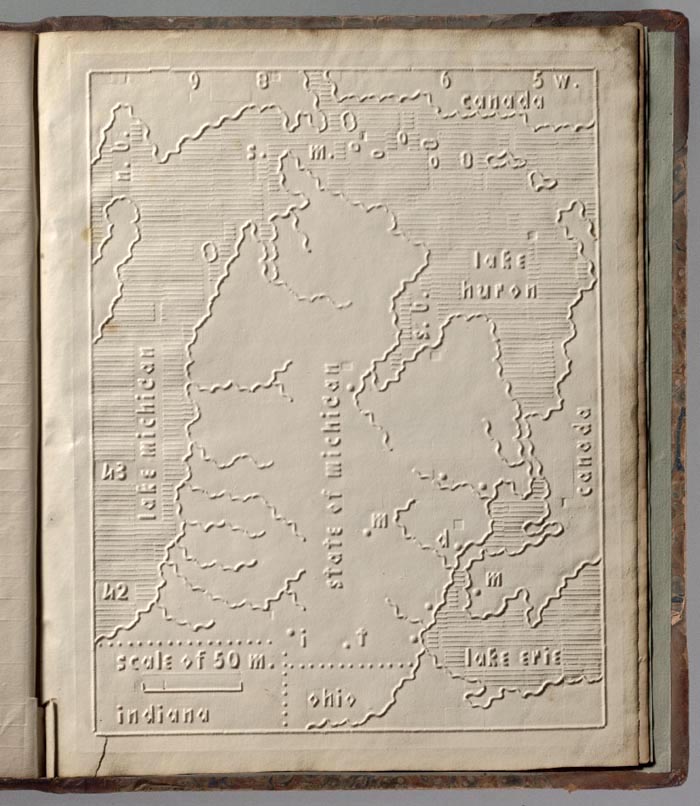
Though created in Europe, tactile maps have had a relatively long history in the U.S., debuting in 1837 with an atlas of the United States developed by Samuel Gridley Howe of the Perkins School for the Blind. (See Michigan above.) Klemm’s map up top, depicting the Roman Empire (284–476 CE), is a later entry, patented in 1888, and, he promises it’s a decided improvement on earlier models. In an article that year for The American Teacher, he described “the painstaking process of creating one of these relief maps,” notes Onion, “a process he used as another teaching tool, enlisting students to help him scrape and carve plaster casts into negative shapes of mountain ranges and plateaus.”
Those students, he wrote, developed “so clear a conception of the topography and irrigation of the respective country that it can scarcely be improved.” Tactile accuracy meant a lot to Klemm. In text published alongside the map, he took Howe and other publishers to task for raising water above land, an idea “so unnatural, that the mind never thoroughly becomes accustomed to it.” Klemm also critiques a French map of “very perfect construction.” This handmade version, he says, though ingenious, is “expensive and very inefficient.” While its utility “in the case of institutions, and for the use of pupils of the wealthy classes is undoubted… the costliness of maps constructed on such a principle places the advantages of the system beyond the reach of the blind generally.”
Klemm’s concern for the quality, accuracy, utility, and economic accessibility of this early accessibility tool is admirable. And though you can’t experience it through your screen, his method is probably a vastly-improved way of learning geography for many people, sighted or not. Tactile maps did not quite become general use technologies, but their digital progeny may soon have us all experiencing more of the world through touch. View and download a larger (2D) version of Klemm’s map and learn more at 19th Century Disability Cultures & Contexts.
via Slate
Related Content:
Vintage Geological Maps Get Turned Into 3D Topographical Wonders
A Radical Map Puts the Oceans–Not Land–at the Center of Planet Earth (1942)
Josh Jones is a writer and musician based in Durham, NC. Follow him at @jdmagness
Read More...Hear Underground 12, the Earliest Known Case of Musicians Recording While Under the Influence of LSD (1966)
Music and LSD: after “Tomorrow Never Knows” and Sgt. Pepper, we knew what an acid trip should sound like. Other folks needed to know more. Somewhere in Los Angeles in 1966 a group of musicians were dosing and recording while tripping.
The resulting recording–credited to “Underground 12” and considered the earliest known case of musicians recording while under the influence of LSD–was only available, as the legend goes, by mail order–you can see a copy of it here on discogs, a plain red label with only an address: 12457 Ventura Blvd. in Studio City, CA. A little bit of Google snooping revealed this to be an office for Huntington Park First Savings and Loan in 1966, but assuming there was another office there, an issue of Billboard from that year also mentions an artist manager called Bob Reed at the same address. (Bob, we’re on to you!).
There’s nothing particularly groovy about this music. There’s no sitars, no fuzz pedals, no incense, no peppermints. There is, however, a lot of echo and delay, a lot of sped up tape (which in parts sounds a bit like Zappa’s “King Kong”), plenty of atonal laughing, and welp, that’s about it for side one.
Side two is a bit better, with an actual piano played at normal speed, and an electric guitar soloing against it. This sounds a bit proggy, about five years ahead of its time. But then the producer (Bob Reed, is that you again?) starts speeding up the tape again.
Con job or bad trip? Did these musicians know what they were in for? Did they really dose, or was studio trickery seen as a good enough placebo? Did the LSD produce some pretty ordinary studio jamming and the LP is a salvage job? So many mysteries, so little time.
Lysergia, a Swedish label that re-releases rare grooves such as this has also put out The Psychedelic Experience: The Ultimate Journey Through Late 60s Psychedelia, Acid Burns and Druggy Grooves by Patrick Lundborg, a Swedish writer whose subject was LSD, and rereleased the only album by Madrigal, a Morristown, New Jersey twosome which has a 13-minute track called “Stoned Freakout.”
However if the above sampler thrills you and you would like to own an original copy of this dubious classic by the Underground 12, it will set you back $666. The seller, obviously, knows what’s up.
Related Content:
Ted Mills is a freelance writer on the arts who currently hosts the artist interview-based FunkZone Podcast and is the producer of KCRW’s Curious Coast. You can also follow him on Twitter at @tedmills, read his other arts writing at tedmills.com and/or watch his films here.
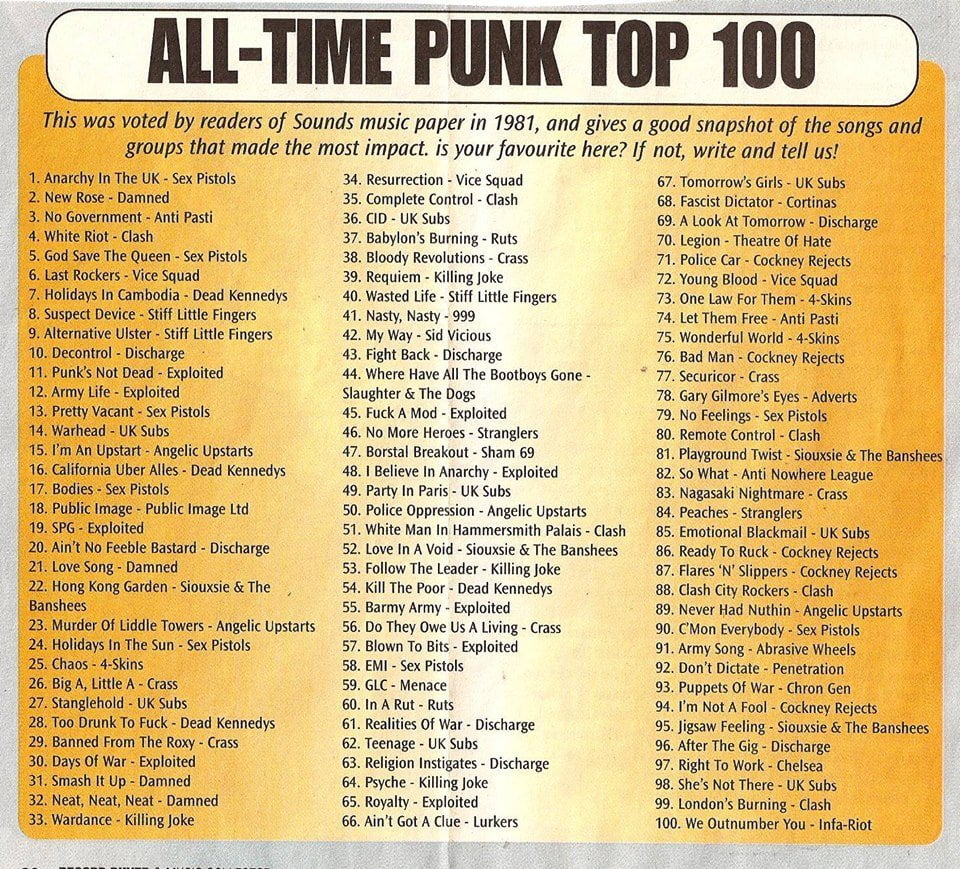
Read More...The 100 Top Punk Songs of All Time, Curated by Readers of the UK’s Sounds Magazine in 1981

When did punk rock die? Everyone knows it happened sometime in recent history, but few people agree on when. The music still exists, in knowing quotation marks, but its winning combination of unforced abrasiveness and calculated offensiveness seems to have disappeared. Maybe pick a year at random; say, 2010, the year the last great punk songwriter, Jay Reatard, died. It also happens to be the year the last great punk band, OFF!, formed, but they’re a supergroup of classic punk musicians.
One could push that date back into any decade and make reasoned arguments. One snarling purist even once wrote that punk died in 1977 when the Clash signed to CBS. Maybe he was on to something. The following year, it was post-punk, with Johnny Rotten, aka Lydon, releasing his post-Sex Pistol’s project Public Image Limited’s first album, First Issue. Also in 1978, Siouxsie and the Banshees released their debut album, a statement for the spikiness and melodrama of post punk if there ever was one.
By 1981, a year someone might also choose to etch on punk’s tombstone, surviving members of post-punk darlings Joy Division had reformed into New Order and released their first album, Movement. Declaring the death of punk sounds like a bummer, but many people found solace in the arms of new wave synthpop and acid house. Still, 1981 didn’t care about anyone’s punk opinions. A slew of now-classic punk and hardcore albums coexisted with the likes of Gary Numan—Black Flag’s Damaged and D.O.A.’s Hardcore ’81, classic albums from Crass, The Adicts, Adolescents, T.S.O.L., and, of course, The Exploited’s Punk’s Not Dead.
The list above (view it in a larger format here), the “All-Time Punk Top 100”—voted on in 1981 by readers of the “music paper” Sounds—contains a handful of songs from Siouxsie and the Banshees and Public Image Limited. Some people might choose to split hairs. The Exploited make many appearances, as do the Sex Pistols, The Clash, UK Subs, Discharge and other British stalwarts. The heavy UK lean is to be expected from readers of the short-lived UK music mag, but the fact that there are no Ramones, no Dead Boys, no Stooges, no Blondie, no Black Flag even… can begin to feel downright insulting.
Maybe punk just looked different on the other side of the pond in 1981. If it looked like the all-time top 100 list, then it sounded like the playlist above (stream it on Spotify here), which collects these 100 best-ofs, or greats, or not so greats, or clearly misguided choices, or whatever. Enjoy it as you furiously correct it with your own picks.
Related Content:
The History of Punk Rock in 200 Tracks: An 11-Hour Playlist Takes You From 1965 to 2016
Stream a Playlist of 68 Punk Rock Christmas Songs: The Ramones, The Damned, Bad Religion & More
Josh Jones is a writer and musician based in Durham, NC. Follow him at @jdmagness
Read More...A Brief Animated Introduction to Noam Chomsky’s Linguistic Theory, Narrated by The X‑Files’ Gillian Anderson
How is it that children just entering toddlerhood pick up the structure of their respective languages with ease? They are not formally taught to use speech; they have limited cognitive abilities and a “poverty of stimulus,” given their highly circumscribed environments. And yet, they learn the function and order of subjects, verbs, and objects, and learn to recognize improper usage. Children might make routine mistakes, but they understand and can be understood from a very early age, and for the most part without very much difficulty. How?
These are the questions that confronted Noam Chomsky in the early years of his career in linguistics. His answers produced a theory of Universal Grammar in the 1960s, and for decades, it has been the reigning theory in the field to beat, initiating what is often referred to as the “Chomskyan Era,” a phrase the man himself dislikes but which nonetheless sums up the kinds of issues that have been at stake in linguistics for over fifty years.
Questions about language acquisition have always been the subject of intense philosophical speculation. They were folded into general theories of epistemology, like Plato’s theory of forms or John Locke’s so-called “blank slate” hypothesis. Variations on these positions surface in different forms throughout Western intellectual history. Descartes picks up Plato’s dualism, arguing that humans speak and animals don’t because of the existence of an immortal “rational soul.” Behaviorist B.F. Skinner suggests that operant conditioning writes language onto a totally impressionable mind. (“Give me a child,” said Skinner, “and I will shape him into anything.”)
Chomsky “gave a twist” to this age-old debate over the existence of innate ideas, as Gillian Anderson tells us in the animated video above from BBC 4’s History of Ideas series. Chomsky’s theory is biolinguistic: it situates language acquisition in the structures of the brain. Not being himself a neurobiologist, he talks of those theoretical structures, responsible for reproducing accurate syntax, as a metaphorical “language acquisition device” (LAD), a hardwired faculty that separates the human brain from that of a dog or cat.
Chomsky’s theory has little to do with the content of language, but rather with its structure, which he says is universally encoded in our neural architecture. Children, he writes, “develop language because they’re pre-programmed to do this.” Syntax is prior to and independent of specific meaning, a point he demonstrated with the poetic sentence “Colorless green ideas sleep furiously.” Every English speaker can recognize the sentence as grammatical, even very small children, though it refers to no real objects and would never occur in conversation.
Conversely, we recognize “Furiously sleep ideas green colorless” as ungrammatical, though it means no more nor less than the first sentence. The regional variations on word order only underline his point since, in every case, children quickly understand how to use the version they’re presented with at roughly the same developmental age and in the same way. The existence of a theoretical Language Acquisition Device solves the chicken-egg problem of how children with no understanding of and only a very limited exposure to language, can learn to speak just by listening to language.
Chomsky’s theory was revolutionary in large part because it was testable, and researchers at the professor’s longtime employer, MIT, recently published evidence of a “language universal” they discovered in a comparative study of 37 languages. It’s compelling research that just might anticipate the discovery of a physical Language Acquisition Device, or its neurobiological equivalent, in every human brain.
Related Content:
Watch Michel Gondry Animate Philosopher, Linguist & Activist Noam Chomsky
The Ideas of Noam Chomsky: An Introduction to His Theories on Language & Knowledge (1977)
Noam Chomsky Defines What It Means to Be a Truly Educated Person
Josh Jones is a writer and musician based in Durham, NC. Follow him at @jdmagness
Read More...18 Classic Myths Explained with Animation: Pandora’s Box, Sisyphus & More
Greek myths have an incredible shelf life.
We may not retain all the players’ names or the intricacies of the various plot lines, but the creative punishments the gods—Zeus, in particular—visited upon those who displeased them have provided modern mortals with an enduring shorthand for describing our own woes.
Tempted to sneak a peek inside a lover’s diary? Take a teeny swig from the liquor cabinet whilst housesitting? Go snooping in your teenager’s Internet history?
DON’T DO IT, PANDORA!!!
But if curiosity compels you to explore beyond the famous punchlines of mythology’s greatest hits, TED-Ed’s animated Myths from Around the World series is a recommended rummage.
Averaging around five minutes per tale, each episode is packed tight as a snake in a can of mixed nuts. Prepare to be surprised by some of the tidbits that come springing out.
Take Pandora’s box, above.
(Actually it was a jar, but why quibble?)
Not to unleash too many major spoilers, but how many of us remembered that the thing contained a bit of good along with all that evil?
Or that the vessel she wasn’t allowed to open was but one of many gifts the gods bestowed upon her at birth? In fact, Zeus gave her two presents, that pretty box, jar, whatever, and—wait for it—an irrepressibly inquisitive nature.
Or the close connection between Pandora and Prometheus? Zeus conceived of Pandora as a retribution for Prometheus stealing fire and returning it to earth.
Remember Prometheus?
No, not the guy who’s doomed to spend his life rolling a massive rock uphill, only to have it roll back down before he reaches the top. That’s Sisyphus, as in Sisyphean task, like laundry or cleaning the cat litter.
Prometheus is the Titan who winds up chained to a rock so Zeus can send a hungry vulture—some say eagle—to devour his liver once a day.
(Which kind of puts the cat litter in perspective.)
In addition to ancient Greek crowd pleasers, the 18-episode Myths from Around the World playlist delves into the familiar stuff of Norse, Chinese, and ancient Egyptian legends, as well as less widely known Cambodian and Irish tales.
Each video’s description has a link to a full Ted-Ed lesson, with the usual complement of quizzes, resources and opportunities for teacher customization.
Watch the full playlist here.
Related Content:
The Myth of Sisyphus Wonderfully Animated in an Oscar-Nominated Short Film (1974)
Greek Myth Comix Presents Homer’s Iliad & Odyssey Using Stick-Man Drawings
Concepts of the Hero in Greek Civilization (A Free Harvard Course)
Ayun Halliday is an author, illustrator, theater maker and Chief Primatologist of the East Village Inky zine. Join her in New York City for the next installment of her book-based variety show, Necromancers of the Public Domain, this March. Follow her @AyunHalliday.
Read More...Watch the Last Time Peter Tork (RIP) & The Monkees Played Together During Their 1960s Heyday: It’s a Psychedelic Freakout
Peter Tork died yesterday at age 77. You might not have heard the news over the deafening alarms in your social media feeds lately. But a muted response is also noteworthy because of the way Tork’s fame imploded at the end of the sixties, at a time when he might have become the kind of rock star he and his fellow Monkees had proved they could become, all on their own, without the help of any studio trickery, thanks very much. The irony of making this bold statement with a feature film was not lost on the band at all.
The film was Head, co-written and co-produced by Jack Nicholson, who appears alongside the Monkees, Teri Garr, Annette Funicello, Frank Zappa, Sonny Liston, Jerry Lee Lewis, Fats Domino, and Little Richard, among many other famous guest stars and musicians. Dennis Hopper and Toni Basil pop up, and the soundtrack, largely written and played by the band, is a truly groovy psych rock masterpiece and their last album to feature Tork until a reunion in the mid-80s.
Head was a weird, cynical, embittered, yet brilliant, attempt to torpedo everything the Monkees had been to their fans—teen pop idols and goofy Beatles rip-offs at a time when The Beatles had maybe gotten too edgy for some folks. And while it may have taken too much of a toll on the band, especially Tork, for them to recover, it’s clear that they had an absolute blast making both the movie and the record, even as their professional relationships collapsed.
Tork’s best songwriting contribution to Head, and maybe to the Monkees catalog on the whole, is “Can You Dig It,” a meditation on “it” that takes what might have been cheap hipster appropriation in a funky, pseudo-deep, vaguely Eastern direction free of guile—it’s light and breezy, like the Monkees, but also sinister and slinky, like Donovan or the folk rock of Brian Jones, and also spidery and jangly like Roger McGuinn. In the estimation of many a psychedelic rock fan, this is music that deserves a place beside its obvious influences. That Monkees fans could not dig it at the time only reflects poorly on them, but since some of them were fans of what they thought was a slapstick comedy troupe or a backup act for dreamy Davy Jones, they can hardly be blamed.
Cast as the Ringo of the gang (The Monkees and Head director Bob Rafelson compared him to Harpo Marx), Tork brought to it a similarly serious whimsy, and when he was finally allowed to show what he could do—both as a musician and a songwriter—he more than acquitted himself. Where Ringo mastered idiot savant one-liners, Tork excelled in the kind of oblique riffs that characterized his playing—he was the least talented vocalist in the band, but the most talented musician and the only one allowed to play on the band’s first two records. Tork played bass, guitar, keyboards, banjo, harpsichord, and other instruments fluently. He honed his craft, and his “lovable dummy” persona on Greenwich Village coffeehouse stages.
It’s not hard to argue that the Monkees rose above their TV origins to become bona fide pop stars with the songwriting and promotional instincts to match, but Head, both film and album, make them a band worth revisiting for all sorts of other reasons. Now a widely-admired cult classic, in 1968, the movie “surfaced briefly and then sank like a costumed dummy falling into a California canal,” writes Petra Mayer at NPR, in reference to Head’s first scene, in which Micky Dolenz appears to commit suicide. If the Monkees had been trying in earnest to do the same to their careers, they couldn’t have had more success. Head cost $750,000 and made back $16,000. “It was clear they were in free fall,” Andy Greene writes at Rolling Stone.
“After that debacle,” writes Greene, they could have tried a return to the original formula to recoup their losses, but instead “they decided to double down on psychedelic insanity” in an NBC television special, 33⅓ Revolutions per Monkee, greenlighted that year after the huge chart success of “Daydream Believer.” Tork had already announced that he was leaving the band as the cameras rolled on the very loosely plotted variety show. He stuck around till the end of filming, however, and played the last live performance with The Monkees for almost 20 years in the bang-up finale of “Listen to the Band” (top) which “quickly devolves into a wild psychedelic freakout crammed with guest stars.” Tork, behind the keys, first turns the downbeat Neil Young-like, Nesmith-penned tune into the rave-up it becomes. It’s a glorious send-off for a version of the Monkees people weren’t ready to hear in ’68.
Related Content:
Watch Frank Zappa Play Michael Nesmith on The Monkees (1967)
Josh Jones is a writer and musician based in Durham, NC. Follow him at @jdmagness
Read More...A Telecaster Made Out of 1200 Colored Pencils
A couple weeks back, Burls Art dared to make a Stratocaster out of 1200 Crayola colored pencils. Now comes a Telecaster-style guitar, which Fender first put into production back in 1950. You can watch it get made, from start to finish, in the 11-minute video above.
On a more serious note, anyone interested in the history of the electric guitar–particularly the Strat, Tele and Les Paul–should spend time with the new book by Ian S. Port, The Birth of Loud: Leo Fender, Les Paul, and the Guitar-Pioneering Rivalry That Shaped Rock ‘n’ Roll. It offers a pretty rich and lively account of the inventors and instruments who created a new modern sound. If interested, you can get The Birth of Loud as a free audiobook if you sign up for Audible.com’s free trial program. Find details on that here.
If you would like to support the mission of Open Culture, consider making a donation to our site. It’s hard to rely 100% on ads, and your contributions will help us continue providing the best free cultural and educational materials to learners everywhere. You can contribute through PayPal, Patreon, and Venmo (@openculture). Thanks!
Related Content:
A Fender Stratocaster Made Out of 1200 Colored Pencils
Behold the First Electric Guitar: The 1931 “Frying Pan”
Brian May’s Homemade Guitar, Made From Old Tables, Bike and Motorcycle Parts & More
Oxford Scientist Explains the Physics of Playing Electric Guitar Solos
Read More...An Animated Reconstruction of Ancient Rome: Take A 30-Minute Stroll Through the City’s Virtually-Recreated Streets
There are numerous ancient stories illustrating the gargantuan ego of the Emperor Nero. Some of these may rise to the level of historical character assassination. Nero did not, for example, fiddle while Rome burned. For one thing, the fiddle did not exist. For another, as the historian Tacitus records, although the emperor was miles away at his villa in Antium when the fires began, it’s said he returned to Rome and led relief efforts, paying for many of them out of his own pocket and housing the newly homeless in his garden.
But the story may have been rewritten to burnish Nero’s reputation. After the masses blamed him for starting the fire, he turned around and blamed the city’s Christians, Tacitus reports, staging elaborate spectacles of torture, burning, and dismemberment. Suetonius does record him as giving some sort of musical performance during the fires of 64 A.D., a rumor that had apparently taken hold among the people. Whatever part he played, and whatever truth there is to charges that he murdered the son of Claudius, one of his wives, and even his own mother, Nero clearly felt a pressing need to leave a different impression of himself—as a towering, bronze god-like figure nearly 100 feet high.
In the same year as the fires, he commissioned a colossal statue of himself as the sun god, inspired by the Colossus of Rhodes. The massive Nero held a rudder perched atop a globe, suggesting that his rule steered the course of the whole world. Nero killed himself before the statue was completed, but Pliny the Elder writes of seeing its creation in the studio of the sculptor, Zenodorus. It arose towering above his palace, the Domus Aurea, in 72 A.D., and in 127, Hadrian moved it near the Amphitheatrum Flavium, which subsequently became known in the statue’s honor as the Colosseum. It took up to 24 elephants to do the job, or so it’s said.
For the next few hundred years, until at least the sack of Rome by Alaric in 410 and a subsequent series of earthquakes, residents and visitors to the city walked beneath the looming Nero/Helios/Apollo statue, just fifty feet shy of the Statue of Liberty. It was depicted on medallions and gems. Now the statue is completely vanished, with nothing but a remnant of its pedestal remaining. But you can see it reconstructed, along with 27 other ancient Roman monuments, temples, baths, mausoleums, amphitheaters, arenas, etc.—many of them as grandiose and storied as the Colossus—in the thirty-minute video above.
No, it’s not like strolling the streets of ancient Rome. The blockily-rendered CGI recreations appear over contemporary video of the city, full of contemporary traffic and contemporary fashions. As in every historical recreation of antiquity, for which the sources are few and contradictory, we have to use our imaginations. The exercise is infinitely richer the more you learn about the vanished or ruined structures that once dominated the city. See the full list of ancient buildings and sculptures below.
0:10 Palatine Hill (https://en.wikipedia.org/wiki/Palatin…)
3:25 The Forum (https://en.wikipedia.org/wiki/Roman_F…)
5:22 Basilica of Maxentius (https://en.wikipedia.org/wiki/Basilic…)
7:18 Temple of Vesta (https://en.wikipedia.org/wiki/Temple_…)
7:26 House of the Vestals (https://en.wikipedia.org/wiki/House_o…)
7:48 Temple of Castor and Pollux (https://en.wikipedia.org/wiki/Temple_…)
8:03 Temple of Caesar (https://en.wikipedia.org/wiki/Temple_…)
8:13 Basilica Aemilia (https://en.wikipedia.org/wiki/Basilic…)
8:40 Basilica Julia (https://en.wikipedia.org/wiki/Basilic…)
9:17 Temple of Saturn (https://en.wikipedia.org/wiki/Temple_…)
10:56 Curia Julia (https://en.wikipedia.org/wiki/Curia_J…)
12:18 Forum of Augustus (https://en.wikipedia.org/wiki/Forum_o…)
13:05 Forum of Nerva (https://en.wikipedia.org/wiki/Forum_o…)
13:47 Trajan’s Forum (https://en.wikipedia.org/wiki/Trajan%…)
14:54 Forum of Caesar (https://en.wikipedia.org/wiki/Forum_o…)
15:29 Colosseum (https://en.wikipedia.org/wiki/Colosseum)
17:42 Temple of Venus and Roma (https://en.wikipedia.org/wiki/Temple_…)
18:59 Colossus of Nero and Meta Sudans (https://en.wikipedia.org/wiki/Colossu… -https://en.wikipedia.org/wiki/Meta_Su…)
19:28 Baths of Caracalla (https://en.wikipedia.org/wiki/Baths_o…)
26:39 Pantheon (https://en.wikipedia.org/wiki/Pantheo…)
28:13 Stadium of Domitian (https://en.wikipedia.org/wiki/Stadium…)
29:23 Mausoleum of Augustus (https://en.wikipedia.org/wiki/Mausole…)
29:39 Circus Maximus (https://en.wikipedia.org/wiki/Circus_…)
30:25 Sacred area (https://en.wikipedia.org/wiki/Largo_d…)
31:21 Theatre of Pompey (https://en.wikipedia.org/wiki/Theatre…)
31:56 Theatre of Marcellus (https://en.wikipedia.org/wiki/Theatre…)
32:05 Tiber Island (https://en.wikipedia.org/wiki/Tiber_I…)
32:32 Mausoleum of Hadrian (https://en.wikipedia.org/wiki/Castel_…)
Related Content:
An Interactive Map Shows Just How Many Roads Actually Lead to Rome
All the Roman Roads of Italy, Visualized as a Modern Subway Map
Josh Jones is a writer and musician based in Durham, NC. Follow him at @jdmagness
Read More...How Talking Heads and Brian Eno Wrote “Once in a Lifetime”: Cutting Edge, Strange & Utterly Brilliant
Few albums of the late 1970s and early 1980s have held up as well as those by Talking Heads, but what to call the music recorded on them? Rock? Pop? New Wave? In the difficulty to pin it down lies its enduring appeal, and that difficulty didn’t come about by accident: impatient with musical categorizations and expectations, frontman David Byrne and the rest of the band kept pushing themselves into new territories even after they’d begun to find success. When they set out to create their fourth album, 1980’s Remain in Light, “they were looking to change the way they made songs.” Instead of leaving the writing to Byrne, “the band wanted a more democratic process. And so they tried something they never had before.”
So says the Polyphonic video above on how the band wrote “Once in a Lifetime,” surely the most beloved song on Remain in Light and quite possibly the most beloved in Talking Heads’ entire catalog. “Inspired by Afrobeat legend Fela Kuti, the instrumentalists in the band recorded a number of jams,” such as the proto-“Once in a Lifetime” outtake “Right Start” (which itself followed on “I Zimbra” from Talking Heads’ previous album, Fear of Music).
When bassist Tina Weymouth came up with a striking bass line, the band “took that lick and extrapolated it, slowly building a piece around it. After weeks of jamming, David Byrne and producer Brian Eno came in to the studio to start adding arrangements and lyrics to the music pieces.”
Eno counted the rhythm of the song differently than everyone else did, resulting in a distinctive layering of different grooves all at once. On top of this came the lyrics, which Byrne developed as he “sat down and listened to televangelist sermons, pulling phrases from them and crafting them into lyrics.” Put together, “the song creates a trancelike state, capturing the manic monotony of middle-class existence” with both its captivatingly repetitive music (played by the band members acting as “human samplers”) and its words, as Byrne himself interprets them, “about the unconscious, about how we operate half-awake on autopilot.”
Like so many hits of the 1980s, “Once in a Lifetime” launched into the zeitgeist from the platform of MTV — a network that didn’t even exist when the song came out. “Made on a shoestring budget, the video for ‘Once in a Lifetime’ is one of the most memorable of its time.” Co-directed by Toni Basil (of “Mickey” fame), it “played with bluescreen technology, composing multiple David Byrnes on top of a white background or images of religious ceremony.” Byrne and Basil “pored over film of preachers, people in trances, religious sects, and much, much more. Some of these were put in the background, but more importantly, they were used as the basis for Byrne’s dancing.” When the content-hungry MTV launched six months after “Once in a Lifetime” came out, the video went right into heavy rotation. 37 years later, we can look back at both it and the song as “the walking embodiment of all that the Talking Heads were: it’s cutting-edge, it’s strange, and it’s utterly brilliant.”
Related Content:
How David Byrne and Brian Eno Make Music Together: A Short Documentary
Hear the Earliest Known Talking Heads Recordings (1975)
Based in Seoul, Colin Marshall writes and broadcasts on cities, language, and culture. His projects include the book The Stateless City: a Walk through 21st-Century Los Angeles and the video series The City in Cinema. Follow him on Twitter at @colinmarshall or on Facebook.
Read More...Becoming: A Short Timelapse Film Shows a Single Cell Morphing Into a Complete, Complex Living Organism
From Jan van IJken comes “Becoming,” a short timelapse film that documents “the miraculous genesis of animal life.” He writes:
In great microscopic detail, we see the ‘making of’ an Alpine Newt in its transparant egg from the first cell division to hatching. A single cell is transformed into a complete, complex living organism with a beating heart and running bloodstream.
The first stages of embryonic development are roughly the same for all animals, including humans. In the film, we can observe a universal process which normally is invisible: the very beginning of an animal’s life.
“Becoming” has been “selected at more than 20 international film festivals and won the award for Best short documentary at Innsbruck Nature Film Festival 2018, Austria.” Enjoy.
If you would like to support the mission of Open Culture, consider making a donation to our site. It’s hard to rely 100% on ads, and your contributions will help us continue providing the best free cultural and educational materials to learners everywhere. You can contribute through PayPal, Patreon, and Venmo (@openculture). Thanks!
Related Content:
Free Online Biology Courses
The Map of Biology: Animation Shows How All the Different Fields in Biology Fit Together
Biology That Makes Us Tick: Free Stanford Course by Robert Sapolsky
Read More...Support Us
We're hoping to rely on loyal readers, rather than erratic ads. Please click the Donate button and support Open Culture. You can use Paypal, Venmo, Patreon, even Crypto! We thank you!

About Us

Open Culture scours the web for the best educational media. We find the free courses and audio books you need, the language lessons & educational videos you want, and plenty of enlightenment in between.
Advertise With Us

FREE UPDATES!
GET OUR DAILY EMAIL
Get the best cultural and educational resources on the web curated for you in a daily email. We never spam. Unsubscribe at any time.
FOLLOW ON SOCIAL MEDIA

Open Culture editor Dan Colman scours the web for the best educational media. He finds the free courses and audio books you need, the language lessons & movies you want, and plenty of enlightenment in between.
Advertise With Us