George Orwell’s Essay “British Cookery” is Officially Published 70 Years After It Was Rejected by the British Council (1946)

Image by BBC, via Wikimedia Commons
Voltaire once joked that Britain had “a hundred religions and only one sauce.” In my experience, that sauce is a curry, which was already a British staple in Voltaire’s time. No doubt he had something much blander in mind. Of course, it’s all hyperbolic fun until someone takes offense, as did George Orwell in 1946, when he wrote, against Voltairean stereotypes, about the misunderstood pleasures of British food. His essay, “British Cookery,” was commissioned by the British Council, but they subsequently deemed that it would be “’unwise to publish,’” reports the Daily Mail, “so soon after the hungry winter of 1946 and wartime rationing.”
Not that it matters much now, but the Council has formally apologized to the deceased Orwell, over 70 years later. Senior policy analyst Alasdair Donaldson explains they are “delighted to make amends” by publishing the essay in full, alongside “the unfortunate rejection letter.” You can read it here at the British Council site. Orwell grants that the British diet is “simple, rather heavy, perhaps slightly barbarous… with its main emphasis on sugar and animal fats…. Cheap restaurants in Britain are almost invariably bad, while in expensive restaurants the cookery is almost always French, or imitation French.”
Elsewhere, he concedes, “the British are not great eaters of salads.” Indeed, he says, “the two great shortcomings of British cookery are a failure to treat vegetables with due seriousness, and an excessive use of sugar.” He does go on at length, in fact, about what sounds like a national epidemic of sugar addiction. Such lapses of taste are also what we would now label a nutritional emergency. He may seem to grant too much to critics of British cooking. But this is mainly by contrast with spicier, more vegetable-friendly cuisines of the continent and colonies. The kind of cooking he describes makes creatively varied uses of sturdy but limited local resources (except for the sugar).
Orwell’s brutal honesty about British food’s deficiencies makes him sound like a trustworthy guide to its true delights. One of the truths he tells is that “British cookery displays more variety and more originality than foreign visitors are usually ready to allow.” The average visitor encounters British food principally in restaurants, pubs, and hotels, which, “whether cheap or expensive” are not representative of “the diet of the great mass of the people.” This may be said of many regional cuisines. But Orwell is devoted to a native British cooking which had, at the time, almost disappeared after six years of war rationing.
This cooking is rich in roast and cold meats, cheeses, breads, Yorkshire and suet puddings, potatoes and turnips. The British diet is, or was, Orwell writes, eaten by the lower and upper classes alike, under different names and prices. Seasonings are few. “Garlic, for instance, is unknown in British cookery proper.” What stands out is mint, vinegar, butter, dried fruits, jam, and marmalade.
Orwell himself included a marmalade recipe. (A handwritten note reads “Bad recipe! Too much sugar and water.”), which you can see below. Decide for yourself how much sugar to add.
ORANGE MARMALADE
Ingredients:
2 seville oranges
2 sweet oranges (no)
2 lemons (no)
8lbs of preserving sugar
8 pints of water
Method. Wash and dry the fruit. Halve them and squeeze out the juice. Remove some of the pith, then shred the fruit finely. Tie the pips in a muslin bag. Put the strained juice, rind and pips into the water and soak for 48 hours. Place in a large pan and simmer for 1/2 hours until the rind is tender. Leave to stand overnight, then add the sugar and let it dissolve before bringing to the boil. Boil rapidly until a little of the mixture will set into a jelly when placed on a cold plate. Pour into jars which have been heated beforehand, and cover with paper covers.
An increasing number of people are cutting back or quitting nearly every main ingredient in what Orwell describes as authentic British cooking: from meat to dairy to gluten to sugar to suet…. But if we are going to give it a fair shake, he argues, we must try the real thing. Or his version of it anyway. He includes several more recipes: Welsh rarebit, Yorkshire pudding, treacle tart, plum cake, and Christmas pudding.
Orwell’s “British Cookery” wars with itself and comes to terms. He fills each paragraph with frank acknowledgements of British cuisine’s shortcomings, yet he relishes its simple, solid virtues. He writes that “British cookery” is “best studied in private houses, and more particularly in the homes of the middle-class and working-class masses who have not become Europeanized in their tastes.” It’s a kind of cultural nationalism, but perhaps one suggesting those who want others to understand and appreciate a specific kind British culture should invite outsiders in to share a meal.
Related Content:
George Orwell Explains How to Make a Proper Cup of Tea
Try George Orwell’s Recipe for Christmas Pudding, from His Essay “British Cookery” (1945)
Foodie Alert: New York Public Library Presents an Archive of 17,000 Restaurant Menus (1851–2008)
Josh Jones is a writer and musician based in Durham, NC. Follow him at @jdmagness
Read More...A Short History of How Punk Became Punk: From Late 50s Rockabilly and Garage Rock to The Ramones & Sex Pistols
Seems there was a time when the dominant story of punk was the story of British punk. If you knew nothing else, you knew the name Sid Vicious, and that seemed to sum it up. Maybe it was only in the mid-nineties, around the time Legs McNeil and Gillian McCain released Please Kill Me: the Uncensored Oral History of Punk that more people began to popularly understand the lineage of late sixties garage rock, the Velvet Underground, Detroit’s Iggy and the Stooges, and the early CBGB scene in the mid-seventies crowned by the sound of The Ramones, Patti Smith, Blondie, and Talking Heads.
Now even that story can seem oversimplified, sketched out in brief on the way to discussing the literary triumph of Patti Smith, cultural interventions of David Byrne, career highlights of punk power couple Debbie Harry and Chris Stein, or the many, always fascinating doings of Iggy Pop.
The Ramones roared back into fashion twenty years ago, and the demise of CBGB in 2007 brought on waves of marketing nostalgia of almost Disney-like proportions. Most everyone who pays attention to pop culture now knows that late-seventies punk wasn’t a movement that arrived out of nowhere, bent on destroying the past, but a continuity and evolution of earlier forms.
But the Trash Theory video at the top reaches back even earlier than garage bands like the Monks and the Sonics—typically cited as some of the earliest common ancestors of punk and rock and roll. Punk was “rock and roll bored down to its bare bones,” says the narrator, and begins with a rockabilly artist who called himself The Phantom and tried to outdo Elvis in 1958 with the raucous single “Love Me.” The Phantom himself may not have embraced the label at all, but like Link Wray, he was still something of a proto-punk. Wray’s raunchy, gritty instrumental “Rumble,” also released in 1958, inspired huge numbers of guitarists and aspiring musicians, including young Iggy Pop, who cities it as a primary reason he joined a band.
From there, we’re on to “elemental” tracks like The Kingsmen’s “Louie Louie,” The Trashmen’s “Surfin’ Bird,” The Sonic’s “Psycho,” The Monk’s “I Hate You,” and Love’s “7 and 7,” all clear progenitors of the sound. And the Mysterians, of garage classic “96 Tears,” were the first band to be described as punk by the mainstream press. The Kinks and The Who set templates in Britain while the Velvets perfected sleazy, experimental noise back in New York. The MC5 in Detroit helped bring us The Stooges. The Modern Lovers’ 1972 “Roadrunner” launched hundreds of bands.
The video is a convincing short history showing how punk arose naturally from trends in the late 50s and 60s that clearly pointed the way. Like every such history, especially one undertaken in the span of fifteen minutes, it leaves out some pretty heavyweight figures who should have a central place in the narrative. Irritated YouTube commenters have pointed out lapses like The New York Dolls (see them further up in 1973), without whom there would have been no Sex Pistols. (Proto-punk Detroit band Death does get a mention, though their influence is negligible since they went mostly unheard until 2009.)
Also needing inclusion as early punk pioneers are Television (check them out in ’78) and Richard Hell and the Voidoids (above in 1980’s Blank Generation). And these are just a few missing New York bands. Any devotee of this musical history will come up with a dozen or so more from both sides of the Atlantic who deserve mention in the early history of punk. And that’s why, I guess, that popular history keeps getting told and retold. As soon as it starts to get stale, it seems, there’s always more to add.
Related Content:
The History of Punk Rock in 200 Tracks: An 11-Hour Playlist Takes You From 1965 to 2016
Punking Out, a Short 1978 Documentary Records the Beginning of the Punk Scene at CBGB’s
Josh Jones is a writer and musician based in Durham, NC. Follow him at @jdmagness
Read More...The Mastermind of Devo, Mark Mothersbaugh, Presents His Personal Synthesizer Collection
Mark Mothersbaugh’s studio is located in a cylindrical structure painted bright green — it looks more like a festive auto part than an office building. It’s a fitting place for the iconoclast musician. For those of you who didn’t spend your childhoods obsessively watching the early years of MTV, Mark Mothersbaugh was the mastermind behind the band Devo. They skewered American conformity by dressing alike in shiny uniforms and their music was nervy, twitchy and weird. They taught a nation that if you must whip it, you should whip it good.
In the years since, Mothersbaugh has segued into a successful career as a Hollywood composer, spinning scores for 21 Jump Street and The Royal Tenenbaums among others.
In the video above, you can see Mothersbaugh hang out in his studio filled with synthesizers of various makes and vintages, including Bob Moog’s own personal Memorymoog. Watching Mothersbaugh pull out and play with each one is a bit like watching a precocious child talk about his toys. He just has an infectious energy that is a lot of fun to watch.
Probably the best part in the video is when he shows off a device that can play sounds backward. It turns out that if you say, “We smell sausage” backwards it sounds an awful lot like “Jesus loves you.” Who knew?
Below you can see Mothersbaugh in action with Devo, performing live in Japan during the band’s heyday in 1979.
If you would like to support the mission of Open Culture, consider making a donation to our site. It’s hard to rely 100% on ads, and your contributions will help us continue providing the best free cultural and educational materials to learners everywhere. You can contribute through PayPal, Patreon, and Venmo (@openculture). Thanks!
Note: An earlier version of this post appeared on our site in February 2015.
Related Content:
Thomas Dolby Explains How a Synthesizer Works on a Jim Henson Kids Show (1989)
Watch Herbie Hancock Rock Out on an Early Synthesizer on Sesame Street (1983)
All Hail the Beat: How the 1980 Roland TR-808 Drum Machine Changed Pop Music
Jonathan Crow is a Los Angeles-based writer and filmmaker whose work has appeared in Yahoo!, The Hollywood Reporter, and other publications. You can follow him at @jonccrow. And check out his blog Veeptopus, featuring lots of pictures of badgers and even more pictures of vice presidents with octopuses on their heads. The Veeptopus store is here.
Read More...Nick Cave Answers the Hotly Debated Question: Will Artificial Intelligence Ever Be Able to Write a Great Song?

Photo by Bleddyn Butcher via Wikimedia Commons
Spike Jonze’s AI love story Her offered a sort of an answer to one of the critical questions posed about Artificial Intelligence: Can machines feel love? Maybe, and maybe deeply, in a certain sense, but maybe not for just one person and not for very long before they take off to explore limitless others, which makes them sound like very seductive but also very shallow lovers.
Maybe it helps to keep that metaphor in mind when we read Nick Cave’s answer to a question a Slovenian fan posed in the Birthday Party/Bad Seeds/Grinderman singer’s brutally tender newsletter, The Red Right Hand. “Do you think,” asks Peter from Ljubljana, “AI will ever be able to write a good song?” Cave begins with a concession: AI might “produce a song that makes us feel,” and maybe “more intensely than any human songwriter could do.”
And yet, after listing a number of human examples, from Nirvana to Prince to Iggy Pop to Nina Simone, Cave describes what makes their abilities alien to a machine mind:
We go to songs to make us feel something – happy, sad, sexy, homesick, excited or whatever – but this is not all a song does. What a great song makes us feel is a sense of awe. There is a reason for this. A sense of awe is almost exclusively predicated on our limitations as human beings. It is entirely to do with our audacity as humans to reach beyond our potential.
AI cannot die, at least in the sense we understand it. Nor is it constrained by painful physical limitations, nor privy to fleeting physical pleasures. “Artificial Intelligence, for all its unlimited potential, simply doesn’t have this capacity. How could it? And this is the essence of transcendence.” The holy or harrowing knowledge of finitude and fragility, love and death and grief.
Another way to state the case comes from the most moving of Cave’s fan letter answers, in which he consoles a bereaved fan in Vermont with a description of his own grief over the death of his son.
Maybe AI could write the sentence, “dread grief trails bright phantoms in its wake.” But it could not write it from the heart of a bereaved parent who learns that “grief and love are forever intertwined,” or from a place where supernatural beliefs may be untrue yet still have supernatural power. Cave’s description of his grief is also a description of transcendence, of going beyond what is possible to find what is timeless.
Like ideas, these spirits speak of possibility. Follow your ideas, because on the other side of the idea is change and growth and redemption. Create your spirits. Call to them. Will them alive. Speak to them. It is their impossible and ghostly hands that draw us back to the world from which we were jettisoned; better now and unimaginably changed.
In answer to Peter’s question, he concludes with the poetic authority of a writer of great songs: “AI would have the capacity to write a good song, but not a great one. It lacks the nerve.”
Read Nick Cave’s full response here. And while there, sign up for his free newsletter.
via Austin Kleon
Related Content:
Listen to Nick Cave’s Lecture on the Art of Writing Sublime Love Songs (1999)
Josh Jones is a writer and musician based in Durham, NC. Follow him at @jdmagness
Read More...Visualizing the Bass Playing Style of Motown’s Iconic Bassist James Jamerson: “Ain’t No Mountain High Enough,” “For Once in My Life” & More
As part of Motown’s Funk Brothers house band, James Jamerson was the bubbling bass player behind hundreds of hit records from Stevie Wonder, Marvin Gaye, The Supremes, Martha and the Vandellas, and plenty more. His licks duck and dive and weave like Ali but never get in the way of the melody or the rest of the band.
Paul McCartney was an early fan, but for the general public, Jamerson was not a household name for decades–Motown never listed the Wrecking Crew in its credits–until much later when music journalists and filmmakers pushed him into the spotlight.
But his style is so identifiable that YouTube channel Scott’s Bass Lessons has several videos about the man, explaining in detail how Jamerson produced that sound.
Jamerson used a Precision Bass made by Fender, heavy flat wound strings that gave it those thick tones, and a very high action (i.e. how tight the strings are). So high in fact, that many contemporaries said his bass was impossible to play. (The tightness had warped the neck of the instrument.) He also placed foam under the bridge, and played high on the body with only his index finger, “the hook” as they used to call it.
The other peculiarity of Jamerson’s recordings it that he plugged straight into the recording deck, instead of recording his amp. (McCartney started doing this in the middle of the Beatles’ career as well.) This led to a very compressed sound that helped his playing stand out in the mix.
These techniques are all easy to adopt, but one then has to add the talent, and that’s the hard part.
As you can see from these visualizations, Jamerson never stays still. If he could play a note on an open string he would (instead of moving over a fret), and that led to a fluid journey over the neck. On something like “I Was Made to Love Her,” Jamerson always makes sure to head up to double the sitar-like riff at the end of the verse:
While on “For Once In My Life,” he uses the steady groove of the band (not heard on the video, but listen here) as a jumping off point of some very tricky rhythms. And though it’s complex, it never gets in the way, nor does it feel flashy or indulgent.
Jamerson rarely changed strings, only if they broke, and he didn’t really look after his “black beauty” bass.
Asked why, he said, “The dirt keeps the funk.”
Related Content:
How Carol Kaye Became the Most Prolific Session Musician in History
The “Amen Break”: The Most Famous 6‑Second Drum Loop & How It Spawned a Sampling Revolution
Every Appearance James Brown Ever Made On Soul Train. So Nice, So Nice!
Ted Mills is a freelance writer on the arts who currently hosts the artist interview-based FunkZone Podcast and is the producer of KCRW’s Curious Coast. You can also follow him on Twitter at @tedmills, read his other arts writing at tedmills.com and/or watch his films here.
Read More...Watch 110 Lectures by Donald Knuth, “the Yoda of Silicon Valley,” on Programming, Mathematical Writing, and More
Many see the realms of literature and computers as not just completely separate, but growing more distant from one another all the time. Donald Knuth, one of the most respected figures of all the most deeply computer-savvy in Silicon Valley, sees it differently. His claims to fame include The Art of Computer Programming, an ongoing multi-volume series of books whose publication began more than fifty years ago, and the digital typesetting system TeX, which, in a recent profile of Knuth, the New York Times’ Siobhan Roberts describes as “the gold standard for all forms of scientific communication and publication.”
Some, Roberts writes, consider TeX “Dr. Knuth’s greatest contribution to the world, and the greatest contribution to typography since Gutenberg.” At the core of his lifelong work is an idea called “literate programming,” which emphasizes “the importance of writing code that is readable by humans as well as computers — a notion that nowadays seems almost twee.
Dr. Knuth has gone so far as to argue that some computer programs are, like Elizabeth Bishop’s poems and Philip Roth’s American Pastoral, works of literature worthy of a Pulitzer.” Knuth’s mind, technical achievements, and style of communication have earned him the informal title of “the Yoda of Silicon Valley.”
That appellation also reflects a depth of technical wisdom only attainable by getting to the very bottom of things, which in Knuth’s case means fully understanding how computer programming works all the way down to the most basic level. (This in contrast to the average programmer, writes Roberts, who “no longer has time to manipulate the binary muck, and works instead with hierarchies of abstraction, layers upon layers of code — and often with chains of code borrowed from code libraries.) Now everyone can get more than a taste of Knuth’s perspective and thoughts on computers, programming, and a host of related subjects on the Youtube channel of Stanford University, where Knuth is now professor emeritus (and where he still gives informal lectures under the banner “Computer Musings”).
Stanford’s online archive of Donald Knuth Lectures now numbers 110, ranging across the decades and covering such subjects as the usage and mechanics of TeX, the analysis of algorithms, and the nature of mathematical writing. “I am worried that algorithms are getting too prominent in the world,” he tells Roberts in the New York Times profile. “It started out that computer scientists were worried nobody was listening to us. Now I’m worried that too many people are listening.” But having become a computer scientist before the field of computer science even had a name, the now-octogenarian Knuth possesses a rare perspective to which anyone in 21st-century technology could certainly benefit from exposure.
Related Content:
Free Online Computer Science Courses
50 Famous Academics & Scientists Talk About God
The Secret History of Silicon Valley
When J.M. Coetzee Secretly Programmed Computers to Write Poetry in the 1960s
Introduction to Computer Science and Programming: A Free Course from MIT
Peter Thiel’s Stanford Course on Startups: Read the Lecture Notes Free Online
Based in Seoul, Colin Marshall writes and broadcasts on cities, language, and culture. His projects include the book The Stateless City: a Walk through 21st-Century Los Angeles and the video series The City in Cinema. Follow him on Twitter at @colinmarshall or on Facebook.
Read More...Moebius Draws Adventurous Ads for Maxwell House Coffee (1989)

What do you do after you’ve helped create one of the “first anti-heroes in Western comics”; pioneered the underground comics industry and heavy metal album covers; won the enduring admiration of Federico Fellini, Stan Lee, and Hayao Miyazaki; and brought your distinctive creative style to the look of sci-fi classics like Blade Runner, Alien, Tron, and The Abyss?
Sit back, have a coffee, and design a series of ads for Maxwell House. Why not? You’re Moebius. You can draw whatever you want. No one’s going to accuse Alejandro Jodorowsky’s partner in the legendary never-made Dune film and The Incal comics of selling out—not when contemporary comic art, science fiction, and fantasy could hardly have existed without him.
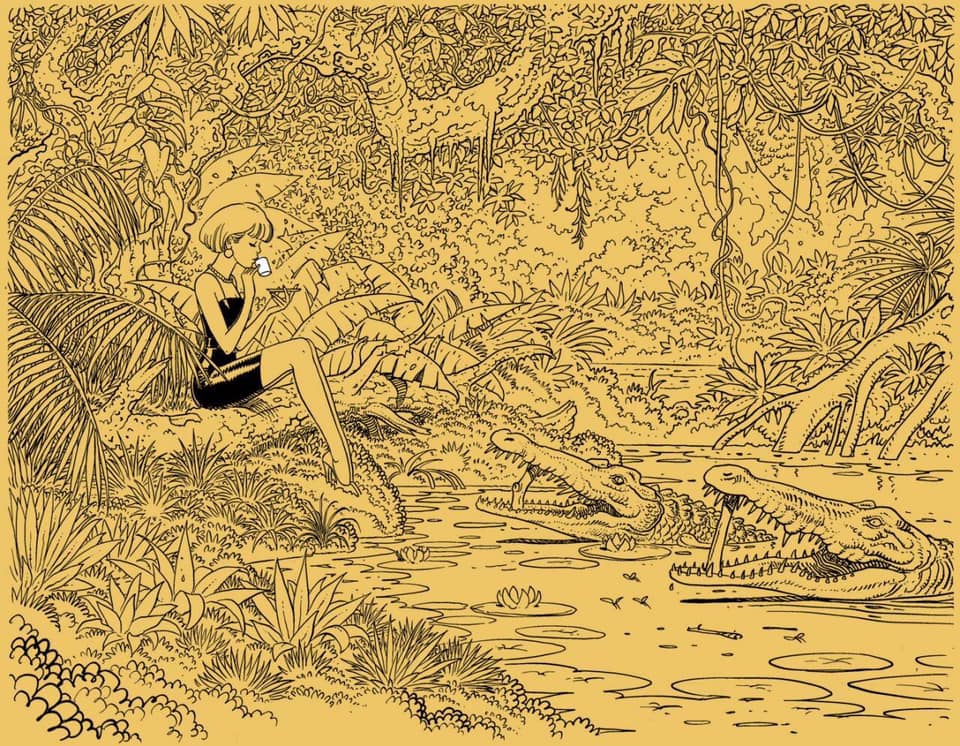
“Probably the most important fantasy comic artist of all time,” as Art Futura dubs him, the man originally known by his birth name Jean Giraud began his career as an illustrator for the youth press Fleurus, who were the first in France to publish fellow bande dessinées artist Herge’s Adventures of Tintin. The Maxwell House ads here, drawn in 1989, recall those early days of Franco-Belgian comic art, when adventurers raced around the colonies, braving wild animals and surly natives.
Moebius’ confident hand leaves a signature in the dense patterns of the foliage and slender jawline of the elegant, coffee-sipping damsel, who does not seem remotely in distress, downed plane and curious gorillas notwithstanding. But the settings are just as reminiscent of Tintin’s juvenile conceptions of the Amazon and “darkest Africa,” though Moebius leaves out the swashbucklers and ugly native caricatures.
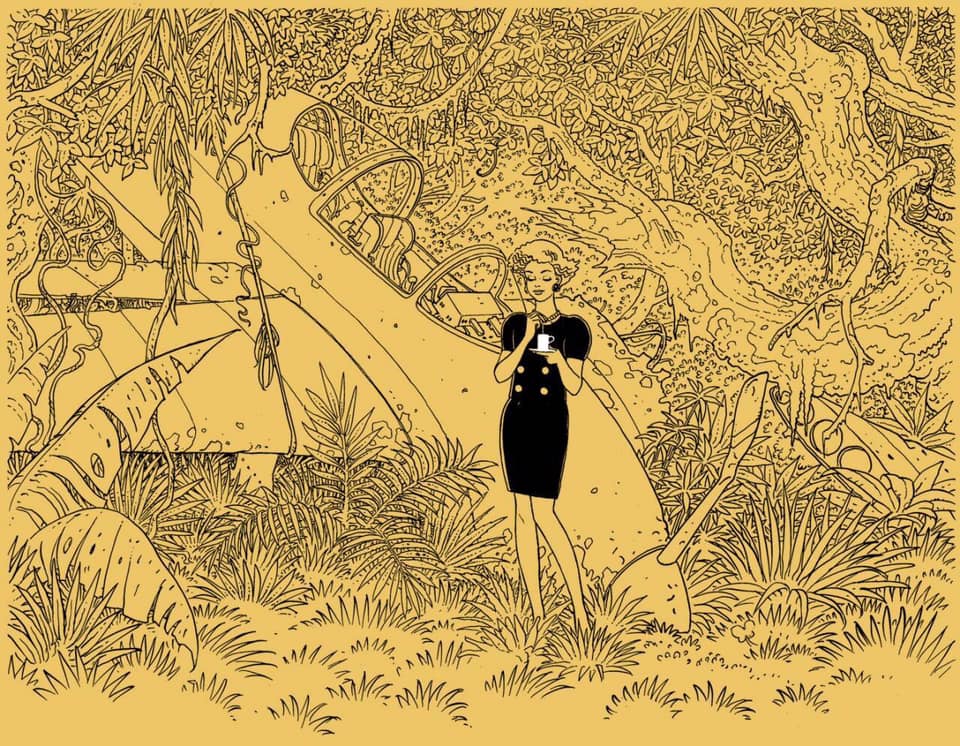
Giraud’s own travels took him through Mexico—where he joined his mother as a teenager and saw for the first time the magnificent Western landscapes he had always dreamed of—and through Algeria, where he worked as an illustrator for the French army magazine while finishing his military service. Unlike many of his contemporaries, he portrayed non-European nations and people with sympathy and respect.
Though he first took the name Moebius in 1974 in order to pursue more fantasy-oriented work after drawing the Western Blueberry for over a decade, some of Giraud’s ‘70s comic stories under the name drew upon real events, like the murder of a North African immigrant, Wounded Knee, and the famous speech of Chief Seattle.

The Maxwell House panels keep things light and sweet, so to speak, though where the cream and sugar might be hiding is anyone’s guess. The heroine of the series, named Tatiana, is “a self-possessed and fashionable young woman who happens to find herself alone on a desert jungle island or the like,” as Martin Schneider writes at Dangerous Minds. Unperturbed, she takes more interest in her coffee than the wildness around her.
At Dangerous Minds you’ll find alternate unused images and the ad campaign’s droll captions describing Tatiana taking coffee breaks from some mundane errand or chore. The commentary, though amusing, is hardly necessary. We can imagine dozens of stories embedded in each panel. The ability to create such complex and evocative illustrations, every one a world within a world, has always set Moebius ahead of his peers and many imitators.
via TripWire/Dangerous Minds
Related Content:
Watch Groundbreaking Comic Artist Mœbius Draw His Characters in Real Time
Behold Moebius’ Many Psychedelic Illustrations of Jimi Hendrix
Josh Jones is a writer and musician based in Durham, NC. Follow him at @jdmagness
Read More...Behold Moebius’ Many Psychedelic Illustrations of Jimi Hendrix
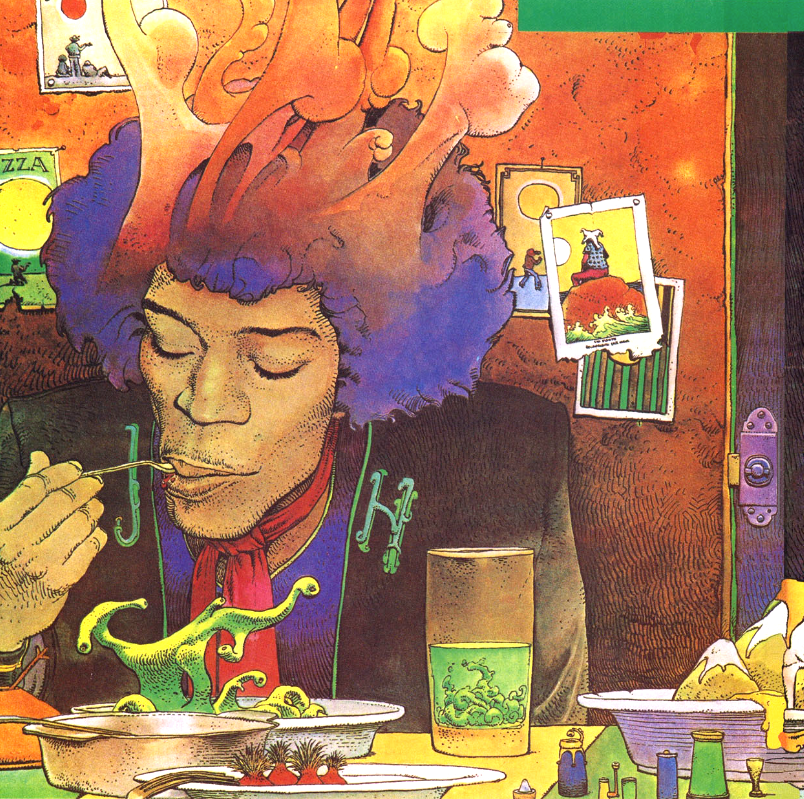
The 1995 release of posthumous Jimi Hendrix compilation Voodoo Soup has divided fans and critics for over two decades now. But whatever its merits, its cover art should hold an honored place in every Hendrix fan’s collection. Drawn by the legendary cult comic artist Moebius from a photograph of Hendrix eating soup in France, it captures the sound Hendrix was moving toward at the end of his life—his head exploding in flames, or mushroom clouds, or pink psychedelic bronchial tubes, or whatever. The image comes from a larger gatefold, excerpted below, which Moebius drew for the French double LP Are You Experienced/Axis: Bold as Love in 1975.
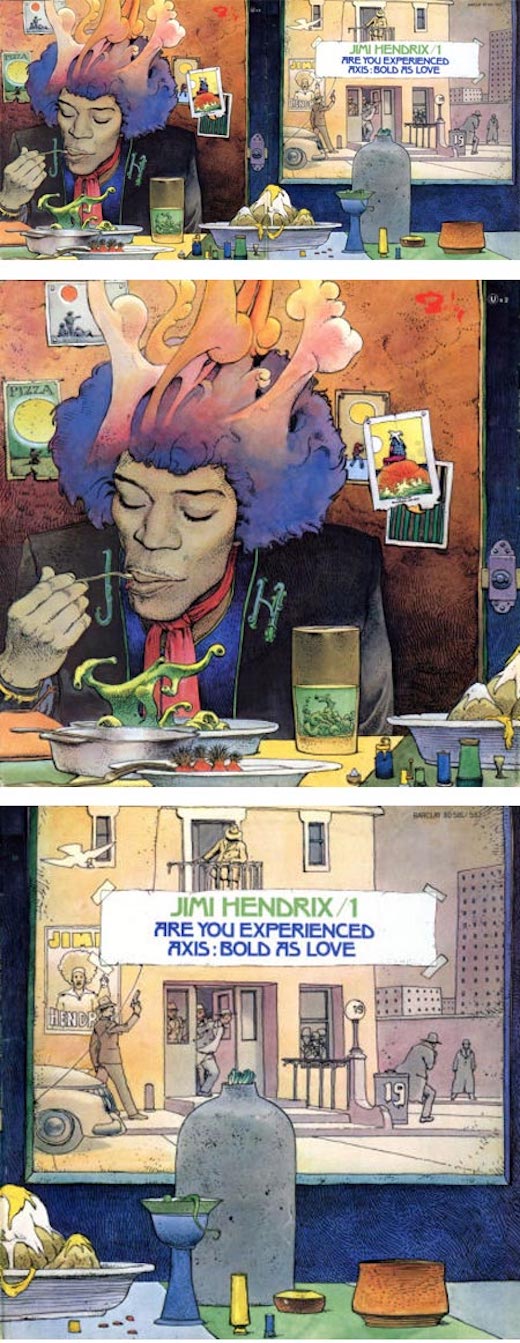
Journalist Jean-Nöel Coghe was supposedly very upset that he did not even receive mention for taking the original photo, but in the nineties he and Moebius came together again for a project that would do them both credit, a book called Emotions électriques that Coghe wrote of his experiences traveling through France as Hendrix’s guide during the Experience’s first tour of the country in 1967.
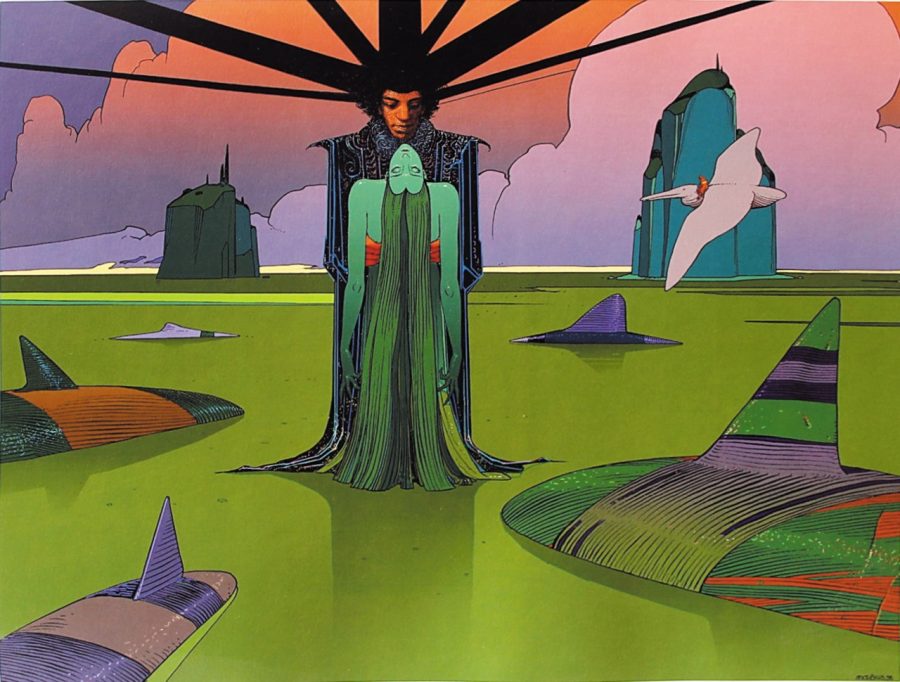
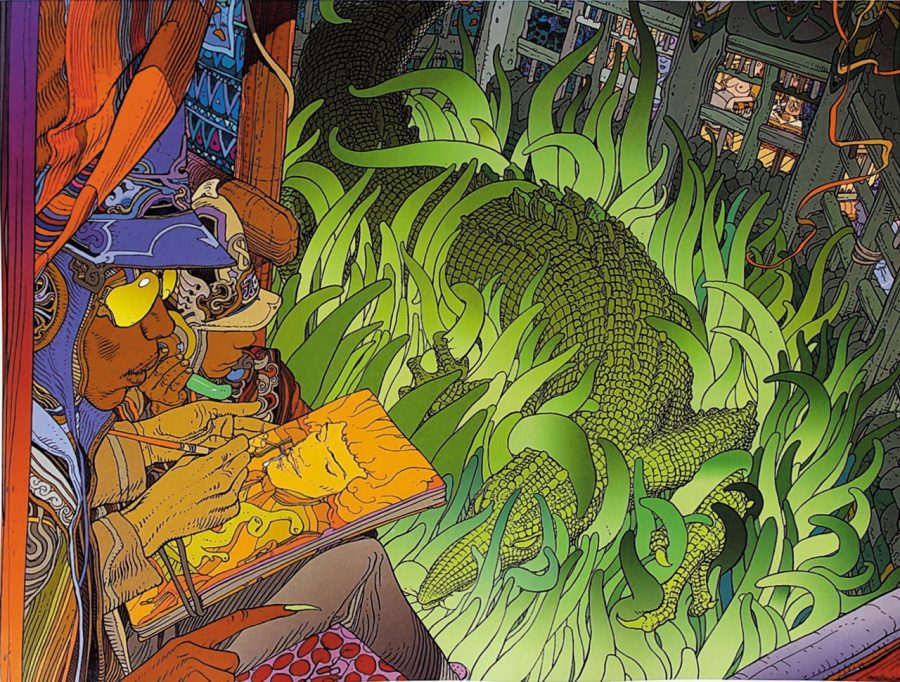
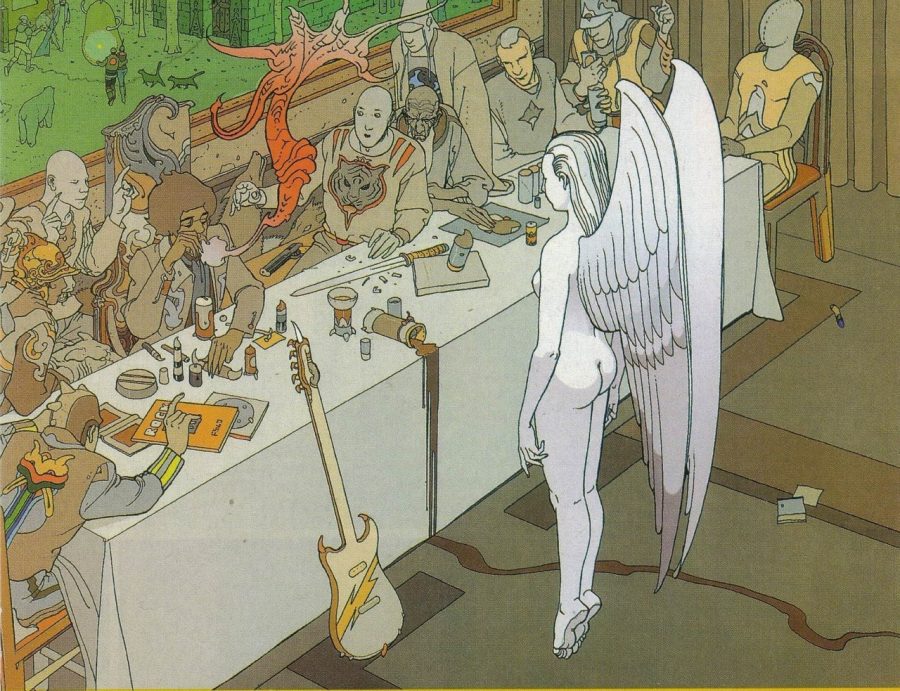
Moebius provided the book’s illustrations, many of which you can see below, “each of them,” as the publisher’s description has it, “imagining Hendrix in a classic Moebius landscape of dreams.”

Obviously a huge Hendrix fan, Moebius is in many ways as responsible for the psychedelic space race of the 1970s as the guitarist himself. His work in the French comic magazine Métal hurlant—Heavy Metal in the American version—epitomized the sci-fi and fantasy elements that came to dominate heavy rock. His work with Alejandro Jodorowsky on the Chilean visionary filmmaker’s aborted Dune is the stuff of legend.

Moebius had illustrated album covers since the early seventies, mostly those of European artists. But his creations as a magazine and comics illustrator (and film scenarist) have the most enduring appeal for much the same reason as Hendrix’s music. They are both unparalleled masters and natural storytellers whose imagined worlds are so richly detailed and consistently surprising they have birthed entire genres. The two may have crossed paths too late to actually work together, but I like to think Moebius carried on the spirit of Hendrix in a visual form.
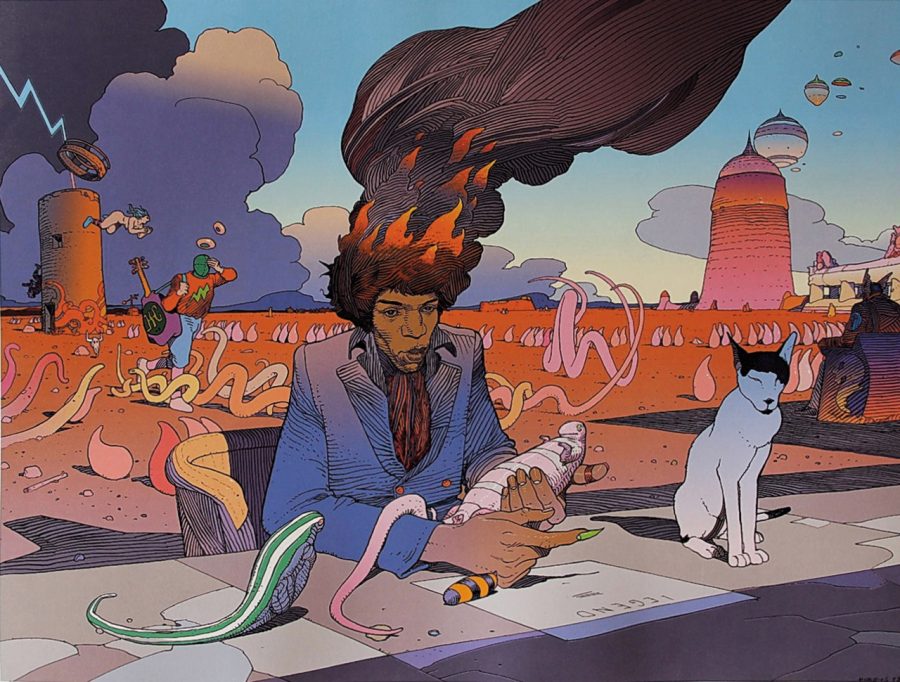
It may not be common knowledge that Hendrix hated his album covers, leaving detailed notes about them for his record company, who ignored them. His own choices, one must admit, including a Linda McCartney photo for the cover of Electric Ladyland that makes the band look like they’re on the set of a proto-Sesame Street, do not exactly sell the records’ treasures. But Jimi might have loved Moebius’ interpretations of his headspace, a visual continuation of a prominent strand of Hendrix’s imagination. See all of Moebius’ Hendrix illustrations here.
Related Content:
Jimi Hendrix’s Final Interview Animated (1970)
Josh Jones is a writer and musician based in Durham, NC. Follow him at @jdmagness
Read More...Complex Math Made Simple With Engaging Animations: Fourier Transform, Calculus, Linear Algebra, Neural Networks & More
In many an audio engineering course, I’ve come across the Fourier Transform, an idea so fundamental in sound production that it seems essential for everyone to know it. My limited understanding was, you might say, functional. It’s some kind of mathematical reverse engineering machine that turns waveforms into frequencies, right? Yes, but it’s much more than that. The idea can seem overwhelming to the non-mathematically-inclined among us.
The Fourier Transform, named for French mathematician and physicist Jean-Baptiste Joseph Fourier, “decomposes” any wave form into frequencies, and “virtually everything in the world can be described via a waveform,” writes one introduction to the theory. That includes not only sounds but “electromagnetic fields, the elevation of a hill versus location… the price of your favorite stock versus time,” the signals of an MRI scanner.
The concept “extends well beyond sound and frequency into many disparate areas of math and even physics. It is crazy just how ubiquitous this idea is,” notes the 3Blue1Brown video above, one of dozens of animated explorations of mathematical concepts. I know far more than I did yesterday thanks to this comprehensive animated lecture. Even if it all seems old hat to you, “there is something fun and enriching,” the video assures us, “about seeing what all of its components look like.”
Things get complicated rather quickly when we get into the dense equations, but the video illustrates every formula with graphs that transform the numbers into meaningful moving images.
3Blue1Brown, a project of former Khan Academy fellow Grant Sanderson, has done the same for dozens of STEM concepts, including such subjects as higher dimensions, cryptocurrencies, machine learning, and neural networks and essentials of calculus and linear algebra like the derivative paradox and “Vectors, what even are they?”
In shorter lessons, you can learn to count to 1000 on two hands, or, just below, learn what it feels like to invent math. (It feels weird at first.)
Sanderson’s short courses “tend to fall into one of two categories,” he writes: topics “people might be seeking out,” like many of those mentioned above, and “problems in math which many people may not have heard of, and which seem really hard at first, but where some shift in perspective makes it both doable and beautiful.” These puzzles with elegantly clever solutions can be found here. Whether you’re a hardcore math-head or not, you’ll find Sanderson’s series of 3Blue1Brown animations illuminating. Find them all here.
Related Content:
The Map of Mathematics: Animation Shows How All the Different Fields in Math Fit Together
Citizen Maths: A Free Online Course That Teaches Adults the Math They Missed in High School
Josh Jones is a writer and musician based in Durham, NC. Follow him at @jdmagness
Read More...The “David Bowie Is” Exhibition Is Now Available as an Augmented Reality Mobile App That’s Narrated by Gary Oldman: For David Bowie’s Birthday Today
Maybe it’s too soon to divide pop music history into “Before David Bowie” and “After David Bowie,” but two years after Bowie’s death, it’s impossible to imagine pop music history without him. Yet, if there ever did come a time when future generations did not know who David Bowie is, they could do far worse than hear Gary Oldman tell the story. Luckily for them, and us, Oldman narrates the new David Bowie augmented reality app, which launches today on what would have been the legend’s 72nd birthday.
Bowie and Oldman were both born and raised in South London. They became friends in the 80s, starred together in Julian Schnabel’s 1996 film Basquiat, and collaborated on the 2013 video for “The Next Day,” in which Oldman plays a sleazy, ducktailed priest. As much the consummate changeling in his medium as Bowie, Oldman brings a fellow craftsman’s appreciation to his role as docent, without any sense of star-struckness. “I see him less as ‘David Bowie,’” he once remarked, “and more as Dave from Brixton and I’m Gary from New Cross.”
The app is based on the sensational 2013 Victoria & Albert museum exhibition David Bowie Is, which traveled the world for five years before ending at the Brooklyn Museum this past summer. Focused on “the colourful, theatrical side of Bowie,” Tim Jonze writes at The Guardian, the show drew “a staggering 2m visitors” with its stunning breadth of costumes, props, sketches, lyrics sheets, film, and photography. The digital version intends, however, not only to “recreate the experience of going to the exhibition,” but “to better it.”
Learn how “Dave from Brixton” (or Davy Jones, before a Monkee of the same name came along) made “sketches proposing outfits for his teenage band the Delta Lemons (brown waistcoats with jeans).” See how that young aspiring crooner learned to love “hikinuki—the Japanese method of quick costume change that he experimented with during his Aladdin Sane shows at Radio City Music Hall.” The exhibition brilliantly fulfilled his own wishes for his legacy. “As Bowie himself puts it,” Jonze writes, “he didn’t want to be a radio, but a colour television.”
Bowie probably would have been pleased to have his friend Gary hosting his variety show. But does the AR app match, or better, the real thing? It’s “no match for seeing the costumes in real life,” or seeing Bowie himself in the flesh. But for the millions of people who never got the chance—a category that will soon include everyone—it may currently be the best way to experience the musician/actor/writer/one-man-zeitgeist’s career in three dimensions. See a preview of the app from Rolling Stone, above, and download the AR David Bowie Is for iPhone and Android via these links. The cost is $7.99.
Related Content:
The Thin White Duke: A Close Study of David Bowie’s Darkest Character
David Bowie Memorialized in Traditional Japanese Woodblock Prints
Josh Jones is a writer and musician based in Durham, NC. Follow him at @jdmagness
Read More...Support Us
We're hoping to rely on loyal readers, rather than erratic ads. Please click the Donate button and support Open Culture. You can use Paypal, Venmo, Patreon, even Crypto! We thank you!

About Us

Open Culture scours the web for the best educational media. We find the free courses and audio books you need, the language lessons & educational videos you want, and plenty of enlightenment in between.
Advertise With Us

FREE UPDATES!
GET OUR DAILY EMAIL
Get the best cultural and educational resources on the web curated for you in a daily email. We never spam. Unsubscribe at any time.
FOLLOW ON SOCIAL MEDIA

Open Culture editor Dan Colman scours the web for the best educational media. He finds the free courses and audio books you need, the language lessons & movies you want, and plenty of enlightenment in between.
Advertise With Us


