15-Year-Old French Guitar Prodigy Flawlessly Rips Through Solos by Eddie Van Halen, David Gilmour, Yngwie Malmsteen & Steve Vai
I’ve been playing guitar off and on for most of my life, and I’d be the first to admit that I’m not the most spectacular musician. I do it for joy and don’t sweat my musical limitations too much. This is a good thing; otherwise I might find myself seething with mad envy—like F. Murray Abraham’s Salieri—upon realizing that in 15 lifetimes I’d never be as good as young French prodigy Tina S is at 15 years of age. Tina has sent guitar nerds everywhere fleeing to their bedrooms, working their fingers bloody in furious efforts to match her speed and accuracy. Watch her flawlessly rip through Yngwie Malmsteen’s “Arpeggios from Hell” above, ye mighty shredders, and despair. See her destroy Steve Vai’s “Paganini 5th Caprice (Crossroads)” below, ye monsters of rock, and rend your denim vests asunder with grief.
The baroque speed metal of Malmsteen and Vai aren’t really my bag, but I have to say, there’s maybe a little Salieri voice cackling into the void in the back of my mind when I watch Tina’s videos. Maybe she’s a one-trick-pony, it tells me, playing arpeggios all day like a few hundred other guitarists in the audition line for a hundred metal bands in a hundred cities a day—players who couldn’t slow down and play the blues if they were heavily medicated.
So says my inner Salieri. But no, there she is below, flawlessly pulling off the “Comfortably Numb” solo, her bends and slides so impeccably timed I could close my eyes and almost swear it’s David Gilmour. Sigh and alas.
But can she do Van Halen, you rightly ask? Because, you know, anyone can play Malmsteen, Vai, and Gilmour, but Eddie Van Halen, c’mon…. Yet there she is below, with a searing rendition of “Eruption,” a song guitarists who learn Van Halen often avoid for reasons that will likely become evident when you see Tina play it. Is she too much technique, too little soul, you say? Yeah, well, she’s 15, and better than most of us are at twice that age. Comments on her videos include the following: “I want to throw my guitar out the window” and “This makes me want to kill myself.” In all seriousness, I hope anyone who genuinely feels this way seeks help. Also in all seriousness, don’t despair. Do what you do and enjoy it. And maybe after many long lifetimes you’ll be reborn as a Parisian guitar prodigy.
That Tina S has obvious natural ability in no way means she hasn’t had to work hard for this level of skill. On the contrary, anyone this good gets there through endless regular practice and the guidance of a talented teacher (in this case, French guitarist Renaud Louis-Servais). Tina posted her first video in 2008 at the tender age of 8, playing a composition by guitarist Maria Linnemann. You can see her below honing the classical chops that she later put to ludicrously fast use on a metal tribute to Vivaldi.
But does she do Mozart? Not so far on her Youtube channel, where you’ll find more early acoustic performances, like “Let it Be” and “Hotel California,” and more recent shredfests like Jason Becker’s “Altitudes.” To learn just how Tina views her own musicianship and sees her future as a guitarist, read this interview with her on the Guitar Channel. “I have not yet started my career as a guitarist,” she deadpans. Many would-be Salieris have already sworn to end theirs after watching her videos.
Related Content:
Fourteen-Year-Old Girl’s Blistering Heavy Metal Performance of Vivaldi
Great Violinists Playing as Kids: Itzhak Perlman, Anne-Sophie Mutter, & More
The Guitar Prodigy from Karachi
Josh Jones is a writer and musician based in Durham, NC. Follow him at @jdmagness
Read More...A Rollicking French Animation on the Perils of Drinking a Little Too Much Coffee
Moderate coffee consumption may decrease your risk of dying prematurely from cardiovascular disease, reduce your risk of letting colon cancer take you to the grave, possibly help you stave off dementia, and maybe, writes The New York Times, dodge a number of other bullets–“Type 2 diabetes, basal cell carcinoma (the most common skin cancer), prostate cancer, oral cancer and breast cancer recurrence.” Pour me a cup, please.
These days, I’m feeling pretty good about my last remaining vice. But, as always, too much of anything is not a good thing. And that includes coffee too. Just ask Honoré de Balzac, who, according to legend, met an untimely death by drinking 50 cups per day. Or ask the fellow featured in the French animation called Le café–or simply Coffee in English. Up top, you can find a subtitled version of the riotous film directed by Stephanie Marguerite and Emilie Tarascou. Beneath, we have a non-subtitled but higher resolution version. Enjoy, and remember to drink coffee responsibly.
More creative shorts can be found in the Animation section of our collection, 4,000+ Free Movies Online: Great Classics, Indies, Noir, Westerns, Documentaries & More.
Related Content:
Philosophers Drinking Coffee: The Excessive Habits of Kant, Voltaire & Kierkegaard
David Lynch Directs a Mini-Season of Twin Peaks in the Form of Japanese Coffee Commercials
“The Virtues of Coffee” Explained in 1690 Ad: The Cure for Lethargy, Scurvy, Dropsy, Gout & More
Read More...Monty Python’s John Cleese Creates Ads for the American Philosophical Association

Creative Commons image by Paul Boxley
John Cleese, you say, a spokesman for the American Philosophical Association? Why would such a serious organization, whose stated mission is to foster the “broader presence of philosophy in public life,” choose a British comedian famous for such characters as the overbearing Basil Fawlty and ridiculous Minister of Silly Walks as one of their public faces?
They chose him, I imagine, because in his various roles—as a onetime prep school teacher and student of law at Cambridge, as a comedy writer and Monty Python star, and as a post-Python comedian, author, public speaker, and visiting professor at Cornell—Cleese has done more than his part to spread philosophy in public life. Monty Python, you’ll remember, aired a number of absurd philosophy sketches, notable for being as smart as they are funny.
Cleese has presented his personal philosophy of creativity at the World Creativity Forum; he’s explained a common cognitive bias to which media personalities and politicians seem particularly susceptible; and he had his own podcast in which, among other things, he explained (wink) how the human brain works.
Given these credentials, and his ability to apply his intelligence, wit, and comic timing to subjects not often seen as particularly exciting by the general public, Cleese seems like the perfect person for the job, even if he isn’t an American philosopher. The APA, founded in 1900, has recently hosted conferences on religious tolerance and “Cultivating Citizenship.” In 2000, as part of its centennial celebration, the organization had Cleese record 22 very short “Public Service Announcements” to introduce novices to the important work of philosophy. These range from the very general “What Philosophers Do” at the top of the post to the influence of philosophy on social and political reformers like Martin Luther King, Jr., Jane Addams, and Simone de Beauvoir (above), showing philosophy’s “bearing on the real world.”
In this PSA, Cleese makes the controversial claim that “the 21st century may belong far more to philosophy than to psychology or even traditional religion.” “What a strange thought,” he goes on, then explains that philosophy “works against confusion”—certainly a hallmark of our age. There’s not much here to argue with—Cleese isn’t formulating a position, but giving his listeners provocative little nuts to crack on their own, should they find his PSAs intriguing enough to draw them into further study. They might as well begin where most of us do, with Socrates, whom Cleese introduces below.
Hear the rest of Cleese’s philosophy PSAs at the American Philosophical Association’s website. And should you wish to dig deeper, you’ll find an abundance of resources in our archives, which includes big lists of Free Online Philosophy Courses and Free Philosophy eBooks.
Related Content:
Monty Python’s Best Philosophy Sketches
John Cleese Explains the Brain — and the Pleasures of DirecTV
Learn The History of Philosophy in 197 Podcasts (With More to Come)
Download 100 Free Philosophy Courses and Start Living the Examined Life
Josh Jones is a writer and musician based in Durham, NC. Follow him at @jdmagness
Read More...One Man-Band Plays Amazing Covers, Note-for-Note, of Yes, CSNY, Zeppelin & More
I’ve had the opportunity to meet many incredible musicians in person, and I’ve always enjoyed watching them do something better than I ever could, whether it’s wailing away on the drums, guitar, keyboards, bass… whatever the instrument, it’s great fun to see a master in action. And I’ve met a few multitalented individuals who could do a little, or a lot, of everything. But I’ve never met anyone as talented as Jim, the musician in these videos, who goes by the name of Friday Night Lullaby, and who recreates nearly every note and nuance in classic rock songs from Yes, Led Zeppelin, Jethro Tull, the Who, CSNY, and more.
His one-man-band motto is “we are one person,” and you can see why. With the benefit of recording technology, he can turn himself into an orchestra. At the top of the post, see a teaser video in which Jim gives us snippets of the 60 songs he’s remade. And above, see his version of Yes’s “Roundabout.”
Now you can argue that no matter how good he is, he could never reproduce the musical personalities of, say, Steve Howe or Jon Anderson, and that’s fair enough, but beside the point, really. The guy is good beyond belief, and I’m certainly in awe watching these videos of him at work in his home studio, playing all 43 tracks of “Roundabout.” Or, if Yes isn’t your bag, let him wow you below with the vocal harmonies in CSNY’s “Carry On.”
Still not impressed? Check his version of Stairway to Heaven here, or alternatively A‑Ha’s “Take On Me,” below. It’s a departure from the classic rock material he’s clearly more comfortable with, and he handles it with the same deftness and skill, including that mid-song high note, showing off some pretty keen video editing skills to boot. For even more mind blowing covers, check out the Friday Night Lullaby Youtube channel.
via Laughing Squid
Related Content:
Fourteen-Year-Old Girl’s Blistering Heavy Metal Performance of Vivaldi
Dutchman Masters the Art of Singing Led Zeppelin’s “Stairway to Heaven” Backwards
Josh Jones is a writer and musician based in Durham, NC. Follow him at @jdmagness
Read More...Mœbius & Jodorowsky’s Sci-Fi Masterpiece, The Incal, Brought to Life in a Tantalizing Animation
Last year we featured artwork from the Dune movie that never was, a collaboration between Alejandro Jodorowsky, the mysticism-minded Chilean director of such oft-described-as-mind-blowing pictures as El Topo and The Holy Mountain, and the artist Jean Giraud, better known as Mœbius, creator of oft-described-as-mind-blowing comics as Arzach, Blueberry, and The Airtight Garage. If ever a meeting of two creative minds made more sense, I haven’t heard about it. Alas, Jodorowsky and Mœbius’ work didn’t lead to their own Dune movie, but it didn’t mark the end of their artistic partnership, as anyone who’s read The Incal knows full well.
Telling a metaphysical, satirical, space-operatic story in the form of comic books originally published throughout the 1980s (with sequel and prequel series to come over the following 25 years), The Incal on the page became the fullest realization of Jodorowsky and Mœbius’ combined vision.
Its success made it a logical candidate for film adaptation, and so director Pascal Blais brought together artists from Heavy Metal magazine (in which Mœbius first published some of his best known work) to make it happen. It resulted in nothing more than a trailer, but what a trailer; you can watch a recently revamped edition of the one Blais and his collaborators put together in the 1980s at the top of the post.
Any Incal fan who watches this spruced-up trailer will immediately want nothing more in this life than to see a feature-film version of dissolute private investigator John DiFool, his concrete seagull Deepo, and the titular all-powerful crystal that sets the story in motion. And anyone not yet initiated into the science-fiction “Jodoverse” for which The Incal forms the basis will want to plunge into the comic books at the earliest opportunity. Perhaps Blais will one day fully revive the project; until then, we’ll have to content ourselves with Luc Besson’s The Fifth Element (with its Mœbius-developed production design, similar enough to The Incal’s to have sparked a lawsuit) and maybe, just maybe, a live-action adaptation from Drive director Nicholas Winding Refn.
Related Content:
Moebius’ Storyboards & Concept Art for Jodorowsky’s Dune
The Inscrutable Imagination of the Late Comic Artist Mœbius
Moebius Gives 18 Wisdom-Filled Tips to Aspiring Artists (1996)
Mœbius Illustrates Paulo Coelho’s Inspirational Novel The Alchemist (1998)
Mœbius Illustrates Dante’s Paradiso
Based in Seoul, Colin Marshall writes and broadcasts on cities and culture. He’s at work on a book about Los Angeles, A Los Angeles Primer, the video series The City in Cinema, and the crowdfunded journalism project Where Is the City of the Future? Follow him on Twitter at @colinmarshall or on Facebook.
Read More...Get to Know Socrates, Camus, Kierkegaard & Other Great Philosophers with the BBC’s Intelligent Radio Show, In Our Time
When writer, politician, and BBC radio and television personality Melvyn Bragg began his long-running radio program In Our Time, which brings academics together to discuss philosophy, history, science, religion, and culture, he didn’t think the show would last very long: “Six months,” he told The Scotsman in 2009, “but I’ll have a go.” Now, seventeen years after the show began in 1998, In Our Time is going strong, with millions of listeners from around the world who tune in on the radio, or download the In Our Time podcast. Though it’s easy to despair when faced with the onslaught of mass media devoted to triviality and sensationalism, Bragg has shown there’s still a sizable audience that cares about thoughtful engagement with matters of import, and in particular that cares about philosophy.
Though the subject takes a beating these days, especially in unfavorable comparisons to the hard sciences, the concerns articulated by philosophers over the centuries still inform our views of ethics, language, politics, and human existence writ large. In Our Time’s philosophy programs follow the same format as the show’s other topics—in Bragg’s words, he gets “three absolutely top-class academics to discuss one subject and explore as deeply as time allow[s].” In this case, the “subject,” is often a proper name, like Simone Weil, David Hume, Albert Camus, Simone de Beauvoir or Socrates.
The show just as often tackles philosophical movements like Skepticism, Neoplatonism, or The Frankfurt School, that aren’t associated with only one thinker; likewise, Bragg and his guests have devoted their discussions to longstanding philosophical problems, like the existence of Free Will, and historical developments, like the Continental-Analytic Split in Western philosophy.
Though there is certainly no shortage of high quality resources for people who wish to learn more about philosophy—such as the many free courses, podcasts, and lectures we’ve featured on this site—few are as immediately accessible as In Our Time’s philosophy discussions. Bragg describes his preparation for each show as “swotting”—or cramming. He’s not an expert, but he’s knowledgeable enough to ask pertinent questions of his guests, who then go on to educate him, and the listeners, for the almost hour-long conversation. Hear how well the approach works in the In Our Time philosophy programs featured here. At the top, Bragg discusses the philosophy and activism of Bertrand Russell with academic philosophers A.C. Grayling, Mike Beaney, and Hilary Greaves. Below that, he talks Kierkegaard with Jonathan Ree, Clare Carlisle, and John Lippitt. Just above, hear Bragg discuss Jean-Paul Sartre with Jonathan Rée, Benedict O’Donohoe, and Christina Howells. Finally, below, hear his conversation on Karl Marx with Anthony Grayling, Francis Wheen, and Stedman Jones.
These four examples are but a small sampling of the many compelling In Our Time philosophy discussions. Explore, stream, and download dozens more at the BBC Radio 4 site or hear them on Youtube and iTunes here. And if any these conversations whet your appetite for more, then head over to our expansive archive of Free Philosophy Courses, and Free Philosophy eBooks.
Related Content:
Learn The History of Philosophy in 197 Podcasts (With More to Come)
Download 100 Free Philosophy Courses and Start Living the Examined Life
Take First-Class Philosophy Courses Anywhere with Free Oxford Podcasts
Josh Jones is a writer and musician based in Durham, NC. Follow him at @jdmagness
Read More...Charles Dickens (Channeling Jorge Luis Borges) Created a Fake Library, with 37 Witty Invented Book Titles
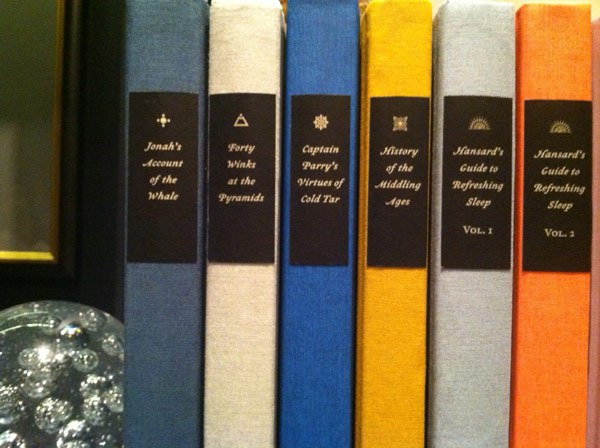
I don’t know about you, but I’ve sort of always associated Charles Dickens with the kind of humorless moralism and didactic sentimentality that are hallmarks of so much Victorian literature. That’s probably because the work of Dickens contains no small amount of humorless moralism and didactic sentimentality. But it also contains much wit and absurdity, inventive characterization and rich description. While novels like the short Hard Times, published in 1854, can seem more like thinly veiled tracts of moral philosophy than fully realized fictions, others, like the strange and whimsical Pickwick Papers—Dickens’ first—work as fanciful, lighthearted satires. The big, baggy novels like Great Expectations, Bleak House, and A Tale of Two Cities (find in our collection of Free eBooks) manage to skillfully combine these two impulses with his own twist on the gothic, such that Dickens’ work is not overwhelmed, as it might be, by sermonizing.
For all of this tidy summation of that giant of Victorian letters, one adjective now comes to mind that I would never have previously thought to apply at any time to the writer of A Christmas Carol: Borgesian, as in possessed of the scholastic wit of 20th century Argentine writer Jorge Luis Borges. I’m not the first to note a resemblance, but I must say it never would have occurred to me to think of the two names in the same sentence were it not for an extra-curricular activity Dickens engaged in while outfitting his London home, Tavistock House, in 1851. Letters of Note’s sister site Lists of Note brings us the following anecdote:
[Dickens] decided to fill two spaces in his new study with bookcases containing fake books, the witty titles of which he had invented. And so, on October 22nd, he wrote to a bookbinder named Thomas Robert Eeles and supplied him with the following “list of imitation book-backs” to be produced.
You can see the complete—completely Borgesian—list below. Borges is of course well known for inventing titles of books that have never existed, but seem like they should, in another dimension somewhere. His invention of alternate realities, and publications, manifests in most all of his stories, as well as in oddities like the Book of Imaginary Beings. Like Borges’ made-up books, Dickens’ contain just the right mix of the self-serious and the ridiculous, so as to make them at once plausible, cryptic, exotic, and hilarious—both Pickwickian and, indeed, proto-Borgesian.
History of a Short Chancery Suit
Catalogue of Statues of the Duke of Wellington
Five Minutes in China. 3 vols.
Forty Winks at the Pyramids. 2 vols.
Abernethy on the Constitution. 2 vols.
Mr. Green’s Overland Mail. 2 vols.
Captain Cook’s Life of Savage. 2 vols.
A Carpenter’s Bench of Bishops. 2 vols.
Toot’s Universal Letter-Writer. 2 vols.
Orson’s Art of Etiquette.
Downeaster’s Complete Calculator.
History of the Middling Ages. 6 vols.
Jonah’s Account of the Whale.
Captain Parry’s Virtues of Cold Tar.
Kant’s Ancient Humbugs. 10 vols.
Bowwowdom. A Poem.
The Quarrelly Review. 4 vols.
The Gunpowder Magazine. 4 vols.
Steele. By the Author of “Ion.”
The Art of Cutting the Teeth.
Matthew’s Nursery Songs. 2 vols.
Paxton’s Bloomers. 5 vols.
On the Use of Mercury by the Ancient Poets.
Drowsy’s Recollections of Nothing. 3 vols.
Heavyside’s Conversations with Nobody. 3 vols.
Commonplace Book of the Oldest Inhabitant. 2 vols.
Growler’s Gruffiology, with Appendix. 4 vols.
The Books of Moses and Sons. 2 vols.
Burke (of Edinburgh) on the Sublime and Beautiful. 2 vols.
Teazer’s Commentaries.
King Henry the Eighth’s Evidences of Christianity. 5 vols.
Miss Biffin on Deportment.
Morrison’s Pills Progress. 2 vols.
Lady Godiva on the Horse.
Munchausen’s Modern Miracles. 4 vols.
Richardson’s Show of Dramatic Literature. 12 vols.
Hansard’s Guide to Refreshing Sleep. As many volumes as possible.
As Flavorwire reports, designer Ann Sappenfield created her own fake bookbindings with Dickens’ titles (see some at the top of the page, courtesy of the NYPL). These are part of a New York Public Library exhibit called Charles Dickens: The Key to Character that ran in 2012–13. You can read Dickens original letter to Thomas Robert Eeles in The Letters of Charles Dickens here.
via Lists of Note/Flavorwire
Related Content:
Charles Dickens Gave His Cat “Bob” a Second Life as a Letter Opener
Charles Dickens’ Hand-Edited Copy of His Classic Holiday Tale, A Christmas Carol
Josh Jones is a writer and musician based in Durham, NC. Follow him at @jdmagness
Read More...Masterpieces of Western Art with All Gluten Products Removed: See Works by Dalí, Cézanne, Van Gogh & Others
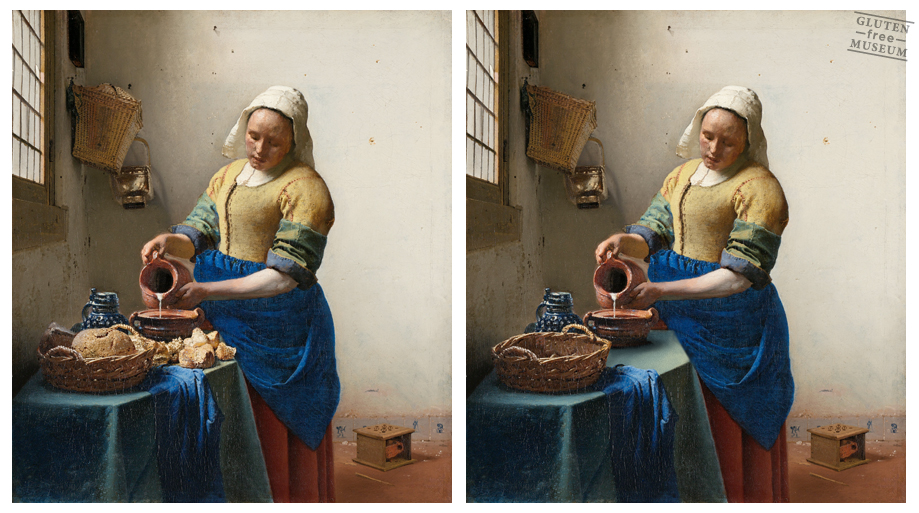
left: Johannes Vermeer, The Milkmaid. right: Arthur Coulet, d’après Johannes Vermeer
It has been suggested plausibly that Vermeer’s kitchen maid is making bread porridge, which puts stale bread—there is an unusual amount of bread on the table—to good use by combining it with milk and a few other ingredients to make a filling mash or meal.
- Walter Liedtke, Department of European Paintings, The Metropolitan Museum of Art
It’s a matter for conjecture. Perhaps Vermeer wanted to title his painting The Bread Porridge Maid, but caved to market research suggesting that Milkmaid would better appeal to what Liedtke calls “male viewer’s amorous musings.”
Recently, graphic artist Arthur Coulet made bread a focal point in Vermeer’s Milkmaid and other iconic works, ironically by Photoshopping it out.
His online Gluten Free Museum is a nod to détournement, manipulations of existing works born of Letterist International and the Situationists. Gone are the crusty loaves, fields golden with wheat, and anything containing grains that could cause discomfort to those afflicted by gluten intolerance or celiac disease.

Even the pitchfork in Grant Wood’s American Gothic gets the digital heave ho…with nothing to harvest, what’s the point?
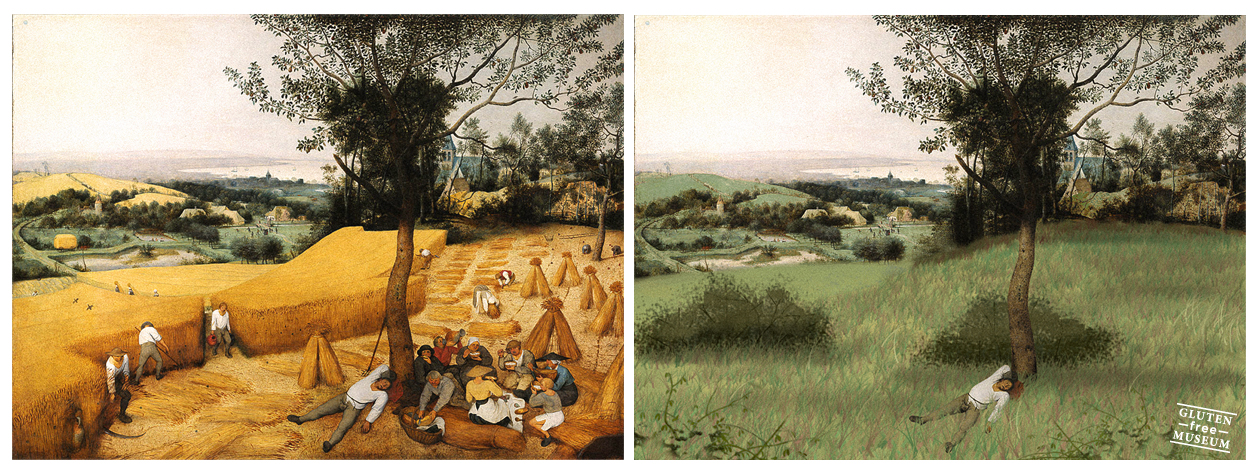
Pieter Bruegel’s the Harvesters gets the most radical redo.
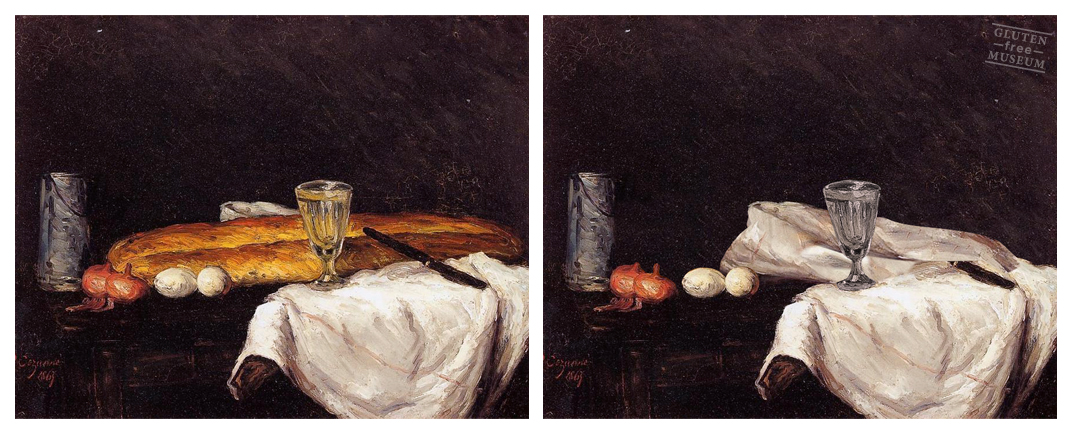
Cezanne’s Still Life with Bread and Eggs is now just Eggs…
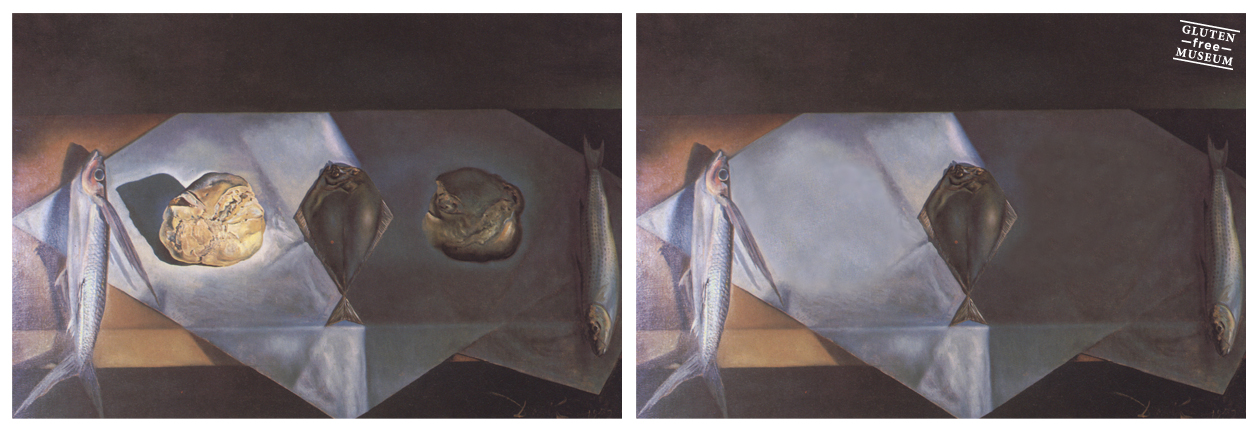
…and Salvador Dali’s Eucharistic Still Life has been reduced to mere fishes.
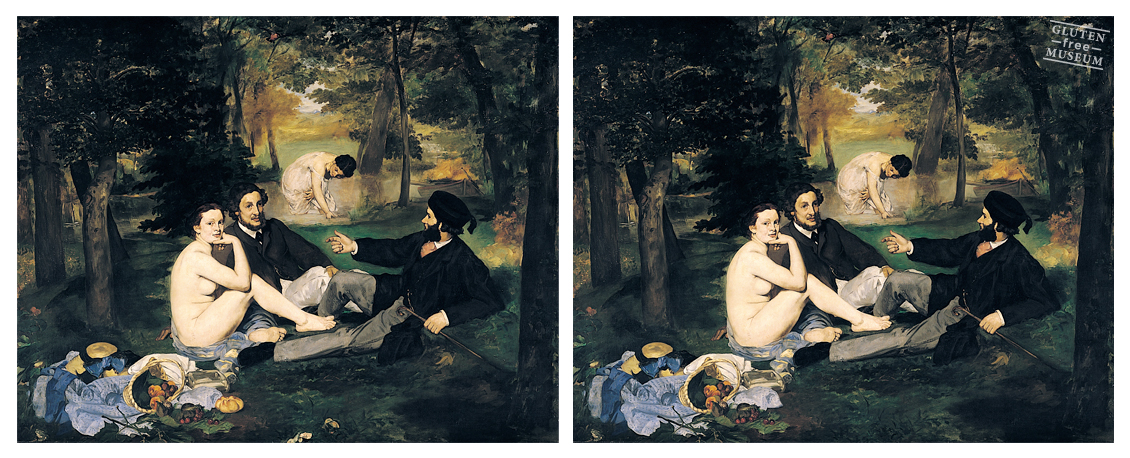
By contrast, the picnickers in Édouard Manet’s Le Déjeuner Sur L’Herbe probably don’t even notice the omission.
See more, including work by Jean-François Millet, Vincent van Gogh, Caravaggio, Giuseppe Arcimboldo, and Jeff Koons in Coulet’s Gluten Free Museum.
A quick image search using the phrase “bread painting” suggests that much work remains to be done.
Related Content:
Philosopher Portraits: Famous Philosophers Painted in the Style of Influential Artists
What Happens When a Cheap Ikea Print Gets Presented as Fine Art in a Museum
Salvador Dalí’s Melting Clocks Painted on a Latte
Ayun Halliday is an author, illustrator, and Chief Primatologist of the East Village Inky zine. Her play, Fawnbook, is playing in New York City through November 20. Follow her @AyunHalliday
Read More...Sea-Serpents, Vampires, Pirates & More: The Public Domain Review’s Second Book of Essays
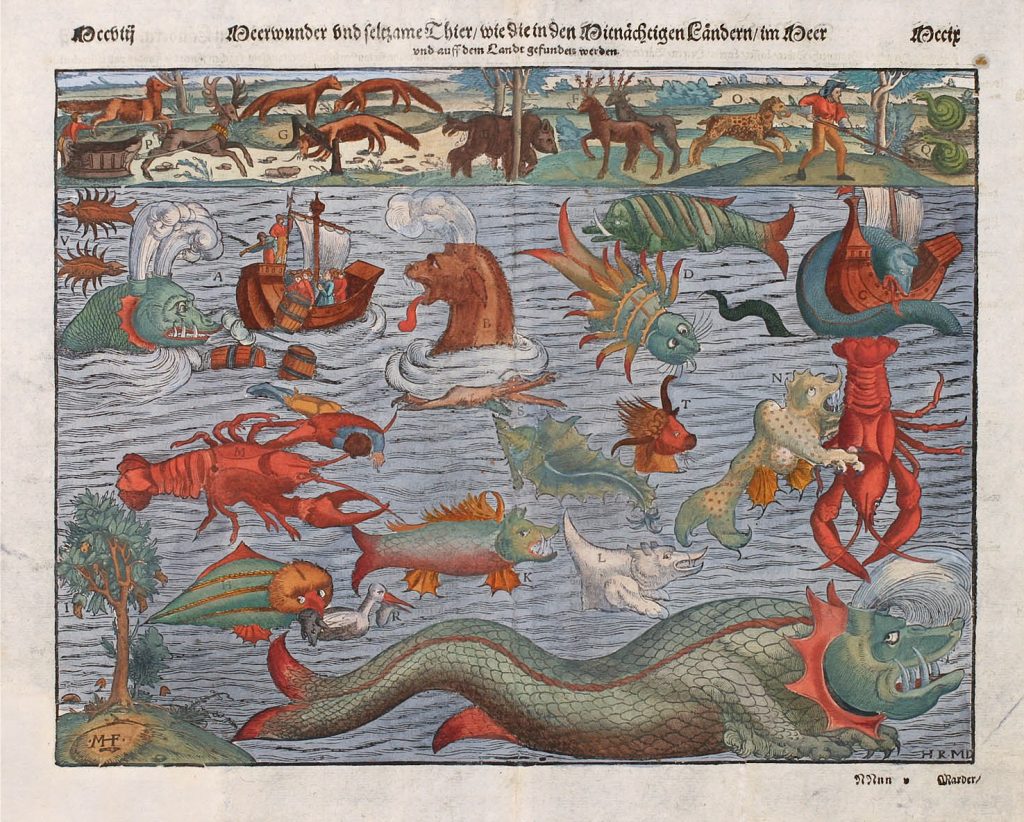
The image above is a version of Sebastian Münster’s 16th-century chart of sea monsters, starring all kinds of fantastical denizens of the deep: from ship-eating serpents and giant lobsters to some kind of seal-octopus hybrid. Featured in the opening essay on the history of sea serpents, the image is one of ninety-nine illustrations to adorn the pages of The Public Domain Review’s wonderful new book of selected essays.
That the collection should begin with this most elusive of snakes is perhaps particularly appropriate. Representing as it does the very idea of terra incognita, the sea serpent is a figure which echoes on in so many of the essays which follow, if we see these “lands unknown” to be not merely geographical but to refer also to the lesser known realms of knowledge. All manner of oft-overlooked histories are explored in the book. We learn of the strange skeletal tableaux of Frederik Ruysch, pay a visit to Humphry Davy high on laughing gas, and peruse the pages of the first ever picture book for children (which includes a wonderful table of Latin animal sounds). There’s also fireworks in art, petty pirates on trial, brainwashing machines, truth-revealing diseases, synesthetic auras, Byronic vampires, and Charles Darwin’s photograph collection of asylum patients. Together the fifteen essays chart a wonderfully curious course through the last five hundred years of history, taking us on a journey through some of the darker, stranger, and altogether more intriguing corners of the past.
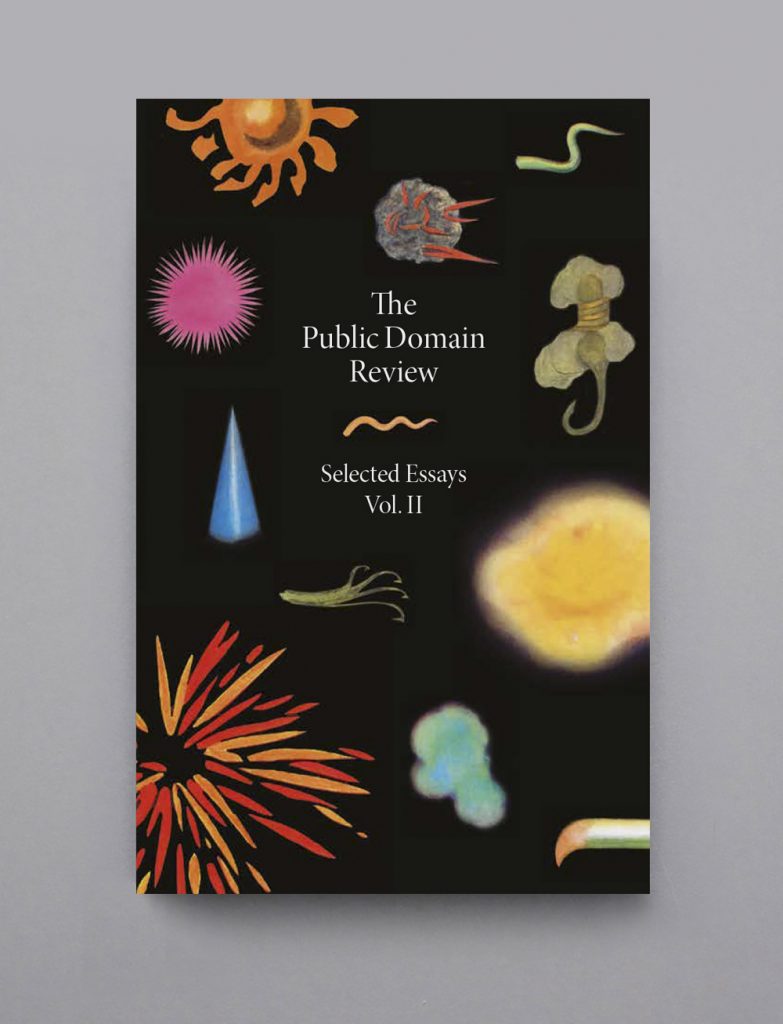
You can find out more about the book through The Public Domain Review’s website. If you want it before Christmas (and we think it’d make an excellent present for that history-loving relative!), then make sure to order by midnight on Wednesday 18th November. Orders before this date will also benefit from a special reduced price.
–Adam Green is the co-founder and editor of The Public Domain Review.
Two Guitar Effects That Revolutionized Rock: The Invention of the Wah-Wah & Fuzz Pedals
In the late 50s, a fearful, racist backlash against rock and roll, coupled with money-grubbing corporate payola, pushed out the blues and R&B that drove rock’s sound. In its place came easy listening orchestration more palatable to conservative white audiences. As sexy electric guitars gave way to string and horn sections, the comparatively aggressive sound of rock and roll seemed so much a passing fad that Decca’s senior A&R man rejected the Beatles’ demo in 1962, telling Brian Epstein, “guitar groups are on their way out.”
But it wasn’t only the blues, R&B, and doo wop revivalism of British Invasion bands that saved the American art form. It was also the often unintentional influence of audio engineers who—with their incessant tinkering and a number of happy accidents—created new sounds that defined the countercultural rock and roll of the 60s and 70s. Ironically, the two technical developments that most characterized those decades’ rock guitar sounds—the wah-wah and fuzz pedals—were originally marketed as ways to imitate strings, horns, and other non-rock and roll instruments.
As you’ll learn in the documentary above, Cry Baby: The Pedal that Rocks the World, the wah-wah pedal, with its “waka-waka” sound so familiar from “Shaft” and 70s porn soundtracks, officially came into being in 1967, when the Thomas Organ company released the first incarnation of the effect. But before it acquired the brand name “Cry Baby” (still the name of the wah-wah pedal manufactured by Jim Dunlop), it went by the name “Clyde McCoy,” a backward-looking bit of branding that attempted to market the effect through nostalgia for pre-rock and roll music. Clyde McCoy was a jazz trumpet player known for his “wah-wah” muting technique on songs like “Sugar Blues” in the 20s, and the pedal was thought to mimic McCoy’s jazz-age effects. (McCoy himself had nothing to do with the marketing.)
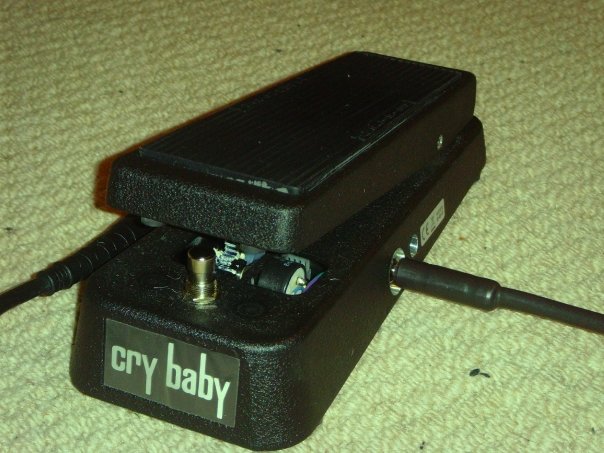
Nonetheless the development of the wah-wah pedal came right out of the most current sixties’ technology made for the most current of acts, the Beatles. Increasingly drowned out by screaming crowds in larger and larger venues, the band required louder and louder amplifiers, and British amp company Vox obliged, creating the 100-watt “Super Beatle” amp in 1964 for their first U.S. tour. As Priceonomics details, when Thomas Organ scored a contract to manufacture the amps stateside, a young engineer named Brad Plunkett was given the task of learning how to make them for less. While experimenting with the smooth dial of a rotary potentiometer in place of an expensive switch, he discovered the wah-wah effect, then had the bright idea to combine the dial—which swept a resonant peak across the upper mid-range frequency—with the foot pedal of an organ.
The rest, as the cliché goes, is history—a fascinating history at that, one that leads from Elvis Presley studio guitarist Del Casher, to Frank Zappa, Clapton and Hendrix, and to dozens of 70s funk guitarists and beyond.
Art Thompson, editor of Guitar Player Magazine, notes in the star-studded Cry Baby documentary that prior to the invention of the wah-wah pedal, guitarists had a limited range of effects—tape delay, tremolo, spring reverb, and fuzz. Only one of these effects, however, was then available in pedal form, and that pedal, Gibson’s Maestro Fuzz-Tone, would also revolutionize the sound of sixties rock. But as you can hear in the short 1962 demonstration record above for the Maestro Fuzz-Tone, the fuzz effect was also marketed as a way of simulating other instruments: “Organ-like tones, mellow woodwinds, and whispering reeds,” says the announcer, “booming brass, and bell-clear horns.”
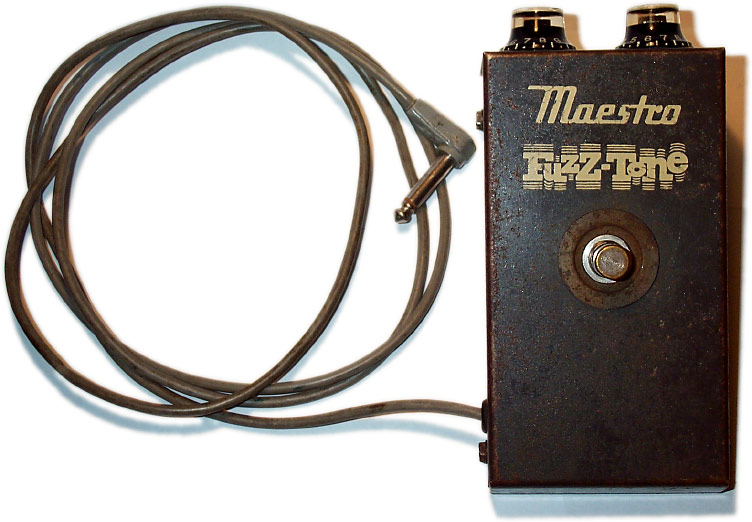
In fact, Keith Richards, in the Stones’ “(I Can’t Get No) Satisfaction”—the song credited with introducing the Maestro’s sound to rock and roll in 1965—originally recorded his fuzzed-out guitar part as a placeholder for a horn section. “But we didn’t have any horns,” he wrote in his autobiography, Life; “the fuzz tone had never been heard before anywhere, and that’s the sound that caught everybody’s attention.”
The assertion isn’t strictly true. While “Satisfaction” brought fuzz to the forefront, the effect first appeared, by accident, in 1961, with “a faulty connection in a mixing board,” writes William Weir in a history of fuzz for The Atlantic. Fuzz, “a term of art… came to define the sound of rock guitar,” but it first appeared in “the bass solo of country singer Marty Robbins on ‘Don’t Worry,’” an “otherwise sweet and mostly acoustic tune.” At the time, engineers argued over whether to leave the mistaken distortion in the mix. Luckily, they opted to keep it, and listeners loved it. When Nancy Sinatra asked engineer Glen Snoddy to replicate the sound, he recreated it in the form of the Maestro.
Guitarists had experimented deliberately with similar distortion effects since the very beginnings of rock and roll, cutting through their amp’s speakers—like Link Wray in his menacing classic instrumental “Rumble”—or pushing small, tube-powered amplifiers past their limits. But none of these experiments, nor the pedals that later emulated them, sound like the fuzz pedal, which achieves its buzzing effect by severely clipping the guitar’s signal. Later iterations from other manufacturers—the Tone Bender, Big Muff, and Fuzz Face—have acquired their own cache, in large part because of Jimi Hendrix’s heavy use of various fuzz pedals throughout his career. “Like the shop talk of wine enthusiasts,” writes Weir, “discussions among distortion cognoscenti on nuances of tone can baffle outsiders.”
Indeed. Those early experiments with effects pedals now fetch upwards of several thousand dollars on the vintage market. And a recent boom in boutique pedals has sent prices for handcrafted replicas of those original models—along with several innovative new designs—into the hundreds of dollars for a single pedal. (One handmade overdrive, the Klon Centaur, has become the most imitated of modern pedals; originals can go for up to two thousand dollars.) The specialization of effects pedal technology, and the hefty pricing for vintage and contemporary effects alike, can be daunting for beginning guitarists who want to sound like their favorite players. But what early players and engineers figured out still holds true—musical innovation is all about creating original sounds by experimenting with whatever you have at hand.
Cry Baby: The Pedal that Rocks the World has been added to our list of Free Documentaries, a subset of our collection 4,000+ Free Movies Online: Great Classics, Indies, Noir, Westerns, Documentaries & More
via Priceonomics
Related Content:
The “Amen Break”: The Most Famous 6‑Second Drum Loop & How It Spawned a Sampling Revolution
All Hail the Beat: How the 1980 Roland TR-808 Drum Machine Changed Pop Music
A Brief History of Sampling: From the Beatles to the Beastie Boys
Josh Jones is a writer and musician based in Durham, NC. Follow him at @jdmagness
Read More...Support Us
We're hoping to rely on loyal readers, rather than erratic ads. Please click the Donate button and support Open Culture. You can use Paypal, Venmo, Patreon, even Crypto! We thank you!

About Us

Open Culture scours the web for the best educational media. We find the free courses and audio books you need, the language lessons & educational videos you want, and plenty of enlightenment in between.
Advertise With Us

FREE UPDATES!
GET OUR DAILY EMAIL
Get the best cultural and educational resources on the web curated for you in a daily email. We never spam. Unsubscribe at any time.
FOLLOW ON SOCIAL MEDIA

Open Culture editor Dan Colman scours the web for the best educational media. He finds the free courses and audio books you need, the language lessons & movies you want, and plenty of enlightenment in between.
Advertise With Us


