Declassified CIA Document Reveals That Ben Franklin (and His Big Ego) Put U.S. National Security at Risk
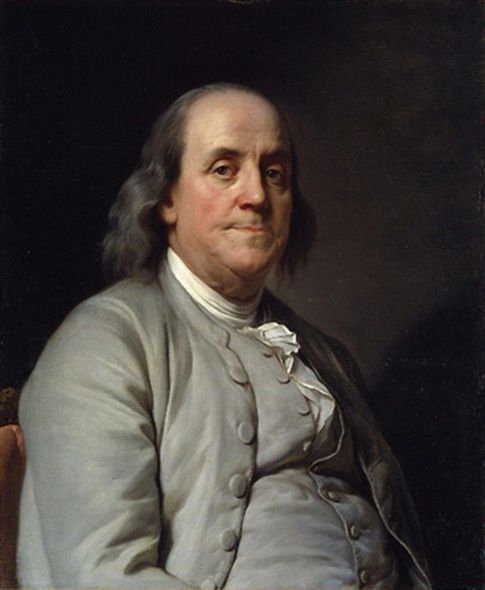
Benjamin Franklin might have been a brilliant author, publisher, scientist, inventor and statesman, but he was pretty lousy at keeping state secrets. That’s the finding from a recently declassified CIA analysis of Franklin’s critically important diplomatic mission to France during the Revolutionary War.
In September 1776, Franklin was dispatched to Paris to enlist France’s support for the American Revolution. At the time, France was still smarting from losing the Seven Years’ War to Britain and was eager to do anything that could reduce its rival’s power and prestige. Franklin’s Commission ran all kinds of clandestine operations with tacit French aid, including procuring weapons, supplies and money for the American Army; sabotaging the Portsmouth Royal Navy Dockyard; and negotiating a secret treaty between America and France.
And according the CIA’s in-house publication, Studies in Intelligence, the British knew just about everything that was going on. “The British had a complete picture of American-French activities supporting the war in America and of American intentions regarding an alliance with France. The British used this intelligence effectively against the American cause.”
Some of the problems with the Commission seem head-slappingly obvious. “There was no real physical security at the Commission itself. The public had access to the mansion, documents and papers were spread out all over the office, and private discussions were held in public areas.”
One of Franklin’s fellow commissioners, Arthur Lee, was outraged over this lack of security.
[Lee] wrote that a French official “had complained that everything we did was known to the English ambassador, who was always plaguing him with the details. No one will be surprised at this who knows that we have no time or place appropriate to our consultation, but that servants, strangers, and everyone else was at liberty to enter and did constantly enter the room while we were talking about public business and that the papers relating to it lay open in rooms of common and continual resort.
Not surprisingly, the American mission was riddled with British spies; chief among them was Franklin’s long-time friend Edward Bancroft, who, as the Commission’s secretary, had complete access to all of its papers. He was reportedly paid a princely sum of 1000 pounds a year by the British Empire to play the part of an Enlightenment-era James Bond.
Lee suspected Bancroft of being a spy, but Franklin dismissed his concerns largely because he greatly disliked Lee. “[Franklin’s] attitude … is all too familiar among policymakers and statesmen,” writes the CIA. “His ego may have overwhelmed his common sense.”
In the end, the analyst lays the blame on these catastrophic lapses in intelligence on that inflated ego.
“By the time [Franklin] arrived in Paris in late 1776, he was elderly and had little interest in the administrative aspects of the Commission. Franklin was widely recognized as a statesman, scientist, and intellectual. While highly respected, he was also vain, obstinate, and jealous of his prerogatives and reputation. … The Commission was “under protection” of the French Government, and Franklin may have underestimated British capabilities to operate in a third country. In any event, he did nothing to create a security consciousness at the Commission.”
The portrait that the CIA paints is indeed a grim one that in different circumstances could have lost the war. Thankfully, Britain proved wholly unable to use this wealth of information to turn the tide of the war. As the CIA wryly notes: “Perhaps the greatest irony in the whole story of the penetration of the American Commission is that, while British intelligence activities were highly successful, British policy was a total failure.”
Related Content:
How the CIA Secretly Funded Abstract Expressionism During the Cold War
Jonathan Crow is a Los Angeles-based writer and filmmaker whose work has appeared in Yahoo!, The Hollywood Reporter, and other publications. You can follow him at @jonccrow. And check out his blog Veeptopus, featuring vice presidents with octopuses on their heads. The Veeptopus store is here.
Read More...Hear the Album Björk Recorded as an 11-Year-Old: Features Cover Art Provided By Her Mom (1977)
Iceland’s biggest export, aside from volcanic ash, is that pixyish pop singer, Björk. Or at least that’s how it seems in the American popular imagination. Björk’s first three of albums were pretty much required listening in certain circles during the ‘90s. Since then, her stature in the indie world has only grown.
Yet before she had a run of beautiful and strange masterpieces; before she was systematically tortured in front of the camera by Lars Von Trier in Dancer in the Dark; and before she was singing about birthdays with her breakout band The Sugarcubes, Björk cut her very first album. It was 1977, and Björk was only eleven.
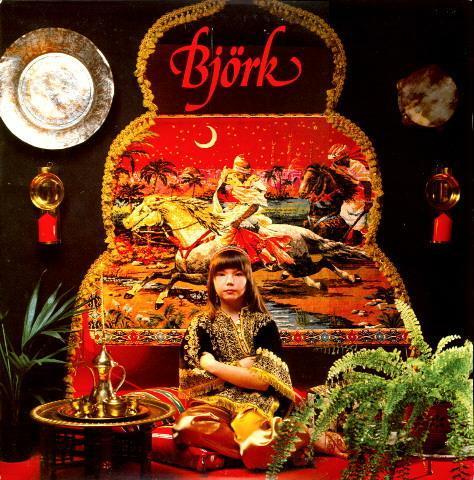
Björk, whose name rhymes with “work” not “pork,” landed the record deal after a tape of her singing Tina Charles’ 1976 disco hit “I Love to Love” played on Iceland’s one and only radio station. The album, called simply Björk, was something of a family affair. While Björk sang and played the flute, her stepfather Sævar Árnason played guitar while her mom, Hildur Hauksdóttir, designed the album cover. (See above.) Overall, the record sounds exactly like what you might expect an Icelandic album from the ‘70s sung by a tweenaged chanteuse might sound like – part Abba, part King Crimson and part early Miley Cyrus. Björk does pretty groovy covers of The Beatles’ “Fool on the Hill” (top) and Syreeta Wright’s “Your Kiss is Sweet (middle),” both sung in Icelandic. There’s also an equally groovy psychedelic instrumental track dedicated to painter Jóhannes Kjarval, (below) whose work is on Icelandic currency. Björk reportedly went platinum in Iceland. You can listen to more tracks from that album on WFMU.
via WFMU
Related Content:
Björk and Sir David Attenborough Team Up in a New Documentary About Music and Technology
Jonathan Crow is a Los Angeles-based writer and filmmaker whose work has appeared in Yahoo!, The Hollywood Reporter, and other publications. You can follow him at @jonccrow. And check out his blog Veeptopus, featuring one new drawing of a vice president with an octopus on his head daily. The Veeptopus store is here.
Read More...Christopher Walken Reads Where The Wild Things Are
Perhaps you saw Spike Jonze and Dave Egger’s twee, sunlit, achingly earnest adaptation of the Maurice Sendak classic Where the Wild Things Are. Perhaps you found it irresistibly charming. Perhaps, however, you missed the sharp edges of Sendak’s lean adventure, its undercurrent of feral violence, its flirtations with matricide and cannibalism. Well who better to convey such frightening undertones than master of casual menace Christopher Walken?
Just above, hear him read Wild Things like you’ve never heard it before. Walken’s interpolated commentary on the illustrations draws our attention to a few features we probably missed in our several hundred readings of the book, such as the possible suicide of Max’s teddy bear and a potential swarm of giant insects in his transformed bedroom. After you hear Walken’s take, Max’s harmless suppertime daydream might give you nightmares.
Walken has long enjoyed entertaining the kiddies with his creepy interpretations of children’s stories. Just above see him read the Three Little Pigs in 1993 on the British comedy series Saturday Zoo. Once again, he adds his own explanatory comments. He’s a little more Billy Crystal than Captain Koons this time, and if his delivery doesn’t make you LOL, his day-glo sweater and wicker throne won’t fail to. Host Jonathan Ross liked the reading so much he invited Walken to read again in 2009 on his BBC show Friday Night with Jonathan Ross. This one’s for the older kids—a deadpan rendition of Lada Gaga’s “Poker Face,” below. Can’t get enough of Walken’s readings? Don’t miss Kevin Pollack’s spot-on parody of the actor Mickey Rourke once called a “strange being from another place.”
If you would like to support the mission of Open Culture, consider making a donation to our site. It’s hard to rely 100% on ads, and your contributions will help us continue providing the best free cultural and educational materials to learners everywhere. You can contribute through PayPal, Patreon, and Venmo (@openculture). Thanks!
Related Content:
Edgar Allan Poe’s “The Raven,” Read by Christopher Walken, Vincent Price, and Christopher Lee
Horror Legend Christopher Lee Presents a Heavy Metal Version of The Little Drummer Boy
Lou Reed Rewrites Edgar Allan Poe’s “The Raven.” See Readings by Reed and Willem Dafoe
Josh Jones is a writer and musician based in Durham, NC. Follow him at @jdmagness.
Read More...Cartoonists Draw Their Famous Cartoon Characters While Blindfolded (1947)
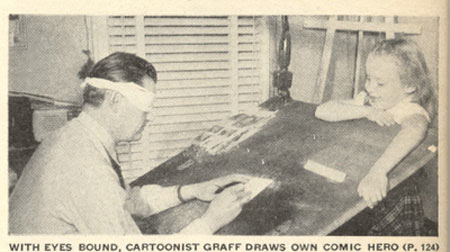
At some point in your life, no doubt, you’ve thought that you have done something so many times that you could do it with your eyes closed — be it change a diaper, make coffee, drive to work or perform a minor surgical procedure. Not that this would necessarily be a good idea (especially that last one) but there’s something about repetition, routine and muscle memory that makes a task so familiar that sight seems superfluous.
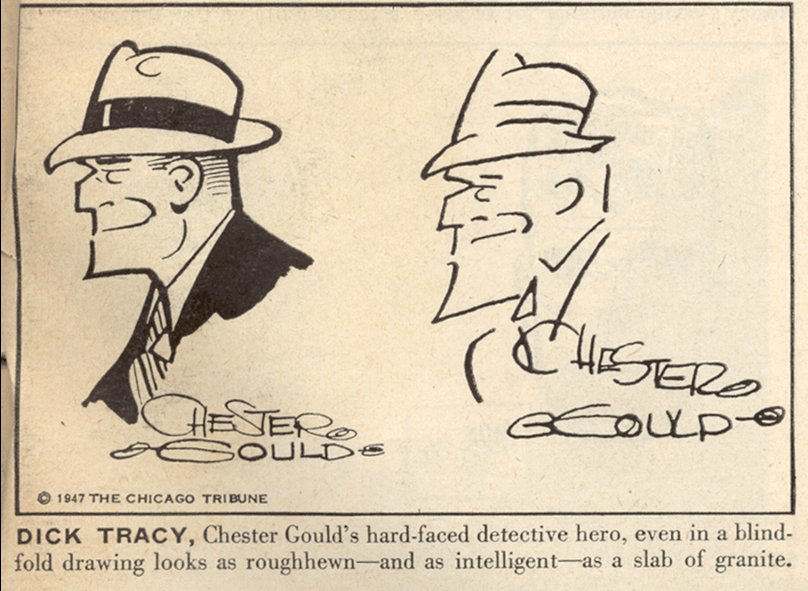
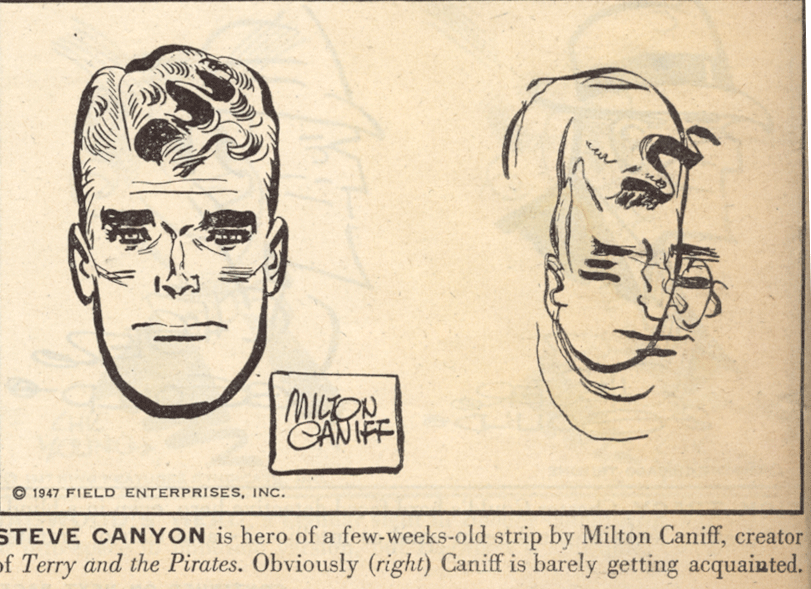
In 1947, LIFE Magazine asked some of the most famous cartoonists around to draw their comic strip characters blindfolded. The results are fascinating, looking a bit like the outcome of a clinical test on artists before and after taking illicit substances. (See our previous post: Artist Draws Nine Portraits on LSD During 1950s Research Experiment.)
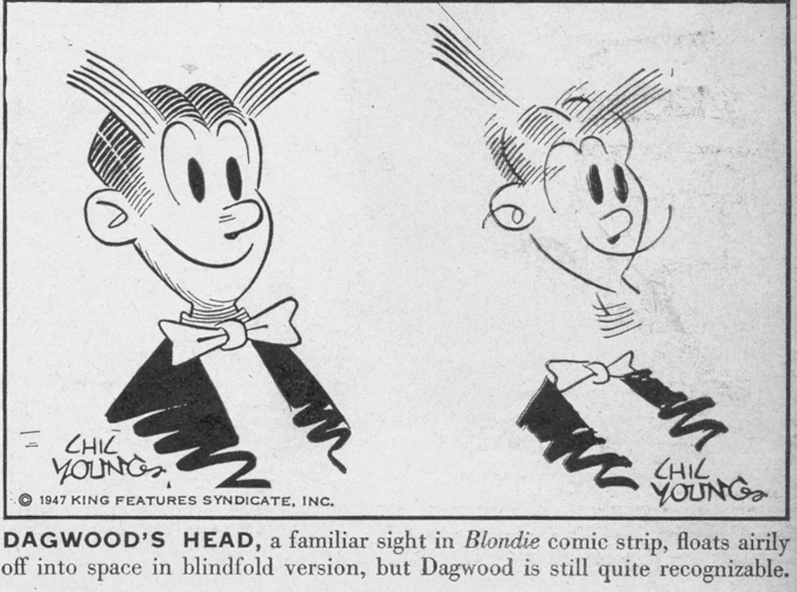
Chic Young’s blindfolded version of Dagwood Bumstead is all dynamic lines and spirals, looking a bit like a doodle from an Italian Futurist. Chester Gould’s blind attempt at Dick Tracy’s chiseled profile looks not all that different from the sighted version. And Milton Caniff’s Steve Canyon has all the elements there — the flinty eyes, the wavy hair – but it’s all jumbled together.
You can see more such drawings here.
via BoingBoing
Related Content:
Gertie the Dinosaur: The Mother of all Cartoon Characters
How Walt Disney Cartoons are Made
Jonathan Crow is a Los Angeles-based writer and filmmaker whose work has appeared in Yahoo!, The Hollywood Reporter, and other publications. You can follow him at @jonccrow. And check out his blog Veeptopus, featuring one new drawing of a vice president with an octopus on his head daily. The Veeptopus store is here.
Read More...
Watch Miles Davis, Grace Jones, Adam Ant & Devo in 1980s Ads for Honda Scooters
Beginning scooter riders can find a veritable biker’s breakfast of pointers on the Internet. One could cobble them together to make a contemporary owners manual, covering such crucial topics as braking, throttling, steering, and staying upright. But sometimes one craves something a bit more elusive, a bit more spiritual. Is there a youtube equivalent of Zen and the Art of Motorcycle Maintenance?
Not really, but there are these early 80s ads for Honda scooters, featuring some of the era’s most iconoclastic acts.
They put Adam Ant’s dashing post-punk appeal to the test by confining him in close quarters with Grace Jones. Grace, above, dominated, with all the confidence and ease of a tiger caged up with a peacock.
The prize? Can’t speak for Adam, but Grace got to film another spot. Her co-stars this time were a grid of infants, whose mothers must’ve been relieved that the alien diva queen never actually interacted with them. Can you imagine if Huggies had shared Honda’s adventurous advertising sensibilities?
Jazz great musician Miles Davis didn’t have to do much to lend an air of cool to that scooter. Even the cardboard boxes scattered in the background of his garage benefit from his presence. The Prince of Darkness’ reputation was never an 80’s-specific phenomenon, but he looks the part, kitted out like the Road Warrior.
Synth-pop superstars Devo urged beginning riders to adopt their extremely unconventional brand of conformity, suggesting that the band’s uniform of coveralls and, uh, shoes was the perfect thing to wear while riding that Honda. Those who wanted to hang on to some semblance of individuality could do so via scooter color.
Ironic though it may have been, their willingness to be seen sporting, nay, promoting helmets makes Devo’s ad my personal favorite.
To see Lou Reed’s contribution to Honda’s series of ads, see our previous post: Selling Cool: Lou Reed’s Classic Honda Scooter Commercial, 1984
Related Content:
David Lynch’s Perfume Ads Based on the Works of Hemingway, F. Scott Fitzgerald & D.H. Lawrence
Watch Laurence Olivier, Liv Ullmann and Christopher Plummer’s Classic Polaroid Ads
Klaus Nomi’s Ad for Jägermeister (Circa 1980)
Ayun Halliday is an author, homeschooler, and Chief Primatologist of the East Village Inky zine. Follow her @AyunHalliday
Read More...Watch Frank Zappa Play Michael Nesmith on The Monkees (1967)
In December 1967, The Monkees blew their audience’s minds by hosting Frank Zappa, “participant in and perhaps even leader of” the Mothers Of Invention.
Or did they?
The tidal wave of affection that comprises twenty-first century Monkees mania makes us forget that children were the primary audience for The Monkees’ titular sitcom. (One might also say that The Monkees were the sitcom’s titular band.)
But even if the kids at home weren’t sufficiently conversant in the musical underground to identify the special guest star of the episode, “The Monkees Blow Their Minds,” we are.
It’s a joy to see Zappa and The Monkees’ supremely laid back Michael Nesmith (he auditioned for the show with his laundry bag in tow) impersonating each other.
Zappa’s idea, apparently. He’s in complete control of the gimmick from the get go, whereas Nesmith struggles to keep their names straight and his prosthetic nose in place before getting up to speed.
It’s important to remember that it’s not Frank, but Nesmith playing Frank who accuses The Monkees’ music of being banal and insipid.
Zappa himself was a great supporter of The Monkees. “When people hated us more than anything, he said kind things about us,” Nesmith recalled in Barry Miles’ Zappa biography. Zappa attempted to teach Nesmith how to play lead guitar, and offered drummer Micky Dolenz a post-Monkees gig with The Mothers of Invention.
Their mutual warmth makes lines like “You’re the popular musician! I’m dirty gross and ugly” palatable. It put me in mind of comedian Zach Galifianakis’ Between Two Ferns, and countless other loosely rehearsed web series.
After a couple of minutes, Nesmith gets his hat back to conduct as Zappa smashes up a car to the tune of the Mother’s Of Invention’s “Mother People.”
Watch the full episode here, or if pressed for time, perhaps just Zappa’s cameo in the Monkees’ movie Head, as a studio lot bull wrangler who counsels lead singer Davy Jones on his career.
Related Content:
A Young Frank Zappa Turns the Bicycle into a Musical Instrument on The Steve Allen Show (1963)
In One of his Final Interviews, Frank Zappa Pronounces Himself “Totally Unrepentant”
Ayun Halliday is an author, homeschooler, and Chief Primatologist of the East Village Inky zine. Follow her @AyunHalliday
Read More...
Young Joni Mitchell Performs a Hit-Filled Concert in London (1970)
It’s hard to imagine the young lady seen performing her own songs on the BBC in the video above twerking or even tweeting, for that matter. The utterly unadorned quality of this performance suits the now-legendary purity of her youthful voice.
Woe, the deleterious effects of her longtime cigarette habit.
Now, back to 1970, when just shy of 27, Joni Mitchell played a hit-filled set to a British studio audience, despite a “little London flu” she alludes to more than once.
If it seemed unpretentious at the time, it’s even more so now, nary a laser beam or back up dancer in sight. No costume changes. Barely any makeup. Just Joni, her guitar, her piano, and a nifty custom dulcimer made by “a dynamite girl who lives in California.”
Passing the time as she tunes this last instrument, she mentions that the upcoming song, “California,”concerns an adventure to which she’d recently treated herself. She’d written it before her return, as a sort of postcard home. Meaning that that park bench in Paris, France was barely cold! This is way more exciting to me than a bevy of hair extensions, served with a practiced snarl and a side of auto tune.
A girlish giggle and dignified bow seal the deal. Classy!
If you would like to support the mission of Open Culture, consider making a donation to our site. It’s hard to rely 100% on ads, and your contributions will help us continue providing the best free cultural and educational materials to learners everywhere. You can contribute through PayPal, Patreon, and Venmo (@openculture). Thanks!
Related Content:
Watch Classic Performances of Joni Mitchell’s “Both Sides Now” & “The Circle Game” (1968)
The Music, Art, and Life of Joni Mitchell Presented in a Superb 2003 Documentary
James Taylor and Joni Mitchell, Live and Together (1970)
Ayun Halliday is an author, homeschooler, and Chief Primatologist of the East Village Inky zine. Follow her @AyunHalliday
Read More...Dripped: An Animated Tribute to Jackson Pollock’s Signature Painting Technique
To make an exciting movie, do you really need much more than an art thief and his capers? With Dripped, animator Léo Verrier sees that can’t-miss premise and raises it in an exploration of art history. In its 1940s New York City setting, painting-swiping protagonist Jack lives not just to make world-renowned canvasses his own, but a part of him. When he gets these works of art back to his apartment, he doesn’t even consider selling them; instead, he chews and swallows them, thus enabling him to assume in body the forms and colors famously expressed in paint on their surfaces. We are what we eat, and Jack eats art, but even becoming the art of others ultimately leaves him unsatisfied. Determined to paint and eat a canvas of his own, he finds his stomach can’t handle his work in progress. Thrown into a bout of frustration, an angered Jack tosses one of his paintings to the ground, randomly splattering it with every color at hand. And thus he discovers, in this animated fantasy, the technique that Jackson Pollock would pioneer in reality.
To see the real artist — one not known for his eating, though his drinking did gain a reputation of its own — in action have a look at Hans Namuth’s 1951 footage of Pollock painting with his signature “drip” method above. To learn more about the how and the why of it, see also the 1987 documentary Portrait of an Artist: Jackson Pollock, which we featured in 2012; and below, see the Museum of Modern Art’s short examination and re-creation of Pollock’s “action painting” technique. Chance may have led him to discover this practice, but it hardly means he gave up control. Filmmaker Stan Brakhage liked to tell the following illustrative story, which came out of hanging out with various artists and composers in Pollock’s studio in the late 40s:
They were, like, commenting, and they used the words “chance operations” — which was no bother to me because I was hearing it regularly from John Cage — and the power and the wonder of it and so forth. This really angered Pollock very deeply and he said, “Don’t give me any of your ‘chance operations.’ ” He said, “You see that doorknob?” and there was a doorknob about fifty feet from where he was sitting that was, in fact, the door that everyone was going to have to exit. Drunk as he was, he just with one swirl of his brush picked up a glob of paint, hurled it, and hit that doorknob smack-on with very little paint over the edges. And then he said, “And that’s the way out.”
via Juxtapoz
Related Content:
Watch Portrait of an Artist: Jackson Pollock, the 1987 Documentary Narrated by Melvyn Bragg
Jackson Pollock 51: Short Film Captures the Painter Creating Abstract Expressionist Art
MoMA Puts Pollock, Rothko & de Kooning on Your iPad
Colin Marshall hosts and produces Notebook on Cities and Culture and writes essays on cities, language, Asia, and men’s style. He’s at work on a book about Los Angeles, A Los Angeles Primer. Follow him on Twitter at @colinmarshall or on Facebook.
Read More...Foodie Alert: New York Public Library Presents an Archive of 17,000 Restaurant Menus (1851–2008)
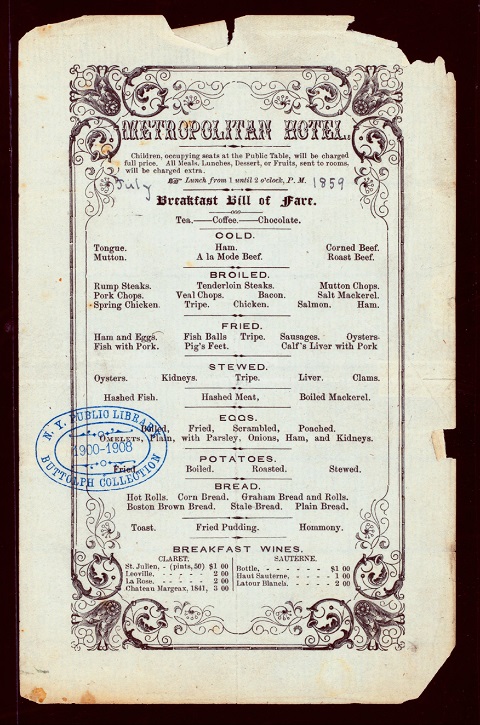
To be a New Yorker is to be a gourmand—of food carts, local diners, supermarkets, outer borough mercados, whatever latest upscale restaurant surfaces in a given season.… It is to be as likely to have a menu in hand as a newspaper, er… smartphone…, and it is to notice the design of said menus. Well, some of us have done that. Often the added attention goes unrewarded, but then sometimes it does. Now you, dear reader, can experience well over one-hundred years of staring at menus, thanks to the New York Public Library’s enormous digitized collection. Fancy a time warp through dining halls abroad? You’ll not only find several hundred New York restaurants represented here, but hundreds more from all over the world. With a collection of 17,000 menus and counting, a person could easily get lost.
You may notice I used the word “gourmand,” and not “foodie” above. While it might be a gross anachronism to call someone a “foodie” in 1859, the year the menu for the Metropolitan Hotel (above) was printed, it might also import a cosmopolitan concept of dining that didn’t seem to exist, at least at this establishment. More than anything, the menu resembles the various descriptions of pub food that populate Joyce’s Ulysses. Though much of it was delicious, I’m sure, for heavy eaters of meat, eggs, potatoes, and bread, you won’t find a vegetable so much as mentioned in passing. The fare does include such hearty staples as “Hashed Fish,” “Stale Bread,” and “Breakfast Wine.” The design marries flowery Victorian elements with the kind of font found in Old West typesets.

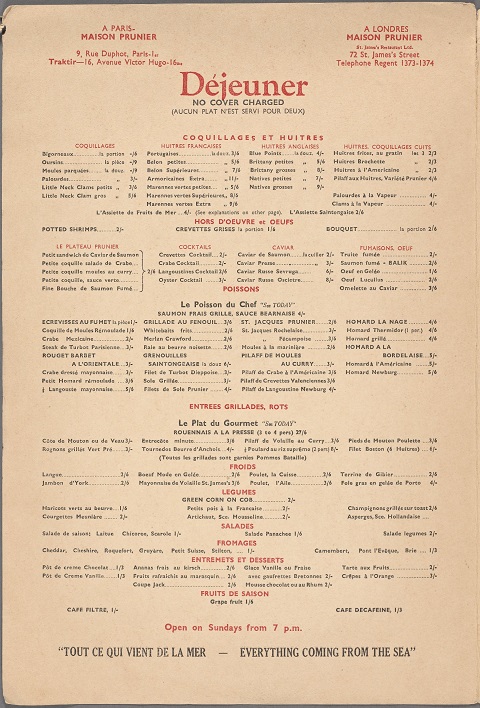
1939 was a good year for menus, at least in Europe. While New York institutions like the Waldorf Astoria practiced certain design austerities, the Maison Prunier, with locations in Paris and London, spared no expense in the printing of their full-color fishermans’ slice of life painting on the menu cover above and the elegant typography of its extensive contents below. A version was printed in English—though The New York Public Library (NYPL) doesn’t seem to have a copy of it digitized. One English phrase stands out at the bottom, however: the translation of “Tout Ce Qui Vient De La Mer–Everything From the Sea.” Other menus for this restaurant show the same kind of careful attention to design. Clicking on the pages of many of the NYPL menus—like this one from a 1938 Maison Prunier menu—brings up an interactive feature that links each dish to close-up views.
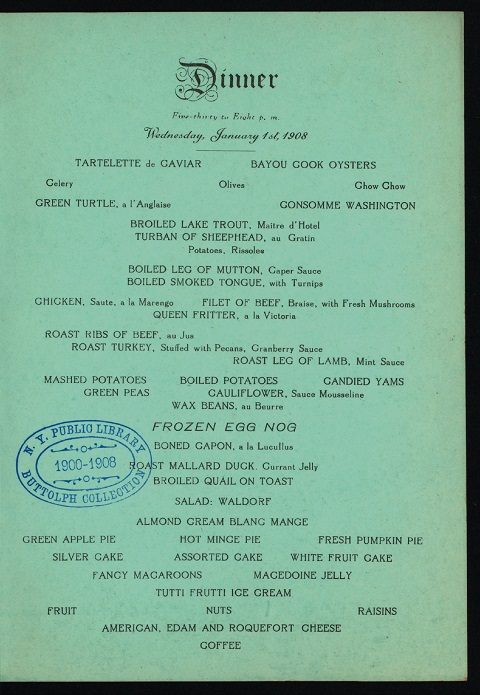
In a post on the NYPL menu collection, Buzzfeed specifically compares New York menus of today with those of 100 years ago, noting that prices quoted signify cents, not dollars. A 1914 Delmonico “Rib of Roast” would run you .75 cents, for example, while a 2014 rib eye there sells for 58 big ones. Of course then, as now, many restaurants considered it gauche to print prices at all. See, for example, the dinner menu at New Orleans’ St. Charles Hotel from 1908 below. We may have an all-inclusive feast here since this comes from a New Years Eve bill, which also includes a “Musical Program” in two parts and a list of local “Amusements” at such places as Blaney’s Lyric Theatre, Tulane, Dauphine, “French Orera” (sic), and the 2:00 pm races at City Park. Matinees and 8 o’clock shows every day except Sunday.
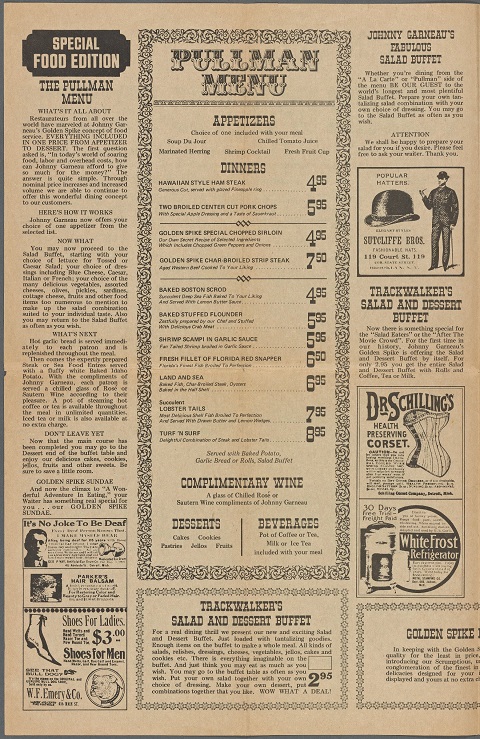
The sixties gave us an explosion of menus that parallel in many cases the breakout designs of magazine and album covers. See two standouts below. The North German Lloyd, just below, went with a funky children’s book-cover illustration for its 1969 menu cover, though its interior maintains a minimalist clarity. Below it, see the striking first page of a menu for Johnny Garneau’s Golden Spike from that same year. The cover boasts a nostalgic headline story for Promontory News: “Golden Spike is Driven: The last rail is laid! East meets West in Utah!” Put it on the cover of a Band or CSNY album and no one bats an eye.

See many, many, many more menus at the NYPL site. With the steady growth of food scholarship, this collection is certainly a boon to researchers, as well as curious gourmands, foodies, and rabid diners of all stripes.
via Buzzfeed
Related Content:
What Prisoners Ate at Alcatraz in 1946: A Vintage Prison Menu
Howard Johnson’s Presents a Children’s Menu Featuring Kubrick’s 2001: A Space Odyssey (1968)
Extensive Archive of Avant-Garde & Modernist Magazines (1890–1939) Now Available Online
Josh Jones is a writer and musician based in Durham, NC. Follow him at @jdmagness
Read More...New Albums by Robert Plant, Ryan Adams & Justin Townes Earle Streaming Online for a Limited Time
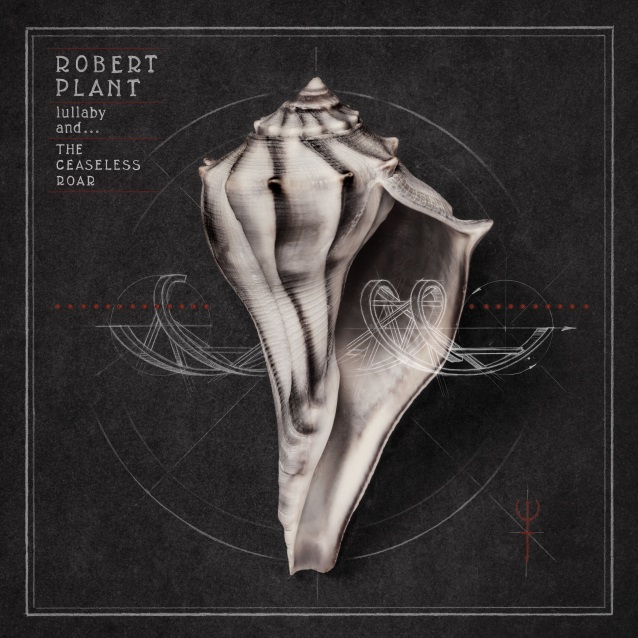
Quick note: If you’re not familiar with it, NPR’s First Listen site lets you stream new albums by major artists. And this week’s lineup deserves a special mention. First Listen is featuring Robert Plant’s new release Lullaby And… The Ceaseless Roar. The album, writes NPR, is “an expression of many kinds of rich, autumnal love: of the English countryside to which Plant recently returned after several years living and working in Nashville and Texas; of the musical diaspora he’s been exploring since Led Zeppelin first connected its American-inspired blues to North Africa in ‘Kashmir’; of the Celtic and Romantic literary lines he’s always favored; and of a woman, whom the songs’ narrator treasures but, for reasons upon which at least half of the album dwells, leaves behind.” You can stream it here for a limited time.
While at NPR, you might also want to hear Ryan Adams by, yes, Ryan Adams. It’s his 14th album, and, says The New York Daily News, it “goes all in for neo-classic rock. It draws on the kind of serrated riffs Keith Richards likes to hone — but weighted with the heavy bottom and burning organ of Tom Petty and the Heartbreakers.”
Last but not least, NPR is serving up Justin Townes Earle’s fifth album, Single Mothers. Many of the songs offer a take on “the mercurial nature of infatuation.”
Stream away, but don’t delay. The albums usually remain online for a week at most.
Read More...Support Us
We're hoping to rely on loyal readers, rather than erratic ads. Please click the Donate button and support Open Culture. You can use Paypal, Venmo, Patreon, even Crypto! We thank you!

About Us

Open Culture scours the web for the best educational media. We find the free courses and audio books you need, the language lessons & educational videos you want, and plenty of enlightenment in between.
Advertise With Us

FREE UPDATES!
GET OUR DAILY EMAIL
Get the best cultural and educational resources on the web curated for you in a daily email. We never spam. Unsubscribe at any time.
FOLLOW ON SOCIAL MEDIA

Open Culture editor Dan Colman scours the web for the best educational media. He finds the free courses and audio books you need, the language lessons & movies you want, and plenty of enlightenment in between.
Advertise With Us


