Dick Van Dyke, Paul Lynde & the Original Cast of Bye Bye Birdie Appear on The Ed Sullivan Show (1961)
?si=cd3WFcukQgkDVXT4
Think back, if you will to the dawn of the 60’s, or failing that, the third season of Mad Men, when Broadway musicals could still be considered legitimate adult entertainment and Bye Bye Birdie was the hottest ticket in town.
Six months after the show’s 1960 opening, Broadway’s—soon to be television’s—latest star Dick Van Dyke, appeared on the Ed Sullivan show to introduce the rest of the country to the musical their high schools and community theaters would be performing in perpetuity.
The showcase also afforded the American viewing public their first glimpse of the man who would outlast Sullivan as a fixture in their living rooms, Hollywood’s most outrageous Square, Paul Lynde.
Lynde had his camp and ate it too in the role of a solidly Midwestern father of two who, by virtue of his association with his teenage daughter, finds himself appearing on none other than… The Ed Sullivan Show! It’s a truly meta moment. The studio audience seems to enjoy the joke, and Sullivan appears pleased too, when he wanders on after “Hymn for a Sunday Evening” as the song is properly called. According to his biography, Always on Sunday, his response upon first hearing was less enthusiastic. When the merry Broadway crowd turned to check Sullivan’s response to Lynde’s gulping final admission, (“I love you, Ed!”), Sullivan reported that he wanted the floor to open up and swallow both him and his wife.
Way to get with the joke, Ed!
Later in the episode, there’s some graceful Van Dyke footwork on “Put on a Happy Face,” a song that even the most seasoned theatergoers tend to forget originated with this show, probably because it does nothing to advance the plot.
Lynde and Van Dyke reprised their roles in the 1962 film, but in a typical tale of stage-to-screen heartbreak, Susan Watson, Lynde’s original Birdie daughter, was replaced by 22-year-old bombshell, Ann-Margret. (The deliciously bitchy remark Maureen Stapleton made about her at the wrap party turns out to be apocryphal, or at least intended more kindly than it would seem.) See what she brings to “Hymn for a Sunday Evening” below.
Related Content:
A Young Frank Zappa Turns the Bicycle into a Musical Instrument on The Steve Allen Show (1963)
Digital Archive of Vintage Television Commercials
Ayun Halliday is an author and homeschooler, and Chief Primatologist of the East Village Inky zine. Follow her @AyunHalliday
Read More...Brian Eno’s Take on the Gaza Conflict Appears on David Byrne’s Web Site

On his web site, former Talking Heads frontman David Byrne writes:
I received this email last Friday morning from my friend, Brian Eno. I shared it with my office and we all felt a great responsibility to publish Brian’s heavy, worthy note. In response, Brian’s friend, Peter Schwartz, replied with an eye-opening historical explanation of how we got here. What’s clear is that no one has the moral high ground.
First comes Eno’s clearly heartfelt condemnation of civilian deaths in Gaza (particularly the death of children) and America’s apparent indifference to what’s happening there:
Today I saw a picture of a weeping Palestinian man holding a plastic carrier bag of meat. It was his son. He’d been shredded (the hospital’s word) by an Israeli missile attack — apparently using their fab new weapon, flechette bombs. You probably know what those are — hundreds of small steel darts packed around explosive which tear the flesh off humans. The boy was Mohammed Khalaf al-Nawasra. He was 4 years old.
I suddenly found myself thinking that it could have been one of my kids in that bag, and that thought upset me more than anything has for a long time.
Then I read that the UN had said that Israel might be guilty of war crimes in Gaza, and they wanted to launch a commission into that. America won’t sign up to it.
What is going on in America? I know from my own experience how slanted your news is, and how little you get to hear about the other side of this story. But — for Christ’s sake! — it’s not that hard to find out. Why does America continue its blind support of this one-sided exercise in ethnic cleansing? WHY?
What follows is part of futurist Peter Schwartz’s response, which, rich in historical detail, splits the blame somewhere down the middle. Echoing Byrne’s sense that the two sides have lost their moral positions, Schwartz notes:
Even though I have no support for the Israeli position I find the opposition to Israel questionable in its failure to be similarly outraged by a vast number of other moral horrors in the recent past and currently active. Just to name a few; Cambodia, Tibet, Sudan, Somalia, Nicaragua, Mexico, Argentina, Liberia, Central African Republic, Uganda, North Korea, Bosnia, Kosovo, Venezuela, Syria, Egypt, Libya, Zimbabwe and especially right now Nigeria. The Arab Spring, which has become a dark winter for most Arabs and the large scale slaughter now underway along the borders of Iraq and Syria are good examples of what they do to themselves. And our nations, the US, the Brits, the Dutch, the Russians and the French have all played their parts in these other moral outrages. The gruesome body count and social destruction left behind dwarfs anything that the Israelis have done. The only difference with the Israeli’s is their claim to a moral high ground, which they long ago left behind in the refugee camps of Lebanon. They are now just a nation, like any other, trying to survive in a hostile sea of hate.
We should be clear, that given the opportunity, the Arabs would drive the Jews into the sea and that was true from day one. There was no way back from war once a religious state was declared. So Israel, once committed to a nation state in that location and granted that right by other nations have had no choice but to fight. In my view therefore, neither side has any shred of moral standing left, nor have the nations that supported both sides…
I don’t think there is any honor to go around here. Israel has lost its way and commits horrors in the interest of their own survival. And the Arabs and Persians perpetuate a conflict ridden neighborhood with almost no exceptions, fighting against each other and with hate of Israel the only thing that they share.
To read the complete exchange, head over to Byrne’s site and read Gaza and the Loss of Civilization.
Related Content:
How David Byrne and Brian Eno Make Music Together: A Short Documentary
Listen to “Brian Eno Day,” a 12-Hour Radio Show Spent With Eno & His Music (Recorded in 1988)
Jump Start Your Creative Process with Brian Eno’s “Oblique Strategies”
David Byrne: How Architecture Helped Music Evolve
Read More...Hear Roland Barthes Present His 40-Hour Course, La Préparation du roman, in French (1978–80)
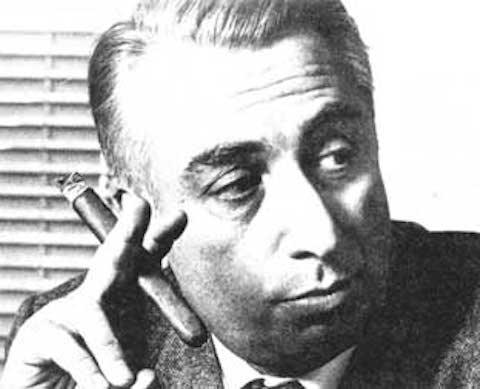
A key figure in such academic areas as semiology, structuralism, and post-structuralism, and author of such theoretical classics as Mythologies, The Pleasure of the Text, and S/Z, Roland Barthes is familiar to students across the humanities. His prolific output encompassed books on literary theory, philosophy, linguistics, anthropology, and theoretical essays on photography, music, fashion, sports, and love. In addition to his wide-ranging writings, Barthes lectured in the U.S., Switzerland, and at the Collège de France, where he was elected Chair of Semiology in 1977.
Barthes’ 1978–1980 lecture course at the Collège de France—titled The Preparation of the Novel—has been preserved in an English translation by Kate Briggs. Speakers of French, however, can hear Barthes himself deliver the lecture series in audio archived at Ubuweb. Listen to the first session from December, 1978 at the top of the post, and hear the fifth, with some musical accompaniment, above.
Delivered shortly after publication of the seminal texts mentioned above, these lectures, writes editor Nathalie Léger in her introduction, “form a diptych—the two parts can be accessed independently of each other, yet each one is indispensable to the other.” The last two lecture courses Barthes taught at the Collège de France, both, Léger writes, represent not a systematic theory, but “the peregrination of a quest,” exploring “one question and one question only: that of literary utopia.” Such probing investigations propelled Barthes’ entire career, and opened up new critical paths for a great many thinkers who dared to trace his winding intellectual steps and often intensely personal explorations.
La Préparation du roman will be added to our list of Free Online Literature Courses, part of our larger collection, 1,700 Free Online Courses from Top Universities.
Related Content:
Susan Sontag Lectures On Literary Pornography (1964)
Walter Kaufmann’s Classic Lectures on Nietzsche, Kierkegaard and Sartre (1960)
Josh Jones is a writer and musician based in Durham, NC. Follow him at @jdmagness
Read More...Learn How Crayons Are Made, Courtesy of 1980s Videos by Sesame Street and Mr. Rogers
Some things are difficult to improve upon. Take crayons. The new generation may be clamoring for shades like “mango tango” and “jazzberry jam” but the actual technology appears unchanged since Sesame Street detailed the process in the early 80s, in the lovely, non verbal documentary above. Not a product placement in sight, I might add, though few can mistake that familiar green and gold box.
Those who prefer a bit more explanation might prefer Fred Rogers’ hypnotic step-by-step guide, playing in perpetuity on Picture Picture.
By the time the industry’s giant gorilla got around to weighing in, the wooden collection boxes and analog counters had been replaced, but otherwise, it’s still business as usual on the ol’ crayon-manufacturing floor. Don’t expect to find the recipe for the “secret proprietary blend of pigments and other ingredients” any time soon. Just know they’re capable of cranking out 8500 crayons per minute. For those playing along at home, that’s enough to encircle the globe 6 times per calendar year, with a full third owing their existence to solar energy.
There’s a Homeland Security-ish vibe to some of the dialogue, but the Life of an American Crayon, above, does our native assembly lines proud. Prouder than the American slaughterhouse, anyway, or some other factory floors, I could name. The workers seem content enough to stay in their positions for decades, happily declaring allegiance to this or that hue.
Related Content:
Philip Glass Composes for Sesame Street (1979)
How Animated Cartoons Are Made: Watch a Short, Charming Primer from 1919
Ayun Halliday is an author, homeschooler, and Chief Primatologist of the East Village Inky zine. Follow her @AyunHalliday
Read More...
Theodor Adorno’s Philosophy of Punctuation
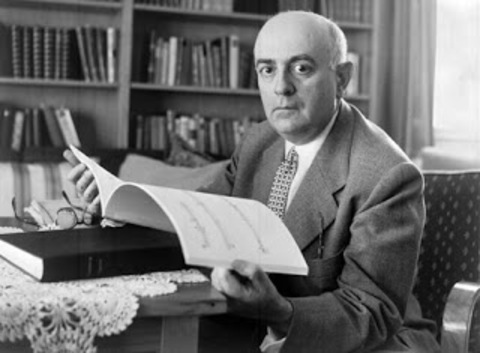
German critical theorist Theodor Adorno is known for many things, but a light touch isn’t one of them. His work includes despairing post-fascist ethics and a study on the sociology and psychology of fascism. Those who dig deeper into his catalog may know his rigorously philosophical Negative Dialectics or dense, opaque Aesthetic Theory. Given the seriously heavy nature of these books, you might be surprised, as I was, to read the paragraph below:
An exclamation point looks like an index finger raised in warning; a question mark looks like a flashing light or the blink of an eye. A colon, says Karl Kraus, opens its mouth wide: woe to the writer who does not fill it with something nourishing. Visually, the semicolon looks like a drooping moustache; I am even more aware of its gamey taste. With self-satisfied peasant cunning, German quotation marks («> >) lick their lips.
The skillful deployment of aphorism seems typical; the playfulness not so much. But Adorno’s short essay, “punctuation marks,” takes a sober turn shortly thereafter, and for good reason. Punctuation is serious business. Sounding much more like the Adorno I know, the dour Marxist writes, “History has left its residue in punctuation marks, and it is history, far more than meaning or grammatical function, that looks out at us, rigidified and trembling slightly, from every mark of punctuation.” Okay.
Well, Adorno would just hate what I’m about to do, but—hey—this is the internet; who has the time and concentration to traverse the rocky course of thought he carves out in his work? Maybe you? Good, read the full essay. Not you? See below for some bite-sized highlights.
Punctuation as music: “punctuation marks,” Adorno writes, “are marks of oral delivery.” As such, they function like musical notation. “The comma and the period correspond to the half-cadence and the authentic cadence.” Exclamation points are “like silent cymbal clashes, question marks like musical upbeats.” Colons are like “dominant seventh chords.” Adorno, a musicologist and composer himself, heard things in these symbols most of us probably don’t.
The semicolon: There is no mark of punctuation that Adorno rejects outright. All have their place and purpose. He does decry the modernist tendency to mostly leave them out, since “then they simply hide.” But Adorno reserves a special pride of place for the semicolon. He claims that “only a person who can perceive the different weights of strong and weak phrasings in musical form” can understand the difference between semicolon and comma. He differentiates between the Greek and German semicolon. And he expresses alarm “that the semicolon is dying out.” This, he claims, is due to a fear of “page-long paragraphs”—the kind he often writes. It is “a fear created by the marketplace—by the consumer who does not want to tax himself.” Right, I told you, he would hate the internet, though he seems to thrive—posthumously—on Twitter.
Quotation marks: While Adorno accepts every punctuation mark as meaningful, he does not accept all uses of them. In the case of the quotation mark, his advice is precisely what I have received, and have passed on to overly glib and thoughtless students. Quotation marks, he writes, should only be used for direct quotes, “and if need be when the text wants to distance itself from a word it is referring to.” This can include writing words as words (the word “word” is a word…). Adorno rejects quotation marks as an “ironic device.” This usage presents “a predetermined judgment on the subject”; it offers a “blind verdict.”
The ellipsis: On this mark, Adorno becomes very prickly, particular, and, well… elliptical. Three dots “suggests an infinitude of thoughts and associations.” Two is the mark of a hack. I leave it to you to parse his reasoning.
The dash: First, we have “the serious dash,” in which “thought becomes aware of its fragmentary character.” Dashes may signal “mute lines into the past, wrinkles on the brow” of the text, ”uneasy silence.” Dashes need not connect thoughts. The “desire to connect everything,” Adorno writes, is the mark of “literary dilettantes.” Thus the “modern dash” is debased, a symptom of “the progressive degeneration of language.” It prepares us “in a foolish way for surprises that by that very token are no longer surprising.” Adorno also prefers another use of dashes—more below.
Parentheses: Parenthetical phrases (like this) create “enclaves” and admit the “superfluousness” of their contents, which is why many stylebooks frown upon them. Their use in this way “capitulate[s] to pedantic philistinism.” The “cautious writer”—writes punctiliously cautious Adorno—will place parentheticals between dashes, “which block off parenthetical material from the flow of the sentence without shutting it up in a prison.” The parentheses do have their place, as do all marks of punctuation in Adorno’s lexical theory. But probably only if you are Proust.
Reading Adorno—on punctuation and anything else—can be intimidating. His erudition, his disdain for carelessness, middlebrow expediency, and the crude forms of expression given birth by commerce of all kinds: these are attitudes that can seem at times like overbearing elitism. And yet, Adorno understands the burdensome nature of writing prescriptions. “The writer,” he admits, “is in a permanent predicament when it comes to punctuation marks: if one were fully aware while writing, one would sense the impossibility of ever using a mark of punctuation correctly and would give up writing altogether.” Far too many have done so. We “cannot trust in the rules,” nor can we ignore them. What to do? Err on the side of the abstemious says our poker-faced German Strunk; to avoid sloppiness or rote misuse, follow an Epicurean mean: “better too few than too many.”
Related Content:
Cormac McCarthy’s Three Punctuation Rules, and How They All Go Back to James Joyce
The Curious History of Punctuation: Author Reveals the Beginnings of the #, ¶, ☞, and More
Hear Theodor Adorno’s Avant-Garde Musical Compositions
Josh Jones is a writer and musician based in Durham, NC. Follow him at @jdmagness
Read More...5 Wonderfully Long Literary Sentences by Samuel Beckett, Virginia Woolf, F. Scott Fitzgerald & Other Masters of the Run-On

Despite its occasional use in spoken monologue, the Very Long Literary Sentence properly exists in the mind (hence “stream-of-consciousness”), since the most wordy of literary exhalations would exhaust the lungs’ capacity. Molly Bloom’s 36-page, two-sentence run-on soliloquy at the close of Joyce’s Ulysses takes place entirely in her thoughts. Faulkner’s longest sentence—smack in the middle of Absalom, Absalom! —unspools in Quentin Compson’s tortured, silent ruminations. According to a 1983 Guinness Book of Records, this monster once qualified as literature’s longest at 1,288 words, but that record has long been surpassed, in English at least, by Jonathan Coe’s The Rotter’s Club, which ends with a 33-page-long, 13,955 word sentence. Czech and Polish novelists have written book-length sentences since the sixties, and French writer Mathias Énard puts them all to shame with a one-sentence novel 517 pages long, though its status is “compromised by 23 chapter breaks that alleviate eye strain,” writes Ed Park in the New York Times. Like Faulkner’s glorious run-ons, Jacob Silverman describes Énard’s one-sentence Zone as transmuting “the horrific into something sublime.”
Are these literary stunts kin to Philippe Petit’s highwire challenges—undertaken for the thrill and just to show they can be done? Park sees the “The Very Long Sentence” in more philosophical terms, as “a futile hedge against separation, an unwillingness to part from loved ones, the world, life itself.” Perhaps this is why the very long sentence seems most expressive of life at its fullest and most expansive. Below, we bring you five long literary sentences culled from various sources on the subject. These are, of course, not the “5 longest,” nor the “5 best,” nor any other superlative. They are simply five fine examples of The Very Long Sentence in literature. Enjoy reading and re-reading them, and please leave your favorite Very Long Sentence in the comments.
At The New Yorker’s “Book Club,” Jon Michaud points us toward this long sentence, from Samuel Beckett’s Watt. We find the title character, “an obsessively rational servant,” attempting to “see a pattern in how his master, Mr. Knott, rearranges the furniture.”
Thus it was not rare to find, on the Sunday, the tallboy on its feet by the fire, and the dressing table on its head by the bed, and the night-stool on its face by the door, and the washand-stand on its back by the window; and, on the Monday, the tallboy on its back by the bed, and the dressing table on its face by the door, and the night-stool on its back by the window and the washand-stand on its feet by the fire; and on the Tuesday…
Here, writes Michaud, the long sentence conveys “a desperate attempt to nail down all the possibilities in a given situation, to keep the world under control by enumerating it.”
The next example, from Poynter, achieves a very different effect. Instead of listing concrete objects, the sentence below from F. Scott Fitzgerald’s The Great Gatsby opens up into a series of abstract phrases.
Its vanished trees, the trees that had made way for Gatsby’s house, had once pandered in whispers to the last and greatest of all human dreams; for a transitory enchanted moment man must have held his breath in the presence of this continent, compelled into an aesthetic contemplation he neither understood nor desired, face to face for the last time in history with something commensurate to his capacity for wonder.
Chosen by The American Scholar editors as one of the “ten best sentences,” the passage, writes Roy Peter Clark, achieves quite a feat: “Long sentences don’t usually hold together under the weight of abstractions, but this one sets a clear path to the most important phrase, planted firmly at the end, ‘his capacity for wonder.’”
Jane Wong at Tin House’s blog “The Open Bar” quotes the hypnotic sentence below from Jamaica Kincaid’s “The Letter from Home.”
I milked the cows, I churned the butter, I stored the cheese, I baked the bread, I brewed the tea, I washed the clothes, I dressed the children; the cat meowed, the dog barked, the horse neighed, the mouse squeaked, the fly buzzed, the goldfish living in a bowl stretched its jaws; the door banged shut, the stairs creaked, the fridge hummed, the curtains billowed up, the pot boiled, the gas hissed through the stove, the tree branches heavy with snow crashed against the roof; my heart beat loudly thud! thud!, tiny beads of water grew folds, I shed my skin…
Kincaid’s sentences, Wong writes, “have the ability to simultaneously suspend and propel the reader. We trust her semi-colons and follow until we are surprised to find the period. We stand on that rock of a period—with water all around us, and ask: how did we get here?”
The blog Paperback Writer brings us the “puzzle” below from notorious long-sentence-writer Virginia Woolf’s essay “On Being Ill”:
Considering how common illness is, how tremendous the spiritual change that it brings, how astonishing, when the lights of health go down, the undiscovered countries that are then disclosed, what wastes and deserts of the soul a slight attack of influenza brings to view, what precipices and lawns sprinkled with bright flowers a little rise of temperature reveals, what ancient and obdurate oaks are uprooted in us by the act of sickness, how we go down into the pit of death and feel the water of annihilation close above our heads and wake thinking to find ourselves in the presence of the angels and harpers when we have a tooth out and come to the surface in the dentist’s arm-chair and confuse his “Rinse the Mouth —- rinse the mouth” with the greeting of the Deity stooping from the floor of Heaven to welcome us – when we think of this, as we are frequently forced to think of it, it becomes strange indeed that illness has not taken its place with love and battle and jealousy among the prime themes of literature.
Blogger Rebecca quotes Woolf as a challenge to her readers to become better writers. “This sentence is not something to be feared,” she writes, “it is something to be embraced.”
Finally, from The Barnes & Noble Book Blog, we have the very Molly Bloom-like sentence below from John Updike’s Rabbit, Run:
But then they were married (she felt awful about being pregnant before but Harry had been talking about marriage for a while and anyway laughed when she told him in early February about missing her period and said Great she was terribly frightened and he said Great and lifted her put his arms around under her bottom and lifted her like you would a child he could be so wonderful when you didn’t expect it in a way it seemed important that you didn’t expect it there was so much nice in him she couldn’t explain to anybody she had been so frightened about being pregnant and he made her be proud) they were married after her missing her second period in March and she was still little clumsy dark-complected Janice Springer and her husband was a conceited lunk who wasn’t good for anything in the world Daddy said and the feeling of being alone would melt a little with a little drink.
Sentences like these, writes Barnes & Noble blogger Hanna McGrath, “demand something from the reader: patience.” That may be so, but they reward that patience with delight for those who love language too rich for the pinched limitations of workaday grammar and syntax.
Related Content:
Opening Sentences From Great Novels, Diagrammed: Lolita, 1984 & More
Lists of the Best Sentences — Opening, Closing, and Otherwise — in English-Language Novels
Cormac McCarthy’s Three Punctuation Rules, and How They All Go Back to James Joyce
Josh Jones is a writer and musician based in Durham, NC. Follow him at @jdmagness
Read More...“Weird Al” Yankovic Releases “Word Crimes,” a Grammar Nerd Parody of “Blurred Lines”
When “Weird Al” Yankovic is in the zone, he can spin a parody that is better than the original. He took R. Kelly’s preposterous pop soap opera “Trapped in the Closet” and turned it into “Trapped in the Drive Thru,” one of the best portraits of everyday suburban ennui I’ve ever come across. His hilarious tune “White and Nerdy” got twice as much traffic on YouTube than the song he spoofed, “Ridin’” by Chamillionarie. And off of his latest (and possibly last) album, Mandatory Fun, Yankovic takes Robin Thicke’s bizarre but catchy ode to date rape “Blurred Lines” and flips it into “Word Crimes,” a ditty that is bound to delight grammar pedants everywhere. Watch it above.
Jonathan Crow is a Los Angeles-based writer and filmmaker whose work has appeared in Yahoo!, The Hollywood Reporter, and other publications. You can follow him at @jonccrow.
Read More...Watch the 7 Hour Trailer for the 720 Hour Film, Ambiancé, the Longest Movie in History
There’s an old truism in Hollywood that a movie shouldn’t last much longer than the endurance of the average audience member’s bladder. Most feature films run around an hour and a half to two hours, though summer blockbusters can last longer. Studios generally resist making long movies for the simple reason that they can’t pack as many screenings per day. While some art house auteurs have made movies that extend to bladder-busting lengths – Bela Tarr’s brilliant Satantango clocks in at seven and a half hours – the place to find truly long movies is in the art world.
Christian Marclay’s masterpiece The Clock is a 24-hour montage of watches, clocks and other timepieces from iconic movies synced to the actual time the film is running. Another incredibly long movie is the aptly named A Cure for Insomnia, which features artist Lee Groban reading a really long poem intercut with clips of porn and heavy metal music. That movie lasts over 3 days. And if you wanted to watch the entirety of Chinese artist Ai Weiwei’s movie Beijing 2003 – which documents every single street within Beijing’s inner ring – it would take you over a week.
But those films have nothing on Swedish artist and filmmaker Anders Weberg, who is making Ambiancé, which is, at 720 hours, the longest movie in the history of cinema. 720 hours. That’s 30 days. To put this into perspective, you can watch the entire special extended cut of the Lord of the Rings trilogy over 60 times in the time it takes for Ambiancé to unspool just once. The first trailer came out July 4th, and it clocks in at 72 minutes long, making it almost a feature unto itself. You can see it above. If this seems lengthy – most trailers are three or so minutes after all – note that Weberg promises that the next trailer will last seven hours and 20 minutes.
Weberg describes Ambiancé as a movie where space and time intertwine “into a surreal dream-like journey beyond places and [it] is an abstract nonlinear narrative summary of the artist’s time spent with the moving image. A sort of memoir movie.” As you can see above, the movie features densely layered images with a haunting, minimal score. Weberg plans to screen the entirety of the movie in 2020 on every continent simultaneously just once before destroying it. The trailer is only going to be available until July 20th, so watch it while you can.
Related Content:
The Clock, the 24-Hour Montage of Clips from Film & TV History, Introduced by Alain de Botton
Jonathan Crow is a Los Angeles-based writer and filmmaker whose work has appeared in Yahoo!, The Hollywood Reporter, and other publications. You can follow him at @jonccrow.
Read More...Johnny Cash Reads the New Testament
The best gospel recordings—by Aretha Franklin, The Staples Singers, The Carter Family, even Elvis—hum with a deep sincerity that can be truly moving, despite the unintentionally funny earnestness of ballads like “He Touched Me” (not to mention some of those album covers). You can add to the list of Southern gospel greats the name of Johnny Cash, who, like Elvis, got his start singing gospel and returned frequently to the hymns of his youth. Unlike the King, however, Cash also returned to the fold in the 1970s, partly influenced by his wife June Carter.
Cash would record a total of eight solo gospel albums with Columbia Records over his career, and a sort of old-time gospel greatest hits with The Million Dollar Quartet (Cash, Elvis, Jerry Lee Lewis, and Carl Perkins). He wrote a 1986 novelization of the life of the Apostle Paul called Man in White, and a song of the same name (below), and in 1990, the aging star recorded the entire New Testament, New King James Version. Hear the Gospel of Matthew above, and listen to it on Youtube. Running over 19 hours, the recording was repackaged in 2008 as a DVD called Chapter and Verse, with a slideshow and a CD of 14 of Cash’s gospel recordings.
Like his life and career, Cash’s religious journey was tumultuous, but once he’d kicked his addiction, he became something of a “staunch, conservative Bible thumper,” writing in the introduction to The Man in White, “Please understand that I believe the Bible, the whole Bible, to be the infallible, indisputable Word of God.” His theological views may have tempered over the years, but they remained staunchly Evangelical to the end of his life. That said, Cash “was a private man and preferred to keep his faith to himself,” once declaring, “If I’m with someone who doesn’t want to talk about it, I don’t talk about it. I don’t impose myself on anybody in any way, including religion.”
As in everything else Cash recorded, his conviction comes through in his reading above. While he didn’t preach, he did practice what he understood to be the values of his faith, standing up for the poor, imprisoned, and oppressed and against the power structures that constantly beat them down. Cash’s humility and commitment to principle have inspired millions of people who share his beliefs and millions who don’t. To learn more about this little-discussed side of the Man in Black, listen to the one-hour radio documentary below from Public Radio Exchange.
Related Content:
Animated Video: Johnny Cash Explains Why Music Became a Religious Calling
The First Episode of The Johnny Cash Show, Featuring Bob Dylan & Joni Mitchell (1969)
Harvard Presents Two Free Online Courses on the Old Testament
Free Online Religion Courses
Josh Jones is a writer and musician based in Durham, NC. Follow him at @jdmagness
Read More...The Art of Mapping Music: Mike Hamad’s 200 Schematics of Songs by Phish, Pink Floyd & The Dead
Mike Hamad, a music writer for The Hartford Courant, has a deep and abiding love for Phish. He also has a talent for drawing “schematics” or maps that turn the experience of listening to music into something visual. Over at his tumblr SetlistSchematics, you can find nearly 200 schematics of songs (usually performed live) by The Grateful Dead, The Dave Matthews Band, Pink Floyd, and mostly Phish. According to a short profile in The New York Times, Hamad “has a master’s degree in music theory and a Ph.D. in musicology” — his dissertation focused on the tonal relationships in Franz Liszt’s songs — and, somewhere along the way, he developed a tendency to translate music into schematics, a flurry of “arrows, descriptive notes, roman numerals and wavy lines.”
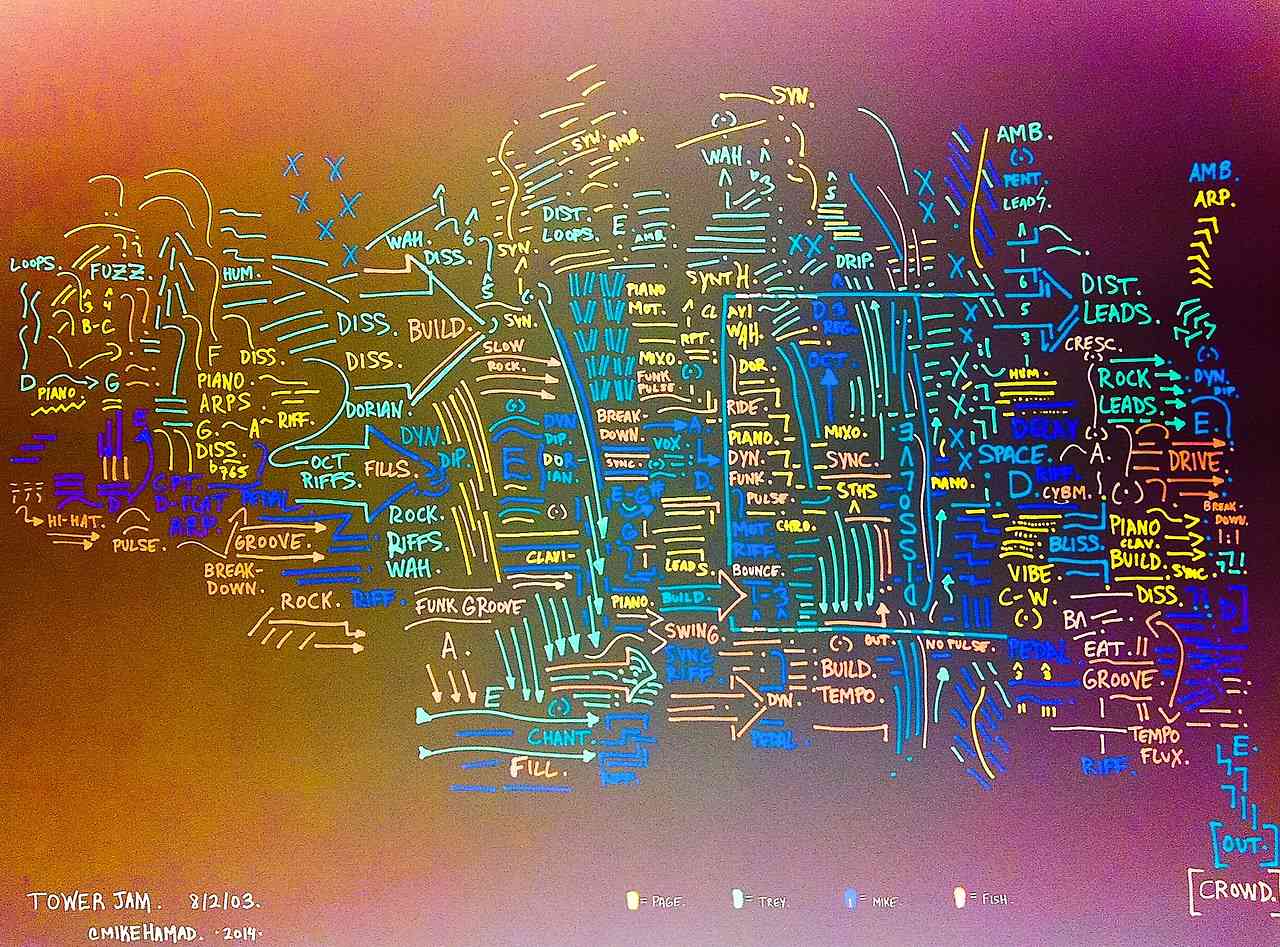
If you’re interested in giving Hamad’s method a try, we suggest lining up some colorful pens and big sheets of paper, and then tuning into these classic Phish concerts found in our archive: Phish Plays the Entirety of the Talking Heads’ Remain in Light (1996) or Phish Plays All of The Rolling Stones’ Classic Album, Exile on Main Street, Live in Concert.
via @NYTimes and h/t Eric
Read More...Support Us
We're hoping to rely on loyal readers, rather than erratic ads. Please click the Donate button and support Open Culture. You can use Paypal, Venmo, Patreon, even Crypto! We thank you!

About Us

Open Culture scours the web for the best educational media. We find the free courses and audio books you need, the language lessons & educational videos you want, and plenty of enlightenment in between.
Advertise With Us

FREE UPDATES!
GET OUR DAILY EMAIL
Get the best cultural and educational resources on the web curated for you in a daily email. We never spam. Unsubscribe at any time.
FOLLOW ON SOCIAL MEDIA

Open Culture editor Dan Colman scours the web for the best educational media. He finds the free courses and audio books you need, the language lessons & movies you want, and plenty of enlightenment in between.
Advertise With Us

