Watch the First Animations of Peanuts: Commercials for the Ford Motor Company (1959–1961)
Bill Watterson, creator of arguably the last great comic strip, Calvin and Hobbes, wrote the following about perhaps the greatest comic strip ever. “Peanuts pretty much defines the modern comic strip, so even now it’s hard to see it with fresh eyes. The clean, minimalist drawings, the sarcastic humor, the unflinching emotional honesty….” Charles Schulz, the artistic force behind Peanuts, funneled a lifetime of loneliness and emotional pain into these spare little drawings, creating a strip that was bleakly funny, philosophical and real. Characters like the socially inept Charlie Brown or the bossy though oddly tragic Lucy connected with audiences in a way that few ever did.
The one way that Watterson and Schulz differed, and differed greatly, was in the area of merchandising. While Watterson famously refused to license any of his characters (those praying/peeing Calvin car decals, it might surprise you to learn, are not officially sanctioned), Schulz licensed his creations far and wide. For those who grew up in the ‘70s, a Snoopy plush toy was simply de rigueur. The Peanuts characters hawked Dolly Madison snack cakes, MetLife insurance, and Wendy’s kids meals. And those sponsorship deals paid spectacularly well. By the time that Schulz died in February 2000 — the night before the final Peanuts strip was to go to print — he had reportedly earned over the course of his life $1.1 billion dollars.
The first instance of Charlie, Snoopy and the gang being corporate spokescharacters happened to be also the first time they were animated. The Ford Motor Company licensed them in 1959 to do TV commercials along with intros to the Tennessee Ernie Ford Show. You can watch them above. Probably the most striking thing about the commercials is that the adults are intelligible, not the incomprehensible muted trumpet bleats of the Peanuts movies.
The spots proved to be such a success that Schulz and animator Bill Meléndez were soon producing half-hour long TV specials, including the Emmy-winning A Charlie Brown Christmas in 1965. In a 1984 interview, Meléndez talked about working with Schulz, who went by the nickname of “Sparky,” for those first Ford spots.
Well, I was doing Ford commercials at J. Walter Thompson when it was decided that Charlie Brown would be the spokesman for the Ford Falcon. I was told Charles Schulz was very shy and reticent about commercializing his strip. So I went to San Francisco and met Sparky and we hit it off. I told him what we did, and he nodded and said, “All right, we’ll try it.” He was very leery of getting involved with “Hollywood types” as he used to call us.
Of course he understands that his drawings are flat, two-dimensional designs, and that, for example, the front view is very different from the side view. They are not three-dimensional characters. You can’t turn them around the way we used to turn the Walt Disney characters, who were designed to be round and three-dimensional. To animate Peanuts characters we have to be more inventive, because we tend not to be realistic. We don’t try to ape real live action as we did in animating Donald Duck and Mickey Mouse.
I imagine Sparky must have been curious about how we were going to do it, but he never gave us any kind of a hint or anything at all about what he wanted. So we showed him how we thought it should move, how we thought they should turn, how we thought they should walk and he accepted everything. From then on we hit it off pretty well.
Related Content:
Gertie the Dinosaur: The Mother of all Cartoon Characters
How Walt Disney Cartoons are Made
Jonathan Crow is a Los Angeles-based writer and filmmaker whose work has appeared in Yahoo!, The Hollywood Reporter, and other publications. You can follow him at @jonccrow.
Read More...Stephen Fry Reads the Legendary British Shipping Forecast
If you live in England, you’re probably familiar with the Shipping Forecast, a nightly BBC radio broadcast that details the weather conditions for the seas surrounding Britain. The broadcast has been on the airwaves since 1911. And many Brits will tell you that the forecast, always read in a soporific voice, can lull you to sleep quicker than a dose of Ambien. The broadcast has a strict format. It can’t exceed 350 words, and it always begins: “And now the Shipping Forecast, issued by the Met Office on behalf of the Maritime and Coastguard Agency at [fill in the time] today.” Below y0u can listen to a recording of actual forecasts. (Or catch the one from 6/29/2014 here.) Don’t listen to it while driving, or operating heavy machinery. A primer that decodes the unfamiliar terminology in the radio transmission can be found here.
All of this gives you just enough context to appreciate Stephen Fry’s parody reading of the Shipping Forecast. It was recorded in 1988, for the first episode of his radio show Saturday Night Fry. (Full episode here.) You can read along with the transcript, while listening to the clip up top:
And now, before the news and weather, here is the Shipping Forecast issued by the Meteorological Office at 1400 hours Greenwich Mean Time.
Finisterre, Dogger, Rockall, Bailey: no.
Wednesday, variable, imminent, super.
South Utsire, North Utsire, Sheerness, Foulness, Eliot Ness:
If you will, often, eminent, 447, 22 yards, touchdown, stupidly.
Malin, Hebrides, Shetland, Jersey, Fair Isle, Turtle-Neck, Tank Top, Courtelle:
Blowy, quite misty, sea sickness. Not many fish around, come home, veering suggestively.
That was the Shipping Forecast for 1700 hours, Wednesday 18 August.
Related Content:
Stephen Fry Reads Oscar Wilde’s Children’s Story “The Happy Prince”
Shakespeare’s Satirical Sonnet 130, As Read By Stephen Fry
Stephen Fry Profiles Six Russian Writers in the New Documentary Russia’s Open Book
Read More...Led Zeppelin, Rolling Stones & The Beatles Played on a 3‑String Electric Mountain Dulcimer
My parents always seemed to me to represent two very different strains of sixties counterculture. My mom loved Peter, Paul and Mary, Appalachian folk and bluegrass, and played the dulcimer and autoharp. My dad loved psychedelic rock, and had an extensive collection of Zeppelin, Beatles, Floyd, and Hendrix records. It wasn’t a Dylan-goes-electric-level disagreement, but their fond reminisces of the glory days could sometimes get a little tense. But as we’ve seen in decades since, folkies, hippies, and psych-rockers can come together, and not only in 70s folk-rock bands from California. Take Robert Plant and Allison Krauss’s fruitful and unlikely collaboration, for instance, or the dozens of Led Zeppelin and Rolling Stones covers by dozens of flannel-clad indie folkers.
In the past decade or so, it almost came to seem like psychedelic blues-rock and mountain folk music had always made comfortable bedfellows, and maybe they had. (After all, Zeppelin included folk instruments on several of their classic songs, like John Paul Jones’ mandolin on “Going to California.”) As further evidence we have 3‑string electric mountain dulcimer player Sam Edelstein, who covers classic rock songs on an instrument usually thought of as particularly gentle, delicate, and sweet, as its name implies. At the top, see Edelstein rip through a searing version of Zeppelin’s “Whole Lotta Love.” Just above, he does a killer take on the Rolling Stones’ “19th Nervous Breakdown,” and below, Edelstein plays an increasingly rocking cover of The Beatles’ “Come Together” at the National Mountain Dulcimer Competition. As uploader Contemporary Dulcimer states on Youtube, “the dulcimer’s roots may be in folk music, but it’s a natural rock & roll instrument.” Indeed. Who knew?
Related Content:
Watch Jimi Hendrix’s ‘Voodoo Chile’ Performed on a Gayageum, a Traditional Korean Instrument
Musicians Re-Imagine the Complete Songbook of the Beatles on the Ukulele
Josh Jones is a writer and musician based in Durham, NC. Follow him at @jdmagness
Read More...Vladimir Nabokov’s Script for Stanley Kubrick’s Lolita: See Pages from His Original Draft
The tag line for Stanley Kubrick’s sixth feature was “How did they ever make a movie of Lolita?” And it’s a good question. Vladimir Nabokov’s infamous novel, first published in 1955, is a delirious account of a middle-aged sophisticate’s obsession with a 12 year-old “nymphet.” The book was both praised and pilloried when it came out. Graham Greene called it one of the best books of the year while an English newspaper called it “sheer unrestrained pornography.” With press like that, Lolita quickly became a best-seller.
So when Kubrick, along with his producing partner James B. Harris, bought the rights to the book in 1958, they first had to prove that it could be filmed in a way that could get past the censors. The Hays code was still in effect in Hollywood, which suppressed any hint of sex between two adults. A love story between a prepubescent girl and a middle-aged pervert was going to be a tall order. “If I realized how severe the [censorship] limitations were going to be,” Kubrick stated later, “I wouldn’t have made the film.”
Eventually, Kubrick had to bow to reality; they changed Lolita’s age from 12 to 14, casting the teenaged Sue Lyon for the part. As Richard Corliss noted in his study on Lolita, “The book is about child abuse; the movie is about the wiles a teenage girl might have learned in those two years: an awareness of her power over men.”
The other challenge of adapting Lolita was the book itself. There’s an old truism in Hollywood that mediocre books make great movies and great books make for lousy films. After all, a novel like Mario Puzo’s The Godfather is all about story, characters and suspense – the same stuff as a good script. Authors like James Joyce, William Faulkner and Nabokov, on the other hand, foreground elements that are particular to literature — interior monologues, unreliable narrators, and a musicality of language – elements that are damned tricky to reproduce on the silver screen. If you don’t believe me, compare The Great Gatsby with its numerous dreadful movie adaptations.
Doubtless aware of such pitfalls, Kubrick approached Nabokov, the author himself, to write the script. After their first meeting, Nabokov turned the offer down. “The idea of tampering with my own novel caused me only revulsion,” Nabokov later wrote in the foreword to the published version of his Lolita script. Kubrick, however, is not a person to be dissuaded easily. He sent Nabokov a telegram renewing the offer a few months later, just as the author was beginning to regret passing on the offer and its generous paycheck.
So Nabokov traveled back to Los Angeles to meet with Kubrick, beginning what he would characterize as “an amiable battle of suggestion and countersuggestion on how to cinemize the novel.” By the end of the summer of 1960, Nabokov delivered his first draft – a 400-page behemoth. The script would require some serious editing. After that, Nabokov’s meetings with the director became more and more sporadic.
True to form, Kubrick was secretive about the film. The author had little idea what shape the final movie was going to take until he saw it a couple of days before the premiere in 1962. “I had discovered that Kubrick was a great director, that his Lolita was a first-rate film with magnificent actors, and that only ragged odds and ends of my script had been used.” Kubrick took the script and stripped out all the backstory and most of the narration. He expanded the character of Quilty to give Peter Sellers more to do. While Nabokov was generally complimentary about the film, he still had some complaints. “Most of the sequences were not really better than those I had so carefully composed for Kubrick, and I keenly regretted the waste of my time while admiring Kubrick’s fortitude in enduring for six months the evolution and infliction of a useless product.”
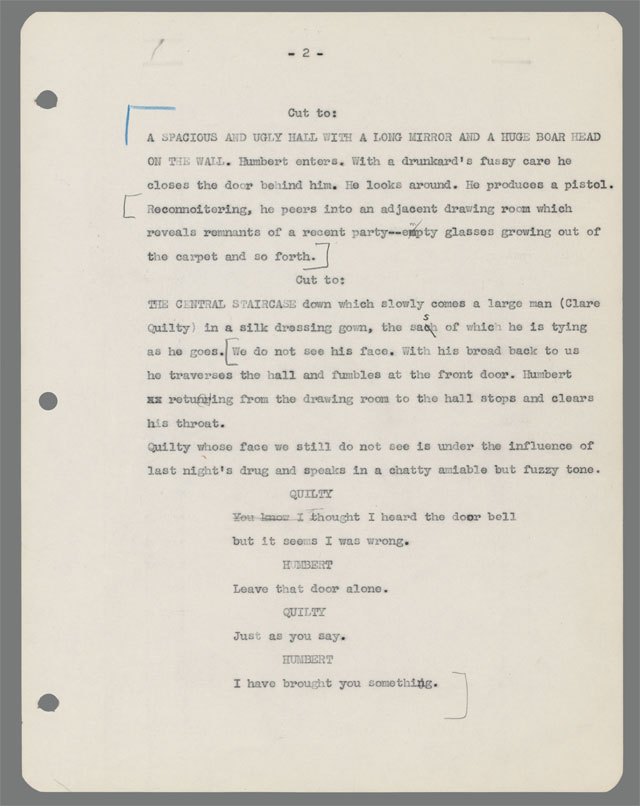
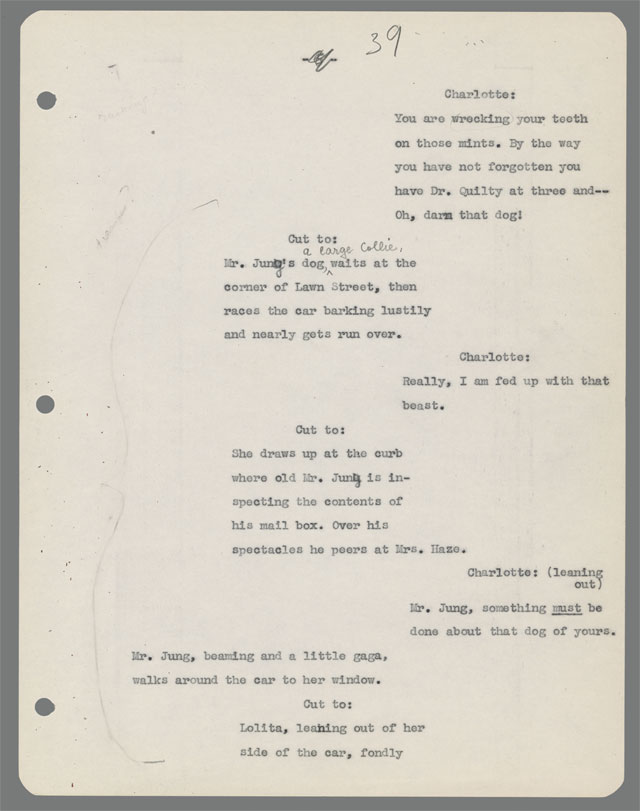
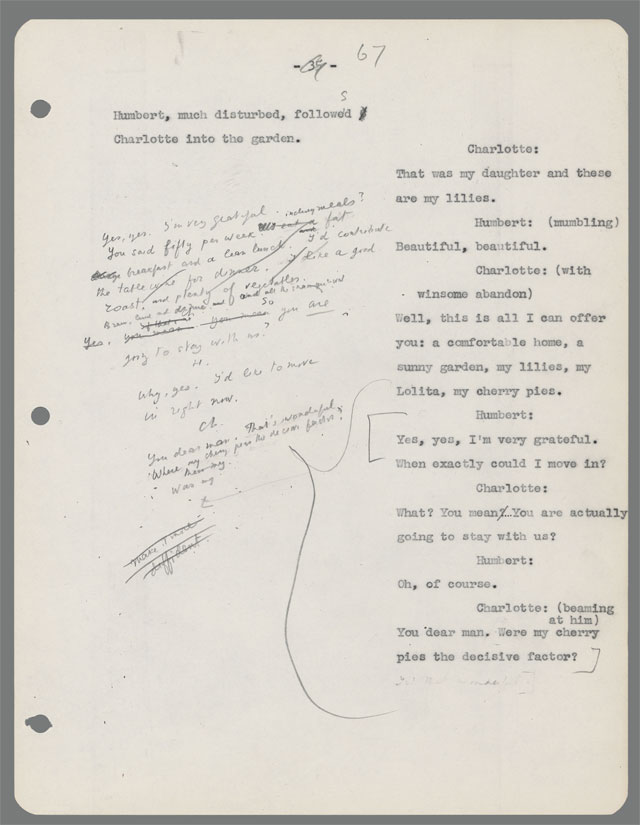
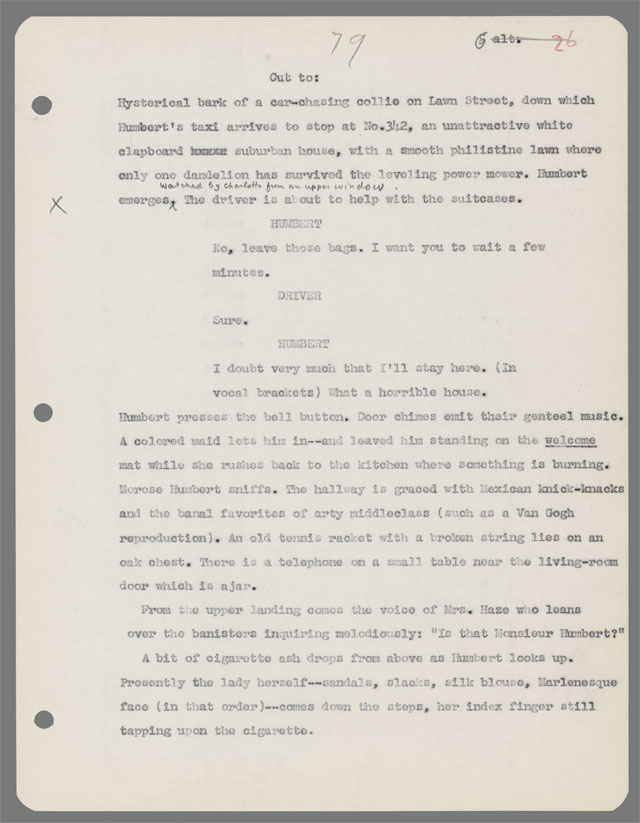
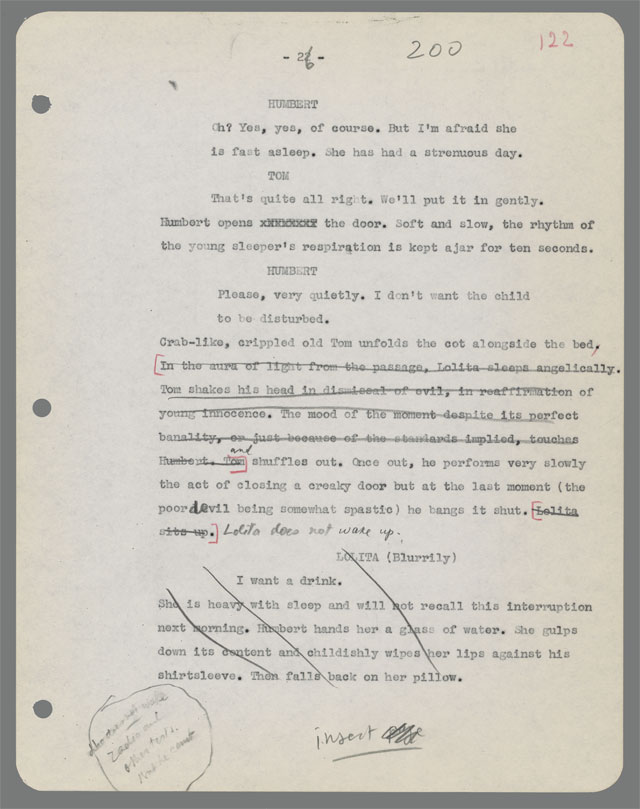
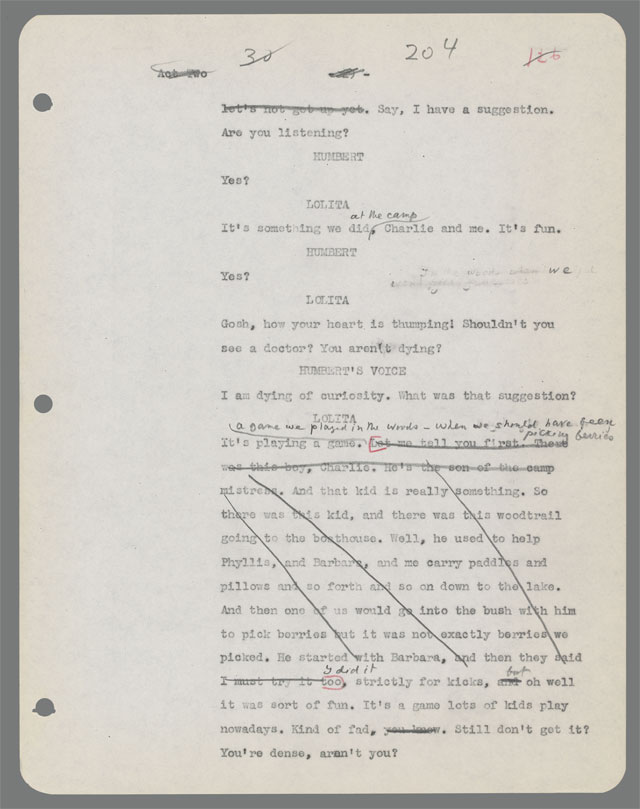
Nonetheless, Nabokov got a single screenwriter credit for the movie and he ended up getting an Oscar nomination for Best Adapted Screenplay. You can see some of Nabokov’s script of Lolita, complete with margin notes, below. (The margin notes apparently don’t appear in the published version.) You can click on each image to view them in a larger format. They come to us via Vice.
Note: You can download essential works by Vladimir Nabokov as free audiobooks (including Jeremy Irons reading Lolita) if you sign up for a 30-Day Free Trial with Audible.com. Find more information on that program here.
Related Content:
Fear and Desire: Stanley Kubrick’s First and Least-Seen Feature Film (1953)
Stanley Kubrick’s Daughter Shares Photos of Herself Growing Up on Her Father’s Film Sets
Stanley Kubrick’s List of Top 10 Films (The First and Only List He Ever Created)
Jonathan Crow is a Los Angeles-based writer and filmmaker whose work has appeared in Yahoo!, The Hollywood Reporter, and other publications. You can follow him at @jonccrow.
Read More...Advice to Young Aspiring Artists from Patti Smith, David Byrne & Marina Abramović
If you dream of becoming the next Disney Channel star, you’d do well to heed the advice of casting director Judy Taylor, who uses “read” and “talent” according to their industry definitions, and seems unlikely to cut anyone slack for youth or inexperience.
If, however, you’ve got the soul of a poet, a painter, a musical adventurer, all three, or none of the above, I suggest falling to your knees and thanking Denmark’s Louisiana Museum of Modern Art for providing you with an alternative. The weekly videos on art, literature, design and architecture for its Louisiana Channel are a goldmine of inspiration for non-mainstream types both young and old, but certain segments speak explicitly to those just embarking on the journey.
As any number of us geezers can attest, Patti Smith and David Byrne speak with authority. It’s okay if you’ve never heard of them. If you were three or four decades further along, you would have.
(As to Marina Abramović, go easy on your parents if they need to spend a moment or two dialing her up on Wikipedia. I’ll bet Patti or David wouldn’t peer down their noses at someone for not recognizing one of the world’s greatest living performance artists. Excuse the dangling preposition, but she’s definitely someone worth finding out about.)
I realize I don’t speak for most of America, but for me, these guys loom larger than Jay‑Z and Beyonce combined. I also realize that in terms of both wealth and name recognition, there’s a stable full of teen celebrities who leave them in the dust.
Interesting how all three resist the notion of talent as something to be commodified.
Abramović, above, speaks of artistic exploration in literal terms. In her view difficult work should be pursued with the bravery of 17th-century sailors who sallied forth, believing that the world was flat. I suspect she’s a tougher cookie than casting director Taylor. Witness her differentiation between garden variety artists and great artists, the month long rubbish basket task she assigned her students, and the rigorousness of her own practice.
Her fellow trailblazer Smith has a more maternal touch. The path she promotes is similarly twisty, low-paying, and hard, but counterbalanced with “the most beautiful experiences.”
Byrne tackles some of the more practical aspects of committing to the artistic way. To wit, there’s no shame in day jobs, even if it’s been eons since he was in a position to need one. He also makes some very valid points about technology, below, with nary a peep as to the impossibility of concentrating on one’s studies when one is checking Twitter every two seconds. We all stand to benefit.
- Ayun Halliday is the author of seven books, including No Touch Monkey! And Other Travel Lessons Learned Too Late. Follow her @AyunHalliday
Related Content:
In Touching Video, Artist Marina Abramović & Former Lover Ulay Reunite After 22 Years Apart
Patti Smith Shares William S. Burroughs’ Advice for Writers and Artists
Read More...Hear Isolated Tracks From Five Great Rock Bassists: McCartney, Sting, Deacon, Jones & Lee
Last week we sparked some heated debate (and some typical internet vitriol) with a post featuring isolated drum tracks from six of rock’s best drummers. Well, here we go again, this time with isolated bass tracks…. Bear in mind that the bassists featured here are some of the top players in rock who actually have bass tracks available online. There are many more I’d love to hear out of the mix—and no shortage of jazz, reggae, funk, and soul bassists I deeply dig. If you don’t see your favorite player here… really, don’t take it personally.
The bass guitar tends to be a forgotten instrument, sometimes not even missed when it’s gone (think Black Keys, The Doors), but despite the success of the rare bass-less band, it’s hard to imagine some of the songs represented here without the fundamental thump and groove of well-played basslines. We begin with John Deacon’s bassline for Queen and David Bowie’s “Under Pressure,” above. As we mentioned in a recent post on that song’s evolution, Stylus named this the #1 bassline of all time.
I don’t know what that accolade is worth, but the bassline is at least one of the most recognizable, thanks in no small part to Vanilla Ice. In the context of Queen, Deacon’s perhaps best known for the pounding stomp of “Another One Bites the Dust,” one of many songs he wrote for the band. He has very deliberately disappeared from the spotlight since Freddie Mercury’s death, but his tasteful, melodic playing is in no danger of being forgotten.
Led Zeppelin’s John Paul Jones, on the other hand, refuses to leave the stage, for which the several dozen musicians he’s toured and recorded with since Zeppelin’s demise are all grateful. Currently one-third of supergroup Them Crooked Vultures (with Dave Grohl and Queens of the Stone Age’s Josh Homme), Jones also plays mandolin (on Zep’s “Going to California,” for example), lap steel, and this triple-necked monster. For all his continued relevance into the 21st century, Jones’s sometimes smooth, sometimes burly basslines for Led Zeppelin, such as the unforgettable “Ramble On” riff above, will be his enduring legacy. One would have to be a hell of a bass player to keep up with John Bonham, and John Paul Jones is exactly that. He got his start playing jazz at age 15, and while still a teenager, played in a jazz-rock collective that included John McLaughlin (whom Jeff Beck has called “the best guitarist alive”). Want to learn how Jones does it? Check out this bass lesson with the master himself.
When the subject of rock bassists arises, Geddy Lee’s name will invariably come up. Like his bandmate Neil Peart, Lee’s musicianship astounds, his prog-rock stylings seem inimitable, except perhaps by Primus’ Les Claypool (who Lee names as one of his favorites). Bass magazine No Treble calls Rush’s “YYZ” (above) “one of the greatest bass lines of all time.” It’s not exactly my cup of tea, but I do know at least one bass player who left for Berklee College of Music hating Rush, then came back listening to this song over and over in hushed awe. Not everyone loves Lee’s over-the-top high pitched vocals, but one has to admire the fact that he plays basslines like this while singing some of the most philosophical lyrics in rock, courtesy of drummer Peart.
The last two bass tracks feature bassists who, like Lee, are also singers. No one pulls that off with more grace and style than Paul McCartney. In the bassline to The Beatles “Come Together” (above), you can hear the deep, resonant tone of McCartney’s semi-hollow Hofner violin bass (many of which have been “nicked” over the years). Of McCartney’s playing, John Lennon once said, “Paul was one of the most innovative bass players ever. And half the stuff that is going on now is directly ripped off from his Beatles period.” In my own bass-playing days, I certainly stole my share of ideas from McCartney—or more probably, his basslines were etched into my music brain, and my fingers automatically plucked out McCartney-style patterns. Music Radar puts “Come Together” at the top of a list of “Paul McCartney’s 12 greatest Beatles bass performances,” for the “spooky, sinuous, throbbing and groovy” track above, “as original as it gets.”
Our isolated drum tracks post happened to feature the other rhythmic halves of every player on this list except John Deacon, and while this wasn’t exactly by design, it’s no surprise to me that’s how it worked out. A great rhythm section works as a closely-aligned team, finding locked grooves, creating emphasis and punctuation, building structures and spaces for lead players to fill. A drummer like the Police’s Stewart Copeland needed a bassist as precise yet passionate as Sting. Very few other bands have successfully fused punk, jazz, and reggae rhythms into a greater whole, a feat accomplished in part because of Sting’s versatility as a player. From the muted “train engine” punk of “Next to You” to the left-field pop of “Message in a Bottle” (above), Sting’s aggressive playing, often fretless, mostly finger-picked—to quote that reputable source Uncyclopedia—“makes him better than all other musicians combined by 12 orders of magnitude, and that’s a pop fact.”
But seriously, he’s good, and so are dozens of other rock bassists who don’t appear above. Name your favorites, and if you find their bass tracks online, share ‘em! Alright, let the bass slugfest begin, and be sure to check out No Treble’s “Isolated Bass Track Week” posts, with tracks from undisputed masters of the instrument like James Jamerson and Jaco Pastorious.
Related Content:
Isolated Drum Tracks From Six of Rock’s Greatest: Bonham, Moon, Peart, Copeland, Grohl & Starr
Paul McCartney Offers a Short Tutorial on How to Play the Bass Guitar
The Story of the Bass: New Video Gives Us 500 Years of Music History in 8 Minutes
Josh Jones is a writer and musician based in Durham, NC. Follow him at @jdmagness
Read More...Samuel Beckett Draws Doodles of Charlie Chaplin, James Joyce & Hats
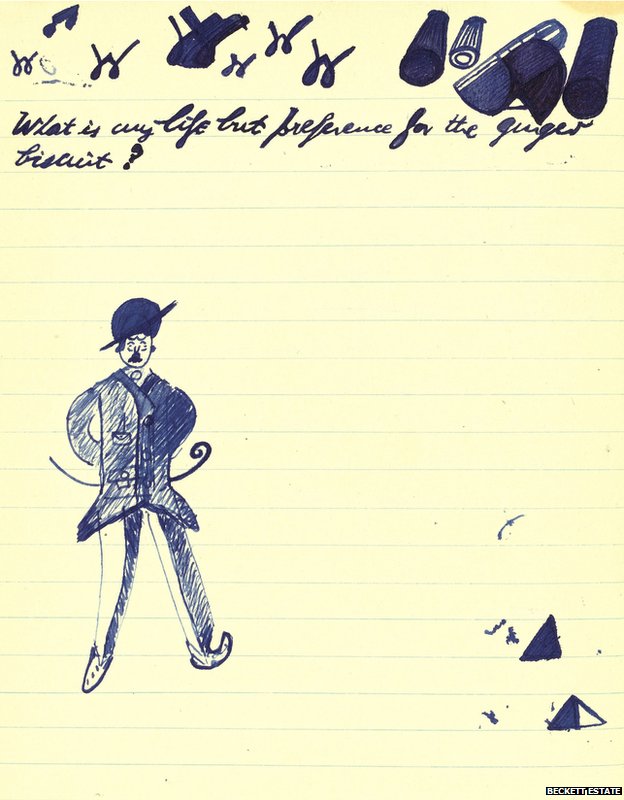
Samuel Beckett was a playwright, a novelist, a Nobel Prize winner and the chauffeur for a school-aged André the Giant. He was also, apparently, a compulsive doodler. The original manuscripts of his first and second novels, Murphy and Watt respectively, are covered in marginalia.
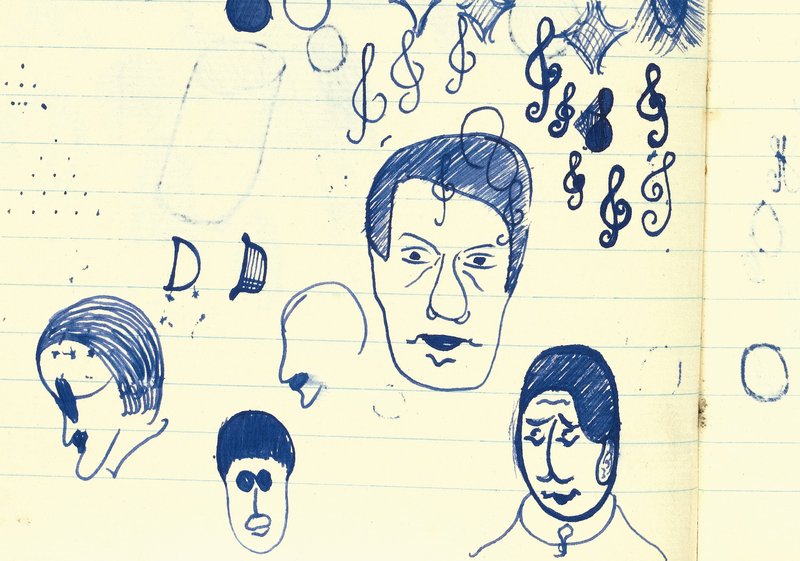
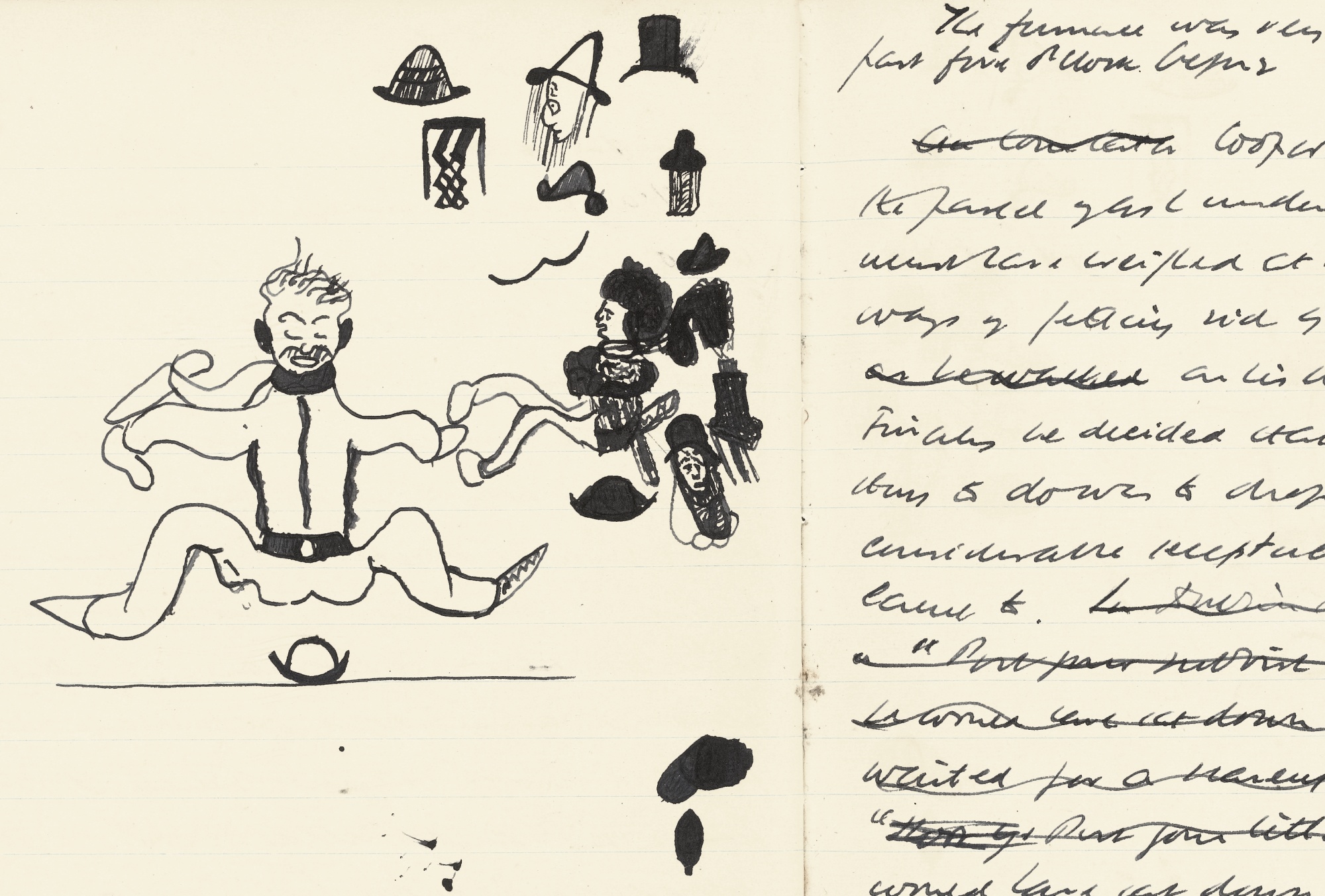
The manuscript for Murphy, comprising six notebooks, was auctioned off last year by Sotheby’s to the tune of £962,500 (or over $1.6 million). The book was written between the years of 1935 to 1936 and the manuscript shows numerous revisions. It also contains this doodle (above) of Charlie Chaplin, who would later influence his seminal play Waiting for Godot. Beckett’s doodle of James Joyce appears beneath it.
For someone who made a career exploring heavy themes like nothingness and futility, his drawings are nothing like the stark, angular doodles of Franz Kafka. Beckett’s pictures are curvy, light-hearted and whimsical. Look at the drawing below. I really don’t know what’s going on there but it sort of looks like a man in earmuffs giving birth to a hat.
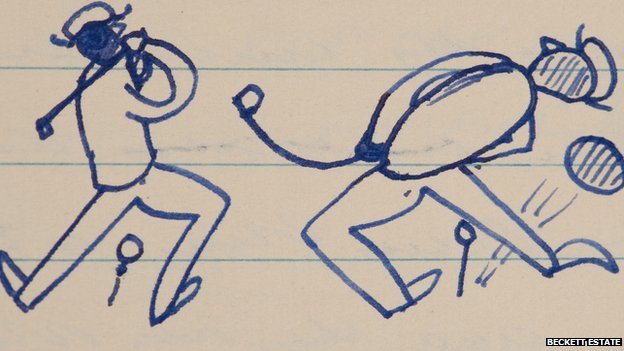
And this one is of a couple golfers.
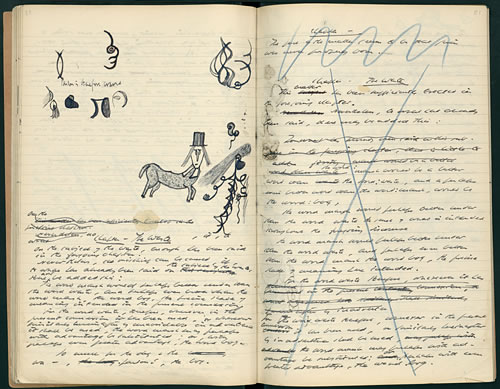
Beckett’s second novel Watt, the last book he wrote in English, also took up six notebooks. According to Beckett’s recollections, Watt was written “in drips and drabs” while he was in living in France during WWII. In the first notebook, alongside an X‑ed out page of text is this odd drawing of a long-haired centaur in a top hat.
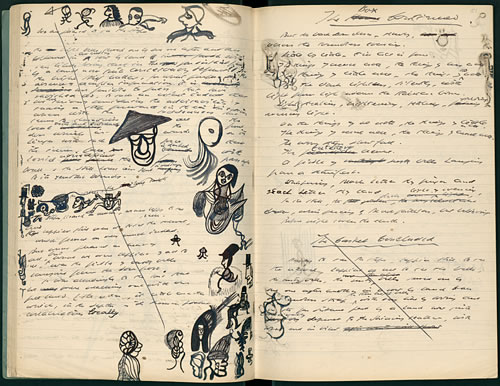
And this page, in the second notebook, features a bunch of terrific, strikingly graphic doodles including one that looks like Morley Safer in an Asian cone hat. (Again with the hats.)
via @SteveSilberman/BrainPickings/Harry Ransom Center
Related Content:
Samuel Beckett Directs His Absurdist Play Waiting for Godot (1985)
Monsterpiece Theater Presents Waiting for Elmo, Calls BS on Samuel Beckett
Rare Audio: Samuel Beckett Reads Two Poems From His Novel Watt
Jonathan Crow is a Los Angeles-based writer and filmmaker whose work has appeared in Yahoo!, The Hollywood Reporter, and other publications. You can follow him at @jonccrow.
Read More...
Isolated Drum Tracks From Six of Rock’s Greatest: Bonham, Moon, Peart, Copeland, Grohl & Starr
“Drums, eh,” says Keith Richards in answer to a fan question on the subject. “Without it you’re kinda nowhere.” He’s got a point. An ace drummer can be the spine, muscle, and even soul of a great band. Pounding, swinging, and smashing away behind showy guitarists and flamboyant frontmen, drummers sometimes have problems being seen, but never heard. But while John Bonham or Keith Moon never got lost in the mix, it’s a rare thing to hear them out of it. The proliferation of rock band video games and isolated tracks posted to Youtube allow us to listen to the nuances of drum grooves we may feel we know by heart, such as Bonham’s driving beat behind Led Zeppelin’s “Whole Lotta Love.”
In a previous post, we brought you a rough mix of the song and Jimmy Page describing its creation. Page wanted Bonham’s drum track to “really stand out, so that every stick stroke sounded clear and you could really feel them.” It certainly does that. The drum track above is all about feeling. As a result of the recording techniques of the time, writes producer/engineer Bobby Owinski, drum tracks tended to sound “like a single instrument,” since they were recorded with only two or three mics capturing the space around the kit, rather than the sound of individual pieces. “Still,” Owinski writes of this track, “there’s plenty of power in [Bonham’s] kick and snare, because he played them hard!” In addition to his power, Bonham is known for his laid-back groove, due to his tendency for playing slightly behind the beat, a quality Youtube drum instructor Terry Keating of Bonzoleum ascribes to “temperament.”
Bonham’s style consisted mainly of creative uses of triplets, so much so that McSweeny’s had a good laugh about his constant use a similar pattern. One of my favorite drummers—crankiest man in rock Ginger Baker—also disparages Bonham’s playing, as well as that of another alcoholic drum star, Keith Moon. But Ginger Baker doesn’t tend to like anyone, and Moon’s playing, while maybe not virtuosic or especially disciplined, was, like his persona, insane. Drum Magazine describes Moon’s style as “tribal, primitive, and impulsive, with him often stomping the bass drums and pounding his wall of toms like a madman” (clearly Moon inspired the Muppets’ Animal). Moon’s many kits often consisted of double bass drums and double rows of toms, and he played them as hard as possible almost all the time. Hear him above thrashing with abandon through “Won’t Get Fooled Again.”
Seemingly miles away from the madness of Keith Moon, Rush’s Neil Peart is a highly technical drummer with impeccable on-the-beat timing and a drum setup that has grown so extensive and complicated over the years that he almost disappears into its depths. Peart’s playing combines the power and stamina of Bonham with complex patterns whose rhythmic dynamics shift subtly several times throughout each song. Check out the isolated drum track for “Tom Sawyer” above as a classic example of Peart’s technique and you may see why he’s classed as one of the all-time best rock drummers (though I wouldn’t class him as one of rock’s greatest lyricists).
Although I’m an admirer of Neil Peart’s drumming, I can’t say I’m much of a Rush fan. Police drummer Stewart Copeland feels the same. In an interview with Music Radar, he jokes about “pull[ing] Neil’s chain at every possible opportunity” for the self-indulgent excess of drum solos (though Copeland gamely played one during David Letterman’s “Drum Solo Week” in 2011). Copeland talks about “a time when bands like Rush were the epitome of what The Police were theoretically against, which was an overemphasis on musicality.” Nonetheless, Copeland is one of the most musical of drummers, making use of odd time signatures and polyrhythmic syncopation to create a thoroughly unique and instantly recognizable style (which has even inspired neuroscience studies). The drum track above comes from “Next to You,” a song on the band’s debut album, during their decidedly anti-Rush phase. While the song itself is uptempo punk rock, Copeland’s Gene Krupa-like drumming, heard in isolation, presages the unusual quirks to come as the band stretched out into jazz and reggae territory.
The sheer number of bands Foo Fighters frontman and former Nirvana drummer Dave Grohl has drummed for is impressive, and a testament to his machine-like speed and timing. Drummer and Portlandia star Fred Armisen may be Grohl’s biggest fan. “Every drum part he does is a masterpiece,” says Armisen, “He’s never just heavy for heavy’s sake or rock for rock’s sake—it’s all so musical, with an incredible sense of dynamics. Every generation has their drumming guy, and Dave is ours.” Even Kurt Cobain, never one to overpraise, once called Grohl “the best drummer in the world.” Maybe a bit of hyperbole, but Grohl’s damned good, even at his most straightforward, as above in his pounding drumbeat for “Smells Like Teen Spirit.” Grohl’s powerhouse playing isn’t the most versatile. He had some trouble adjusting to quieter environs, and Cobain nearly banned him from the band’s legendary “Unplugged” performance for his too-aggressive playing in rehearsals. Nonetheless, when it comes to punk, hardcore, and serious rock, Grohl’s the man.
I can’t resist ending with the isolated track of what maybe be my all-time favorite drum part, Ringo Starr’s wildly funky business at the end of “Strawberry Fields Forever.” Some of the drums here are overdubbed, with several different percussion parts blended with Starr’s full-kit freak out. Starr has taken a lot of completely undeserved flak for his supposed limitations as a drummer, but as Samuel Belkin writes at The Examiner, “his latter day drum patterns are […] often sophisticated, and always idiosyncratic […] nobody has ever been able to sound quite like Ringo.” Ultimately, in my book, what distinguishes a truly great drummer from thousands of technically proficient players is a quality no one can teach or emulate: Personality.
Related Content:
7 Female Bass Players Who Helped Shape Modern Music: Kim Gordon, Tina Weymouth, Kim Deal & More
Listen to The John Bonham Story, a Radio Show Hosted by Dave Grohl
Keith Moon’s Final Performance with The Who (1978)
Hear the Isolated Vocal Tracks for The Beatles’ Climactic 16-Minute Medley on Abbey Road
Josh Jones is a writer and musician based in Durham, NC. Follow him at @jdmagness.
Read More...Thank You, Mask Man: Lenny Bruce’s Lone Ranger Comedy Routine Becomes a NSFW Animated Film (1968)
If you ever really wanted to know what was the deal between The Lone Ranger and Tonto, the above video of Thank You, Mask Man might answer a few questions. Warning: it’s seriously NSFW.
The audio for Thank You, Mask Man is taken from a stand up routine from Lenny Bruce, who ruthlessly, hilariously takes apart the legendary crime fighter. After years of getting saved by a masked hero on a white steed, the denizens of a small Western town corner him into accepting something, anything as a token of their gratitude. The hero points to a nearby Native American and says that he wants him. He proclaims that he wants “to perform an unnatural act.” The townspeople are horrified. “I’ve read a lot of exposes on how bad it is,” the Masked Man explains, “and I want to try it, just once.”
Jeff Hale, who later went on to animate that groovy Pinball Number Countdown bit on Sesame Street, made the short in 1968, two years after Bruce’s death. The movie had a hard time getting booked into theaters reportedly, in part, because Bruce ruffled more than a few feathers in the film industry. Ultimately though Thank You, Mask Man became a staple at gay and cult film festivals.
Bruce was, of course, the original bad boy comic. He laced his free form, lightning quick performances with frank discussions of sex, social issues and lots of swearing. Nowadays, F‑bombs are par for the course in a comedian club but, back during the Kennedy administration, they were shocking. And they got him thrown in jail on several occasions. You can listen to another (unanimated) Bruce routine below. It’s completely NSFW.
You can find Thank You, Mask Man in the Animation section of our collection, 4,000+ Free Movies Online: Great Classics, Indies, Noir, Westerns, Documentaries & More.
Related Content:
Lenny Bruce Riffs and Rants on Injustice and Hypocrisy in One of His Final Performances (NSFW)
George Carlin Performs His “Seven Dirty Words” Routine: Historic and Completely NSFW
Jonathan Crow is a Los Angeles-based writer and filmmaker whose work has appeared in Yahoo!, The Hollywood Reporter, and other publications. You can follow him at @jonccrow.
Read More...Watch William S. Burroughs’ Ah Pook is Here as an Animated Film, with Music By John Cale
The work of William S. Burroughs can be by turns hilarious, opaque and profane – filled with images of drugs, insects and other oddities. Though it might be fascinating, if difficult, on the page, his work really comes alive when read aloud, preferably in Burroughs’s signature deadpan drawl. And if it’s accompanied by some trippy visuals, then, all the better.
The above video is exactly that. In 1994, animator Peter Hunt made this appropriately grotesque stop motion animated film, Ah Pook is Here, with audio taken from Burroughs’s 1990 album Dead City Radio. (You can read along to the video below.) John Cale provides the music. The winner of 10 international film awards, the short film has been archived in the Goethe Institut.
Ah Pook is Here started in 1970 as a collaboration with artist Malcolm McNeil. Originally it was slated to be a magazine comic strip but when the publication folded, Burroughs and McNeil decided to turn it into a book. Ah Pook is Here and Other Texts was finally published in 1979, though without McNeil’s illustrations. You can see them here.
When I become Death, Death is the seed from which I grow…
Itzama, spirit of early mist and showers.
Ixtaub, goddess of ropes and snares.
Ixchel, the spider web, catcher of morning dew.
Zooheekock, virgin fire patroness of infants.
Adziz, the master of cold.
Kockupocket, who works in fire.
Ixtahdoom, she who spits out precious stones.
Ixchunchan, the dangerous one.
Ah Pook, the destroyer.Hiroshima, 1945, August 6, sixteen minutes past 8 AM.
Who really gave that order?
Answer: Control.
Answer: The Ugly American.
Answer: The instrument of Control.
Question: If Control’s control is absolute, why does Control need to control?
Answer: Control… needs time.
Question: Is Control controlled by its need to control?
Answer: Yes.
Why does Control need humans, as you call them?
Answer: Wait… wait! Time, a landing field. Death needs time like a junkie needs junk.
And what does Death need time for?
Answer: The answer is sooo simple. Death needs time for what it kills to grow in, for Ah Pook’s sake.
Death needs time for what it kills to grow in, for Ah Pook’s sweet sake, you stupid vulgar greedy ugly American death-sucker.
Death needs time for what it kills to grow in, for Ah Pook’s sweet sake, you stupid vulgar greedy ugly American death-sucker… Like this.
We have a new type of rule now. Not one man rule, or rule of aristocracy, or plutocracy, but of small groups elevated to positions of absolute power by random pressures and subject to political and economic factors that leave little room for decision. They are representatives of abstract forces who’ve reached power through surrender of self. The iron-willed dictator is a thing of the past. There will be no more Stalins, no more Hitlers. The rulers of this most insecure of all worlds are rulers by accident inept, frightened pilots at the controls of a vast machine they cannot understand, calling in experts to tell them which buttons to push.
You can find Ah Pook is Here in the Animation section of our collection, 4,000+ Free Movies Online: Great Classics, Indies, Noir, Westerns, Documentaries & More.
Related Content:
The Junky’s Christmas: William S. Burrough’s Claymation Christmas Film
William S. Burroughs on Saturday Night Live, 1981
William S. Burroughs Reads Naked Lunch, His Controversial 1959 Novel
Jonathan Crow is a Los Angeles-based writer and filmmaker whose work has appeared in Yahoo!, The Hollywood Reporter, and other publications. You can follow him at @jonccrow.
Read More...
Support Us
We're hoping to rely on loyal readers, rather than erratic ads. Please click the Donate button and support Open Culture. You can use Paypal, Venmo, Patreon, even Crypto! We thank you!

About Us

Open Culture scours the web for the best educational media. We find the free courses and audio books you need, the language lessons & educational videos you want, and plenty of enlightenment in between.
Advertise With Us

FREE UPDATES!
GET OUR DAILY EMAIL
Get the best cultural and educational resources on the web curated for you in a daily email. We never spam. Unsubscribe at any time.
FOLLOW ON SOCIAL MEDIA

Open Culture editor Dan Colman scours the web for the best educational media. He finds the free courses and audio books you need, the language lessons & movies you want, and plenty of enlightenment in between.
Advertise With Us


