It used to be that you couldn’t go into a bookstore this time of year without being literally surrounded by Gary Larson’s The Far Side. His calendars and books were massive best sellers and his single-panel comics seemed to be everywhere, taped to cubicle walls and pinned to bulletin boards. Larson’s hilariously subversive sense of empathy–his way of rendering people with the detachment of an entomologist while investing his animal characters with the most sympathetic of human traits–endeared him to millions.
But in 1995, after 15 years of struggle against grinding deadlines, Larson called it quits. Since then he’s been about as reclusive as Greta Garbo or J.D. Salinger. And while Larson’s calendars and books continued to appear for some years after his retirement, The Far Side is not much in evidence these days. Which is sad. You can’t buy your friends a 2013 Far Side desk calendar this holiday season, but perhaps you can share this: a few twisted scenes from Larson’s 1994 animated film, Tales From the Far Side. The film was originally aired as a Halloween special on CBS. The clip above begins on a fittingly nostalgic note.
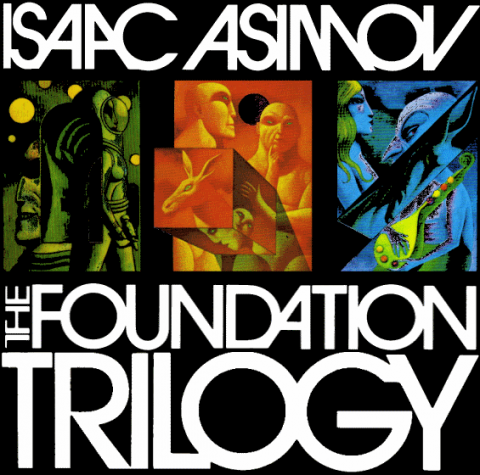
Tireless New York Times columnist and Nobel-prize winning Princeton economist Paul Krugman has long played the role of Cassandra, warning of disasters while the architects of policy look on, shake their heads, and ignore him. I’ve sometimes wondered how he stands it. Well, it turns out that, like many people, Krugman’s long view is informed by epic narrative. Only in his case, it’s neither ancient scripture nor Ayn Rand. It’s the Isaac Asimov-penned FoundationTrilogy, which Krugman, in a recent Guardian piece, dissects in detail as a series that informed his views as a teenager, and has stayed with him for four and a half decades.
The hero of the trilogy, Hari Seldon, is a mathematician, whose particular branch of mathematics, called psychohistory, allows him to make massive, large-scale predictions of the future. This science informs “The Seldon Plan” that silently guides the coming of a new Galactic Empire thousands of years into the future. If it sounds a bit arid in paraphrase, it isn’t, even though Asimov’s characters tend to be thin and his descriptions lack in poetry. “Tolstoy this isn’t,” Krugman tells us.
But the novels work as brilliant speculative fiction, tethered to the familiar history of Western civilization by resonances with ancient Rome, mercantile Europe, and old New York. Instead of space opera or fantasy, Krugman describes Asimov’s fiction as anti-action, anti-prophecy. The protagonist’s “prescience comes from his mathematics.” And this, believe it or not, is fascinating, at least for Krugman. Because for him they function as reminders that “it’s possible to have social science with the power to predict events and, maybe, to lead to a better future.” Krugman writes:
They remain, uniquely, a thrilling tale about how self-knowledge – an understanding of how our own society works – can change history for the better. And they’re every bit as inspirational now as they were when I first read them, three-quarters of my life ago.
He admits that the sentiments of Asimov’s fiction present us with a “very bourgeois version of prophecy,” but then, economics is a very bourgeois science, mostly concerned with one emotion, “greed.” Nonetheless, Krugman believes in the power of “good economics to make correct predictions that are very much at odds with popular prejudices.” And we could all do with fewer of those.
Asimov’s Hugo-winning trilogy was adapted for eight, one-hour radio-drama episodes in 1973. Listen to the first installment above, and download or stream the remaining episodes at the links below:
Part 1 |MP3| Part 2 |MP3| Part 3 |MP3| Part 4 |MP3| Part 5 |MP3| Part 6 |MP3| Part 7 |MP3| Part 8 |MP3|
Or listen to the Spotify version up top.
You can find this audio listed in our collection of Free Audio Books.
Josh Jones is a doctoral candidate in English at Fordham University and a co-founder and former managing editor of Guernica / A Magazine of Arts and Politics.
For an example of empathy that looks to him proto-outrospective, Krznaric cites George Orwell, author of 1984 and Animal Farm. His plunge into the world of urban poverty — the deepest kind of first-hand research — to write Down and Out in Paris and London, coming to know, befriend, and work alongside the down-and-out themselves, makes him “one of the great empathic adventurers of the 20th century.” This line of thought connects Orwell’s active social curiosity to empathy as a potentially collective force; we even hear a call for new, empathy-oriented social institutions like a “human library” with actual people available for illuminating conversations. Empathy, to Krznaric’s mind, will only become more important in the 21st century, and those of us who can master outrospection, the skill of “discovering who we are by stepping outside ourselves and exploring the lives of other people and cultures,” will fare best there. If after the video you still find yourself confused about how best to engage in outrospection, don’t worry: Krznaric writes an entire blog on the subject.
It was a dark collaboration folks. There’s no denying it. In September of 1992, the Beat writer William S. Burroughs entered a studio in Lawrence, Kansas and recorded a narration of “The “Priest” They Called Him,” a short story originally published in his 1973 collectionThe Exterminator. It’s a grim tale about heroin, addiction, withdrawal, and the “immaculate fix.” Two months later, the reading was given a soundtrack when Kurt Cobain, then the frontman for Nirvana, stepped into a Seattle studio and gave Burrough’s reading a soundtrack full of harsh, dissonant guitar riffs that captured the spirit of the story. Mixed together by E. J. Rose and James Grauerholz, the collaborative recording was released as a limited edition vinyl picture disc in 1993, and then again on CD and 10-inch vinyl.
If you would like to support the mission of Open Culture, consider making a donation to our site. It’s hard to rely 100% on ads, and your contributions will help us continue providing the best free cultural and educational materials to learners everywhere. You can contribute through PayPal, Patreon, and Venmo (@openculture). Thanks!
Like the number of feminists needed to screw in a light bulb, gender-based assumptions are NOT FUNNY!
Gender-based sound effects prove to be the exception in Bleep Blap Bloop, a very funny short film featuring real people attempting to impersonate various machines, primarily vehicles and weapons of the sort one rarely encounters in every day use. They’re not the most diverse bunch with regard to age or ethnicity, but as far as white people in their 20’s go, Bleep Blap Bloop’s findings are pretty airtight. The Y chromosomes are the clear winners.
“Couldn’t you have done, like, a duck?” one of the female contestants asks as the credits roll.
What about you? Is this a case where you fit the mold? Please share your most triumphal (or least humilating) sound effect below. Transpeople heartily encouraged to expand the conversation!
- Ayun Halliday is a proud feminist who changes lightbulbs solo and couldn’t make a machine gun noise even if she had an actual machine gun.
Quentin Tarantino sat down this week for an interview that covered a lot of terrain — his strained his relationship with his father, his ninth-grade education and how it shapes his filmmaking, his path from working in a video rental store to writing scripts and eventually directing films, his approach to filming violence, his new Western film Django Unchained, his plans to retire before he gets old and lots more. The interviewer? Yup, it’s Howard Stern on Sirius and the hearty chuckles you hear in the background belong to the Star Trek icon George Takei. Needless to say the interview enters some Not-Safe-for-Work territory.
I’ve ridden a lot of busses–back and forth from city to city, taking the cheapest tickets, which meant traveling overnight, and eating cheap and greasy food at hurried stops along the way. I remember thinking sometimes that I might never come back, that I might lose myself in some small southern town and disappear. I remember those times now as I read Charles Bukowski’s poem “Nirvana,” a poem about a lost young man who finds in the quaint strangeness of a diner in North Carolina a respite from the confusion of his life.
Then he boards his bus again, and the moment is gone, the moment of the poem, that is, which is all there is, since we don’t know where he came from or where he’s bound. We’re only told he’s “on the way to somewhere,” and the omission means it doesn’t really matter. The poem is “about” its details: the snow, the little café in the hills, the unaffected waitress with her “natural humor.” The way these familiar things are made strange by the presence of a stranger. While I may relate to the aimless young man in the poem, it really isn’t about him so much as about that estrangement, which for him becomes a temporary home. Then before he gets too comfortable, he’s out again and on the road to “somewhere.”
Bukowski had a way with these small scenes, a way of estranging the ordinary. The short film above, from Lights Down Low productions, offers one interpretation of what the moment of Bukowski’s poem might look like. The film has the slow, meditative pacing of a Terrence Malick film, the same kind of obsessive dwelling on the details of a lost mid-century America. An apple pie, the slow-motion sway of the leggy waitress’ sky-blue dress as she walks toward a snow-covered window—none of these details bear the slightest trace of kitsch. Instead they are objects of wabi sabi, the Japanese term for impermanence. Nirvana is forever, life is temporary.
While the film above draws on Malick’s Americana, Tom Waits’ reading of “Nirvana” (below) comes closest, perhaps, to the world-weary Bukowski’s voice, and the images and music that accompany Waits’ grizzled sigh convey the dreary grit of the real world of bus travel, not as it looks in the movies, but as it looks from the road: the bleak sameness of highways and the way the snow is oily and speckled with black minutes after it falls.
A third interpretation of Bukowski’s poem (below) is read by a man who calls himself Tom O’Bedlam, and who sounds a bit like Richard Burton. However, his reading is the least dramatic of the three; his lack of affect draws attention to the words, which appear in stark black and white text on the screen as he intones them like a mass. This one comes courtesy of Roger Ebert, who recommends O’Bedlam’s Spoken Verse YouTube page as one of his favorite places on the web.
It’s hard for me to choose a favorite of the three. Each one draws attention to the poem in different ways, sometimes, perhaps, turning it into a script, and sometimes getting out of its way and letting it do all the work. Neither approach strikes me as a bad one; each one has its merits. But tell me, readers, what do you think?
Josh Jones is a doctoral candidate in English at Fordham University and a co-founder and former managing editor of Guernica / A Magazine of Arts and Politics.
As one Metafilter commenter put it, this visualization is cool and creepy at once. Assembled by Brad Flyon, the visualization gives you a feel for the qualitative rhythm of births and deaths in the U.S.. (Fortunately the births exceed deaths by a significant margin.) When you enter the visualization, you’ll want to give things a few moments to get going. And you can mouse over parts of the map to get more data.
The visualization itself was created with the following (and I’m quoting Flyon verbatim here):
Burton was a great friend and admirer of Thomas, who shared his Welsh heritage and rakish demeanor. The two men also shared a love of literature. “I was corrupted by Faust,” Burton once said. “And Shakespeare. And Proust. And Hemingway. But mostly I was corrupted by Dylan Thomas. Most people see me as a rake, womanizer, boozer and purchaser of large baubles. I’m all those things depending on the prism and the light. But mostly I’m a reader.”
In 1954 Burton read a selection of his friend’s poetry for a recording that would be released the following year as Richard Burton Reads 15 Poems by Dylan Thomas. The recordings were made about a year after the poet’s death, and just when Burton was riding high on the success of his 1954 performance in Thomas’s radio play Under Milk Wood. The long poem “Ballad of the Long-Legged Bait,” above, is from the 1954 sessions. The 14 poems below are mostly from the same sessions, although a couple of them might be from later recordings made by Burton.
Sometimes a tune lives in your head and you hum it now and again without any recollection of where it originally came from. Chances are, if you grew up in the United States watching Saturday morning cartoons, that tune came from Schoolhouse Rock.
Like so many of its biggest fans, Schoolhouse Rock is now officially in its 40s. This year marks the 40th anniversary of the pilot segment, Three is a Magic Number, whose melody and lyrics ooze the type of hippie Sunshine Family wholesomeness so abundant in ‘70s children’s programming.
Man and a woman had a little baby,
Yes they did.
They had three in the family.
And that’s a magic number
Follow that up with Schoolhouse Rock’s winning formula: simple, hummable tunes mixed with math fact lyrics.
Schoolhouse Rock started out as an advertising venture on ABC, dreamed up by an executive whose son was struggling to memorize his multiplication tables. But it grew into the most popular interstitial programming (short vignettes shown between TV segments) in modern television.
One of the most memorable melodies is Blossom Dearie’s sweet and melancholy Figure Eight, broadcast in February, 1973. This one was covered by Eliot Smith in a decidedly less upbeat version.
Without a doubt these three-minute animations (by Loonie Tunes animator Chuck Jones) are some of the best modern educational videos around. Whose social studies teacher didn’t show this tuneful explanation of the legislative process during class?
And this one about the Constitution, well I have to admit that it still chokes me up.
The man behind the vast majority of the music is Bob Dorough, a pianist who worked with Miles Davis and Allen Ginsberg before becoming the voice and main composer for Schoolhouse Rock.
The series took on nearly every subject, from multiplication and grammar to science and American government. Today’s educational software developers would kill to make grammar as fun as Conjunction Junction and Lolly, Lolly, Lolly Get Your Adverbs Here. The producers didn’t shy away from more weighty issues either. Take a listen to this little ditty on the theme of American territorial expansion.
The series took a break during the 1980s but picked up again in the mid-’90s with Money Rock. In 2009 came Earth Rock. Both featured a more gloom-and-doom feel than the inspiring tone of the earlier Schoolhouse Rock iterations.
Here’s a collision of cultural figures you don’t see every day: Salo, or the 120 Days of Sodom director Pier Paolo Pasolini sitting down with modernist poet Ezra Pound. Though only eight minutes in length and perhaps not subtitled with ideal fluency, this clip nonetheless hints at the kind of conversation, or conversations, you’d like to have been in the room for. Here Pound and Pasolini discuss the linguistically experimental Italian literary movement “neoavanguardia,” which counted among its adherents Umberto Eco, Edoardo Sanguineti, and Amelia Rosselli. Pasolini, not just a filmmaker but a poet and all-around man of letters himself, would naturally know to bring this subject up, since the group famously looked to Anglophone modernists like Pound himself (as well as T.S. Eliot) for their inspiration.
Pound came to Italy in 1924, by which point he already held expatriate status. Born in 1885 in what we now know as Idaho, he moved to London early in the 20th century. Horrified and devastated by the First World War, he moved to Paris in 1921 before landing in the small Italian town of Rapallo three years later. He there proceeded to tarnish his reputation by endorsing the fascism of Mussolini and even Hitler. Pasolini shows interest not in political questions, but artistic ones: about the avant-garde, about Pound’s beloved 14th- and 15th-century painters, and about his Pisan Cantos. Pasolini actually dons his glasses and performs a reading from that work as Pound gazes on. We then see the 82-year-old poet taking his leave, leaning on his cane, moving haltingly through the rustic Italian countryside that spreads out behind him.
We're hoping to rely on loyal readers, rather than erratic ads. Please click the Donate button and support Open Culture. You can use Paypal, Venmo, Patreon, even Crypto! We thank you!
Open Culture scours the web for the best educational media. We find the free courses and audio books you need, the language lessons & educational videos you want, and plenty of enlightenment in between.