Audio designer and performance-maker Julie Rose Bower deserves a portion of the credit for heightening the aural experience for her use of the ambisonics format.
Kudos too to National Art Library Special Collections curator Catherine Yvard…if she ever wants a break from medieval manuscript illumination and Gothic ivory sculpture, she could specialize in extremely soothing voiceover narration.
It’s rare to find such pleasurably tingly ASMR sensations paired with allusions to the somewhat barbarous process of making parchment from animal skins, but that’s what illuminator Francesco dai Libri, and his son Girolamo were working with in 1492 Verona.
Our ears may not be able to detect much difference between the skin sides and flesh sides of these remarkably well preserved pages, but Bower does due diligence, as Yvard slowly drags her fingers across them.
No need to fear that Yvard’s bare hands could cause harm to this 530-year-old object.
Experts at the British Library have decreed that the modern practice of donning white gloves to handle antique manuscripts decreases manual dexterity, while heightening the possibility of transferred dirt or dislodged pigments.
The sturdy parchment of this particular antiphonary has seen far worse than the careful hands of a professional curator.
Pages 7, 8, 9 have been singed along the bottom margins, and elsewhere, the gothic hand lettering has been scraped away, presumably with a knife, in preparation for a liturgical update that never got entered.
If your brain is crying out for more after spending 15 and a half intimate minutes with these medieval pages, we leave you with the snap crackle and pop of other items in the V&A’s collection:
A couple of weeks ago, the New York Times published an article headlined “How to Stop Ruminating.” If your social media feeds are anything like mine, you’ve seen it pop up with some frequency since then. “Perhaps you spend hours replaying a tense conversation you had with your boss over and over in your head,” writes its author Hannah Seo. “Maybe you can’t stop thinking about where things went wrong with an ex during the weeks and months after a breakup.” The piece’s popularity speaks to the commonness of these tendencies.
But if “your thoughts are so excessive and overwhelming that you can’t seem to stop them,” leading to distraction and disorganization at work and at home, “you’re probably experiencing rumination.” For this broader phenomenon University of Michigan psychology professor Ethan Kross has a more evocative name: chatter.
“Your inner voice is your ability to silently use language to reflect on your life,” he explains in the Big Think video above. “Chatter refers to the dark side of the inner voice. When we turn our attention inward to make sense of our problems, we don’t end up finding solutions. We end up ruminating, worrying, catastrophizing.”
Despite being an invaluable tool for planning, memory, and self-control, our inner voice also has a way of turning against us. “It makes it incredibly hard for us to focus,” Kross says, and it can also have “severe negative physical health effects” when it keeps us perpetually stressing out over long-passed events. “We experience a stressor in our life. It then ends, but in our minds, our chatter perpetuates it. We keep thinking about that event over and over again.” When you’re inside them, such mental loops can feel infinite, and they could result in perpetually dire consequences in our personal and professional lives. To those in need of a way to break free, Kross emphasizes the power of rituals.
“When you experience chatter, you often feel like your thoughts are in control of you,” he says. But “we can compensate for this feeling out of control by creating order around us. Rituals are one way to do that.” Performing certain actions exactly the same way every single time gives you “a sense of order and control that can feel really good when you’re mired in chatter.” Kross goes into greater depth on the range of chatter-controlling tools available to us (“distanced-self talk,” for example, which involves perceiving and addressing the self as if it were someone) in his book Chatter: The Voice in Our Head, Why It Matters, and How to Harness It. His interview with Chase Jarvis above offers a preview of its content — and a reminder that, as means of silencing chatter go, sometimes a podcast works as well as anything.
Based in Seoul, Colin Marshall writes and broadcasts on cities, language, and culture. His projects include the Substack newsletterBooks on Cities, the book The Stateless City: a Walk through 21st-Century Los Angeles and the video series The City in Cinema. Follow him on Twitter at @colinmarshall or on Facebook.
The Austrian symbolist painter, Gustav Klimt, a driving force of the Vienna Secession, has joined the ranks of famous, dead artists being served up as pricey, super-sized, Instagram-friendly immersive experiences.
Having visited the Gold in Motion immersive Klimt exhibit at New York City’s recently inaugurated Hall des Lumières with Artnet’s Ben Davis, she definitely has some notes:
They take liberties with the originals. If you know the originals well, which I do, it’s sometimes hard to figure out what they were working from. The color is sometimes way off. And some of the images are not by Klimt at all. They seem like pastiches of Klimt or pieces of Klimts that they’ve pasted together in different ways…these images are blown up to a height of, what, 20 feet? It really doesn’t work, aesthetically. Klimt’s drawings are especially difficult because they’re so delicate, at times almost invisible.
But mustn’t some young visitors, after posting the plethora of selfies that motivate many a pilgrimage to this “multi-sensory celebration,” be moved to learn more about the artist it’s cashing in on?
That’d be a good thing, right?
Of course it would, and Paul Priestley provides a great introduction to Klimt’s life and work in the above episode of his Art History Schoolweb series.
We grant that spending 13 minutes with a middle-aged arts educator in a festive vest is a less sexy-seeing prospect than “step(ping) into a wonderland of moving paintings” to be “amazed by the golden era of modernism.”
But Priestley offers something you can’t really focus on while gawking at enormous 360º projections of The Kiss during a $35 timed entry — historical context and a generous portion of art world dish on a “lifelong bachelor who had countless liaisons during his lifetime, usually with his models, and is rumored to have fathered more than a dozen children.”
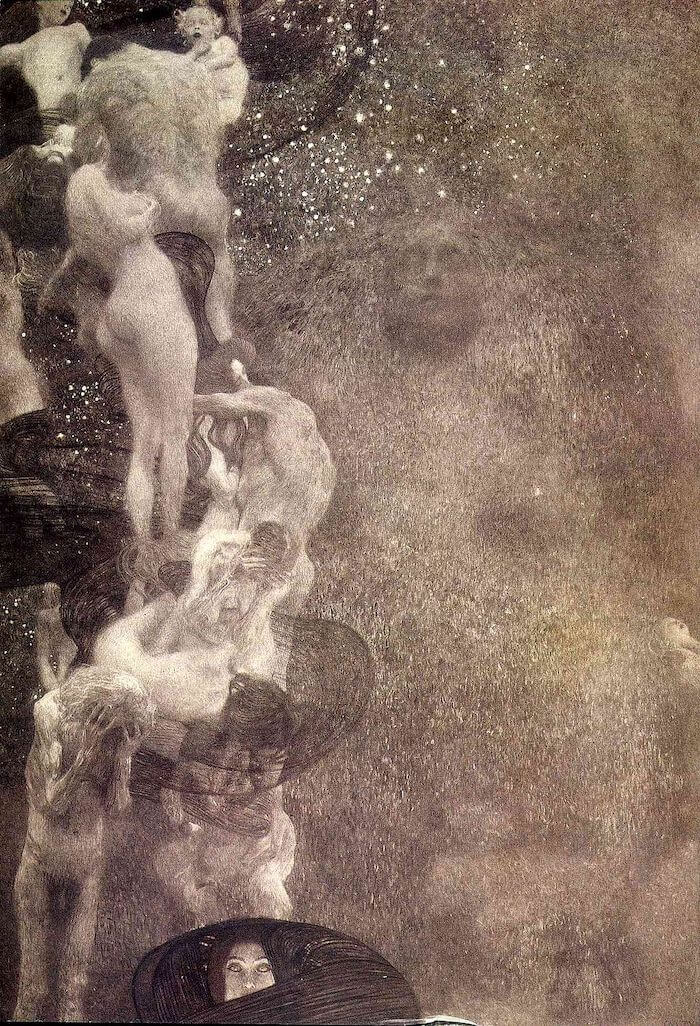
Priestley makes clear how the young Klimt’s career took a fateful turn with Philosophy (below), part of a massive commission for the ceiling of Vienna University’s Great Hall, that was ultimately destroyed by the Nazis, but has since been resurrected after a fashion using AI, black and white photos, and eyewitness descriptions.
When Klimt’s first go at it was displayed, it was savaged by critics as “chaotic, nonsensical and out of keeping with the intended setting.”
Philosophy’s drubbing put an end to Klimt’s official commissions, but private ones flourished due to the bohemian painter’s “beautiful women in elegantly languid and flattering poses.”
Imagine how those status conscious society matrons would have reacted to seeing their likenesses tapped as immersive art, which Vice’s Alex Fleming-Brown pegs as “the latest lazy lovechild of TikTok and enterprising warehouse landlords.”
It’s an astonishing painting, but there’s so much more to discover about Klimt and his four decades worth of work.
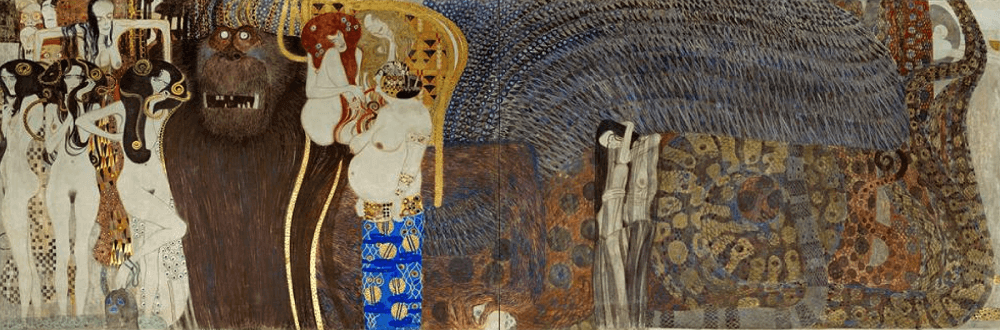
But first, with apologies to any readers who genuinely enjoy immersive art exhibits — many do — here are Jane Kallir’s not entirely conciliatory thoughts on Beethoven Frieze, Klimt’s voluptuous vision of lust, love and disease, which was deliberately enhanced by accompanying sculpture and live music when it made its public debut in 1902, and is currently being parceled out and writ large in digital form in the building formerly known as New York’s Emigrant Industrial Savings Bank:
I asked myself whether Klimt would have approved of the Beethoven Frieze projections. I believe most artists embrace cutting-edge technology, whatever it may be in their day and age. The Beethoven Frieze segment is a Gesamtkunstwerk on a scale that Klimt might have dreamed of—might have. This is the one part of the presentation that could be faithful to his intentions.
Imagine two prisoners, each one placed in solitary confinement. The police offer a deal: if each betrays the other, they’ll both get five years in prison. If one betrays the other but the other keeps quiet, the betrayer will walk free and the betrayed will serve ten years. If neither say anything, they’ll both be locked up, but only for two years. Unable coordinate, both prisoners will likely betray each other in order to secure the best individual outcome, despite the fact that it would be better on the whole for both to keep their mouths shut. This is the “prisoner’s dilemma,” a thought experiment much-cited in game theory and economics since the middle of the twentieth century.
Though the situation the prisoner’s dilemma describes may sound quite specific, its general form actually conforms to that of a variety of problems that arise throughout the modern world, in politics, trade, interpersonal relations, and a great many others besides.
Blogger Scott Alexander describes the prisoner’s dilemmas as one manifestation of what Allen Ginsberg called Moloch, the relentless unseen force that drives societies toward misery. Moloch “always and everywhere offers the same deal: throw what you love most into the flames, and I can grant you power.” Or, as he’d put it to Chewy the gingerbread man, “Betray your friend Crispy, and I’ll make a fox eat only three of your limbs.”
Such is the situation animated in gloriously woolly stop-motion by Ivana Bošnjak and Thomas Johnson in the TED-Ed video at the top of the post, which replaces the prisoners with “sentient baked goods,” the jailer with a hungry woodland predator, and years of imprisonment with bitten-off arms and legs. After explaining the prisoner’s dilemma in a whimsical manner, it presents one proposed solution: the “infinite prisoner’s dilemma,” in which the participants decide not just once but over and over again. Such a setup would allow them to “use their future decisions as bargaining chips for the present one,” and eventually (depending upon how heavily they value future outcomes in the present) to settle upon repeating the outcome that would let both of them walk free — as free as they can walk on one gingerbread leg, at any rate.
Based in Seoul, Colin Marshall writes and broadcasts on cities, language, and culture. His projects include the Substack newsletterBooks on Cities, the book The Stateless City: a Walk through 21st-Century Los Angeles and the video series The City in Cinema. Follow him on Twitter at @colinmarshall or on Facebook.
Just over one foot in height, the fully painted Gnome Chomsky the Garden Noam (Version II) stands relaxed and confident in his classy gnome clothes, hat and glasses. Equipped with a couple books on an authoritative pillar, he’s ready to give your garden or home a big infusion of insightful gnome political perspective. A solid foundation base complete with a carved title assures that Garden Noam will be well-balanced and helps inform anyone who may not immediately recognize him of the identity of this handsome and scholarly gnome.
In putting this post together, I spotted an old comic bit that took the idea of a Noam Garden Gnome as its premise. You can watch it below.
If you would like to support the mission of Open Culture, consider making a donation to our site. It’s hard to rely 100% on ads, and your contributions will help us continue providing the best free cultural and educational materials to learners everywhere. You can contribute through PayPal, Patreon, and Venmo (@openculture). Thanks!
Nearly two centuries after his death, the eighteenth-century utilitarian philosopher and social reformer Jeremy Bentham — or most of him, anyway — still sits in state in the main building of University College London. For a time in the mid-twenty-tens, he was equipped with the PanoptiCam, “an online camera that streams what Bentham sees while sitting in his cabinet at UCL.” That most everyone gets the joke behind its name speaks to the enduring relevance of one of Bentham’s ideas in particular: the Panopticon, “a prison designed so that a prison guard could look into all cells at any time, and ensure that prisoners modified their behavior for the better.”
In Bentham’s Panopticon, many prisoners could be monitored effectively by just a few unseen guards. This accords, as Michel Foucault writes in 1975’s Discipline and Punish, with the principle that “power should be visible and unverifiable. Visible: the inmate will constantly have before his eyes the tall outline of the central tower from which he is spied upon. Unverifiable: the inmate must never know whether he is being looked at any one moment; but he must be sure that he may always be so.” Foucault drew connections between the Panopticon and the complex, large-scale societies that had developed since Bentham’s day. Imagine if he’d lived to see the rise of social media.
In a series of posts by Philosophy for Change, Tim Rayner takes up just such an exercise. “By making our actions and shares visible to a crowd, social media exposes us to a kind of virtual Panopticon,” he writes. “This is not just because our activities are monitored and recorded by the social media service for the purposes of producing market analysis or generating targeted advertising.” But “the surveillance that directly affects us and impacts on our behavior comes from the people with whom we share.” In the online Panopticon, “we are both guards and prisoners, watching and implicitly judging one another as we share content.” Rayner wrote these words more than a decade ago, but anyone who has experienced life on social media then can hardly deny the parallels with Bentham’s vision.
Far from improving our behavior, however, this constant online surveillance has in a fair few cases made it considerably less appealing. Whatever the nature of its actual effects on those who inhabit it, the Panopticon is an undeniably powerful structure, at least metaphorically speaking. But we should remember that Bentham intended it to be a real, physical structure, one that could contain not just prisons but other types of institutions as well. Whether a Panopticon has ever been wholly built to his specifications seems to be a matter of debate, but we can see what one would look like in the 3D rendering by Myles Zhang at the top of the post: an appropriate medium, after all, in which to perceive an idea most fully realized in the digital realm.
Based in Seoul, Colin Marshall writes and broadcasts on cities, language, and culture. His projects include the Substack newsletterBooks on Cities, the book The Stateless City: a Walk through 21st-Century Los Angeles and the video series The City in Cinema. Follow him on Twitter at @colinmarshall or on Facebook.
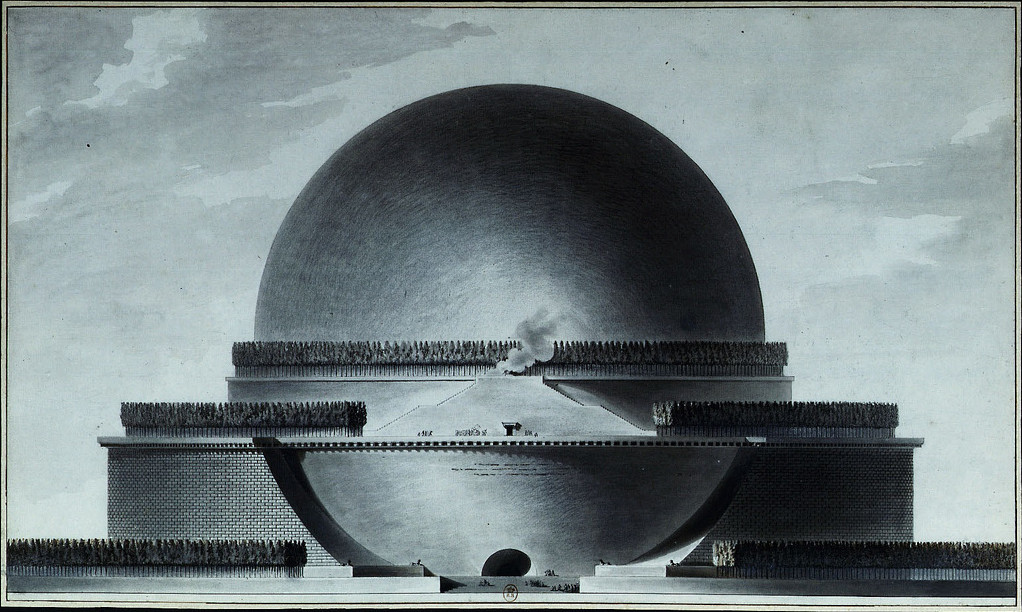
If a painter is ahead of his time, his work won’t sell particularly well while he’s alive. If an architect is ahead of his time, his work probably won’t exist at all — not in built form, at least. Such was the case with Étienne-Louis Boullée, who constructed few projects in the eighteenth century in which he lived, almost none of which remain standing today. The best Boullée devotees can do for a site of pilgrimage is the Hôtel Alexandre in Paris’ eighth arrondissement, which, though handsome enough, doesn’t quite offer a sense of why he would have devotees in the first place. To understand that, one must look to Boullée’s unbuilt works, the most notable of which are introduced in the video from Kings and Things above.
“Paper architect” identifies a member of the profession who may design structures prolifically but seldom, if ever, builds them. It is not a desirable label, especially in its implication of willful impracticality (even by architectural standards). But as practiced by Boullée, paper architecture became an art form unto itself: he left behind not just an extensive essay on his art, but voluminous drawings that envision a host of neoclassical buildings as ambitious in his time as they were unfashionable — and often, due to their sheer size, unbuildable.
These included an updated colosseum, a spherical cenotaph for Isaac Newton taller than the Great Pyramids of Giza, a basilica meant to give its beholders an impression of the universe itself, a royal library of near-Borgesian proportions, and even an actual Tower of Babel.
For Boullée, bigger was better, an idea that would sweep global architecture a century and a half after his death. By the mid-twentieth century, the world had also come to accept a Boullée-like preference for minimal ornamentation as well as his conception of what his contemporaries jokingly termed architecture parlante: that is, buildings that “speak” about their purpose visually, and in no uncertain terms. (You can hear more about it in the video below, a segment by professor Erika Naginski from Harvard’s online course “The Architectual Imagination.”) When Boullée designed a Palace of Justice, he placed a courthouse directly over a jailhouse, articulating “one enormous metaphor for crime overwhelmed by the weight of justice.” This may have been a bit much even for the new French Republic, but for those who appreciated Boullée’s work, it pointed the way to the architecture of the future — a future we would later call modern.
Based in Seoul, Colin Marshall writes and broadcasts on cities, language, and culture. His projects include the Substack newsletterBooks on Cities, the book The Stateless City: a Walk through 21st-Century Los Angeles and the video series The City in Cinema. Follow him on Twitter at @colinmarshall or on Facebook.
Before Super Bowl LVII fades too far into the background (being an Eagles fan, it can’t fade fast enough for me), it’s worth flagging this great ASL performance of Rihanna’s Super Bowl Halftime Show. Above, you can watch Justina Miles, a nursing student at HBCU Bowie State University, become “the first female deaf performer for the Super Bowl’s halftime show,” notes CNBC. Before this, Miles went viral when her ASL performance of Lil’ Kim’s “Crush on You” exploded on TikTok. As one commenter noted on YouTube, this may be the best Super Bowl performance since Prince.
If you would like to support the mission of Open Culture, consider making a donation to our site. It’s hard to rely 100% on ads, and your contributions will help us continue providing the best free cultural and educational materials to learners everywhere. You can contribute through PayPal, Patreon, and Venmo (@openculture). Thanks!
Admittedly, you’re probably not using your phone to stay atop the reproductive cycles of reindeer, salmon, and birds, but such information was of critical interest to our hunter-gatherer ancestors.
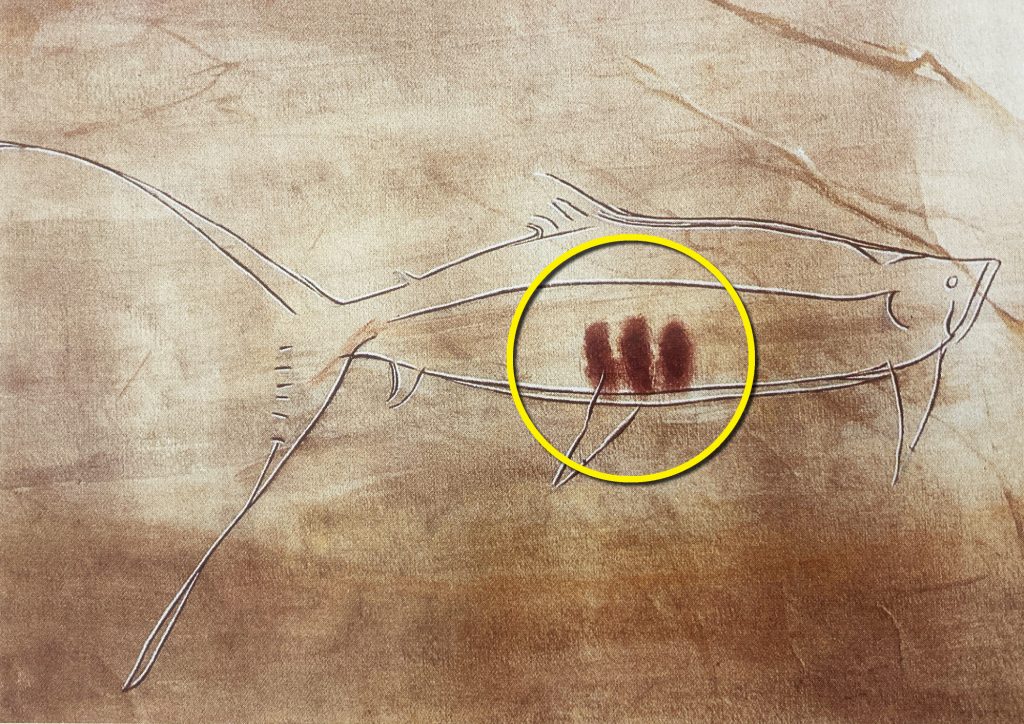
Knowing how crucial an understanding of animal behavior would have been to early humans led London-based furniture conservator Ben Bacon to reconsider what purpose might have been served by non-figurative markings — slashes, dots, and Y‑shapes — on the cave walls’ 20,000-year-old images.
Their meaning had long eluded esteemed professionals. The marks seemed likely to be numeric, but to what end?
Bacon put forward that they documented animal lives, using a lunar calendar.
The amateur researcher assembled a team that included experts from the fields of mathematics, archeology, and psychology, who analyzed the data, compared it to the seasonal behaviors of modern animals, and agreed that the numbers represented by the dots and slashes are not cardinal, but rather an ordinal representation of months.
As Bacon toldAll Things Considered his fellow self-taught anthropological researcher, science journalistAlexander Marshack, came close to cracking the code in the 1970s:
… but he wasn’t actually able to demonstrate the system because he thought that these individual lines were days. What we did is we said, actually, they’re months because a hunter-gatherer doesn’t need to know what day a reindeer migrates. They need to know what month the reindeer migrates. And once you use these months units, this whole system responds very, very well to that.
As to the frequently occurring symbol that resembles a Y, it indicates the months in which various female animal birthed their young. Bacon and his team theorize in the Cambridge Archeological Journal that this mark may even constitute “the first known example of an ‘action‘ word, i.e. a verb (‘to give birth’).
Taken together, the cave paintings and non-figurative markings tell an age-old circular tale of the migration, birthing and mating of aurochs, birds, bison, caprids, cervids, fish, horses, mammoths, and rhinos … and like snakes and wolverines, too, though they were excluded from the study on basis of “exceptionally low numbers.”
Early humans were able to log months by observing the moon, but how could they tell when a new year had begun, essential information for anyone seeking to arrange their lives around their prey’s previously documented activities?
Bacon and his peers, like so many poets and farmers, look to the rites of spring:
The obvious event is the so-called ‘bonne saison’, a French zooarchaeological term for the time at the end of winter when rivers unfreeze, the snow melts, and the landscape begins to green.
Your Pretty Much Pop hosts Mark Linsenmayer, Lawrence Ware, Sarahlyn Bruck, and Al Baker talk through various ethical and narrative problems having to do with the creation of artificial life.
We all watched M3GAN and Steve Spielberg’s A.I., and also touch on After Yang, Ex Machina, Bicentennial Man, the BBC show Humans, and of course this is an element in classic sci-fi properties like Alien, Blade Runner, Star Trek, etc.
We also go on a tangent about A.I. writing academic papers.
Punk is not only not dead, it’s getting a fresh burst of energy, thanks to The Unglamorous Music Project, a female collective in Leicester.
In accordance with punk tradition, musical ability is not a primary concern.
Shockingly, life experience is.
With five, six, and seven decades worth, Unglamorous Music Project participants have no illusions about how women their age — with the possible exception of Patti Smith — are perceived.
Rather than content themselves with crumbs and conform to societal expectations, they are going hard in newly formed bands like The Wonky Portraits, Dada Women, BOILERS, Velvet Crisis and The Verinos, above.
I’ve got no fucks to give any more about what anyone thinks of me…We write our own music and we’ve got a lot to say about everything we’re angry about. I’ve been enraged for years.
The Verinos’ 61-year-old Ruth Miller, founder of The Unglamorous Music Project, told RNZ how she tapped into an unexpectedly rich reservoir of previously unacted upon mature female musical impulse, when she mentioned her plan to form a band to the friend with whom she drank coffee and talked politics.
The friend confessed that she’d long wanted to take up the drums, and on the strength of that comment was drafted as drummer for the Verinos, after watching one instructional YouTube video.
A “really cool looking older woman” with “sticking up hair” whom Miller approached in a restaurant, asking, “Excuse me, are you in a band?” earned her place by answering “No, but I’ve always wanted to learn bass.”
I think as a woman, you hit a particular age and you think, “Well, I don’t care what anyone thinks. It’s my life, and I really want to do music again, and it doesn’t matter whether people like it or not. They don’t have to listen…”
But they do like it! It’s incredibly appealing, that idea of seeing a group of older women who are just themselves.
Miller believes that rather than paying for private lessons and concentrating on the “proper” way to play music, beginners should let go of their inhibitions and have a go at playing communally.
The principles of the Unglamorous Music Project spell it out even more explicitly:
Choose an instrument that appeals and fits in with others
Find helpful people to lend you stuff and support unconditionally
Form a duo or band with other beginners straightaway
Explore very simple rhythms and sounds
Write your own words about your life
Sing great tunes and backing vocals
Play your song in a confident, cool, challenging way
Get encouragement and applause from friends
Start performing to audiences as soon as possible
Perhaps an unspoken principle, given the Project’s emphasis on fun, is assuming Ramones-style stage names, a la Vim, Vi, Volcano, Vixen and VeeDee Verino.
If you’re inspired to join the movement, mark your calendar for March, 8, International Women’s Day and join Miller’s Facebook group, 66 Days to your Debut.
We're hoping to rely on loyal readers, rather than erratic ads. Please click the Donate button and support Open Culture. You can use Paypal, Venmo, Patreon, even Crypto! We thank you!
Open Culture scours the web for the best educational media. We find the free courses and audio books you need, the language lessons & educational videos you want, and plenty of enlightenment in between.