The Rockford Files hit the airwaves in September 1974, and until the show ended in 1980, each episode began in the same way. During the title sequence, you’d hear a phone ring, and then an answering machine would start to play, “This is Jim Rockford. At the tone, leave your name and message. I’ll get back to you.” With each new episode, a caller would leave a different message after the beep:
“It’s Norma at the market. It bounced. You want me to tear it up, send it back, or put it with the others?”
“It’s Laurie at the trailer park. A space opened up. Do you want me to save it or are the cops going to let you stay where you are?”
“It’s Audra. Remember last summer at Pat’s? I’ve got a twelve hour layover before I go to Chicago. How about it?”
“This is the message phone company. I see you’re using our unit, now how about paying for it?”
“I staked out that guy only it didn’t work out like you said. Please call me. Room 234. County Hospital.”
“Hey Rockford, very funny. I ain’t laughing. You’re gonna get yours.”
The short messages told you pretty much everything you needed to know about Jim Rockford. He’s a private detective living paycheck to paycheck. He cuts corners and bends rules when he needs to. He has friends among women, and enemies among men. He’s a quintessential private dick.
In total, 122 different answering machine messages were left during the run of the series. (Apparently, many featured the voices of 1970s celebrities and public figures.) You can play Season 1 above, and the remaining seasons below.
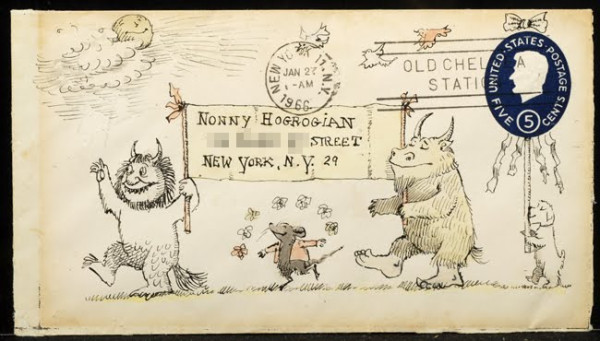
I remember thrilling, as a kid, to the envelope illustrations that the magazines I read ran on their letters pages. Not only would some of these readers (usually readers my age, with a lot of time on their hands) go to the trouble of writing and mailing a physical letter to their periodical of choice, they’d actually get as artistic as possible with the envelope as well. Some even did pretty impressive jobs, though as the envelope-illustrators of our time go, few rank up there with the likes of Maurice Sendak.
“This is how Maurice Sendak sometimes sent his letters,” wrote Letters of Note, tweeting out the image above. “Just imagine getting one.” The author of Where the Wild Things Areand In the Night Kitchen wrote the letter contained in this particular envelope to his fellow children’s book writer-illustrator Nonny Hogrogian, author of One Fine Day and The Contest. Sendak’s close colleagues might have got used to receiving such unconventionally illuminated correspondence, but he also wrote back to each and every one of his young readers, sometimes with similarly prepared correspondence.
Letters of Notealso tweeted a quote from a Fresh Air interview with Sendak in which Terry Gross asked for his favorite comments from his fans. Sendak told the story of a boy from whom he received “a charming card with a little drawing. I loved it.” In reply, he sent the child a postcard of appreciation and drew a Wild Thing on it, just as he did on the envelope of his letter to Hogrogian. The boy’s mother then wrote back to say her son “Jim loved your card so much he ate it,” which Sendak considered “one of the highest compliments I’ve ever received. He didn’t care that it was an original drawing or anything. He saw it, he loved it, he ate it.”
In late August, one of Tokyo’s grandest hotels, Hotel Okura closed its doors and its main wing will be demolished to make way for a $980 million reconstruction. The new hotel will open in 2019.
The move was met with howls of protest around the world. The original hotel was hailed as a modernist treasure. “It’s a masterpiece,” lamented noted architecture writer Hiroshi Matsukuma. “It has a cultural and historical value that can never be reproduced again.”
The hotel first opened its doors in 1962 at a pivotal time in Japanese history. Eager to distance itself from its militaristic past, the country put on a new internationalist face to the world. The 1964 Tokyo Olympics were meant to be a sort of coming out party for a new, thoroughly modern nation. The Hotel Okura was designed in this same optimistic spirit.
Architect Yoshio Taniguchi said that he intended the hotel to be crisply modern though imbued with “a firm dignity impervious to fleeting fashion.” Five decades later, the hotel’s interiors still seem striking, elegant and wonderfully atmospheric. Taniguchi recruited master artisans Hideo Kosaka, Shiko Munakata and Kenkichi Tomimoto to craft the hotel’s look. The hotel’s murals, furniture, exterior facing, even the light fixtures, all draw upon elements of traditional Japanese design, re-imagined for the jet age.
“It’s the lighting fixtures, the furniture. What’s exciting is that you see this concept of Japanese design history play out across the lobby,” said Don Choi, professor of architecture at Cal Poly San Luis Obispo. “You wouldn’t see that in Paris or New York. That attention to detail makes it a complete work of art.”
Hotel Okura has played host to several US Presidents, from Ford to Obama, along with other international luminaries from the Dalai Lama to Mikhail Gorbachev. Even James Bond spent the night there in You Only Live Twice. Haruki Murakami later featured the place prominently in his beloved tome 1Q84.
For 50 years, the hotel has continued to operate largely unchanged. Even the menu for the hotel’s restaurant, the Orchid Room, serves up the same fare they had back in 1964 — from crepes suzette to wiener schnitzel. The place was the Kennedy era dipped in amber. For the 21st century visitor, that was no doubt much of its charm.
Monocle Magazine has produced a lovely video elegy to the hotel, which you can watch above.
Jonathan Crow is a Los Angeles-based writer and filmmaker whose work has appeared in Yahoo!, The Hollywood Reporter, and other publications. You can follow him at @jonccrow. And check out his blog Veeptopus, featuring lots of pictures of vice presidents with octopuses on their heads. The Veeptopus store is here.
Back in 1985, Douglas Adams teamed up with Infocom’s Steve Meretzky to create an interactive fiction video game based on The Hitchhiker’s Guide to the Galaxy. Designed before graphic-intensive video games really hit their stride, the original Hitchhiker’s Guide game (watch an unboxing above) was played with text commands on the Apple II, Macintosh, Commodore 64, CP/M, DOS, Amiga, Atari 8‑bit and Atari ST platforms. And it found instant success. The adventure game sold 400,000 copies, making it one of the best-selling games of its time, and it was named the “Game Of The Year” by various magazines.
The game remains essentially unchanged and the original writing by Douglas Adams remains untouched. It is still played by entering commands and pressing return. Then read the text, follow your judgement and you will probably be killed an inordinate number of times.
Note: The game will kill you frequently. If in doubt, before you make a move please save your game by typing “Save” then enter. You can then restore your game by typing “Restore” then enter. This should make it slightly less annoying getting killed as you can go back to where you were before it happened. You’ll need to be signed in for this to work. You can sign in or register by clicking the BBCiD icon next to the BBC logo in the top navigation bar.
If you would like to support the mission of Open Culture, consider making a donation to our site. It’s hard to rely 100% on ads, and your contributions will help us continue providing the best free cultural and educational materials to learners everywhere. You can contribute through PayPal, Patreon, and Venmo (@openculture). Thanks!
The tale of an ailing New York-based playwright’s unwilling return to his ancestral home is a natural fit for Colbert, raised in Charleston, South Carolina by Northern parents. Recorded at the behest of Selected Shorts, a public radio program wherein well known performers interpret contemporary and classic short fiction, the story—hand picked by Colbert—is a risky choice for 2015.
Like all of O’Connor’s work, it’s darkly comedic, and rife with rich characterizations. It also makes repeated reference to “Negroes,” two of whom the reader—in Colbert’s case, a white man—is tasked with bringing to life. In this current climate, I suspect most white comedians would’ve played it safe with O’Connor’s lurid crowd pleaser, “A Good Man is Hard to Find,” a staple of high school reading lists, which you can hear O’Connor, herself, read here.
Colbert sails through by bringing his Northwestern University theater training to bear. (O’Connor was a favorite of the Performance Studies department during his time there.)
Having spent years embodying a right wing windbag on his satirical Colbert Report, the comedian clearly relishes the opportunity to tackle a variety of roles, including the main character’s willfully superficial mother, his sour sister, and the aforementioned pre-Civil Rights-era African-American men, workers in the hero’s mother’s dairy barn. The Catholic Colbert also has fun with an unexpectedly less-than-erudite Jesuit priest.
As for O’Connor, she gets in a not-so-subtle jab at Gone with the Wind, as well as the sort of reader who, trying to be helpful, counsels an aspirant Southern writer to “put the War in there.”
Something tells me these two would have hit it off…I would’ve loved to hear him interview her along with George Clooney, Amy Schumer, and other first week guests.
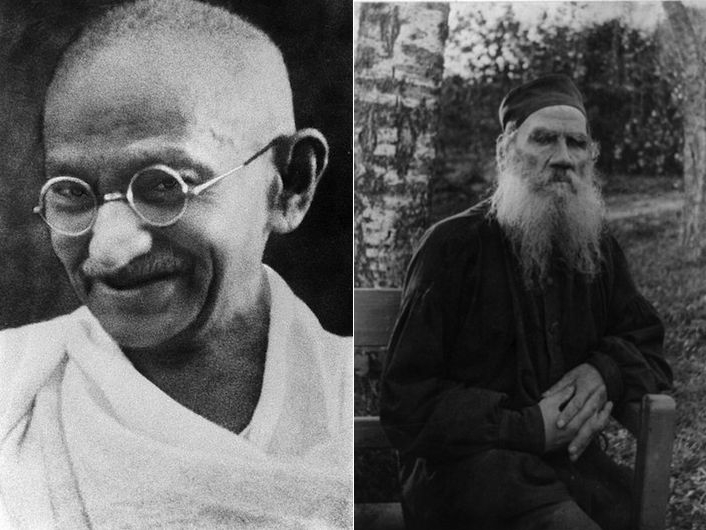
Some of the most rigorous moral thinkers of the past century have spent time on the wrong side of questions they deemed of vital importance. Mohandas Gandhi, for example, at first remained loyal to the British, manifesting many of the vicious prejudices of the Empire against Black South Africans and lobbying for Indians to serve in the war against the Zulu. Maya Jasanoff in New Republic describes Gandhi during this period of his life as a “crank.” At the same time, he developed his philosophy of non-violent resistance, or satyagraha, in South Africa as an Indian suffering the injustices inflicted upon his countrymen by both the Boers and the British.
Gandhi’s sometime contradictory stances may be in part understood by his rather aristocratic heritage and by the warm welcome he first received in London when he left his family, his caste, and his wife and child in India to attend law school in 1888. And yet it is in London that he first began to change his views, becoming a staunch vegetarian and encountering theosophy, Christianity, and many of the contemporary writers who would shift his perspective over time. Gandhi received a very different reception in England when he returned in 1931, the de facto leader of a burgeoning revolutionary movement in India whose example was so important to both the South African and U.S. civil rights movements of succeeding decades.
One of the writers who most deeply guided Gandhi’s political, spiritual, and philosophical evolution, Leo Tolstoy, experienced his own dramatic transformation, from landed aristocrat to social radical, and also renounced property and position to advocate strenuously for social equality. Gandhi eagerly read Tolstoy’s The Kingdom of God is Within You, the novelist’s statement of Christian anarchism. The book, Gandhi wrote in his autobiography, “left an abiding impression on me.” After further study of Tolstoy’s religious writing, he “began to realize more and more the infinite possibilities of universal love.”
It was in England, not India, where Gandhi first read “A Letter to a Hindu,” Tolstoy’s 1908 reply to a note from Indian revolutionary Taraknath Das on the question of Indian independence. Tolstoy divides his lengthy, thoughtful “Letter” into short chapters, each of which begins with a quotation from the Vedas. “Indeed,” writes Maria Popova, the missive “puts in glaring perspective the nuanceless and hasty op-eds of our time.” It so affected Gandhi that, in 1909, he wrote to Tolstoy, thus beginning a correspondence between the two that lasted through the following year. “I take the liberty of inviting your attention to what has been going on in the Transvaal for nearly three years,” begins Gandhi’s first letter, somewhat abruptly, “There is in that Colony a British Indian population of nearly 13,000. These Indians have, for several years, labored under various legal disabilities.”
The prejudice against color and in some respects against Asians is intense in that Colony….The climax was reached three years ago, with a law that many others and I considered to be degrading and calculated to unman those to whom it was applicable. I felt that submission to a law of this nature was inconsistent with the spirit of true religion. Some of my friends and I were and still are firm believers in the doctrine of nonresistance to evil. I had the privilege of studying your writings also, which left a deep impression on my mind.
Gandhi refers to a law forcing the Indian population in South Africa to register with the authorities. He goes on to inquire about the authenticity of the “Letter” and asks permission to translate it, with payment, and to omit a negative reference to reincarnation that offended him. Tolstoy responded a few months later, in 1910, allowing the translation free of charge, and allowing the omission, with the qualification that he believed “faith in re-birth will never restrain mankind as much as faith in the immortality of the soul and in divine truth in love.” Overall, however, he expresses solidarity, greeting Gandhi “fraternally” and writing,
God help our dear brothers and co-workers in the Transvaal! Among us, too, this fight between gentleness and brutality, between humility and love and pride and violence, makes itself ever more strongly felt, especially in a sharp collision between religious duty and the State laws, expressed by refusals to perform military service.
The two continued to write to each other, Gandhi sending Tolstoy a copy of his Indian Home Rule and the translated “Letter,” and Tolstoy expounding at length on the errors—and what he saw as the superior characteristics—of Christian doctrine. You can read their full correspondence here, along with Tolstoy’s “Letter to a Hindu” and Gandhi’s introduction to his edition. Despite their religious differences, the exchange further galvanized Gandhi’s passive resistance movement, and in 1910, he founded a community called “Tolstoy Farm” near Johannesburg.
Gandhi’s views on African independence would change, and Nelson Mandela later adopted Gandhi and the Indian independence movement as a standard for the anti-apartheid movement. We’re well aware, of course, of Gandhi’s influence on Martin Luther King, Jr. For his part, Gandhi wrote glowingly of Tolstoy, and the model the novelist provided for his own anti-colonial campaign. In a speech 18 years later, he said, “When I went to England, I was a votary of violence, I had faith in it and none in nonviolence.” After reading Tolstoy, “that lack of faith in nonviolence vanished…Tolstoy was the very embodiment of truth in this age. He strove uncompromisingly to follow truth as he saw it, making no attempt to conceal or dilute what he believed to be the truth. He stated what he felt to be the truth without caring whether it would hurt or please the people or whether it would be welcome to the mighty emperor. Tolstoy was a great advocate of nonviolence in his age.”
Last year, we featured a few readings and performances of the work of Jack Kerouac by musicians like Patti Smith, John Cale, Thurston Moore, and Joe Strummer. Those tracks got laid down for 1997’s Kerouac: Kicks Joy Darkness, a tribute to the author of On the Roadand The Dharma Bumsand an American cultural presence as resonant as they come. Now, you can listen to the whole thing on Spotify (whose free software you can download here) and revel in renditions of Kerouac’s poetry and prose by an even wider selection of beloved alternative musicians: Warren Zevon, Pearl Jam’s Eddie Vedder, REM’s Michael Stipe, Sonic Youth’s Lee Ranaldo show up on the roster, to name but a few.
It also features contributions from a great many subculture-defining non-musicians, including writers like Hunter S. Thompson and William S. Burroughs, comedian Richard Lewis, actor Matt Dillon, poet Maggie Estep, and a genuine Beat eminence like Lawrence Ferlinghetti. It even brings in cultural figures who, though known for other pursuits, also established enough of a side career in music to hold their own in the recording studio, like Johnny Depp and The Basketball Diariesauthor Jim Carroll. We even hear Kerouac as interpreted with the help of no less a lifelong musician — and no less unexpected a musician on an album like this — than Aerosmith’s Steven Tyler.
“Fourteen of the 25 tracks on this 79½-minute disc are drawn from Kerouac’s poetry book Pomes All Sizes,” writes All Music Guide’s William Ruhlmann. “The rest come from his novels (nothing from On the Road, though) and letters, with some unpublished work also included.” Ruhlmann points out Kerouac’s own lack of enthusiasm for rock and preference for jazz, highlighting Ranaldo, Zevon, Dillon, and Lewis’ contributions as closest to the man’s own sensibility. But altogether, he writes, they “present a good sampling of Kerouac’s literary concerns, and, whether appropriate or not, the recordings demonstrate his extensive influence” — a perfect demonstration of how the cool of one era can inspire the cool of another.
As a sometime musician, it’s only natural that I want my four-year-old daughter to take an interest in music. Sure, it’s a fun bonding activity, and sure, there may be a bit of a stage dad lurking inside me at times. But I’m also convinced of the tangible benefits playing a musical instrument can have on one’s personal development. New science, it seems, backs up this intuition. The Washington Post reported last year on a recent study from Northwestern University which found that “Music training not only helps children develop fine motor skills, but aids emotional and behavioral maturation as well.”
This may not come as a surprise. And yet, the details of the study provide insights our intuitions about the power of musical education may lack. For one thing, as you can see in the CNN report above, the benefits of learning to play music as a child can last for decades, even if someone hasn’t picked up an instrument since those early lessons. As Dr. Nina Kraus, director of Northwestern’s Auditory Neuroscience Laboratory, explains, good musical timing is strongly correlated with reading skills and general mental acuity. According to a co-author of the study, James Hudziak, professor of psychiatry at the University of Vermont, early musical training was shown to have “accelerated cortical organization in attention skill, anxiety management and emotional control.” These brain changes can accompany us well into old age.
Another, Canadian study, published in February in the The Journal of Neuroscience, found that childhood music lessons boost the ability of older adults to hear speech, a skill that begins to weaken later in life. The study found “robust” evidence that “starting formal lessons on a musical instrument prior to age 14 and continuing intense training for up to a decade appears to enhance key areas in the brain that support speech recognition.” Even music lessons taken later life can help rehabilitate the brains of older adults. “The findings,” writes Science Daily, “underscore the importance of music instruction in schools and in rehabilitative programs for older adults.”
Music teachers certainly need this kind of evidence to bolster support for ailing programs in schools, and musically-inclined parents will cheer these findings as well. But before the stage parent in you begins enrolling your kid in every music lesson you can fit into the schedule, take heed. As Dr. Kraus discovered in the Northwestern study, forcing kids to show up and participate under duress won’t exercise their brains. Real, active engagement is key. “We like to say that ‘making music matters,’” says Kraus, “because it is only through the active generation and manipulation of sound that music can rewire the brain.” While musical training may be one particularly enjoyable way to strengthen cognition, it isn’t the only way. But even if they don’t stick with it, the kids willing to put in the hours (and yes, the longer the better) will experience positive change that lasts a lifetime.
I want their minds to be blown the way mine was at 15, when I picked up Slapstick, his 8th novel, for reasons I no longer remember. It wasn’t on recommendation of some beloved teacher, nor was there any Vonnegut on our home shelves, despite the fact that he was a local author. Whatever drew me to that book, thank god it did. It was the beginning of a lifelong romance.
What grabbed me so? His genius idea for bestowing an artificial extended family on every citizen, via the assignment of middle names:
I told him, ‘your new middle name would consist of a noun, the name of a flower or fruit or nut or vegetable or legume, or a bird or a reptile or a fish, or a mollusk, or a gem or a mineral or a chemical element — connected by a hyphen to a number between one and twenty.’ I asked him what his name was at the present time.
‘Elmer Glenville Grasso,’ he said.
‘Well,’ I said, ‘you might become Elmer Uranium‑3 Grasso, say. Everybody with Uranium as a part of their middle name would be your cousin.’
This held enormous appeal for me as the only child of an only child. Lonesome No More!
It also contained the most wonderful profanity I had ever heard:
You ask him his middle name, and when he tells you “Oyster-19” or “Chickadee‑1” or “Hollyhock-13” you say to him: Buster — I happen to be a Uranium‑3. You have one hundred and ninety thousand cousins and ten thousand brothers and sisters. You’re not exactly alone in this world. I have relatives of my own to look after. So why don’t you take a flying fuck at a rolling doughnut? Why don’t you take a flying fuck at the moooooooooooon?
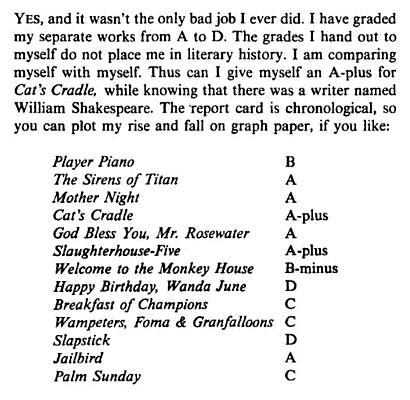
Imagine my dismay when just two books later, Vonnegut gave Slapstick the lowest possible mark in a literary self evaluation published in Palm Sunday, below.
He wasn’t describing the difference between a B and a B+. In Vonnegut’s mind, Slapstick was a D. In other words, a minimally acceptable, deeply below average performance.
He later reflected to journalist Charlie Rose that he’d been overly hard on the title. But the critics had trashed it when it first appeared, and presumably critics knew best. So much for Vonnegut the rebel and class clown. This was a clear case of give the teacher the answer you think she wants.
I give it an A+, and so would you, if you’d discovered it when I did.
How about you? Any marks you’d change on Vonnegut’s report card?
Earlier this week, we featured pioneering German animator Lotte Reiniger’s animated silhouette films, for which she adapted old European stories like “Cinderella,” “Thumbelina,” and “Hansel and Gretel” into a striking visual style — striking now, and even more striking in the 1920s — similar to traditional Indonesian shadow puppet theater. Her work draws plenty of material from folktales, but not just those from in and around her homeland (Germany). For her most ambitious work, for instance, Reiniger looked all the way to Arabia, adapting stories from no less venerable a source than One Thousand and One Nights. The 65-minute result, 1926’s The Adventures of Prince Achmed, stands as the earliest animated feature film. (See a nice clip above. The complete film lives on DVD/Blu Ray.)
“For centuries Prince Achmed on his magic horse had lived a comfortable life as a well-loved fairy tale figure of the Arabian nights and was well contented with that,” Reiniger writes in her introduction to the picture. “But one day he was thrown out of his peaceful existence by a film company which wanted to employ him and many other characters of the same stories for an animated film.” And so, in 1923, it fell to her and a select group of collaborators to make that film. They labored for the better part of three years, not just because of the requirements of shooting each and every frame by hand but because of the experimental nature of animation itself. “We had to experiment and try out all sorts of inventions to make the story come alive. The more the shooting of Prince Achmed advanced the more ambitious he became.”
At that time, The Adventures of Prince Achmed did not, of course, even faintly resemble any feature yet made. “No theatre dared show it,” Reiniger writes, “for ‘it was not done.’ ” And so they did it themselves, screening the film just outside Berlin, which led to a show in Paris, then one in Berlin proper, by which point Prince Achmed and his magic horse were well on their way to a place in the animation history books. They nearly lost that place due to the 1945 battle of Berlin, when the film’s negative was lost amid the destruction, but the British Film Institute had made a negative of their own for a London screening, which eventually became the material for a restoration and revival. “The revival was done by the son of the banker who sponsored the film in 1923,” notes Reiniger. “He had assisted in its creation as a small boy. So it was granted to old Prince Achmed to have a happy resurrection after almost half a century” — and he continues to win new fans today.
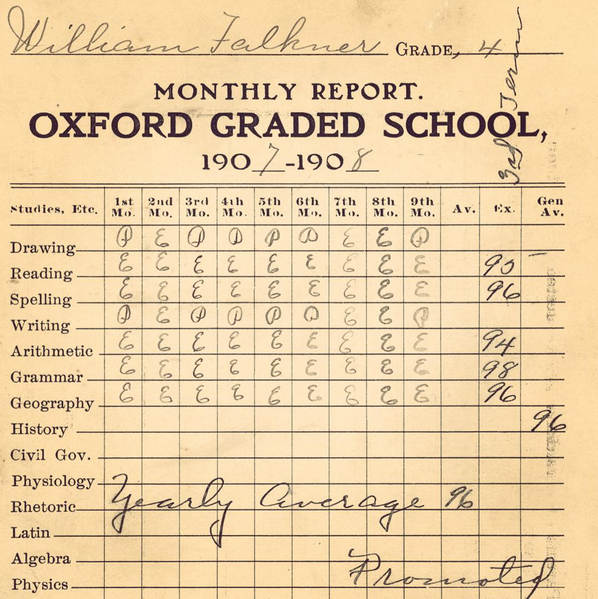
William Faulkner attended the University of Mississippi and lasted only three semesters. He skipped classes, managed to pull a D in English, and then dropped out in 1920.
A far cry from his academic performance in 1907–1908 when, as a fourth grader, he got mostly E’s (presumably meaning “Excellent”), a yearly average of 96, and a high grade of 98 in Grammar.
We're hoping to rely on loyal readers, rather than erratic ads. Please click the Donate button and support Open Culture. You can use Paypal, Venmo, Patreon, even Crypto! We thank you!
Open Culture scours the web for the best educational media. We find the free courses and audio books you need, the language lessons & educational videos you want, and plenty of enlightenment in between.
 and
and  wrote the letter contained in this particular envelope to his fellow children’s book writer-illustrator Nonny Hogrogian, author of
  and
and  . Sendak’s close colleagues might have got used to receiving such unconventionally illuminated correspondence, but he also wrote back to each and every one of his young readers, sometimes with similarly prepared correspondence.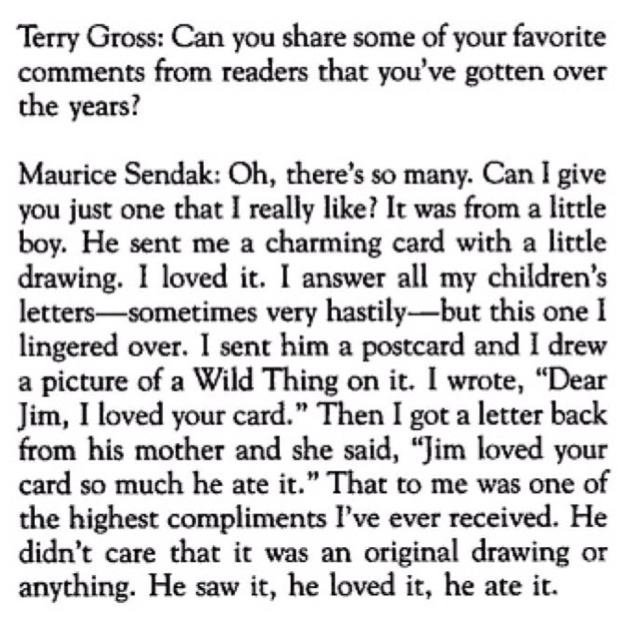
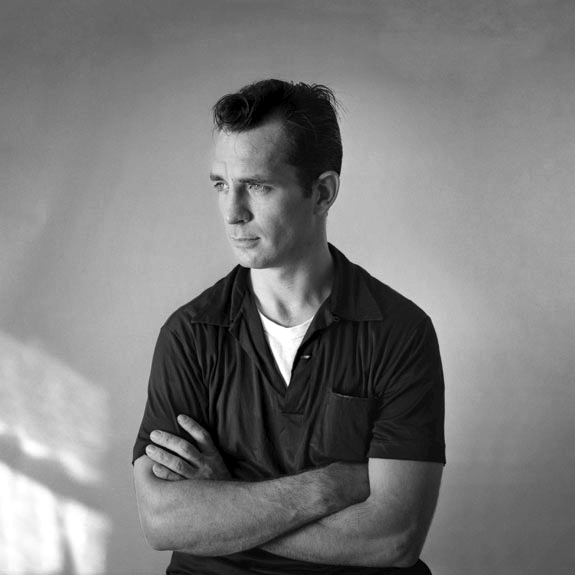

 author Jim Carroll. We even hear Kerouac as interpreted with the help of no less a lifelong musician — and no less unexpected a musician on an album like this — than Aerosmith’s Steven Tyler.
 ,”
,”