Austin City Limits–an PBS music program recorded live in Austin, Texas–has decided to open its archives “as a gift to music fans during the current live music moratorium.” They write: “Starting March 23, the perennial television series will make fan-favorite episodes from the recently broadcast Season 45 available for streaming, in addition to the entire slate of programs from the previous two seasons of the acclaimed concert showcase. Over 35 ACL installments will be available to stream free online at https://www.pbs.org/show/austin-city-limits/ offering a wide variety of music’s finest from every genre. here’s something for everyone: an electrifying hour with guitar hero Gary Clark Jr.; an epic stage journey with 2020’s Grammy-winning global pop phenom Billie Eilish; supergroup The Raconteurs, featuring Jack White and Brendan Benson, in an all-out hour of pure rock and roll.”
Above you can watch Robert Plant on Austin City Limits during a show recorded in 2016.
If you would like to support the mission of Open Culture, consider making a donation to our site. It’s hard to rely 100% on ads, and your contributions will help us continue providing the best free cultural and educational materials to learners everywhere. You can contribute through PayPal, Patreon, and Venmo (@openculture). Thanks!
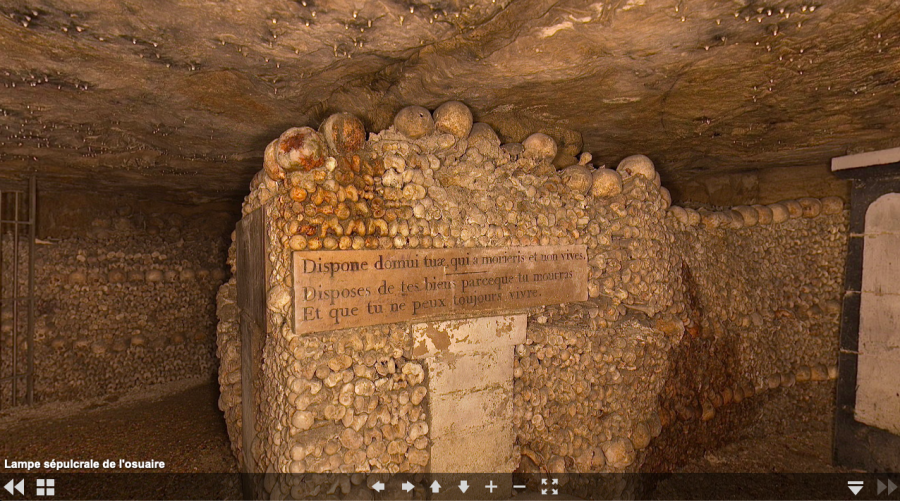
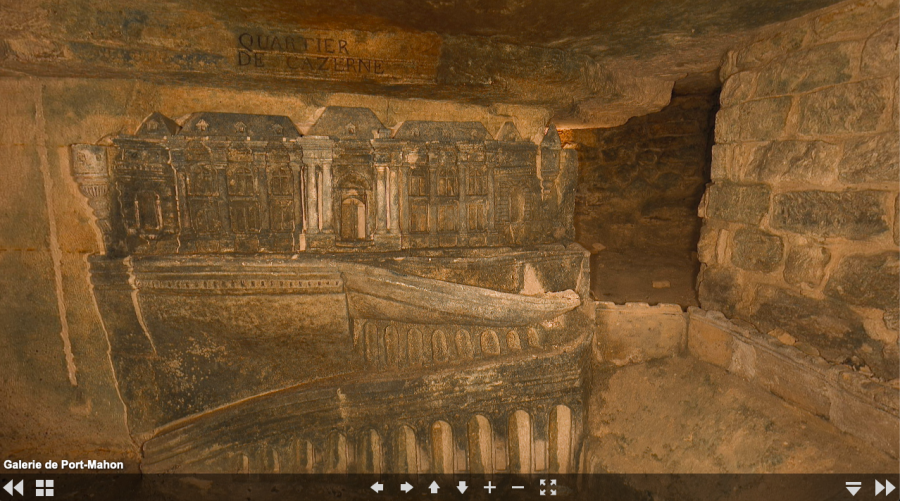
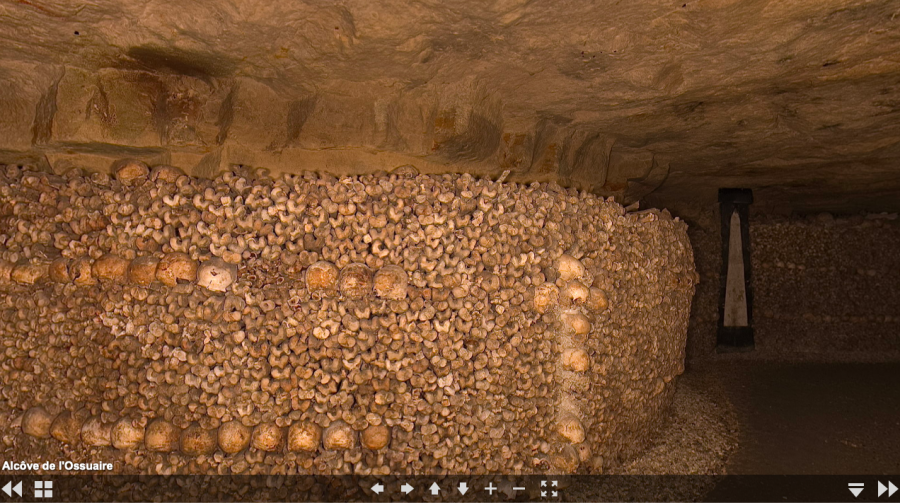
The Paris Catacombs is “one of those places,” wrote photographer Félix Nadar, “that everyone wants to see and no one wants to see again.” If anyone would know, Nadar would. He spent three months in and out of the underground city of death, with its macabre piles of skulls and crossbones, taking photographs (see here) that would help turn it into an internationally famous tourist attraction. In these days of quarantine, no one can see it; the site is closed until further notice. But if you’re the type of person who enjoys touring necropolises, you can still get your fix with a virtual visit.
Why would anyone want to do this, especially during a global outbreak? The Catacombs have attracted seekers after morbid curiosities and spiritual and philosophical truths for over two hundred years, through revolutions, massacres, and plagues.
A stark, haunting reminder of what Nadar called “the egalitarian confusion of death,” they witness mutely, without euphemism, to the future we are all assured, no matter our rank or position. They began as a disordered pile of bones in the late 18th century, transferred from overcrowded cemeteries and became a place where “a Merovingian king remains in eternal silence next to those massacred in September ‘92” during the French Revolution.
Contemplations of death, especially in times of war, plague, famine, and other shocks and crises, have been an integral part of many cultural coping mechanisms, and often involve meditations on corpses and graveyards. The Catacombs are no different, a sprawling memento mori named after the Roman catacombs, “which had fascinated the public since their discovery,” as the official site notes. Expanded, renovated, and rebuilt during the time of Napoleon and later during the extensive renovations of Paris in the mid-19th century, the site was first “consecrated as the ‘Paris Municipal Ossuary’ on April 7, 1786” and opened to the public in 1809.
It is a place that reminds us how all conflicts end. To the “litany of royal and impoverished dead from French history,” writes Allison Meier at the Public Domain Review, Nadar added in his essay on the Catacombs “the names of revolutionary victims and perpetrators like Maximilien Robespierre and Jean-Paul Marat.” Ruminations on the universal nature of death may be an odd diversion for some, and for others an urgent reminder to find out what matters to them in life. Learn more about the fascinating history of the Paris Catacombs here and begin your virtual visithere.
Americans have long been accused of growing socially distant, bowling alone, as Robert Putnam wrote in 2000, or worse becoming radicalized as “lone wolves” and isolated trolls. But we are seeing how much we depend on each other as social distancing becomes the painful normal. Not quite quarantine, social distancing involves a semi-voluntary restriction of our movements. For many people, this is, as they say, a big ask. But no matter what certain world leaders tell us, if at all possible, we should stay home, and stay a safe distance away from people who don’t live with us.
People in the U.S. have done this before, of course, just a little over a hundred years ago during the influenza epidemic called the “Spanish Flu,” though the buzzy term “social distancing” wasn’t used then. As the short VOA News video above explains, during the spread of the disease, city officials in St. Louis did what cities all over the country are doing now: shut down schools, playgrounds, libraries, churches, public offices, and parks and banned gatherings of over 20 people. Philadelphia, on the other hand, refused to do the same. The city “allowed a major World War I support parade to take place that attracted 20,000 people.”
The refusal to shut down large gatherings cost thousands of lives. “Three days later, every bed in Philadelphia’s 31 hospitals was filled with sick and dying Spanish flu patients.” COVID-19 may be a far milder illness in children and most healthy people, but this is exactly what makes it so insidious. One person can infect dozens before showing any symptoms, if ever. During the “Spanish” flu pandemic, “the best approaches were layered,” writes German Lopez at Vox. “It wasn’t enough to just tell people to stay home, because they might feel the need to go to school or work, or they could just ignore guidance and go to events, bars, church or other big gatherings anyway.”
The comparison between St. Louis and Philadelphia stresses the need for city officials to intervene in order for social distancing strategies to work. However we might feel in ordinary circumstances about governments banning public gatherings, the global spread of a deadly virus seems to warrant a coordinated public response that best contains the spread. “In practical terms,” Lopez points out, “this meant advising against or prohibiting just about every aspect of public life, from schools to restaurants to entertainment venues (with some exceptions for grocery stores and drugstores).”
Lopez cites several academic studies of the 1918 influenza outbreak as evidence of the effectiveness of social distancing. For even more data on our current pandemic, see Tomas Pueyo’s extensive Medium essay compiling data and statistics on COVID-19’s spread and prevention. And if you’re still having a little trouble figuring out what exactly “social distancing” involves, see this excellent guide from Asaf Bitton, physician, public health researcher, and director of the Ariadne Labs at Brigham and Women’s Hospital and the Harvard T.H. Chan School of Public Health.
As Bitton tells Isaac Chotiner in a recent New Yorker interview, “social distancing isn’t some external concept that applies only to work and school. Social distancing is really extreme. It is a concept that disconnects us physically from each other. It profoundly reorients our daily life habits. And it is very hard.” No matter how polarized we become, or how glued to our various screens, we are “social creatures” who need connection and community. When we make the transition out of life at a distance, maybe the memory of that need will help us overcome some of our pre-virus social alienation.
When we get sick, many of us habitually use the time away from work and other obligations to do the same thing: watch movies. But old favorites and recent releases we’d missed our first chance to catch can only last us so long: now, with so much of the world either sick or at home trying not to get sick, a combination of isolation and uncertainty about the state of things pushes us to seek out more cinematically daring fare. To satisfy this demand, Los Angeles filmmaker Kate Lain has created a collection called “CABIN FEVER: Coping with COVID-19 playlist of online experimental films & videos,” all of them free to watch online, begun “as an editable Google sheet on March 13 to gather some experimental films together based on moods one might be experiencing while being cooped up.”
Since then, Lain writes, “the list has morphed some, with some great new categories being added to the mix.” The most recent version of the spreadsheet, available in .XSLX and .PDF formats, includes such categories as “For when you need to laugh or smile,” “For when you’re stuck inside but want to be outside,” “Animals,” “Plants,” “Nostalgia,” and “Virus movies cuz why not.” (One such movie, Tuzan Wu’s Disease of Manifestation, appears at the top of the post.)
Inspired by Lain’s collection, Hyperallergic’s Dessane Lopez Cassell has “reached out to artists, filmmakers, and Hyperallergic contributors to assemble a list of what we’ve been sharing and encountering across our networks.” Their selections include Afronauts, “a luminous short which renders the story of the Zambian Space Program” — at which we looked back earlier this month — “as a dreamlike work of speculative fiction”; Bassem Saad’s Saint Rise, about the transportation of a statue of Saint Charbel (“now being heralded by conservative religious media as a healer of the Coronavirus,” the filmmaker adds) to a high mountaintop in Faraya, Lebabanon; and Guy Maddin’s The Green Fog (watch in full here and see the trailer below), described by critic Carman Tse as “a scene-by-scene recreation of Vertigo, made entirely of footage from other movies that take place in San Francisco.”
“There’s an especially funny montage right at the climax of the movie that uses Chuck Norris clips,” Tse notes, making The Green Fog a promising choice for those of us who need to lighten the mood of our isolation — and who also appreciate a high density of inter-cinematic reference. Hailing as he does from the notoriously wintry Canadian city of Winnipeg, Maddin himself surely knows a thing or two about how best to amuse oneself during long periods stuck indoors. Indeed, every artist growing up in circumstances of isolation, occasional or frequent, develops a strong appreciation and highly refined sense of artistic daring, one that unfailingly shows in their work when it debuts in the wider world. If we take this opportunity to expand the depth and breadth of our own viewing experiences, imagine how much more astute filmgoers we’ll be after the pandemic passes.
Based in Seoul, Colin Marshall writes and broadcasts on cities, language, and culture. His projects include the book The Stateless City: a Walk through 21st-Century Los Angeles and the video series The City in Cinema. Follow him on Twitter at @colinmarshall or on Facebook.
Watchers of Westworld will have heard a character in the most recent episode utter the line, “for the first time, history has an author.” It’s as loaded a bit of dialogue as the series has dropped on fans, not least for its suggestion that in the absence of a god we should be better off with an all-knowing machine.
The line might bend the ear of literary scholars for another reason. The idea of authorship is a complicated one. In one sense, maybe, everyone is an author of history, and in another, perhaps no one is. But it’s difficult to comprehend these abstractions—we crave stories with strong characters, hence our veneration of Great Men and Women of the past.
Still, in many times and places, individual authorship was irrelevant. Renaissance thinkers revalued the author as an auctoritas, a worthy figure of influence and renown. “Death of the author” theorists pointed out that the appearance of a literary text could never be reduced to a single, unchanging personality. In religious studies, questions of authorship open onto minefield after minefield. There may be no commonly agreed-upon way to think about what an author is.
Does it make sense, then, to talk about the “world’s first author”? Perhaps. In the TED-Ed lesson above by Soraya Field Fiorio, we learn that the first known person to use written language for literary purposes was named was Enheduanna, a powerful Mesopotamian high priestess who wrote forty-two hymns and three epic poems in cuneiform 4,3000 hundred years ago.
Daughter of Sargon of Akkad, who placed her in a position to rule, Enheduanna lived about “1,500 years before Homer and about 500 years before the Biblical patriarch Abraham.” (There’s considerable doubt, of course, about whether either of those people existed, whether they wrote the works attributed to them, or whether such works were penned by committee, so to speak.)
Sargon was also an author, having composed an autobiography, The Legend of Sargon, that “exerted a powerful influence over the Sumerians he sought to conquer,” notes Joshua J. Mark at the Ancient History Encyclopedia. But first, Enheduanna used her position as high priestess to unify her father’s empire with religious hymns that praised the gods of each major Sumerian city. “In her writing, she humanized the once aloof gods,” just as Homer would hundreds of years later. “Now they suffered, fought, loved, and responded to human pleading.”
Her hymns to Inanna are her most defining literary achievement, but Enheduanna has somehow been completely left out of history. “We know who the first novelist is,” writes Charles Halton at Lit Hub, “eleventh century Japanese Noblewoman Murasaki Shikibu, who wrote the Tale of Genji.” Likewise, we know the first novelist of the western world, Miguel de Cervantes, and the first essayist, Michel de Montaigne. But “ask any person in your life who wrote the first poem and they’re apt to draw a blank.”
Maybe this is because, unlike novels, we don’t think of poetry as being invented by a single individual. It seems as though it must have sprung from the collective psyche not long after humans began using language. Yet from the point of view of literary history—which, like most histories, consists of a succession of great names—Enheduanna certainly deserves the honor as the world’s first known poet and first known author. Learn more about her in the lesson above.
After winning the Nobel Prize, physicist Max Planck “went around Germany giving the same standard lecture on the new quantum mechanics. Over time, his chauffeur memorized the lecture and said, ‘Would you mind, Professor Planck, because it’s so boring to stay in our routine, if I gave the lecture in Munich and you just sat in front wearing my chauffeur’s hat?’ Planck said, ‘Why not?’ And the chauffeur got up and gave this long lecture on quantum mechanics. After which a physics professor stood up and asked a perfectly ghastly question. The speaker said, ‘Well, I’m surprised that in an advanced city like Munich I get such an elementary question. I’m going to ask my chauffeur to reply.’ ”
That this intellectual switcheroo never actually happened didn’t stop Charlie Munger from using it as an opener for a commencement speech to USC’s Law School. But when a successful billionaire investor finds value even in an admittedly “apocryphal story,” most of us will find value in it as well. It illustrates, according to the Freedom in Thought video above, the difference between “two kinds of knowledge: the deep knowledge that Max had, and the shallow knowledge that the chauffeur had.” Both forms of knowledge have their advantages, especially since none of us have lifetime enough to understand everything deeply. But we get in trouble when we can’t tell them apart: “We risk fooling ourselves into thinking we actually understand or know something when we don’t. Even worse, we risk taking action on misinformation or misunderstanding.”
Even if you put little stock into a made-up anecdote about one Nobel-winning physicist, surely you’ll believe the documented words of another. Richard Feynman once articulated a first principle of knowing as follows: “You must not fool yourself, and you are the easiest person to fool.” This principle underlies a practical process of learning that consists of four steps. First, “explain the topic out loud to a peer who is unfamiliar with the topic. Meet them at their level of understanding and use the simplest language you can.” Second, “identify any gaps in your own understanding, or points where you feel that you can’t explain an idea simply.” Third, “go back to the source material and study up on your weak points until you can use simple language to explain it.” Finally, “repeat the three steps above until you’ve mastered the topic.”
We’ve featured the so-called “Feynman technique” once or twice before here on Open Culture, but its emphasis on simplicity and concision always bears repeating — in, of course, as simple and concise a manner as possible each time. Its origins lie in not just Fenyman’s first principle of knowledge but his intellectual habits. This video’s narrator cites James Gleick’s biography Genius, which tells of how “Richard would create a journal for the things he did not know. His discipline in challenging his own understanding made him a genius and a brilliant scientist.” Like all of us, Feynman was ignorant all his life of vastly more subjects than he had mastered. But unlike many of us, his desire to know burned so furiously that it propelled him into perpetual confrontation with his own ignorance. We can’t learn what we want to know, after all, unless we acknowledge how much we don’t know.
Based in Seoul, Colin Marshall writes and broadcasts on cities, language, and culture. His projects include the book The Stateless City: a Walk through 21st-Century Los Angeles and the video series The City in Cinema. Follow him on Twitter at @colinmarshall or on Facebook.
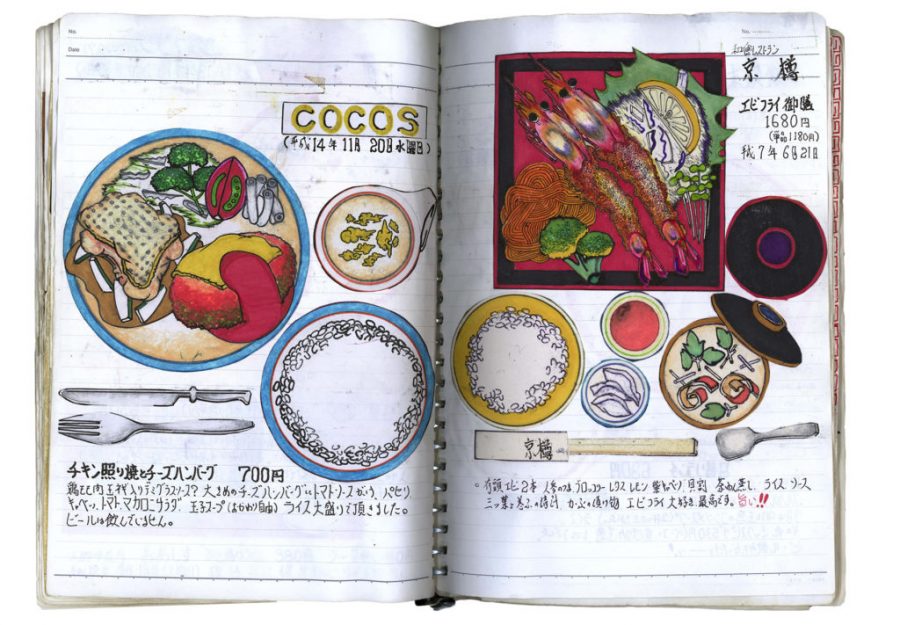
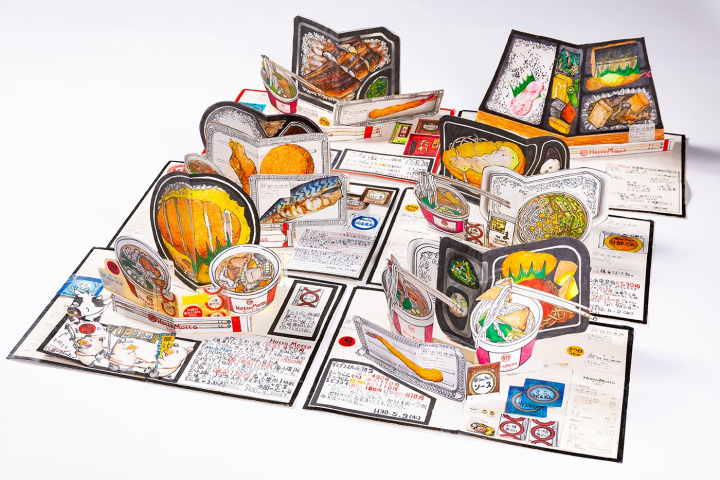
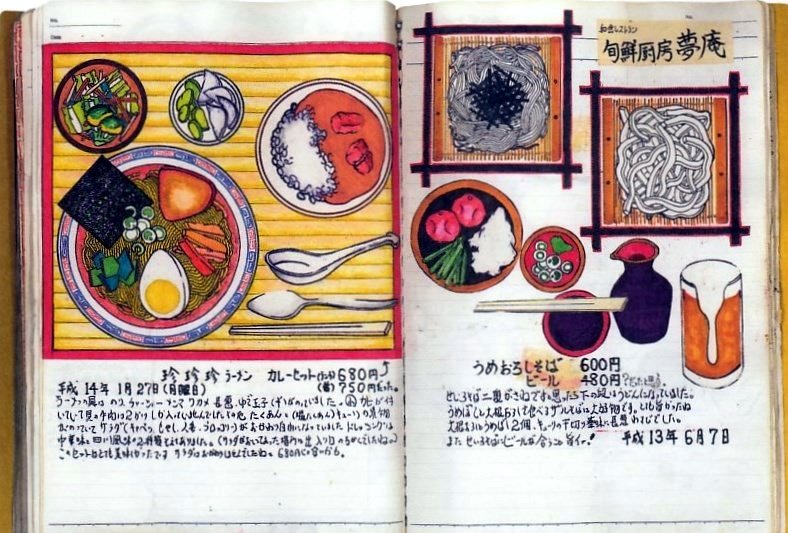
Since the 1980s, Itsuo Kobayashi has drawn a picture of every single meal he eats. However notable we find this practice now, it would surely have struck us as downright eccentric back then. Kobayashi began drawing his food before the arrival of inexpensive digital cameras and cellphones, and well before the smartphone combined the two into the single package we now keep close at hand. We all know people who take camera-phone pictures of their meals, some of them with the regularity and solemnity of prayer, but how many of them could produce lifelike renderings of the food placed before them with only pen and paper?
“The Japanese outsider artist and professional cook, born in 1962, first began keeping food diaries as a teenager,” Artnet’s Sarah Cascone writes of Kobayashi. “In his 20s, he began adding illustrations of the dishes he made at work, and those he ate while dining out.” When, at the age of 46, a “debilitating neurological disorder made it difficult for him to walk, leaving him largely confined to his home,” Kobayashi began to focus on his food diaries even more intensely.
His subjects are now mostly “food deliveries — sometimes from restaurants, sometimes from his mother. And though his day-to-day existence rarely varies, he’s been pushing his practice in a new direction, creating a new series of pop-up paintings.”
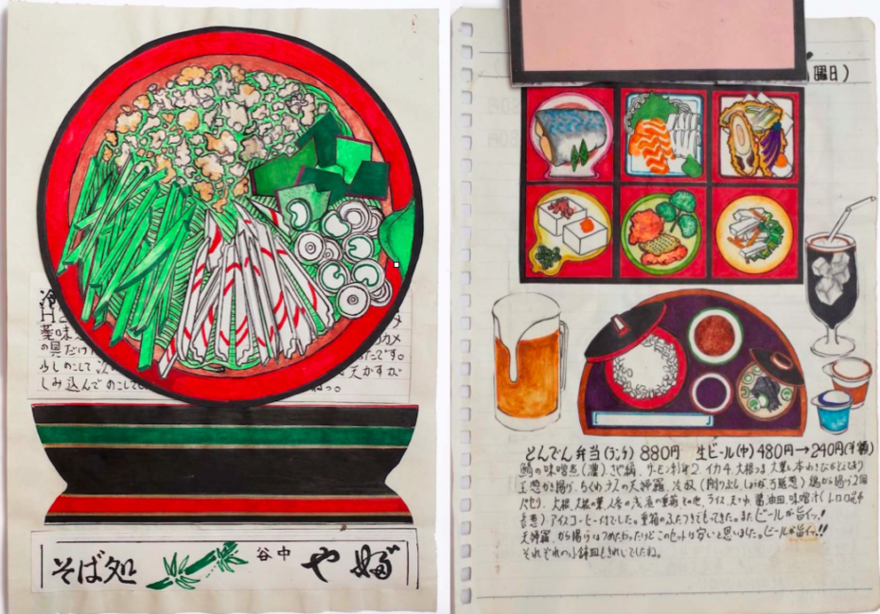
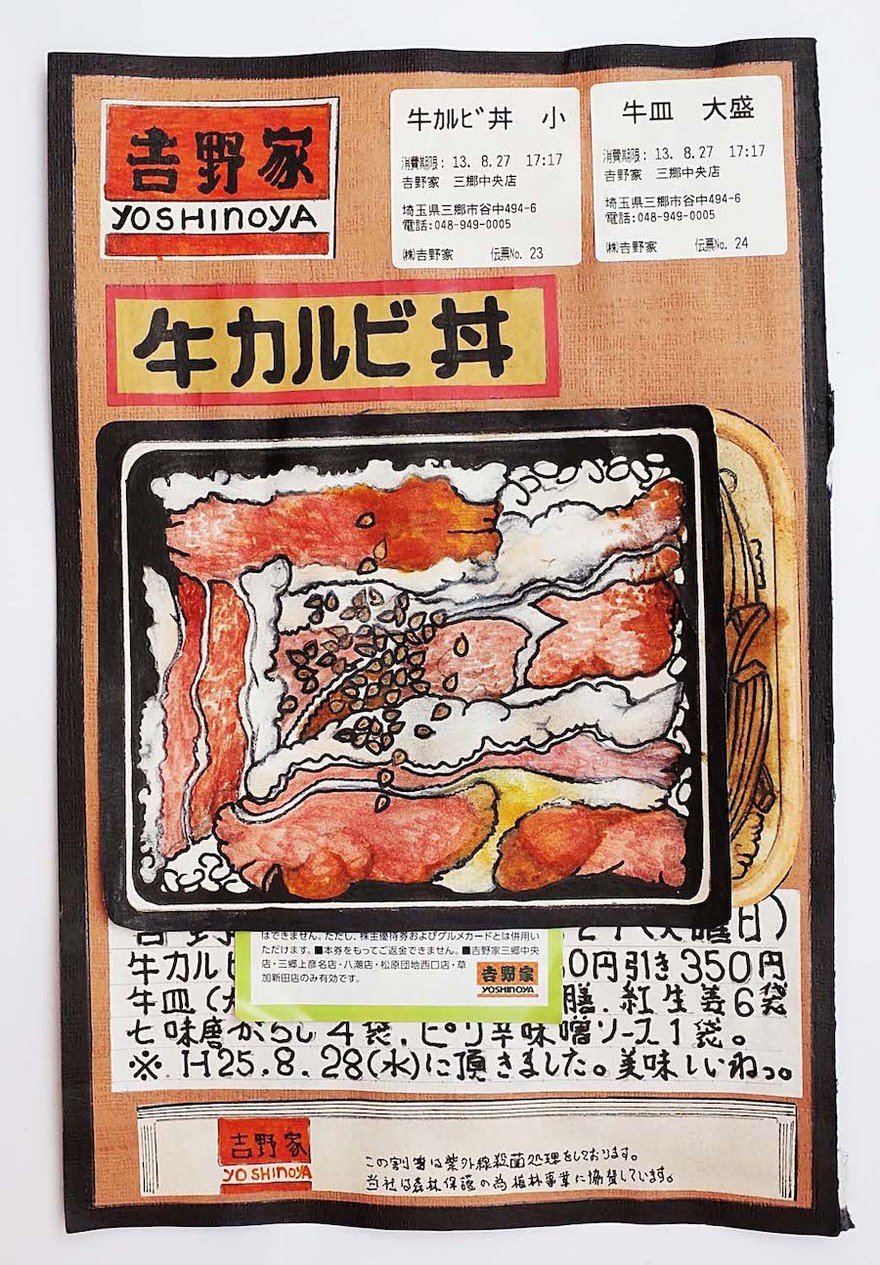
After 32 years of making increasingly detailed and realistic overhead drawings of his every meal — including such information as names, prices, flavor notes, and faithfully replicated restaurant logos — Kobayashi’s work has caught the attention of the American art world. The Fukuyama-based gallery Kushino Terrace “gave Kobayashi his US debut in January, at New York’s Outsider Art Fair,” Cascone writes. “His works sell for between $500 and $3,000.” That makes for quite a step up in prestige from his old job cooking at a soba restaurant, though his copious experience with that dish shows whenever it appears in his diary.
But then, after decade upon decade of daily practice, everything Kobayashi draws looks good enough to eat, from bowls of ramen to plates of curry to bento boxes filled with all manner of delights from land and sea. Though hardly fancy, especially by the advanced standards of Japanese food culture, these are the kind of meals you want to savor, the ones to which you feel you should pay appreciative attention rather than just scarfing down. Or at least they look that way under Kobayashi’s gaze, which even the most ardent 21st-century food-photographing hobbyist must envy. Many of us wish to eat more consciously, and the work of this cook-turned-artist shows us how: put down the phone, and pick up the sketchbook.
Based in Seoul, Colin Marshall writes and broadcasts on cities, language, and culture. His projects include the book The Stateless City: a Walk through 21st-Century Los Angeles and the video series The City in Cinema. Follow him on Twitter at @colinmarshall or on Facebook.
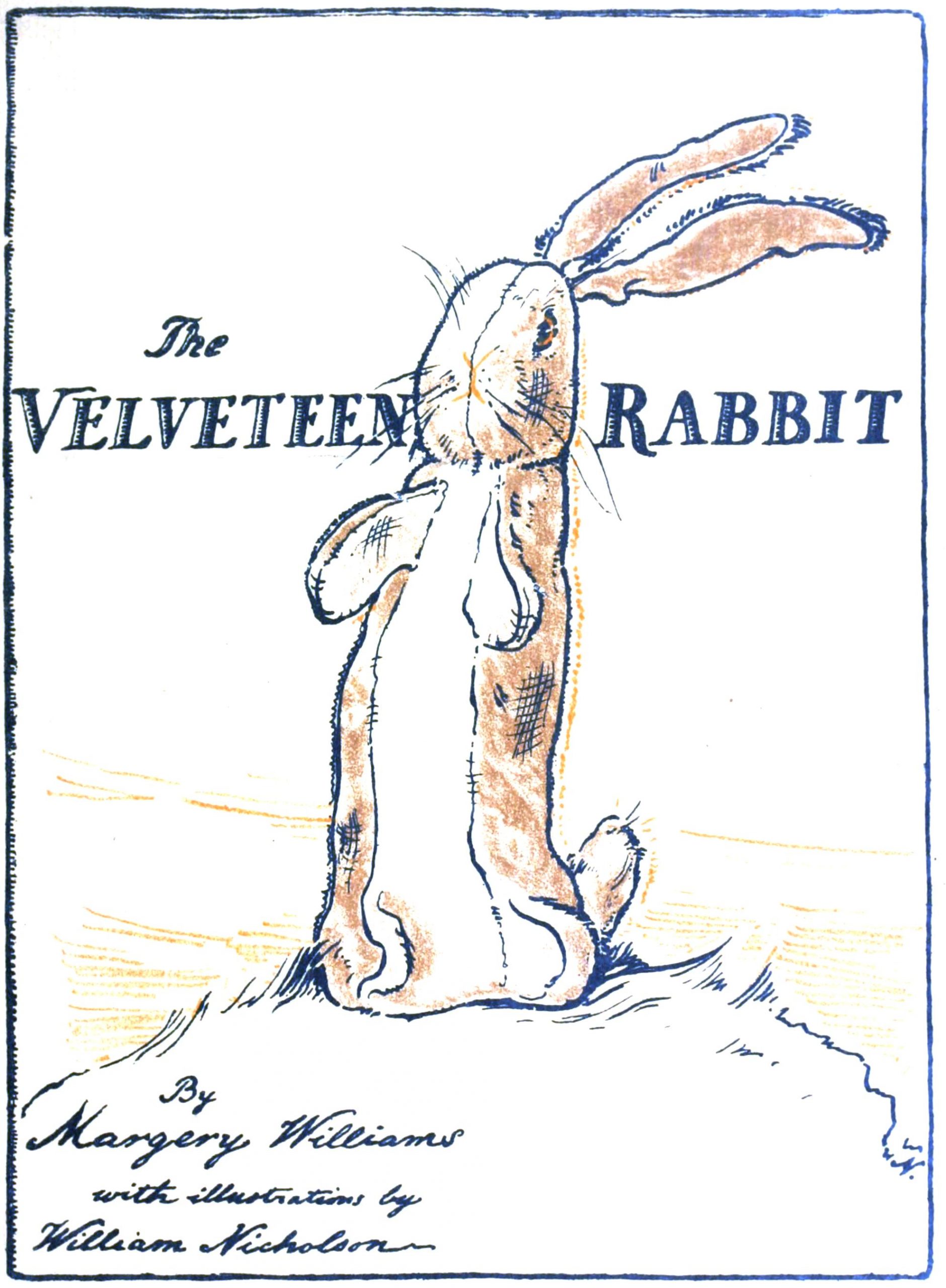
It is no arbitrary coincidence that Margery Williams’ classic The Velveteen Rabbit involves a terrifying brush with scarlet fever. Published in 1922, the book was based on her own children. But all of its first readers would have shuddered at the mention, given very recent memories of the global devastation wrought by “Spanish” flu. The story earns its fairy-tale ending by invoking catastrophe, with images of the poor rabbit nearly thrown into the fire and then tossed out with the trash.
The Velveteen Rabbit recalls Oscar Wilde’s 19th century children’s stories, in which “loss is not a pose; it is real,” writes Jeanette Winterson. All may eventually be restored, “there is usually a happy ending,” but “Wilde’s fairytale transformations turn on loss.” The author of The Velveteen Rabbit did not share Wilde’s contrarian streak, nor indulge the same sentimental fits of piety, but Williams’ intent was no less profound and serious. The specter of fever still haunts the book’s Arcadian ending.
Williams’ major influence was Walter de la Mare, whom the Poetry Foundation describes as a writer of “dreams, death, rare states of mind and emotion, fantasy worlds of childhood, and the pursuit of the transcendent”—all themes The Velveteen Rabbit engages in the narrative language of kids. Do children’s books still recognize early childhood as uniquely formative, while also regarding children as sophisticated readers who can appreciate emotional depth and psychological complexity?
Do Disney’s modern franchises take loss as seriously? What about Paw Patrol? Were Wilde and Williams’ stories unusual for their time or did they mark a trend? How do children’s books serve as codes of conduct, and what do they tell us about how we filter life’s calamities in digestible narratives for our kids? How can we use such stories to educate in the midst of overwhelming events?
For those who find these questions intriguing for purely academic reasons, or who struggle with them as both parents and newly minted homeschool teachers, we offer, below, several online libraries with thousands of scanned historical children’s books, from very early printed examples in the 18th century to examples of a much more recent vintage.
These come from publishers in England, the U.S., and the Soviet Union, and from names like Christina Rosetti, Jules Verne, Wizard of Oz author Frank L. Baum, and English artist Randolph Caldecott, whose surname has distinguished the best American picture books for 70 years. For every star of children’s writing and illustration, there are hundreds of writers and artists hardly anyone remembers, but whose work can be as playful, moving, and honest as the famous classic children’s stories we pass on to our kids.
Whether we’re parents, scholars, teachers, curious readers, or all of the above, we find that the best children’s books show us “why we need fairy tales,” as Winterson writes, at every age. “Reason and logic are tools for understanding the world. We need a means of understanding ourselves, too. That is what imagination allows.”
When I became the Kennedy Center Education Artist-in-Residence, I didn’t realize the most impactful word in that title would be “Residence.” —illustrator Mo Willems
Even as schools regroup and online instruction gathers steam, the scramble continues to keep cooped-up kids engaged and happy.
These COVID-19-prompted online drawing lessons and activities might not hold much appeal for the single-minded sports nut or the junior Feynman who scoffs at the transformative properties of art, but for the art‑y kid, or fans of certain children’s illustrators, these are an excellent diversion.
Once the design is complete, he rolls the dice to advance both his piece and that of his home viewer. A 5 lands him on the crowd-pleasing directive “fart.” Clearly the online instructor enjoys certain liberties the classroom teacher would be ill-advised to attempt.
Check out the full playlist on the Kennedy Center’s YouTube channel and download activity pages for each episode here.
#MoLunchDoodles
If the daily LUNCHDOODLES leaves ‘em wanting more, there’s just enough time for a quick pee and snack break before Lunch Lady’sJarrett J. Krosoczka takes over with Draw Everyday with JJK, a basic illustration lesson every weekday at 2pm EST. These are a bit more nitty gritty, as JJK, the kid who loved to draw and grew up to be an artist, shares practical tips on penciling, inking, and drawing faces. Pro tip: resistant Star Wars fans will likely be hooked by the first episode’s Yoda, a character Krosoczka is well versed in as the author and illustrator of the Star Wars Jedi Academy series.
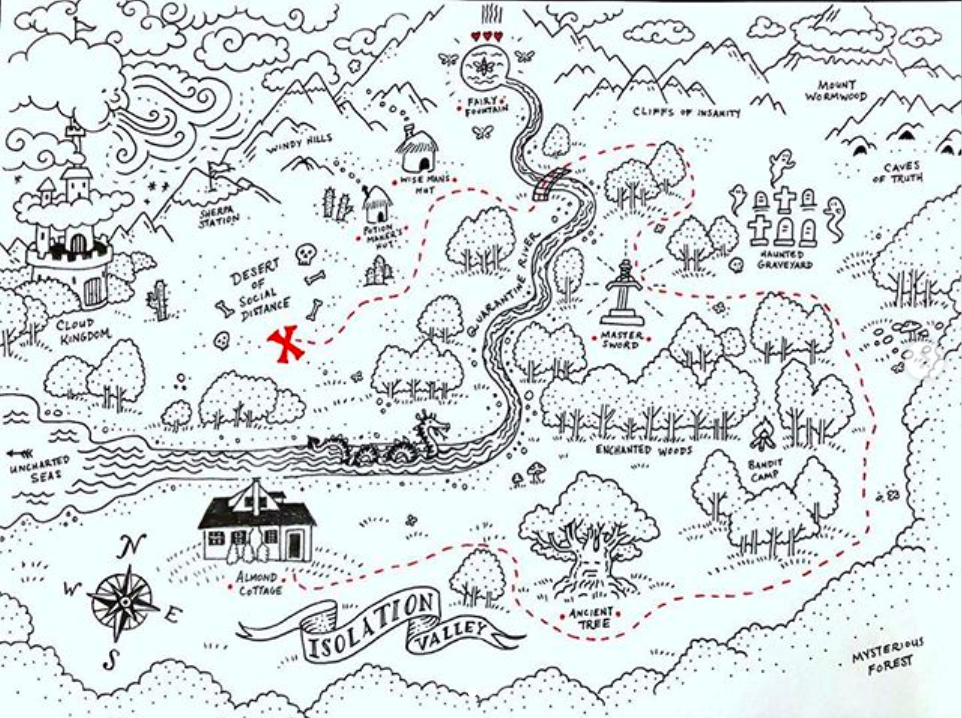
DRAW A MAP: When we think of treasure maps, we think of sea monsters, islands with palm trees, pirate ships, anthropomorphic clouds blowing gales upon white-capped seas. YOUR map can be of anywhere: an enchanted wood, a dystopian suburb, your backyard, your apartment that has never felt so small, all of the above, none of the above. Or your map can be a traditional treasure map leading to a pirate’s hoard. It’s totally up to you. Three things that you MUST include are: a compass rose (very important—look this up if you don’t know what it is), the name of the place you are mapping, and a red X.
DRAW THE TREASURE: The first part of this assignment is to draw a map with a red X to mark the location of hidden treasure. The second part of this assignment is to draw the treasure. I don’t know what the treasure is. Only you know what the treasure is. Draw it on a separate piece of paper from the map.
BONUS POINTS: If you’re going to post this on instagram, I recommend formatting it with two images. Post the map first, then the treasure which the viewer will swipe to see. This will create what we in the kids book world call AN IMPACTFUL PAGE TURN. That’s the thing that happens when you’re reading a picture book and you turn the page to discover something funny or surprising. It’s kind of hard to explain, but you know a good page turn when you’ve experienced one.
#QuarantineArtClub
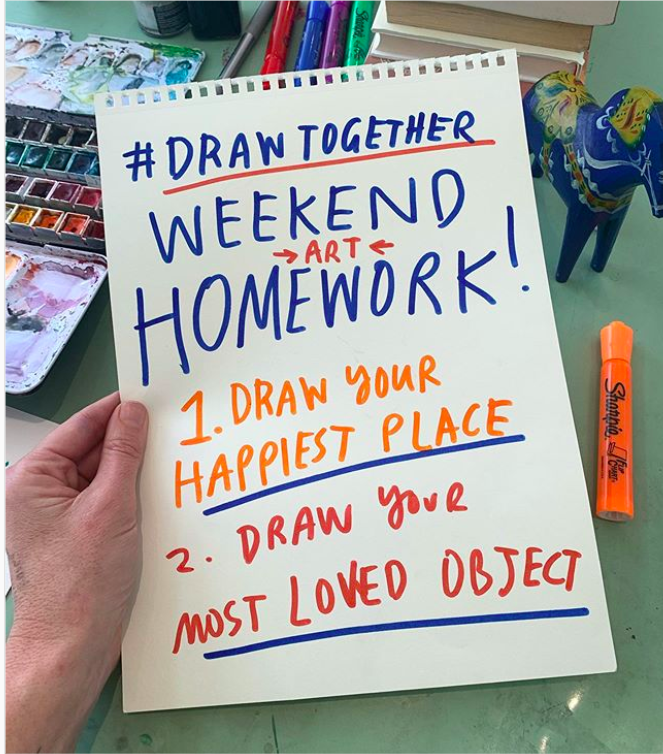
Wendy McNaughton, who specializes in drawn journalism, also likes the Instagram platform, hosting a live Draw Together session every school day, from 10–10.30 am PST. Her approach is a bit more freeform, with impromptu dance parties, special guests, and field trips to the backyard.
Her How to Watch Draw Together highlight is a hilarious crash course in Instagram Live, scrawled in magic marker by someone who’s possibly only now just getting a grip on the platform. Don’t see it? Maybe it’s the weekend, or “maybe ask a millennial for help?”
And bless E.B. Goodale, an illustrator, first time author and mother of a young son, who having counteracted the heartbreak of a cancelled book tour with a hastily launched week of daily Instagram Live Toddler Drawing Club meetings, made the decision to scale back to just Tuesdays and Thursdays:
It was fun doing it everyday but turned out to be a bit too much to handle given our family’s new schedule. We’re all figuring it out, right? I hope you will continue to join me in our unchartered territory next week as we draw to stay sane. Tune in live to make requests or watch it later and follow along at home.
(Her How to Draw a Cat tutorial, above, was likely intended for in-person bookstore events relating to her just published Under the Lilacs…)
#drawingwithtoddlers
Our personal favorite is Stickies Art School, whose online children’s classes are led not by multi-disciplinary artist Nina Katchadourian, whose Facebook page serves as the online institution’s home, but rather her senior tuxedo cat, Stickies.
Stickies, who comes to the gig with an impressive command of English, honed no doubt by frequent appearances on Katchadourian’s Instagram page, affects a diffident air to dole out assignments, the latest of which is above.
He allows his students ample time to complete their tasks—thus far all portraits of himself. The next one, to render Stickies in a costume of the artist’s choice, is due Wednesday by 9am, Berlin time.
There have been so many conversations at NYU Gallatin where I’m on the faculty about online teaching, how to do it, how to think of a studio course in this new form, etc, and I think perhaps that crossed over with the desire to cheer up some people with kids, many of whom are already Stickies fans, or so I have been told.
His child proteges are no doubt unaware that Stickies looked ready to leave the planet several weeks ago, a fact whose import will resonate with many pet owners in these dark days:
Maybe a third element was just being so glad he is still around, that having him actively “out there” feels good and life-affirming at the moment.
Stickies Art School is marvelous fun for adults to audit from afar, via Katchadourian’s public Facebook posts. If you are a parent whose child would like to participate, send her a friend request and mention that you’re doing so on behalf of your child artist.
Searching on the hashtag #artteachersofinstagram will yield many more resources.
Ayun Halliday is an author, illustrator, theater maker and Chief Primatologist of the East Village Inky zine. Given the cancellation of everything, she’s taken to Instagram to document her social distance strolls through New York City’s Central Park, using the hashtag #queenoftheapeswalk Follow her @AyunHalliday.
Dick Cavett excelled at turning the late-night talk show format into a showcase for genuinely revealing conversations (and the occasional wrestling match). Of the many riveting guests he had on throughout the 60s and 70s, some appearing multiple times, few could match Orson Welles for sheer storytelling prowess. As if in a contest to outdo himself, Welles appeared on Cavett’s show three times in 1970, and once more in 1973, as an amiable, gruff raconteur who lived a life almost impossible to believe actually happened.
Welles met everyone. He even met Hitler, he says in the clip above from a July 1970 appearance on the show, his second that year. In those early days, he says, “the Nazis were just a very comical kind of minority party of nuts that nobody took seriously at all” except Welles’ Austrian hiking instructor, who brought the legendary actor and director to a Nazi dinner with the future mass-murdering dictator. Welles was seated next to Hitler, who “made so little an impression on me that I can’t remember a second of it. He had no personality. He was invisible…. I think there was nothing there.”
By 1938, everyone knew who he was: Hitler was named “man of the year” by Time magazine, who wrote, “lesser men of the year seemed small indeed beside the Führer”—and Welles was named “Radio’s Man of the Year.” His “famous The War of the Worlds broadcast, scared fewer people than Hitler,” the editors wrote, “but more than had ever been frightened by radio before, demonstrating that radio can be a tremendous force in whipping up mass emotion.” Welles’ never met Stalin, he tells Cavett, unprompted, but knew Roosevelt “very well.”
In a later appearance on the show, in September 1970, Welles claimed Roosevelt told him no one believed the Pearl Harbor announcement because of the War of the Worlds hoax. Here, in this twelve-minute clip from July, he has many more stories to tell and excellent questions from Cavett to answer (if he went back to school, he says, and “really wanted to get good at a subject,” he would study anthropology). Towards the end, at 9:00, he talks about another world leader who did make a distinct impression on him: Winston Churchill. “He was quite another thing,” says Welles. “He had great humor and great irony.”
Welles tells a story of Churchill coming to see him play Othello in London. “I heard a murmuring in the front row. I thought he was talking to himself.” Churchill later came to visit Welles in his dressing room and began to recite all of Othello’s lines from memory, “including the cuts which I had made.” Years later, after the war, when Churchill was out of office, Welles ran into him once more in Venice, and their prior association came very much in handy in the financing of his next picture. (He doesn’t name the film, but it might have been The Stranger.)
No one experienced the 20th century quite like Orson Welles, and no one left such a creative legacy. Always entertaining, his Cavett appearances are more than opportunities for name dropping—they’re televised memoirs, in extemporaneous vignettes, from one of history’s most engaging storytellers.
Since the first stirrings of the internet, artists and curators have puzzled over what the fluidity of online space would do to the experience of viewing works of art. At a conference on the subject in 2001, Susan Hazan of the Israel Museum wondered whether there is “space for enchantment in a technological world?” She referred to Walter Benjamin’s ruminations on the “potentially liberating phenomenon” of technologically reproduced art, yet also noted that “what was forfeited in this process were the ‘aura’ and the authority of the object containing within it the values of cultural heritage and tradition.” Evaluating a number of online galleries of the time, Hazan found that “the speed with which we are able to access remote museums and pull them up side by side on the screen is alarmingly immediate.” Perhaps the “accelerated mobility” of the internet, she worried, “causes objects to become disposable and to decline in significance.”
Fifteen years after her essay, the number of museums that have made their collections available online whole, or in part, has grown exponentially and shows no signs of slowing. We may not need to fear losing museums and libraries—important spaces that Michel Foucault called “heterotopias,” where linear, mundane time is interrupted. These spaces will likely always exist.
Yet increasingly we need never visit them in person to view most of their contents. Students and academics can conduct nearly all of their research through the internet, never having to travel to the Bodleian, the Beinecke, or the British Library. And lovers of art must no longer shell out for plane tickets and hotels to see the precious contents of the Getty, the Guggenheim, or the Rijksmuseum. And who would dare do that during our current pandemic?
For all that may be lost, online galleries have long been “making works of art widely available, introducing new forms of perception in film and photography and allowing art to move from private to public, from the elite to the masses.”
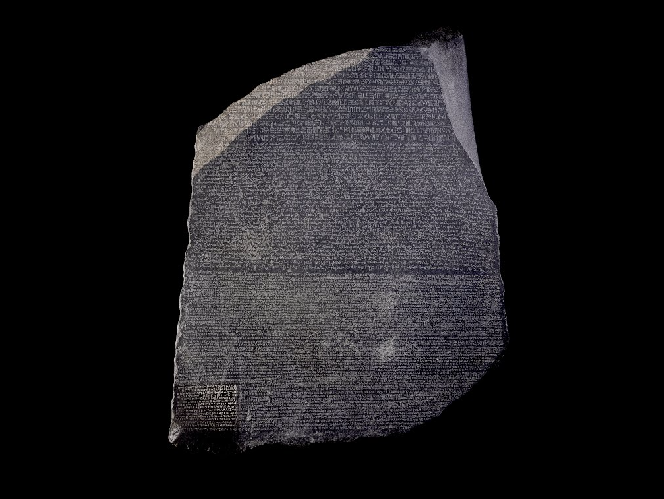
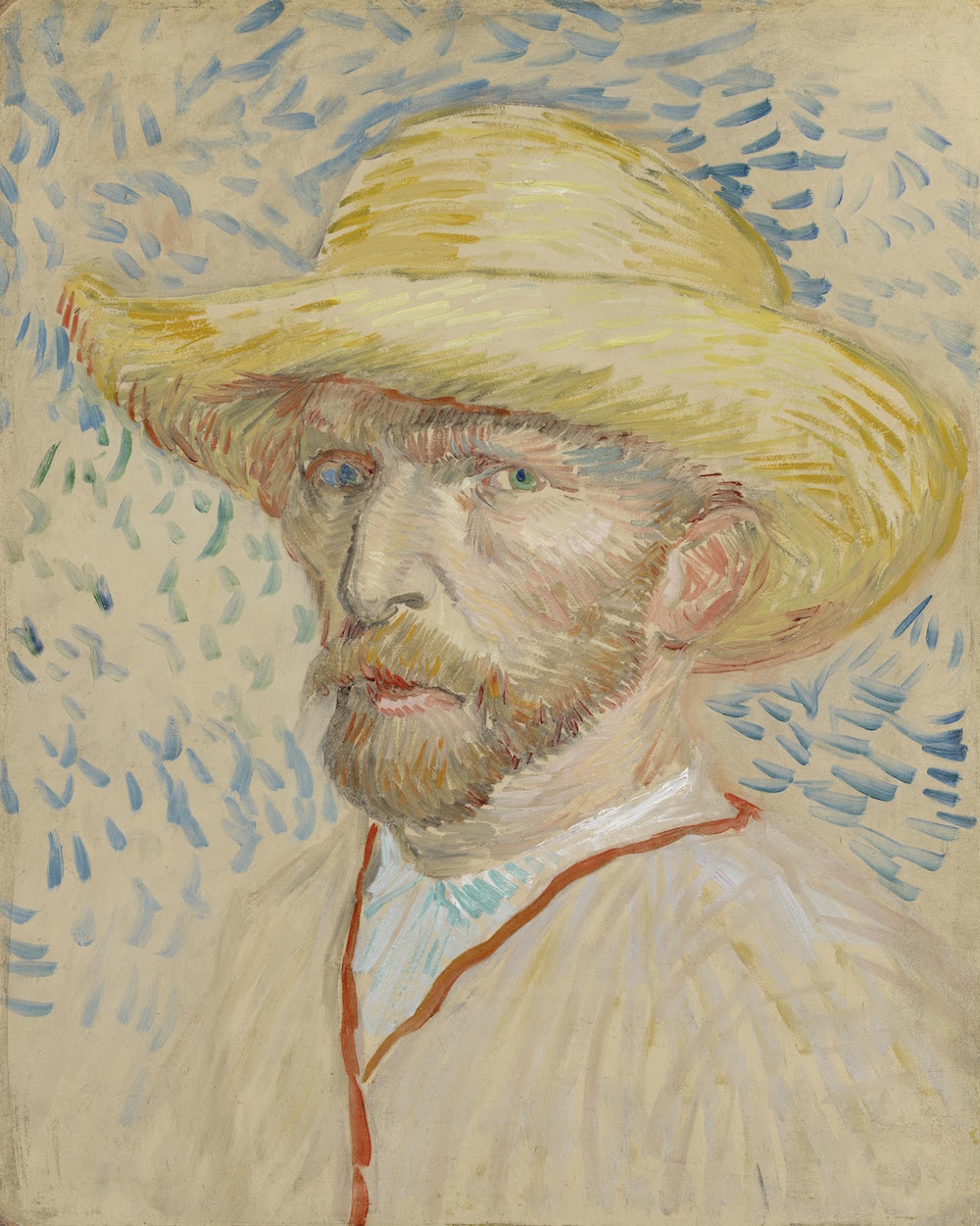
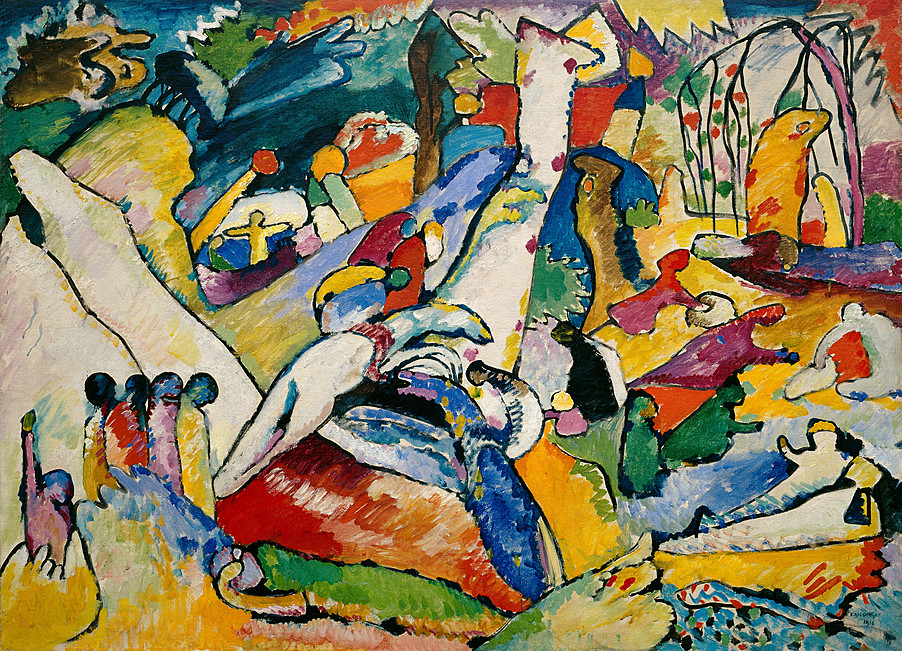
Even more so than when Hazan wrote those words, the online world offers possibilities for “the emergence of new cultural phenomena, the virtual aura.” Over the years we have featured dozens of databases, archives, and online galleries through which you might virtually experience art the world over, an experience once solely reserved for only the very wealthy. And as artists and curators adapt to a digital environment, they find new ways to make virtual galleries enchanting. The vast collections in the virtual galleries listed below await your visit, with 2,000,000+ paintings, sculptures, photographs, books, and more. See the Rosetta Stone at the British Museum (top), courtesy of the Google Cultural Institute. See Van Gogh’s many self-portraits and vivid, swirling landscapes at The Van Gogh Museum. Visit the Asian art collection at the Smithsonian’s Freer and Sackler Galleries. Or see Vassily Kandinsky’s dazzling abstract compositions at the Guggenheim.
And below the list of galleries, find links to online collections of several hundred art books to read online or download. Continue to watch this space: We’ll add to both of these lists as more and more collections come online.
We're hoping to rely on loyal readers, rather than erratic ads. Please click the Donate button and support Open Culture. You can use Paypal, Venmo, Patreon, even Crypto! We thank you!
Open Culture scours the web for the best educational media. We find the free courses and audio books you need, the language lessons & educational videos you want, and plenty of enlightenment in between.