Last Friday, Alexander Gerst, an astronaut living aboard the International Space Station, welcomed Kraftwerk and 7500 attendees to the Jazz Open Festival in Stuttgart. There, writes the European Space Agency, “Kraftwerk founding member Ralf Hütter and Alexander played a special duet version of the track Spacelab, for which Alexander had a tablet computer configured with virtual synthesizers on board.” You can watch the far-out scene play out above.
If you would like to support the mission of Open Culture, consider making a donation to our site. It’s hard to rely 100% on ads, and your contributions will help us continue providing the best free cultural and educational materials to learners everywhere. You can contribute through PayPal, Patreon, and Venmo (@openculture). Thanks!
When we imagine a symphony orchestra, even those of us otherwise unfamiliar with classical music imagine a conductor standing up front. We know the conductor leads the orchestra, but how exactly does he/she do it? “What the public needs to understand about conducting is that it’s an anticipatory art,” says conductor James Gaffigan in the short Vox explainer video above. “What we do takes place before the music happens,” all of it meant “to do justice to the composer.” He then breaks down the function of the main tools available to the conductor to do that: the right hand, which holds the baton, and the left hand, which “has a much more complicated, strange role in our physical world.”
Clearly some aspects of conducting aren’t so easily explained. Hence the beauty of conducting as an art form, which encompasses exemplars as different as Gustav Mahler, represented in his day by caricatures “making crazy gestures” and “jumping up and down on the podium,” and Mahler’s contemporary Richard Strauss, who conducted by “barely moving.”
Gaffigan also brings in the example of Leonard Bernstein, the best-known conductor of the 20th century in the West, who in recordings of his performances is “always dancing,” who “can’t help moving around the podium, and his rhythm is contagious.” (But as Open Culture readers know, Bernstein could also conduct with only his eyebrows.)
You can hear, and see, another perspective on what a conductor does in the New York Times video just above. “There’s no way to really put your finger on what makes conducting great, even what makes conducting work,” says New York Philharmonic director Alan Gilbert. Gilbert provides several examples of the techniques he uses while conducting not just to tell which musicians to start playing when, but to imbue their collective performance with just the desired textures and nuances and bring out all the layers of the music and the relationship between them. All the while, the conductor must remain in constant communication: sometimes with all the players at once, sometimes with just one section, and sometimes with just one individual.
“There are some conductors who look as if they’re incredibly well put together, and physically all in order,” Gilbert says. “That doesn’t necessarily mean that you’ll hear inspired music-making. There will be some conductors whose technique is ostensibly all over the place, not necessarily so clear, but something comes across, and it can even be extremely precise.” A conductor can have all manner of ideas about how the orchestra should play, but without the faith of the musicians, none of those ideas can take musical form. “One of the ways to make your sound better is to make it really obvious that you’re really listening, and that it really matters to you what it sounds like. That’s not actually conducting; that’s embodying or representing an aspiration.” Conductors, in other words, must be the music they wish to hear.
Based in Seoul, Colin Marshall writes and broadcasts on cities and culture. His projects include the book The Stateless City: a Walk through 21st-Century Los Angeles and the video series The City in Cinema. Follow him on Twitter at @colinmarshall or on Facebook.
Expectations ran high when it was announced last month that a lost (!) John Coltrane album, Both Directions at Once, had been discovered by the family of his ex-wife Naima, and would finally be released for fans to hear. Would it prove worthy of Sonny Rollin’s comparison to “finding a new room in the Great Pyramid”? Such discoveries can lead to dead ends and disappointments as often as to revelations. In this case, the album yields neither, which is not to say it isn’t, as Chris Morris writes at Variety, “a godsend.”
The album lives up to its title, chosen by Coltrane’s son Ravi, as a transitional document, stunning, but not particularly surprising. Hear all 7 cuts on the single-disc version of the release on this page, with typically excellent playing by Coltrane’s classic quartet (bassist Jimmy Garrison, drummer Elvin Jones, and pianist McCoy Tyner) and an early take on “one of the warhorses of the Coltrane catalog”—“Impressions”—including three additional takes on the Deluxe Version, which you can stream on Spotify here or purchase here. (Tyner sits out the take on the single disc version, turning it into a “hard-edged, percolating showcase for Coltrane in trio format.”)
Several critics have suggested that this “lost album” isn’t a proper album at all, but rather, as Ravi Coltrane put it, “a kicking-the-tires kind of session,” and perhaps that’s so. Nonetheless, it works as “a portrait of an artist and a band on the brink of a historic explosion,” Morris writes.
“The bracing, probing, self-questioning and keenly played music on this collection is the missing link between the provisional work heard on 1962’s ‘Coltrane’ and the quartet’s epochal studio albums – ‘Crescent,’ the devout ‘A Love Supreme’ and (with additional personnel) the free jazz magnum opus ‘Ascension.’”
Others echo this assessment. Drowned in Sound’s Joe Goggins calls Both Directions at Once “hard evidence that he was still looking for new sounds within old structures,” and The New Yorker’s Richard Brody describes the session as “something of a stocktaking” that balances the experiments of the band’s live sets with the reigned-in discipline of its early 60s studio work. Brody also laments that “little on the album matches the music that Coltrane was making at the time in concert.” Winston Cook-Wilson at Spin describes the music as “sometimes at war with itself…. The contrasts of their catalogue are pushed against each other, sometimes within the same song.”
All of this internal tension makes for an exciting listen, especially in its two new originals, known only as “Untitled Original 11383” and “Untitled Original 11386,” and the 11-minute “Slow Blues,” which Morris aptly describes as “a geared-down, encyclopedic workout on blues changes” that builds, after its tempo doubles, to a “full-cry conclusion.”
In all, the new lost album shows Coltrane just about to break new ground, but not quite yet, which perhaps makes it a newly essential document for the Coltrane completist. For most lovers of the great innovator, it’s just a damn fine “new” Coltrane record, both daring and accessible at once.
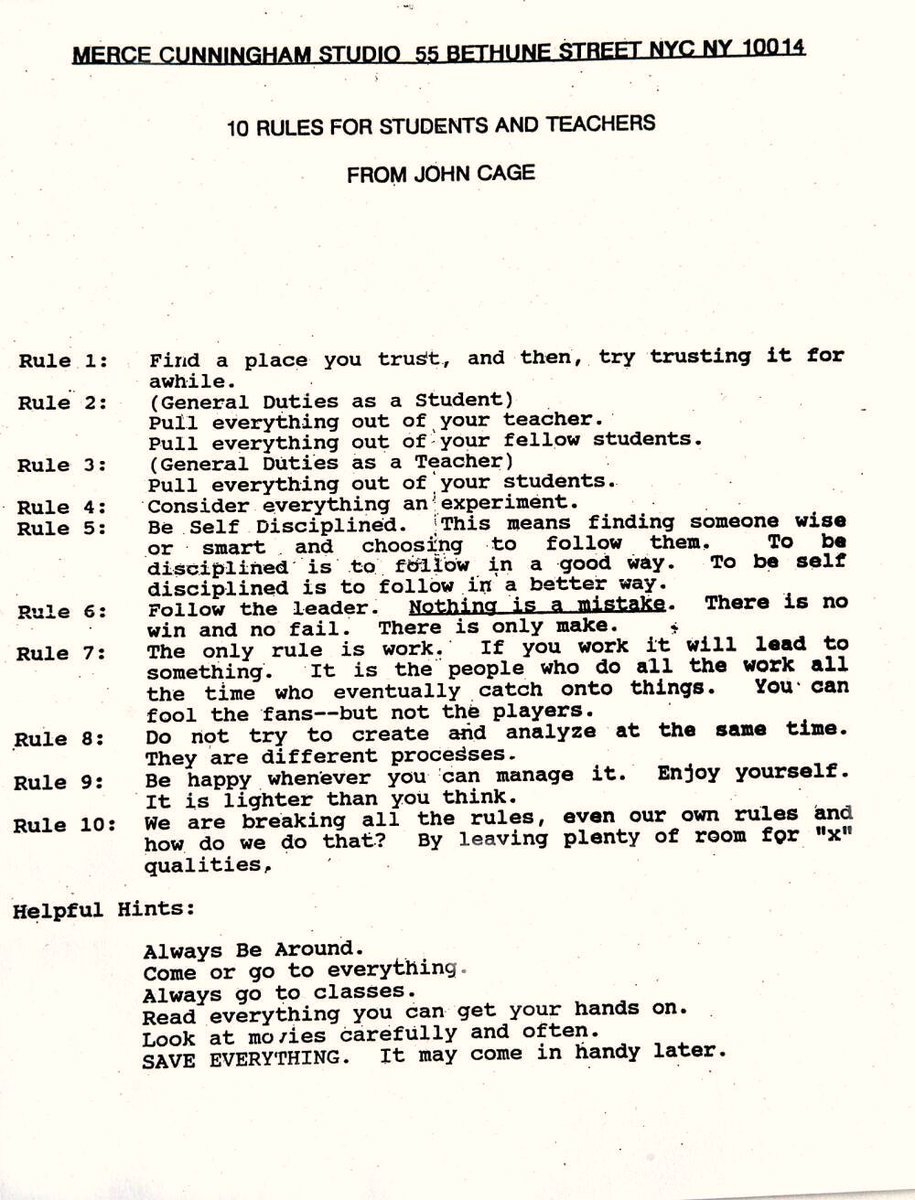
The Brian Eno archive More Dark than Shark recently posted on its Twitter account a list of twelve rules for students and teachers used by John Cage. Though much has been written about the artistic affinities between Eno and Cage, both of whose compositions have pushed the boundaries of how we think about music itself, they also both have a deep connection to the idea of using rules to enhance the experience of creation. Where Eno has his deck of creative process-enhancing Oblique Strategies cards, Cage had this list of rules first composed by an educator, silkscreen artist, and nun named Sister Corita Kent.
Kent came up with the list, writes Brainpickings’ Maria Popova, “as part of a project for a class she taught in 1967–1968. It was subsequently appropriated as the official art department rules at the college of LA’s Immaculate Heart Convent, her alma mater, but was commonly popularized by Cage, whom the tenth rule cites directly.”
That tenth rule, more of a meta-rule, reminds the reader that “we’re breaking all the rules” by “leaving plenty of room for X quantities.” But one can easily imagine how the previous nine, having as much to do with the enjoyment of the work of learning, teaching, and creating as with its rigorous performance, might appeal to Cage as well. The complete list runs as follows:
RULE ONE: Find a place you trust, and then try trusting it for a while.
RULE TWO: General duties of a student: Pull everything out of your teacher; pull everything out of your fellow students.
RULE THREE: General duties of a teacher: Pull everything out of your students.
RULE FOUR: Consider everything an experiment.
RULE FIVE: Be self-disciplined: this means finding someone wise or smart and choosing to follow them. To be disciplined is to follow in a good way. To be self-disciplined is to follow in a better way.
RULE SIX: Nothing is a mistake. There’s no win and no fail, there’s only make.
RULE SEVEN: The only rule is work. If you work it will lead to something. It’s the people who do all of the work all of the time who eventually catch on to things.
RULE EIGHT: Don’t try to create and analyze at the same time. They’re different processes.
RULE NINE: Be happy whenever you can manage it. Enjoy yourself. It’s lighter than you think.
RULE TEN: We’re breaking all the rules. Even our own rules. And how do we do that? By leaving plenty of room for X quantities.
HINTS: Always be around. Come or go to everything. Always go to classes. Read anything you can get your hands on. Look at movies carefully, often. Save everything. It might come in handy later.
Some of the rules on Kent’s list, which has now exerted its influence for half a century, sound faintly like the Oblique Strategies Eno and the painter Peter Schmidt would come up with in the 1970s. Take rule number six, “Nothing is a mistake,” which brings to mind the Oblique Strategy “Honor thy error as a hidden intention.” But we’re all on the same field when it comes to techniques to move our minds in worthwhile new directions, as Cage, Kent, Eno, Schmidt, and most other serious students, teachers, and creators might agree. They’d certainly agree that, all rules aside, everything ultimately comes down to doing the work itself, day in and day out. “Craft,” as Eno once said,” is what enables you to be successful when you’re not inspired.”
Based in Seoul, Colin Marshall writes and broadcasts on cities and culture. His projects include the book The Stateless City: a Walk through 21st-Century Los Angeles and the video series The City in Cinema. Follow him on Twitter at @colinmarshall or on Facebook.
Yes, the short video demonstrations come with supply lists and step-by-step instructions, but without an existing fine arts background, you may feel more than a little bit daunted, pining for the sort of kid-friendly modifications that help second graders mimic famous artists with such aplomb.
Rather than relegate your freshly-purchased screens, roll of acetate, and economy-sized container of photo-emulsion to the same closet where your cross country skis, foreign language cassettes, and beer-making kit are currently spending eternity, we suggest that you not buy them at all.
Instead, appreciate the way these videos bridge “the gap between Art History and Art Creation,” in the words of one viewer.
So THAT’S how Warhol and untold thousands of other artists, including this segment’s guide Marianne Keating, make their prints! A lot of equipment! A lot of precise steps. Maybe some day you’ll take a stab at it.
’Til then… Keating picked former Jamaican Prime Minister Michael Manley as her subject. Who would you choose?
Artist Sui Kim’s segment on Wassily Kandinsky’s approach to painting inspires a semi-abstract scene from her South Korean childhood, using the same color palette as Kandinsky’s Cossacks.
What would you paint?
Though before blithely slapping a second-grader rainbow on your vision and assuming you now know how to paint like Kandinsky (whether or not you know how to paint), check out the Tate’s description of the original:
Painted between 1910 and 1911, Cossacks is an expression of Kandinsky’s belief in the power of art “to awaken this capacity for experiencing the spiritual in material and in abstract phenomena.” The dynamic tension between abstract form and concrete content may be read as a manifestation of the wider conflict between the forces of political oppression – Kandinsky had been deeply moved by the strikes and upheavals in Odessa a few years earlier – and the hunger for spiritual rejuvenation consequent upon the rise of soulless modernity. Like his contemporaries Piet Mondrian and Henri Matisse, Kandinsky saw painting as an extension of religion, capable, as he wrote in his Reminiscences (1913), of revealing ‘new perspectives and true truths’ in ‘moments of sudden illumination, resembling a flash of lightning.’ The echo of the Ancient Greek writer Longinus’s notion of sublime speech, which similarly strikes like a bolt of lightning, is carried over into Kandinsky’s description of the spiritual mission of the modern artist. In his 1911 essay On the Spiritual in Art, he compares the life of the spirit to ‘a large, acute-angled triangle,’ at the apex of which stands the solitary artistic genius dispensing spiritual food to the multitudes below.
Pretty complex stuff!
Perhaps Picasso is a more straightforward proposition.
Reckon you could rope a friend into modeling for a Cubist portrait a la Bust of a Woman (1909)? If so, which friend, and what might you do for them in return?
One of the greatest tour stories of jazz takes place not in its birthplace but in Europe, where John Coltrane reluctantly joined Miles Davis for a nine-date “Jazz At The Philharmonic European Tour” in 1960. It’s not down to any shenanigans offstage, but the pure musical fire that erupted onstage. This is the sound of two geniuses pulling apart and heading in different directions. They may have returned to the States at the same terminus, but Coltrane and Davis landed on different planets afterwards.
You can hear that in the above video. Kind of Blue had been released the year before–imagine a time where that was the case!–and here the Davis quintet dive in to “So What” with a fury not heard on the record.
The concerts have been endlessly bootlegged, and rightly so. They are stunning. Several were recorded for radio broadcast, others went into the hands of collectors. Not all of the nine dates are complete, but there’s plenty of magic in those sets to satisfy the curious.
But the final meeting of Coltrane and Davis nearly didn’t happen. Months after the release of Kind of Blue, Coltrane had recorded Giant Steps and was pretty much ready to go his own way. But Davis pleaded with Coltrane–he knew the material really well, of course, having played it all that year–who eventually, reluctantly gave in. (Coltrane did suggest Wayne Shorter take his place, and Davis later brought the young sax man into the group).
Along with Davis and Coltrane, the European tour quintet featured pianist Wynton Kelly, bassist Paul Chambers, and drummer Jimmy Cobb. And according to Cobb, it was obvious Coltrane’s mind was elsewhere on the trip.
“He sat next to me on the bus, looking like he was ready to split at any time. He spent most of the time looking out the window and playing Oriental-sounding scales on soprano.”
But when he was onstage, that tension resulted in the kind of mind-melting solos that made these recordings so essential. The “sheets of sound” that one critic used to describe Coltrane’s style is all here, as are moments where Coltrane just seems to be obsessed with two or three notes, toying with them, trying to uncover their essence. (Some in the audience thought it was too indulgent–you can hear them whistling in disapproval on some of the numbers.) In some of these recordings you also hear Davis becoming the sideman in his own band as Coltrane takes off into the stratosphere. By the way, you can stream the full album on Spotify.
It’s not animosity, just the sound of two artists going their own way, and that’s rarely something that gets recorded. Fortunately, the best of five dates–two in Paris, two in Stockholm, one in Copenhagen–are now officially released, 50-some odd years later for the rest of us to enjoy.
Ted Mills is a freelance writer on the arts who currently hosts the artist interview-based FunkZone Podcast and is the producer of KCRW’s Curious Coast. You can also follow him on Twitter at @tedmills, read his other arts writing at tedmills.com and/or watch his films here.
Imagine you’re a “hypereducated avant-gardist in grad school learning to write.” But at your grad school, “all the teachers are realists. They’re not at all interested in postmodern avant-garde stuff.” They take a dim view of your writing, you assume because “they just don’t happen to like this kind of aesthetic,” but actually because your writing isn’t very good. Amid all this, with you “hating the teachers but hating them for exactly the wrong reasons,” David Lynch’s Blue Velvet comes out. Not only does it belong to “an entirely new and original kind of surrealism,” it shows you that “what the really great artists do is they’re entirely themselves. They’ve got their own vision, their own way of fracturing reality, and that if it’s authentic and true, you will feel it in your nerve endings.”
This happened to David Foster Wallace, as he says in the clip above from his 1997 appearance on Charlie Rose, one of his very few interviews on video. He went on the show, seemingly under duress, to promote his collection A Supposedly Fun Thing I’ll Never Do Again, which among its long-form essays on the cruise ship experience, the Illinois State Fair, and professional tennis contains a piece on the man who made Blue Velvet.
“Lynch has remained remarkably himself throughout his filmmaking career,” Wallace writes in the version of the article that first ran in Premiere. Whether “Lynch hasn’t compromised or sold out” or whether “he hasn’t grown all that much,” the fact remains that he has “held fast to his own intensely personal vision and approach to filmmaking, and that he’s made significant sacrifices in order to do so.”
Elsewhere in the piece, Wallace describes the adjective “Lynchian” as “referring to a particular kind of irony where the very macabre and the very mundane combine in such a way as to reveal the former’s perpetual containment within the latter.” When Rose asks Wallace about the meaning of the word, Wallace explains that “a regular domestic murder is not Lynchian. But if the police come to the scene and see the man standing over the body and the woman’s 50s bouffant is undisturbed and the man and the cops have this conversation about the fact that the man killed the woman because she persistently refused to buy, say, for instance, Jif peanut butter rather than Skippy, and how very, very important that is, and if the cops found themselves somehow agreeing that there were major differences between the brands and that a wife who didn’t recognize those differences was deficient in her wifely duties, that would be Lynchian.”
A few years ago Youtube channel Dom’s Sketch Cast turned Wallace’s vision of an ideally Lynchian scene into the animation above. Lynch’s visions exist, Wallace says to Rose, at “this weird confluence of very dark, surreal, violent stuff and absolute, almost Norman Rockwell-banal American stuff, which is terrain he’s been working for quite a while — I mean, at least since Blue Velvet.” Though Lynch may owe certain stylistic debts — “to Hitchcock, to Cassavetes, to Robert Bresson and Maya Deren and Robert Wiene” — nothing like the Lynchian existed in any tradition before he came along. Lynch has his detractors, but “if you think about the outrageous kinds of moral manipulation we suffer at the hands of most contemporary directors, it will be easier to convince you that something in Lynch’s own clinically detached filmmaking is not only refreshing but redemptive” — and, as a young David Foster Wallace found in the theater that spring of 1986, revelatory.
Based in Seoul, Colin Marshall writes and broadcasts on cities and culture. His projects include the book The Stateless City: a Walk through 21st-Century Los Angeles and the video series The City in Cinema. Follow him on Twitter at @colinmarshall or on Facebook.
In her landmark study The Body in Pain, Elaine Scarry describes “the annihilating power of pain,” which is “visible in the simple fact of experience observed by Karl Marx, ‘There is only one antidote to mental suffering, and that is physical pain.’” Marx’s comment defines a class distinction between types of pain: that of the overtaxed body of the worker and the mind of the bourgeois subject with the liberty for morbid self-reflection. His pronouncement, Scarry writes, is “only slightly distorted in Oscar Wilde’s ‘God spare me physical pain and I’ll take care of the moral pain myself,’” a somewhat glib admission of the relative privilege of mental suffering in comparison to torture.
This distinction becomes even more pronounced in later reflections, such as ultra-conservative German writer and WWI war hero Ernst Jünger’s Nietzschean 1934 essay “On Pain,” which asks, “what role does pain play in the new race we have called the worker that is now making its appearance on the historical stage?” Physical pain, writes Jünger is one of “several great and unalterable dimensions that show a man’s stature… the most difficult in a series of trials one is accustomed to call life…. Tell me your relation to pain, and I will tell you who you are!”
This idea of the sharpening effect of physical pain as an “antidote” or heroic trial distinct from mental suffering persists long into the 20th century when Freudian trauma studies, the diagnosis of PTSD in veterans, and the work of psychiatrists like Bessel Van Der Kolk begins to collapse the categories and unite the suffering of mind and body. The experiences of soldiers, prisoners, victims of abuse and assault, Holocaust survivors, enslaved people, etc. are then seen in a different light, as composed of emotional anguish as real as their physical suffering, which manifests somatically and in extreme cases even, perhaps, alters DNA.
Long before the paradigmatic shift in the recognition of trauma, Wilde, who had made light of “moral pain” in his aphorism, explored suffering in great depth in his De Profundis. Ostensibly an open letter to his lover Lord Alfred Douglass, Wilde penned the piece while imprisoned in Reading Jail from 1895–97 for “gross indecency.” While there, he endured both physical and psychological torment. As Ireland’s Raidió Teilifís Éireann writes:
Wilde was kept in total isolation, first in Pentonville and Wandsworth prisons. For the first month of his sentence, he was tethered to a treadmill six hours a day, with five minutes’ rest after every 20 minutes. At Reading Jail, to which he was moved in November 1895, he slept on a plank bed with no mattress and he was allowed only one hour’s exercise a day. He would walk in single file in the yard with other prisoners but was forbidden contact with them. Wilde slept little, was hungry all of the time, and suffered from dysentery during his incarceration.
During his two-year incarceration, his mother died. “I, once a lord of language,” he wrote, “have no words in which to express my anguish and shame.” Nonetheless, he found the words, a profusion of them, writes Max Nelson at The Paris Review, “petulant, vindictive, bathetic, indulgent, excessive, florid, massively arrogant, self-pitying, repetitive, showy, sentimental, and shrill,” searching, as he put it, to express “that mode of existence in which soul and body are one and indivisible: in which the outward is expressive of the inward: in which Form reveals.”
They were first published in 1905 in an edited version, and it is that version you can hear read—prefaced by a sung lament—above in a dolorous monotone by Patti Smith, who conveys with voice and body the tenor of Wilde’s prose. The letter, writes Wilde’s biographer Richard Ellmann, is “one of the greatest and the longest” love letters “ever written.” (See a scan of the original manuscript at the British Library site.)
The reading took place in the former chapel of Reading Jail in 2016, opened to the public for the first time “for an exhibition of art, writing and performance,” notes Artangel, sponsor of the event. We’ve previously featured a short excerpt of Smith’s reading. Above, you can see her full 3‑hour performance, complete with her own interjections and interactions with the audience. De Profundis begins with one of the most eloquent descriptions of deep depression in modern literature, an experience of paralysis that traps its sufferer in a mental prison of stuckness in time:
. . . Suffering is one very long moment. We cannot divide it by seasons. We can only record its moods, and chronicle their return. With us time itself does not progress. It revolves. It seems to circle round one centre of pain. The paralysing immobility of a life every circumstance of which is regulated after an unchangeable pattern, so that we eat and drink and lie down and pray, or kneel at least for prayer, according to the inflexible laws of an iron formula: this immobile quality, that makes each dreadful day in the very minutest detail like its brother, seems to communicate itself to those external forces the very essence of whose existence is ceaseless change. Of seed-time or harvest, of the reapers bending over the corn, or the grape gatherers threading through the vines, of the grass in the orchard made white with broken blossoms or strewn with fallen fruit: of these we know nothing and can know nothing.
For us there is only one season, the season of sorrow.
If you would like to support the mission of Open Culture, consider making a donation to our site. It’s hard to rely 100% on ads, and your contributions will help us continue providing the best free cultural and educational materials to learners everywhere. You can contribute through PayPal, Patreon, and Venmo (@openculture). Thanks!
Perhaps one of the most criminally overlooked voices from World War I, Siegfried Sassoon, was, in his time, enormously popular with the British reading public. His war poems, as Margaret B. McDowell writes in the Dictionary of Literary Biography, are “harshly realistic laments or satires” that detail the grisly horrors of trench warfare with unsparingly vivid images and commentary. In lieu of the mass medium of television, and with film still emerging from its infancy, poets like Sassoon and Wilfred Owen served an important function not only as artists but as moving, firsthand documentarians of the war’s physical and emotional ravages.
It is unfortunate that poetry no longer serves this public function. These days, video threatens to eclipse even journalistic writing as a primary means of communication, a development made especially troubling by how easily digital video can be faked or manipulated by the same technologies used to produce blockbuster Hollywood spectacles and video games. But a fascinating new use of that technology, Peter Jackson shows us above, will also soon bring the grainy, indistinct film of the past into new life, giving footage of WWI the kind of startling immediacy still conveyed by Sassoon’s poetry.
Jackson is currently at work on what he describes as “not the usual film that you would expect on the First World War,” and as part of that documentary work, he has digitally enhanced footage from the period, “incredible footage of which the faces of the men just jump out at you. It’s the faces, it’s the people that come to life in this film. It’s the human beings that were actually there, that were thrust into this extraordinary situation that defined their lives in many cases.” In addition to restoring old film, Jackson and his team have combed through about 600 hours of audio interviews with WWI veterans, in order to further communicate “the experience of what it was like to fight in this war” from the point of view of the people who fought it.
The project, commissioned by the Imperial War Museums, “will debut at the BFI London Film Festival later this year,” reports The Independent, “later airing on BBC One. A copy of the film will also be given to every secondary school in the country for the 2018 autumn term.” No word yet on where the film can be seen outside the UK, but you can check the site 1418now.org.uk for release details. In the meanwhile, consider picking up some of the work of Siegfried Sassoon, whom critic Peter Levi once described as “one of the few poets of his generation we are really unable to do without.”
Learn more about the war at the free course offerings below.
The novel medium of social media—and the novel use of Twitter as the official PR platform for public figures—allows not only for endless amounts of noise and disinformation to permeate our newsfeeds; it also allows readers the opportunity to refute statements in real time. Whether corrections register or simply get drowned in the sea of information is perhaps a question for a 21st century Marshall McLuhan to ponder.
Another prominent theorist of older forms of media, Noam Chomsky, might also have an opinion on the matter. In his 1988 book Manufacturing Consent, written with Edward Herman, Chomsky details the ways in which governments and media collude to deliberately mislead the public and socially engineer support for wars that kill millions and enrich a handful of profiteers.
Moreover, in mass media communications, those wars, invasions, “police actions,” regime changes, etc. get conveniently erased from historical memory by public intellectuals who serve the interests of state power. In one recent example on the social medium of record, Twitter, Richard N. Haas, President of the Council on Foreign Relations, expressed dismay about the disturbingly cozy state of affairs between the U.S. Administration and Putin’s Russia by claiming that “International order for 4 centuries has been based on non-interference in the international affairs of others and respect for sovereignty.”
One recent critique of foreign policy bodies like CFR would beg to differ, as would the history of hundreds of years of colonialism. In a very Chomsky-like rejoinder to Haas, journalist Nick Turse wrote, “This might be news to Iraqis and Afghans and Libyans and Yemenis and Vietnamese and Cambodians and Laotians and Koreans and Iranians and Guatemalans and Chileans and Nicaraguans and Mexicans and Cubans and Dominicans and Haitians and Filipinos and Congolese and Russians and….”
Genuine concerns about Russian election tampering notwithstanding, the list of U.S. interventions in the “affairs of others” could go on and on. Haas’ initial statement offers an almost perfect example of what Chomsky identified in another essay, “The Responsibility of Intellectuals,” as not only a “lack of concern for truth” but also “a real or feigned naiveté about American actions that reaches startling proportions.”
“It is the responsibility of intellectuals to speak the truth and to expose lies,” wrote Chomsky in his 1967 essay. “This, at least, may seem enough of a truism to pass over without comment. Not so, however. For the modern intellectual, it is not at all obvious.” Chomsky proceeds from the pro-Nazi statements of Martin Heidegger to the distortions and outright falsehoods issued routinely by such thinkers and shapers of foreign policy as Arthur Schlesinger, economist Walt Rostow, and Henry Kissinger in their defense of the disastrous Vietnam War.
The background for all of these figures’ distortions of fact, Chomsky argues, is the perpetual presumption of innocence on the part of the U.S., a feature of the doctrine of exceptionalism under which “it is an article of faith that American motives are pure, and not subject to analysis.” We have seen this article of faith invoked in hagiographies of past Administrations whose domestic and international crimes are conveniently forgotten in order to turn them into foils, stock figures for an order to which many would like to return. (As one former Presidential candidate put it, “America is great, because America is good.”)
Chomsky would include the rhetorical appeal to a nobler past in the category of “imperialist apologia”—a presumption of innocence that “becomes increasingly distasteful as the power it serves grows more dominant in world affairs, and more capable, therefore, of the unconstrained viciousness that the mass media present to us each day.”
We are hardly the first power in history to combine material interests, great technological capacity, and an utter disregard for the suffering and misery of the lower orders. The long tradition of naiveté and self-righteousness that disfigures our intellectual history, however, must serve as a warning to the third world, if such a warning is needed, as to how our protestations of sincerity and benign intent are to be interpreted.
For those who well recall the events of even fifteen years ago, when the U.S. government, with the aid of a compliant press, lied its way into the second Iraq war, condoning torture and the “extraordinary rendition” of supposed hostiles to black sites in the name of liberating the Iraqi people, Chomsky’s Vietnam-era critiques may sound just as fresh as they did in the mid-sixties. Are we already in danger of misremembering that recent history? “When we consider the responsibility of intellectuals,” Chomsky writes, the issue at hand is not solely individual morality; “our basic concern must be their role in the creation and analysis of ideology.”
What are the ideological features of U.S. self-understanding that allow it to recreate past errors again and again, then deny that history and sink again into complacency, perpetuating crimes against humanity from the Cambodian bombings and My Lai massacre, to the grotesque scenes at Abu Ghraib and the drone bombings of hospitals and weddings, to supporting mass killings in Yemen and murder of unarmed Palestinian protestors, to the kidnapping and caging of children at the Mexican border?
The current ruling party in the U.S. presents an existential threat, Chomsky recently opined, on a world historical scale, displaying “a level of criminality that is almost hard to find words to describe.” It is the responsibility of intellectuals, Chomsky argues in his essay—including journalists, academics, and policy makers and shapers—to tell the truth about events past and present, no matter how inconvenient those truths may be.
We're hoping to rely on loyal readers, rather than erratic ads. Please click the Donate button and support Open Culture. You can use Paypal, Venmo, Patreon, even Crypto! We thank you!
Open Culture scours the web for the best educational media. We find the free courses and audio books you need, the language lessons & educational videos you want, and plenty of enlightenment in between.