I’ve spent the past week on a road trip across America, and, during it, experienced perhaps my most intense case of déjà vu ever. Rolling into Memphis for the first time in my life, I walked into the lobby of the hotel at which I’d reserved a room for the night and immediately felt, in every fiber of my being, that I’d walked into that lobby before. But I then realized exactly why: it followed the same floor plan, to the last detail — the same front desk, the same business center computers, the same café with the same chalkboard asking me to “Try Our Classic Oatmeal” — of the one I’d visited the previous day in Oklahoma City.
Should we chalk this up to generic American placemaking at its most efficient, or can we find a more interesting psychological phenomenon at work? Michio Kaku, though best known for his work with physics, has some ideas of his own about what we experience when we experience déjà vu. “There is a theory,” says Kaku in the Big Think video above,“that déjà vu simply elicits fragments of memories that we have stored in our brain, memories that can be elicited by moving into an environment that resembles something that we’ve already experienced.”
But wait! “Is it ever possible on any scale,” he then tantalizingly asks, “to perhaps flip between different universes?” And does déjà vu tell us anything about our position in those universes, giving us signs of the others even as we reside in just one? Kaku quotes an analogy first made by physicist Steven Weinberg which frames the notion of a “multiverse” in terms of our vibrating atoms and the frequency of a radio’s signal: “If you’re inside your living room listening to BBC radio, that radio is tuned to one frequency. But in your living room there are all frequencies: radio Cuba, radio Moscow, the Top 40 rock stations. All these radio frequencies are vibrating inside your living room, but your radio is only tuned to one frequency.” And sometimes, for whatever reason, we hear two signals on our radio at once.
Given that, then, maybe we feel déjà vu when the atoms of which we consist “no longer vibrate in unison with these other universes,” when “we have decoupled from them, we have decohered from them.” It may relieve you to know there won’t be an exam on all this. While Kaku ultimately grants that “déjà vu is probably simply a fragment of our brain eliciting memories and fragments of previous situations,” you may get a kick out of putting his multiverse idea in context with some more traditional explanations, such as the ones written about in venues no less dependable than Scientific American and Smithsonian. But in any case, I beg you, Marriott Courtyard hotels: change up your designs once in a while.
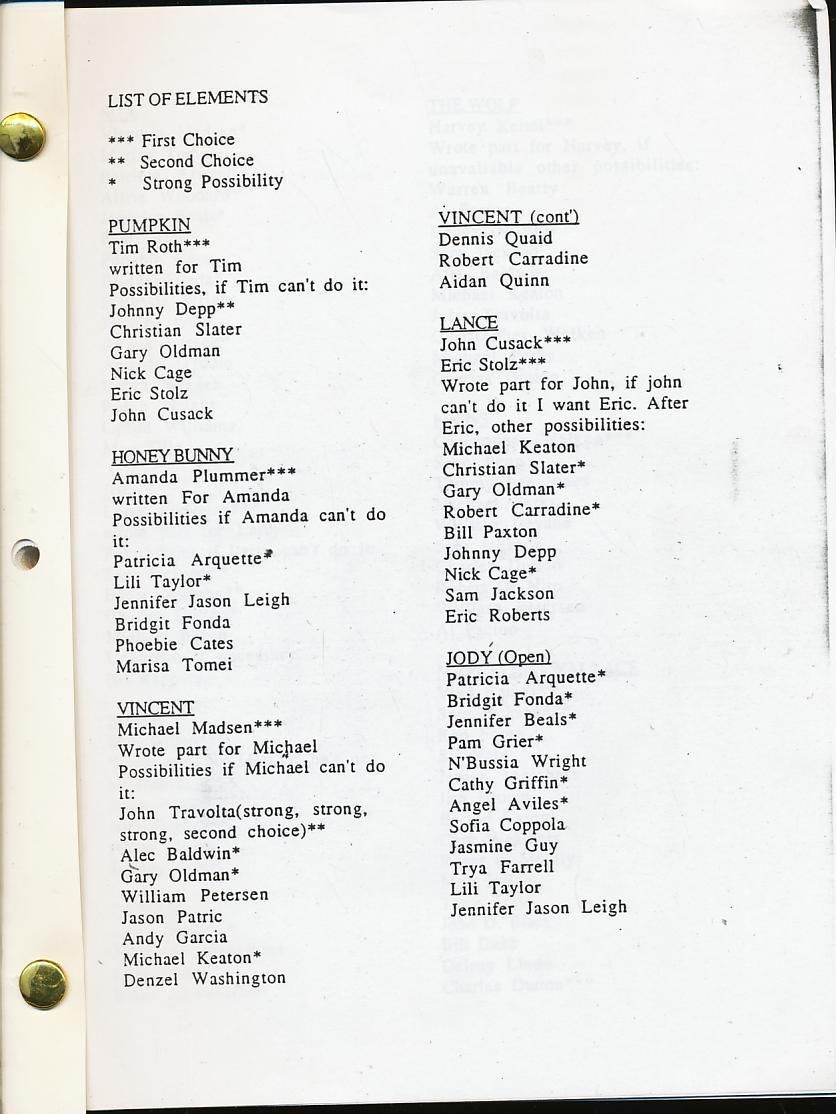
Documents about the movie recently surfaced on Reddit, offering a fascinating glimpse into the early creative discussions for the hugely influential movie. In Tarantino’s wish list, which you can see above, he states that he wrote the roles of Pumpkin and Honey Bunny, the would-be Bonnie and Clyde of the family dining restaurant circuit, with Tim Roth and Amanda Plummer in mind. They, of course, were ultimately cast but Tarantino was willing to entertain Johnny Depp and Patricia Arquette. One wonders how Depp’s otherworldly weirdness would have translated as a low level street tough. On the other hand, Tarantino’s first choice for Lance, Vincent Vega’s bathrobe-sporting drug dealer, was none other than John Cusack. That would have been amazing.
Many of the studio’s approved casting choices for the movie, seen here in a fax also appearing in the same Reddit post, are much stranger. Eddie Murphy was tapped as a possible Jules. Miramax liked Nicolas Cage or Johnny Depp (really?) for Butch, the samurai-sword wielding boxer. Bruce Willis, who played the role, wasn’t even on the original list. And mob clean-up man The Wolf, played with an off-kilter decorousness by Harvey Keitel, could have gone to Warren Beatty or Danny DeVito. Strangely, the studio didn’t think Johnny Depp would have been right for the role.
Jonathan Crow is a Los Angeles-based writer and filmmaker whose work has appeared in Yahoo!, The Hollywood Reporter, and other publications. You can follow him at @jonccrow. And check out his blog Veeptopus, featuring lots of pictures of vice presidents with octopuses on their heads. The Veeptopus store is here.
Despite its ancient origins, The Odyssey is an epic for modernity. The Greek poem gives us the hero as a homesick wanderer and uprooted seeker, an exile or a refugee, sustained by his cunning; he even comes across, writes scholar Deirdre McClosky, as “a crafty merchant type,” while also representing “three pagan virtues—temperance, justice, and prudence.” He’s a complicated hero, that is to say—most unlike Achilles, his antithesis in the prior epic The Iliad, the “foundational text,” says Simon Goldhill, “of Western culture.”
Goldhill, a Cambridge classics professor, introduces an undertaking itself admirably epic: a reading of The Iliad featuring “sixty-six artists, 18,225 lines of text” and—on the day it took place, August 14th of this year—an “audience of more than 50,000 people across the world, watching online or in person at the Almeida and the British Museum.” Now you can watch all 68 sections of the marathon event at the Almeida’s website until September 21, 2016. (Access the videos on pages One, Two, and Three.) Just above, see a short video that documents the making of this historic reading.
Goldhill goes on to say that the epic poem, “puts in place most of the great themes of Western literature, from power to adultery.” In a way, it’s fitting that it be a huge communal event: If The Odyssey is novelistic in many ways, as James Joyce’s Ulysses seems to have definitively shown, The Iliad is like a blockbuster comic book film. Achilles, writes McClosky, “is what the Vikings called a berserker”—his motive force, over and above companionship or love—is kleos: fame and glory. The one question that drives the “whole of The Iliad,” says Goldsmith, is “the question of what is worth dying for. For Achilles, the answer is simple.”
Undoubtedly we admire Achilles even as we cringe at his fury, and we celebrate all sorts of people who run headlong into what seems like certain death. But we also find figures who embody his violence and certainty disturbing, to say the least, both on and off the battlefield. Though crafty Odysseus temporarily stays Achilles’ rage, the warrior eventually kills so many Trojans that a river turns against him, and his abuse of Hector’s body makes for stomach-turning reading—or listening as the case may be. Pragmatic Odysseus may have given us the modern hero, and anti-hero, but power and glory-mad strongmen like Agamemnon and Achilles may be even more with us these days, and The Iliad is still an essential part of the architecture of Western grand narrative traditions.
After Goldhill’s introduction, see “greatest stage actor of his generation” Simon Russell Beale pick up the text, then younger actors Pippa Bennett-Warner and Mariah Gale, followed by gruff Brian Cox. (Find the readings on this page.) Few of the readers are as famous as Scottish film and stage star Cox, but nearly all are British theater-trained actors who deliver stirring, often thrilling, readings of the Robert Fagles translation. See the remaining 63 readings at the Almeida Theatre’s website here.
If you read Open Culture even casually, you know we love Alfred Hitchcock, Stanley Kubrick, and videos that make us see film in a new way. It only makes sense, then, that we’d jump right on Adrien Dezalay, Emmanuel Delabaere, and Simon Philippe’s The Red Drum Getaway, which mashes Hitchcock and Kubrick up into a four-minute shot of distilled cinematic collision. “Jimmy was having a rather beautiful day,” reads the video’s preparatory description, “until he bumped into Jack and things got weird.”
“Jimmy” refers, of course, to Jimmy Stewart as seen in the work of Alfred Hitchcock. “Jack” refers to Jack Nicholson seen in the work of Stanley Kubrick — which, of course, means Jack Nicholson of The Shining. Strange enough, you might think, that those two would ever encounter each other, but what might happen if the gang of droogs from A Clockwork Orange also turned up? Or if poor mild-mannered Jimmy found himself at the aristocratic, NSFW fetish party from Eyes Wide Shut?
When an auteur successfully taps into our subconscious minds, as Hitchcock and Kubrick so often did, we describe their work, in a complimentary sense, as “dreamlike.” But art that feels like a dream can also feed material to our nightmares, and as The Red Drum Getaway more closely intertwines these two disparate cinematic worlds as it goes, it begins to resemble the most harrowing filmic freakouts any of us have ever endured. It makes a perfect setting for Jack, who, as we know, has already gone insane due to his own alcoholism and the goading of the spirits who haunt the Overlook Hotel. And as for Jimmy, surely Vertigo put him through enough of the surreal to prepare him for the psychedelic end of 2001.
However, the Pythons are giving a few things away and one of them is the above compilation of unused animations by Gilliam from the Holy Grail. They can be found on the new Blu-Ray, but the group’s official Youtube channel is sharing them-—first with Gilliam’s commentary, then with sound effects—for free.
These animations are links between the skits that make up Holy Grail, and include dragons, giants, and a very large snail. Gilliam took a lot of the illustrations that he didn’t do himself from a book on illuminated manuscripts, and, seeing them all together in one go, one can imagine an alternative universe where the animator makes an entire movie this way. (On the commentary track, he half-jokingly describes himself as “the man who could have gone on to become a great animator but was forced into live action film.”)
As per Python, a lot of the commentary track berates the viewer for throwing money away on a redundant version of what the consumer probably owns, and how Gilliam isn’t getting paid enough to do this. (Cue some coinage sound effects and Gilliam gets back on mic.)
If this kind of archiving is going on, it would be interesting to know the status of Gilliam’s other animations for both Python and the various shows he did in the years running up to it. There are indeed some interesting early works out there that need a facelift.
As for Gilliam and the Holy Grail, he says he doesn’t watch it:
I’m glad it makes a lot of money and keeps me in the style I’ve grown accustomed to. But watch it again? Why? We’ve got lives to lead.
Ted Mills is a freelance writer on the arts who currently hosts the FunkZone Podcast. You can also follow him on Twitter at @tedmills, read his other arts writing at tedmills.com and/or watch his films here.
If you’ve ever had difficulty getting around in Yoknapatawpha—getting the lay of the land, as it were—Faulkner has stepped in again to help his readers. He drew several maps of varying levels of detail that show Yoknapatawpha, its county seat of Jefferson in the center, and various key characters’ plantations, crossroads, camps, stores, houses, etc. from the fifteen novels and story cycles set in the author’s native Mississippi.
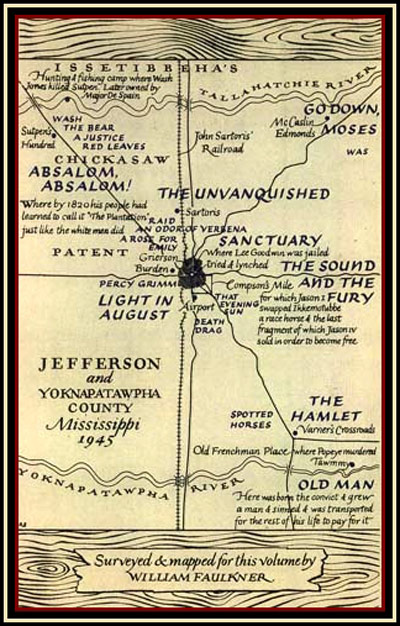
Perhaps the most reproduced of Faulkner’s maps, above, comes from 1946’s The Portable Faulkner and was drawn by the author at the request of editor Malcolm Cowley. We see named on the map the locations of settings in The Unvanquished, Sanctuary, The Sound and the Fury, The Hamlet, Go Down, Moses, Light in August, and the stories “A Rose for Emily” and “Old Man,” among others. This map, dated 1945, had an important predecessor, however: the map below, the final page in Faulkner’s epic tragedy Absalom, Absalom! Most readers of that novel, myself included, have thought of Quentin Compson’s deeply conflicted, repeated assertions that he doesn’t hate the South as the novel’s conclusion. It’s a passionate speech as memorable, and as final, as Molly Bloom’s silent “Yes” at the end of Joyce’s Ulysses. Not so, writes Faulkner scholar Robert Hamblin, the novel actually ends after Quentin, and after the appendix’s chronology and genealogy; the novel truly ends with the map.
What Hamblin wants us to acknowledge is that the map creates more ambiguity than it resolves. The map, he says “is more than a graphic representation of an actual place”—or in this case, a fictional place based on an actual place—“it is simultaneously a metaphor.” While it further attempts to situate the novel in history, giving Yoknapatawpha the tangibility of Thomas Hardy’s fictional Wessex or Sherwood Anderson’s Winesburg, Ohio, the map also elevates the county to a mythic dimension, like “Bullfinch’s maps depicting the settings of the Greek and Roman myths and the wanderings of Ulysses, Sir Thomas More’s map of Utopia, Jonathan Swift’s maps of the travels of Lemuel Gulliver.”
The Portable Faulkner map at the top of the post appears “in a style unlike Faulkner’s” and was “much reduced for publication in first and subsequent printings,” A Companion to William Faulkner tells us. The Absalom map, on the other hand, appeared in a first, limited-edition of the novel in 1936, hand-drawn and lettered in red and black ink, a color-coding feature common to “Faulkner’s many hand-made books.” Click the image, then click it again to zoom in and read the details. You’ll notice a number of odd things. For one, Faulkner gives equal attention to naming locations and describing events that occurred in other Yoknapatawpha novels, mainly murders, deaths, and various crimes and hardships. For another, his neat capital lettering reproduces the letter “N” backwards several times, but just as many times he writes it normally, occasionally doing both in the same word or name—a stylistic quirk that is not reproduced in The Portable Faulkner map.
Finally, in contrast to the map at the top, which Faulkner gives his name to as one who “surveyed & mapped” the territory,” in the Absalom map, he lists himself—beneath the town and county names, square mileage, and population count by race—as “sole owner & proprietor.” Against Alfred Korzybski’s famous dictum, Tokizane Sanae insists that at least when it comes to literary maps, “Map is Territory… proof of newly conquered ownership of a land”—the territory of a deed. Suitably, Faulkner ends a novel obsessed with ownership and property with a statement of ownership and property—over his entire fictional universe. In an ironic exaggeration of the power of surveyors, cartographers, architects, and their landowning employers, the map “spatializes and visualizes the concept of a mythical soil and the power of this God.” In that sense, it forces us to view all of the Mississippi novels not as historical fiction, but as episodes in a great religious mythology, with the same depth and resonance as ancient scripture or political allegory.
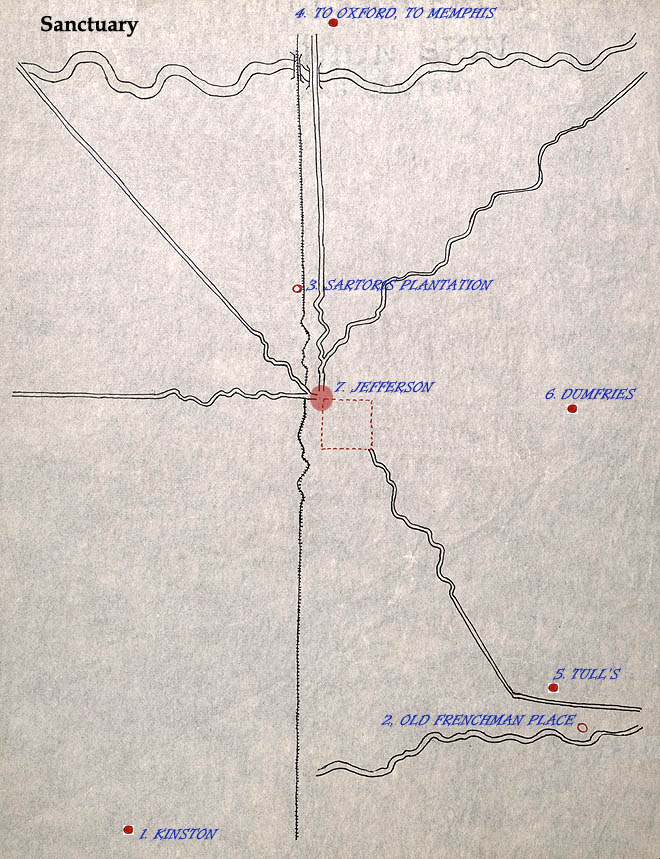
If we wish to see Faulkner’s map this way—a zoom out into an aerial shot at the end of an epic picture—then we’re unlikely to find it of much use as a guide to the plain-faced logistics of his fiction. It’s unclear to me that Faulkner intended it that way, as much as it’s unclear that Ezra Pound and T.S. Eliot’s footnotes to The Waste Land serve any purpose except to distract and confuse readers. But of course readers have been using those footnotes, and Faulkner’s map, as guidelines to their respective texts for decades anyway, noting inconsistencies and finding meaningful correspondences where they can. One interesting example of such a use of Faulkner’s mapmaking comes to us from the site of a comprehensive University of Virginia Faulkner course that covers a bulk of the Yoknapatawpha books. The project, “Mapping Faulkner,” begins with a considerably sparser Yoknapatawpha map, one probably made “late in his life” and which “seems unfinished,” lacking most of the place names and descriptions, and certainly the assertive signature. With overlaid blue lettering, the site does what the Absalom map does not—gives each novel, or 9 of them anyway, its own map, with discrete boundaries between events, characters, and time periods.
If Faulkner wanted us to see the books as manifestations of a singular consciousness, all radiating from a single source of wisdom, this project isolates each novel, and its themes. In the map of Sanctuary, above, only locations from that novel appear. On the page itself, a click on the circular markings under each locale brings up a window with annotations and page references. The apparatus might at first appear to be a useful guide through the notoriously difficult novels, provided Faulkner meant the locations to actually correspond to the text in this way. But what are we to do with this visual information? Lacking any legend, we can’t use the map to judge scale and distance. And by removing all of the other events occurring in the vicinity in the span of around a hundred years or so, the maps denude the novels of their greater context, the purpose to which their “owner & proprietor” devoted them at the end of Absalom, Absalom! Faulkner’s maps, as works of art in their own right, extend “the tragic view of life and history that the Sutpen narrative has already conveyed” in Absalom, Absalom!, writes Hamblin: “Through the handwritten entries that Faulkner made,” in that map, the most complete drawn in the author’s own hand, “the landscape of Yoknapatawpha is presented primarily as a setting for grief, villainy, and death.”
The tiny, Himalayan kingdom of Bhutan has a unique national aspiration that sets it apart from its neighbors, China and India. (And certainly the United States too.) Rather than increasing its gross national product, Bhutan has instead made it a goal to increase the Gross National Happiness of its citizens. There’s wealth in health, not just money, the Bhutanese have argued. And since the 197os, the country has taken a holistic approach to development, trying to increase the spiritual, physical, and environmental health of its people. And guess what? The strategy is paying off. A 2006 global survey conducted by Business Weekfound that Bhutan is the happiest country in Asia and the eighth-happiest country in the world.
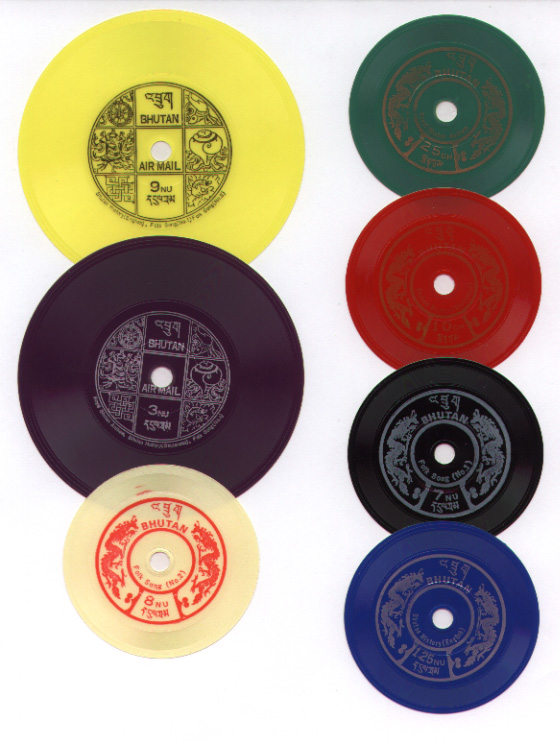
It’s perhaps only a nation devoted to happiness that could throw its support behind this — postage stamps that double as playable vinyl records. Created by an American entrepreneur Burt Todd in the early 70s, at the request of the Bhutanese royal family, the “talking stamps” shown above could be stuck on a letter and then later played on a turntable. According to Todd’s 2006 obituary in The New York Times, one stamp “played the Bhutanese national anthem,” and another delivered “a very concise history of Bhutan.” Thanks to WFMU, our favorite independent free form radio station, you can hear clips of talking stamps above and below. Don’t you feel happier already?
Follow Open Culture on Facebook and Twitter and share intelligent media with your friends. Or better yet, sign up for our daily email and get a daily dose of Open Culture in your inbox. And if you want to make sure that our posts definitely appear in your Facebook newsfeed, just follow these simple steps.
After a frustrating day spent dealing with a tenacious ghost in my two-year-old laptop, I’d much rather visit the dreary bemusement park, Dismaland, than that soulless, slick-surfaced “genius” bar. It just feels more real, somehow.
Sadly for those of us in gloomy, defeatist moods, Dismaland, the artist Banksy’s high concept, multiple acre installation, was never intended to be a permanent fixture. It went the way of Cinderella’s coach earlier this fall, but not before photographer Jamie Brightmore managed to squeeze in amongst the great throngs of British curiosity seekers, camera in hand.
The weather was dreary for his three visits, and a security guard denuded him of his tripod, but he still managed to capture the dystopian scene on behalf of armchair travelers everywhere. A catalogue of horrors awaits you above in Dismaland: The Official Unofficial Film. He also paid close attention to the sound design of the apocalyptic getaway, understanding the audio component to such grim exhibits as Relentless Paparazzi and the horrifying merry-wheel, Corporate Scandal.
Ayun Halliday is an author, illustrator, and Chief Primatologist of the East Village Inky zine. Her play, Fawnbook, opens in New York City later this fall. Follow her @AyunHalliday
Once upon a time, avant-garde composers, surrealist painters, and Gonzo journalists made guest appearances on the most mainstream American game shows. It doesn’t happen much anymore.
If you’re not familiar with the show, To Tell the Truth works like this:
The show features a panel of four celebrities whose object is the correct identification of a described contestant who has an unusual occupation or experience. This central character is accompanied by two impostors who pretend to be the central character; together, the three persons are said to belong to a “team of challengers.” The celebrity panelists question the three contestants; the impostors are allowed to lie but the central character is sworn “to tell the truth”. After questioning, the panel attempts to identify which of the three challengers is telling the truth and is thus the central character.
Given the whole premise of the show, Thompson, only 30 years old, was still an unrecognizable face on America’s cultural scene. But, with the publication of Fear and Loathing in Las Vegas just around the corner, all of that was about to change.
If you would like to support the mission of Open Culture, consider making a donation to our site. It’s hard to rely 100% on ads, and your contributions will help us continue providing the best free cultural and educational materials to learners everywhere. You can contribute through PayPal, Patreon, and Venmo (@openculture). Thanks!
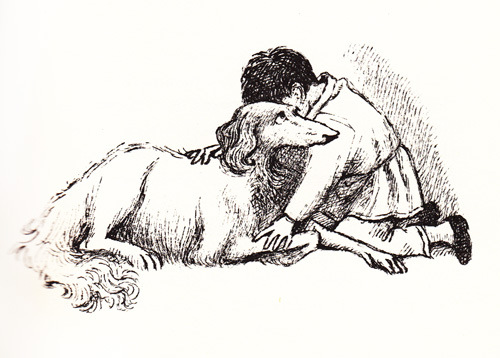
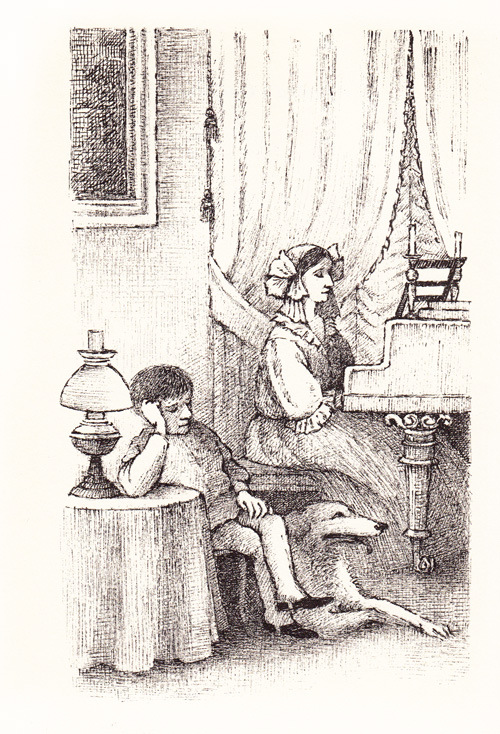
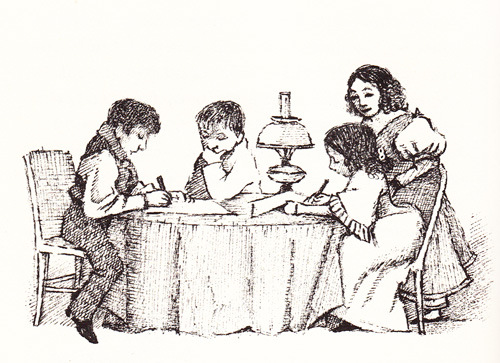
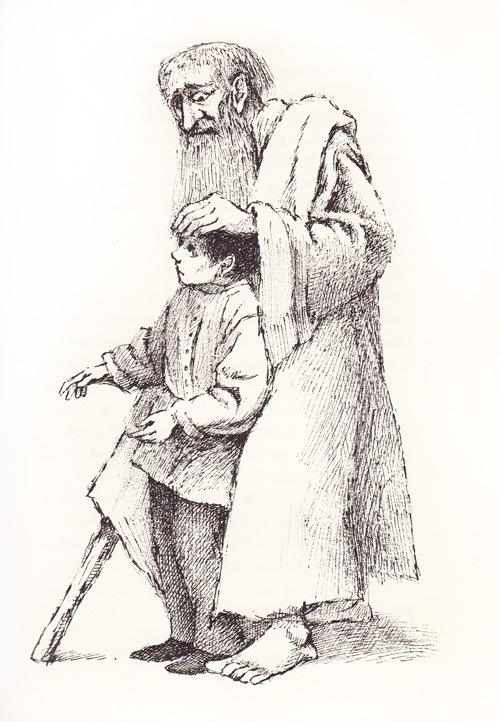
Even those of us who know nothing else of Maurice Sendak’s work know Where the Wild Things Are, almost always because we read and found ourselves captivated by it in our own childhoods — if, of course, our childhoods happened in 1963 or later. Though that year saw the publication of that best-known of Sendak’s many works as an illustrator and writer — and indeed, quite possibly the best-known children’s book of the twentieth century, illustrated or written by anyone — the world got something else intriguing from Sendak at the same time: an illustrated edition of Leo Tolstoy’s 1852 autobiographical novel Nikolenka’s Childhood.
At Brainpickings, Maria Popova writes of the struggle Sendak, then a young and insecure artist at the beginning of his career, endured to complete this lesser-known project: “His youthful insecurity, however, presents a beautiful parallel to the coming-of-age themes Tolstoy explores. The illustrations, presented here from a surviving copy of the 1963 gem, are as tender and soulful as young Sendak’s spirit.” Here we’ve selected a few of the images that Popova gathered from this out-of-print book; to see more, do have a look at her original post.
Later in life Sendak explained his anxiety about accompanying the words of the man who wrote War and Peace: “You can’t illustrate Tolstoy. You’re competing with the greatest illustrator in the world. Pictures bring him down and just limp along.” At Letters of Note, you can read the words of encouragement written to the young Sendak by his editor Ursula Nordstrom, who acknowledged that, “sure, Tolstoy and Melville have a lot of furniture in their books and they also know a lot of facts, but that isn’t the only sort of genius, you know that. Yes, Tolstoy is wonderful (his publisher asked me for a quote) but you can express as much emotion and ‘cohesion and purpose’ in some of your drawings as there is in War and Peace. I mean that.”
Last year we drew your attention to the video above from Munich-based singer Anna-Maria Hefele in which she gives us a stunning demonstration of polyphonic overtone singing. It’s a technique common to Tuva, Inuit, and Xhosa cultures but largely unfamiliar to us in Western music.
Many readers pointed out that Hefele’s fine example of her technique did not in fact show us how to do it, only that it could be done in a variety of different, all equally impressive, ways. Well, today, we bring you a series of lessons Hefele has posted as a response to her first video’s popularity. In each of these videos, she offers detailed instructions on how to harness the power of your voice to sing two notes at once.
Before beginning Hefele’s course, you may wish to get a more theoretical overview of how polyphonic singing works. For that purpose, the video above gives us a visual representation of the overtones in Hefele’s voice. As she demonstrates via spectrogram, her normal singing voice contains several tones at once already, which we typically hear as only one note. Similarly, ethnomusicologist and student of throat singing Mark van Tongeren explains at Smithsonian Folkways, “everyone continuously when you’re speaking [or singing] produces a whole spectrum of sound.” The throat singing method involves altering the voice to enhance overtones. Hefele uses some slightly different techniques to “filter,” as she puts it, specific tones in her voice.
The first introduction to the overtone filtering technique comes to us in Lesson 1 above. Hefele demonstrates how to move from tone to tone by gradually transitioning to different vowel sounds. She also teases the second and third lessons, below, which show how to amplify specific tones once you have isolated them. Hefele is a personable and engaging instructor—she would, I imagine, make an excellent language teacher as well—and her cheeky presentation takes us into the shower with her in Lesson 2, the best place, unsurprisingly, to practice your polyphonic overtone singing. And to hear how Hefele uses her vocal techniques in beautifully haunting, almost otherworldly music, make sure to watch this solo performance from 2012 or hear this Hildegard von Bingen choral composition adapted to Hefele’s polyphonic solo voice.
We're hoping to rely on loyal readers, rather than erratic ads. Please click the Donate button and support Open Culture. You can use Paypal, Venmo, Patreon, even Crypto! We thank you!
Open Culture scours the web for the best educational media. We find the free courses and audio books you need, the language lessons & educational videos you want, and plenty of enlightenment in between.