Pity the man who has everything. Satisfaction is but fleeting.
One wonders if rock god Mick Jagger might know a thing or two about the condition. He doesn’t seem to know all that much about acting, as evidenced by his turn in The Nightingale episode of Shelley Duvall’s Faerie Tale Theatre series.
No matter. His artlessness is part of the charm. As the spoiled emperor of Cathay, he makes no effort to alter his Mockney accent. He also keeps his famous strut under wraps, weighted down by his royal robes (and top knot!).
The emperor demands an audience with a nightingale, after hearing tell of its song, but the toadies who comprise his court are too rarified to locate one in the forest.
A lowly kitchen maid (Barbara Hershey, on the brink of stardom) is the only one with the know how to deliver.
But the emperor is fickle — it isn’t long before his head is turned by a jewel encrusted, mechanics facsimile…a common enough rock n’ roll pitfall.
A large part of Faerie Tale Theater’s magic was the juxtaposition of high wattage stars and extremely low production budgets. There’s an element of student film to the proceedings. The videotape on which it was shot flattens rather than flatters. This is not a criticism. It makes me awfully fond of the big shots who agreed to participate.
In addition to Jagger and Hershey, look for Angelica Huston, Edward James Olmos, and Jagger’s then girlfriend, Jerry Hall, in smaller roles. There’s also Bud Cort of Harold and Maude, flapping around the sparsely decorated forest like a visitor from an entirely different story, nay, planet.
It’s less clear how the great observer of “the Modern Age” would’ve responded to the proliferation of Mommy bloggers.
Their sheer numbers suggest that perhaps female writers do not need a “room of one’s own” (though presumably all of them would be in favor of such a development.)
Ergo, it’s possible for the general public to know of her, without knowing much of anything about her and her work. (Find her major works on our lists of Free eBooks and Free Audio Books).
The latest animated installment in The School of Life humanities series seeks to remedy that situation in ten minutes with the video above, which offers insight into her place in both the Western canon and the ever-glamorous Bloomsbury Group, and celebrates her as a keen observer of life’s daily routine. And that by-now-familiar cut-out animation style takes full advantage of the author’s best known head shots.
If you’re from a fading rock n roll generation, here’s maybe a way to make peace with today’s pop music scene. Just take Taylor Swift hits and hear them sung in the style of The Velvet Underground.
From the Future Of StoryTelling video series comes an animation featuring Margaret Atwood meditating on how technology shapes the way we tell stories. Just like the Gutenberg Press did almost 600 years ago, the recent advent of digital platforms (the internet, ebooks, etc.) has created new ways for us to tell, distribute and share stories. And Atwood hasn’t been afraid to explore it all, writing stories on Wattpad and Twitter. Atwood will appear at The Future of Storytelling Summit on October 7 and 8.
If you would like to support the mission of Open Culture, consider making a donation to our site. It’s hard to rely 100% on ads, and your contributions will help us continue providing the best free cultural and educational materials to learners everywhere. You can contribute through PayPal, Patreon, and Venmo (@openculture). Thanks!
Many of us keep a record of the movies we watch. Few of us, however, lead the free world. As the reliable sales numbers of presidential biographies (no matter how thick) attest, the actions of the President of the United States of America, no matter who that President may be and no matter what sort of actions that President takes, always draw interest. For instance, you may have seen that Paleofuture’s Matt Novak recently went through Jimmy Carter’s diaries to draw up a list of every single movie Carter watched during his Presidency.
“Part of my fascination with the movies that presidents watch is just cheap voyeurism,” Novak writes. “But the other part is an earnest belief that popular culture influences things in the real world. President Nixon was obsessed with the film Patton during the Vietnam War. President Reagan urged Congress to take computer security seriously after seeing War Games in 1983.” And you can learn what else they watched by pulling up What Nixon Saw and When He Saw It by Nixon at the Movies author Mark Feeney, and the list of films Mr. and Mrs. Reagan viewed from the Ronald Reagan Presidential Library.
Nixon watched several depictions of hard-bitten heroes (and antiheroes) toughing out their troubles: not just Patton, but Bullitt, True Grit, Ice Station Zebra, Our Man in Havana, The Treasure of the Sierra Madre, Spartacus, and Lawrence of Arabia— with the occasional Paint Your Wagon or Auntie Mame thrown in there as well. Carter hewed a bit closer to the overall American cinematic zeitgeist, watching such era-defining films as Rocky, Network, Star Wars, Airport ’77, Annie Hall, Animal House, The Last Picture Show, Apocalypse Now, Alien, and 10.
Reagan, famously a film actor himself, watched all sorts movies, though his list shows a certain preference for military-themed spectacles like Gallipoli, Inchon, Das Boot, Firefox, Red Dawn, Iron Eagle, and Top Gun, as well as sports pictures like Breaking Away, The Winning Team, and even Knute Rockne, All American, in which he himself portrayed football player George Gipp, a role that anointed him with the nickname that would stick until the end.
The Freedom of Information act assures us that we’ll have the chance to study the in-office viewing habits of many presidents to come. Novak, in fact, has already put in a request for the lists from George H.W. Bush, Bill Clinton, and George W. Bush: “They said I can expect the list in 46 months.” Well, the wheels of government do grind slowly, after all — we’ve learned that from the movies.
Below you can find a list of the first 10 films each president watched upon taking office. The difference in their cultural sensibilities immediately leaps out.
A couple years ago, we brought you a post on the history of the “Amen Break,” six seconds of sampled drums from a gospel instrumental that—since sampling began in the 80s—has became a ubiquitous rhythmic element in virtually every popular genre of rhythm-based music, from hip-hop, to drum and bass, to EDM. While the technology that enabled the “Amen Break” may be unique to the digital era, the sample’s endless iterations show us something timeless about how music evolves.
Picking up on Richard Dawkins’ 1976 coining of the term “meme,” Susan Blackmore argued in The Meme Machine that “what makes us different” from other animals “is our ability to imitate…. When you imitate ssomeone else, something is passed on. This ‘something’ can then be passed on again, and again, and so take on a life of its own.” In this theoretical schema, the meme is a fundamental unit of culture, and the “Amen Break” is indeed a perfect example of how such units guide cultural evolution. So is another very widely imitated melodic element in jazz and rock and roll. Variously transcribed as “Doo Ba Doo Pee Dwee Doo Ahh” or “Doo ba dih bee dWee doo daah” or other nonsense syllabic sequences, it is just as often referred to simply as “The Lick.”
Licks are, in general, part of the standard vocabulary of every musician. They come in all forms, writes saxophonist, composer, and music theorist Joe Santa Maria—“Cool, Skanky, Soft, Crunchy, Salty, Dirty, Screamin’, Sultry, Tasty”—and they get repeated again and again. But there is one lick in particular, as you can see and hear in the supercut above, that—like the “Amen Break”—has managed to seed itself everywhere. “The Lick,” it seems, “pervades music history.” It shows up in Stravinsky’s “Firebird,” Player’s “Baby Come Back,” Christina Aguilera’s “Get Mine, Get Yours.” Writes Santa Maria, “Everyone from Coltrane to Kenny G has put this hot lick to the test.” It even has its own Facebook page, where users submit example after example of appearances of “The Lick.”
Unlike the “Amen Break,” which can be definitively traced to a single source (the B‑side of a 1969 single called “Color Him Father”), no one seems to know where exactly “The Lick” came from. At some point, its origin ceased to matter. While certain licks are played very self-consciously, Santa Maria admits, “to wow and mystify,” or “entrance groupies like the pied piper,” the archetypal, definitively named “The Lick” seems to have worked itself so deeply into our musical unconscious that many players and composers likely have no idea they’re reproducing a musical quotation. For whatever reason, and your guess is as good as mine, “The Lick” has become a genuine musical meme, a “unit of imitation” that propagates musical culture wherever it lands.
When it comes to theories of artistic lineage, few have been as influential as Harold Bloom’s The Anxiety of Influence, in which the august literary critic argues, “Poetic Influence—when it involves two strong, authentic poets—always proceeds by a misreading of the prior poet, an act of creative correction that is actually and necessarily a misinterpretation.” This kind of misreading—what Bloom calls “misprision”—often takes place between two artists separated by vast gulfs of time and space: the influence of Dante on T.S. Eliot, for example, or of Shakespeare on Herman Melville.
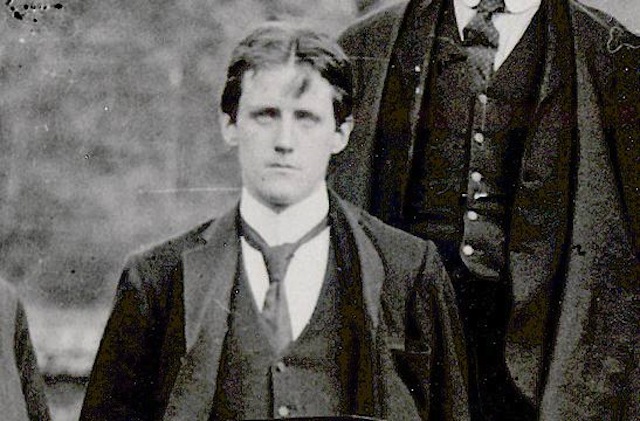
When we come to a study of James Joyce (1882–1941), however, we find the groundbreaking modernist corresponding directly with one of his foremost literary heroes, Norwegian playwright Henrik Ibsen (1828–1906), whom Maria Popova calls Joyce’s “spiritual and mental ancestor.” As Bloom points out, Joyce described Ibsen’s work as being “of universal import.” He extolled and defended Ibsen’s then-controversial work in his student days, both in a 1900 lecture he delivered at University College, Dublin, and in an essay he published that same year in the London journal Fortnightly Review. (See the young Joyce above in 1902, at 20 years of age.)
Joyce’s article, “Ibsen’s New Drama,” focused on the playwright’s latest, When We Dead Awaken, and was warmly received by Ibsen himself, who—through his English translator William Archer—described the essay as “velvillig,” or “benevolent.” Archer conveyed Ibsen’s sentiments in a letter soon after the essay’s publication, and thereafter, Joyce’s essay—writes the James Joyce Centre—was “no longer just a review but a review that Ibsen had read and praised.”
Thus began a three-year correspondence between Joyce and Archer, and a friendly relationship—at some remove—between Joyce and Ibsen. In 1901, on the playwright’s 73rd birthday, Joyce wrote a letter to Ibsen directly. He mentions the circumstances of the review and expresses much youthful admiration, self-confidence, and gratitude for Ibsen’s response. The young Joyce laments that his “immature and hasty article” came to Ibsen’s attention first, “rather than something better,” and boasts, “I have claimed for you your rightful place in the history of drama.”
Read the letter in full below, in all its exuberant egotism. According to James Joyce A to Z: The Essential Reference to the Life and Work, as he matured, the novelist “drew upon Ibsen less for creative encouragement than for psychological inspiration. In Joyce’s mind, Ibsen remained the model of the artist who defies conventional creative approaches and who remains true to the demands of an individual aesthetic.” Whether Joyce “misread” and “creatively corrected” Ibsen is a question I leave for others. You can read many more “fan letters” written by other famous authors to their literary heroes—including George R.R. Martin to Stan Lee, Charles Dickens to George Eliot, and Ray Bradbury to Robert Heinlein—at Flavorwire.
Honoured Sir,
I write to you to give you greeting on your seventy-third birthday and to join my voice to those of your well-wishers in all lands. You may remember that shortly after the publication of your latest play ‘When We Dead Awaken’, an appreciation of it appeared in one of the English reviews — The Fortnightly Review — over my name. I know that you have seen it because some short time afterwards Mr. William Archer wrote to me and told me that in a letter he had from you some days before, you had written, ‘I have read or rather spelled out a review in the Fortnightly Review by Mr. James Joyce which is very benevolent and for which I should greatly like to thank the author if only I had sufficient knowledge of the language.’ (My own knowledge of your language is not, as you see, great but I trust you will be able to decipher my meaning.) I can hardly tell you how moved I was by your message. I am a young, a very young man, and perhaps the telling of such tricks of the nerves will make you smile. But I am sure if you go back along your own life to the time when you were an undergraduate at the University as I am, and if you think what it would have meant to you to have earned a word from one who held so high a place in your esteem as you hold in mine, you will understand my feeling. One thing only I regret, namely, that an immature and hasty article should have met your eye, rather than something better and worthier of your praise. There may not have been any willful stupidity in it, but truly I can say no more. It may annoy you to have your work at the mercy of striplings but I am sure you would prefer even hotheadedness to nerveless and ‘cultured’ paradoxes.
What shall I say more? I have sounded your name defiantly through a college where it was either unknown or known faintly and darkly. I have claimed for you your rightful place in the history of the drama. I have shown what, as it seemed to me, was your highest excellence — your lofty impersonal power. Your minor claims — your satire, your technique and orchestral harmony — these, too, I advanced. Do not think me a hero-worshipper. I am not so. And when I spoke of you, in debating-societies, and so forth, I enforced attention by no futile ranting.
But we always keep the dearest things to ourselves. I did not tell them what bound me closest to you. I did not say how what I could discern dimly of your life was my pride to see, how your battles inspired me — not the obvious material battles but those that were fought and won behind your forehead — how your willful resolution to wrest the secret from life gave me heart, and how in your absolute indifference to public canons of art, friends and shibboleths you walked in the light of inward heroism. And this is what I write to you of now.
Your work on earth draws to a close and you are near the silence. It is growing dark for you. Many write of such things, but they do not know. You have only opened the way — though you have gone as far as you could upon it — to the end of ‘John Gabriel Borkman’ and its spiritual truth — for your last play stands, I take it, apart. But I am sure that higher and holier enlightenment lies — onward.
As one of the young generation for whom you have spoken I give you greeting — not humbly, because I am obscure and you in the glare, not sadly because you are an old man and I a young man, not presumptuously, nor sentimentally — but joyfully, with hope and with love, I give you greeting.
If you would like to support the mission of Open Culture, consider making a donation to our site. It’s hard to rely 100% on ads, and your contributions will help us continue providing the best free cultural and educational materials to learners everywhere. You can contribute through PayPal, Patreon, and Venmo (@openculture). Thanks!
Wylie Overstreet and Alex Gorosh set out to create something you’ve never seen before — our solar system drawn to actual scale. Forget what you’ve seen in books, or on web sites. To depict things accurately, you need a bigger surface. A really large canvas. Like a seven-mile expanse in Nevada’s Black Rock Desert (which otherwise hosts The Burning Man Festival). It’s on this dry lakebed that Overstreet and Gorosh built “the first scale model of the solar system with complete planetary orbits” and it’s a sight to behold. Creative, industrious, and humbling. Enjoy.
Everyone remembers their first kung-fu movie — or everyone remembers their first wave of kung-fu movies, anyway. For some, they came late at night on the less-explored frequencies of the television broadcasting spectrum; for others, they came on sparsely attended double- and triple-bills at the local discount theater. They looked faded and muddy, but somehow still vivid; they felt cheaply produced, yet full of life and energy; and as for how they sounded, time has turned their both hollow and theatrical English-language dubbing into an art form with connoisseurs of its own. They came from faraway lands, which rendered them exotic, but we experienced them almost as dreams, products of another reality altogether. And some of them you can experience again as public domain films.
We still call them “kung fu movies” even though, having grown older and wiser — or at least more culturally aware — we now know their heroes didn’t always defeat their enemies with the Chinese martial arts covered by that umbrella term. But the label applies well enough to 1977’s Legend of Shaolin, the Hong Kong-made epic at the top of the post set in the 13th-century Yuan Dynasty and dealing with that most kung-fu of all themes, revenge. But such historical “kung fu” pictures could also come from countries like Japan, an example of which you can thrill to just above: 1983’s Legend of the Eight Samurai features Sonny Chiba, living embodiment of the 1970s martial-arts film, under the direction of the prolific and respected provocateur Kinji Fukasaku, best known today as the maker of the controversial Battle Royale.
Next in this public-domain martial-arts marathon, we have another Hong Kong movie, Guy with the Secret Kung Fufrom 1981, whose title alone strikes me as recommendation enough. And for our final selection, we move to a more contemporary setting with 1987’s Four Robbers, wherein the titular quartet—pursued by both the police and a malevolent crime syndicate that at first wants to recruit them and later wants revenge against them—have to flee from Hong Kong to Thailand without gambling away the fruits of their labor or compromising their principles. This movie, and many others of its kind, give the lie to the notion that there’s no honor among thieves. Most all of the wanderers, samurai, rebels, aristocrats, cops, and robbers you see in them have one kind of honor or another — but when they come into conflict, it tends to take some old-fashioned kung-fu fighting to settle things. You can find these films added to our collection, 4,000+ Free Movies Online: Great Classics, Indies, Noir, Westerns, Documentaries & More, which includes more 23 Free Kung Fu and Martial Arts Movies Online.
William S. Burroughs, like Christopher Walken, has one of those voices that casts anything he reads in a new light. No matter who the author, if Burroughs reads it, the text sounds like one more missive from the Interzone. In 1995, Burroughs took on the master of the macabre, Edgar Allan Poe, reading “The Masque of the Red Death” and the poem Annabel Lee for a little known PC game called The Dark Eye.
Ignored during its release, the game has since gained cult status, and playthroughs can be found on YouTube (see below). Similar in style to Myst, players point and clicked their way through three narratives based on Poe stories, with little interaction. In the end it was more about mood and design, and the creep of Burroughs’ drawl. (He also voiced the old man character in the game.)
Accompanying Burroughs’ reading was a slideshow that popped up in the middle of the game, with art directed (and possibly drawn) by Bruce Heavin, best known these days as the co-founder of Lynda.com. Thomas Dolby composed the gloomy soundtrack. The Dark Eye was the second game from Inscape, which debuted with the equally ambitious Bad Day on the Midway, a game featuring weird music giants The Residents. Two years after The Dark Eye, the sort of CD-ROM games the company made fell behind due to advances in technology, and the fall of the house of Inscape came inevitably in 1997.
The Internet continues to excavate what’s left of these boundary pushing games, and for those who want an audio version of “Masque”, an mp3 can be enjoyed here.
Ted Mills is a freelance writer on the arts who currently hosts the FunkZone Podcast. You can also follow him on Twitter at @tedmills, read his other arts writing at tedmills.com and/or watch his films here.
We're hoping to rely on loyal readers, rather than erratic ads. Please click the Donate button and support Open Culture. You can use Paypal, Venmo, Patreon, even Crypto! We thank you!
Open Culture scours the web for the best educational media. We find the free courses and audio books you need, the language lessons & educational videos you want, and plenty of enlightenment in between.