“Three passions, simple but overwhelmingly strong, have governed my life,” wrote Bertrand Russell in the prologue to his autobiography: “the longing for love, the search for knowledge, and unbearable pity for the suffering of mankind.”
This five minute video, a preview of a three-part series produced in 2005 for Ontario public television called “The Three Passions of Bertrand Russell,” features a recording of Russell reading passages from the prologue, entitled “What I Have Lived For.” You can read the original text at the Bertrand Russell Society, an excellent online resource, that also makes available free books by Russell, including:
You can also download the first edition of Russell’s landmark 1910–13 collaboration with Alfred North Whitehead, Principia Mathematica, as well as many of Russell’s essays, including:
To explore the full list of available resources, and to learn how you can support the society’s activities, visit the Bertrand Russell Society website.
Also don’t miss some great Russell material in our own archives, including all six of his 1948 BBC Reith Lectures, a clip from a Canadian television interview featuring his views on God, and his eloquent 1959 message to the future.
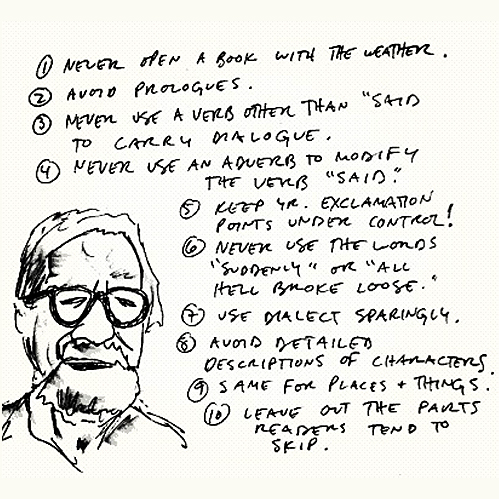
Here’s one way to become a better writer. Listen to the advice of writers who earn their daily bread with their pens. During the past week, lists of writing commandments by Henry Miller, Elmore Leonard (above) and William Safire have buzzed around Twitter. (Find our Twitter stream here.) So we decided to collect them and add tips from a few other veterans — namely, George Orwell, Margaret Atwood, and Neil Gaiman. Here we go:
1. Work on one thing at a time until finished.
2. Start no more new books, add no more new material to “Black Spring.”
3. Don’t be nervous. Work calmly, joyously, recklessly on whatever is in hand.
4. Work according to the program and not according to mood. Stop at the appointed time!
5. When you can’t create you can work.
6. Cement a little every day, rather than add new fertilizers.
7. Keep human! See people; go places, drink if you feel like it.
8. Don’t be a draught-horse! Work with pleasure only.
9. Discard the Program when you feel like it–but go back to it the next day. Concentrate. Narrow down. Exclude.
10. Forget the books you want to write. Think only of the book you are writing.
11. Write first and always. Painting, music, friends, cinema, all these come afterwards.
1. Never use a metaphor, simile, or other figure of speech which you are used to seeing in print.
2. Never use a long word where a short one will do.
3. If it is possible to cut a word out, always cut it out.
4. Never use the passive where you can use the active.
5. Never use a foreign phrase, a scientific word, or a jargon word if you can think of an everyday English equivalent.
6. Break any of these rules sooner than say anything outright barbarous.
Margaret Atwood (originally appeared in The Guardian)
1. Take a pencil to write with on aeroplanes. Pens leak. But if the pencil breaks, you can’t sharpen it on the plane, because you can’t take knives with you. Therefore: take two pencils.
2. If both pencils break, you can do a rough sharpening job with a nail file of the metal or glass type.
3. Take something to write on. Paper is good. In a pinch, pieces of wood or your arm will do.
4. If you’re using a computer, always safeguard new text with a memory stick.
5. Do back exercises. Pain is distracting.
6. Hold the reader’s attention. (This is likely to work better if you can hold your own.) But you don’t know who the reader is, so it’s like shooting fish with a slingshot in the dark. What fascinates A will bore the pants off B.
7. You most likely need a thesaurus, a rudimentary grammar book, and a grip on reality. This latter means: there’s no free lunch. Writing is work. It’s also gambling. You don’t get a pension plan. Other people can help you a bit, but essentially you’re on your own. Nobody is making you do this: you chose it, so don’t whine.
8. You can never read your own book with the innocent anticipation that comes with that first delicious page of a new book, because you wrote the thing. You’ve been backstage. You’ve seen how the rabbits were smuggled into the hat. Therefore ask a reading friend or two to look at it before you give it to anyone in the publishing business. This friend should not be someone with whom you have a romantic relationship, unless you want to break up.
9. Don’t sit down in the middle of the woods. If you’re lost in the plot or blocked, retrace your steps to where you went wrong. Then take the other road. And/or change the person. Change the tense. Change the opening page.
10. Prayer might work. Or reading something else. Or a constant visualisation of the holy grail that is the finished, published version of your resplendent book.
1. Write.
2. Put one word after another. Find the right word, put it down.
3. Finish what you’re writing. Whatever you have to do to finish it, finish it.
4. Put it aside. Read it pretending you’ve never read it before. Show it to friends whose opinion you respect and who like the kind of thing that this is.
5. Remember: when people tell you something’s wrong or doesn’t work for them, they are almost always right. When they tell you exactly what they think is wrong and how to fix it, they are almost always wrong.
6. Fix it. Remember that, sooner or later, before it ever reaches perfection, you will have to let it go and move on and start to write the next thing. Perfection is like chasing the horizon. Keep moving.
7. Laugh at your own jokes.
8. The main rule of writing is that if you do it with enough assurance and confidence, you’re allowed to do whatever you like. (That may be a rule for life as well as for writing. But it’s definitely true for writing.) So write your story as it needs to be written. Write it honestly, and tell it as best you can. I’m not sure that there are any other rules. Not ones that matter.
William Safire (the author of the New York Times Magazine column “On Language”)
1. Remember to never split an infinitive.
2. The passive voice should never be used.
3. Do not put statements in the negative form.
4. Verbs have to agree with their subjects.
5. Proofread carefully to see if you words out.
6. If you reread your work, you can find on rereading a great deal of repetition can be by rereading and editing.
7. A writer must not shift your point of view.
8. And don’t start a sentence with a conjunction. (Remember, too, a preposition is a terrible word to end a sentence with.)
9. Don’t overuse exclamation marks!!
10. Place pronouns as close as possible, especially in long sentences, as of 10 or more words, to their antecedents.
11. Writing carefully, dangling participles must be avoided.
12. If any word is improper at the end of a sentence, a linking verb is.
13. Take the bull by the hand and avoid mixing metaphors.
14. Avoid trendy locutions that sound flaky.
15. Everyone should be careful to use a singular pronoun with singular nouns in their writing.
16. Always pick on the correct idiom.
17. The adverb always follows the verb.
18. Last but not least, avoid cliches like the plague; seek viable alternatives.
In Fox’s world, nothing good is terribly safe. Even the lovable Muppets fall under withering attack.
Last month, Fox Business spent seven minutes (below) unraveling the left wing conspiracy in the latest Muppet movie. Then the Muppets, not taking things lying down, struck back. Appearing at a press conference in London last week, Kermit the Frog and Miss Piggy rebutted Fox’s charges in one comic minute. It’s a pretty funny clip. But the best part is watching a major news outlet argue with puppets.
Today is the birthday of Richard Brautigan, whose funny and imaginative books were a touchstone for the 1960s counterculture and have remained an inspiration to free spirits ever since. He would have been 77.
In this video, uploaded to the Internet exactly a year ago, Ianthe Brautigan Swensen reads her father’s story, “One Afternoon in 1939,” from his collection Revenge of the Lawn. Ianthe was one year old in 1961 when her father sat down with a portable typewriter on a family camping trip to write his most famous work, Trout Fishing in America, and she was 24 when he took his own life in 1984. Now she’s a writer and a teacher.
In 2001 Brautigan Swensen published You Can’t Catch Death: A Daughter’s Memoirabout her life with a difficult but loving father who liked to take her with him to his favorite San Francisco haunts during the 60s. “When I’m here,” she told the San Francisco Chronicle on a visit to the city in 2000, “I still feel my father walking the streets, I still feel my hand in his. And that’s a very happy feeling.”
If you would like to support the mission of Open Culture, consider making a donation to our site. It’s hard to rely 100% on ads, and your contributions will help us continue providing the best free cultural and educational materials to learners everywhere. You can contribute through PayPal, Patreon, and Venmo (@openculture). Thanks!
This past summer, Jonathan Pararajasingham, a neurosurgeon in London, created a montage of 100 renowned academics, mostly all scientists, talking about their thoughts on the existence of God. (Find it in two parts here and here.) Now’s he back with a new video, 30 Renowned Writers Speaking About God. It runs 25 minutes, and it offers as much a critique of orthodox religious belief as it does a literary tribute to humanism and rationalism. Isaac Asimov, Arthur C. Clarke, Salman Rushdie (who kindly tweeted us this weekend), Margaret Atwood, Philip Roth — they all make an appearance. The full list of writers appears below the jump.
And, before we close, let me say this. Whenever we post videos like these, we get the question. Why the occasional focus on atheism/rationalism/humanism? And the simple answer comes down to this: If you cover writers, academics and scientists, the thinking skews in that direction. Yes, there are exceptions, but they are in shorter supply. But if someone pulls them together and makes a montage, we’ll likely feature it too. H/T RichardDawkins.net
Note: As you may have noticed, we have been experiencing intermittent outages over the past couple of days. Our host, Dreamhost, has been stumbling more than we’d like. So we’re figuring out alternatives and hopefully making a move soon. Our apologies for the inconvenience!
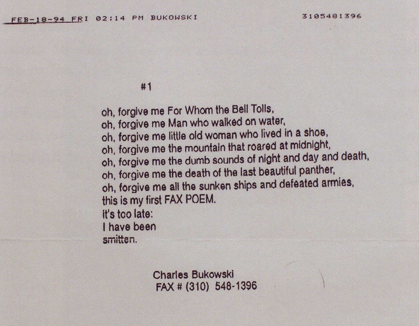
On February 18, 1994, Charles Bukowski had a fax machine installed in his home and immediately sent his first Fax poem to his publisher:
oh, forgive me For Whom the Bell Tolls,
oh, forgive me Man who walked on water,
oh, forgive me little old woman who lived in a shoe,
oh, forgive me the mountain that roared at midnight,
oh, forgive me the dumb sounds of night and day and death,
oh, forgive me the death of the last beautiful panther,
oh, forgive me all the sunken ships and defeated armies,
this is my first FAX POEM.
It’s too late:
I have been
smitten.
Alas this was also Bukowski’s last poem. Just 18 days after Bukowski embraced technology, the poet (once famously called the “laureate of American lowlife” by Pico Iyer) died of leukemia in California. He was 73 years old. According to John Martin at Black Sparrow Press, the Fax poem has never been published or collected in a book. Booktryst has a whole lot more on the story, and we have the singer/songwriter Tom Waits reading Charles Bukowski’s poem, The Laughing Heart. You can also listen to three other Bukowski poems (in audio) here on YouTube:
Here Comes the Sun — it’s one of George Harrison’s contributions to Abbey Road (1969). And, among the many great Beatles’ songs, it’s my sentimental favorite. While we’re feeling sentimental, let me bring you this — Dhani Harrison, the son of the late guitarist, returns to the recording studio (presumably at Abbey Road) with George Martin, the Beatles’ legendary producer, and Martin’s son Giles. Together, they play with the mix of “Here Comes the Sun,” and then the wondrous little moment of discovery happens. They stumble upon the long lost guitar solo that never made the final cut. It’s a pleasure to see.
If you would like to support the mission of Open Culture, consider making a donation to our site. It’s hard to rely 100% on ads, and your contributions will help us continue providing the best free cultural and educational materials to learners everywhere. You can contribute through PayPal, Patreon, and Venmo (@openculture). Thanks!
“We were wanderers on a prehistoric earth,” says the narrator Marlow in Joseph Conrad’s Heart of Darkness, “on an earth that wore the aspect of an unknown planet. We could have fancied ourselves the first of men taking possession of an accursed inheritance, to be subdued at the cost of profound anguish and of excessive toil.”
The palpable menace that permeates Conrad’s classic novella has been edited out of the narration in this short film, made for Tourism Malaysia by British filmmaker James W. Griffiths. What remains is a poetic sense of wonder for a natural world that is no longer frightening, no longer in need of being subdued. In the original, the twisting and turning sentences are like a microcosm of a journey up the winding Congo River, into the metaphorical darkness that lies at the heart of all men. Out of the stillness of the page, Conrad’s imagination washes over us in a rolling wave of words:
The great wall of vegetation, an exuberant and entangled mass of trunks, branches, leaves, boughs, festoons, motionless in the moonlight, was like a rioting invasion of soundless life, a rolling wave of plants, piled up, crested, ready to topple over the creek, to sweep every little man of us out of his little existence. And it moved not.
Griffiths can perhaps be forgiven for defanging Conrad. We Were Wanderers on a Prehistoric Earth is a beautiful little film, a quiet meditation on the unspoiled rainforest of West Malaysia shot in November by cinematographer Christopher Moon, who also collaborated with Griffiths on last year’s award-winning Nokia cellphone film Splitscreen. The music is by Lennert Busch, the sound design is by Mauricio d’Orey, and Conrad’s words are spoken by Terry Burns.
The Fantastic Flying Books of Mr. Morris Lessmore offers a modern tribute to an old world. Made with an animation style that blends stop motion with computer animation and traditional hand-drawing, the silent film pays homage to a bygone era when elegantly printed books inhabited our world. The 15-minute short is the first made by Moonbot Studios, a fledgling animation shop in Shreveport, Louisiana. For their efforts, Moonbot’s founders (William Joyce, Brandon Oldenburg and Lampton Enochs) received an Oscar-nomination this week (Best Animated Short), putting them in competition with two other films featured on Open Culture: Sunday and Wild Life.
We recommend watching The Fantastic Flying Books of Mr. Morris Lessmore in “Couch mode” on Vimeo, or downloading it for free in HD from iTunes. iPad owners will also want to consider buying the related app ($4.99) that turns the film into an interactive narrative experience.
BrainPickings recently highlighted the first kiss in cinema history. That takes you back to 1896, to a film brought to you by Thomas Edison. Now we rewind the videotape and present the first same-sex kiss in film history (or at least one of the earliest known ones). This Brokeback-before-Brokeback moment took place in the 1927 film Wings — the first and only silent film to win the Academy Award for Best Picture. Buddy Rogers and Richard Arlen star in the film, playing two combat pilots who vie for the affection of the same woman (Clara Bow). That’s the storyline. But neither, as writer Kevin Sessums writes, “shows as much love for her … as they do for each other.”
Follow Open Culture on Facebook and Twitter and share intelligent media with your friends. Or better yet, sign up for our daily email and get a daily dose of Open Culture in your inbox. And if you want to make sure that our posts definitely appear in your Facebook newsfeed, just follow these simple steps.
Along the Costa Brava in northern Spain, in the little seaside village of Portlligat, sits the house that became Salvador Dalí’s main residence in 1930. It started off as a small fisherman’s hut. Then Dalí went to work on the structure, renovating it little by little over the next 40 years, creating a living, breathing, labyrinthine home that reflects the artist’s one-of-a-kind aesthetic. Writing about the house, the author Joseph Pla once said:
The decoration of the house is surprising, extraordinary. Perhaps the most exact adjective would be: never-before-seen. I do not believe that there is anything like it, in this country or in any other.… Dalí’s house is completely unexpected.… It contains nothing more than memories, obsessions. The fixed ideas of its owners. There is nothing traditional, nor inherited, nor repeated, nor copied here. All is indecipherable personal mythology.… There are art works (by the painter), Russian things (of Mrs. Gala), stuffed animals, staircases of geological walls going up and down, books (strange for such people), the commonplace and the refined, etc.
For many, it’s a long trip to Portlligat, and only eight people can visit the house at a time. So today we’re featuring a video tour of Dalí’s Spanish home. The interior shots begin around the 1:30 mark. If you love taxidermy, you won’t be wasting your time.
If you would like to support the mission of Open Culture, consider making a donation to our site. It’s hard to rely 100% on ads, and your contributions will help us continue providing the best free cultural and educational materials to learners everywhere. You can contribute through PayPal, Patreon, and Venmo (@openculture). Thanks!
We're hoping to rely on loyal readers, rather than erratic ads. Please click the Donate button and support Open Culture. You can use Paypal, Venmo, Patreon, even Crypto! We thank you!
Open Culture scours the web for the best educational media. We find the free courses and audio books you need, the language lessons & educational videos you want, and plenty of enlightenment in between.