I want their minds to be blown the way mine was at 15, when I picked up Slapstick, his 8th novel, for reasons I no longer remember. It wasn’t on recommendation of some beloved teacher, nor was there any Vonnegut on our home shelves, despite the fact that he was a local author. Whatever drew me to that book, thank god it did. It was the beginning of a lifelong romance.
What grabbed me so? His genius idea for bestowing an artificial extended family on every citizen, via the assignment of middle names:
I told him, ‘your new middle name would consist of a noun, the name of a flower or fruit or nut or vegetable or legume, or a bird or a reptile or a fish, or a mollusk, or a gem or a mineral or a chemical element — connected by a hyphen to a number between one and twenty.’ I asked him what his name was at the present time.
‘Elmer Glenville Grasso,’ he said.
‘Well,’ I said, ‘you might become Elmer Uranium‑3 Grasso, say. Everybody with Uranium as a part of their middle name would be your cousin.’
This held enormous appeal for me as the only child of an only child. Lonesome No More!
It also contained the most wonderful profanity I had ever heard:
You ask him his middle name, and when he tells you “Oyster-19” or “Chickadee‑1” or “Hollyhock-13” you say to him: Buster — I happen to be a Uranium‑3. You have one hundred and ninety thousand cousins and ten thousand brothers and sisters. You’re not exactly alone in this world. I have relatives of my own to look after. So why don’t you take a flying fuck at a rolling doughnut? Why don’t you take a flying fuck at the moooooooooooon?
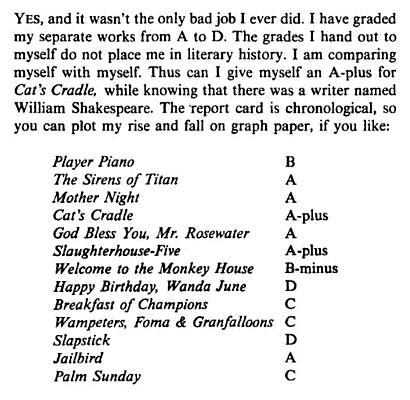
Imagine my dismay when just two books later, Vonnegut gave Slapstick the lowest possible mark in a literary self evaluation published in Palm Sunday, below.
He wasn’t describing the difference between a B and a B+. In Vonnegut’s mind, Slapstick was a D. In other words, a minimally acceptable, deeply below average performance.
He later reflected to journalist Charlie Rose that he’d been overly hard on the title. But the critics had trashed it when it first appeared, and presumably critics knew best. So much for Vonnegut the rebel and class clown. This was a clear case of give the teacher the answer you think she wants.
I give it an A+, and so would you, if you’d discovered it when I did.
How about you? Any marks you’d change on Vonnegut’s report card?
Earlier this week, we featured pioneering German animator Lotte Reiniger’s animated silhouette films, for which she adapted old European stories like “Cinderella,” “Thumbelina,” and “Hansel and Gretel” into a striking visual style — striking now, and even more striking in the 1920s — similar to traditional Indonesian shadow puppet theater. Her work draws plenty of material from folktales, but not just those from in and around her homeland (Germany). For her most ambitious work, for instance, Reiniger looked all the way to Arabia, adapting stories from no less venerable a source than One Thousand and One Nights. The 65-minute result, 1926’s The Adventures of Prince Achmed, stands as the earliest animated feature film. (See a nice clip above. The complete film lives on DVD/Blu Ray.)
“For centuries Prince Achmed on his magic horse had lived a comfortable life as a well-loved fairy tale figure of the Arabian nights and was well contented with that,” Reiniger writes in her introduction to the picture. “But one day he was thrown out of his peaceful existence by a film company which wanted to employ him and many other characters of the same stories for an animated film.” And so, in 1923, it fell to her and a select group of collaborators to make that film. They labored for the better part of three years, not just because of the requirements of shooting each and every frame by hand but because of the experimental nature of animation itself. “We had to experiment and try out all sorts of inventions to make the story come alive. The more the shooting of Prince Achmed advanced the more ambitious he became.”
At that time, The Adventures of Prince Achmed did not, of course, even faintly resemble any feature yet made. “No theatre dared show it,” Reiniger writes, “for ‘it was not done.’ ” And so they did it themselves, screening the film just outside Berlin, which led to a show in Paris, then one in Berlin proper, by which point Prince Achmed and his magic horse were well on their way to a place in the animation history books. They nearly lost that place due to the 1945 battle of Berlin, when the film’s negative was lost amid the destruction, but the British Film Institute had made a negative of their own for a London screening, which eventually became the material for a restoration and revival. “The revival was done by the son of the banker who sponsored the film in 1923,” notes Reiniger. “He had assisted in its creation as a small boy. So it was granted to old Prince Achmed to have a happy resurrection after almost half a century” — and he continues to win new fans today.
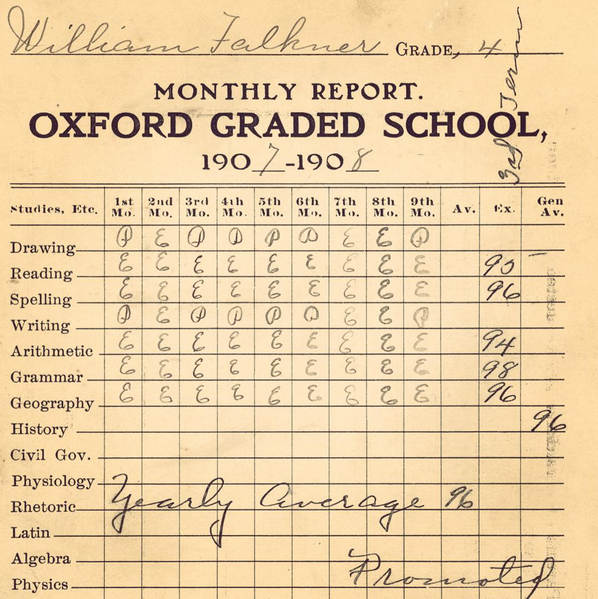
William Faulkner attended the University of Mississippi and lasted only three semesters. He skipped classes, managed to pull a D in English, and then dropped out in 1920.
A far cry from his academic performance in 1907–1908 when, as a fourth grader, he got mostly E’s (presumably meaning “Excellent”), a yearly average of 96, and a high grade of 98 in Grammar.
The problem of violence, perhaps the true root of all social ills, seems irresolvable. Yet, as most thoughtful people have realized after the wars of the twentieth century, the dangers human aggression pose have only increased exponentially along with globalization and technological development. And as Albert Einstein recognized after the nuclear attacks on Hiroshima and Nagasaki—which he partly helped to engineer with the Manhattan Project—the aggressive potential of nations in war had reached mass suicidal levels.
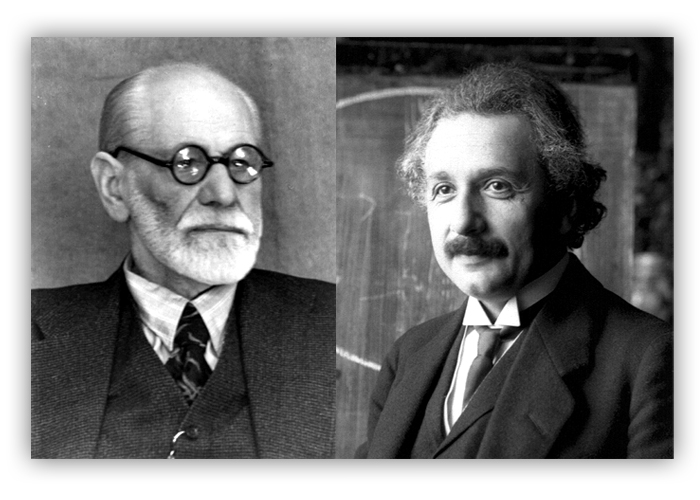
After Einstein’s involvement in the creation of the atomic bomb, he spent his life “working for disarmament and global government,” writes psychologist Mark Leith, “anguished by his impossible, Faustian decision.” Yet, as we discover in letters Einstein wrote to Sigmund Freud in 1932, he had been advocating for a global solution to war long before the start of World War II. Einstein and Freud’s correspondence took place under the auspices of the League of Nation’s newly-formed International Institute of Intellectual Cooperation, created to foster discussion between prominent public thinkers. Einstein enthusiastically chose Freud as his interlocutor.
In his first letter to the psychologist, he writes, “This is the problem: Is there any way of delivering mankind from the menace of war?” Well before the atomic age, Einstein alleges the urgency of the question is a matter of “common knowledge”—that “with the advance of modern science, this issue has come to mean a matter of life and death for Civilization as we know it.”
Einstein reveals himself as a sort of Platonist in politics, endorsing The Republic’s vision of rule by elite philosopher-kings. But unlike Socrates in that work, the physicist proposes not city-states, but an entire world government of intellectual elites, who hold sway over both religious leaders and the League of Nations. The consequence of such a polity, he writes, would be world peace—the price, likely, far too high for any world leader to pay:
The quest of international security involves the unconditional surrender by every nation, in a certain measure, of its liberty of action—its sovereignty that is to say—and it is clear beyond all doubt that no other road can lead to such security.
Einstein expresses his proposal in some sinister-sounding terms, asking how it might be possible for a “small clique to bend the will of the majority.” His final question to Freud: “Is it possible to control man’s mental evolution so as to make him proof against the psychosis of hate and destructiveness?”
Freud’s response to Einstein, dated September, 1932, sets up a fascinating dialectic between the physicist’s perhaps dangerously naïve optimism and the psychologist’s unsentimental appraisal of the human situation. Freud’s mode of analysis tends toward what we would now call evolutionary psychology, or what he calls a “’mythology’ of the instincts.” He gives a mostly speculative account of the prehistory of human conflict, in which “a path was traced that led away from violence to law”—itself maintained by organized violence.
Freud makes explicit reference to ancient sources, writing of the “Panhellenic conception, the Greeks’ awareness of superiority over their barbarian neighbors.” This kind of proto-nationalism “was strong enough to humanize the methods of warfare.” Like the Hellenistic model, Freud proposes for individuals a course of humanization through education and what he calls “identification” with “whatever leads men to share important interests,” thus creating a “community of feeling.” These means, he grants, may lead to peace. “From our ‘mythology’ of the instincts,” he writes, “we may easily deduce a formula for an indirect method of eliminating war.”
And yet, Freud concludes with ambivalence and a great deal of skepticism about the elimination of violent instincts and war. He contrasts ancient Greek politics with “the Bolshevist conceptions” that propose a future end of war and which are likely “under present conditions, doomed to fail.” Referring to his theory of the competing binary instincts he calls Eros and Thanatos—roughly love (or lust) and death drives—Freud arrives at what he calls a plausible “mythology” of human existence:
The upshot of these observations, as bearing on the subject in hand, is that there is no likelihood of our being able to suppress humanity’s aggressive tendencies. In some happy corners of the earth, they say, where nature brings forth abundantly whatever man desires, there flourish races whose lives go gently by; unknowing of aggression or constraint. This I can hardly credit; I would like further details about these happy folk.
Nonetheless, he says wearily and with more than a hint of resignation, “perhaps our hope” that war will end in the near future, “is not chimerical.” Freud’s letter offers no easy answers, and shies away from the kinds of idealistic political certainties of Einstein. For this, the physicist expressed gratitude, calling Freud’s lengthy response “a truly classic reply…. We cannot know what may grow from such seed.”
This exchange of letters, contends Humboldt State University philosophy professor John Powell, “has never been given the attention it deserves.… By the time the exchange between Einstein and Freud was published in 1933 under the title Why War?, Hitler, who was to drive both men into exile, was already in power, and the letters never achieved the wide circulation intended for them.” Their correspondence is now no less relevant, and the questions they address no less urgent and vexing. You can read the complete exchange at professor Powell’s site here.
People come to know the world the way they come to map it—through their perceptions of how its elements are connected and of how they should move among them. This is precisely what the series is attempting by situating the map at the heart of cultural life and revealing its relationship to society, science, and religion…. It is trying to define a new set of relationships between maps and the physical world that involve more than geometric correspondence. It is in essence a new map of human attempts to chart the world.
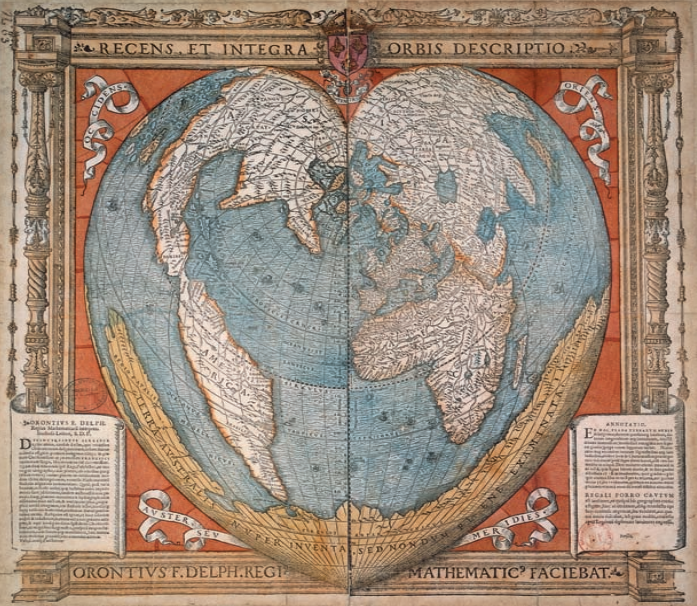
If you head over to this page, then look in the upper left, you will see links to three volumes (available in a free PDF format). My suggestion would be to look at the gallery of color illustrations for each book, links to which you’ll find below. The image above, appearing in Vol. 2, dates back to 1534. It was created by Oronce Fine, the first chair of mathematics in the Collège Royal (aka the Collège de France), and it features the world mapped in the shape of a heart. Pretty great.
The character we know as “Woody Allen,” the persona we see in his films, the stammering neurotic weighed down by existential angst and a desperate horniness laced with intellectuality, was created not in his movies, but in his stand-up, recordings of which have been in and out of circulation since 1964. (They’re now available here.)
The director is reportedly even more embarrassed of these recordings than his films–and anyone who has seen his sit-down with critic Mark Cousins can attest, he can’t even stand to watch his films–but maybe that’s about the performance itself, and not the material.
I say that because in the clip above, a routine that Allen loved enough that he often used it to end his sets in the 60s, we can see the nascent idea for his Oscar-winning 2011 film Midnight in Paris.
Riffing on The Lost Generation, he imagines himself back in time, carousing with Hemingway, Gertrude Stein, Picasso, F. Scott and Zelda Fitzgerald, and famed Spanish bullfighter Manolete. It’s a one-two-three-and punchline joke we won’t ruin, but it’s interesting that consciously or subconsciously, this idea returned some five decades later to be fleshed out into one of Allen’s best late-period films. Was he always thinking of this routine as a someday film? In interviews from the time of the film’s release, he never mentions the stand-up bit.
Creating art is often like composting, and one never knows what might float to the top after years of influences and absorption. Listening to his stand-up, one can find the joke that he recycled for Annie Hall (“I was thrown out of NYU my freshman year, I cheated on my metaphysics final in college, I looked within the soul of the boy sitting next to me.”).
There’s also this routine about a scary subway ride:
The scene was later recreated in Bananas with a young Sylvester Stallone.
Allen’s pre-film career, when he was writing for television and his own stand-up, when his goals were to “write for Bob Hope and host the Oscars” makes for fascinating reading, and we’ll leave you with this history from WMFU. Nerdist has more thoughts on the relationship between The Lost Generation joke and Midnight in Paris here.
Ted Mills is a freelance writer on the arts who currently hosts the FunkZone Podcast. You can also follow him on Twitter at @tedmills, read his other arts writing at tedmills.com and/or watch his films here.
As an unapologetic member of the “Millennial” generation, allow me to tell you how to win over a great many of us at a stroke: just appeal to our long-instilled affinity for Japanese animation and classic video games. Raised, like many of my peers born in the late 1970s and early 1980s, on a steady diet of those art forms — not that everyone knew to acknowledge them as art forms back then — I respond instinctively to either of them, and as for their intersection, well, how could I resist?
I certainly can’t resist the sterling example of anime-meets-retrogaming in action just above: an 8‑Bit Cinema double-feature, offering David and Henry Dutton’s pixelated renditions of hugely respected Japanese animation master Hayao Miyazaki’s films Spirited Away and Princess Mononoke. In just under eight minutes, the video tellsboth stories — the former of a young girl transported into not just the spirit realm but into employment at one of its bathhouses; the latter of the unending struggle between humans and forest gods in 15th-century Japan — as traditional side-scrolling, platform-jumping video games.
Clearly labors of love by true classic gamers, these transformations get not just the graphics (which actually look better than real games of the era, in keeping with Miyazaki’s artistry) but the sound, music, and even gameplay conventions just right. I’d love to play real versions of these games, especially since, apart from an unloved adaptation of Nausicaä of the Valley of the Wind, Miyazaki’s movies haven’t plunged into the video-game realm.
And if you respond better to the aesthetic of classic gaming than to that of Japanese animation, do have a look at 8‑Bit Cinema’s other work, much of which you can sample in their show reel with clips from their versions of pictures like The Shining, Kill Bill, and The Life Aquatic with Steve Zissou. I remember many childhood conversations about how video games would eventually look just like our favorite movies, animated or otherwise; little did we know that, one day, our favorite movies would also look just like video games.
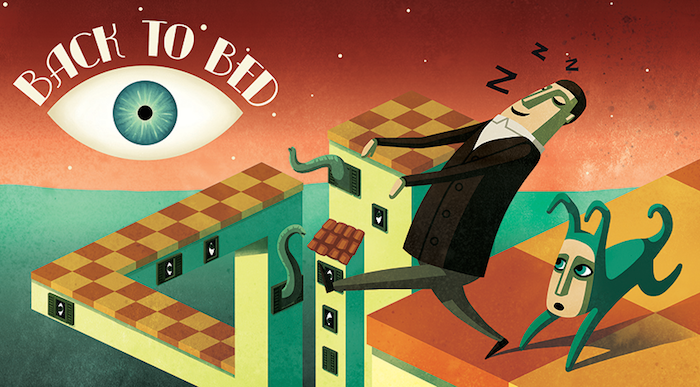
If you’ve ever looked at a mindbending, impossible piece of architecture designed by M.C. Escher and thought, well, I would love to play that, then you just might love Back to Bed, a video game for Windows, Mac, Google Play and Playstation.
Similar to last year’s aesthetically beautiful architecture puzzle game Monument Valley, players make their way through 30 levels of increasingly difficult landscapes. You play a dog-like companion that tries to stop his sleep-walking owner Bob from falling off into space by placing objects in his path. But, as with these games, you must use logic to access some of the objects and thinking several moves ahead stretches the brain.
The giant, green apples recall Rene Magritte, melted watches are out of Dalí, and the voice that says “The stairs are not what they seem”? We have another Lynch fan in Bedtime Time Digital Games’ crew. And the whole narcolepsy theme has a bit of the ol’ Caligari going for it.
The small company consists of former students who created the game “in a freezing old warehouse on the harbor in Aalborg, Denmark,” according to their bio. They forged ahead with the game after a Kickstarter campaign and what sounds like many years later, they won the student showcase at San Francisco’s Independent Games Festival. That attracted investors and with actual funding, they’ve rewritten the game to make it really shine on HDTVs.
Despite the suspenseful gameplay, there’s much that’s relaxing in the worlds of Back to Bed, from its children book graphic design—everything looks airbrushed—to its hypnotic, hypnagogic sound, including a very Brian Eno-esque ambient soundtrack.
“Back to Bed, the game says out loud in a drone, half-awake voice when you finish a level. But this addictive game might just keep you up later than usual.
Ted Mills is a freelance writer on the arts who currently hosts the FunkZone Podcast. You can also follow him on Twitter at @tedmills, read his other arts writing at tedmills.com and/or watch his films here.
Last month, we featured poet, professor, and WFMU radio host Kenneth Goldsmith singing the theory of Theodor Adorno, Sigmund Freud, and Ludwig Wittgenstein — heavy reading, to be sure, but therein lay the appeal. How differently do we approach these formidable theoretical texts, Goldsmith’s project implicitly asks, if we receive them not just aurally rather than textually, but also in a light — not to say goofy — musical arrangement? But if it should drain you to think about questions like that, even as you absorb the thought of the likes of Adorno, Freud, and Wittgenstein, might we suggest Kenneth Goldsmith singing Harry Potter?
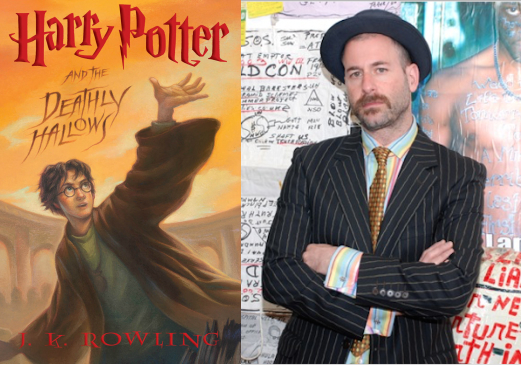
Perhaps the best-known modern exemplar of “light reading” we have, J.K. Rowling’s Harry Potter books present themselves as ripe for adaptation, most notably in the form of those eight big-budget films released between 2001 and 2011. On the other end of the spectrum, with evidently no budget at all, comes Goldsmith’s 30-minute adaptation, which you can hear just above, or along with his various other sung texts at Pennsound. Here he sings, with ever-shifting musical accompaniment and through some otherworldly voice processing, what sounds like the final novel in the Harry Potter series, Harry Potter and the Deathly Hallows.
“She tells a good story” — thus has every adult Harry Potter-reader I know explained the appeal of Rowling’s children’s novels even outside of the children’s demographic, especially as they awaited Deathly Hallows’ release in 2007. Having never dipped into the well myself, I couldn’t say for sure, but to my mind, if she tells a good enough story, that story will survive no matter the form into which you transpose it. The Potter faithful hold a variety of opinions about the degree of justice each movie does to their favorite novels, and even about the voice that reads them aloud in audiobook form, but what on Earth will they think of Goldsmith’s idiosyncratic rendition?
Update: Kenneth shot us an email a few minutes ago and filled out the backstory on this recording. Turns out the story is even more colorful than we first thought. He writes: “I was a DJ on WFMU from 1995–2010. In 2007, J.K. Rowling released the seventh and final Harry Potter and the Deathly Hallows. Prior to the book’s release the day I went on the air at WFMU, someone had leaked a copy to the internet, enraging Scholastic Books, who threatened anybody distributing it with a heavy lawsuit. I printed out and sang in my horrible voice the very last chapter of the book on the air, thereby spoiling the finale of the series for anyone listening. During my show, the station received an angry call from Scholastic Books. It appears that their whole office was listening to WFMU that afternoon. Nothing ever came of it.”
Sooo…. Let’s talk Bernie Sanders. No, I don’t want to talk about Bernie vs. Hillary, or vs. an increasingly worrisome grandstanding demagogue whose name I need not mention. I don’t want to talk Bernie vs. a younger civil rights activist groundswell… No!
Let’s talk about Bernie Sanders the recording artist.
Yeah, that’s right, Bernie made a record in 1987, a spoken-word album of classic hippy folk songs like “This Land is Your Land,” “Where Have All the Flowers Gone,” and—fittingly given his roots as a civil rights campaigner—“We Shall Overcome,” also the title of the album. Sanders, a passionate democratic socialist and stalwart advocate for economic justice, was also so passionate about this music that he wanted to add his voice to the choir. “Apparently,” writes Dan Joseph at MRCTV, “everyone in Sanders’ inner circle thought the recording was a pretty good idea. That was until they realized that Sanders had no musical talent, whatsoever.”
This is no exaggeration. Gawker quotes Todd Lockwood, a Burlington musician who helped produce the record: “As talented of a guy as he is, he has absolutely not one musical bone in his body, and that became painfully obvious from the get-go.” Hell, it never stopped William Shatner, and Shatner is the go-to comparison for the Sanders’ awkward “singing.” (It’s “positively Shatneresque,” writes Dangerous Minds.) Hear for yourself above in the Sander-ization of Woody Guthrie’s “This Land is Your Land.”
Bernie earnestly reads the lyrics in his native Brooklyn accent over a backing track that sounds like an outtake from the frustratingly great/terrible Leonard Cohen/Phil Spector collaboration Death of a Ladies Man. The contrast between the overproduced music and Sanders’ heartfelt and completely unmusical delivery is pretty weird, to say the least. Hear several more samples above, from Todd Lockwood’s Soundcloud. And if for some reason you want to listen to the whole album, and pay for the pleasure, buy Sanders’ We Shall Overcome at Amazon.
A quick follow up: Back in January, Colin Marshall took you inside Haruki Murakami’s unexpected stint as an agony uncle, writing an online advice column called Mr. Murakami’s Place. According to his publisher, readers sent the Japanese novelist 37,465 questions (see a few in translation here), and he penned responses to 3,716 of them — answering questions like: “30 is right around the corner for me, but there isn’t a single thing that I feel like I’ve accomplished.… What should I do with myself?” Or, “My wife quite frequently belches right near the back of my head when she passes behind me… Is there something I can do to stop my wife’s belching?”
Luckily, at least for Japanese readers, Murakami has now published his responses (all of them) as an ebook in Japan. And it’s been climbing Japan’s Kindle bestseller list. Currently, there are no plans to release Mr. Murakami’s Place — The Complete Edition– in English. The task of translating what amounts to an 8‑volume set of books would be formidable. And yet somehow — like most things Murakami has written — I suspect the collection will eventually see the light of day in English-speaking markets.
We're hoping to rely on loyal readers, rather than erratic ads. Please click the Donate button and support Open Culture. You can use Paypal, Venmo, Patreon, even Crypto! We thank you!
Open Culture scours the web for the best educational media. We find the free courses and audio books you need, the language lessons & educational videos you want, and plenty of enlightenment in between.