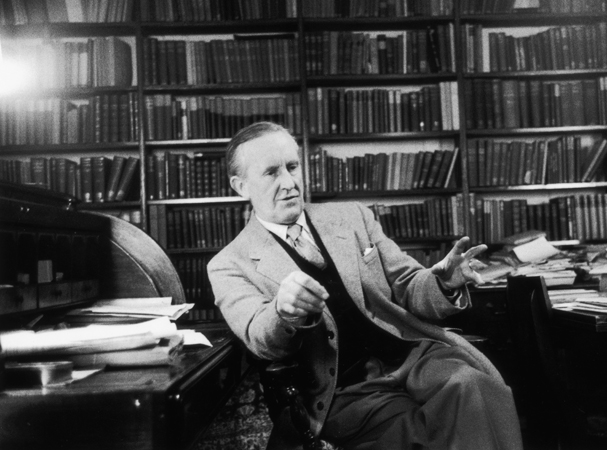
As you’d expect from a man who had to create, in painstaking detail, all the races that populate Middle-Earth, J.R.R. Tolkien had little time for simple racism. He had especially little time for the highest-profile simple racism of his day, the wave of anti-Jewish sentiment on which Adolf Hitler and the Nazi party rode straight into the Second World War. His first novel The Hobbit, predecessor to the Lord of the Rings trilogy, first appeared in 1937, a time when the situation in Europe had turned ominous indeed, and would get far uglier still. It didn’t take long after the book’s initial success for Berlin publisher Rütten & Loening to express their interest in putting out a German edition, but first — in observance, no doubt, of the Third Reich’s dictates — they asked for proof of Tolkien’s “Aryan descent.” The author drafted two replies, the less civil of which reads as follows:
25 July 1938 20 Northmoor Road, Oxford
Dear Sirs,
Thank you for your letter. I regret that I am not clear as to what you intend by arisch. I am not of Aryan extraction: that is Indo-Iranian; as far as I am aware none of my ancestors spoke Hindustani, Persian, Gypsy, or any related dialects. But if I am to understand that you are enquiring whether I am of Jewish origin, I can only reply that I regret that I appear to have no ancestors of that gifted people. My great-great-grandfather came to England in the eighteenth century from Germany: the main part of my descent is therefore purely English, and I am an English subject — which should be sufficient. I have been accustomed, nonetheless, to regard my German name with pride, and continued to do so throughout the period of the late regrettable war, in which I served in the English army. I cannot, however, forbear to comment that if impertinent and irrelevant inquiries of this sort are to become the rule in matters of literature, then the time is not far distant when a German name will no longer be a source of pride.
Your enquiry is doubtless made in order to comply with the laws of your own country, but that this should be held to apply to the subjects of another state would be improper, even if it had (as it has not) any bearing whatsoever on the merits of my work or its sustainability for publication, of which you appear to have satisfied yourselves without reference to my Abstammung.
I trust you will find this reply satisfactory, and
remain yours faithfully,
J. R. R. Tolkien
“I have in this war a burning private grudge against that ruddy little ignoramus Adolf Hitler,” Tolkien wrote to his son Michael three years later, by which time the war had reached a new height. “Ruining, perverting, misapplying, and making for ever accursed, that noble northern spirit, a supreme contribution to Europe, which I have ever loved, and tried to present in its true light.”
He had already faced German forces in combat during his service in World War I, and had almost became one of World War II’s codebreakers after the British Foreign Office’s cryptographic department brought the possibility to him in early 1939. He did not, in the event, participate directly in the conflict, but he did leave behind an uncommonly eloquent paper trail documenting his stance of unambiguous antipathy for the Nazis and their ideology.
For more such fascinating perspectives vouchsafed to history through the mail, do have a look at Letters of Note: An Eclectic Collection of Correspondence Deserving of a Wider Audience, the brand new book from the site of the same name. Tolkien’s letter above comes from it, as do many of the illuminating missives we’ve featured here before — and, without a doubt, those we’ll continue to feature in the future.
Want to download a Tolkien audio book for free? Start a 30-day free trial with Audible.com and you can download one of his major works in unabridged format. You can keep the book regardless of whether you continue with their great program or not. There are no strings attached.
Carol Kaye: you may not recognize her name but chances are you’re familiar with her work.
Now 81, the lady has laid down some deeply iconic bass tracks in a career spanning 55 years and something in the neighborhood of 10,000 recording sessions.
Holy cow, talk about something to tell the grandkids.
Her interview for a never completed documentary above left me with none of the melancholy I felt on behalf of the under-recognized back up singers populating the recent film Twenty Feet from Stardom. This may be due to some rock and roll gender inequality. The girls far outnumber the boys in the ranks of backing vocals, where looks play an undeniable part, at least when the band’s out on the road. Kaye’s contributions occurred in the recording studio. She appears plenty content to have numbered among an elite team of hard working, clean living Los Angeles session musicians.
Unsurprisingly, she was one of a very few women in the field, though girls, take note: her website has 115 playing tips for fledgling bass players. Boys are free to take note too…
John Lennon was an inveterate archivist of sound and image, documenting his life in whatever medium he had available to him and leaving behind acres of tape for friends and fans to discover. Lennon’s tapes comprise hundreds of hours of song sketches, full demos, conversations, jokes, and, as Yoko Ono puts it in her intro to The Lost Lennon Tapes, some “pretty personal stuff.” The Lost Lennon Tapes was a radio series that aired between 1988 and 1992, presenting over two hundred hours of archival Lennon audio in 219 episodes. Hosted by Lennon’s friend Elliot Mintz, the series gave listeners an intimate look into John’s creative process through demos like that above, a 1966 series of sketches that would become Revolver’s “She Said, She Said.”
In this recording, Lennon, alone with a jangly guitar, works out the now-familiar chord progressions and vocal melodies of the song in several different iterations—and with some quirky lyrical variants (“She’s making me feel like my trousers are torn”). We get to hear the song evolve in several stages, from its bouncy two-chord beginnings to its final, Eastern-inspired form. The demo also provides evidence of the song’s conceptual origins; in the first couple versions, you can hear Lennon sing “he said” instead of “she.” The “he” refers to Peter Fonda, who inspired the song by freaking Lennon out during an acid trip, uttering what became the song’s first line, “I know what it’s like to be dead.”
Just above you can hear several different 1966 home demo takes of “Strawberry Fields Forever,” with John singing over a lone electric guitar. Lennon stops and starts several times, then, at 1:55, finds his groove and plays the whole song through. Next, we hear a run-through with added Mellotron, that odd early proto-synthesizer that lent the final George Martin-produced version so much of its distinctive sound. Finally, at 6:15, hear one of the very first demo recordings of the song—a beautiful solo acoustic version recorded in Almeria, Spain. In the prominent guitar, we hear the strange, serpentine chord pattern that gives the song such a haunting feel. Lennon began composing the song in Spain while filming his scenes for Richard Lester’s How I Won the War.
Paul McCartney once called Lennon’s “Don’t Let Me Down” a “genuine plea” to Yoko, interpreting the song as John saying “I’m really just letting my vulnerability be seen, so you must not let me down.” The Beatles recorded several versions of the song for the Let it Be sessions and released it as a B side to the “Get Back” single in 1969, though Phil Spector eventually dropped the song from Let it Be. McCartney restored it to his re-release of the album, Let it Be… Naked, in which he stripped the songs of Spector’s studio effects. Above, hear “Don’t Let Me Down” at its most stripped-down in a 1968 home demo. Just Lennon with his acoustic guitar, quietly strumming out his bluesy love tune, a stark contrast to the screaming rocker the song would become.
Making the rounds on the internet is this performance by the German string quartet Salut Salon. Featuring Angelika Bachmann (violin), Iris Siegfried (violin and vocals), Anne-Monika von Twardowski (piano) and Sonja Lena Schmid (cello), the quartet knows “better than any other chamber music ensemble how to seduce their audience with passionate virtuosity, instrumental acrobatics, charm and a great sense of fun.” Above you can get your week started by watching them perform a mash-up of Vivaldi, Mozart, and Kurt Weill. And to keep your day going, you can always watch 2Cellos banging out a version of Guns N’ Roses “Welcome to the Jungle” and this 14-year-old girl playing a blistering heavy metal performance of Vivaldi. Enjoy.
If you would like to support the mission of Open Culture, consider making a donation to our site. It’s hard to rely 100% on ads, and your contributions will help us continue providing the best free cultural and educational materials to learners everywhere. You can contribute through PayPal, Patreon, and Venmo (@openculture). Thanks!
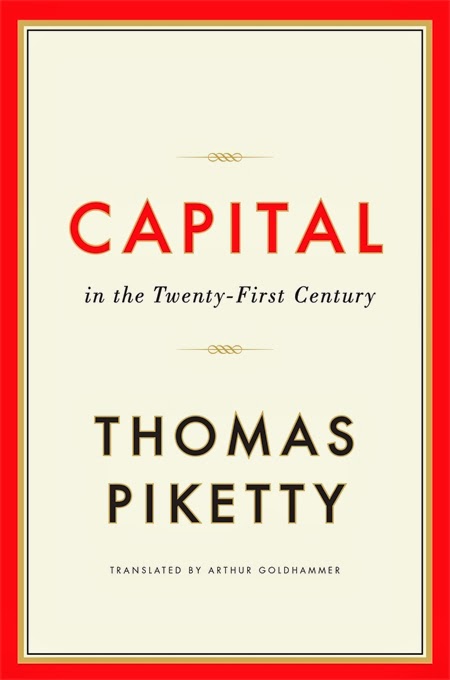
The distribution of wealth is one of today’s most widely discussed and controversial issues. But what do we really know about its evolution over the long term? Do the dynamics of private capital accumulation inevitably lead to the concentration of wealth in ever fewer hands, as Karl Marx believed in the nineteenth century? Or do the balancing forces of growth, competition, and technological progress lead in later stages of development to reduced inequality and greater harmony among the classes, as Simon Kuznets thought in the twentieth century? What do we really know about how wealth and income have evolved since the eighteenth century, and what lessons can we derive from that knowledge for the century now under way?
Capital (which by Piketty’s definition is pretty much the same thing as wealth) has tended over time to grow faster than the overall economy. Income from capital is invariably much less evenly distributed than labor income. Together these amount to a powerful force for increasing inequality. Piketty doesn’t take things as far as Marx, who saw capital’s growth eventually strangling the economy and bringing on its own collapse, and he’s witheringly disdainful of Marx’s data-collection techniques. But his real beef is with the mainstream economic teachings that more capital and lower taxes on capital bring faster growth and higher wages, and that economic dynamism will automatically keep inequality at bay. Over the two-plus centuries for which good records exist, the only major decline in capital’s economic share and in economic inequality was the result of World Wars I and II, which destroyed lots of capital and brought much higher taxes in the U.S. and Europe. This period of capital destruction was followed by a spectacular run of economic growth. Now, after decades of peace, slowing growth, and declining tax rates, capital and inequality are on the rise all over the developed world, and it’s not clear what if anything will alter that trajectory in the decades to come.
On this side of the Atlantic, wealth and income were less concentrated in the 19th century than in Europe. After a spike in top incomes that topped out in the late 1920s, the income distribution flattened out here again, albeit in less dramatic fashion than in Europe. Since the 1970s, though, the U.S. has seen a sharp and unparalleled increase in the percentage of income going to the top 1% and especially 0.1%. This has not been driven by the capital and inheritance dynamics at the heart of Piketty’s story. He attributes it instead to the rise of what he calls “supermanagers.” Piketty cites recent research that shows managers and financial professionals making up 60% of the top 0.1% of the income distribution in the U.S., and proposes that their skyrocketing pay is mainly the product of sharp declines in top marginal tax rates that made it worth managers’ while to bargain harder for raises. This isn’t the only explanation available, and Piketty’s discussion of U.S. inequality doesn’t carry the same historical authority as other parts of the book. But it surely is interesting that, as he and several co-authors report in a new article in the American Economic Journal: Economic Policy, the rise in the top-percentile income share in 13 countries was almost perfectly correlated with declines in top marginal tax rates in those countries. It’s also interesting that this huge rise in relative income inequality has brought no discernible economic benefit. Yes, the U.S. economy has grown a bit faster than those of other developed economies, but that’s purely because of population growth. Per-capita economic growth has been almost identical in the U.S. and Western Europe since 1980, and because of the skew towards the top here, U.S. median income has actually lost ground relative to other nations.
But why let HBR give you insight into Piketty’s thinking when Piketty can do it himself. Below we have a talk he gave at the Economic Policy Institute earlier this month. He starts speaking at the 5:30 mark.
And finally Paul Krugman’s review in the New York Review of Books — “We’re in a New Gilded Age” — is worth a read.
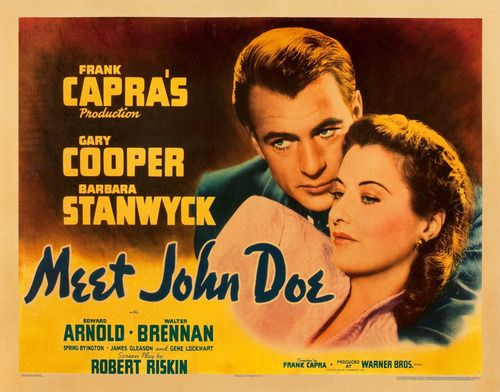
In 2006, a jury of 1,500 filmmakers, actors, actresses, critics and historians created a list of the 100 Most Inspiring Films of All Time. It’s a Wonderful Life, Frank Capra’s 1946 Christmas tale starring Jimmy Stewart, took top honors. And perhaps you know that the film fell into the public domain for some years, before being yanked back out. But another Frank Capra film, Meet John Doe, remains in the commons. And it ranks 49th on the same list of Inspirational Films.
Called “a fable that deals with the dangers of home grown fascism, and the power of the ordinary man and little people to prevent the triumph of dark forces,” Meet John Doe can be “grouped into a populist trilogy of Capra films about American individualism,” along with Mr. Deeds Goes to Town (1936) and Mr. Smith Goes to Washington (1939). Starring Gary Cooper and Barbara Stanwyck, Meet John Doe (1941) was nominated for the Academy Award for Best Story.
If you would like to support the mission of Open Culture, consider making a donation to our site. It’s hard to rely 100% on ads, and your contributions will help us continue providing the best free cultural and educational materials to learners everywhere. You can contribute through PayPal, Patreon, and Venmo (@openculture). Thanks!
“The best reason to hate Bach’s Goldberg Variations,” writes pianist Jeremy Denk, “is that everybody loves them.” As part of Denk’s iconoclastic challenge to this universal love, he cites another reason: “everyone asks you all the time which of the two Glenn Gould recordings you prefer.” Without a doubt the most celebrated pianist of the twentieth century, and perhaps the greatest interpreter of Bach’s keyboard compositions, the eccentric genius Gould famously opened and closed his career with the Goldberg Variations, Bach’s “annoyingly unimpeachable” (in Denk’s words) Baroque piece, written originally for the harpsichord. Gould made his first recording of the piece in 1955, and it immediately launched him to stardom, becoming “what may well be the best known of all piano recordings,” Colin Fleming tells us, with its “masterful showing of command, balance, [and] vigor.”
Twenty-six years later, Gould made his second recording, in 1981, a year before his untimely death at the age of 50. Gould had already retired from public performance 18 years earlier, due in part to his stage fright, but also to a devotion to studio recording techniques that allowed him total control over his musical output. The filmed recording session of Gould’s second Variations, above, opens with a shot not of the pianist and his instrument, but of the bank of analogue dials and switches inside the studio’s control booth. As the camera pans over and pushes in to Gould himself at the piano, we hear the familiar melody of the Goldberg aria, slowed to a snail’s pace. Gould sits in his familiar hunched-over posture, looking aged beyond his years, his body swaying over the keys in an expressive genuflection to the piece that made him more famous—and more controversial—than perhaps any other classical musician.
The shift in Gould’s style between the two Goldberg recordings is remarkable. Revisiting Gould’s legacy thirty years after his death, pianist Steven Osbourne writes in The Guardian of the 1981 performance above:
The contrapuntal detail he finds in every bar is amazing; no one has equalled the way he plays the aria. But even more extraordinary is the line he creates that connects the whole piece. I’m not sure I have heard anything where every single note is placed so carefully, is so carefully thought about. For some people, it’s too controlled, but I don’t find that.
“And yet,” says Osbourne, “I prefer his 1955 recording of the piece. I can’t think of a single artist who made such a profound change in their approach to a piece throughout their whole career.” Certainly Gould’s first Goldberg recording—fueled, as the liner notes inform us, by five bottles of pills, “all different colors and prescriptions”—stands as perhaps the most idiosyncratic, and memorable, rendering of Bach’s composition. But while the first performance has “speed and lightness going for it,” writes Erik Tarloff in Slate, the second has “an autumnal grace and the marvelous clarity Gould seems to privilege above all other qualities.” Luckily for us, Gould, who “never recorded the same piece twice,” but for this “significant exception,” left us these two career bookends to debate, and enjoy, endlessly.
If you’re a regular OC reader, you’re familiar with John Green, the bestselling author who has produced a series of educational videos — most notably, A Crash Course in World History, A Crash Course on Literature, and the new PBS video series, The Art Assignment. John often produces videos with his brother Hank — a musician, biochemist and vlogger — who put his talents together to produce this new song, “I F***ing Love Science.” Be warned, the version above is uncensored. As are the lyrics, found below the jump. A clean, tame, censored version of the song can be found here.
Ever since he was first published in The New Yorker back in 1992, George Saunders has been crafting a string of brilliant short stories that have reinvented the form. His stories are dark, funny, and satirical that then turn on a dime and become surprisingly moving. And the maddening thing about him is that he makes such tonal dexterity look easy. Over the course of his career, he has won piles of awards including a MacArthur “Genius” Fellowship in 2006. In 2013, his collection of short stories The Tenth of December was selected by the New York Times as one of the best books of the year. You can read 10 stories by Saunders free online here.
Last year, Saunders delivered the convocation speech for Syracuse University where he teaches writing. Most such speeches are dull and forgettable or, as was the case when Ross Perot spoke at my graduation, incoherent and churlish. Saunders’s speech, however, was something different — a quiet, self-effacing plea for empathy. When it was reprinted by the New York Times last July, the speech seemingly popped up on every third person’s Facebook feed.
Brooklyn-based group Serious Lunch has created an animated version of Saunders’ speech, voiced by the author himself. You can watch it above and read along below. You’ll probably want to call your mom or help an old lady across the street afterward.
I’d say, as a goal in life, you could do worse than try to be kinder.
In seventh grade, this new kid joined our class. In the interest of confidentiality, her name will be “ELLEN.” ELLEN was small, shy. She wore these blue cat’s‑eye glasses that, at the time, only old ladies wore. When nervous, which was pretty much always, she had a habit of taking a strand of hair into her mouth and chewing on it.
So she came to our school and our neighborhood, and was mostly ignored, occasionally teased (“Your hair taste good?” – that sort of thing). I could see this hurt her. I still remember the way she’d look after such an insult: eyes cast down, a little gut-kicked, as if, having just been reminded of her place in things, she was trying, as much as possible, to disappear. After awhile she’d drift away, hair-strand still in her mouth.
Sometimes I’d see her hanging around alone in her front yard, as if afraid to leave it.
And then – they moved. That was it. One day she was there, next day she wasn’t.
End of story.
Now, why do I regret that? Why, forty-two years later, am I still thinking about it? Relative to most of the other kids, I was actually pretty nice to her. I never said an unkind word to her. In fact, I sometimes even (mildly) defended her. But still, it bothers me.
What I regret most in my life are failures of kindness.
Those moments when another human being was there, in front of me, suffering, and I responded…sensibly. Reservedly. Mildly.
Or, to look at it from the other end of the telescope: Who, in your life, do you remember most fondly, with the most undeniable feelings of warmth?
Those who were kindest to you, I bet.
But kindness, it turns out, is hard — it starts out all rainbows and puppy dogs, and expands to include … well, everything.
Jonathan Crow is a Los Angeles-based writer and filmmaker whose work has appeared in Yahoo!, The Hollywood Reporter, and other publications. You can follow him at @jonccrow.
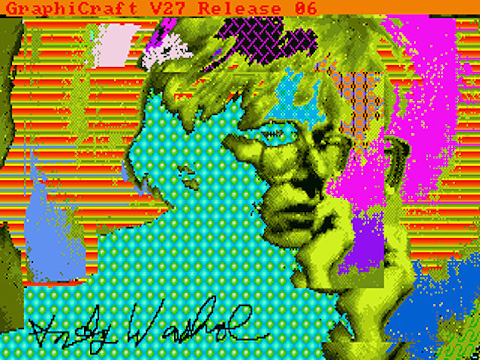
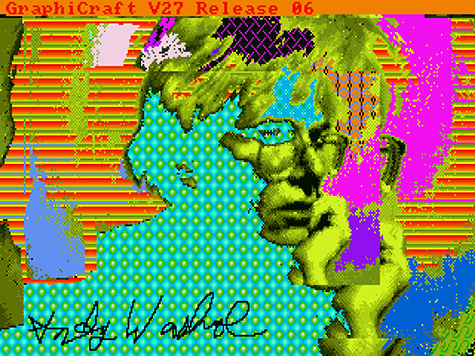
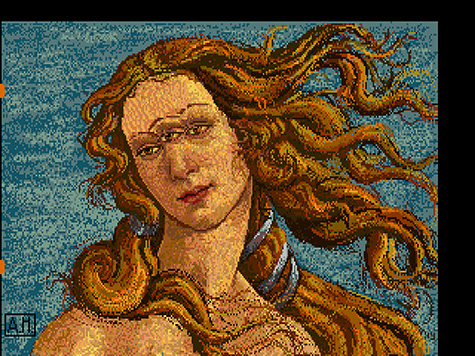
If you saw our post on Andy Warhol digitally painting Debbie Harry at the 1985 launch of the Commodore Amiga 1000, you know how effusively — effusively by the impassive Warholian standard, anyway — the artist praised the computer’s artistic power. Now, thanks to a recent discovery by members of Carnegie Mellon University’s Computer Club, we know for sure that the mastermind behind the Factory didn’t simply shill for Commodore; he actually spent time creating work with their then-graphically advanced machine, a few pieces of which, unseen for nearly thirty years, just came back to light on monitors everywhere. Above we have the 1985 self-portrait Andy2. The 27 other finds include a mouse-drawn rendition of his signature Campbell’s soup can and a three-eyed Venus, surely one of the eerier early uses of cut-and-paste functionality, all products, explains the press release from The Frank-Ratchye STUDIO for Creative Inquiry at Carnegie Mellon,” of a commission by Commodore International to demonstrate the graphic arts capabilities of the Amiga 1000 personal computer.”
1980s electronics-loving artist Cory Arcangel, upon watching the video of Warhol at the launch, contacted the Andy Warhol Museum “regarding the possibility of restoring the Amiga hardware in the museum’s possession.” The effort necessitated acts of “forensic retrocomputing” — a delicate process, since “even reading the data from the diskettes entailed significant risk to the contents.” The CMU Computer Club team even had to reverse-engineer the “completely unknown file format” in which Warhol had saved his images. “By looking at these images, we can see how quickly Warhol seemed to intuit the essence of what it meant to express oneself, in what then was a brand-new medium: the digital,” Arcangel says in the press release. “FYI, it was the most fun project I ever worked on,” he says on his blog — a meaningful statement indeed, since so much of his other work involves old Nintendo games. The Hillman Photography Initiative captured it all in a film called Trapped: Andy Warhol’s Amiga Experiments, which premieres Saturday, May 10, at Pittsburgh’s Carnegie Library Lecture Hall, thereafter becoming viewable at nowseethis.org.
We're hoping to rely on loyal readers, rather than erratic ads. Please click the Donate button and support Open Culture. You can use Paypal, Venmo, Patreon, even Crypto! We thank you!
Open Culture scours the web for the best educational media. We find the free courses and audio books you need, the language lessons & educational videos you want, and plenty of enlightenment in between.