(Shots of muscular, heavily tattooed gang-bangers glowering, fighting, smoking pot, and enjoying super-hot twice-weekly conjugal visits)
“In a hellish, overstuffed maximum security prison in Peru…”
(Close up of Vin Diesel or Vin Diesel-type wiping away a tear as he bids goodbye to a neatly dressed, bespectacled teenage girl)
“One man will do whatever it takes to win the respect of his daughter…”
(Cut to Vin in a colorful, coordinated outfit, leading hundreds of fellow inmates in an aerobics class as they attempt to break a Guinness World Record)
No doubt it would be godawful. That’s not to say convicted kidnapper Alejandro Nuñez del Arco’s story isn’t inspiring in the original.
Colonel Tomas Garay, who greenlighted del Arco’s Full Body aerobics class back in November, is pleased by the changes in attitude he’s noticed at Lurigancho, “a branch of hell” where drugs, alcohol, and violence were previously the norm. Although the sport, a cardiovascular workout combining dance, boxing, and Tae Bo was invented by a Peruvian man, macho inmates were standoffish at first. A mere eight attended del Arco’s first class. By June 14, the date he attempted to best the Philippines’ Cebu Prison’s world record for the most people dancing behind bars, at least 1179 of his fellow inmates were raging with dance fever. Talk about transformative effects…
Hopefully not coming soon to a theater near you, unless it’s as an expansion of the five-minute documentary above.
She is 14 years old, and apparently French. Not much else is known about this precocious young guitarist who goes by the name “Tina S” on her YouTube channel.
Tina became an Internet sensation in late May, when she posted an astonishing cover version of “Eruption,” from Van Halen’s debut album. Eddie Van Halen’s son Wolfgang was so impressed he tweeted, “I need to meet this girl!!!”
Writing as “@Tina_Guitare,” the young musician replied, “I need to meet you too! Haha :))” Talk show host Ellen DeGeneres also went on Twitter and said, “This girl is incredible. If you know where she is, I want her on my show immediately.” There was no reply to that one — at least not on Twitter.
If you would like to support the mission of Open Culture, consider making a donation to our site. It’s hard to rely 100% on ads, and your contributions will help us continue providing the best free cultural and educational materials to learners everywhere. You can contribute through PayPal, Patreon, and Venmo (@openculture). Thanks!
I recently read an article in which a music critic argued for Bob Dylan’s 1970 double album Self Portrait as his best. This provoked so much derision and outrage in the comments that I almost felt sorry for the author. But this is not unusual. Rolling Stone’s Greil Marcus opened his review of the record with a surly “What is this shit?” Dylan himself explained in a 1984 interview with the magazine that the record was intentionally bad, a “screw you” to his less discerning fans. And why not? Bob Dylan can do whatever he wants.
Well, the album The Onion’s AV Club calls “almost universally loathed” is being reissued in a four-disc set that includes outtakes and bootlegs, as well as alternates and demo takes from Nashville Skyline and 1970’s New Morning. You’ll find the full tracklist of what will be released on August 27 as Another Self Portraithere. (The album itself can be pre-ordered here.) For a preview, watch the video above of “Pretty Saro,” an 18th century English folk tune Dylan recorded for Self Portrait but never released. As with Marcus’ review and Dylan’s explanatory interview, this comes to us via the stalwart Rolling Stone.
Filmmaker Jennifer Lebeau made the video, which consists of carefully selected photos from the Farm Security Administration and which Lebeau says “literally goes from women on farms with wagons to Rosie the Riveter.” It’s a cool concept and a beautiful song. Might it persuade you to re-evaluate Self Portrait? If you never loathed it but defended it, does this outtake enhance your appreciation of its genius? Maybe you’re in need of a refresher on the confused, amused, and infuriated reactions that this record generates. If so, you may wish to visit this site for “24 minutes of footage of people talking about Bob Dylan’s puzzling” 1970 album.
In June 1945, the 27-year-old physicist Richard Feynman lost his wife, Arline Feynman, to tuberculosis. Only 25 years old, she was Richard’s high-school sweetheart. And yet she was much more. As Lawrence Krauss writes in 2012 biography on Feynman:
Richard and Arline were soul mates. They were not clones of each other, but symbiotic opposites — each completed the other. Arline admired Richard’s obvious scientific brilliance, and Richard clearly adored the fact that she loved and understood things he could barely appreciate at the time. But what they shared, most of all, was a love of life and a spirit of adventure.
I know how much you like to hear that — but I don’t only write it because you like it — I write it because it makes me warm all over inside to write it to you.
It is such a terribly long time since I last wrote to you — almost two years but I know you’ll excuse me because you understand how I am, stubborn and realistic; and I thought there was no sense to writing.
But now I know my darling wife that it is right to do what I have delayed in doing, and that I have done so much in the past. I want to tell you I love you. I want to love you. I always will love you.
I find it hard to understand in my mind what it means to love you after you are dead — but I still want to comfort and take care of you — and I want you to love me and care for me. I want to have problems to discuss with you — I want to do little projects with you. I never thought until just now that we can do that. What should we do. We started to learn to make clothes together — or learn Chinese — or getting a movie projector. Can’t I do something now? No. I am alone without you and you were the “idea-woman” and general instigator of all our wild adventures.
When you were sick you worried because you could not give me something that you wanted to and thought I needed. You needn’t have worried. Just as I told you then there was no real need because I loved you in so many ways so much. And now it is clearly even more true — you can give me nothing now yet I love you so that you stand in my way of loving anyone else — but I want you to stand there. You, dead, are so much better than anyone else alive.
I know you will assure me that I am foolish and that you want me to have full happiness and don’t want to be in my way. I’ll bet you are surprised that I don’t even have a girlfriend (except you, sweetheart) after two years. But you can’t help it, darling, nor can I — I don’t understand it, for I have met many girls and very nice ones and I don’t want to remain alone — but in two or three meetings they all seem ashes. You only are left to me. You are real.
My darling wife, I do adore you.
I love my wife. My wife is dead.
Rich.
PS Please excuse my not mailing this — but I don’t know your new address.
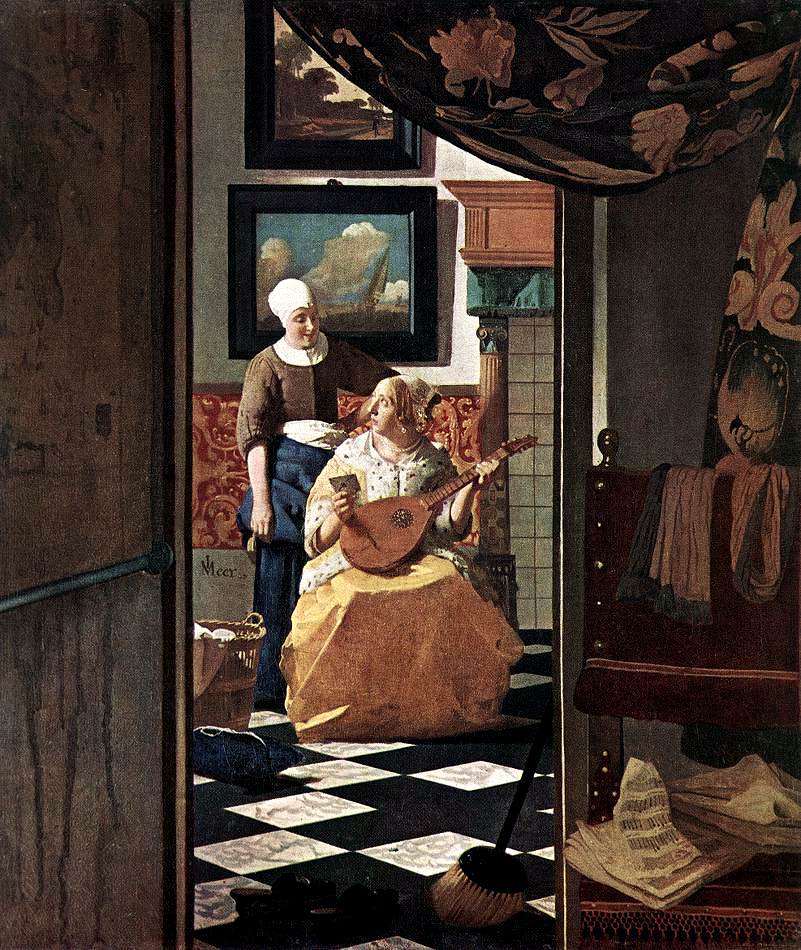
We all thrilled to Johannes Vermeer painting his best-known portrait as dramatized in Peter Webber’s 2003 film Girl with a Pearl Earring. But for every heightened, scintillating feature film built around a well-known artist, there exists — or should exist, anyway — a documentary that examines the work itself in greater detail. For such a counterpart to the aforementioned Colin Firth/Scarlett Johansson vehicle, I nominate Joe Krakora’s 2001 Vermeer: Master of Light, a rich look at the paintings of the well-known visual chronicler of seventeenth-century middle-class Dutch life, whose use of color could reach pretty formidable heights of scintillation itself. Providing its narration, we have a certain Meryl Streep.
Click each image for a larger version
Streep’s words and those of the documentary’s expert interviewees must of necessity focus on Vermeer’s actual paintings, since we know little of the painter’s life. And we don’t even have very many paintings to talk about: living from 1632 to 1672, Vermeer turned out fewer than 40 canvases. But what canvases: Master of Light goes into detail on his particular mastery not only of light and color, but of textures, perspectives, and seemingly minor but nonetheless painstaking touches. We do, however, offer a viewing tip: unless you particularly enjoy shots of light through windows, you may want to begin the video at 5:22 or so. The analysis of Vermeer takes its time coming, but when it begins, it offers a wealth of surprising detail — just as do the paintings themselves. But don’t believe me; find out for yourself by viewing fifteen of them up close at the Google Art Project, including Lady at the Virginal with a Gentleman just above, or, below, The Love Letter.
Humanists are feeling a bit beleaguered these days. And who can blame them? Enrollments in humanities courses are in steady decline nationwide, and everyone’s looking for a cause. Some blame the decline on the tough economy and the relentlessly vocational focus of students. Others attribute it to the “anti-intellectual moment” in which we’re now living. Still others place the blame right in the laps of humanists who have “lost faith in their own enterprise.” They’re committing their own form of career suicide. And then some fault the ever-increasing encroachment of science. For nowadays science tries to answer all questions, including what’s good, beautiful and true.
[Science doesn’t have] an imperialistic drive to occupy the humanities; the promise of science is to enrich and diversify the intellectual tools of humanistic scholarship, not to obliterate them. And it is not the dogma that physical stuff is the only thing that exists. Scientists themselves are immersed in the ethereal medium of information, including the truths of mathematics, the logic of their theories, and the values that guide their enterprise. In this conception, science is of a piece with philosophy, reason, and Enlightenment humanism. It is distinguished by an explicit commitment to two ideals, and it is these that scientism seeks to export to the rest of intellectual life.
If you’re a humanist trying to figure out whether you can take comfort in Pinker’s argument, you can read the rest of his piece here.
If you’ve taken a film studies course, you’ve almost certainly seen the work of Georges Méliès. His 1902 short A Trip to the Moon, at the top, which some cinema scholars cite as the picture where special effects as we know them began,has a particularly important place in cinema history. Nobody who watches that fourteen-minute production ever forgets the image of the moon’s consternation after the protagonists’ spacecraft crashes into it. And the rest of the movie, if narratively shaky, still has an impressive visual power. If anybody had both sufficient imagination and sufficient know-how to commit such a voyage to that cutting-edge medium known as motion film over a century ago, the theater owner and seasoned illusionist Méliès did. Charged by the cinematic pioneering of his countrymen the Lumière brothers, he began doing it in 1896, and continued until 1913, which makes A Trip to the Moon a mid-career highlight.
A mid-career highlight, that is, alongside 1904’s The Impossible Voyage (just above), which continues in the same vein of Jules Verne-style fantastical science fiction. This time, in fact, Méliès took not just the sensibility from Verne but, in part, a story, drawing inspiration from Verne’s play Journey Through the Impossibleabout a young Danish baron tempted to travel to far-off lands, planets, and realities. He wrote into this sequel, of sorts, a natural destination: the sun. MUBI.com’s “public domain greats” page offers a list of these and other Méliès films available free to watch online, the likes of which inspired Martin Scorsese to adapt Brian Selznick’s Méliès-centric novel The Invention of Hugo Cabret into Hugo, a film visually inventive by the early 21st century’s standards just as A Voyage to the Moon excelled by the early 20th century’s. Those films currently available include:
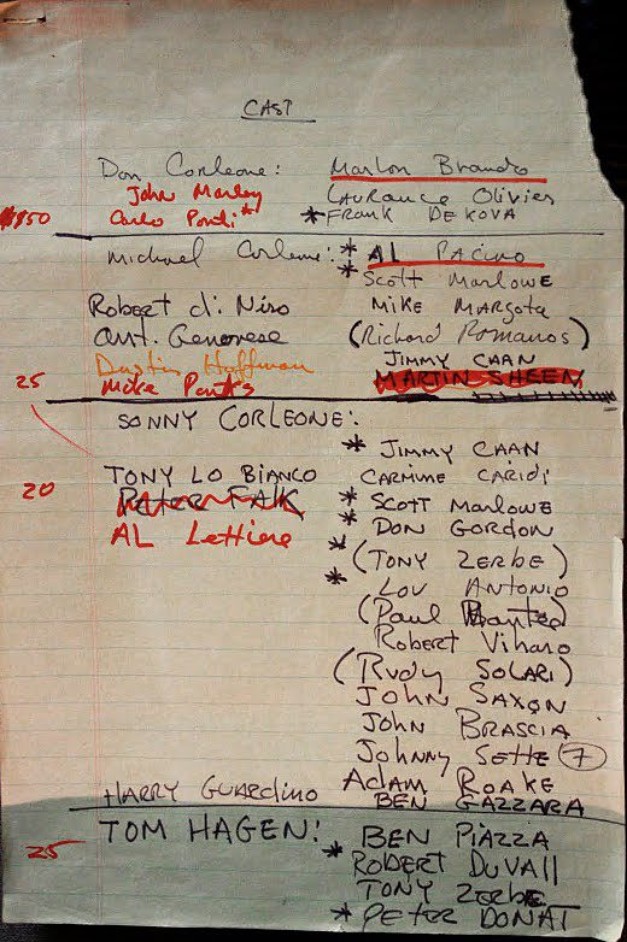
Laurence Olivier as Vito Corleone? Dustin Hoffman as Michael? Those are two of the intriguing options director Francis Ford Coppola was apparently mulling over when he jotted down these notes while preparing to make his classic 1972 film The Godfather.
The casting of The Godfather was a notoriously contentious affair. Executives at Paramount Pictures thought Marlon Brando — Coppola’s first choice to play Mafia “Godfather” Vito — was too difficult to work with. They thought Al Pacino was too short to play his son Michael.
“The war over casting the family Corleone was more volatile than the war the Corleone family fought on screen,” writes former Paramount head of production Robert Evans in his memoir, The Kid Stays in the Picture. At one point the studio wanted Danny Thomas to play Vito and Warren Beatty to play Michael. A long list of leading Hollywood actors were considered for the role of Michael, including Robert Redford, Ryan O’Neal and Jack Nicholson.
Coppola eventually settled on Pacino as the cerebral Michael and the little-known Carmine Caridi as Michael’s tough-guy older brother, Sonny. Evans told the director he could have one but not both. In a passage from the book, quoted in Mark Seal’s 2009 Vanity Fair piece, “The Godfather Wars,” Evans describes a tense meeting with Coppola:
“You’ve got Pacino on one condition, Francis.”
“What’s that?”
“Jimmy Caan plays Sonny.”
“Carmine Caridi’s signed. He’s right for the role. Anyway, Caan’s a Jew. He’s not Italian.”
“Yeah, but he’s not six five, he’s five ten. This aint Mutt and Jeff. This kid Pacino’s five five, and that’s in heels.”
“I’m not using Caan.”
“I’m not using Pacino.”
Slam went the door. Ten minutes later, the door opened. “You win.”
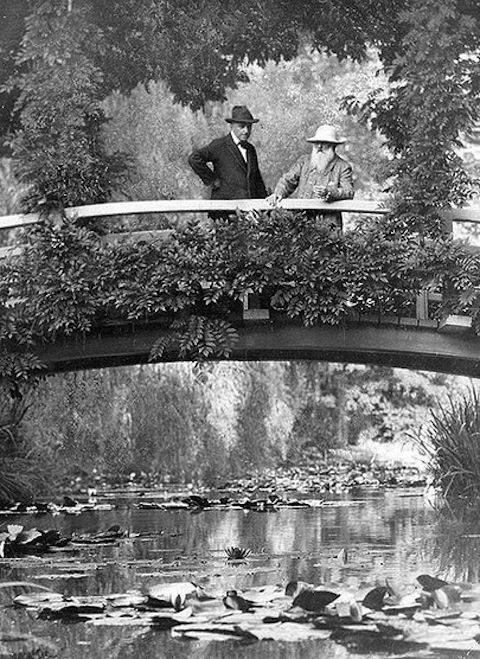
The late-1800’s European fascination with things Japanese sometimes bordered on the collection of Orientalist kitsch. At the height of French impressionism, so called Japonisme was everywhere, but rarely were Far East designs integrated into Western landscapes with such skill and sensitivity as in the work of Claude Monet. Next to his water lilies and haystacks, one of the most recognizable features in the painter’s work is a Japanese-style footbridge, which, like the lilies, was part of his garden at Giverny (see the aged Monet on the bridge in the 1922 New York Times photo above).
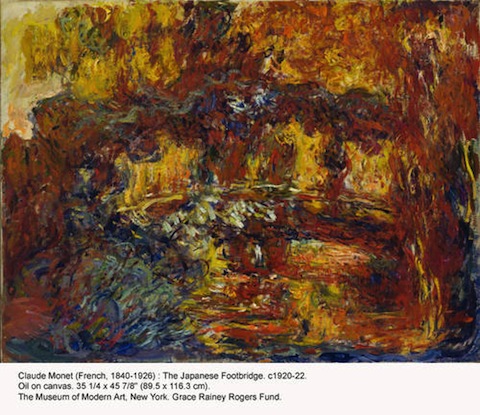
We’re familiar with the bridge as it appears in an 1899 painting Waterlily pond, green harmony, a symmetrical gray structure hovering in a lush, reflective sea of greens, lavenders, and pinks. As Monet’s eyesight further failed him, his paintings became harder to parse, turning to deep, Van Gogh-like swirls of color that are beautiful but sometimes completely abstract. Try and make out the bridge, for instance, in The Japanese Footbridge (above), painted between 1920 and 1922. Monet’s fascination with the bridge is particularly poignant when we consider that, as Australia’s National Gallery of Art says of Waterlily Pond, “not only did Monet create this painting, he made everything depicted in it,” meaning that Monet curated the landscape and supervised the footbridge’s construction.
Monet had it built in 1893, deliberately choosing a Japanese style, but employing local craftsman in the construction. And while the bridge had to be rebuilt in 1970, as you can see from French Impressionist travel guide Thomas Dowson’s 2011 photo of Monet’s real Normandy landscape (above), the painter’s gardens seem little changed from their nineteenth century character as a carefully balanced synthesis of East and West aesthetics.
A special thanks goes to @stevesilberman for sharing this with us.
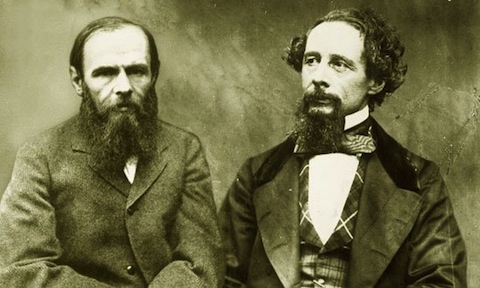
Given the way nineteenth-century literature is sometimes conceived—as the special province of a few great, hairy celebrity novelists—one might imagine that a meeting between Charles Dickens and Fyodor Dostoevsky would not be an unusual occurrence. Maybe it was even routine, like Jay Z and Kanye bumping elbows at a party! So when I read that the two had once met, in London in 1862, my first thought was, “well, sure. And then Herman Melville and Gustave Flaubert stopped by, and they got into a brawl over the check.” Alright, that’s ridiculous. Melville didn’t achieve any degree of fame until after his death, after all, and while the other three were respected, even wildly famous (in Dickens’ case), it is unlikely they read much of each other, much less traveled hundreds of miles for personal visits.
And yet, the story of Dickens and Dostoevsky—since revealed to be as much a fabrication as the image above—was plausible enough to find purchase in two recent Dickens biographies. Though the two men had vastly different sensibilities, their shared experiences of the seamier side of life, and their sprawling serialized novels cataloguing their time’s social ills in great detail, would seem likely to draw them together. New York Times literary critic Michiko Kakutani seemed to think so when she repeated the story as told in Claire Tomalin’s 2011 Charles Dickens, A Life. Tomalin—who found the story in the Dickensian, the journal of the Dickens Fellowship, and reported it in good faith—recounts how the Russian novelist intentionally sought out his English counterpart in London, and, upon finding him, heard Dickens bare his soul, confessing that he longed to be like his honest, simple characters, but used his own personal failings to construct his villains.
The story might still have currency had not several Russian literature scholars read Kakutani’s review and found it far too credulous: Why would Dostoevsky have only mentioned the encounter in a letter written sixteen years after the fact, a letter no scholar has seen? What language would the two men have in common—and if they had one, probably French, would they be fluent enough to have a heart to heart? And even if Dostoevsky visited London in 1862, as it seems, he did, would he have intentionally sought out Charles Dickens? Eric Naiman, professor of Slavic Language and Literatures at UC Berkeley, doubted all of this, and, in undertaking some research, found it to be the elaborate production of a man named A.D. Harvey, who has created for himself a coterie of fictional academic identities so thorough as to constitute what Naiman calls a “community of scholars who can analyse, supplement and occasionally even ruthlessly criticise each other’s work.”
As far as literary hoaxers go, Harvey is quite accomplished. You may find his story—driven, as such things often are, by wounded ego, misplaced talent, vanity, and frustrated ambition—much more interesting than any supposed tête-à-tête between the Russian and British novelists. A recent Guardian piece profiles the “man behind the great Dickens and Dostoevsky hoax,” and Eric Naiman’s exhaustive Times Literary Supplement expose of the hoax shows us just how deeply embedded such spurious lore can become in a literary community before it can be rooted out by skeptical scholars. The lesson here is trite, I guess. Don’t believe everything you read. But when we’re inclined—mostly for good reasons—to trust the word of those who pose as experts and authorities, this can be a hard lesson to heed.
Cookpad bills itself as having the “Best Japanese recipes from the largest cooking community in Japan.” And that’s not just your usual web site hyperbole. Established back in 1997, Cookpad houses 1.5 million recipes created by a base of 20 million users. And it’s now a publicly-traded company on the Tokyo stock exchange. This week, Cookpad did everyone in the Anglophone world a favor by releasing an English-language version of its site. Right now, you can navigate your way through 1,500 recipes and find dishes like Udon with Thick Egg Soup, Very Delicious Stir-fried Tofu with Shimeji Mushrooms, and Pan-Fried Autumn Salmon with Ginger Sauce. And if you’re patient, you’ll soon find another 30,000 recipes added to the site. It’s worth noting that all recipes are translated by humans, not computers, and the translators are apparently compensated for their efforts.
We're hoping to rely on loyal readers, rather than erratic ads. Please click the Donate button and support Open Culture. You can use Paypal, Venmo, Patreon, even Crypto! We thank you!
Open Culture scours the web for the best educational media. We find the free courses and audio books you need, the language lessons & educational videos you want, and plenty of enlightenment in between.