You can’t fault people for turning away from current events these days, but there are many pockets of light, even if they rarely make headlines or get curated by gloom and doom algorithms. Some optimism has come to us by way of musicians like David Byrne, whose good-news aggregator “Reasons to Be Cheerful” showcases positive developments around the world. Indie rock drummer Thor Harris has encouraged fans with tips on how to stay healthy in trying times, and he has announced a run for governor of Texas. And last fall, Cheap Trick’s bassist Tom Petersson started a project called Rock Your Speech, which “leverages the power of music to build language skills in children who are working to overcome speech delay associated with autism.”
As Petersson and his wife Alison explain above, they were inspired by their experience with their son, Liam, who, “until the age of five,” reports David Chiu at Huffington Post, “had difficulty communicating,” They discovered that music could help when Liam began singing along to one of her favorite Elton John songs. Petersson wanted “to help other parents,” he told HuffPo, “and to let people know they’re not alone.” An L.A. benefit concert harnessed the collective power of celebrities and indie artists to jumpstart the project, with bands like the Dandy Warhols and Red Kross and actors Ed Asner and Billy Bob Thornton participating.
Rock Your Speech is not the only such initiative, but it is probably the most high-profile, and could bring attention to similar efforts like Auditory-Motor Mapping Training, developed by Dr. Gottfried Schlaug of the Music and Neuroimaging Laboratory. At the Autism Speaks blog, Schlaug writes, “as many as three in ten children with autism are nonverbal. Yet many children with autism have superior auditory skills and a particular attraction to music.” Like Rock Your Speech, his approach uses “forms of music-making that encourage vocalization as a pathway to developing language.” Musician and psychologist Adam Reece has also written about his research showing the positive role music therapy can play in language acquisition for kids on the spectrum.
Petersson’s project puts a rock star face on music therapy and comes “from the point of view of the parent,” he says. Rock Your Speech not only raises autism awareness but also offers original music and videos designed to stimulate and inspire kids. Hear “Blue” from the Rock Your Speech, Volume 1album above, one of several songs Petersson wrote that “employs actual rock music,” Chiu writes, “not necessarily the gentle, kiddie-type of sounds that are generally prevalent in children’s music.” Videos on the Rock Your Speech site for “Blue” and other songs “not only show the words but also demonstrate to kids how those words are formed and mouthed.”
The project’s Vimeo channel shows the Petersson family involved in Liam’s speech development through music, including his older sister Lilah coaching her brother with a song called “Wash Your Hands.” (See Lilah’s video above for her song “All the Same,” written for Liam.) Liam, now ten, has come a long way. “He’s in school,” says Petersson, “He loves music… He’s definitely on the autism spectrum, but he speaks, he’s social. He’s the sweetest little guy.” His musical family has a lot to do with that, but Rock Your Speech offers even non-musician parents a wealth of catchy tools to help kids struggling with speech to connect with language through rock ‘n’ roll. For many families, that could be very good news indeed.
As an American man in his thirties, I can, if necessary, communicate entirely in Simpsons references. But however voluminous and close at hand my knowledge of the Simpson family and their hometown of Springfield, it doesn’t extend past the 1990s. Most of my demographic can surely say the same, as can quite a few outside it: take the Irishman behind the Youtube channel Super Eyepatch Wolf, author of the video essay “The Fall of The Simpsons: How It Happened.” We both remember tuning in to the show’s debut on December 14, 1989, and how it subsequently “transformed television as we knew it” — and we’ve both lamented how, in the nearly three decades since, “one of the best and most influential TV shows of all time became just another sitcom.”
So how did it happen? To understand what made The Simpsons fall, we have to understand what put it at the top of the zeitgeist in the first place. Not only did the counterculture still exist back in the 1990s, The Simpsons quickly came to constitute its most popular expression. And as with any powerful countercultural product, it was just as quickly labeled dangerous, as anyone who grew up describing each week’s episode of the show to friends not allowed to watch it remember. Yet its “rebellious satire” and all the consequent violations both subtle and blatant of the staid conventions of mainstream American culture (especially in its purest manifestation, the sitcom) came unfailingly accompanied by “comedy grounded in character and heart.”
The fact that The Simpsons’ first generation of writers might well revise a joke twenty or thirty times — creating the countless moments of intricately structured, multilayered verbal and visual comedy we still remember today — didn’t hurt. But even if current writers put in the same hours, they do it on a show that has long since lost touch with what made it great. While each of its characters once had “a very specific set of conflicting beliefs and motivations,” they now seem to do or say anything, no matter how implausible or absurd, that serves the gag of the moment. Celebrity guest stars stopped playing characters specially crafted for them but caricatures of themselves. Plots became bizarre. “The only thing that The Simpsons was a parody of now,” says Super Eyepatch Wolf bringing us to the present day, “was The Simpsons.”
While the show has been self-referentially acknowledging its own decline since about the turn of the millennium, that doesn’t make comparisons with its 1990s “golden age” any less dispiriting. One thinks of the comic strip Calvin and Hobbes, another generational touchstone, whose creator Bill Watterson ended it after just ten years: it still finds an audience today in part, he says, “because I chose not to run the wheels off it.” The Simpsons, by contrast, now draws its lowest ratings ever, and it would pain those of us who grew up with it as much to see it end as it does to see it keep going. But then, “entertainment isn’t meant to last forever. Rather, it’s an extension of the people and places that made it at a particular moment in time.” The Simpsons at its countercultural best will always define that moment, no matter how long it insists on running beyond it.
Based in Seoul, Colin Marshall writes and broadcasts on cities and culture. His projects include the book The Stateless City: a Walk through 21st-Century Los Angeles and the video series The City in Cinema. Follow him on Twitter at @colinmarshall or on Facebook.
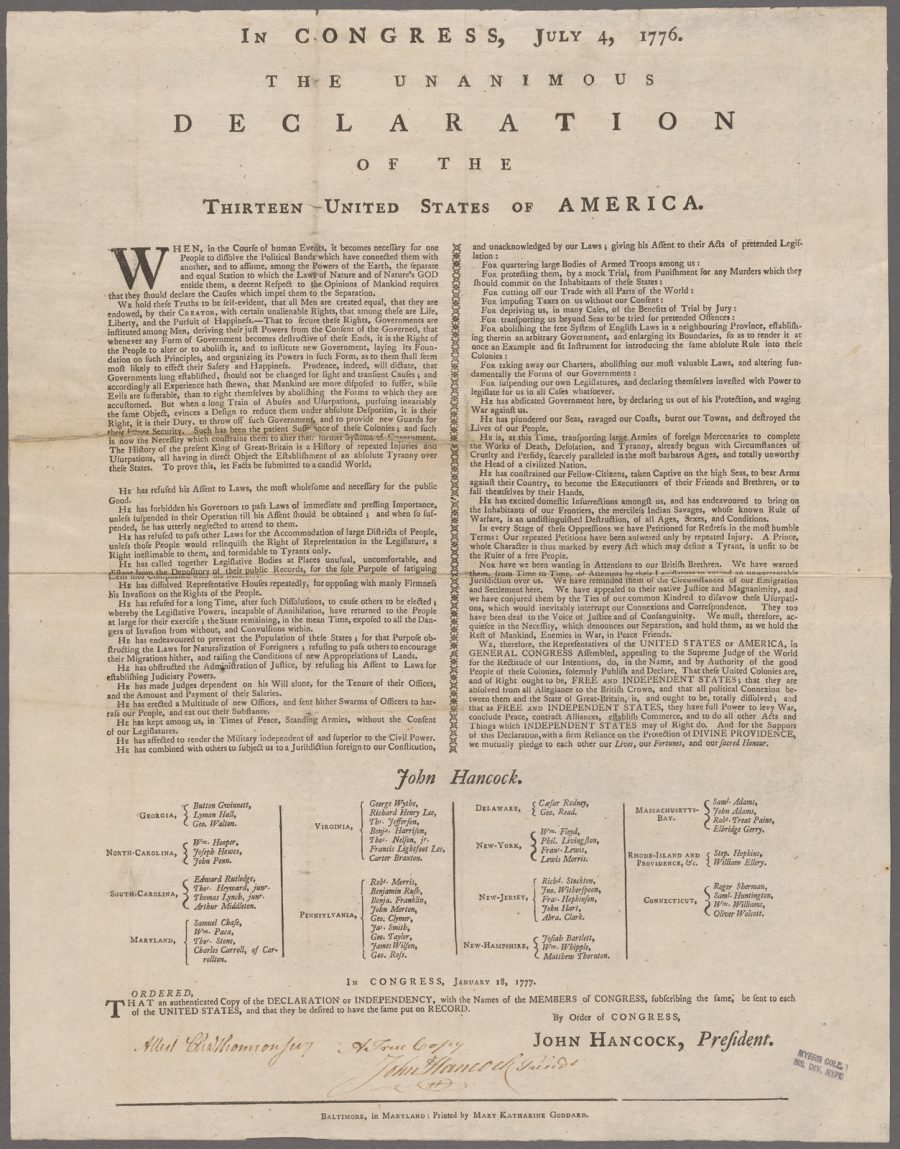
Once again, it’s time for Americans to celebrate their country’s “birthday,” a rather miraculous event, we might say, since the only people present at the birth were founding fathers. See their names on the printed Declaration of Independence above, from the outsized John Hancock, to famous favorites Benjamin Franklin, Thomas Jefferson, and second cousins John and Sam Adams, to a bunch of other guys no one remembers. But wait, zoom in (to the scanned copy here), who’s that at the bottom? No, the very, very bottom, in tiny type…. “Baltimore, in Maryland: Printed by Mary Katharine Goddard.” Who?
“If you’ve never noticed it or heard of her, you aren’t alone,” writes Petula Dvorak at The Washington Post, but Mary Goddard could be called “a Founding Mother, of sorts,” as a publisher of the Maryland Journal, proprietor of a printing press, bookstore owner, and postmaster general of Baltimore.
Goddard was fearless her entire career as one of America’s first female publishers, printing scoops from Revolutionary War battles from Concord to Bunker Hill and continuing to publish after her offices were twice raided and her life was repeatedly threatened by haters.
In “her boldest move,” she put her full name at the bottom of copies of the Declaration that her press printed and distributed to all of the colonies. This was the first copy Americans would see with all of the signers’ name. Goddard had received the commission from Congress and more honors besides. In 1775, she was appointed Baltimore’s first postmaster, serving “under the leadership of Postmaster General Benjamin Franklin,” notes the National Postal Museum. She “may have been the first woman postmaster in colonial America.”
The printing and postal trades were a family business: her father Giles served as postmaster of New London, Connecticut, and her younger brother William established the colonial postal system. Just as she has been sidelined by history, she was sidelined in her lifetime. She “lost her job as publisher,” writes Dvorak, “after her brother married and returned to Baltimore in 1784, taking over the Maryland Journal and ousting his sister.”
And after serving as Baltimore postmaster for 14 years, she was pushed out of the job by Postmaster General Samuel Osgood, who “didn’t think a woman could handle all the travel associated with the job.” (Over 200 merchants and residents of Baltimore petitioned Osgood, to no avail.) The story of Goddard’s life and career is both inspiring and frustrating—but here’s to hoping she makes it into the history books where she belongs. See her printed copy of the Declaration in high-resolution detail at the New York Public Library’s Digital Collections.
Contrary to a thoroughly abused political metaphor, Washington, DC was not in fact built on a swamp, though anyone who has visited in the summer will find that story plausible. Having just returned to my hometown for a few days, I’ve had ample reminder of its stickiness, and have experienced its figuratively overheated atmosphere firsthand. I needn’t go over the political and moral crises turning the capital into a cauldron of “incivility.”
But what exactly is “civility” and what does it entail? Is it just another word for politeness, or a hypocritically insidious code for silencing dissent? Oxford Dictionaries recently chose the word for its Weekly Word Watch, citing an Oxford English Dictionary entry defining it as “the minimum degree” of decorum in social situations. Deriving from the Latin civis, or “citizen,” and related to “civics” and “civilization,” the word first meant “citizenship,” and connoted the treatment supposedly due a person with said status. As often happens, connotation became denotation, and civility came to stand for basic respect.
Nervous columnists now worried about civility’s decline have pinned the problem on citizen protesters exercising civil disobedience and their first amendment rights, rather than on the torrents of abuse, threats, and lies that pour forth daily from the executive, who seems incapable of treating anyone with minimal decency. But the very first holder of the office—faced with a fractious and uncivil populace (some of whom toasted to his “speedy death”)—believed it was his duty to set “a standard to which the wise and honest can repair.”
What, we might wonder, would George Washington, builder of DC, have thought of the city’s current state? We can speculate by reference to his “Farewell Address,” in which the departing president wrote:
The alternate domination of one faction over another, sharpened by the spirit of revenge natural to party dissention, which in different ages & countries has perpetrated the most horrid enormities, is itself a frightful despotism. But this leads at length to a more formal and permanent despotism. The disorders & miseries, which result, gradually incline the minds of men to seek security & repose in the absolute power of an Individual: and sooner or later the chief of some prevailing faction more able or more fortunate than his competitors, turns this disposition to the purposes of his own elevation, on the ruins of Public Liberty.
Washington, argues historian and conservative columnist Richard Brookhiser, governed his own behavior with a strict code of conduct based on “The Rules of Civility & Decent Behavior in Company and Conversation,” a list he carefully copied out by hand as a schoolboy in Virginia. “Based on a 16th-century set of precepts compiled for young gentlemen by Jesuit instructors,” notes NPR, “the Rules of Civility were one of the earliest and most powerful forces to shape America’s first president,” as Brookhiser claims in his 2003 book Rules of Civility: The 110 Precepts That Guided Our First President in War and Peace.
Many of these “rules” are outmoded etiquette, many are baroque in their level of detail, some should never go out of style, and many would be mocked and derided today as “political correctness.” Brookhiser “warns against dismissing the maxims” as mere politeness, noting that they “address moral issues, but they address them indirectly. Maybe they can work on us in our century as the Jesuits intended them to work in theirs—indirectly—by putting us in a more ambitious frame of mind.” Or maybe they could induce some humility among the already politically ambitious.
See all of the 110 “Rules of Civility” below, with modernized spelling and punctuation, courtesy of NPR:
Every action done in company ought to be with some sign of respect to those that are present.
When in company, put not your hands to any part of the body not usually discovered.
Show nothing to your friend that may affright him.
In the presence of others, sing not to yourself with a humming voice, or drum with your fingers or feet.
If you cough, sneeze, sigh or yawn, do it not loud but privately, and speak not in your yawning, but put your handkerchief or hand before your face and turn aside.
Sleep not when others speak, sit not when others stand, speak not when you should hold your peace, walk not on when others stop.
Put not off your clothes in the presence of others, nor go out of your chamber half dressed.
At play and attire, it’s good manners to give place to the last comer, and affect not to speak louder than ordinary.
Spit not into the fire, nor stoop low before it; neither put your hands into the flames to warm them, nor set your feet upon the fire, especially if there be meat before it.
When you sit down, keep your feet firm and even, without putting one on the other or crossing them.
Shift not yourself in the sight of others, nor gnaw your nails.
Shake not the head, feet, or legs; roll not the eyes; lift not one eyebrow higher than the other, wry not the mouth, and bedew no man’s face with your spittle by approaching too near him when you speak.
Kill no vermin, or fleas, lice, ticks, etc. in the sight of others; if you see any filth or thick spittle put your foot dexterously upon it; if it be upon the clothes of your companions, put it off privately, and if it be upon your own clothes, return thanks to him who puts it off.
Turn not your back to others, especially in speaking; jog not the table or desk on which another reads or writes; lean not upon anyone.
Keep your nails clean and short, also your hands and teeth clean, yet without showing any great concern for them.
Do not puff up the cheeks, loll not out the tongue with the hands or beard, thrust out the lips or bite them, or keep the lips too open or too close.
Be no flatterer, neither play with any that delight not to be played withal.
Read no letter, books, or papers in company, but when there is a necessity for the doing of it, you must ask leave; come not near the books or writtings of another so as to read them unless desired, or give your opinion of them unasked. Also look not nigh when another is writing a letter.
Let your countenance be pleasant but in serious matters somewhat grave.
The gestures of the body must be suited to the discourse you are upon.
Reproach none for the infirmities of nature, nor delight to put them that have in mind of thereof.
Show not yourself glad at the misfortune of another though he were your enemy.
When you see a crime punished, you may be inwardly pleased; but always show pity to the suffering offender.
Do not laugh too loud or too much at any public spectacle.
Superfluous compliments and all affectation of ceremonies are to be avoided, yet where due they are not to be neglected.
In putting off your hat to persons of distinction, as noblemen, justices, churchmen, etc., make a reverence, bowing more or less according to the custom of the better bred, and quality of the persons. Among your equals expect not always that they should begin with you first, but to pull off the hat when there is no need is affectation. In the manner of saluting and resaluting in words, keep to the most usual custom.
‘Tis ill manners to bid one more eminent than yourself be covered, as well as not to do it to whom it is due. Likewise he that makes too much haste to put on his hat does not well, yet he ought to put it on at the first, or at most the second time of being asked. Now what is herein spoken, of qualification in behavior in saluting, ought also to be observed in taking of place and sitting down, for ceremonies without bounds are troublesome.
If any one come to speak to you while you are are sitting stand up, though he be your inferior, and when you present seats, let it be to everyone according to his degree.
When you meet with one of greater quality than yourself, stop and retire, especially if it be at a door or any straight place, to give way for him to pass.
In walking, the highest place in most countries seems to be on the right hand; therefore, place yourself on the left of him whom you desire to honor. But if three walk together the middest place is the most honorable; the wall is usally given to the most worthy if two walk together.
If anyone far surpasses others, either in age, estate, or merit, yet would give place to a meaner than himself in his own lodging or elsewhere, the one ought not to except it. So he on the other part should not use much earnestness nor offer it above once or twice.
To one that is your equal, or not much inferior, you are to give the chief place in your lodging, and he to whom it is offered ought at the first to refuse it, but at the second to accept though not without acknowledging his own unworthiness.
They that are in dignity or in office have in all places precedency, but whilst they are young, they ought to respect those that are their equals in birth or other qualities, though they have no public charge.
It is good manners to prefer them to whom we speak before ourselves, especially if they be above us, with whom in no sort we ought to begin.
Let your discourse with men of business be short and comprehensive.
Artificers and persons of low degree ought not to use many ceremonies to lords or others of high degree, but respect and highly honor then, and those of high degree ought to treat them with affability and courtesy, without arrogance.
In speaking to men of quality do not lean nor look them full in the face, nor approach too near them at left. Keep a full pace from them.
In visiting the sick, do not presently play the physician if you be not knowing therein.
In writing or speaking, give to every person his due title according to his degree and the custom of the place.
Strive not with your superior in argument, but always submit your judgment to others with modesty.
Undertake not to teach your equal in the art himself professes; it savors of arrogancy.
Let your ceremonies in courtesy be proper to the dignity of his place with whom you converse, for it is absurd to act the same with a clown and a prince.
Do not express joy before one sick in pain, for that contrary passion will aggravate his misery.
When a man does all he can, though it succeed not well, blame not him that did it.
Being to advise or reprehend any one, consider whether it ought to be in public or in private, and presently or at some other time; in what terms to do it; and in reproving show no signs of cholor but do it with all sweetness and mildness.
Take all admonitions thankfully in what time or place soever given, but afterwards not being culpable take a time and place convenient to let him know it that gave them.
Mock not nor jest at any thing of importance. Break no jests that are sharp, biting, and if you deliver any thing witty and pleasant, abstain from laughing thereat yourself.
Wherein you reprove another be unblameable yourself, for example is more prevalent than precepts.
Use no reproachful language against any one; neither curse nor revile.
Be not hasty to believe flying reports to the disparagement of any.
Wear not your clothes foul, or ripped, or dusty, but see they be brushed once every day at least and take heed that you approach not to any uncleaness.
In your apparel be modest and endeavor to accommodate nature, rather than to procure admiration; keep to the fashion of your equals, such as are civil and orderly with respect to time and places.
Run not in the streets, neither go too slowly, nor with mouth open; go not shaking of arms, nor upon the toes, kick not the earth with your feet, go not upon the toes, nor in a dancing fashion.
Play not the peacock, looking every where about you, to see if you be well decked, if your shoes fit well, if your stockings sit neatly and clothes handsomely.
Eat not in the streets, nor in the house, out of season.
Associate yourself with men of good quality if you esteem your own reputation; for ’tis better to be alone than in bad company.
In walking up and down in a house, only with one in company if he be greater than yourself, at the first give him the right hand and stop not till he does and be not the first that turns, and when you do turn let it be with your face towards him; if he be a man of great quality walk not with him cheek by jowl but somewhat behind him, but yet in such a manner that he may easily speak to you.
Let your conversation be without malice or envy, for ’tis a sign of a tractable and commendable nature, and in all causes of passion permit reason to govern.
Never express anything unbecoming, nor act against the rules moral before your inferiors.
Be not immodest in urging your friends to discover a secret.
Utter not base and frivolous things among grave and learned men, nor very difficult questions or subjects among the ignorant, or things hard to be believed; stuff not your discourse with sentences among your betters nor equals.
Speak not of doleful things in a time of mirth or at the table; speak not of melancholy things as death and wounds, and if others mention them, change if you can the discourse. Tell not your dreams, but to your intimate friend.
A man ought not to value himself of his achievements or rare qualities of wit; much less of his riches, virtue or kindred.
Break not a jest where none take pleasure in mirth; laugh not aloud, nor at all without occasion; deride no man’s misfortune though there seem to be some cause.
Speak not injurious words neither in jest nor earnest; scoff at none although they give occasion.
Be not froward but friendly and courteous, the first to salute, hear and answer; and be not pensive when it’s a time to converse.
Detract not from others, neither be excessive in commanding.
Go not thither, where you know not whether you shall be welcome or not; give not advice without being asked, and when desired do it briefly.
If two contend together take not the part of either unconstrained, and be not obstinate in your own opinion. In things indifferent be of the major side.
Reprehend not the imperfections of others, for that belongs to parents, masters and superiors.
Gaze not on the marks or blemishes of others and ask not how they came. What you may speak in secret to your friend, deliver not before others.
Speak not in an unknown tongue in company but in your own language and that as those of quality do and not as the vulgar. Sublime matters treat seriously.
Think before you speak, pronounce not imperfectly, nor bring out your words too hastily, but orderly and distinctly.
When another speaks, be attentive yourself and disturb not the audience. If any hesitate in his words, help him not nor prompt him without desired. Interrupt him not, nor answer him till his speech be ended.
In the midst of discourse ask not of what one treats, but if you perceive any stop because of your coming, you may well entreat him gently to proceed. If a person of quality comes in while you’re conversing, it’s handsome to repeat what was said before.
While you are talking, point not with your finger at him of whom you discourse, nor approach too near him to whom you talk, especially to his face.
Treat with men at fit times about business and whisper not in the company of others.
Make no comparisons and if any of the company be commended for any brave act of virtue, commend not another for the same.
Be not apt to relate news if you know not the truth thereof. In discoursing of things you have heard, name not your author. Always a secret discover not.
Be not tedious in discourse or in reading unless you find the company pleased therewith.
Be not curious to know the affairs of others, neither approach those that speak in private.
Undertake not what you cannot perform but be careful to keep your promise.
When you deliver a matter do it without passion and with discretion, however mean the person be you do it to.
When your superiors talk to anybody hearken not, neither speak nor laugh.
In company of those of higher quality than yourself, speak not ’til you are asked a question, then stand upright, put off your hat and answer in few words.
In disputes, be not so desirous to overcome as not to give liberty to each one to deliver his opinion and submit to the judgment of the major part, especially if they are judges of the dispute.
Let your carriage be such as becomes a man grave, settled and attentive to that which is spoken. Contradict not at every turn what others say.
Be not tedious in discourse, make not many digressions, nor repeat often the same manner of discourse.
Speak not evil of the absent, for it is unjust.
Being set at meat scratch not, neither spit, cough or blow your nose except there’s a necessity for it.
Make no show of taking great delight in your victuals. Feed not with greediness. Eat your bread with a knife. Lean not on the table, neither find fault with what you eat.
Take no salt or cut bread with your knife greasy.
Entertaining anyone at table it is decent to present him with meat. Undertake not to help others undesired by the master.
If you soak bread in the sauce, let it be no more than what you put in your mouth at a time, and blow not your broth at table but stay ’til it cools of itself.
Put not your meat to your mouth with your knife in your hand; neither spit forth the stones of any fruit pie upon a dish nor cast anything under the table.
It’s unbecoming to heap much to one’s mea. Keep your fingers clean and when foul wipe them on a corner of your table napkin.
Put not another bite into your mouth ’til the former be swallowed. Let not your morsels be too big for the jowls.
Drink not nor talk with your mouth full; neither gaze about you while you are drinking.
Drink not too leisurely nor yet too hastily. Before and after drinking wipe your lips. Breathe not then or ever with too great a noise, for it is uncivil.
Cleanse not your teeth with the tablecloth, napkin, fork or knife, but if others do it, let it be done with a pick tooth.
Rinse not your mouth in the presence of others.
It is out of use to call upon the company often to eat. Nor need you drink to others every time you drink.
In company of your betters be not longer in eating than they are. Lay not your arm but only your hand upon the table.
It belongs to the chiefest in company to unfold his napkin and fall to meat first. But he ought then to begin in time and to dispatch with dexterity that the slowest may have time allowed him.
Be not angry at table whatever happens and if you have reason to be so, show it not but on a cheerful countenance especially if there be strangers, for good humor makes one dish of meat a feast.
Set not yourself at the upper of the table but if it be your due, or that the master of the house will have it so. Contend not, lest you should trouble the company.
If others talk at table be attentive, but talk not with meat in your mouth.
When you speak of God or His attributes, let it be seriously and with reverence. Honor and obey your natural parents although they be poor.
Let your recreations be manful not sinful.
Labor to keep alive in your breast that little spark of celestial fire called conscience.
In the history of photography and film, getting the right image meant getting the one which conformed to prevalent ideas of humanity. This included ideas of whiteness, of what colour — what range of hue — white people wanted white people to be.
As the bride in the 2014 Interracial Wedding Photographer skit (see below) on her titular sketch comedy TV show, comedian Amy Schumer cast herself in a small but essential background role. She is for all practical purposes a living Shirley card, an image of a young white woman that was for years the standard photography techs used to determine “normal” skin-color balance when developing film in the lab.
The Shirley card—named for its original model, Kodak employee Shirley Page–featured a succession of young women over the years, but skin tone-wise, the resemblance was striking.
As described by Syreeta McFadden in a Buzzfeed essay that also touches on Carrie Mae Weems’ 1988 four-panel portrait, Peaches, Liz, Tamika, Elaine, a color wheel meme featuring actress Lupita Nyong’o, and artists Adam Broomberg and Oliver Chanarin’s 2013 project that trained an apartheid-era Polaroid ID2 camera and nearly 40-year-old film stock on dark-skinned South African subjects as a lens for examining racism:
She is wearing a white dress with long black gloves. A pearl bracelet adorns one of her wrists. She has auburn hair that drapes her exposed shoulders. Her eyes are blue. The background is grayish, and she is surrounded by three pillows, each in one of the primary colors we’re taught in school. She wears a white dress because it reads high contrast against the gray background with her black gloves. “Color girl” is the technicians’ term for her. The image is used as a metric for skin-color balance, which technicians use to render an image as close as possible to what the human eye recognizes as normal. But there’s the rub: With a white body as a light meter, all other skin tones become deviations from the norm.
This explains why the portrait session McFadden’s mom set up in a shopping mall studio chain yielded results so disastrous that McFadden instinctively gravitated toward black-and-white when she started taking pictures. Grayscale did a much better job of suggesting the wide variety of multicultural skin tones than existing color film.
In her 2009 paper “Looking at Shirley, the Ultimate Norm: Colour Balance, Image Technologies and Cognitive Equity,” Concordia University media and communication studies professor Lorna Roth went into the chemistry of inherent, if unconscious, racial bias. The potential to recognize a spectrum of yellow, brown and reddish skin tones was there, but the film companies went with emulsions that catered to the perceived needs of their target consumers, whose hides were noticeably lighter than those of black shutterbugs also seeking to document their family vacations, milestones, and celebrations.
Industry progress can be chalked up to pressure from vendors of wood furniture and chocolate, who felt their dark products could look better on film.
Oprah Winfrey and Black Entertainment Television were early adopters of cameras equipped with two computer chips, thus enabling them to accurately portray a variety of individual tones simultaneously.
Who knew that Amy Schumer sketch, below, would turn out to have such historic significance? Once you know about the Shirley card, the comedy becomes even darker. Generations of real brides and grooms, whose skin tones fell to either side of Schumer’s TV groom, DJ Ali Shaheed Muhammad of A Tribe Called Quest fame, failed to show up in their own wedding photos, through no fault of their own.
In addition to his buildings, Frank Lloyd Wright left behind more than 23,000 drawings, 40 large-scale models, 44,000 photographs, 600 manuscripts and 300,000 pieces of correspondence. Any archives of that size, in this case a size commensurate with Wright’s presence in architectural history, demand a daunting (and expensive) amount of maintenance work. The Frank Lloyd Wright Foundation did the best it could with them after the architect’s death in 1959, housing most of their materials at Wright’s two far-flung studio-home-school complexes: Taliesin in Spring Green, Wisconsin and Taliesin West in Scottsdale, Arizona.
In 2012, the Foundation partnered with the Museum of Modern Art and the Avery Architectural and Fine Arts Library to move the archives to New York and digitize them. Taliesin and Taliesin West, however, still stand in the same places that they always have.
With a quarter of the 400 structures Wright designed in his lifetime now demolished or otherwise lost, one has to wonder: could the buildings themselves be digitally archived as well? Leica Geosystems has taken a step in that direction by using “the world’s smallest and lightest imaging laser scanner, the BLK360″ to produce “a dimensionally accurate laser captured representation” of Taliesin West.
The resulting “point cloud” version of Taliesin West appears in the video above, which shows how the data captured by the system represents the exterior and the interior of the building. Like most important works of architecture, its aesthetics somehow both represent the project’s time (in this case, construction and additions spanning from 1911–1959) and transcend it. The scan also includes the surrounding natural landscape, from which one can never separate Wright’s masterworks, as well as the specially designed furniture inside. This technology also makes possible a virtual tour, which you can take here. You might follow it up with the virtual tour of the original Taliesin previously featured here on Open Culture, thereby making an architectural pilgrimage of 1600 miles in an instant.
Wright, according to the New York Review of Books’ architectural critic Martin Filler, believed in “the supremacy of the Gesamtkunstwerk, the complete work of art that was the dream of nineteenth-century visionaries who foresaw the disintegration of culture in the wake of the Industrial Revolution.” It makes sense that the architect, equally a man of the nineteenth and the twentieth centuries, would dedicate himself to the notion that “only by changing the world — or, failing that, creating an alternative to it — could art be saved.” With his buildings, Wright did indeed create an alternative to the world as it was. How they’ll hold up in the centuries to come nobody can say, but with more and more advanced methods of integration between the physical and digital worlds, perhaps his art can be saved.
Based in Seoul, Colin Marshall writes and broadcasts on cities and culture. His projects include the book The Stateless City: a Walk through 21st-Century Los Angeles and the video series The City in Cinema. Follow him on Twitter at @colinmarshall or on Facebook.
Rare exceptions may only underline the rule: a good rock riff should be simple, primal—two, three, maybe four notes. What makes a riff so distinctive you can’t stop humming it in the shower? Personality. Bends, slides, double-stops, etc, put in exactly the right places. How do you write such a riff? Given how most famous guitar players talk about it: entirely by accident, a frustrating answer for would-be hitmakers, though it shouldn’t stop anyone from trying. The best riff-writers wrote hundreds of riffs before they stumbled upon that just-right collection of notes. Or they just ripped off a lesser-known riff and made it their own. All’s fair in love and riffs.
Articulating what we already intuitively know, Chicago Tribune critic Greg Kot writes at BBC.com, “a riff, when done right, can shape a song and often rule it. It’s a brief statement—sometimes only a handful of notes or chords—that recurs throughout the arrangement and can become the song’s central hook. Many of the greatest songs of the rock era begin with a riff—the Rolling Stones ‘(I Can’t Get No) Satisfaction,’ Deep Purple’s ‘Smoke on the Water,’ Aerosmith’s ‘Walk this Way,’ The Smith’s ‘How Soon is Now,’ Nirvana’s ‘Smells Like Teen Spirit,’ The Isley Brother’s ‘Who’s that Lady?’ And when done that spectacularly, the riff becomes the core of the tune, its most memorable feature when listeners play it back in their head.”
Indeed, so central is the riff to the catchiness of a song that one could write an entire history of rock ‘n’ roll in riffs, which is exactly what Alex Chadwick has done in the video above, opening with the groovy jazz lick of 1953’s “Mr. Sandman” and wrapping up with St. Vincent’s “Cruel.” Though the more recent riffs might elude many people—having not yet become classic rock hits played at hockey games—nearly all of these 100 riffs from 100 rock ‘n’ roll songs will be instantly familiar. The video comes from music store Chicago Music Exchange, where employees likely hear many of these tunes played all day long, but never in chronological succession with such perfect intonation.
And lest we think guitarists deserve all the riffage glory, the folks at Chicago Music Exchange put together a follow-up video of 100 bass (and drum) riffs, “A Brief History of Groove.” Here, bassist Marc Najjar and drummer Nate Bauman cover 60 years of music history in under 20 minutes. As noted a few years back, these impressive medleys were performed “in one continuous take.” See the full guitar riff tracklist here and bass riff tracklist here.
(I assume he should have been working on his dissertation instead, but this is much more fascinating.)
“I think trade routes and topography explains world history in the most concise way,” Månsson explains in the very small print at the map’s lower right corner. “By simply studying the map, one can understand why some areas were especially important–and remained successful even up to modern times.”
The map covers 200 years, spanning both the 11th and 12th centuries, and “depicts the main trading arteries of the high Middle Ages, just after the decline of the Vikings and before the rise of the Mongols, the Hansa and well before the Portuguese rounded the Cape of Good Hope.”
It also shows the complex routes already available to Africa and Asia, and the areas where Muslim and Christian traders would meet. The open-to-trade Song Dynasty ruled China, and the competitive kingdoms in the Indonesia region provided both Muslims and Europeans with spice.
Looking like a railway map, Månsson’s work shows how interconnected we really were back in the Middle Ages, from Greenland in the west to Kikai and Kagoshima in the East, from Arkhangelsk in the frozen north to Sofala in modern-day Mozambique.
Månsson credits Wikipedia for a majority of the basic work, but also lists 20 other sources for this detailed work, including The Silk Road by Valerie Hanson, Across Africa and Arabia by Irene M. Franck and David M. Brownstone.
There’s much to take away from the map–a printable version would be great–but one thing that stands out to me is how many once-important trade cities have faded from memory, or importance, or just lost to time, plunder, and change. In another 1,000 what cities of our own will have come and gone?
Ted Mills is a freelance writer on the arts who currently hosts the artist interview-based FunkZone Podcast and is the producer of KCRW’s Curious Coast. You can also follow him on Twitter at @tedmills, read his other arts writing at tedmills.com and/or watch his films here.
Why keep a dream journal? There’s probably amusing befuddlement and even a kind of roundabout enlightenment to be had in looking back over one’s subconscious visions, so vivid during the night, that vanish so soon after waking. But now we have another, more compelling reason to write down our dreams: Vladimir Nabokov did it. This we know from the recently published Insomniac Dreams, a collection of the entries from the Lolitaand Pale Fireauthor’s dream journal — written, true to his compositional method, on index cards— edited and contextualized by Nabokov scholar Gennady Barabtarlo.
“On October 14, 1964, in a grand Swiss hotel in Montreux where he had been living for three years, Vladimir Nabokov started a private experiment that lasted till January 3 of the following year, just before his wife’s birthday (he had engaged her to join him in the experiment and they compared notes),” writes Barabtarlo in the book’s first chapter, which you can read online. “Every morning, immediately upon awakening, he would write down what he could rescue of his dreams. During the following day or two he was on the lookout for anything that seemed to do with the recorded dream.”
He wanted to “test a theory according to which dreams can be precognitive as well as related to the past. That theory is based on the premise that images and situations in our dreams are not merely kaleidoscoping shards, jumbled, and mislabeled fragments of past impressions, but may also be a proleptic view of an event to come.” That notion, writes Dan Piepenbring at the New Yorker, “came from J. W. Dunne, a British engineer and armchair philosopher who, in 1927, published An Experiment with Time, arguing, in part, that our dreams afforded us rare access to a higher order of time.” The book’s fan base included such other literary notables as James Joyce, T.S. Eliot, and Aldous Huxley.
Nabokov had his own take on Dunne’s theory: “The waking event resembling or coinciding with the dream event does so not because the latter is a prophecy,” he writes on the first notecard in the stack produced by his own three-month experiment with time, “but because this would be the kind of dream that one might expect to have after the event.” But Nabokov’s dream data seem to have provided little in the way in absolute proof of what he called “reverse memory.” In the strongest example, a dream about eating soil samples at a museum precedes his real-life viewing of a television documentary about the soil of Senegal. And as Barabtarlo points out, the dream “distinctly and closely followed two scenes” of a short story Nabokov had written 25 years before.
And so we come to the real appeal of Insomniac Dreams: Nabokov’s skill at rendering evocative and memorable images in language — or rather, in his polyglot case, languages – as well as dealing with themes of time and memory. You can read a few samples at Lithub involving not just soil but sexual jealousy, a lecture hastily scrawled minutes before class time, the Red Army, and “a death-sign consisting of two roundish golden-yellow blobs with blurred edges.” They may bring to mind the words of the narrator of Ada, the novel Nabokov published the following year, who in his own consideration of Dunne guesses that in dreams, “some law of logic should fix the number of coincidences, in a given domain, after which they cease to be coincidences, and form, instead, the living organism of a new truth.”
Based in Seoul, Colin Marshall writes and broadcasts on cities and culture. His projects include the book The Stateless City: a Walk through 21st-Century Los Angeles and the video series The City in Cinema. Follow him on Twitter at @colinmarshall or on Facebook.
Making friends with similar interests can be a challenge for anyone. But imagine you are the founder of an entirely new discipline, with its own peculiar jargon, set of practices, and conceptual categories. Imagine, for example, that you are Sigmund Freud, who in 1896 made his break with medicine to pursue the work of psychoanalysis. Drawing on clinical experience with patients, his own self-analysis, cocaine-induced reveries, and an idiosyncratic reading of Greek mythology, Freud invented his strange psychosexual theories within the confidence of a very small circle of acquaintances and admirers.
One of his close relationships during those productive and turbulent years, with eccentric ear, nose, and throat doctor Wilhelm Fliess—a collaborator, influence, “confessor and moral supporter”—ended badly in 1906. It was in that same year that Freud met the much-younger Carl Jung. At their first meeting, the two “talked nonstop for 13 hours,” the Aeon video above, animated by Andrew Khosravani, tells us. Thus began the intense and now-legendary six-year friendship between the psychiatrists, a “passionate and surpassingly weird relationship, which, given the people involved, perhaps shouldn’t come as a surprise.” Freud settled upon Jung as his protege and successor, the “Joshua to my Moses,” overjoyed to have found a friend who seemed to understand his ideas intimately.
They traveled to the US to give joint lectures and analyzed each other’s dreams. Freud wrote to propose that Jung should think of their relationship as between “father and son,” an odd proposal in any friendship, but especially when the “father” invented the Oedipal complex; “this did not go unnoticed by Freud, and he freaked out a little.” The unsettling dynamic already presented a shaky basis for a long term bond, but it was their wildly divergent ideas that ultimately drove them apart. Jung took issue with Freud’s obsession with libido as the primary driver of human behavior. Freud cast a withering eye on Jung’s keen interest in religion, mysticism, and the paranormal as expressions of a collective unconscious.
As he had divorced himself from Wilhelm Fleiss in 1906, Freud similarly, abruptly, broke off his friendship with Jung in 1913, sending a rather nasty break-up letter to sever their “emotional tie.” Jung, he wrote, “while behaving abnormally keeps shouting that he is normal,” giving rise to “the suspicion that he lacks insight into his illness. Accordingly, I propose that we abandon our personal relations entirely.” The video ends by declaring Freud the winner of this “feud,” such as it was, though the personal conflict seems rather one-sided. As Jung would later relate, he “soon discovered that when [Freud] had thought something, then it was settled.” After Freud broke it off, Jung wrote in his diary, “the rest is silence.”
As for the legacies of both men, these seem settled as well. They both had significant influence on writers and artists of all kinds, on literary theorists, new age mystics, and philosophers. But Jung is hardly taken seriously in the mainstream of psychiatry, and Freud’s ideas have largely been abandoned, save for one: as millions who still reveal themselves weekly on therapists’ couches can attest, the talking cure of psychoanalysis is alive and well.
Why, 35 years after his death, do so many music lovers still respect Glenn Gould above all other pianists? One might assume that, since he played the work of such well-known composers as Bach, Beethoven, Mozart, Haydn, and Brahms, he would have acceptable substitutes among the most highly skilled pianists of each successive generation. But none have ever taken Gould’s place, and quite possibly none ever will. His distinctiveness owes both to sheer aptitude, and to something else besides: Leonard Bernstein attempts an explanation of that something in the clip above, from the CBS Ford Presents broadcast of January 31, 1960.
“Gould and Bach have become a kind of legendary combination, in spite of Gould’s extreme youth and Bach’s extreme age,” says Bernstein just before a 28-year-old Gould makes his American television debut playing Bach’s Keyboard Concerto No. 1 in D minor. He goes on to explain the special challenge of playing Bach, who “belonged to a time when composers weren’t being very generous with information about how to play their notes.”
Simply playing the notes on the page would result in an “unutterably dull” performance, but “to what extent can the pianist supply dynamic variety?” Gould imbued the pieces he played with variety, dynamic and otherwise, all of it reflecting his own “judgments, instincts, and highly individual personality.”
In the years after this broadcast (which you can see in full here), Gould’s personality would grow even more highly individual. Just two years later, Gould and the New York Philharmonic’s performance of Brahms’ First Piano Concerto came preceded by Bernstein’s infamous disclaimer: he found himself not in “total agreement” Gould’s performance, one “distinctly different from any I’ve ever heard, or even dreamt of for that matter, in its remarkably broad tempi and its frequent departures from Brahms’ dynamic indications.” Two years after that, Gould would retire from live performance entirely, keeping a safe distance from his audience in the studio instead. We now remember him as the first classical pianist to truly inhabit the age of recording and broadcasting; did that habitation begin, in some sense, in thetelevision studio with Bernstein?
Based in Seoul, Colin Marshall writes and broadcasts on cities and culture. His projects include the book The Stateless City: a Walk through 21st-Century Los Angeles and the video series The City in Cinema. Follow him on Twitter at @colinmarshall or on Facebook.
We're hoping to rely on loyal readers, rather than erratic ads. Please click the Donate button and support Open Culture. You can use Paypal, Venmo, Patreon, even Crypto! We thank you!
Open Culture scours the web for the best educational media. We find the free courses and audio books you need, the language lessons & educational videos you want, and plenty of enlightenment in between.