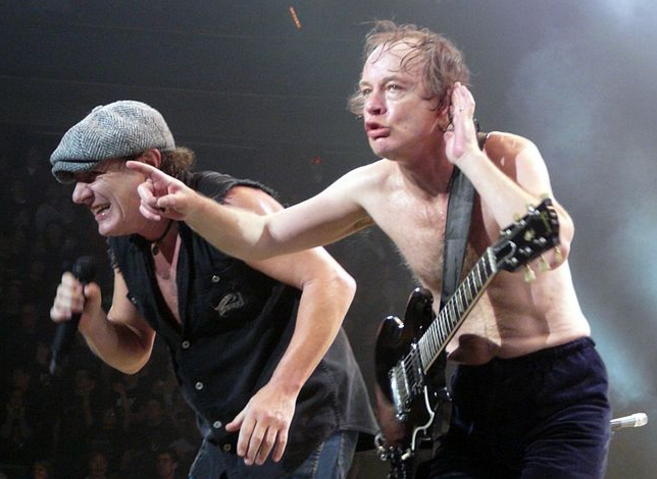
Last summer, Paul Marshall, a DJ at the classic rock station 100.7 KSLX in Phoenix Arizona, went the distance in trying to answer a question: how many AC/DC songs end in pretty much the same way? The result of his study is the supercut below. On his Facebook page, Marshall writes:
It took a LONG time to go through. I promise you, *no song was repeated.* These are all the final notes, of almost every AC/DC song ever recorded (very few songs in their history, fade out. They were omitted). They know how to end a song. That’s for sure. Feel free to share, steal, and give to your morning show without crediting me (you know who you are!). Annnd.…power chord!
All of this puts the quote attributed to Angus Young (AC/DC co-founder/guitarist) in a funny light: “I’m sick to death of people saying we’ve made 11 albums that sounds exactly the same, Infact, [sic] we’ve made 12 albums that sound exactly the same.”
If you would like to support the mission of Open Culture, consider making a donation to our site. It’s hard to rely 100% on ads, and your contributions will help us continue providing the best free cultural and educational materials to learners everywhere. You can contribute through PayPal, Patreon, and Venmo (@openculture). Thanks!
What’s it like inside the mind of theoretical physicist Stephen Hawking? Is it an electro-cosmic dance party narrated by Carl Sagan? I would like to think so. So would director Will Studd of Aardman Studios who created the hip promo video above, which also includes audio clips from Hawking himself and fellow physicists Brian Cox and Andrew Strominger, with music by Max Halstead. Pretty cool, but what’s it for?
Ask Hawking—or rather, read his paper (or one of the layfolk summaries), “Soft Hair on Black Holes,” which he posted a couple of weeks ago on Cornell University’s arXiv, an open access database of physics, mathematics, and other scientific research. Of Hawking and other physicists’ theory, Tia Ghose at Live Science writes, “black holes may sport a luxurious head of ‘hair’ made up of ghostly, zero-energy particles.” These “hairs” may store quantum information that would otherwise be lost forever. In the second part of his lecture, Hawking will expand on his theory of black hole radiation. Get a brief summary of that theory in the video clip above, and watch this space for Hawking’s sure-to-be-enlightening black hole lectures.
Those familiar with David Bowie lore may know one or two things about the recording of his seminal 1978 track “Heroes.” One is that the recording studio did, in fact, look out over the Berlin Wall and the lovers that Bowie saw made it into the lyrics (“I can remember standing by the wall/And the guns shot above our heads/And we kissed as though nothing could fall”). The other is the microphone set up in Hansa’s expansive recording studio: one next to Bowie’s mouth, another 15 — 20 feet away, and another at the far end of the room to catch the reverb. (Hands up how many of us learned about that when Steve Albini copied it for Nirvana’s “All Apologies”? Anybody?) But as this video above with producer Tony Visconti shows, that’s only a few of the magical inventions and daring decisions made for this recording. The session contains lessons for any young producer endlessly fiddling about with their ProTools and the millions of choices afforded by a $2.99 synth app for the iPad.
When Bowie added his vocals at the end of the recording session, there was only one track left on the tape, having filled up the 23 other tracks with the band’s backing track, Eno’s synths, extra percussion, three (!) tracks of Robert Fripp commanding the gods through his guitar pickup and feedback, and more. If they didn’t like the take, they’d erase over it with the new one. Those were the analog days. But as Visconti says, that scary decision electrified Bowie. As an artist, everything was at stake. It’s like they knew they were making a song for the ages. Maybe it’s Visconti’s 20/20 hindsight, but they were right.
But there’s so much more to be discovered among those 24 audio tracks of “Heroes.” In this wonderful BBC documentary from 2012 (also see up top), Visconti sits down with the digitally transferred master tapes and takes us through the construction of the song. Here we get to hear Robert Fripp’s raw guitar tracks which sound so incredibly abrasive it’s hard to believe they exist in the song; Visconti’s “cowbell,” which is him hitting a pipe outside in the yard; Eno’s synth in a briefcase, the EMS Synthi‑A; and numerous painterly daubs of audio that all make up the mix. And then there’s that vocal, which Visconti lets play without any of the music, a song for the history books, a voice that couldn’t be constrained to just one mic. The video unfortunately couldn’t be embedded on our site, but it’s definitely worth your time.
Ted Mills is a freelance writer on the arts who currently hosts the FunkZone Podcast. You can also follow him on Twitter at @tedmills, read his other arts writing at tedmills.com and/or watch his films here.
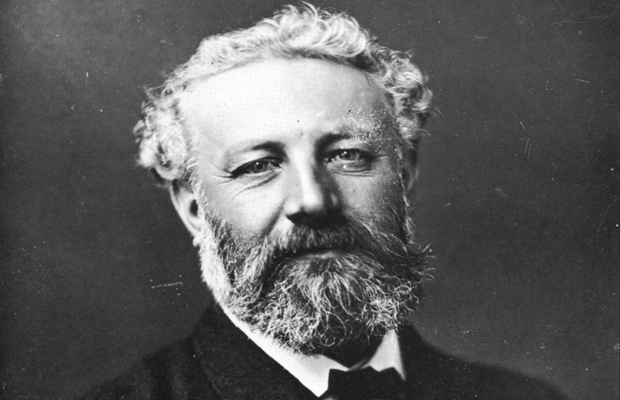
Science fiction, they say, doesn’t really deal with the future; it uses the setting of the future as a way to deal with the present. That would explain all the standard preposterous tropes you regularly see in the genre’s less gracefully aging novels and films: jetpacks, flying cars, holo-phones, that sort of thing. So when you look into sci-fi’s back pages and do come across the occasional accurate or even semi-accurate prediction of the future — that is, an accurate prediction of our present — it really jumps out at you. Many such predictions have jumped out at readers from the pages of Jules Verne’s lost second novel, Paris in the Twentieth Century.
Originally written in 1863 but not published until found at the bottom of a vault in 1994, the book’s scorecard of seemingly bang-on elements of the then-future include the explosion of suburban living and shopping and large-scale higher education; career women; synthesizer-driven electronic music and a recording industry to sell it; ever more advanced forms of ever cruder entertainment; cities of elevator-equipped, automatically surveilled skyscrapers electrically illuminated all night long; gas-powered cars, the roads they drive on, and the stations where they fill up; subways, magnetically-propelled trains, and other forms of rapid transit; fax machines as well as a very basic internet-like communication system; the electric chair; and weapons of war too dangerous to use.
You may sense that the young Verne did not see the future, which takes its form in the novel of Paris in 1960, as a utopia. In fact, he went a little too far in using the setting and its story of an artistic soul adrift in a culturally dead, progress-worshiping technocracy to express his own anxieties about the 19th century and its rise of conglomeration, automation, and mechanization — or so thought his publisher, who believed the book’s bleak predictions, even if accurate, would fail to win over the common reader. “My dear Verne,” he wrote in his rejection letter to the author, “even if you were a prophet, no one today would believe this prophecy… they simply would not be interested in it.”
But over 150 years later, the predictions of Paris in the Twentieth Century do interest us, or at least those of us who wonder whether we’ve handed too much of our humanity over to the realms of technology, finance, and entertainment. Even if Richard Bernstein, reviewing the novel in The New York Times when it finally saw publication, found its satire “weak, innocent and adolescent in light of what actually happened in the 20th century,” it has given us more than ever to talk about today. To get in on the conversation, have a listen to the episode of the Futility Closet podcast on the book just above. Do you think Verne accurately foresaw our current condition — or does his dystopia still lie in wait?
There are few things in life that I can enjoy uncritically—totally surrender to—and yet also appreciate as intellectually complex, finely-wrought works of art. The music of Kate Bush is one of those things. Her preternatural voice, sublimely ridiculous costumes, dance, and gesture, and haunting, literary lyricism immediately captivate the ear and eye—and work their magic on the mind not long after. It’s an unusual—I’d say extremely rare—set of qualities that set her apart from every pop star in the era of her prime and in our own. At the risk of drawing a perhaps too-easy comparison, but I think an apt one: as a solo artist she rivals maybe only David Bowie in her ability to own the spotlight and remain in total control of her sound and image. (Both of them, in fact, trained with the same dance teacher, Lindsay Kemp.)
But while Bowie made it look easy, and found ways to stay nearly-ever-present in every decade since the 70s, for Bush that control was hard won, and meant withdrawals from the public, including a 12-year break that, writes The Guardian, reminded some of “the mythological resonance of Bob Dylan’s Basement Tapes hiatus.” She has toured only twice: once at the very beginning of her career in 1979 and again, 35 years later, in 2014. Critics and die-hard fans have long speculated about the reasons for Bush’s withdrawal from performance and her general public reticence, but statements from the artist herself have made it clear that part of her struggle with stardom had to do with feeling exploited in the way so many women are by the music industry.
By the end of her lavish, 28-night 1979 extravaganza, she recalled, “I felt a terrific need to retreat as a person, because I felt that my sexuality, which in a way I hadn’t really had a chance to explore myself, was being given to the world in a way which I found impersonal.” “Bush,” The Guardian writes, “did everything she could to prevent herself being exposed in that way again.”
The move was both a loss and a gain for her fans. While her live shows might have become legendary in the way Bowie’s did over the years, her retreat into a private sphere all her own allowed her to continue writing and recording consistently brilliant, challenging music that never became compromised by industry hackwork, as she herself never became someone else’s product.
Her ability to assert herself so early in her career is also a testament to her creative confidence. Bush was only 19 years old when she released her first album, The Kick Inside, an age at which many emerging pop stars allow themselves to be commandeered by overbearing management. But she has remained relevant by remaining her—odd, enigmatic, totally original—self. “Artists shouldn’t be made famous,” she once remarked, “it is a forced importance.”
Before launching that first tour, and deciding it wasn’t for her, Bush made her first television appearance on a German program in 1978—see it at the top of the post. Rather than opening with “Wuthering Heights,” the song that did make her famous, she instead starts with the B‑side, “Kite.” But then we hear that familiar, tinkling piano intro, and she delivers the big single, wearing the flowing red gown she donned in the oft-parodied American video for the song (above). The weird and wonderful dance moves are a little subdued, but like all of her performances—in very rare stage appearances, numerous videos, and ten amazing albums—it’s glorious.
In her first American TV appearance, on Saturday Night Live later that same year, Bush sang “The Man With the Child in His Eyes” in the gold lamé bodysuit she wore in the song’s official video (above). Just one of the many fashion choices that, along with those uninhibited dance moves—“those weird, spastic, fantastic interpretive dance moves,” writes Matthew Zuras in an appreciation—later gave us unforgettable classics like the “Babooshka” video (below). We have this unique, uncompromising body of work both because a more adventurous music industry decided to invest in developing Bush’s talent in the early 70s, and because she refused, after all, to accede to that industry’s usual demands.
Past exploits include relieving actress Jennifer Garner of her engagement ring and basketball Hall-of-Famer Charles Barkleyof a thick bankroll. In 2001, he virtually picked former U.S. president Jimmy Carter’s Secret Service detail clean, netting badges, a watch, Carter’s itinerary, and the keys to his motorcade. (Robbins wisely steered clear of their guns.)
How does he does he do it? Practice, practice, practice… and remaining hyper vigilant as to the things commanding each individual victims’s attention, in order to momentarily redirect it at the most convenient moment.
Clearly, he’s a put lot of thought into the emotional and cognitive components. In a TED talk on the art of misdirection, above, he cites psychologist Michael Posner’s “Trinity Model” of attentional networks. He has deepened his understanding through the study of aikido, criminal history, and the psychology of persuasion. He understands that getting his victims to tap into their memories is the best way to temporarily disarm their external alarm bells. His easygoing, seemingly spontaneous banter is but one of the ways he gains marks’ trust, even as he penetrates their spheres with a predatory grace.
Watch his hands, and you won’t see much, even after he explains several tricks of his trade, such as securing an already depocketed wallet with his index finger to reassure a jacket-patting victim that it’s right where it belongs. (Half a second later, it’s dropping below the hem of that jacket into Robbins’ waiting hand.) Those paws are fast!
I do wonder how he would fare on the street. His act depends on a fair amount of chummy touching, a physical intimacy that could quickly cause your average straphanger to cry foul. I guess in such an instance, he’d limit the take to one precious item, a cell phone, say, and leave the wallet and watch to a non-theoretical “whiz mob” or street pickpocket team.
Though he himself has always been scrupulous about returning the items he liberates, Robbins does not withhold professional respect for his criminal brothers’ moves. One real-life whiz mobber so impressed him during a television interview that he drove over four hours to pick the perp’s brains in a minimum security prison, a confab New Yorker reporter Adam Green described in colorful detail as part of a lengthy profile on Robbins and his craft.
One small detail does seem to have escaped Robbins’ attention in the second demonstration video below, in which reporter Green willingly steps into the role of vic’. Perhaps Robbins doesn’t care, though his mark certainly should. The situation is less QED than XYZPDQ.
While you’re taking notice, don’t forget to remain alert to what a potential pickpocket is wearing. Such attention to detail may serve you down at the station, if not onstage.
Ayun Halliday is an author, illustrator, and Chief Primatologist of the East Village Inky zine. The sleeping bag-like insulating properties of her ankle-length faux leopard coat make her very popular with the pickpockets of New York. Follow her @AyunHalliday
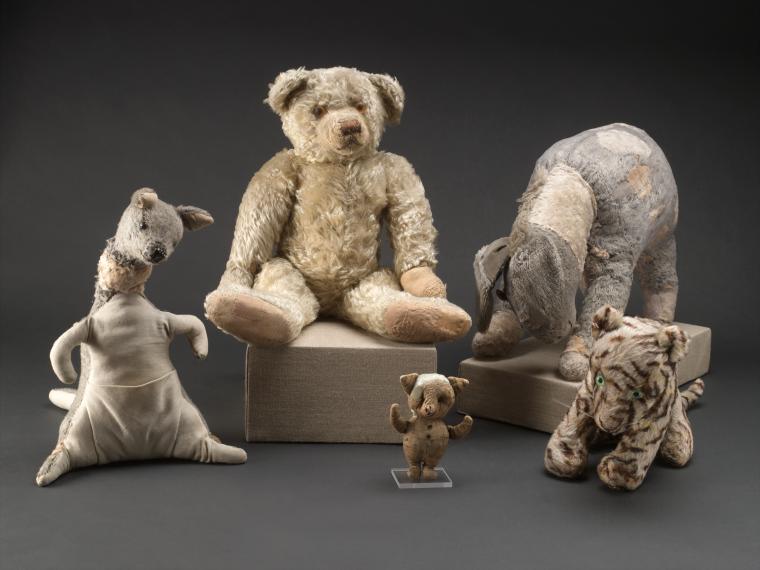
In the picture above, you can see the original Winnie the Pooh bear, joined by his friends Tigger, Kanga, Eeyore, and Piglet. They all now live at The New York Public Library, where kids and adults can see them on display. It should be noted that Roo isn’t in the picture because he was lost a long time ago. Meanwhile you won’t find Owl or Rabbit, because they weren’t originally based on stuffed animals.
If you would like to support the mission of Open Culture, consider making a donation to our site. It’s hard to rely 100% on ads, and your contributions will help us continue providing the best free cultural and educational materials to learners everywhere. You can contribute through PayPal, Patreon, and Venmo (@openculture). Thanks!
The Gong Show-worthy performance left host Johnny Carson—and presumably the majority of home viewers—speechless.
Was it comedy or a fading, mentally unbalanced novelty act’s attempt to rekindle the passion of a fickle spotlight?
Maybe just a particularly unbridled foray into new artistic territory… Like his elaborately formal manners, Tiny Tim’s usual repertoire harkened to an earlier period. (“No one knew more about old music than Tiny Tim,” Bob Dylan once remarked.)
His oddly demure comportment is in short supply here as he veers from his customary falsetto to a more manly lower register, stripping off jacket and braces to showcase a portly, middle aged mid-section. Musicianship also seems a bit wanting, though to be fair, that’s rarely the criteria by which we measure the success of an act that ends with writhing on the floor.
Whatever his intentions, Tiny Tim’s place in the annals of WTF performance history would be secured on this turn alone.
I wonder: do the fan bases of modern comedy and modern jazz overlap at all? At first, it’s hard to imagine two artistic worlds farther apart, with the comedians seeming like unserious goofballs who consider nothing sacred and the jazz players seeming like serious artists who regard their musical tradition as sacred indeed. But look closer and the difference doesn’t seem as stark as all that: comedy and jazz, both performative pursuits, demand from those who want to succeed in them an almost obsessive commitment to improving their craft. And the best practitioners of both, despite acknowledging the importance of learning and building upon the work of their antecedents, have to know when to break from tradition and experiment.
So perhaps H. Jon Benjamin’s new album Well, I ShouldHave…, which brings comedy and jazz together but not in the way any of us would have expected,comes as something of an inevitability. Benjamin, a comedian best known for doing voices on such animated shows as Archer, Bob’s Burgers, Dr. Katz: Professional Therapist and Home Movies, has put out not a record of sketches or stand-up material, but of actual jazz music, with him sitting at the piano. The comedic element? The album has a subtitle: … Learned to Play the Piano.
“I don’t play piano at all,” Benjamin deadpans in the trailer for Well, I Should Have…at the top of the post. “And I’m not a huge fan of jazz. I never was. And that’s why I thought it would be funny to make a jazz album.” To compensate for his total lack of skill or experience at his instrument, Benjamin brought three genuine jazz professionals into the studio to fill out the quartet: Scott Kreitzer on saxophone, David Finck on bass, and Jonathan Peretz on drums, all of whom do their best to build legitimate compositions around Benjamin’s near-random poking and slapping of the ivories. Here we see — or rather hear — revealed something else in common between comedians and jazz musicians: both need to improvise.
In the end, you could listen to this as either a conceptual comedy album, a conceptual jazz album, or both. You can hear selections from it (though, given the videos’ geo-restriction, that depends on which country you’re in) in the playlist just above. For most of us, showing up to a recording session completely ignorant of the instrument we have to play constitutes the stuff of nightmares, but Benjamin uses it as an opportunity to play a role he calls “Jazz Daredevil.” Does this count as real comedy? It certainly gets me laughing. I’ll leave the other obvious question to the serious jazz aficionados, who seem to enjoy only one thing almost as much as listening to jazz: arguing over what counts as jazz. If Benjamin has a particular joke to make with all this, it may be on them.
We knew David Bowie could pretty much do it all—glam rock, jazz, funk, Philly soul, cabaret, pop, drum and bass, folk, avant-garde, you name it. In front of the camera, he could stretch himself into the beautiful but wounded alien in The Man Who Fell to Earth, the scary-sexy-cool Goblin King of Labyrinth, the mystical genius Tesla in The Prestige. Nothing he attempted seemed beyond his grasp, including, as you can hear above, off-the-cuff, mostly spot-on impressions of friends and fellow singers like Iggy Pop, Lou Reed, Tom Waits, and Bruce Springsteen.
The audio clip you hear comes from outtakes producer Mark Saunders happened to capture on tape during the 1985 sessions for the Absolute Beginners film soundtrack (“a better soundtrack than it was a movie!” Saunders remarks).
While recording a lead vocal, Saunders writes, Bowie “broke into the impersonations and I realized that these might get erased at some point, so I quickly put a cassette in and hit ‘record.’” You can read his full recollections at The Talkhouse in a short essay he wrote to accompany the audio—introduced by Zach Staggers of indie band the So So Glos, who writes:
Bowie goes through a handful of sung impressions, including but not limited to, Bruce Springsteen, Iggy Pop, Tom Waits, Loud Reed and Anthony Newly, who was such a big influence on the iconic singer that the impersonation almost sounds like Bowie mimicking himself. Between takes you can hear Bowie having fun and going back and forth with the engineers. Jokes.
Bowie also does what sounds like Bob Dylan (or Tom Petty, or Marc Bolan as some have speculated?) in the second take and a passable Neil Young in the last. His Springsteen, Reed, and Pop are excellent (Bowie called the Iggy impression “difficult, he’s somewhere between all of them.”) He closes the impromptu performance with “That’s it, night night.”
Bowie did indeed have jokes, though anyone who followed him over the decades knows of his comedic talents, whether playing straight man to Ricky Gervais’ obnoxious superfan or displaying impeccable timing in his deadpan delivery of “Bowie Secrets” from Late Night With Conan O’Brien in 2002.
Despite the kiss-off he gives Gervais in their comedy bit, those who knew and worked with Bowie all testify that he never took himself too seriously or, as Saunders remembers, threw his weight around by “using a big rock star ‘Hey, I’m David Bowie and I want it done my way.” He may have seemed to many like an alien or a god, but he was apparently in person a pretty humble, and very funny, guy.
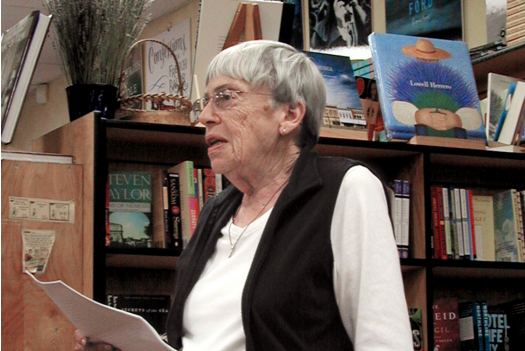
Though it’s sometimes regarded as a pretentious-sounding term for genre writers who don’t want to associate with genre, I’ve always liked the phrase “speculative fiction.” J.G. Ballard, Philip K. Dick, Shirley Jackson, Margaret Atwood, Neil Gaiman… A touch of surrealist humor, a highly philosophical bent, and a somewhat tragic sensibility can be found among them all, and also in the work of Ursula K. Le Guin, who does not shy away from the genre labels of science fiction and fantasy, but who approaches these categories in the way of, say, Virginia Woolf in her Orlando: as feminist thought experiments and fables about human ecological failings and inter-cultural potential.
That’s not to say that Le Guin’s writing is driven by political agendas, but that she has a very clear, uncompromising vision, which she has realized over the course of over five decades in novels, short stories, and children’s fiction. LeGuin’s writing takes us away from the familiar to worlds we recognize as alternatives to our own.
Like those in ancient epics, her characters undertake journeys to realms unknown, where they learn as much or more about themselves as about the alien inhabitants. And though we experience in her stories the thrill of discovery and danger common to fantasy and sci-fi, we also enter a world of ideas about who we are as human beings, and how we might be different. For Le Guin, fiction is a vessel that can carry us out of ourselves and return us home changed.
Le Guin stated last year that she no longer has the “vigor and stamina” for writing novels, and having given up teaching as well, said she missed “being in touch with serious prentice writers.” Thus, she decided to start an online writing workshop at the site Book View Café, describing it as “a kind of open consultation or informal ongoing workshop in Fictional Navigation.” In keeping with the metaphor of sea voyaging, she called her workshop “Navigating the Ocean of Story” and declared that she would not take reader questions about publishing or finding an agent: “We won’t be talking about how to sell a ship, but how to sail one.” Reader questions poured in, and Le Guin did her best to answer as many as she could, posting advice every other Monday for all of the summer and much of the fall of 2015.
The first question she received was a doozy—“How do you make something good?”—and her lengthy answer sets the tone for all of her counsel to follow. She is witty and honest, and surprisingly helpful, even when confronted with such a vague, seemingly unanswerable query. The dozens of questions she selected in the following weeks tend to deal with much more manageable issues of style and technique, and in each instance, Le Guin offers the querent a clear set of coordinates to help them navigate the waters of their own fictional journeys. Below are just a few choice excerpts from the many hundreds of words Le Guin generously donated to her reading community.
The problem of exposition:
In answers to two readers’ questions about providing sufficient backstory, Le Guin refers to an old New Yorker feature called “The Department of Fuller Explanation, where they put truly and grand examples of unnecessary explaining.” Most of us, Le Guin writes, “tend to live in the Department of Fuller Explanation” when writing; “We are telling ourselves backstory and other information, which the reader won’t actually need to know when reading it.”
To avoid the “Expository Lump or the Infodump,” as she calls it, Le Guin advises the writer to “decide—or find out when revising—whether the information is actually necessary. If not, don’t bother. If so, figure out how to work it in as a functional, forward-moving element of the story… giving information indirectly, by hint and suggestion.”
The problem of description:
When it comes to describing characters’ appearances, Le Guin suggests getting specific:
It’s not just facial features—a way of moving, a voice quality, can ’embody’ a character. Specific features or mannerisms (even absurdly specific ones!) can help fix a minor character in the reader’s mind when they turn up again…. To work on this skill, you might try describing people you see on the bus or in the coffee shop: just do a sentence about them in your head, trying to catch their looks in a few words.
The problem of setting:
Le Guin answers a reader who confesses to trouble with “world building” by pointing out the central importance of setting:
Event requires location. Where we are affects who we are, what we say and and do, how and why we say and do it. It matters, doesn’t it, whether we’re in Miami or Mumbai — even more whether we’re on Earth or in Made-Up Place? So, I don’t know if it would work to try and build up a world– “all those details” – and tack it onto what you’ve written. If inventing a world isn’t your thing, OK. Stick close to this world, or use readymade, conventional sf and fantasy props and scenery. They’re there for all of us to use.
The problem of dialogue:
Le Guin offers some very practical advice on how to make speech sound convincing and genuine:
All I can recommend is to read/speak your dialogue aloud. Not whispering, not muttering, OUT LOUD. (Virginia Woolf used to try out her dialogue in the bathtub, which greatly entertained the cook downstairs.) This will help show you what’s fakey, hokey, bookish — it just won’t read right out loud. Fix it till it does. Speaking it may help you to vary the speech mannerisms to suit the character. And probably will cause you to cut a lot. Good! Many contemporary novels are so dialogue-heavy they seem all quotation marks — disembodied voices yaddering on in a void.
Getting started:
Many readers wrote to ask Le Guin about their difficulty in getting a story started at all. She replied with the caveat that “no answer to this question is going to fit every writer.” While some writers work from “a rough sketch, notes as to where the story is headed and how it might get there, with more extended notes about the world it takes place in,” for others, “a complete outline is absolutely necessary before starting to write.” Whatever the method:
A story is, after all, and before everything else, dynamic: it starts Here, because it’s going There. Its life principle is the same as a river: to keep moving. Fast or slow, straight or erratic, headlong or meandering, but going, till it gets There. The ideas it expresses, the research it embodies, the timeless inspirations it may offer, are all subordinate to and part of that onward movement. The end itself may not be very important; it is the journey that counts. I don’t know much about “flow” states, but I know that the onward flow of a story is what carries a writer from the start to the end of it, along with the whole boatload of characters and ideas and knowledge and meaning — and carries the reader in the same boat.
There are dozens more questions from readers, and dozens more insightful, funny, and very helpful answers from Le Guin. Whether you are a writer of science fiction, fantasy, speculative fiction, or none of the above, much of her advice will apply to any kind of fiction writing you do—or will give you unique insights into the techniques and trials of the fiction writer. Read all of the questions and Le Guin’s answers in her “Navigating the Ocean of Story” posts at Book View Café.
We're hoping to rely on loyal readers, rather than erratic ads. Please click the Donate button and support Open Culture. You can use Paypal, Venmo, Patreon, even Crypto! We thank you!
Open Culture scours the web for the best educational media. We find the free courses and audio books you need, the language lessons & educational videos you want, and plenty of enlightenment in between.