Think back, if you will to the dawn of the 60’s, or failing that, the third season of Mad Men, when Broadway musicals could still be considered legitimate adult entertainment and Bye Bye Birdie was the hottest ticket in town.
The showcase also afforded the American viewing public their first glimpse of the man who would outlast Sullivan as a fixture in their living rooms, Hollywood’s most outrageous Square, Paul Lynde.
Lynde had his camp and ate it too in the role of a solidly Midwestern father of two who, by virtue of his association with his teenage daughter, finds himself appearing on none other than… The Ed Sullivan Show! It’s a truly meta moment. The studio audience seems to enjoy the joke, and Sullivan appears pleased too, when he wanders on after “Hymn for a Sunday Evening” as the song is properly called. According to his biography, Always on Sunday, his response upon first hearing was less enthusiastic. When the merry Broadway crowd turned to check Sullivan’s response to Lynde’s gulping final admission, (“I love you, Ed!”), Sullivan reported that he wanted the floor to open up and swallow both him and his wife.
Way to get with the joke, Ed!
Later in the episode, there’s some graceful Van Dyke footwork on “Put on a Happy Face,” a song that even the most seasoned theatergoers tend to forget originated with this show, probably because it does nothing to advance the plot.
Lynde and Van Dyke reprised their roles in the 1962 film, but in a typical tale of stage-to-screen heartbreak, Susan Watson, Lynde’s original Birdie daughter, was replaced by 22-year-old bombshell, Ann-Margret. (The deliciously bitchy remark Maureen Stapleton made about her at the wrap party turns out to be apocryphal, or at least intended more kindly than it would seem.) See what she brings to “Hymn for a Sunday Evening” below.
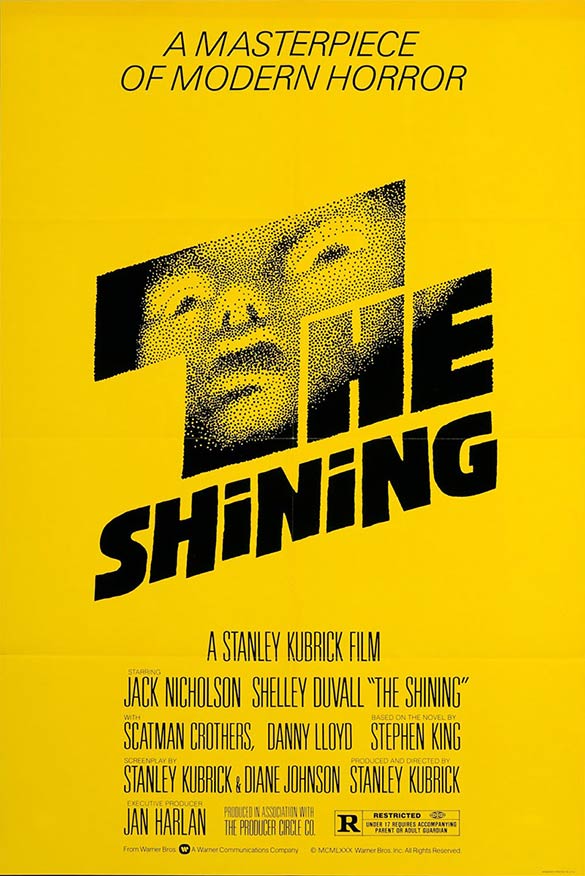
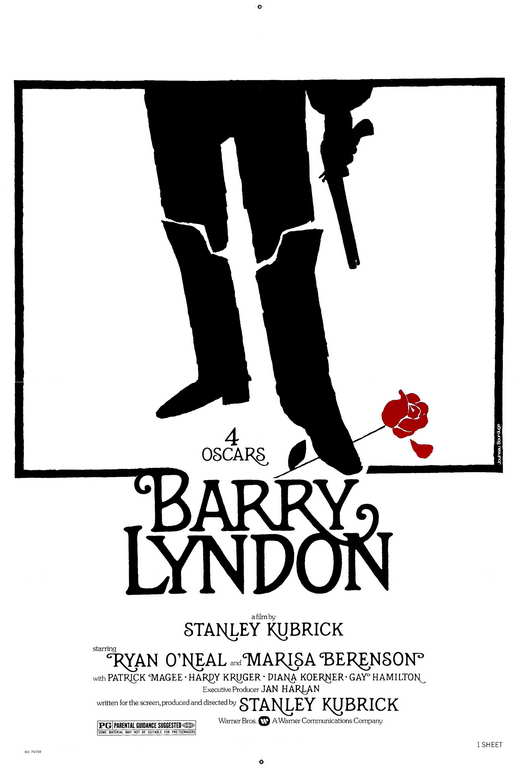
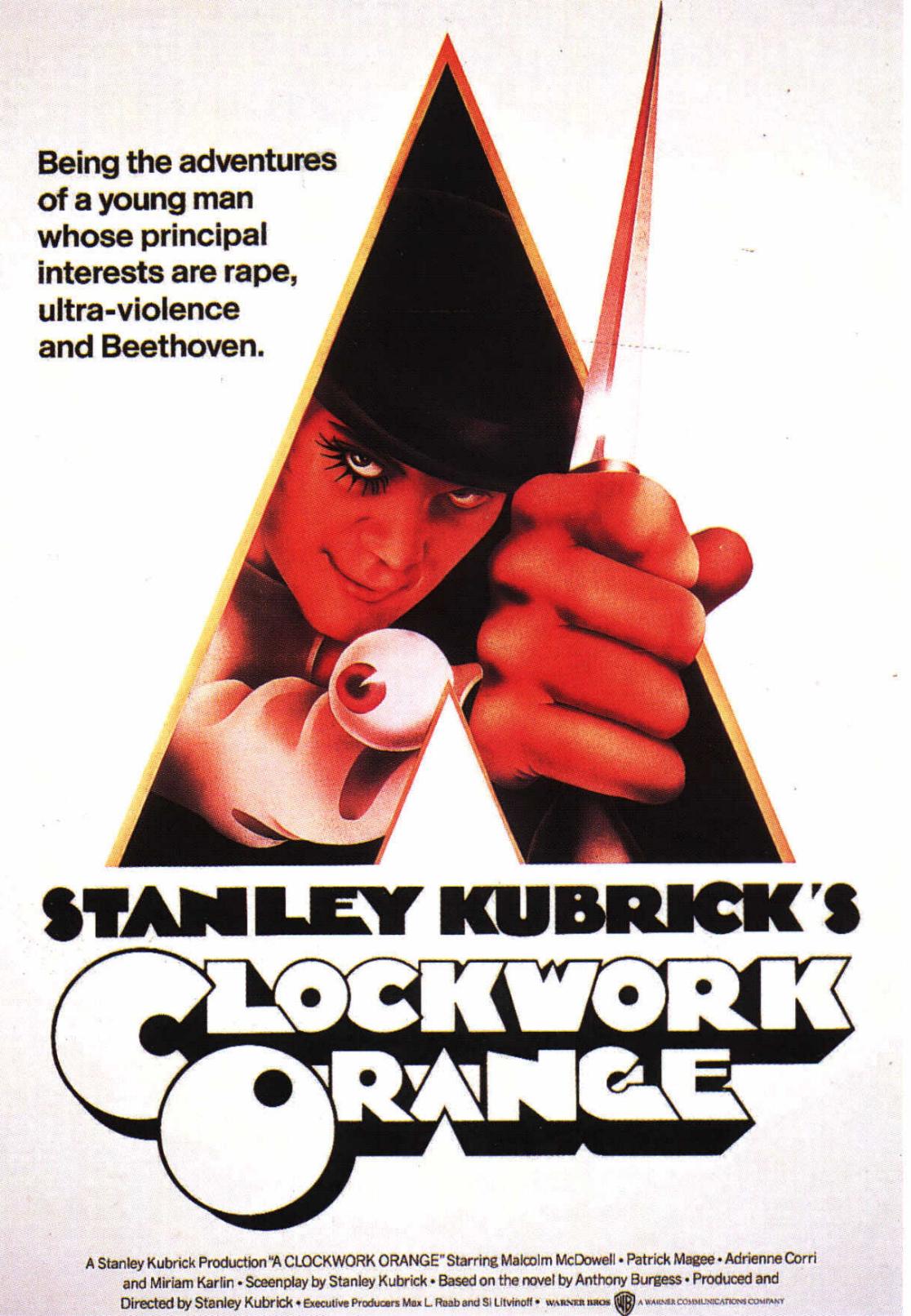
Stanley Kubrick’s perfectionism extended well beyond his films themselves. He even took pains to ensure the promotion of his projects with posters as memorable as the actual experience of watching them. The poster for Barry Lyndonremains perhaps the most elegant of all time, and who could forget the first time A Clockwork Orange’s promised audiences (or threatened audiences with the promise of) “the adventures of a young man whose principal interests are rape, ultra-violence, and Beethoven”? Though less often seen today, the bright yellow original poster for The Shining, with that unidentified pointillist face and its expression of shock, may well unsettle you more than even the film itself.
It came from the office of famous graphic designer Saul Bass, known not just for storyboarding Kubrick’s Spartacus but for creating the title sequences for movies like Otto Preminger’s The Man with the Golden Arm and Alfred Hitchcock’s Vertigo (whose poster Bass also designed), North by Northwest, and Psycho (whose immortal “shower scene” Bass may also have come up with). Kubrick rightly figured Bass had what it took to deliver the considerable impact of his psychological horror picture in graphic form.
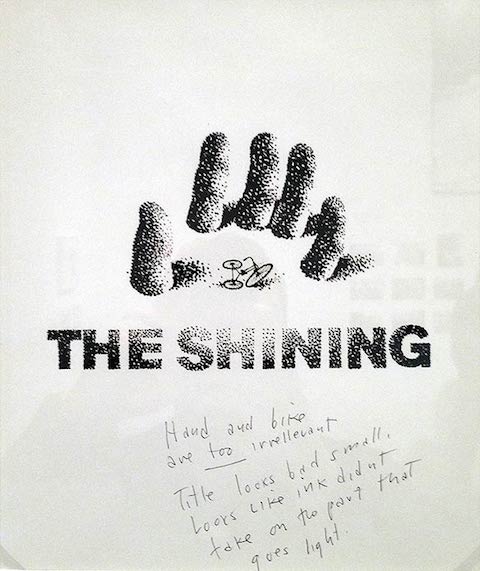
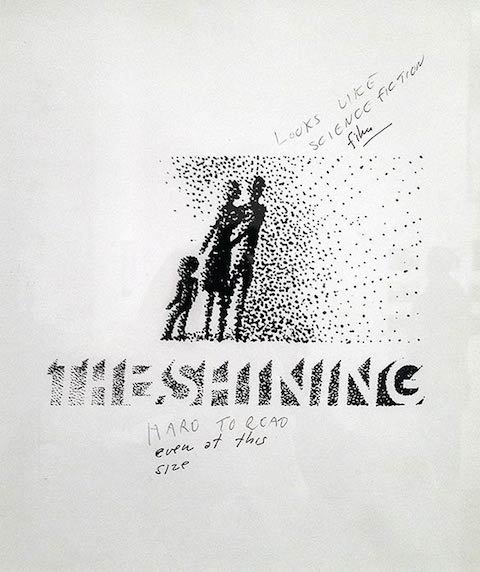
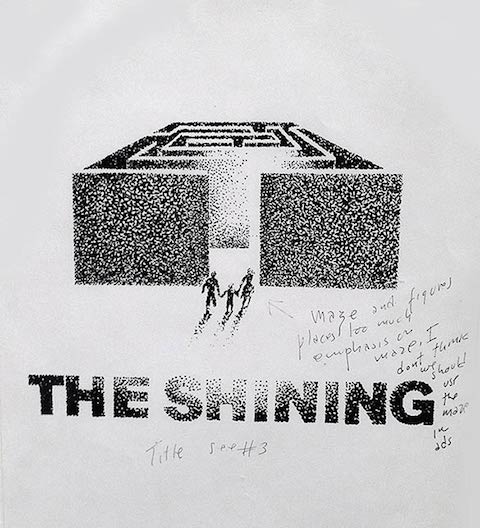
“This poster design wasn’t a ‘design and done’ deal however,” writes Derek Kimball in a DesignBuddy post on the evolution of the image. “Many of Bass’ concepts were rejected by Kubrick before settling on the final design.” You can see three of them here in this post, and the rest there. Each one includes Kubrick’s handwritten notes of objection: “hand and bike are too irrelevant,” “title looks bad small,” “too much emphasis on maze,” “looks like science fiction film,” “hotel looks peculiar.” You’ve got to admit that the man has a point in every case, although I suspect Bass knew in advance which design the auteur would, once through the wringer of revisions, have the least trouble with. “I am excited about all of them,” Bass writes, “and I could give you many reasons why I think they would be strong and effective identifiers for the film,” but one in particular, “provocative, scary, and emotional,” “promises a picture I haven’t seen before.”
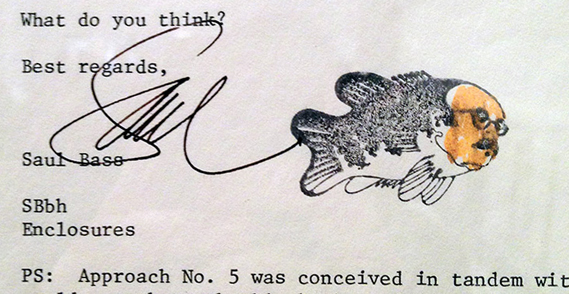
You have to appreciate that kind of confidence in his team’s work when dealing with such a famously exacting client — and, looking at the letter itself, you really have to have to appreciate the kind of confidence it takes to sign your name with a caricature of your own face on the body of your namesake fish.
Orson Welles once claimed that Gregg Toland, cinematographer for Citizen Kane, taught him everything he needed to know about shooting movies in a half hour. Director Robert Rodriguez — who started off as the poster boy for ‘90s indie cinema and is currently making a healthy living turning out movies like Sin City: A Dame to Kill For– claims that he can reduce that time by a third. In 10 Minute Film School, which you can watch above, Rodriguez quickly hits on some of the key points of movie making while espousing the same rebel DIY spirit that made him a success. Remember, this is a guy who made a feature film, El Mariachi, for $7000.
Rodriguez’s basic philosophy doesn’t dwell on learning the fine points of Aristotelian act structure or the technical nuances of the Red camera. He just wants you to start shooting stuff. “Don’t dream about being a filmmaker,” he proclaims in the video, which looks like it was shot some time during the Clinton administration. “You are a filmmaker. Now let’s get down to business.”
He tells aspiring filmmakers to become technical — learn the tools of the trade. If you don’t, you might become overly reliant on the techies who may or may not be interested in realizing your vision. He also doesn’t put too much stock in screenwriting books like Save the Cat. “Anyone know how to write?” he asks the audience. “No? Good. Everyone else writes the same way. Start writing your way. That makes you unique.”
He also advises against storyboards. “Make a blank screen for yourself and sit there and watch your movie. Imagine your movie, shot for shot, cut for cut…Write down the shots you see and then go get those shots.”
The video shows its age when Rodriguez starts to talk about equipment. No aspiring filmmaker aside from a celluloid fetishist is going to shoot a first feature on 16mm when cheaper, easier digital cameras are available. Yet the core of his message is still valid. “You don’t want anything too fancy,” he states over and over. Fancy equipment makes for lifeless, dull films, lacking in that reckless, adventurous spirit of the newbie moviemaker.
Essentially, Rodriguez wants to keep the “independent” in independent filmmaking. Just as he tells his charges to get technical, Rodriguez also tells them to keep their budgets low. The more money a studio sinks into a production, the more they can dictate how that money is spent. Rodriguez had a guitar case, a turtle and a small Texan town at his disposal when he was starting out, and, with that, he strung together the story of El Mariachi. In the 20 plus years since, Rodriguez has maintained creative control over just about all of his movies.
One final note. “Don’t bother going to film school,” he says. As someone with an overpriced MFA in film, I have to say that he’s probably right.
Jonathan Crow is a Los Angeles-based writer and filmmaker whose work has appeared in Yahoo!, The Hollywood Reporter, and other publications. You can follow him at @jonccrow. And check out his blog Veeptopus, featuring one new picture of a vice president with an octopus on his head daily.
Last week, America’s reigning bard of silly parody songs, “Weird Al” Yankovic scored his first number one album, Mandatory Fun. His vastly improved take on Robin Thicke’s catchy, if deeply creepy, earworm Blurred Lines alone might just be worth the price of the album. This weekend saw the release of the James Brown biopic Get On Up, starring Chadwick Boseman, Octavia Spencer and Dan Aykroyd. So we thought you all might be interested in watching Weird Al’s interview of the Godfather of Soul in 1986. You can watch it above.
Ok, so that interview didn’t actually happen. It was cobbled together to make it look like Weird Al was peppering the music legend with bizarre and inane questions. Example: “What was it like the very first time you sat in a bucket full of warm oatmeal?” or “What can you do with a duck that you can’t do with an elephant?”
Back in the ‘80s and early ‘90s when MTV played videos and not endless reality TV shows about the drunk and the vapid, Weird Al regularly hosted Al-TV, a parody of the music channel. Boasting the tagline “putting the ‘vid’ in video and the ‘odd’ in audio,” Al-TV featured skits, fake news reports and, of course, Weird Al’s trademark music video spoofs. It also featured dada-esque “interviews,” like the one with Brown. Below we have some more to check out, like this one where Weird Al ridicules that most dull and pompous of pop stars, Sting.
Weird Al’s interview with pop genius Prince is really odd, and not just because of Weird Al’s dopey questions — “What do you do when someone on the street gives you a piece of cheese?” Perhaps it’s that knowing smirk on Prince’s face. Or maybe it’s because the interview happens while surrounded by his well-coiffed entourage.
And finally, Weird Al doesn’t have to do much with Avril Lavigne. One suspects that the original interview would be pretty funny even without the jokes. At one point, Yankovic asks, “Can you ramble incoherently for a while about something that nobody cares about?”
Jonathan Crow is a Los Angeles-based writer and filmmaker whose work has appeared in Yahoo!, The Hollywood Reporter, and other publications. You can follow him at @jonccrow. And check out his blog Veeptopus, featuring one new picture of a vice president with an octopus on his head daily.
Have you heard of the Society for the Prevention of Cruelty to Long-Haired Men? If not, you can’t say you know all of David Bowie’s groups. Fifty years ago, in his very first television interview, Bowie appeared in the capacity of its spokesman, as well as that of “President of the International League for the Preservation of Animal Filament.” “I think we’re all fairly tolerant,” says the 17-year-old then known as David (or even Davey) Jones, “but for the last two years we’ve had comments like ‘Darling!’ and ‘Can I carry your handbag?’ thrown at us, and I think it just has to stop now.” Cliff Michelmore, host of the BBC program Tonight where this all went down in November 1964, asks if such behavior surprises him, because, “after all, you’ve got really rather long hair, haven’t you?” “We have, yes,” replies the proto-Bowie Bowie. “I think we all like long hair, and we don’t see why other people should persecute us because of this.”
The “we” to which he refers comprises all the equally mop-topped young dudes flanking him. Together, they would later appear on another BBC program, Gadzooks! It’s All Happening, as the group — this time musical — the Manish Boys, performing their big number, a cover of Bobby Bland’s “I Pity the Fool.” But according to the David Bowie FAQ, producer Barry Langford had, for that appearance, previously “insisted that David cut his 17” long hair,” resulting in the brief formation of the Society for the Prevention of Cruelty to Long-Haired Men and, consequently, “numerous newspaper reports… of course it was all a scam for some free publicity.” Whatever his style — and he’s had a few — Bowie has clearly always known how to work the ever-reengineered publicity machine. Sometimes he’s done it by going with the flow, but only partially, as we see here, where he and the Manish Boys sport roughly nine-inch hair rather than cuts to the harsh early-1960s standard. Bowie, never one of rock’s dedicated longhairs, can’t have found this too terribly oppressive in reality, although when he returned to the BBC 35 years later for a chat with the more strident Jeremy Paxman, he did so with a look that might have done the old Society proud.
Farmers like Derek Klingenberg know that you can enchant cows with music. Above, watch him start playing Lorde’s “Royals” on the trombone and the cows come a runnin’.
Working with his colleagues, Maximilian Schich, an art historian at the University of Texas at Dallas, took Freebase (Google’s “community-curated database of well-known people, places, and things”) and gathered data on 150,000 important artists and cultural figures who lived during the long arc of Western history (6oo BCE to 2012). The scholars then mapped these figures’ births and deaths (blue=birth, red=death) and traced their movements through time and place. The result is a 5‑minute animation (above), showing how the West’s great cultural centers shifted from Rome, eventually to Paris (circa 1789), and more recently to New York and Los Angeles. Maps documenting the flow of ideas and people in other geographies will come next.
According to NPR, “The models [used to create the videos] are the latest application of a rapidly growing field, called network science — which uses visualizations to find the underlying patterns and trends in complex data sets.” And they could yield some unexpected insights into the history of migration — for example, even with the advent of planes, trains and automobiles, modern artists don’t move too much farther from their birthplaces (an average of 237 miles) relative to the artsy types who lived in the 14th century (133 miles on average).
A complete report on the project was published in the journal Science by Schich and his colleagues. Unfortunately you’ll need a subscription to read it.
Earlier this year we featured the aesthetically radical 1929 documentary A Man with a MovieCamera. In it, director Dziga Vertov and his editor-wife Elizaveta Svilova, as Jonathan Crow put it, gleefully use “jump cuts, superimpositions, split screens and every other trick in a filmmaker’s arsenal” to craft a “dizzying, impressionistic, propulsive portrait of the newly industrializing Soviet Union.”
He mentioned then that no less authoritative a cinephilic institution than Sight and Sound named A Man with a Movie Camera, in their 2012 poll, “the 8th best movie ever made,” But now, in their new poll in search of the greatest documentary of all time, they gave Vertov’s film an even higher honor, naming it, well, the greatest documentary of all time. A Man with a Movie Camera, writes Brian Winston, “signposts nothing less than how documentary can survive the digital destruction of photographic image integrity and yet still, as Vertov wanted, ‘show us life.’ Vertov is, in fact, the key to documentary’s future.”
High praise indeed, though Sight and Sound’s critics make strong claims (with supporting clips) for the other 55 documentaries on the list as well. In the top ten alone, we have the following:
Shoah(Claude Lanzmann, France 1985). Lanzmann’s “550-minute examination of the Jewish Holocaust falls within the documentary tradition of investigative journalism, but what he does with that form is so confrontational and relentless that it demands to be described in philosophical/spiritual terms rather than simply cinematically.”
Sans soleil(Chris Marker, 1982). “It’s a cliché to say about a movie [ … ] that its true shape or texture is in the eye of the beholder – but it’s true of Sans soleil, which not only withstands multiple viewings, but never seems to be the same film twice. It addresses memory even as its different threads seem to forget themselves; it parses geopolitics without betraying any affiliation; it might be Marker’s most elaborately self-effacing film, or his most plangently personal.”
Night and Fog (Alain Resnais, 1955). “In 1945 moviegoers worldwide became familiar through weekly newsreels in their local cinemas with the unspeakable conditions in the recently liberated Nazi extermination camps. [ … ] Not, however, until Night and Fog (Nuit et brouillard), commissioned to mark the tenth anniversary of the Allied liberation of the most notorious camp, at Auschwitz, did film producers truly confront and define the moral and aesthetic parameters involved in treating such an intractable subject.”
The Thin Blue Line(Errol Morris, 1989). “A good prosecutor can put a guilty suspect behind bars, we hear in The Thin Blue Line, but it takes a great one to convict an innocent man. Something similar might be said of Errol Morris’s brilliantly unstable, highly influential investigation into the 1976 roadside shooting of a Texas cop and the wrongful conviction of one Randall Adams.” Demonstrating a miscarriage of justice is impressive, but it’s quite another thing to undermine the very notion of a stable truth.”
Chronicle of a Summer (Jean Rouch & Edgar Morin, 1961). Rouch and Morin “are the architects of a social collaboration and are rigorously open-handed with the materials they’re using. Their loose vox-pop style, beginning each encounter by asking whether the interviewee is happy, disarmingly mixes with scenes that show how cinema, in any regard, must be artificial – employing classic shot-reverse-shot techniques in otherwise uneventful conversational moments.”
Nanook of the North (Robert Flaherty, 1922). “Nanook of the North is notorious for its fakery, its open-faced igloo and cutesy depiction of the Inuit as untouched by Western culture. [But] Flaherty’s photography is beautiful, and his make-believe methods captured the traditional skills of Allakariallak’s ancestors on film before they died out altogether; to the cinema audiences of the time, Nanook was a journey to a foreign and fascinating place.”
The Gleaners and I(Agnès Varda, 2000). Varda’s “handheld DV autoportrait of the artist as an older woman,” though it “seems small and simple, albeit rigorous in its intimacy, brilliantly encompasses agriculture, art history, class politics, ecology, economics, recycling raps and (via an interview with a descendant of Louis Daguerre) the origins of cinema.”
Dont Look Back (D.A. Pennebaker, 1967). “The man born Robert Zimmerman knows well the value of obscuring myths and shifting personas, and part of the fascination of Pennebaker’s pioneering Direct Cinema account of Dylan’s 1965 tour of Britain is the way it captures the singer transforming on camera into ‘Dylan’, the unreachably cool, detached yet wired, lightning-in-a-bottle young genius who, as Greil Marcus memorably wrote, ‘seemed less to occupy a turning point in cultural space and time than to be that turning point.’ ”
Grey Gardens, (Albert and David Maysles, Ellen Hovde, Muffie Meyer, 1975). “Imagine if John Waters shot a script by Tennessee Williams and it was broadcast in a TV slot usually reserved for The Hoarder Next Door or How Clean Is Your House? [ … ] a fly-in-a-Harvey-Wallbanger look at the world of Jackie O.’s eccentric cousins, Big Edie and Little Edie (and their interloper, ‘the Marble Faun’). It’s fingernails-down-blackboard wonderful, as the Edies reminisce, sing, dance, yell at each other and watch approvingly as cats and raccoons befoul their rotting Long Island retreat.”
You can read up on the rest of the 50 greatest documentaries of all time, which range across the world, across history, and across the spectrum of truth and fiction, at Sight and Sound.
Anyone remember Michael Crichton’s Westworld (or the Simpsonsparody)? In this dystopian 1973 sci-fi, tourists visit a triumvirate of fantasy theme parks staffed by robotic historical re-enactors: Roman World, Medieval World, and the titular West World, with its “lawless violence on the American Frontier.” When a virus infects the parks’ androids, James Brolin must fight a ruthless robot gunslinger—played by a stone-faced Yul Brenner—to the death. The film may look laughably dated, but the fears it taps into are anything but: 2001, Terminator, Battlestar Galactica, I, Robot, and even a Westworldremake in the works—the perennial theme of man vs. machine, as old in film at least as Fritz Lang’s silent Metropolis, becomes ever more relevant in our drone-haunted world.
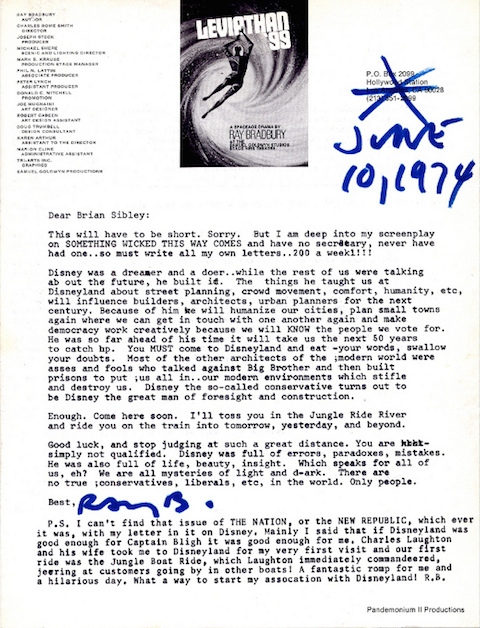
But are evil—or at least dangerously malfunctioning—robots something we should legitimately fear? Not according to visionary sci-fi author and Disney enthusiast Ray Bradbury in a letter to English writer Brian Sibley, penned in 1974, one year after the release of theme-park horror Westworld. The main body of Bradbury’s letter consists of a vigorous defense of Walt Disney and Disneyland, against whom “most of the other architects of the modern world were asses and fools.” Sibley recalls that his initial letter “expressed doubts about Disney’s use of Audio-Animatronic creations in Disneyland.” “At the time,” he explains, “I… had probably read too many sci-fi stories about the danger of robots taking over our human world—including, of course, some by Ray—and so saw it as a sinister rather than benign experiment.”
After his praise of Disney, Bradbury writes two agitated postscripts exploding what Sibley calls “ill-informed and prejudiced views” on robots. He classes automated entities with benign “extensions of people” like books, film projectors, cars, and presumably all other forms of technology. Notwithstanding the fact that books cannot actually wield weapons and kill people, Bradbury makes an interesting argument about fears of robots as akin to those that lead to censorship and enforced ignorance. But Bradbury’s counterclaim sounds a misanthropic note that nonetheless rings true given the salient examples he offers: “I am not afraid of robots,” he states, emphatically, “I am afraid of people, people, people.” He goes on to list just a few of the conflicts in which humans kill humans, religious, racial, nationalist, etc.: “Catholics killing Protestants… whites killing blacks… English killing Irish.…” It’s a short sampling that could go on indefinitely. Bradbury strongly implies that the fears we project onto robotic bogeymen are in reality well-grounded fears of each other. People, he suggests, can be monstrous when they don’t “remain human,” and technology—including robots—only assists with the necessary task of “humanizing” us. “Robots?” Bradbury writes, “God, I love them. And I will use them humanely to teach all of the above.”
Read a transcript of the letter below, courtesy of Letters of Note, and be sure to check out that site’s new book-length collection of fascinating historical correspondence.
June 10, 1974
Dear Brian Sibley:
This will have to be short. Sorry. But I am deep into my screenplay on SOMETHING WICKED THIS WAY COMES and have no secretary, never have had one..so must write all my own letters..200 a weekl!!!
Disney was a dreamer and a doer..while the rest of us were talking ab out the future, he built it. The things he taught us at Disneyland about street planning, crowd movement, comfort, humanity, etc, will influence builders architects, urban planners for the next century. Because of him we will humanize our cities, plan small towns again where we can get in touch with one another again and make democracy work creatively because we will KNOW the people we vote for. He was so far ahead of his time it will take is the next 50 years to catch up. You MUST come to Disneyland and eat your words, swallow your doubts. Most of the other architects of the modern world were asses and fools who talked against Big Brother and then built prisons to put us all up in..our modern environments which stifle and destroy us. Disney the so-called conservative turns out to be Disney the great man of foresight and construction.
Enough. Come here soon. I’ll toss you in the Jungle Ride River and ride you on the train into tomorrow, yesterday, and beyond.
Good luck, and stop judging at such a great distance. You are simply not qualified. Disney was full of errors, paradoxes, mistakes. He was also full of life, beauty, insight. Which speaks for all of us, eh? We are all mysteries of light and dark. There are no true conservatives, liberals, etc, in the world. Only people.
Best,
(Signed, ‘Ray B.’)
P.S. I can’t find that issue of THE NATION, of the NEW REPUBLIC, which ever it was, with my letter in it on Disney. Mainly I said that if Disneyland was good enough for Captain Bligh it was good enough for me. Charles Laughton and his wife took me to Disneyland for my very first visit and our first ride was the Jungle Boat Ride, which Laughton immediately commandeered, jeering at customers going by in other boats! A fantastic romp for me and a hilarious day. What a way to start my association with Disneyland! R.B.
P.S. Can’t resist commenting on you fears of the Disney robots. Why aren’t you afraid of books, then? The fact is, of course, that people have been afraid of books, down through history. They are extensions of people, not people themselves. Any machine, any robot, is the sum total of the ways we use it. Why not knock down all robot camera devices and the means for reproducing the stuff that goes into such devices, things called projectors in theatres? A motion picture projector is a non-humanoid robot which repeats truths which we inject into it. Is it inhuman? Yes. Does it project human truths to humanize us more often than not? Yes.
The excuse could be made that we should burn all books because some books are dreadful.
We should mash all cars because some cars get in accidents because of the people driving them.
We should burn down all the theatres in the world because some films are trash, drivel.
So it is finally with the robots you say you fear. Why fear something? Why not create with it? Why not build robot teachers to help out in schools where teaching certain subjects is a bore for EVERYONE? Why not have Plato sitting in your Greek Class answering jolly questions about his Republic? I would love to experiment with that. I am not afraid of robots. I am afraid of people, people, people. I want them to remain human. I can help keep them human with the wise and lovely use of books, films, robots, and my own mind, hands, and heart.
I am afraid of Catholics killing Protestants and vice versa.
I am afraid of whites killing blacks and vice versa.
I am afraid of English killing Irish and vice versa.
I am afraid of young killing old and vice versa.
I am afraid of Communists killing Capitalists and vice versa.
But…robots? God, I love them. I will use them humanely to teach all of the above. My voice will speak out of them, and it will be a damned nice voice.
Unmanned aerial vehicles, more colloquially known as drones, have drawn bad press in recent years: as the intrusive tools of the coming surveillance state, as deliverers of death from above in a host of war zones, as the purchase-delivering harbingers of world domination by Amazon.com. But as with any technology, you can also use drones for the good, or at least for the interesting. A number of urban photographers have attracted a great deal of attention in the past few months doing just that, buying or building camera-equipped drones of their own, taking to the skies above their cities, and capturing views of them we’d never see otherwise. I live in Los Angeles and like to think I explore its ever-more-revitalized downtown (from which I type this post) on a regular basis, but nearly every shot Ian Wood got in the early morning with his drone in the video above shows off an aesthetic element of the neighborhood I hadn’t noticed before.
Those of you who know Bangkok might feel startled to get the highly unusual view of it, nearly free of people provided by Coconuts TV, who took a camera drone out on a day when protesters shut down seven of the city’s most vital intersections. (It reminds me of a few favorite moments by that most celebrated Thai “auteur of languor,” Apichatpong Weerasethakul.) But you may have noticed that all the videos here focus on depopulated places, due most likely to the tricky host of applicable laws to do with privacy and aerial photography. So if you decide to film a drone flythrough of your own city, perhaps have a chat with your lawyer first.
On a recent road trip through the Deep South, I made a pilgrimage to several sacred shrines of American music, including obligatory stops in Memphis at the garish Graceland and unassuming Sun Studios. But the highlight of the tour had to be that city’s Stax Museum of American Soul Music (“nothing against the Louvre, but you can’t dance to Da Vinci”). Housed in a re-creation of the original Stax Records, the museum mainly consists of aisles of glass cases, in which sit instruments, costumes, and other memorabilia from artists like Booker T. and the MGs, Sam & Dave, The Staples Singers, and Isaac Hayes. One particular relic caught my attention for its radiating aura of authenticity—a battered first pressing of James Brown’s 1956 “Please, Please, Please,” the song that built the house of Brown and his backing singer/dancers the Famous Flames—a song, wrote Philip Gourevitch, that “doesn’t tell a story so much as express a condition.”
“Please, Please, Please” was not a Stax release, but the museum rightly claims it as a seminal “precursor to soul.” Brown bequeathed to sixties soul much more than his over-the-top impassioned delivery—he brought to increasingly kinetic R&B music a theatricality and showmanship that dozens of artists would strive to emulate. But no group could work a stage like Brown and his band, with their machine-like precision breakdowns and elaborate dance routines. And while it seems like Chadwick Boseman does an admirable impression of the Godfather of Soul in the upcoming Brown biopic Get on Up, there’s no substitute for the real thing, nor will there ever be another. By 1964, Brown and the Flames had worked for almost a decade to hone their act, especially the centerpiece rendition of “Please, Please, Please.” And in the ’64 performance above at the T.A.M.I.—or Teenage Awards Music International—at the Santa Monica Civic Auditorium, you can see Brown and crew for the first time do the so-called “cape act” (around 7:50) during that signature number. David Remnick describes it in his New Yorker piece on this performance:
…in the midst of his own self-induced hysteria, his fit of longing and desire, he drops to his knees, seemingly unable to go on any longer, at the point of collapse, or worse. His backup singers, the Flames, move near, tenderly, as if to revive him, and an offstage aide, Danny Ray, comes on, draping a cape over the great man’s shoulders. Over and over again, Brown recovers, throws off the cape, defies his near-death collapse, goes back into the song, back into the dance, this absolute abandonment to passion.
It’s an act Brown distilled from both charismatic Baptist church services and professional wrestling, and it’s a hell of a performance, one he pulled out, with all his other shimmying, strutting, moonwalking stops, in order to best the night’s lineup of big names like the Beach Boys, Chuck Berry, Marvin Gaye, the Supremes, and the Rolling Stones, who had the misfortune of having to follow Brown’s act. Keith Richards later called it the biggest mistake of their career. You can see why. Though the Stones put on a decent show (below), next to Brown and the Flames, writes Remnick, they looked bland and compromising—“Unitarians making nice.”
We're hoping to rely on loyal readers, rather than erratic ads. Please click the Donate button and support Open Culture. You can use Paypal, Venmo, Patreon, even Crypto! We thank you!
Open Culture scours the web for the best educational media. We find the free courses and audio books you need, the language lessons & educational videos you want, and plenty of enlightenment in between.