If you’re one of our philosophically-minded readers, you’re perhaps already familiar with Stanford professor John Perry. He’s one of the two hosts of the Philosophy Talk radio show that airs on dozens of public radio stations across the US. (Listen to a recent show here.) Perry has the rare ability to bring philosophy down to earth. He also, it turns out, can help you work through some worldly problems, like managing your tendency to procrastinate. In a short essay called “Structured Procrastination” — which Marc Andreessen (founder of Netscape, Opsware, Ning, and Andreessen Horowitz) read and called “one of the single most profound moments of my entire life” – Perry gives some tips for motivating procrastinators to take care of difficult, timely and important tasks. Perry’s approach is unorthodox. It involves creating a to-do list with theoretically important tasks at the top, and less important tasks at the bottom. The trick is to procrastinate by avoiding the theoretically important tasks (that’s what procrastinators do) but at least knock off many secondary and tertiary tasks in the process. The approach involves “constantly perpetrating a pyramid scheme on oneself” and essentially “using one character flaw to offset the bad effects of another.” It’s unconventional, to be sure. But Andreesen seems to think it’s a great way to get things done. You can read “Structured Procrastination” here.
Have your procrastination tips? Add them to the comments section below. Would love to get your insights.
When I was a child, my father, enchanted by the notion that I might someday provide live piano accompaniment to his evening cocktails, signed me up for lessons with a mild-mannered widow who—if memory serves—charged 50¢ an hour.
Had I only been forced to practice more regularly, I’d have no trouble remembering the exact price of these lessons. My memory would be a supremely robust thing of beauty. Ditto my math skills, my cognitive function, my ability to multitask.
Instead, my dad eventually conceded that I was not cut out to be a musician (or a ballerina, or a tennis whiz…) and Mrs. Arnold was out a pupil.
Would that I stuck with it beyond my halting versions of “The Entertainer” and “Für Elise.” According to the TED-Ed video above, playing an instrument is one of the very best things you can do for your brain. Talent doesn’t matter in this context, just ongoing practice.
Neuroscientists using fMRI (Functional Magnetic Resonance Imaging) and PET (Positron Emission Tomography) technology to monitor the brain activity of subjects listening to music saw engagement in many areas, but when the subjects traded in headphones for actual instruments, this activity morphed into a grand fireworks display.
(The animated explanation of the interplay between various musically engaged areas of the brain suggests the New York City subway map, a metaphor I find more apt.)
This massive full brain workout is available to anyone willing to put in the time with an instrument. Reading the score, figuring out timing and fingering, and pouring one’s soul into creative interpretation results in an interoffice cerebral communication that strengthens the corpus calossum and executive function.
Though to bring up the specter of another stereotype, stay away from the hard stuff, guys…don’t fry those beautiful minds.
If you’d like to know more about the scientific implications of music lessons, WBUR’s series “Brain Matters” has a good overview here. And good luck breaking the good news to your children.
On his web site, former Talking Heads frontman David Byrne writes:
I received this email last Friday morning from my friend, Brian Eno. I shared it with my office and we all felt a great responsibility to publish Brian’s heavy, worthy note. In response, Brian’s friend, Peter Schwartz, replied with an eye-opening historical explanation of how we got here. What’s clear is that no one has the moral high ground.
First comes Eno’s clearly heartfelt condemnation of civilian deaths in Gaza (particularly the death of children) and America’s apparent indifference to what’s happening there:
Today I saw a picture of a weeping Palestinian man holding a plastic carrier bag of meat. It was his son. He’d been shredded (the hospital’s word) by an Israeli missile attack — apparently using their fab new weapon, flechette bombs. You probably know what those are — hundreds of small steel darts packed around explosive which tear the flesh off humans. The boy was Mohammed Khalaf al-Nawasra. He was 4 years old.
I suddenly found myself thinking that it could have been one of my kids in that bag, and that thought upset me more than anything has for a long time.
Then I read that the UN had said that Israel might be guilty of war crimes in Gaza, and they wanted to launch a commission into that. America won’t sign up to it.
What is going on in America? I know from my own experience how slanted your news is, and how little you get to hear about the other side of this story. But — for Christ’s sake! — it’s not that hard to find out. Why does America continue its blind support of this one-sided exercise in ethnic cleansing? WHY?
What follows is part of futurist Peter Schwartz’s response, which, rich in historical detail, splits the blame somewhere down the middle. Echoing Byrne’s sense that the two sides have lost their moral positions, Schwartz notes:
Even though I have no support for the Israeli position I find the opposition to Israel questionable in its failure to be similarly outraged by a vast number of other moral horrors in the recent past and currently active. Just to name a few; Cambodia, Tibet, Sudan, Somalia, Nicaragua, Mexico, Argentina, Liberia, Central African Republic, Uganda, North Korea, Bosnia, Kosovo, Venezuela, Syria, Egypt, Libya, Zimbabwe and especially right now Nigeria. The Arab Spring, which has become a dark winter for most Arabs and the large scale slaughter now underway along the borders of Iraq and Syria are good examples of what they do to themselves. And our nations, the US, the Brits, the Dutch, the Russians and the French have all played their parts in these other moral outrages. The gruesome body count and social destruction left behind dwarfs anything that the Israelis have done. The only difference with the Israeli’s is their claim to a moral high ground, which they long ago left behind in the refugee camps of Lebanon. They are now just a nation, like any other, trying to survive in a hostile sea of hate.
We should be clear, that given the opportunity, the Arabs would drive the Jews into the sea and that was true from day one. There was no way back from war once a religious state was declared. So Israel, once committed to a nation state in that location and granted that right by other nations have had no choice but to fight. In my view therefore, neither side has any shred of moral standing left, nor have the nations that supported both sides…
I don’t think there is any honor to go around here. Israel has lost its way and commits horrors in the interest of their own survival. And the Arabs and Persians perpetuate a conflict ridden neighborhood with almost no exceptions, fighting against each other and with hate of Israel the only thing that they share.
Any serious reader of Haruki Murakami — and even most of the casual ones — will have picked up on the fact that, apart from the work that has made him quite possibly the world’s most beloved living novelist, the man has two passions: running and jazz. In his memoir What I Talk About When I Talk About Running, he tells the story of how he became a runner, which he sees as inextricably bound up with how he became a writer. Both personal transformations occurred in his early thirties, after he sold Peter Cat, the Tokyo jazz bar he spent most of the 1970s operating. Yet he hardly put the music behind him, continuing to maintain a sizable personal record library, weave jazz references into his fiction, and even to write the essay collections Portrait in Jazz and Portrait in Jazz 2.
“I had my first encounter with jazz in 1964 when I was 15,” Murakami writes in the New York Times. “Art Blakey and the Jazz Messengers performed in Kobe in January that year, and I got a ticket for a birthday present. This was the first time I really listened to jazz, and it bowled me over. I was thunderstruck.” Though unskilled in music himself, he often felt that, in his head, “something like my own music was swirling around in a rich, strong surge. I wondered if it might be possible for me to transfer that music into writing. That was how my style got started.”
He found writing and jazz similar endeavors, in that both need “a good, natural, steady rhythm,” a melody, “which, in literature, means the appropriate arrangement of the words to match the rhythm,” harmony, “the internal mental sounds that support the words,” and free improvisation, wherein, “through some special channel, the story comes welling out freely from inside. All I have to do is get into the flow.”
With Peter Cat long gone, fans have nowhere to go to get into the flow of Murakami’s personal jazz selections. Still, at the top of the post, you can listen to a playlist of songs mentioned in Portrait in Jazz, featuring Chet Baker, Charlie Parker, Stan Getz, Bill Evans, and Miles Davis. (You can find another extended playlist of 56 songs here.) Should you make the trip out to Tokyo, you can also pay a visit to Cafe Rokujigen, profiled in the short video just above, where Murakami readers congregate to read their favorite author’s books while listening to the music that, in his words, taught him everything he needed to know to write them. And elsewhere on the very same subway line, you can also visit the old site of Peter Cat: just follow in the footsteps taken by A Geek in Japan author Héctor García, who set out to find it after reading Murakami’s reminiscences in What I Talk About When I Talk About Running. And what plays in the great eminence-outsider of Japanese letters’ earbuds while he runs? “I love listening to the Lovin’ Spoonful,” he writes. Hey, you can’t spin to Thelonious Monk all the time.
The Clash had been called sellouts ever since they signed with CBS and made their 1977 debut, so the charge was pretty stale when certain critics lobbed it at their turn to disco-flavored new wave and “arena rock” in 1982’s popular Combat Rock. As Allmusic writes of the record, “if this album is, as it has often been claimed, the Clash’s sellout effort, it’s a very strange way to sell out.” Combat Rock’s hits—“Rock the Casbah” and “Should I Stay or Should I Go”—are catchy and anthemic, respectively, but this hardly breaks new stylistic ground, though the sounds are cleaner and the influences more diffuse. But the true standouts for my money—“Straight to Hell” and “Ghetto Defendant”—perfect the strain of reggae-punk The Clash had made their career-long experiment.
The latter track, a midtempo dub take on the pathos of heroin addiction and underclass angst, features a cameo spoken-word vocal from Allen Ginsberg, who co-wrote the song with Joe Strummer. Far from simply lending the song Beat cred—as Burroughs would for a string of artists, to varying degrees of artistic success—the Ginsberg appearance feels positively essential, such that the poet joined the band on stage during the New York leg of their tour in support of the album.
But before “Ghetto Defendant,” there was “Capitol Air,” a composition of Ginsberg’s own that he performed impromptu with the band in New York in 1981. As Ginsberg tells it, he joined the band backstage during one of their 17 shows at Bonds Club in Times Square during the Sandinista tour. Strummer invited the poet onstage to riff on Central American politics, and Ginsberg instead taught the band his very own punk song, which after 5 minutes of rehearsal, they took to the stage and played.
Just above, hear that onetime live performance of “Capitol Air,” one of those anti-authoritarian rants Ginsberg turned into an art form all its own—ripping capitalists, communists, bureaucrats, and the police state—as the band backs him up with a chugging three-chord jam. Ginsberg wrote the song, according to the Allen Ginsberg Project, in 1980, after returning from Yugoslavia and “realizing that police bureaucracies in America and in Eastern Europe were the same, mirror images of each other finally,” a feeling captured in the lines “No Hope Communism, No Hope Capitalism, Yeah. Everybody is lying on both sides.” Many of these same themes worked their way into “Ghetto Defendant,” written and recorded six months later.
Here you can hear the Combat Rock album version of “Ghetto Defendant.” (The track appeared in longer form on the record’s first, unreleased, incarnation, Rat Patrol From Fort Bragg). Ginsberg’s contributions to the track, which he intones as “the voice of God,” match his free-associative dark humor against Strummer’s narrative concreteness. Off the wall hipster lines like “Hooked on necropolis,” “Do the worm on the acropolis” and “Slamdance the cosmopolis” become elliptical references to Arthur Rimbaud, Salvadorian death squads, and Afghanistan before Ginsberg launches into the Buddhist heart sutra over Strummer’s final chorus. The effect is comic, hypnotic, and disorienting, reminiscent of the sample-based electronic collages groups like Cabaret Voltaire and Throbbing Gristle constructed around the same time. It’s such a perfect symbiosis that the song loses much of its impact without Ginsberg’s nutty offerings, I think, though you can judge for yourself in the live, Ginsberg-less version below.
“I probably worry less about the real future than the average person,” says William Gibson, the man who coined the term “cyberspace” and wrote books like Neuromancer, Idoru, and Pattern Recognition. These have become classics of a science-fiction subgenre branded as “cyberpunk,” a label that seems to pain Gibson himself. “A snappy label and a manifesto would have been two of the very last things on my own career want list,” he says to David Wallace-Wells in a 2011 Paris Review interview. Yet the popularity of the concept of cyberspace — and, to a great extent, its having become a reality — still astonishes him. “I saw it go from the yellow legal pad to the Oxford English Dictionary, but cyberspace is everywhere now, having everted and colonized the world. It starts to sound kind of ridiculous to speak of cyberspace as being somewhere else.” A dozen years earlier, in Mark Neale’s biographical documentary No Maps for These Territories, the author tells of how he first conceived it as “an effective buzzword,” “evocative and essentially meaningless,” and observes that, today, the prefix “cyber-” has very nearly gone the way of “electro-”: just as we’ve long since taken electrification for granted, so we now take connected computerization for granted.
“Now,” of course, means the year 1999, when Neale shot the movie’s footage. He did it almost entirely in the back of a limousine, tricked out for communication and media production, that carried Gibson on a road trip across North America. The long ride gives us an extended look into Gibson’s curious, far-reaching mind as he explores issues of the inevitability with which we find ourselves “penetrated and co-opted” by our technology; growing up in a time when “the future with a capital F was very much a going concern in North America”; the loss of “the non-mediated world,” a country to which we now “cannot find our way back”; the modern reality’s combination of “a pervasive sense of loss” and a Christmas morning-like “excitement about what we could be gaining”; his early go-nowhere pastiches of J.G. Ballard and how he then wrote Neuromancer as an approach to the “viable but essentially derelict form” of science fiction; his fascination with the sheer improbability of those machines known as cities; and his mission not to explain our moment, but to “make it accessible,” finding the vast, near-incomprehensible structure underlying the pounding waves of thought, trend, and technology through which we all move. Watching No Maps for These Territories here in cyberspace, I kept forgetting that Gibson said these things a tech-time eternity ago, so pertinent do they sound to thismoment. And happiness, as he puts it in one aside, “is being in the moment.”
Ever since the advent of YouTube and the release of Thom Andersen’s Los Angeles Plays Itself, the video essay about filmmaking has blossomed on the internet. When these essays are good, they force you to look at movies anew. Kogonada’s brilliant interrogation of Stanley Kubrick’s use of one-point perspective, Matt Zoller Seitz’s dissection of Wes Anderson’s cinematic style and, in a completely different tone, Red Letter Media’s blistering, exhaustive take down of George Lucas’s regrettable Star Warsprequels, all argue convincingly that perhaps the best way to discuss the merits and flaws of a movie or filmmaker is through the medium of film itself.
Add to this list Tony Zhou’s Every Frame a Picture. An editor by trade, Zhou has created a series of videos about how the masters of cinema use the basic elements of cinema – the duration of a shot, the application of sound, the use of a tracking shot. In his elegant videos he makes arguments that are unexpected. Martin Scorsese, for instance, who is famous for his groundbreaking use of music, is just as brilliant with his judicious use of silence. You can watch it above.
And below, Zhou argues that Steven Spielberg, a filmmaker not commonly associated with restraint, is actually a master of the understated long take.
And in this video, he argues that while Michael Bay might make adolescent, over-stuffed, soulless spectacles, he does know how to construct a shot.
You can nerd out and watch even more of Zhou’s films here.
Jonathan Crow is a Los Angeles-based writer and filmmaker whose work has appeared in Yahoo!, The Hollywood Reporter, and other publications. You can follow him at @jonccrow. And check out his blog Veeptopus, featuring pictures of vice presidents with octopuses on their heads.
Here is how MetropolisTV, a global collective of young filmmakers and TV producers coming out of Holland, sets up their touching video:
Farmer N’Da Alphonse grows cocoa [in the Ivory Coast] and has never seen the finished product. “To be honest I do not know what they make of my beans,” says farmer N’Da Alphonse. “I’ve heard they’re used as flavoring in cooking, but I’ve never seen it. I do not even know if it’s true.”
It’s great — and yet, in its own way, sad — to watch his face light up as he gets his very first taste…
1974 was a cynical time. That was the year that Nixon resigned after the grueling Watergate scandal, Vietnam War was finally grinding to a halt and, thanks to the Oil Shock of ’73, the economy was in the toilet. It was also a time when TV execs were scrambling to keep up with America’s rapidly changing cultural tastes. Audiences wanted something with a little edge. The TV adaptation of Robert Altman’s lacerating war comedy MASH became a huge hit. As did All in the Family, about everyone’s favorite armchair bigot Archie Bunker. Saturday Night Live was just a year away from premiering. So it isn’t surprising that execs from ABC approached the “usual gang of idiots” at Mad Magazine — that fount of anti-authoritarian satire — about making a series. The resulting pilot, which was later rebranded as a TV special, never aired because it provided way too much edge for the network. You can watch it above.
The show, culled from some of the better bits from the magazine, features art from Don Martin, Mort Drucker, Al Jaffee and Dave Berg – names that will be very familiar to you if you grew up obsessively reading the magazine as a child, like I did – and the animation was supervised by Jimmy Murakami along with Chris Ishii and Gordon Bellamy.
The network claimed that the show was shelved because it had too much “adult” humor. In this post-South Park, post-Family Guy world, the adult humor in this show, by comparison, seems downright tame. What the Mad Magazine TV Special does have in abundance is withering barbs. Something about translating the cynical, adolescent humor of the magazine from the page to screen made its satire feel much, much sharper. During their parody of The Godfather, called the Oddfather, mafia don Vito Minestrone (groan) tells a group of mobsters that their gang war must stop. “We must stop destroying each other and start destroying the plain, ordinary citizens again. Like normal American businessmen.”
The show’s most caustic zingers, however, are reserved for America’s bloated, complacent auto industry where a Walter Cronkite-like journalist interviews auto exec Edsel Lemon. In five or so minutes, the bit unsparingly lays out why GM and Ford eventually lost out to Toyota and Honda – crappy cars, lousy safety, and an upper management that was as mendacious as it was shortsighted. While field testing a new model, which involved coasting the car down a hill, Lemon quips, “If our prototype can go 500 feet without falling apart we’ll put it into production.” This seemingly explains how the Ford Pinto got made.
In the end, the networks squeamishness with the show was more due to its ridicule of an industry with deep pockets than with its toilet humor. As Dick DeBatolo, the MAD’s maddest writer, who penned much of the show noted, “Nobody wanted to sponsor a show that made fun of products that were advertised on TV, like car manufacturers.”
Jonathan Crow is a Los Angeles-based writer and filmmaker whose work has appeared in Yahoo!, The Hollywood Reporter, and other publications. You can follow him at @jonccrow. And check out his blog Veeptopus, featuring pictures of vice presidents with octopuses on their heads.
The Partially Examined Life, The History of Philosophy Without Any Gaps, Philosophy Bites, Philosophize This!: we’ve featured quite a few entertaining and educational fruits of the still-new discipline of podcasting’s inclination toward the very old discipline of philosophy. But the podcast has proven an even better fit for comedians than it has for philosophers. Even if you’ve never downloaded an episode in your life, you’ve almost certainly heard about the medium-legitimizing successes of intelligent, conversational, highly opinionated, or otherwise unconventional funnymen like Ricky Gervais with The Ricky Gervais Show, Adam Carolla with his also-eponymous podcast, and Marc Maron with WTF. Yet nobody dared to explicitly cross podcasting’s comedic and philosophical strengths until last year, when Danny Lobell launched Modern Day Philosophers(web site — itunes — soundcloud).
Lobell, himself a pioneer in not just philosophical comedy podcasting but comedy podcasting, and indeed podcasting itself, began his comic-interviewing show Comical Radio a decade ago. “As podcasting grew in popularity,” he writes, “many celebrity comedians started doing similar shows to the one I was doing. [ … ] Before I knew it, what I had once felt was a unique and important undertaking now no longer seemed like it served a purpose in the universe for me.” This dark night of the soul saw him move from New York to Los Angeles, this cradle of so many podcasts comedic and otherwise, where he turned his attention back toward the subjects he neglected in school. He paid special attention to philosophy, but struggled to understand the material. “I realized that my friends, stand up comedians, would make great study partners. I’ve often heard us referred to as the philosophers of our day which I figured sounded like a good enough excuse to approach them.”
And so Lobell has produced 40 episodes and counting featuring philosophical discussions conducted with some of today’s sharpest comics, many of them star podcasters in their own right. One recent conversation finds Lobell in conversation about John Cage — a philosophical figure too often dismissed as primarily an artist — with the cerebral, chance-oriented, and somewhat askew Reggie Watts (top). (The pairing makes especially good sense, since Cage influenced Brian Eno, and Watts has publicly discussed Eno’s influence on his own act.) A few months ago, Lobell talked the suicide-minded Arthur Schopenhauer with the once-suicide-minded Artie Lange (middle). And he even brings in elder statesmen of comedy to talk about matters eternal, such as Carl Reiner on religion, prayer and memory as reflected upon by Maimonides (above). Each episode contains a healthy consideration of not just the work of the philosopher in question, but that of the comedian as well. Personally, I can’t wait to hear what Yakov Smirnoff has to say about his fellow Russian artist-philosopher of note, Fyodor Dostoyevsky.
Martin Scorsese’s mean streets are as long gone as graffiti-festooned subway trains, the real Max’s Kansas City, and Yogi Berra’s pennant-winning Mets. But while the 1973 film that broke open his career is now over forty years old, Scorsese hasn’t looked back, nor has he stayed trapped in the rough milieu of New York gangster films. He’s adapted Edith Wharton, told stories of the Dalai Lama, Howard Hughes, handfuls of rock and blues stars, and cinematic hero Georges Méliès (sort of).
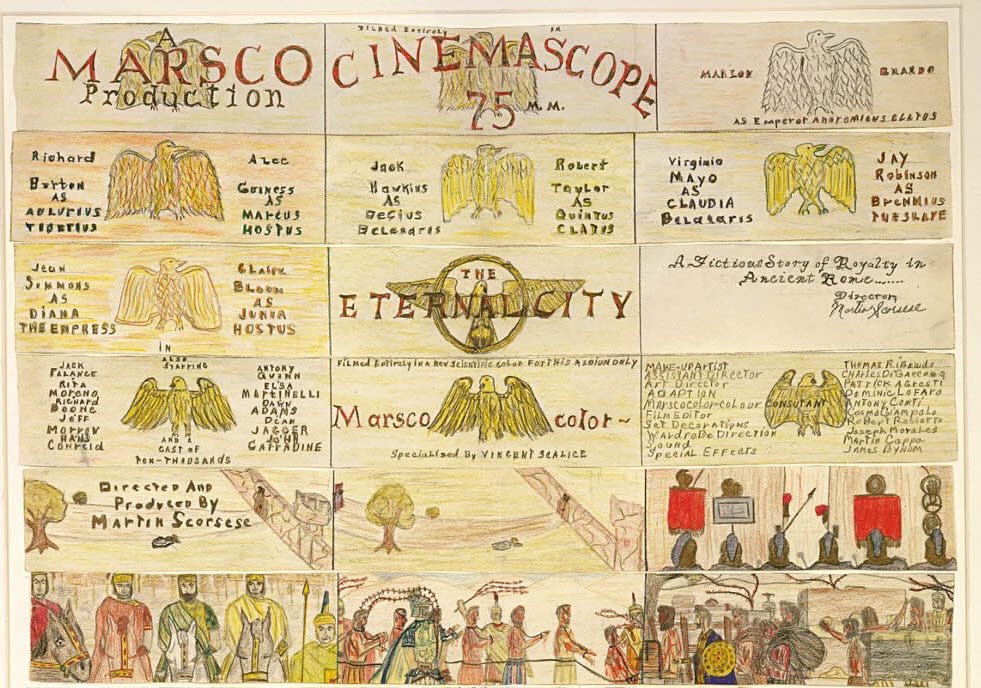
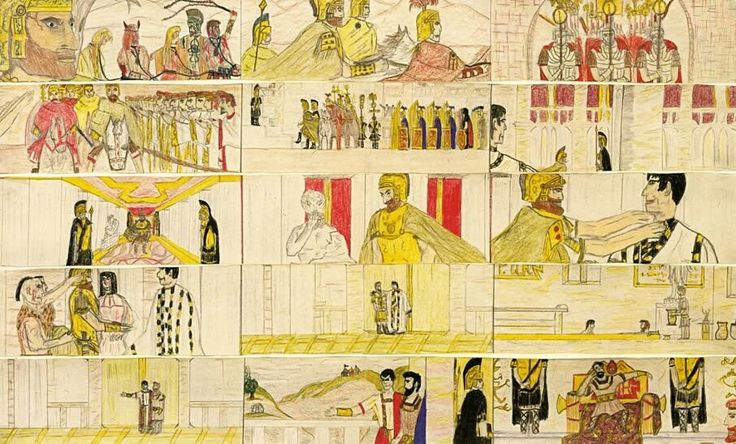
Last year’s The Wolf of Wall Street further cemented Scorsese’s reputation as a director with more breadth than almost any of his contemporaries. But it would perhaps be a mistake to call Scorsese’s genre-hopping an evolutionary development. The series of storyboards here for an imagined widescreen Roman epic called The Eternal City— drawn by 11-year-old Scorsese—show us that his vision always exceeded the cramped Little Italy streets of his youth.
Young Scorsese described his Cecil B. Demille-like production as “A fictitious story of Royalty in Ancient Rome,” and though he didn’t give us character names, he made sure to specify the film’s actors, casting Marlon Brando, Richard Burton, Virginia Mayo, and Alec Guinness, among others. As for Scorsese’s own role, The Independent notes, “it is striking that he has given himself a bigger credit as producer-director than any of the stars.” Reproduced in David Thompson’s series of interviews, Scorsese on Scorsese, the drawings’ impressive level of detail demonstrate a precocious eye for shot composition and the dramatic perspectives that characterize his mature work.
The director of such meticulously composed films as Taxi Driver and Goodfellas has had much to say about the importance of storyboards to his process. (We’ve previously featured his hand-drawn storyboards for Taxi Driver.) They are, he’s said, “the way to visualize the entire movie in advance,” to “show how I would imagine a scene and how it should move to the next.” And while many directors would make similar claims about this essential production tool, Scorsese cherishes the craft as well as the utility of the storyboard. “Pencil drawing is my favorite,” he remarks. “The pencil line leaves little impression on the paper, so if the storyboard is photocopied it loses something. I refer back to my original drawings in order for me to conjure up the idea I had when I saw the pencil line made.”
Can we look forward to Scorsese looking back, just once, to his plans for The Eternal City? He’d have to recast, of course, but given how confidently he sketches out each of his films on paper, the 71-year-old director might find much to work with in this youthful cinematic vision of antiquity.
We're hoping to rely on loyal readers, rather than erratic ads. Please click the Donate button and support Open Culture. You can use Paypal, Venmo, Patreon, even Crypto! We thank you!
Open Culture scours the web for the best educational media. We find the free courses and audio books you need, the language lessons & educational videos you want, and plenty of enlightenment in between.