Wallace Carlson, a pioneering animator who created films like Dreamy Dud: He Resolves Not to Smoke (1915), joined Bray Studios in 1917, where, among other things, he produced a film called How Animated Cartoons Are Made. According to Cartoon Research, a site dedicated to cartoon history, the film offers perhaps the earliest and truest look at how cartoons were made nearly a century ago. And it’s all done with some charm and wit. You can find the nine-minute short added to the Animation section of our collection of 575 Free Movies Online. Meanwhile, if old-time animation fascinates you, you’ll want to watch How Walt Disney Cartoons Are Made, a 1939 production that takes you inside the making of Snow White (1937).
If you would like to support the mission of Open Culture, consider making a donation to our site. It’s hard to rely 100% on ads, and your contributions will help us continue providing the best free cultural and educational materials to learners everywhere. You can contribute through PayPal, Patreon, and Venmo (@openculture). Thanks!
A new study published this week in Scienceconcludes that you may get something unexpected from reading great literary works: more finely-tuned social and emotional skills. Conducted by Emanuele Castano and David Comer Kidd (researchers in the psych department at the New School for Social Research), the study determined that readers of literary fiction (as opposed to popular fiction or non-fiction) find themselves scoring better on tests measuring empathy, social perception and emotional intelligence. In some cases, it took reading literary fiction for only a few minutes for test scores to improve.
The New York Times has a nice overview of the study, where, among other things, it features a quote by Albert Wendland, an English professor at Seton Hall, who puts the relationship between literature and social intelligence into clear terms: “Reading sensitive and lengthy explorations of people’s lives, that kind of fiction is literally putting yourself into another person’s position — lives that could be more difficult, more complex, more than what you might be used to in popular fiction. It makes sense that they will find that, yeah, that can lead to more empathy and understanding of other lives.”
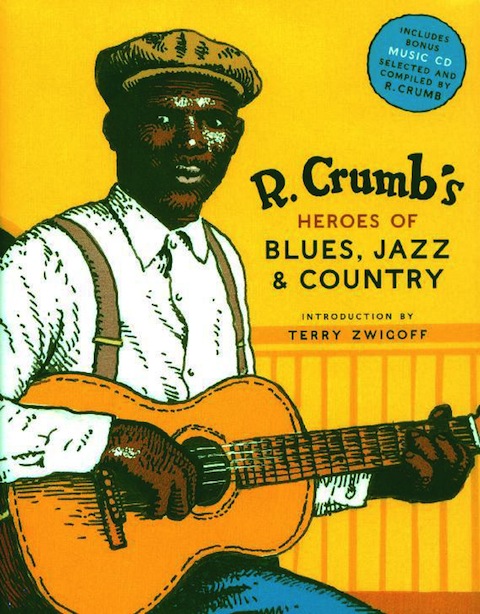
It was one of my favorite gifts of Christmas 2006. No, all apologies to everyone who bought me thoughtful gewgaws, but it was, without a doubt, the favorite. A humble, unassuming package contained a veritable encyclopedia of Americana: over one hundred portraits of jazz, blues, and country artists from the golden eras of American music, all drawn by a foremost antiquarian of pre-WWII music, R. Crumb. Beside each portrait—some made with Crumb’s exaggerated proportions and thick-lined shading, some softer and more realist—was a brief, one-paragraph bio, just enough to situate the singer, player, or band within the pantheon.
Though a fan of this sort of thing may think that it could get no better, glued to the back cover was a slipcase containing a CD with 21 tracks—seven from each genre. A quick scan showed a few familiar names: Skip James, Charlie Patton, Jelly Roll Morton. Then there were such unknown entities as Memphis Jug Band, Crockett’s Kentucky Mountaineers, and East Texas Serenaders, culled from Crumb’s enormous, library-size archive of rare 78s. Joy to the world.
Crumb’s Heroes of Blues, Jazz & Country began in the 80s with a series of illustrated trading cards, as you can see in the video above (which only covers the blues and jazz corners of the triangle). The first cards, “Heroes of the Blues,” came attached to old-time reissues from the Yazoo record company. Eventually expanding the cards to include jazz and country, working in each category from old photos or newsreel footage, Crumb covered quite a lot of musico-historical ground. Archivists and authors Stephen Calt, David Jasen, and Richard Nevins wrote the short blurbs. Finally Yazoo, rather than issuing the cards individually with each record, combined them into boxed sets.
The book—which validates my sense that this music belongs together cheek by jowl, even if some of its partisans can’t stand each other’s company—evolved through a painstaking process in which Crumb redrew and recolored the original illustrations from the printed trading cards (the original artwork having disappeared). You can follow one step of that process in a detailed description of Crumb’s conversion of the blues cards to a silkscreened poster. Crumb’s process is as thorough as his period knowledge. But Crumb fans know that the comic artist’s reverence for Americana goes beyond his collecting and extends to his own version of kitchen-sink bluegrass, blues, and jazz. Listen to Crumb on the banjo above with his Cheap Suit Serenaders. And if anyone feels like getting me a Christmas present this year, I’d like a copy of their record Chasin Rainbows. On vinyl of course.
The Second World War was waged over six long years on every continent save South America and Antarctica. Seventy-some years later, the daily shifts of the European Theater’s front lines can be tracked in under seven minutes, thanks to a mysterious, map-loving animator known variously as Emperor Tigerstar or Kaiser Tigerstar (the latter accounts for the helmet-wearing kitten gracing the upper corner of his World War I time-lapse).
The power-shifting colors (blue for Allies, red for Axis) are mesmerizing, as is a relentless timer ticking off the days between Germany’s invasion of Poland on September 1, 1939 and VE Day, May 8, 1945. Royalty-free music by Kevin MacLeod and audio samples ranging from Hitler and Mussolini’s declarations of war to Roosevelt’s Day of Infamy speech add import.
Careful reading of his blog reveals a diehard history buff with a weakness for metal music, wholesome CGI movies, and statistics.
He’s also a workaholic. His YouTube channel boasts a boggling assortment of map animations. This in addition to an alternate YouTube channel where he remaps history in response to his own “what if” type prompts. Somehow he finds the time to preside over The Blank Atlas, a site whose members contribute unlabeled, non-copyrighted maps available for free public download. And he may well be a brony, as evidenced by the video he was purportedly working on this summer, World War II: As Told by Ponies.
Ayun Halliday didn’t know she’d be keeping things fresh by failing to listen to a single second of 8th grade Geography. Follow her @AyunHalliday
You’ll almost certainly recognize the piece itself. But what have we on the screen? Clearly each block represents a sound from the piano, but what do their colors signify? “Each pitch class (C, C‑sharp, D, D‑sharp, etc.) has its own color, and the colors are chosen by mapping the musician’s ‘circle of fifths’ to the artist’s ‘color wheel,’ ” Malinowski writes in the FAQ below the video, linking to a more detailed explanation of the process on his site. He also recommends watching not just the Youtube version, improved its resolution though he has, but the newer iPad version: “Because the iPad can support 60 frames per second (instead of the usual 30), the scrolling is silky smooth (the way it’s supposed to be), and you can watch it at night, in the dark, in bed. You can get the video here.” The Music Animation Machine creator also addresses perhaps the most important question about this piece, originally titled Promenade Sentimentale, which has both signified and elicited so much emotion over the past century: “Is it just me, or does this piece make everyone cry?” Malinowski’s reply: “Maybe not everyone, but lots of people…”
Ever wonder how famous philosophers from the past spent their many hours of tedium between paradigm-smashing epiphanies? I do. And I have learned much from the biographical morsels on “Daily Routines,” a blog about “How writers, artists, and other interesting people organize their days.” (The blog has also now yielded a book, Daily Rituals: How Artists Work.) While there is much fascinating variety to be found among these descriptions of the quotidian habits of celebrity humanists, one quote found on the site from V.S. Pritchett stands out: “Sooner or later, the great men turn out to be all alike. They never stop working. They never lose a minute. It is very depressing.” But I urge you, be not depressed. In these précis of the mundane lives of philosophers and artists, we find no small amount of meditative leisure occupying every day. Read these tiny biographies and be edified. The contemplative life requires discipline and hard work, for sure. But it also seems to require some time indulging carnal pleasures and much more time lost in thought.
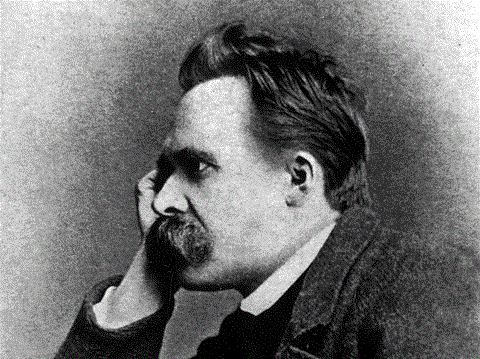
Let’s take Friedrich Nietzsche (above). While most of us couldn’t possibly reach the great heights of iconoclastic solitude he scaled—and I’m not sure that we would want to—we might find his daily balance of the kinetic, aesthetic, gustatory, and contemplative worth aiming at. Though not featured on Daily Routines, an excerpt from Curtis Cate’s eponymous Nietzsche biography shows us the curious habits of this most curious man:
With a Spartan rigour which never ceased to amaze his landlord-grocer, Nietzsche would get up every morning when the faintly dawning sky was still grey, and, after washing himself with cold water from the pitcher and china basin in his bedroom and drinking some warm milk, he would, when not felled by headaches and vomiting, work uninterruptedly until eleven in the morning. He then went for a brisk, two-hour walk through the nearby forest or along the edge of Lake Silvaplana (to the north-east) or of Lake Sils (to the south-west), stopping every now and then to jot down his latest thoughts in the notebook he always carried with him. Returning for a late luncheon at the Hôtel Alpenrose, Nietzsche, who detested promiscuity, avoided the midday crush of the table d’hôte in the large dining-room and ate a more or less ‘private’ lunch, usually consisting of a beefsteak and an ‘unbelievable’ quantity of fruit, which was, the hotel manager was persuaded, the chief cause of his frequent stomach upsets. After luncheon, usually dressed in a long and somewhat threadbare brown jacket, and armed as usual with notebook, pencil, and a large grey-green parasol to shade his eyes, he would stride off again on an even longer walk, which sometimes took him up the Fextal as far as its majestic glacier. Returning ‘home’ between four and five o’clock, he would immediately get back to work, sustaining himself on biscuits, peasant bread, honey (sent from Naumburg), fruit and pots of tea he brewed for himself in the little upstairs ‘dining-room’ next to his bedroom, until, worn out, he snuffed out the candle and went to bed around 11 p.m.
This comes to us via A Piece of Monologue, who also provide some photographs of Nietzsche’s favorite Swiss vistas and his austere accommodations. No doubt this life, however lonely, led to the production of some of the most world-shaking philosophical texts ever produced, perhaps rivaled in the nineteenth century only by the work of the prodigious Karl Marx.
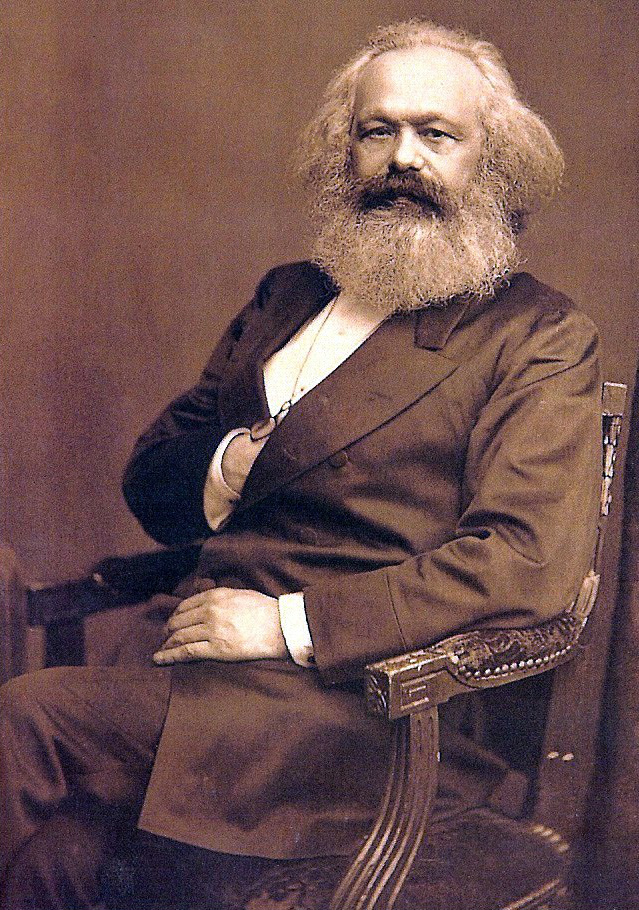
So how did Marx’s daily life compare to the morose and monkish Nietzsche? According to Isaiah Berlin, Marx also had his daily habits, though not quite so well-balanced.
His mode of living consisted of daily visits to the British Museum reading-room, where he normally remained from nine in the morning until it closed at seven; this was followed by long hours of work at night, accompanied by ceaseless smoking, which from a luxury had become an indispensable anodyne; this affected his health permanently and he became liable to frequent attacks of a disease of the liver sometimes accompanied by boils and an inflammation of the eyes, which interfered with his work, exhausted and irritated him, and interrupted his never certain means of livelihood. “I am plagued like Job, though not so God-fearing,” he wrote in 1858.
Marx’s money worries contributed to his physical complaints, surely, as much as Nietzsche’s social anxiety did to his. Not all philosophers have had such dramatic emotional lives, however.
Smoking plays a significant role as a daily aid, for good or ill, in the daily lives of many philosophers, such as that of giant of 18th century thought, Immanuel Kant. But Kant suffered from neither penury nor some severe case of unrequited love. He seems, indeed, to have been a rather dull person, at least in the biographical sketch below by Manfred Kuehn.
His daily schedule then looked something like this. He got up at 5:00 A.M. His servant Martin Lampe, who worked for him from at least 1762 until 1802, would wake him. The old soldier was under orders to be persistent, so that Kant would not sleep longer. Kant was proud that he never got up even half an hour late, even though he found it hard to get up early. It appears that during his early years, he did sleep in at times. After getting up, Kant would drink one or two cups of tea — weak tea. With that, he smoked a pipe of tobacco. The time he needed for smoking it “was devoted to meditation.” Apparently, Kant had formulated the maxim for himself that he would smoke only one pipe, but it is reported that the bowls of his pipes increased considerably in size as the years went on. He then prepared his lectures and worked on his books until 7:00. His lectures began at 7:00, and they would last until 11:00. With the lectures finished, he worked again on his writings until lunch. Go out to lunch, take a walk, and spend the rest of the afternoon with his friend Green. After going home, he would do some more light work and read.
For all of their various complaints and ailments, throughout their most productive years these highly productive writers embraced Gustave Flaubert’s maxim, “Be regular and orderly in your life, so that you may be violent and original in your work.” I have always believed that these are words to live and work by, with the addition of a little vice or two to spice things up.
If you would like to support the mission of Open Culture, consider making a donation to our site. It’s hard to rely 100% on ads, and your contributions will help us continue providing the best free cultural and educational materials to learners everywhere. You can contribute through PayPal, Patreon, and Venmo (@openculture). Thanks!
If subtitles don’t automatically appear, please click the “CC” button at the bottom of the video.
“I like being an outcast,” the French writer Jean Genet once said, “just as, with all due respect, Lucifer liked being cast out by God.”
Genet was a kind of poet laureate of outcasts. He was a champion of the socially alienated and a subverter of traditional morality. His poetic and highly original first novel,Our Lady of the Flowers, was written in prison. It deals frankly with his life as a petty criminal and homosexual. Jean Cocteau recognized Genet’s genius and helped get him published. Jean-Paul Sartre canonized him in Saint Genet, Actor and Martyr. Simone de Beauvoir called him a “thug of genius.”
The son of a prostitute and an unknown father, Genet was abandoned as an infant by his mother and raised in foster homes in a village in central France, where he was made to feel like an outsider. As a young boy he developed the habit of stealing things and running away from home. At the age of 15 he was sent to the Mettray Penal Colony, a reformatory for boys. When he got out, he joined the Foreign Legion, from which he eventually deserted. He spent years as a wandering prostitute and thief before finding fame as a poet, novelist and playwright.
In 1981, Genet agreed to collaborate with actress and film producer Danièle Delorme on a “cinematic poem” based on his writings. Delorme enlisted Genet’s friend Antoine Bourseiller, a prominent theatrical director who had staged Genet’s The Balcony. They filmed a series of sequences meant to evoke the atmosphere of Genet’s novels, but were unhappy with the results. They felt the only way to make the film work was to have Genet speak. The 70-year-old writer, who was suffering from throat cancer and finding it difficult to speak, reluctantly agreed. “I will respond,” Genet said, “to one question only: why am I not in prison?”
In the resulting film, Jean Genet: An Interview with Antoine Bourseiller, Genet explains that by the time he reached a certain age, prisons had lost their erotic appeal. He goes on to explain, somewhat cryptically, of his love of darkness and his special fondness for Greece, where “the darkness mixed with light.” In his notes for the film, Genet writes:
When I spoke of the mixture of shadows and light in Greece, I was of course not thinking of the light from the sun, and not even the milky stream of the Turkish baths. Evoking ancient Greece (which is still present), I was thinking not only of Dionysos in opposition to the shining brilliance and the harmony of Apollo, but of something even more distant than they: the Python snake who had her sanctuary at Delphi, and who never stopped rotting there, stinking up Dionysos, Apollo, the Turkish wali, King Constantine, the colonels, and the suns that followed them.
The first of two interviews for the film was recorded at Delphi in the early summer of 1981. The second was recorded a short time later in France, at the producer’s family home near Rambouillet. Genet talks revealingly about his childhood, his sexual awakening and his rejection of Christianity. He touches briefly on a wide range of subjects, from Arthur Rimbaud to the Black Panthers. Excerpts from his books are read by Roger Blin, Gérard Desarthes and J.Q. Chatelain. Genet supervised the editing of the film, which was first exhibited in the fall of 1982. Jean Genet: An Interview with Antoine Bourseiller will be added to our collection of over 500 free movies online.
Even readers not particularly well versed in science fiction know Philip K. Dick as the author of the stories that would become such cinematic visions of a troubled future as Blade Runner, Total Recall, Minority Report, and A Scanner Darkly. Dick’s fans know him better through his 44 novels, 121 short stories, and other writings not quite categorizable as one thing or the other. All came as the products of a creatively hyperactive mind, and one subject to more than its fair share of disturbances from amphetamines, hallucinogens, unconventional beliefs, and what those who write about Dick’s work tend to call paranoia (either justified or unjustified, depending on whom you ask). But Dick, who passed in 1982, channeled this constant churn of visions, theories, convictions, and fears into books like The Man in the High Castle, Do Androids Dream of Electric Sheep?, Ubik, and VALIS, some of the most unusual works of literature ever to carry the label of science fiction — works that, indeed, transcend the whole genre.
But what must it have felt like to live with the guy? The Penultimate Truth About Philip K. Dick (named after his 1964 novel of humanity tricked into living in underground warrens) seeks out the writer’s friends, colleagues, collaborators, stepdaughter, therapist, and wives (three of them, anyway), assembling a portrait of the man who could create so many textual worlds at once so off-kilter and so tapped into our real worries and obsessions. Each of these interviewees regards differently Dick’s dedication to the pursuits of both literary achievement and psychonautical adventure, his complicated conception of the true nature of reality, his at times unpredictable behavior, and his penchant for encounters with the divine. Director Emeliano Larre and writer Patricio Vega’s 2007 documentary reveals one of the most fascinating personalities in late 20th-century letters, though, as any professor of literature will tell you, we ultimately have to return to the work itself. Fortunately, Dick’s personality ensured that we have a great deal of it, all of it unsettling but greatly entertaining. Readers taken note. You can Download 14 Great Sci-Fi Stories by Philip K. Dick as Free Audio Books and Free eBooks.
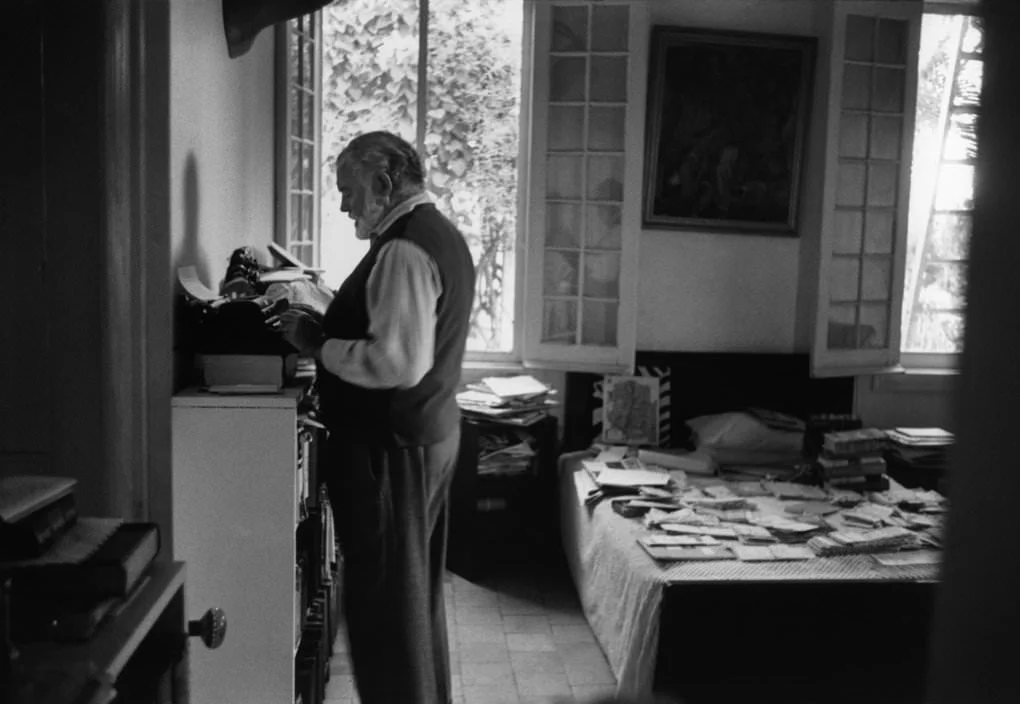
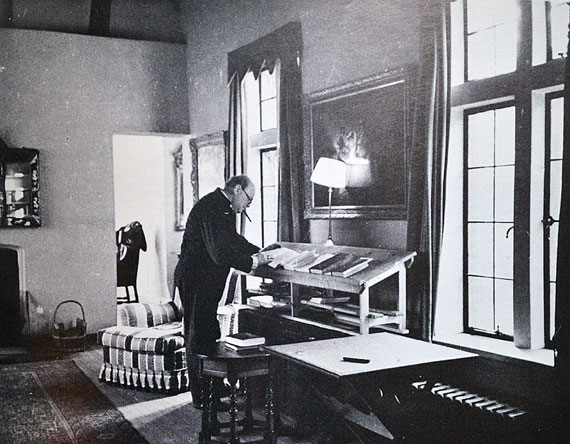
Kierkegaard apparently did his best writing standing up, as did Charles Dickens, Winston Churchill, Vladimir Nabokov and Virginia Woolf. Also put Ernest Hemingway in the standing desk club too.
In 1954, George Plimpton interviewed Hemingway for the literary journal he co-founded the year before, The Paris Review. The interview came prefaced with a description of the novelist’s writing studio in Cuba:
Ernest Hemingway writes in the bedroom of his house in the Havana suburb of San Francisco de Paula. He has a special workroom prepared for him in a square tower at the southwest corner of the house, but prefers to work in his bedroom, climbing to the tower room only when “characters” drive him up there…
The room is divided into two alcoves by a pair of chest-high bookcases that stand out into the room at right angles from opposite walls.…
It is on the top of one of these cluttered bookcases—the one against the wall by the east window and three feet or so from his bed—that Hemingway has his “work desk”—a square foot of cramped area hemmed in by books on one side and on the other by a newspaper-covered heap of papers, manuscripts, and pamphlets. There is just enough space left on top of the bookcase for a typewriter, surmounted by a wooden reading board, five or six pencils, and a chunk of copper ore to weight down papers when the wind blows in from the east window.
A working habit he has had from the beginning, Hemingway stands when he writes. He stands in a pair of his oversized loafers on the worn skin of a lesser kudu—the typewriter and the reading board chest-high opposite him.
Popular Science, a magazine with roots much older than the Paris Review, first began writing about the virtues of standing desks for writers back in 1883. By 1967, they were explaining how to fashion a desk with simple supplies instead of forking over $800 for a commercial model — a hefty sum in the 60s, let alone now. Plywood, saw, hammer, nails, glue, varnish — that’s all you need to build a DIY stand-up desk. Or, as Papa Hemingway did, you could simply throw your writing machine on the nearest bookcase and get going. As for how to write the great American novel, I’m not sure that Popular Science offers much help. But maybe some advice from Hemingway himself will steer you in the right direction. See Seven Tips From Ernest Hemingway on How to Write Fiction.
If you would like to support the mission of Open Culture, consider making a donation to our site. It’s hard to rely 100% on ads, and your contributions will help us continue providing the best free cultural and educational materials to learners everywhere. You can contribute through PayPal, Patreon, and Venmo (@openculture). Thanks!
put a Carnegie Hall orchestra in the middle of New York City and placed an empty podium in front of the musicians with a sign that read, “Conduct Us.” Random New Yorkers who accepted the challenge were given the opportunity to conduct this world-class orchestra. The orchestra responded to the conductors, altering their tempo and performance accordingly.
Improv Everywhere is “a New York City-based prank collective that causes scenes of chaos and joy in public places. Created in August of 2001 by Charlie Todd, the organization “has executed over 100 missions involving tens of thousands of undercover agents.” Find more of their “work” on YouTube.
Follow Open Culture on Facebook and Twitter and share intelligent media with your friends. Or better yet, sign up for our daily email and get a daily dose of Open Culture in your inbox. And if you want to make sure that our posts definitely appear in your Facebook newsfeed, just follow these simple steps.
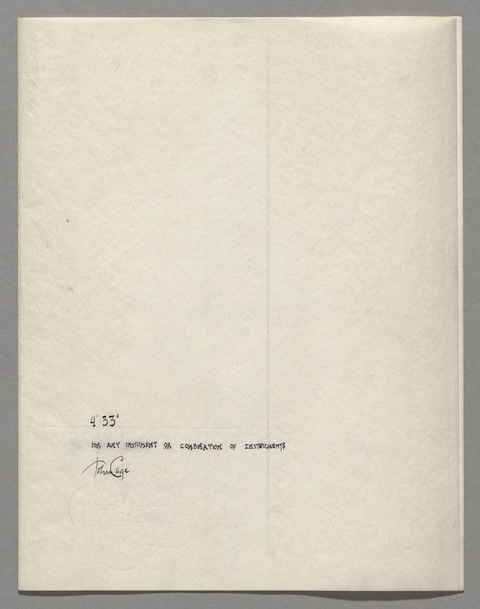
In most of the performances of John Cage’s famously silent composition 4’33”, the performer sits in front of what appears to be sheet music (as in the performance below). The audience, generally prepared for what will follow, namely nothing, may sometimes wonder what could be printed on those pages. Probably also nothing? Now we have a chance to see what Cage envisioned on the page as he composed this piece. Starting on October of this month, New York’s Museum of Modern Art will exhibit Cage’s 1952 score “4’33” (In Proportional Notation).” You can see the first page above.
As you might imagine, subsequent pages (viewable here) look nothing like a typical score, but they are not blank, nor do they contain blank staves; instead they are traversed by carefully hand-drawn vertical lines that seem to denote the units of time as units of space. In fact, this is exactly what Cage did (hence proportional notation). On the fourth page of the score, Cage writes the following formula: “1 page=7 inches=56 seconds.” Artist Irwin Kremen, to whom Cage dedicated the piece, has this to say about the unusual score:
In this score, John made exact, rather than relative, duration, the only musical characteristic. In effect, real time is here the fundamental dimension of music, its very ground. And where time is primary, change, process itself, defines the nature of things. That aptly describes the silent piece — an unfixed flux of sound through time, a flux from performance to performance.
Interpreters of Cage have frequently taken his “silent” piece as a playful bit of conceptual performance art. For example, philosopher Julian Dodd emphatically declares that 4’33” is not music, a distinction he takes to mean that it is instead analytical, “a work about music…,” that it is “a witty, profound work… of conceptual art.” Thinking of Cage’s piece as a kind of meta-analysis of music seems to miss the point, however. Kremen and many others, including Cage himself, call this notion into question. In the interview below, for example, Cage does make an important distinction between “music” and “sound.” He favors the latter for its chance, impersonal qualities, but also, importantly, because it is neither analytical nor emotional. Sound, says Cage, does not critique, interpret, or elaborate—it does not “talk.” It simply is. But the distinction between music and not-music soon collapses, and Cage cites Emmanuel Kant in saying that music “doesn’t have to mean anything,” any more than the chance occurrences of sound.
Cage’s rejection of meaning in music may have played out in a rejection of traditional forms, but it seems mistaken to think of 4’33” as a high concept joke or intellectual exercise. Perhaps it makes more sense to think of the piece as a Zen exercise, carefully designed to awaken what Suzuki Roshi called “the true dragon.” In a 1968 lecture, the Zen master tells the following story:
In China there was a man named Seko, who loved dragons. All his scrolls were dragons, he designed his house like a dragon-house, and he had many pictures of dragons. So the real dragon thought, “If I appear in his house, he will be very pleased.” So one day the real dragon appeared in his room and Seko was very scared of it. He almost drew his sword and killed the real dragon. The dragon cried, “Oh my!” and hurriedly escaped from Seko’s room. Dogen Zenji says, “Don’t be like that.”
The subject of Suzuki’s lecture is zazen, or Zen meditation, a practice that very much influenced Cage through his study of another Zen interpreter, D.T. Suzuki. Instead of practicing zazen, however, Cage practiced what he called his “proper discipline.” He describes this himself in a quotation from a biography by Kay Larsen:
[R]ather than taking the path that is prescribed in the formal practice of Zen Buddhism itself, namely, sitting cross-legged and breathing and such things, I decided that my proper discipline was the one to which I was already committed, namely, the making of music. And that I would do it with a means that was as strict as sitting cross-legged, namely, the use of chance operations, and the shifting of my responsibility from the making of choices to that of asking questions.
Cage, who loved Zen parables and was himself a storyteller, would appreciate Suzuki Roshi’s telling of Zenji’s true dragon story. While much of his compositional work seems to skirt the edges of music, focusing on the negative space around it, for Cage, this space is no less important that what we think of as music. As Suzuki interprets the story: “For people who cannot be satisfied with some form or color, the true dragon is an imaginary animal which does not exist. For them something which does not take some particular form or color is not a true being. But for Buddhists, reality can be understood in two ways: with form and color, and without form and color.” Read against this backdrop, Cage’s “silent” piece is as much a way of understanding reality—as much a true being—as a musical composition expressly designed produce specific formal effects. And while his published collection of lectures and writings is titled Silence, as Cage himself said of 4’33”, in a remark that provides the title for the MoMA’s exhibit, “there will never be silence.” In the absence of formalized music, 4′33″ asks us to hear the true dragon of sound.
We're hoping to rely on loyal readers, rather than erratic ads. Please click the Donate button and support Open Culture. You can use Paypal, Venmo, Patreon, even Crypto! We thank you!
Open Culture scours the web for the best educational media. We find the free courses and audio books you need, the language lessons & educational videos you want, and plenty of enlightenment in between.