Here’s a collision of cultural figures you don’t see every day: Salo, or the 120 Days of Sodom director Pier Paolo Pasolini sitting down with modernist poet Ezra Pound. Though only eight minutes in length and perhaps not subtitled with ideal fluency, this clip nonetheless hints at the kind of conversation, or conversations, you’d like to have been in the room for. Here Pound and Pasolini discuss the linguistically experimental Italian literary movement “neoavanguardia,” which counted among its adherents Umberto Eco, Edoardo Sanguineti, and Amelia Rosselli. Pasolini, not just a filmmaker but a poet and all-around man of letters himself, would naturally know to bring this subject up, since the group famously looked to Anglophone modernists like Pound himself (as well as T.S. Eliot) for their inspiration.
Pound came to Italy in 1924, by which point he already held expatriate status. Born in 1885 in what we now know as Idaho, he moved to London early in the 20th century. Horrified and devastated by the First World War, he moved to Paris in 1921 before landing in the small Italian town of Rapallo three years later. He there proceeded to tarnish his reputation by endorsing the fascism of Mussolini and even Hitler. Pasolini shows interest not in political questions, but artistic ones: about the avant-garde, about Pound’s beloved 14th- and 15th-century painters, and about his Pisan Cantos. Pasolini actually dons his glasses and performs a reading from that work as Pound gazes on. We then see the 82-year-old poet taking his leave, leaning on his cane, moving haltingly through the rustic Italian countryside that spreads out behind him.
Here’s a good story for a cold December night: Franz Kafka’s cryptic, hallucinatory tale of “A Country Doctor.”
Written in Prague during the icy winter of 1916–1917, Kafka’s story unfolds in one long paragraph like a fevered nightmare. “I was in great perplexity,” says the narrator, an old doctor, as he sets out in a blizzard at night on an urgent but vague mission. But he can’t go anywhere. His horse, worn out by the winter, has just died and his servant girl is going door to door pleading for help. A surreal sequence of events follow.
“A Country Doctor” is permeated with the qualities John Updike found so compelling in Kafka: “a sensation of anxiety and shame whose center cannot be located and therefore cannot be placated; a sense of an infinite difficulty within things, impeding every step; a sensitivity acute beyond usefulness, as if the nervous system, flayed of its old hide of social usage and religious belief, must record every touch as pain.”
In 2007 the award-winning Japanese animator Koji Yamamura made a 21-minute film (see above) which captures some of the strangeness and beauty of Kafka’s story. It seems somehow appropriate that the dreamlike narrative has been transmuted into a form and language unknown to Kafka. And if you aren’t familiar with the original, you can read a translation of “A Country Doctor” by Willa and Edwin Muir. You can also find Kafka’s stories in our collection of Free Audio Books and Free eBooks.
If you would like to support the mission of Open Culture, consider making a donation to our site. It’s hard to rely 100% on ads, and your contributions will help us continue providing the best free cultural and educational materials to learners everywhere. You can contribute through PayPal, Patreon, and Venmo (@openculture). Thanks!
Sorry to bring you the sad news. This morning, the great jazz musician Dave Brubeckdied in Connecticut, just a day short of his 92nd birthday. He’s, of course, best remembered for his jazz standard “Take Five,” recorded and performed first in 1959. Below, you can watch a vintage performance from the Jazz Casual TV show in 1961.
Above, we’re bringing you a reprise of our favorite moment with Brubeck. The footage you’re watching was recorded in December 1997, when the pianist paid a visit to the Moscow Conservatory. During his concert, an audience member asked him to improvise on the old Russian sea shanty “Ej, Uhnem.” About two minutes into the improvisation, a young violinist rose from his seat and started to play along. You just have to love Dave’s surprised look at 2:09. The young man turned out to be a student at the conservatory. His name is Denis Kolobov and he is now a violinist of international renown. We will sorely miss you Dave.…
Earlier this year, the blues guitarist Charles ‘Skip’ Pitts passed away after a bout of lung cancer. He had a musical career that spanned many decades. But, he’s best remembered for his riffs on one song — Isaac Hayes’ theme song for the 1971 film Shaft. (Catch it below.) Pitts’ licks have been sampled by countless younger musicians, everyone from Snoop Dogg and the Beastie Boys to Dr. Dre and Massive Attack. Starting in the late 90s, the bluesman began playing with a band called The Bo-Keys, which became the subject of a mini documentary in 2011. The short film yielded some insightful interviews with Pitts. And, once he departed from our world, the conversations became the basis for the “animated interpretation” you’re hopefully now watching above. It’s the work of Loaded Pictures, a studio based in Seattle, Washington.
Offscreen, Rainn Wilson—Dwight from The Office—has become a kind of pop-guru for the Web 2.0 set. In 2009, Wilson and friends Joshua Homnick and Devon Gundry created SoulPancake, a media company designed to provide an interactive experience for people to “Chew on Life’s Big Questions” (says the tagline): religion, philosophy, art, culture, science, humor, life, death, you name it. And the refreshing thing about it is, while Wilson is of the Bahai faith himself, his organization is unaffiliated with any particular religion. So it’s a safely ecumenical space for atheists, agnostics, and the growing number of “Nones” to interact without any danger of proselytizing or religious inside baseball.
SoulPancake has produced a best-selling book and scored a content deal with Oprah’s OWN network, but it all grew out of a rather simple idea—a video series called Metaphysical Milkshake. Billed as a “travelling talk show,” Metaphysical Milkshake is as low-concept, high-appeal as Jerry Seinfeld’s web series “Comedians in Cars Getting Coffee”: Basically, Wilson drives around in a beat-up seventies stoner van and picks up celebrities like Joseph Gordon-Levitt or lesser-known internet stars like blogger and “twitter funny girl” Kelly Oxford, (who calls his ride “a sweaty rape van”). Then he dishes with them about some deep and some not-so-deep stuff. And thanks to some cheap special effects, the van magically transports them wherever the guest wants to go.
A couple days ago, Wilson picked up conceptual prop-comic Demetri Martin (or the other way around). They gabbed about comedy archaeology, getting mugged for beliefs, and drawing the state of their souls. Watch the short episode above and subscribe to the SoulPancake YouTube channel to see them all and more.
Josh Jones is a doctoral candidate in English at Fordham University and a co-founder and former managing editor of Guernica / A Magazine of Arts and Politics.
“I think like a genius, I write like a distinguished author, and I speak like a child.” So begins Vladimir Nabokov in the foreword to his 1973 book of interviews and articles, Strong Opinions.
To avoid speaking like a child in public, Nabokov took great pains to prepare his every word. “Throughout my academic ascent in America from lean lecturer to Full Professor, I have never delivered to my audience one scrap of information not prepared in typescript beforehand and not held under my eyes on the bright-lit lectern.”
When it came to giving interviews, Nabokov was horrified by the notion of sitting back and having a casual chat with a reporter. “It has been tried at least twice in the old days,” he writes, “and once a recording machine was present, and when the tape was rerun and I had finished laughing, I knew that never in my life would I repeat that sort of performance. Nowadays I take every precaution to ensure a dignified beat of the mandarin’s fan. The interviewer’s questions have to be sent to me in writing, answered by me in writing, and reproduced verbatim. Such are the three absolute conditions.”
So the excerpt above from a 1969 interview with the British journalist James Mossman should be understood as a carefully prepared performance. As Nabokov says in his own introduction to the full text version of the interview in Strong Opinions, Mossman submitted 58 questions on September 8, 1969, and “some 40 were answered and recorded by me from written cards in Montreaux.” In a conversation ranging from the pleasure and agony of composing fiction to Dostoyevsky’s “ghastly Crime and Punishment rigmarole,” the mandarin’s fan keeps a dignified beat.
Did Orson Welles ever make an non-notable movie? Sure, the sheer cinematic importance of Citizen Kane, Touch of Evil, The Lady from Shanghai, and even the famously incomplete The Magnificent Ambersons, tend to draw all the attention most people have for his filmography. Make sure you watch those — no self-respecting lover of American film could do without them — but then look beyond them.
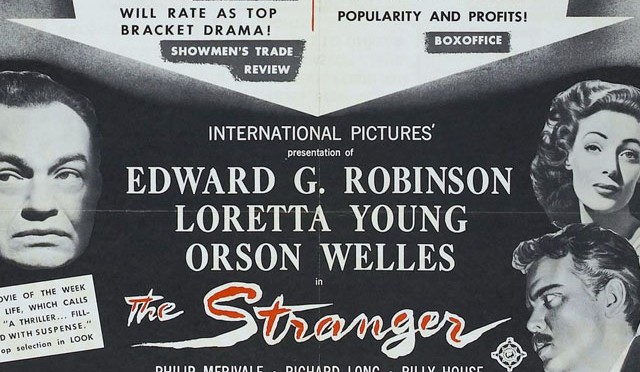
Personally, I yield to no one in my endorsement of Welles’ formally unique multi-genre quasi-documentary F for Fake. But first, I suggest you look to the top of this post and watch 1946’s The Stranger, a far more mainstream picture (for one can hardly travel farther from the mainstream than F for Fake), and in fact the only Welles film to meet with immediate box office success. Considering what it shows, that may come as a surprise.
The picture pits a United Nations Nazi hunter, played by Hollywood Golden Age legend Edward G. Robinson, against a Third Reich war criminal played by Welles himself. The hunter tracks down the hunted, who has taken on a new, nearly anonymous identity in small-town Connecticut. The U.N. man becomes desperate to bring the Nazi to justice, the Nazi’s becomes desperate to live his new life in peace, and his unsuspecting wife becomes desperate to deny the truth about her husband’s past. In order to convince the lady, Robinson’s character screens her actual footage of Nazi concentration camps. The shock on actress Loretta Young’s face was the shock on the faces of American audiences; neither previously had much of a chance to see what had really happened in wartime Europe. Leave it to Welles, whose fascination with and hatred of fascism led him to write a series of columns on the subject for the New York Post, to smuggle this depth of real human horror into what looks at first glance like a plain old 1940s noir thriller.
Albert Einstein is the patron saint of slackers redeemed. We’ve all heard some version of his late-bloomer story: “You know, Albert Einstein did terribly in high school” (says every high school guidance counselor at some point). Most of us normals like to see him this way—it bucks us up—even if he was anything but your average low achiever. The above 2006 profile of Einstein by PBS’s “American Masters” documentary series, Albert Einstein: How I See the World, takes the opposite tack, surrounding him with the aura of a hero in a Hermann Hesse novel. The film begins with William Hurt’s narration of Einstein’s solo trek through the Alps at twenty-two, during which he “longed to grasp the hidden design, the underlying principles of nature.” Over the intrigue conjured by Michael Galasso’s haunting, minimalist score and a montage of black-and-white nature films, narrator Hurt intones:
Every once in a while there comes a man who is able to see the universe in a totally new way, whose vision upsets the very foundations of the world as we know it. Throughout his life, Albert Einstein would look for this harmony, not only in his science, but in the world of men. The world wanted to know Albert Einstein, yet he remained a mystery to those who only saw his public face and perhaps to himself as well. “What does a fish know of the water in which he swims?” he asked himself.
After this sententious beginning, with its strangely outdated pronoun use, Hurt tells us that those who knew Einstein best saw a little of him, and the film goes on to document those impressions in interviews: colleague Abraham Pais comments on Einstein’s love of Jewish humor (and that his laughter sounded like “the bark of a contented seal”). Hanna Loewy, a family friend, describes his ability to look at “many, many dimensions, whether they be proven or not,” and to see the whole. Intercut between these statements is archival footage of Einstein himself and commentary from Hurt, some of it questionable (for example, the idea that Einstein was a “scientist who believed in God” is tendentious, at best, but a subject best left for the endless bickering of YouTube commenters).
It’s a bit of an Olympian treatment, fitting to the subject in some respects. But in another sense, the documentary performs the function of a hagiography, a genre well-suited for encomium and reverence, but not for “getting to know” its subject personally. The film places a great deal of emphasis, rightly perhaps, on Einstein’s public persona: his vocal pacifism—in which he joined with Mahatma Gandhi—and statements against German militarism, even as the rising fascist order dismissed his work and denounced the man.
But while Albert Einstein: How I See the World provides a compelling portrait and offers a wealth of historical context for understanding Einstein’s world, it leaves out the voices of those who perhaps knew him best: his children, wife Elsa, or his first wife, Mileva. (Their divorce gets a brief mention at 15:20, along with his subsequent marriage to first cousin Elsa.) Einstein’s troubled personal life, revealed through private correspondence like an angry post-divorce letter to Mileva and an appalling list of demands written to her during the deterioration of their marriage, has received more scrutiny of late. These personal details have perhaps prompted PBS to reevaluate Mileva’s influence; rather than “little more than a footnote” in his biography, Mileva may have played a role in his success for which she never received credit, giving Hurt’s gendered narration something of a bitter personal twist.
None of this is to say that a documentary treatment of any public figure needs to dredge the family secrets and display the dirty laundry, but as far as learning how Einstein, or anyone else of his stature, saw the world, the personal seems to me as relevant as the professional. PBS’s documentary is very well-made, however, and worth watching for its production values, interviews with Einstein’s friends and colleagues, and archival newsreel footage, even if it sometimes fails to truly illuminate its subject. But as Hurt’s narration disclaims at the outset, maybe Einstein was a mystery, even to himself.
The film will be added to the Documentary section of our collection of Free Movies Online.
Josh Jones is a doctoral candidate in English at Fordham University and a co-founder and former managing editor of Guernica / A Magazine of Arts and Politics.
Led Zeppelin — they started off making a mess of bourgeois households; now, like many of their 60s counterparts, they’re getting honored by the powers that be. This weekend, the band’s three surviving members — Robert Plant, John Paul Jones and Jimmy Page — were honored for their cultural achievements at a festive ceremony in Washington D.C.. Looking very at ease with things, President Obama reminded us that, 30 years after the band’s last album, the “Led Zeppelin legacy lives on.” Somewhere Paul Ryan is eating his heart out.
Below we have footage of Led Zep during their heyday — a full concert recorded Live at the Royal Albert Hall in 1970.
Ah, 20th-century philosophy: even a great many philosophers of the 20th century wouldn’t touch it. When you want to approach a thorny, complex, contradictory field like this, you especially value a teacher like Rick Roderick (1949–2002). Called “the Bill Hicks of Philosophy” by his fan sites, Roderick recorded a series of lectures for The Teaching Company, in the early nineties. (Though the Great Courses have grown far more slickly produced since then, the intellectual content of their older efforts, like this one, remains solid.) Above, you’ll find “The Masters of Suspicion,” the introductory lecture to “The Self Under Seige,” his video course on 20th-century philosophers. In eight segments (available in a playlist below), Roderick covers the likes of Jacques Derrida, Michel Foucault, Jean-Paul Sartre, and Jürgen Habermas. Perhaps he can make sense of them for you; if not, he’ll make them into hours of entertainment.
Not having come up steeped in 20th-century philosophy during his own education, Roderick has his own opinions about how these luminaries throw into question all forms of human knowledge and identity. But he does take their ideas seriously, connecting them as he considers them to real issues and then-current events.
This reveals that he also has his own opinions, more than willingly given, about — bear in mind, the year was 1993 — Bill Clinton, Jesse Helms, political correctness, Pat Buchanan, Billy Graham, network television, Jerry Falwell, and The Big Chill. “When we do philosophy my way,” Roderick announces in his distinctive West Texas accent, “we just talk about what’s goin’ on and try to find our way about.” If that’s how you like philosophy done, visit rickroderick.org to hear much more of it.
You can find more recent philosophy courses produced by The Great Courses here.
The news the world receives from the continent of Africa is almost uniformly bad, and this is certainly an unjust situation. A recent parody ad campaign by Norwegian Erik Schreiner Evans attempts to say as much; Evans’ Africa for Norway spoof intends to send the message to “stop treating Africans like passive recipients of aid, and recognize that the continent is more than the sum of its problems.” This message may have some effect on the tendency of major news and aid organizations to capitalize on the suffering of African people, but recent stories highlighting the ingenuity and self-sufficiency of African teenagers may do more to change perceptions. First, there is the story of four Nigerian teenagers who debuted their “urine-powered generator” at the 2012 “Maker Faire Africa” in Lagos, a story that made headlines in international news. Another prodigy, from Sierra Leone, has made a splash with his ability to turn garbage into useable technology. Fifteen-year-old Kelvin Doe—a.k.a. D.J. Focus—has wowed engineers by building his own batteries, generators, and transmitters with scrounged-up spare parts and youthful resourcefulness.
The above THINKR video profiles Kelvin, with interviews from engineers like MIT doctoral student David Sengeh, also from Sierra Leone, who has used his connections to help young people like Kelvin develop their talents for the benefit of their war-torn and impoverished country. Kelvin’s a pretty amazing young guy. He explains his alter-ego “D.J. Focus” as part of his personal ethos: “I believe if you focus, you can do an invention perfectly.” Kelvin hosts his own radio show, which provided the impetus for his tech innovations. Kelvin’s story struck a chord: the short video garnered over three-million views in just ten days.
A more recent episode of THINKR’s “Prodigies” series profiles Kelvin’s mentor, David Sengah, whose research focuses on designing comfortable prosthetic limbs, an interest he developed through his own experience of the ten-year Sierra Leone Civil War, during which rebel forces amputated limbs to intimidate their opposition.
Kelvin Doe and David Sengah are extraordinary inventors, but they are only two examples of a steady stream of African tech innovators, artists, writers, and entrepreneurs dedicated to changing their countries’ fates and thereby changing the official narrative of Africans as helpless victims.
Josh Jones is a doctoral candidate in English at Fordham University and a co-founder and former managing editor of Guernica / A Magazine of Arts and Politics.
We're hoping to rely on loyal readers, rather than erratic ads. Please click the Donate button and support Open Culture. You can use Paypal, Venmo, Patreon, even Crypto! We thank you!
Open Culture scours the web for the best educational media. We find the free courses and audio books you need, the language lessons & educational videos you want, and plenty of enlightenment in between.