Maybe the biggest winner of the 2012 presidential election, other than Barack Obama, was Nate Silver, the young statistician who runs the 538 blog at the New York Times. As you may recall (it was only a few weeks ago), Silver gave President Obama roughly an 80% — 90% chance of winning during the final days of October. The talking heads railed against Silver, calling him an “ideologue” and a “joke.” But, just as Silver accurately predicted the outcome of every Senate race during the 2008 election cycle, so did he pretty much nail the big race of 2012. He estimated Obama would receive 313 electoral votes, a touch below the 332 the president actually received. Silver was vindicated. It was time to take a victory lap … and sell a few books.
In late September, Silver shrewdly published a new book, The Signal and the Noise: Why Most Predictions Fail but Some Don’t. The book tour eventually, if not inevitably, brought him to Google, where the celebrity statistician fielded questions from data-loving Googlers for an hour. A grand old time was had by all.
Today is the birthday of the writer Joseph Conrad. He was born Józef Teodor Konrad Korzniowski on December 3, 1857 in Berdichev, in the Polish Ukraine. As a young man he traveled the world as a merchant sailer, an experience that furnished material and inspiration for his English-language books, which include such classics as Nostromo, Lord Jim and Heart of Darkness.
To mark the occasion we bring you a recording of Orson Welles reading (listen to it here) Conrad’s short story “The Secret Sharer” in 1985 as one of his selections for The Orson Welles Library. “I think I’m made for Conrad,” Welles once said. “I think every Conrad story is a movie.” Conrad wrote “The Secret Sharer” in 1909. The story is told by the captain of a ship. One night, while on watch in waters near the Gulf of Siam, the captain discovers a naked swimmer clinging desperately to the side of the ship. He helps the mysterious man aboard and learns his story. The captain is then faced with a dilemma: Should he help the man, or turn him over to the people who are looking for him?
Hey, hoarders, think you’re the only ones who see potential in a single crutch, an empty Scotch bottle, the jagged remains of a skateboard? Not so. Musician, artist, and all-around visionary Ken Butler has been turning such trash into treasure since 1978, when he fitted an ax with a tail piece, fingerboard and contact mic and snuggled it inside a 3/4 size violin case. Chop a cherry tree with it, or play it just like Buddy Guy plays his ax. Like most of the hybrids Butler creates in his Brooklyn studio, it’s a functioning musical instrument, though he’s quick to point out that for him, the sound is immaterial. What really counts is the poetic coupling of unlikely materials.
Things really get cookin’ at the 4:20 mark, when Butler plays a few licks on a three-stringed shovel before moving on to a bowable, electrified tennis racket. The results are far lovelier than the master would lead you to believe.
- Ayun Halliday can stumble her way through the Entertainer if there’s a piano handy.
If books figure into your holiday gift-giving plans, then we’ve got a little something for you — a meta list of the best books of 2012. It’s now December, the final month of the year, which means that newspapers and magazines can start taking stock of 2012 and declare their favorites.
You can find more good reads with “Best of” lists created by NPR, Publishers Weekly, Esquire, HuffPo and The Guardian. And if you’re looking for a deal, don’t miss this: Amazon.com is now offering 40% off books appearing on its list of 2012 Editors’ Picks. Meanwhile Audible.com has produced its own list of favorites, and it’s worth highlighting if only because, when you sign up for a Free Trial, you can download one of their selections (or pretty much any other audiobook you want) for free. Learn more and initiate the free download here.
Now my dear fellow readers, it’s your turn. We want to hear what books (published in 2012) left the strongest impression on you. Give us your thoughts in the comments section below and we’ll publish the Open Culture Best of 2012 list later this week. We look forward to hearing your picks!
But the collection also lets you sort ads thematically. So, for example, you can jump into the U.S. Get a Mac campaign, where you’ll get plenty of John Hodgman. Also find versions of the same campaign from the UK and Japan. Finally, Apple ads featuring celebrities — from Bob Dylan to Zooey Deschanel to Spike Lee — are all neatly packaged together too. H/T @coudal
“This is my dream job,” Conan O’Brien says while in conversation with presidential biographer Edmund Morris. He didn’t say it when he brought Morris onto Conan, his late-night talk show on TBS. He says it on Serious Jibber-Jabber, an altogether different operation. On Conan, he talked to Morris for seven minutes; on Serious Jibber-Jabber, they talk for 47 minutes. Officially described as a web series wherein “Conan O’Brien has lengthy, uninterrupted conversations with interesting people on topics which fascinate him,” the show casts the icon of Gen‑X irreverence not as a purveyor of intelligent silliness, but as a conversationalist in the mold of Charlie Rose. In any case, he does it practically on the set of Charlie Rose: a table, chairs, a background of purest black, and no further distractions. (If you’re going to borrow, they say, borrow from the best.) O’Brien’s followers may not know he has a fervent interest in presidential history, but after watching his interview with the man who wrote three volumes on Theodore Roosevelt and one on Ronald Reagan, they’ll certainly have found out.
Though the show’s title contains the word Serious and O’Brien speaks with genuine curiosity throughout, it also contains the words Jibber-Jabber, and I doubt he has it in him not to crack jokes. This is welcome, and a reason why I’d like to see him direct all of Team Coco’s considerable resources to these interviews from now on. He even gets into the subject of presidential senses of humor — evidently presidents aren’t allowed to have them anymore — which he picks up again in the show’s second interview, with comedy writer and filmmaker Judd Apatow. Though we get a warning that O’Brien will only tape more of these conversations “whenever time and fate allow,” I personally await the next one with bated breath. Somehow, the man who gave the world the Horny Manatee, the Coked-Up Werewolf, and the immortal Masturbating Bear realized the most important thing about viewers like you and me: we’d much rather watch two people discuss enthusiastically and at length subjects that interest them rather than swiftly mangle subjects they guess might interest us.
Having seen Radiohead a few times since their post-2000 Kid A transformation, I can tell you firsthand that while their last several records have trended toward bedroom rock, the live show is still a full-on experience. No twiddling behind laptops and drum machines. And if you haven’t had the pleasure of seeing them perform since their break with noisy alt-rock, now you can, thanks to the fans who produced the above film, shot at NYC’s Roseland Ballroom and the second of only three shows the band played in 2011 in support of The King of Limbs.
Edited together from the YouTube footage of ten different fans, the video is a remarkable example of crowdsourced dedication. Radiohead generously donated the audio straight from the soundboard, providing stellar sound, and the fan-editors obtained at least two camera angles for every song, giving this production the look of a professional concert film. It’s quite an achievement overall (and not the first time this has been done).
Finally, in the spirit of fan collaboration, YouTube user MountainMan1092 helpfully typed up and posted the tracklist below:
0:00:58 Bloom 0:07:23 Little By Little 0:12:07 Staircase 0:17:02 The National Anthem 0:22:03 Feral 0:26:20 Subterranean Homesick Alien 0:31:24 Like Spinning Plates 0:34:50 All I Need 0:39:06 True Love Waits/ Everything In Its Right Place 0:44:49 15 Step 0:49:04 Weird Fishes/ Arpeggi 0:55:08 Lotus Flower 1:00:55 Codex 1:06:43 The Daily Mail 1:10:33 Good Morning Mr. Magpie 1:16:22 Reckoner 1:24:00 Give Up The Ghost 1:29:19 Myxomatosis 01:33:24 Bodysnatchers 1:41:28 Supercollider 1:47:17 Nude
Josh Jones is a doctoral candidate in English at Fordham University and a co-founder and former managing editor of Guernica / A Magazine of Arts and Politics.
Back in the mid-to-late 1980s, some of the figures we consider Rock and Roll icons were near or at the nadir of their popularity. With Duran Duran, The Police and Michael Jackson at the top of the charts, artists like George Harrison, Bob Dylan and even David Bowie had put out their last great records and were waiting for the nostalgia wheel to turn.
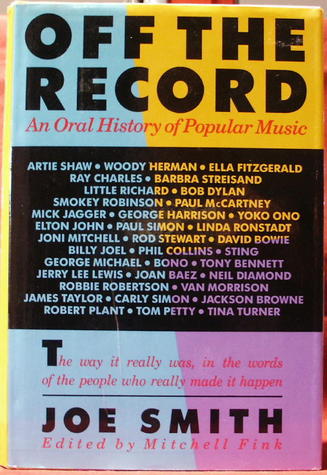
Enter Joe Smith, recording industry executive and former disc jockey. Over two years in the late 80s, while president of Capitol Records/EMI, Smith recorded nearly 240 hours of interviews with a catalog of major musical artists from Mick Jagger, Bowie and Paul McCartney to Yoko Ono, George Harrison and Linda Ronstadt.
Smith used excerpts of the interviews for the book Off the Record, published in 1988. Now retired, he has donated the archive of unedited audio interviews to the Library of Congress. The Joe Smith Collection will feature talks with more than 200 artists. As an industry insider Smith had extraordinary access. It’s not that these artists aren’t already heavily interviewed and documented. It’s the intimate tone of the conversations that pleases and surprises.
In a leisurely conversation with Smith, David Bowie (above) talks about taking classes from Peter Frampton’s father in art school. Yoko Ono, interviewed in late 1987, comes across as still living in the shadow of her late husband. By now, Ono has a bigger reputation as an artist in her own right. Linda Ronstadt, who Smith signed to a recording contract, reflects on her years performing at L.A.’s Troubadour nightclub during the rise of country rock.
By now each of these superstars has written his or her memoir and the golden era of major labels has been dissected by musical diggers. So listening to these interviews from the 1980s takes on a nostalgic feel of its own. Smith’s questions sound naive now. Isn’t it amazing, he remarks to the legendary producer George Martin, that the Beatles were so heavily influenced by African-American blues?! It’s sweet to hear legendary artists and an industry insider stumble upon observations like that one, which have now been so thoroughly digested.
Smith transitioned from broadcast radio to record promotions, eventually rising to executive ranks as president of Warner Brothers, Elektra/Asylum and Capitol Records/EMI. He signed the Grateful Dead, Jimi Hendrix and Van Morrison, so it’s no surprise that Mickey Hart is interviewed, sharing an intimate story about his father.
So far, audio for only 25 interviews is available on the library’s site. More interviews will be uploaded over time, including one with Smith himself in which he talks dirt about his relationship with former business partner Frank Sinatra.
Kate Rix writes about digital media and education. Read more of her work at and thenifty.blogspot.com.
Prior to public radio superstardom, Ira Glass enjoyed modest success as an amateur teenage magician with a side in balloon animals. At the behest of Rookie, an online magazine by and for teen girls, Glass shared some trade secrets gleaned from the 1974 pamphlet, Roger’s Rubber Ark, Volume II. Ignore the diabolical squeaking, and you’ll come out of this video knowing every step that goes into a seated Snoopy and a surprisingly elegant French poodle.
Even better than the balloon how-tos are Glass’ straightforward responses to Rookie readers’ questions, a challenge previously faced by Jon Hamm and Paul Rudd.
He applauds the courage of “Anonymous,” who revealed her true feelings to a crush via text message. But, when presented with the facts, Glass concludes unequivocally that her sentiment is not shared. (It’s not.)
The entirety of womankind will embrace him for what he has to say to nerdy girls and those with short hairdos.
And when the topic turns to condom etiquette and fellatio, well, let’s just say that the teenagers of the world could use more sex educators like Ira Glass.
Cheetahs are the fastest land animals on Earth, able to reach speeds of up to 70 miles per hour.
Earlier this year, the team at National Geographic visited the Cincinnati Zoo and filmed cheetahs running at full sprint, as seen in the majestic video above. The National Geographicteam used a Phantom camera filming at 1,200 frames per second to capture every nuance in the cheetah’s gallop. The filming took three days and, so as not to burden the animals, five different cheetahs were filmed.
You can read more about this initiative here. Also be sure to check out the accompanying National Geographic article, “Cheetahs on the Edge.”
Eugene Buchko is a blogger and photographer living in Atlanta, GA. He maintains a photoblog, Erudite Expressions, and writes about what he reads on his reading blog.
So what is human nature? Who are we, how do we think, feel and act? What are our limitations, and how can we overcome them? What do we share, how we are different, how we can be fooled and how lucky are we to be alive?
Those are the questions at the heart of the 2012 edition of TEDxAmsterdam, and you can watch it live online, in HD, starting tomorrow morning at 9am Amsterdam time. (The video will stream from the TEDxAmsterdam homepage here.)
If you check out the program, you’ll see that Dan Ariely will be among the speakers. He’s the Duke prof who will teach “A Beginner’s Guide to Irrational Behavior,” a Massive Open Online Course (MOOC) starting next year. (It’s in our collection of Free Online Certificate Courses & MOOCs from Great Universities.)
In anticipation of the event, artist Guido Verhoef blew up 15,000 balloons to reveal the true face of human nature. You can see what it looks like above.
We're hoping to rely on loyal readers, rather than erratic ads. Please click the Donate button and support Open Culture. You can use Paypal, Venmo, Patreon, even Crypto! We thank you!
Open Culture scours the web for the best educational media. We find the free courses and audio books you need, the language lessons & educational videos you want, and plenty of enlightenment in between.