On October 4, 1982, “more than 5,000 people filled the Radio City Music Hall to experience a remarkable event. That event was the world premiere of Koyaanisqatsi.” So says the poster for the wide release of that film, an experimental documentary without spoken words on the natural and manmade environment that neither looked nor sounded — nor felt — like anything many of its viewers had ever experienced in a movie theater before.
Unable to muster any of their standard reactions, they had no choice but to sit and observe as, in slow motion and fast motion and every speed in between, waterfalls thundered, chasms yawned, skyscrapers soared, commuters scurried, and rockets launched before their eyes — all to the music of Philip Glass. You might say that Koyaanisqatsi (see trailer below), as well as its formally similar sequels Powaqqatsi and Naqoyqatsi, puts its viewers in an altered state of mind.
The trilogy’s director, a former monk-in-training named Godfrey Reggio, might say the same thing about television, whose flickering blueish presence emerges from time to time in his work, but he wouldn’t mean it in a good way. In 1995, between Powaqqatsi and Naqoyqatsi, he made a short called Evidencewhich, in the words of koyaanisqatsi.org, “looks into the eyes of children watching television — in this case Walt Disney’s Dumbo. Though engaged in a daily routine, they appear drugged, retarded, like the patients of a mental hospital.”
Accompanying and in a sense commenting on their glazed, often slack-jawed expressions, we once again, as in Reggio’s transfixing feature documentaries, have a Glass-composed score. Unlike moviegoers in a theater, “television viewers become prey to the television’s own light impulses, they go into an altered state — a transfixed condition where the eyes, the mind, the breathing of the subject is clearly under the control of an outside force. In a poetic sense and without exaggerating one might say that the television technology is eating the subjects who sit before its gaze.”
In the more than two decades since, this kind of criticism of television has given way to a more general criticism of electronic media, most of whose currently popular forms didn’t exist in 1995; Reggio and Glass’ most recent collaboration, 2013’s Visitors, deals with “humanity’s trancelike relationship with technology.” You and your children may have escaped the “tractor beam that holds its subjects in total control” as Evidence depicts it, but in the 21st century the number of tractor beams has greatly multiplied. And so the question remains worth asking: which ones have you under their control?
I didn’t get the Beach Boys for a while. They had provided the soundtrack to an alien world, one I knew mostly from chewing gum commercials. They were “uncool—cornball,” writes Ben Ratliff, “unenlightened” purveyors of “beach privilege.” The “narrators of Beach Boys songs used their time as they liked: amusement parks, surfing, drag racing, dating, sitting in their rooms.” They had no cares, no real burdens, just shallow summer loves and heartaches. They came off as some of the blandest, safest-sounding people on earth.
Then, in a puzzling turn in the nineties, indie artists like Neutral Milk Hotel, Jim O’Rourke, and The Sea and Cake began experimenting with the complex arrangements, odd instrumentation, and sunny melodies of 60s pop artists like The Beach Boys and Burt Bacharach.
This is music that can seduce us into thinking it is simplistic, childish, uninspired vanilla. Its use as background muzak in supermarkets and shopping malls confirms the impression. But critical listening explodes it. (Dig the phrasing in the otherwise silly, Bacharach/Hal David-composed “Do You Know the Way to San Jose.”)
Yes, it took a retro-hip return to ’60s lounge music, bossa nova, and surf pop for many people to reconsider the Beach Boys as serious artists. And while the trend became a little cloying, once I put on the headphones and gave the radical Pet Sounds a few dozen spins, as so many songwriters I admired had gushed about doing, I got it. Of course. Yes. The arrangements, and those harmonies…. It isn’t only the technical wizardry, though there’s that. It’s how thoroughly weird those classically-inspired arrangements are. Perhaps a better way to put it would be, totally counterintuitive.
What nearly any other pop arranger would naturally do with a harmony or rhythm part—just to get the house in order and showcase more important “lead” parts—Brian Wilson almost never does. As the minimalist composer John Adams put it, “more than any other songwriter of that era, Brian Wilson understood the value of harmonic surprise.” At least in Pet Sounds and the long-unfinished “labyrinth of melody” SMiLE, each part of the song sustains its own individual interest without breaking away from the miniature symphonic whole.
Even within the harmonies, there is a strange tension, an off-kilter wobbling as in a machine whose gears are all just a bit off-center. Instruments and voices go in and out of key, tempos slow and quicken. The vocal harmonies are angelic, but troubled, uncertain, maudlin, and underlined with unexpected intensity given the innocuousness of their lyrics. In the isolated vocal tracks here for “Wouldn’t It Be Nice,” “God Only Knows,” “Sloop John B,” and “Good Vibrations,” you may catch it, or not. It isn’t foreboding, exactly, but a kind of uneasy recognition that the pleasures these songs celebrate will soon pass away. An Arcadian theme in the California pastoral.
The tension is there in Wilson’s idol Phil Spector’s compositons as well, but the contrast is remarkably greater in Pet Sounds, of longing, nostalgia, and youth at its peak. The utopia they imagine may only appeal to a specific subset of boomer Americans, but their intricate, melodically complex, yet harmoniously appealing soundworld belongs to everyone. As Zack Schonfeld observed in a sadly prophetic review of Wilson’s Pet Sounds performance in Brooklyn last summer, “it is hard to imagine modern indie or indie-pop—or pop in general—without Pet Sounds.” (That includes, of course The Beatles, who answered with Sgt. Peppers.) “A world without Pet Sounds is a frightening dystopia,” he writes, “like imagining a world without beaches or one in which Donald Trump is president.” Maybe as you sit back and listen to the otherworldly beauty of these naked harmonies, think of all those lovely beaches we still have left.
In his top-grossing comedies, actor Jim Carrey displayed an antic quality that seemed to rule over his personal life as well. While other stars used interviews as opportunities to normalise themselves to the civilians in the audience, clown prince Carrey was relentless, an uncontrollable fire hose of funny faces and voices that felt not unlike demons.
All that output was exhausting, and caused many to wonder if the man was capable of calming down long enough to receive any meaningful input.
As did the revelation that he spent a lot of his childhood in his bedroom drawing — the flip side to his crazy living room performances, staged, in part, to keep an emotionally troubled family from sinking any lower. He also drew in school, aggravating teachers with unauthorised portraits.
After I became famous, my sixth-grade teacher sent me sketches she had confiscated. She kept them because she thought they were cute. She also knew how to harness the energy. If I was quiet, she would give me 15 minutes at the end of class to perform. Today, I’d be on Ritalin, and Ace Ventura would have never been made.
These days, the funny man seems to have turned his back on performing in favor of a more contemplative visual arts practice. His most recent acting credit is over a year old. As David Bushell’s documentary short, I Needed Color, above reveals, the quantity of Carrey’s output is still impressive, but there’s a qualitative difference where the artist is concerned.
His face and body are calm, and the crazed imperative to entertain seems to have left him. Watching him go about his work, one is reminded of cartoonist and educator Lynda Barry’s observations about the neurological connection between the ability to go down the rabbit hole of art and a child’s mental health:
I think it’s what keeps us sane. I think about how, if I’m sitting here with a kid who’s four years old and I have all these markers and I say, do you want to draw, and that kid’s too freaked out to draw, we’d be worried about that kid a little bit, wouldn’t you? We’d be worried about them emotionally. OK, on this side I have a 40-year-old, same situation, she’s too scared to draw, but we’re not worried about her. Why? Because there is a tacit understanding that something is going on when kids are playing or [drawing] that has something to do with their mental health. All of us know that if a kid is not allowed to play till he’s 21, he’s going to be a nut. He’s going to be a psychopath, actually. The brain studies they’ve done of kids in deep play show that their brains are identical to an adult’s brain that is in creative concentration. We know that play is essential for mental health. I would argue that so is drawing.
Art saves lives, right?
Carrey’s earlier success affords him the luxury of time and money to immerse himself in his new vocation without limiting himself to any one style or medium. Giant paintings, tiny sculptures, works that involve black light, squeegees, or shredded canvas stitched back together with wire are all cricket.
Given his movie star status, nasty reviews are to be expected, but approval is no longer what Carrey is seeking:
When I paint and sculpt it stops the world for me, as if all time has been suspended. My spirit is completely engaged, my heart is engaged, and I feel completely free. I think I just like creating. All of it is a portal into present, into absolute, quiet, gentle, stillness. This involvement, this presence, is freedom from concern. That’s harmony with the universe.
The threat of widespread violence and unrest descends upon the country, thanks again to a collection of actors viciously opposed to civil rights, and in many cases, to the very existence of people who are different from them. They have been given aid and comfort by very powerful enablers. Veteran activists swing into action. Young people on college campuses turn out by the hundreds week after week. But for many ordinary people with jobs, kids, mortgages, etc. the cost of participating in constant protests and civil actions may seem too great to bear. Yet, given many awful examples in recent history, the cost of inaction may be also.
What can be done? Not all of us are Rosa Parks or Howard Zinn or Martin Luther King, Jr. or Thich Nat Hanh or Cesar Chavez or Dolores Huerta, after all. Few of us are revolutionaries and few may wish to be. Not everyone is brave enough or talented enough or knowledgeable enough or committed enough or, whatever.
The problem with this kind of thinking is a problem with so much thinking about politics. We look to leaders—men and women we think of as superior beings—to do everything for us. This can mean delegating all the work of democracy to sometimes very flawed individuals. It can also mean we fundamentally misunderstand how democratic movements work.
In the video above, Noam Chomsky addresses the question of what ordinary people can do in the face of seemingly insurmountable injustice. (The clip comes from the 1992 documentary Manufacturing Consent.) “The way things change,” he says, “is because lots of people are working all the time, and they’re working in their communities or their workplace or wherever they happen to be, and they’re building up the basis for popular movements.”
In the history books, there’s a couple of leaders, you know, George Washington or Martin Luther King, or whatever, and I don’t want to say that those people are unimportant. Martin Luther King was certainly important, but he was not the Civil Rights Movement. Martin Luther King can appear in the history books ‘cause lots of people whose names you will never know, and whose names are all forgotten and who may have been killed and so on were working down in the South.
King himself often said as much. For example, in the Preface of his Stride Toward Freedom he wrote—referring to the 50,000 mostly ordinary, anonymous people who made the Montgomery Bus Boycott happen—“While the nature of this account causes me to make frequent use of the pronoun ‘I,’ in every important part of the story it should be ‘we.’ This is not a drama with only one actor.”
As for public intellectuals like himself engaged in political struggle, Chomsky says, “people like me can appear, and we can appear to be prominent… only because somebody else is doing the work.” He defines his own work as “helping people develop courses of intellectual self-defense” against propaganda and misinformation. For King, the issue came down to love in action. Responding in a 1963 interview above to a critical question about his methods, he counters the suggestion that nonviolence means sitting on the sidelines.
I think of love as something strong and that organizes itself into powerful, direct action…. We are not engaged in a struggle that means we sit down and do nothing. There’s a great deal of difference between nonresistance to evil and nonviolent resistance. Nonresistance leaves you in a state of stagnant passivity and deadening complacency, whereas nonviolent resistance means that you do resist in a very strong and determined manner.
Both Chomsky, King, and every other voice for justice and human rights would agree that the people need to act instead of relying on movement leaders. Whatever actions one can take—whether it’s engaging in informed debate with family, friends, or coworkers, writing letters, making donations to activists and organizations, documenting injustice, or taking to the streets in protest or acts of civil disobedience—makes a difference. These are the small individual actions that, when practiced diligently and coordinated together in the thousands, make every powerful social movement possible.
Let’s rewind the videotape to 1956, to Samuel James Seymour’s appearance on the CBS television show, “I’ve Got a Secret.” At 96 years of age, Seymour was the last surviving person present at Ford’s Theater the night Abraham Lincoln was assassinated by John Wilkes Booth (April 14, 1865).
Only five years old at the time, Mr. Seymour traveled with his father to Washington D.C. on a business trip, where they attended a performance of Our American Cousin. The youngster caught a quick glimpse of the president, the play began, and the rest is, well, history.
A quick footnote: Samuel Seymour died two months after his TV appearance. His longevity had something to do, I imagine, with declining those Winstons over the years.
If you would like to sign up for Open Culture’s free email newsletter, please find it here. It’s a great way to see our new posts, all bundled in one email, each day.
If you would like to support the mission of Open Culture, consider making a donation to our site. It’s hard to rely 100% on ads, and your contributions will help us continue providing the best free cultural and educational materials to learners everywhere. You can contribute through PayPal, Patreon, and Venmo (@openculture). Thanks!
Note: This post originally appeared on our site in August, 2011.
While our country looks like it might be coming apart at the seams, it’s good to revisit, every once in a while, moments when it did work. And that’s not so that we can feel nostalgic about a lost time, but so that we can remind ourselves how, given the right conditions, things could work well once again.
One example from history (and recently rediscovered by a number of blogs during the AHCA debacle in Congress) is this government propaganda film from 1949—the Harry S. Truman era—that promotes the idea of cradle-to-grave health care, and all for three cents a week. This money went to school nurses, nutritionists, family doctors, and neighborhood health departments.
Directed by Chuck Jones, better known for animating Bugs Bunny, Porky Pig, Daffy Duck, and the Road Runner, “So Much for So Little” follows our main character from infancy—where doctors help immunize babies against whooping cough, diphtheria, rheumatic fever, and smallpox—through school to dating, marriage, becoming parents, and settling into a nice, healthy retirement. Along the way, the government has made sure that health care is nothing to worry about.
The film won an Academy Award in 1950 for Documentary Short Subject—not best sci-fi, despite how radical this all sounds.
So what happened? John Maher at the blog Dot and Lineputs it this way:
Partisanship and capitalism and racist zoning policies shattered its idealistic dream that Americans might actually pay communally for their health as well as that of their neighbors and fellow citizens.
Three cents per American per week wouldn’t cut it now in terms of universal health coverage. But according to Maher, quoting a 2009 Kingsepp study on the original Affordable Care Act, taxpayers would have to pay $3.61 a week.
So folks, don’t get despondent, get idealistic. The Greatest Generation came back from WWII with a grand idealism. Maybe this current generation just needs to fight and defeat Nazis all over again…
Ted Mills is a freelance writer on the arts who currently hosts the FunkZone Podcast. You can also follow him on Twitter at @tedmills, read his other arts writing at tedmills.com and/or watch his films here.
We tend to think of film as roughly divided into the “black and white” and “color” eras, the latter ushered in by such lavish Technicolor productions as Gone with the Wind and The Wizard of Oz. But we also know it’s not as simple as that: those pictures came out in Hollywood’s “golden year” of 1939, but some filmmakers had already been experimenting with color, and the golden age of black-and-white film would continue through the 1960s. Movies today still occasionally dare to venture into the never-entirely-shuttered realm of the monochrome, but on the whole, color reigns supreme.
Even though most movies now use color, few use it to its fullest advantage. Color gives viewers something more to look at, of course, but it can also give a movie its visual identity. Think of the films you’ve seen that you can call back most vividly to mind, almost as if you had a projector inside your head, and most of them will probably have a distinctive color palette.
The most memorable cinematic images, in other words, will have been composed not just with any color they happened to need, but with a very specific set of colors, deliberately assembled by the filmmakers for its particular expressiveness.
For a few years now, the Twitter account Cinema Palettes has drawn out and isolated those colors, ten per film, for all to see. “Though based on a momentary still, each spectrum of shades seems to encapsulate its movie’s overall mood,” writes My Modern Met’s Leah Pellegrini, pointing to “the somber, otherworldly blues of Harry Potter and the Deathly Hallows: Part 2, the dreamlike pinks and purples of The Grand Budapest Hotel, the cloyingly pretty pastels of Edward Scissorhands, and the earthly, organic greens and browns of Atonement.”
It will surprise nobody to see the work of Wes Anderson, famed for the care he gives not just to color but every visual element of his film, appear more than once on the feed. Here we see Cinema Palettes’ selections from The Royal Tenenbaums, as well as from Quentin Tarantino’s Reservoir Dogs, Stanley Kubrick’s A Clockwork Orange, and Ridley Scott’s Blade Runner. The project reveals an aspect of filmmaking that few of us may think consciously about, but nevertheless reflects the nature of cinema itself: the best films select not just the right colors but the right aspects of reality itself to present, to intensify, to diminish, and to leave out entirely.
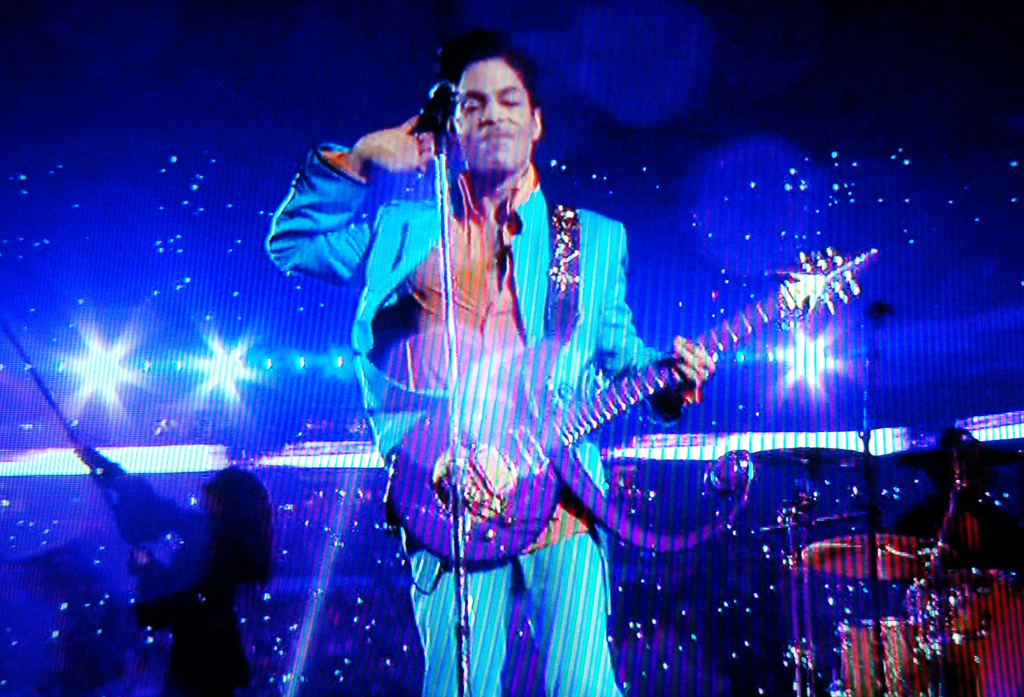
The Pantone Color Institute has announced that they’ve created “a standardized custom color to represent and honor international icon, Prince.” Called “Love Symbol #2”, the color (below) draws inspiration from Prince’s Yamaha purple piano. Somewhere, Marie Schrader is jealous.
As a novelist, George Orwell did not traffic in subtleties, but then neither did the authors of Medieval morality plays. The allegorical Animal Farm performs a similar, if secular, function, giving us unambiguous villainy and clear didactic intent. Orwell noted in his essay “Why I Write” that he meant the book to “fuse political purpose and artistic purpose into one whole.“ Originally published with the subtitle A Fairy Story, the novel caricatures Stalinism and the Russian Revolution, and Orwell left no mystery as to his intent when he commented in the preface to a 1947 Ukrainian edition that he meant the book to “end on a loud note of discord” meant to signify what he saw as the instability of the Tehran Conference.
Leaden statements like these aside, Orwell swore he “did not wish to comment on the work,” writing, “if it does not speak for itself, it is a failure.” The book does indeed speak, in two particular ways: its vividly grotesque characterizations of the humans and animals on the farm and its indelible collection of propagandistic slogans.
These are the features best captured by gonzo illustrator Ralph Steadman, famous for his collaborations with Hunter S. Thompson. Published in 1995—with the Fairy Story subtitle restored—the Steadman-illustrated 50th anniversary edition realizes another previous variation on the book’s title: Animal Farm: A Contemporary Satire.
These images draw out the exaggerated absurdities of the novel as only an artist with Steadman’s twisted, surrealist sense of visual humor could. They are profoundly effective, though there’s no telling what Orwell would have thought of them. Steadman’s caricatures universalize the book’s drama, providing the kind of stock characters we find in folklore, “fairy stories,” and religious allegory. But Orwell wrote that he wished us not to mistake his express political intent: “It was of the utmost importance to me that people in Western Europe should see the Soviet regime for what it really was…. I have been convinced that the destruction of the Soviet myth was essential if we wanted a revival of the Socialist movement.”
Steadman, to his great credit, felt no need to literalize Orwell’s stated intentions in his illustrations, but rather took the book’s bizarre world on its own terms. You can read more quotes from Orwell’s earnest, intended preface for the book, restored in the Steadman edition, at Brain Pickings, where you’ll also find a good number of the illustrations as well. Copies of the book can be purchased on Amazon.
Steadman not only applied his skill as a caricaturist to Orwell’s fictional farm denizens, we should note, but also to the author himself. He made several sketches of Orwell, such as that below of the writer with a cage of rats around his neck. You can see several more of Steadman’s drawings of Orwell at The Guardian.
No name has become more synonymous with the very concept of “movie music” than that of Hans Zimmer. Beginning in the 1980s by composing for such cult filmmakers of distinctive vision as Jerzy Skolimowski, Nico Mastorakis, and Nicolas Roeg, Zimmer soon rose to Hollywood heights, creating the scores for big hits like Rain Man, The Lion King, As Good as It Gets, Gladiator, and the Pirates of the Caribbean series. In recent years, he has entered into an ongoing collaboration with the director Christopher Nolan, himself an indie favorite turned blockbuster king, scoring his Batman movies as well as Inception, Interstellar,and Nolan’s new World War II picture Dunkirk, whose unusual sonic intensity the Vox video above explains.
“My weakness is that I didn’t go to music school, and that my formal education is two weeks of piano lessons,” Zimmer told Indiewire a couple years ago, after the release of Interstellar. “My strength is that I know how to listen,” and “the way Chris Nolan and I work is we listen to each other.”
Unlike many productions where “the composer is this nearly uncontrollable element that comes into the film” and to whom the director must defer, Zimmer starts working on Nolan’s movies from the beginning, a process he describes as a conversation: “While he was writing, while he was shooting, I was writing, and the music was happening sort of in a — to use an Interstellar term — parallel universe, really.” With no need for the dreaded “temp score,” the drama of Zimmer’s music and Nolan’s stories develop together.
You can hear the results of Zimmer’s process in this nine-hour playlist, which includes Zimmer’s work for Nolan’s films up to Dunkirk–its sound based in part on the ticking of a watch Nolan had given him–and others besides. (The playlist also includes Zimmer’s soundtracks for Interstellar, Inception, The Dark Knight, The Dark Knight Rises, Black Hawk Down, Sherlock Holmes, Gladiator, and The Thin Red Line.) If it leaves you with the desire to learn a bit more about how this instinctive master of movie music does it, have a look at the trailer above for “Hans Zimmer Teaches Film Scoring,” his $90 course from the online educational platform Masterclass. The very first piece of wisdom he offers reflects the fact that his instinct for back-and-forth collaboration extends well beyond his partnership with Nolan to his view on the craft itself: “In music, you’re basically having a conversation” — with your artistic collaborators, with your fellow musicians, with anyone to whom you can listen.
It’s difficult to appraise the complicated legacy of Franklin D. Roosevelt. His New Deal policies are credited for lifting millions out of destitution, and they created opportunities for struggling artists and writers, many of whom went on to become some of the country’s most celebrated. But Roosevelt also compromised with racist southern senators like Mississippi’s Theodore Bilbo, and underwrote housing segregation, job and pay discrimination, and exclusions in his economic recovery aimed most squarely at African-Americans. He is lauded as a wartime leader in the fight against Nazism. But he built concentration camps on U.S. soil when he interned over 100,000 Japanese Americans after Pearl Harbor. His commitment to isolationism before the war and his “moral failure—or indifference” to the plight of European Jews, thousands of whom were denied entry to the U.S., has come under justifiable scrutiny from historians.
Both blame and praise are well warranted, and not his alone to bear. Yet, for all his serious lapses and wartime crimes, FDR consistently had an astute and idealistic economic vision for the country. In his 1944 State of the Union address, he denounced war profiteers and “selfish and partisan interests,” saying, “if ever there was a time to subordinate individual or group selfishness to the national good, that time is now.”
He went on to enumerate a series of proposals “to maintain a fair and stable economy at home” while the war still raged abroad. These include taxing “all unreasonable profits, both individual and corporate” and enacting regulations on food prices. The speech is most extraordinary, however, for the turn it takes at the end, when the president proposes and clearly articulates a “second Bill of Rights,” arguing that the first one had “proved inadequate to assure us equality in the pursuit of happiness.”
Roosevelt did not take the value of equality for granted or merely invoke it as a slogan. Though its role in his early policies was sorely lacking, he showed in 1941 that he could be moved on civil rights issues when, in response to a march on Washington planned by Bayard Rustin, A. Philip Randolph, and other activists, he desegregated federal hiring and the military. In his 1944 speech, Roosevelt strongly suggests that economic inequality is a precursor to Fascism, and he offers a progressive political theory as a hedge against Soviet Communism.
“We have come to a clear realization,” he says, “of the fact that true individual freedom cannot exist without economic security. ‘Necessitous men are not free men.’ People who are hungry and out of a job are the stuff of which dictatorships are made. In our day these economic truths have become accepted as self-evident.” In the footage at the top of the post, you can see Roosevelt himself read his new Bill of Rights. Read the transcript yourself just below:
We have accepted, so to speak, a second Bill of Rights under which a new basis of security and prosperity can be established for all regardless of station, race, or creed.
Among these are:
The right to a useful and remunerative job in the industries or shops or farms or mines of the Nation;
The right to earn enough to provide adequate food and clothing and recreation;
The right of every farmer to raise and sell his products at a return which will give him and his family a decent living;
The right of every businessman, large and small, to trade in an atmosphere of freedom from unfair competition and domination by monopolies at home or abroad;
The right of every family to a decent home;
The right to adequate medical care and the opportunity to achieve and enjoy good health;
The right to adequate protection from the economic fears of old age, sickness, accident, and unemployment;
The right to a good education.
All of these rights spell security. And after this war is won we must be prepared to move forward, in the implementation of these rights, to new goals of human happiness and well-being.
Roosevelt died in office before the war ended. His successor tried to carry forward his economic and civil rights initiatives with the “Fair Deal,” but congress blocked nearly all of Truman’s proposed legislation. We might imagine an alternate history in which Roosevelt lived and found a way through force of will to enact his “second Bill of Rights,” honoring his promise to every “station, race” and “creed.” Yet in any case, his fourth term was nearly at an end, and he would hardly have been elected to a fifth.
But FDR’s progressive vision has endured. Many seeking to chart a course for the country that tacks away from political extremism and toward economic justice draw directly from Roosevelt’s vision of freedom and security. His new bill of rights is striking for its political boldness. Its proposals may have had their clearest articulation three years earlier in the famous “Four Freedoms” speech. In it he says, “the basic things expected by our people of their political and economic systems are simple. They are:
Equality of opportunity for youth and for others.
Jobs for those who can work.
Security for those who need it.
The ending of special privilege for the few.
The preservation of civil liberties for all.
The enjoyment of the fruits of scientific progress in a wider and constantly rising standard of living.
These are the simple, the basic things that must never be lost sight of in the turmoil and unbelievable complexity of our modern world. The inner and abiding strength of our economic and political systems is dependent upon the degree to which they fulfill these expectations.
Guaranteeing jobs, if not income, for all and a “constantly rising standard of living” may be impossible in the face of automation and environmental degradation. Yet, most of Roosevelt’s principles may not only be realizable, but perhaps, as he argued, essential to preventing the rise of oppressive, authoritarian states.
We're hoping to rely on loyal readers, rather than erratic ads. Please click the Donate button and support Open Culture. You can use Paypal, Venmo, Patreon, even Crypto! We thank you!
Open Culture scours the web for the best educational media. We find the free courses and audio books you need, the language lessons & educational videos you want, and plenty of enlightenment in between.