How does the existence of YouTube, social media, and virtual spaces changed the way comedians construct a set, relate to their fans, and make a living? We talk about story-telling vs. one-liners, repping your hometown, comedy cliques, surviving negativity, and more.
Some articles that go into these issues further include:
From Frog to Prince: We will always love your music and you. Our hearts are yours. Thanks for being a friend.
– Kermit the Frog, April 21, 2016
There was a time when sharing the screen with the Muppets was the ultimate celebrity status symbol.
Prince never appeared on The MuppetShow– 1999, the 1982 album that made him a household name, was released the year after the series concluded its run — but he got his chance fifteen years later, with an appearance on the shorter lived Muppets Tonight.
In a tribute written shortly after Prince’s death, Muppets Tonight writer Kirk Thatcher recalled:
We were very excited that Prince had agreed to do our Muppet comedy and variety show but had been told by his managers and support staff before we met with him that we must never look at him directly or call him anything but, “The Artist” or just, “Artist”. As the writers of the show, we were wondering how we were going to work or collaborate with someone you can’t even look at, especially while trying to create comedy with puppets!
His staff sent an advance team to make sure the working environment would be to his liking, special food and drink was laid in at his request, and the scripts of sketches that had been written for him were sent ahead for his approval.
The Muppets’ crew grew even more nervous when Prince asked for a meeting the night before the scheduled shoot day. Thatcher had “visions of him trashing everything and forcing us to start over,” adding that it would not have been the first time a guest star would have insisted on a total overhaul at zero hour.
Instead of the monster they’d been bracing for, Prince — who Thatcher described as “only half again bigger than most of the Muppets” — proved a game if somewhat “bemused” and “quiet” collaborator:
He had fun additions and improvs and loved playing and ad-libbing with the puppets and was very easy to talk to and work with. The whole situation with his advance team and management reminded me of the relationship I had created between Kermit and Sam the Eagle in Muppet Treasure Island. Sam had convinced everyone that Kermit, playing Captain Smollet, was a furious and angry tyrant, beset by inner demons and outer tirades. But when we meet him, he was just good, old, sweet-natured Kermit the Frog… just in a captains outfit. The same for Prince. He was just a nice, fun, creative guy who had built this persona around himself, and had a team there to reinforce it, probably to protect his art, his personal life and even his sanity.
The episode riffed on his established image, shoehorning Muppets into a “leather and lace” look that Prince himself had moved on from, and cracking jokes related to the unpronounceable “Love Symbol” to which he’d changed his name four years earlier.
Naturally, they plumbed his catalogue for musical numbers, having particular fun with “Starfish and Coffee,” which features a proto-Prince Muppet and an alternate origin story.
(The actual origin story is pretty great, and provides another tiny glimpse of this mysterious artist’s true nature.)
The show also afforded Prince the opportunity to chart some unexpected territory with Hoo Haw, a spoof of the countrified TV variety show Hee Haw.
If you’ve ever wondered how The Purple One would look in overalls and a plaid button down, here’s your chance to find out.
However, interactive conversations about texts you probably haven’t read can be difficult to follow no matter how much we try to make them accessible, and a decade of history means that many names that might be dropped that those newly checking in may or may not be familiar with.
I’m one of the hosts of that podcast, and while I’m very happy with the format and thrilled to have reached so many people with it, I also appreciate the dynamic of a one-on-one tutoring interchange, and I stand firmly behind one of the original rules of The Partially Examined Life: No name-dropping.
As we read more complicated texts, our interest becomes figuring out what the philosopher meant, and only secondarily whether that meaning actually relates to something in people’s actual lives. Yes, we are critical (some say too critical) of the subject-matter, but we’re also big fans; we could bask in the literary glow of Hegel or Plato or Simone de Beauvoir or Hannah Arendt all day, and have often done so.
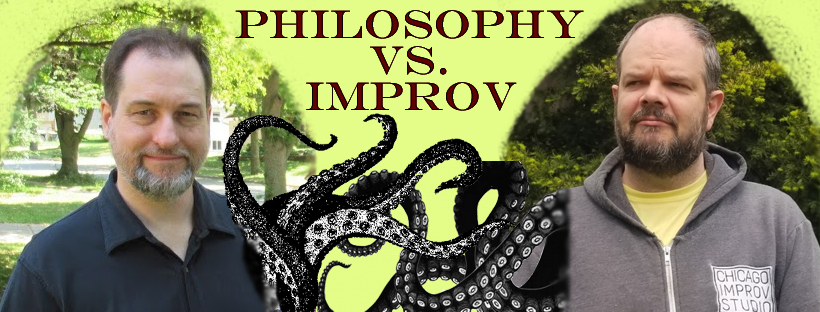
My newest podcast, Philosophy vs. Improv, is reciprocal tutoring realized as comedy (or at least performance art?). As someone who studied philosophy for many years in school and has then been hosting The Partially Examined Life for so long, I’m in a good position to come up with particular philosophical points worth teaching to a new learner.
My Philosophy vs. Improv co-host is Bill Arnett, founder of the Chicago Improv Studio, author of The Complete Improviser, and the former training director at Chicago’s famed iO Theater. He has appeared repeatedly on the Hello From the Magic Tavern improv comedy podcast as a character named Metamore who leads the show’s hosts (who are all fantasy characters a la Tolkein or Narnia) in a table-top role-playing game called Offices and Bosses. This and other shows ignited in me an urge to learn the fundamentals of improv comedy, and so each Philosophy vs. Improv episode, Bill comes up with some trick of the trade to try to teach me.
There are two rules of engagement: First, we can’t just state up front what the lesson is. We can ask each other questions, go through exercises, and otherwise discuss the material, but the lesson should emerge naturally. Second, we don’t take turns in trying to teach each other. As he’s making me act out scenes, I’m trying to set up those scenes or have my character react in such a way to exemplify my philosophical point. As we’re discussing philosophy, Bill is relating it to comparable points about improv. Of course, we’re both interested in learning as well as teaching, so the “vs.” in the show’s title is not so much competition between us as between which lesson ends up more nearly producing its intended effect in the other person.
It is surprising how smoothly these dueling lessons often fit together, as lessens about ethics in particular, about the art of living, are very much relevant to the improvisational skills of being present, presenting yourself, discovering the reality of a situation, and exploring truths of character. Fiction is often a very effective vehicle for addressing philosophy, whether the characters themselves are talking philosophically (even if they’re animals, cave men, or otherwise in a non-typical situation for discussion), or perhaps we’re embodying some political situation or thought experiment that we’re subjecting to philosophical analysis.
Likewise, back to the days of Plato, a dose of irony in discussing philosophy can be useful, and this format allows us to not just be ourselves on a podcast discussing philosophy, but at any point to launch into some comedy bit, and in this way show the absurdity of views we’re arguing against or just play with the ideas in a manner that I think enhances mental flexibility, which is essential both for improvisation and for philosophical creativity.
Listen to the latest episode (#7), entitled “Meritocracy Now!”
Mark Linsenmayer is the host of four podcasts: Pretty Much Pop: A Culture Podcast, Nakedly Examined Music, The Partially Examined Life, and Philosophy vs. Improv.
Just a little fun to send you into the summer weekend. Above, we present the 1975 animated short, “Pink Da Vinci,” which IMDB frames as follows:
Another battle of the paintbrush between the Pink Panther and a diminutive painter, who this time is Leonardo Da Vinci, painting his masterpiece, the Mona Lisa. The little Da Vinci paints a pouting mouth on the Mona Lisa, but the Pink Panther decides to covertly replace the pout with a smile. When the smile wins the appreciation of an art patron, Da Vinci is enraged and repaints the pout. The Pink Panther repeatedly changes the pout to a smile while the little painter is not looking, and ultimately it is the Pink Panther’s version of the Mona Lisa that hangs in the Louvre.
If you would like to sign up for Open Culture’s free email newsletter, please find it here. It’s a great way to see our new posts, all bundled in one email, each day.
If you would like to support the mission of Open Culture, consider making a donation to our site. It’s hard to rely 100% on ads, and your contributions will help us continue providing the best free cultural and educational materials to learners everywhere. You can contribute through PayPal, Patreon, and Venmo (@openculture). Thanks!
What makes for a good comedy film or show? Funny people reading (or improvising) funny lines is not enough; an good director needs to capture (or recreate in the editing room) comic timing, construct shots so that the humor comes through and coach the actors to make sure that the tone of the work is consistent.
Your Pretty Much Pop hosts Mark Linsenmayer, Erica Spyres, and Brian Hirt are joined by Heather Fink to discuss the role of the director in making a comedy (or anything else) actually good. Heather has directed for TV, film, and commercials and spent a lot of time doing sound (a boom operator or sound utility) for productions like Saturday Night Live, Get Out, The Morning Show, and Marvel’s Daredevil.
We talk about maintaining comedy through the tedious process of filming, putting actors through sex scenes and other hardships, not telling them how to say their lines, comedians in dramas, directing improv/prank shows, and more. We touch on include Bad Trip, Barry, and Ted Lasso, and more.
Watch some of Heather’s work:
Alleged, a short about dramatizing accusations against Steven Segal
Inside You, a film she wrote, directed, and (reluctantly) starred in
The Focus Group, a short Heather directed written by and starring Sara Benincasa
We used some articles to bring various directors and techniques to mind:
TikTok, the short-form video-sharing platform, is an arena where the young dominate — last summer, The New York Times reported that over a third of its 49 million daily users in the US were aged 14 or younger.
30-year-old Brooklyn-based artist Tyler Gunther views his creation, Greedy Peasant, as “the manifestation of all the strange medieval art we now enjoy in meme form”:
Often times medieval history focuses on royals, wars, popes and plagues. With this peasant guide, we get to experience the world through the lens of a queer artist who is just trying to make sure everyone is on time for their costume fittings for the Easter pageant.
Then last February, he found himself quarantining in an Australian hotel room for 2 weeks prior to performing in the Adelaide Festival as part of The Plastic Bag Store, artist Robin Frohardt’s alternately hilarious and sobering immersive supermarket installation:
My quarantine plans had been to work on a massive set of illustrations and teach myself the entire Adobe Creative Suite. Instead I just wandered from one corner of the hotel room to the next and stared at the office building directly outside my window. About 4 days in, Robin texted, “Now is your time to make a TikTok.” I had avoided it for so long. I always had an excuse and I was genuinely confused about how the app worked. But with no alternatives left I made a few videos “just to test out some of the filters” and I was instantly hooked.
Now, a green screen and a set of box lights are permanently installed in his Brooklyn studio so he can film whenever inspiration strikes, provided it’s not too steamy to don the tights, cowls, wigs and woolens that are an integral part of Greedy Peasant’s look.
One of Gunther’s most eye popping creations came about when Greedy Peasant answered an ad post in the town square seeking a Spider Man (i.e., a man with spiders) to combat a bug infestation:
As a former costume design student, I’m intrigued by how superhero uniforms fit within the very conservative world of Western men’s fashion. We’re supposed to believe these color blocked bodysuits are athletic and high tech. These manly men don’t wear them just because they look great in them, they wear them for our protection and the greater good. But what if one superhero did value style over substance? Would he still retain his authoritative qualities if his super suit was embroidered and beaded and dripping with tassels? This medievalist believes so.
To me tassels represent ornamentation for ornamentation’s sake at its peak. This decorative concept is so maligned in our current age. 21st century design trends are so sleek and smooth, which does make our lives practical and efficient. But soon we’ll all be dead. Medieval artisans seemed to understand this on some level. I think if iPhones were sold in the middle ages they would have 4 tassels on each corner. Why? Because it would look very nice. A tassel looks beautiful as a piece of static sculpture. It adds an air of authority and polish to whatever object it is attached to. If that were all they provided us it would be enough. But then suddenly you give your elbow a little flick and before you know it your sleeve tassels are in flight! They are performing a personal ballet with their little strings going wherever the choreography may take them. It’s a gift.
He also shoots on location when the situation warrants:
Especially in New York City, where it seems like every neighborhood has at least one building dressed up to look as if it survived the Black Plague. I love this blatantly false illusion of a heroic past. We American’s know it’s a façade. We know the building was built in 1910, not 1410, but somehow it still pleases us. Even when I went home to Arkansas to visit family, we were constantly scouting filming locations which looked convincingly medieval. Our greatest find were the back rooms and the choir loft of a beautiful gothic revival church in our town.
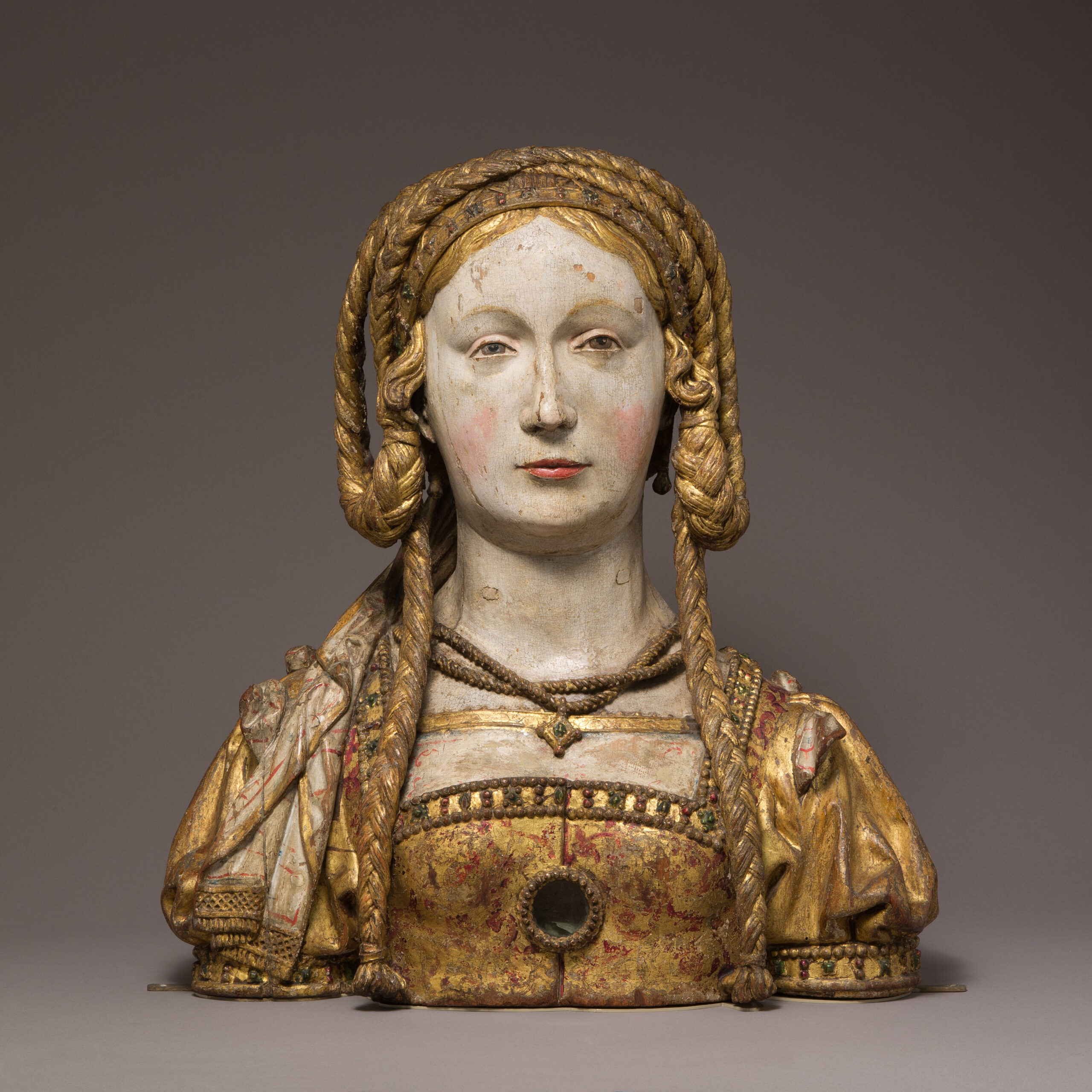
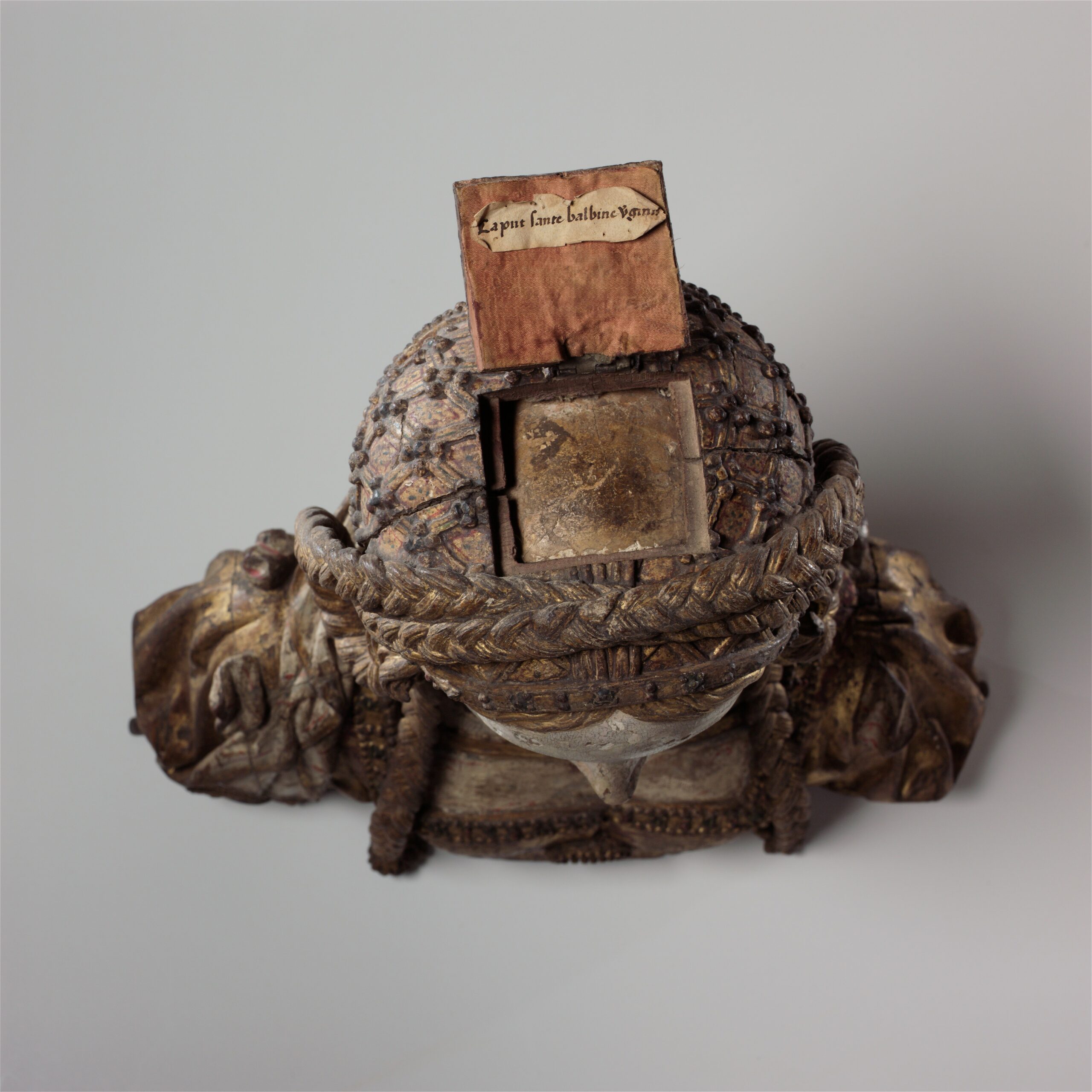
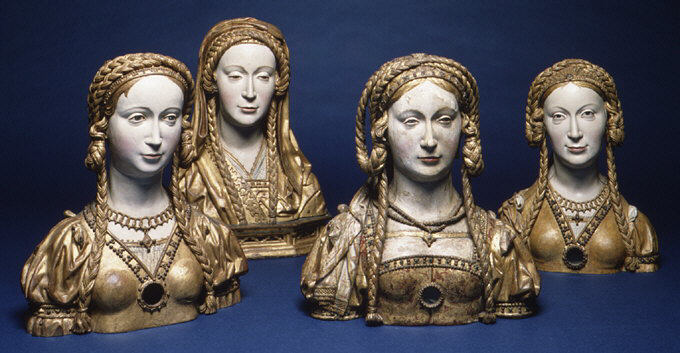
While Gunther is obviously his own star attraction, he alternates screen time with a group of “reliquary ladies,” whose main trio, Bridgette, Amanda and Susan are the queen bees of the side aisle. Even before he used a green screen filter to animate them with his eyes, lips, and a hint of mustache, he was drawn to their hairdos and individual personalities during repeat visits to the Met Cloisters.
“As reliquaries, they embody such a specific medieval sensibility,” he enthuses. “Each housed a small body part of a deceased saint, which people would make a pilgrimage to see. This combination of the sacred, macabre and beautiful includes all my favorite medieval elements.”
The portion set to Chopin’s Waltz in E Minor, above, has earned the nickname The Mistake Waltz. It’s an anthology of screw ups that will be familiar to anyone who’s attended a few amateur ballet productions and school recitals.
When the entire ensemble is meant to be traveling in the same direction or synchronizing swanlike gestures, the one who’s egregiously out of step is a guaranteed standout… if not the audience’s flat out favorite.
Robbins generously spreads the clowning between all six members of the corps, getting extra mileage from the telegraphed irritation in every indiscreetly attempted correction.
Performed well, the silliness seems almost improvisational, but as with all of this legendary choreographer’s work, the spontaneous beats are very, very specific.
It only works if the dancers have the technical prowess and the comic chops to pull it off. Les Ballets Trockadero de Monte Carlo aside, this can present a sizable casting challenge.
Robbins also felt that The Concert should be presented sparingly, to keep the jokes from becoming stale.
Individual companies have some agency over their costumes, but other than that, it is executed just as it was in its 1956 debut with the New York City Ballet.
He had the unique ability to become kid-like in the studio, giggling with others and often laughing robustly at his own jokes. He was certainly his own best audience for The Concert. How many times had he seen those gags and yet fresh, spontaneous laughter erupted from him as if it was a first telling.
The ATTC’s repertoire consists of great works of literature, song and dance… performed exclusively in aircraft lavatories, a true feat when one considers that Turner, impresario and sole company member, is 6’8”.
2015’s inaugural production, above, remains among the company’s most ambitious — a 50th anniversary recreation of Bob Dylan’s 1965 promotional film clip for Subterranean Homesick Blues, shot on various flights throughout the Ukulele Orchestra’s US tour.
Before long, Turner’s carry-on was stuffed with props and costumes — a toga, three self-adhesive Abraham Lincoln beards, a fat suit, a plastic cigar, cardboard face masks of Jimi Hendrix and Queen’s Brian May, and a numbers of inflatables, including a woman, a horse, and a not particularly realistic handgun.
Staging solo, site specific mini productions struck Turner as a far more amusing prospect than remaining in his seat, watching a movie:
I don’t like passive consumerism — I’d rather make my own movie than watch some CGI blockbuster on a plane. 90% of touring is NOT performing but sitting around on a plane/train/bus staring into space — I’m just trying to do something creative to make the time pass.
With advance planning, the simpler productions can make it into the can on a single take.
The James Bond Tribute, below, which called for costume changes, puppets and cardboard masks of Sean Connery, Roger Moore, and Daniel Craig, was shot in segments — London to Frankfurt, Singapore to Auckland, and Singapore to London.
Rather than projecting for the benefit of folks in the non-existent back row, Turner prefers to lip synch prerecorded lines, fed to him via earbud. This helps dial down the suspicions of flight attendants and fellow passengers. Once the “occupied” light comes on, he reckons he has between 7 to 10 minutes to take care of business. Should anyone question the length of his stay, or his large bag of costumes and props, his excuse is that “I suffer from haemorrhoids and need to change my pants. (Believe me, this is a conversation no one wants to take further.)”
We're hoping to rely on loyal readers, rather than erratic ads. Please click the Donate button and support Open Culture. You can use Paypal, Venmo, Patreon, even Crypto! We thank you!
Open Culture scours the web for the best educational media. We find the free courses and audio books you need, the language lessons & educational videos you want, and plenty of enlightenment in between.