Among my works, the one I like best is the Home that I have had built in Milan for accommodating old singers not favored by fortune, or who, when they were young did not possess the virtue of saving. Poor and dear companions of my life!
—Giuseppe Verdi
Is there a remedy for the isolation of old age?
What about the jolly fraternity and competitiveness of an art college dorm, as envisioned by opera composer Giuseppe Verdi?
Shortly before his death, the composer donated all royalties from his operas to the construction and administration of a luxurious retreat for retired musicians, designed by his librettist’s brother, architect Camillo Boito.
Completed in 1899, Casa Verdi still serves elderly musicians today—up to 60 at a time. Residents of Casa Verdi include alumnae of the Metropolitan Opera and the Royal Opera House. Guests have worked alongside such notables as Chet Baker and Maria Callas.
Competition for residential slots is stiff. To qualify, one must have been a professional musician or music teacher. Those selected enjoy room, board, and medical treatment in addition to, writes The New York Times, “access to concerts, music rooms, 15 pianos, a large organ, harps, drum sets and the company of their peers.” Musical programming is as constant as the fine view of Verdi’s grave.
Dining tables are named in honor of Verdi’s works. Those inclined to worship do so in a chapel named for Santa Cecilia, the patron saint of musicians.
Practice rooms are alive with the sound of music and criticism. As Casa Verdi’s music therapist told the Financial Times, “They are very competitive: they are all prima donnas.”
When memory fails, residents can tune in to such documentaries as actor Dustin Hoffman’s Tosca’s Kiss, below
Get a peek inside Verdi’s retirement home for artists, compliments of Urban Sketchers here.
Note: An earlier version of this post appeared on our site in 2018.
It takes about five hours to drive from Düsseldorf to Hamburg on the Autobahn. During that stretch, you can listen to Kraftwerk’s album Autobahn seven times — or if you prefer, you can loop its eponymous opening song thirteen times. For it was “Autobahn,” more so than Autobahn, that changed the sound of music around the world in ways we still hear today. “Germany was suddenly on the musical map,” writes the Guardian’s Tim Jonze. “David Bowie – who used to ride the autobahn while listening to the record – moved to Berlin and went on to make the electronically influenced Low, “Heroes” and Lodger. Brian Eno relocated to the rural village of Forst to record with the influential avant-garde band Harmonia.” Soon would come the electronic pop of Ultravox, DAF and the Eurythmics, followed by Donna Summer and Giorgio Moroder’s floodgate-opening “I Feel Love”.
Not a bad pop-cultural coup for, as Jonze puts it, “a 22-minute 43-second song about the German road network.” At the time of its release in early 1975, Kraftwerk had put out three full albums, but what would become their signature Teutonic-electronic sound hadn’t quite taken shape. But it was already clear that their work took its inspiration from twentieth-century modernity, a subject of which no single work of man in their homeland could have been more evocative than the Autobahn.
With its origins in the Weimar Republic and its long stretches without a speed limit, the German freeway network is internationally regarded as a concrete symbol of total personal freedom, and total personal responsibility, within a highly rule-respecting culture. To the young members of Kraftwerk, who often drove the Düsseldorf-Hamburg section, it held out the promise of freedom.
So did the then-new Minimoog synthesizer, which cost as much as a Volkswagen at the time, but offered the chance to make music like nothing the public had ever heard before. “Autobahn” captured the imaginations of listeners everywhere with not just its electronic effects, but also the incongruity of their combination with instruments like the flute (a holdover from Kraftwerk’s earlier compositions) and vehicular sounds evocative of a genuine road trip — all assembled at what would then have seemed a hypnotically expansive length for a pop song. Little did even the hippest listeners of the mid-seventies, such as the Americans tuned into early free-form FM stations where no corporate programming rules applied, know that they were hearing what Jones calls “the point where electronic pop music truly began.” All car trips run out of road eventually, but humanity’s journey into the possibilities of high-tech music shows no signs of approaching its end.
Based in Seoul, Colin Marshall writes and broadcasts on cities, language, and culture. He’s the author of the newsletterBooks on Cities as well as the books 한국 요약 금지 (No Summarizing Korea) and Korean Newtro.Follow him on the social network formerly known as Twitter at @colinmarshall.
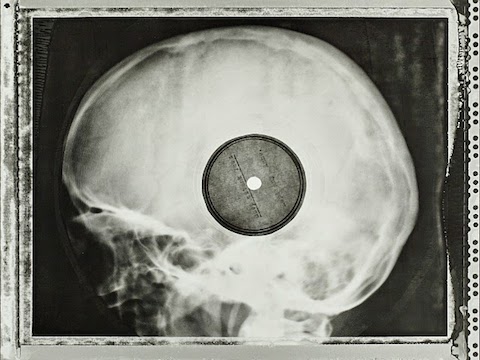
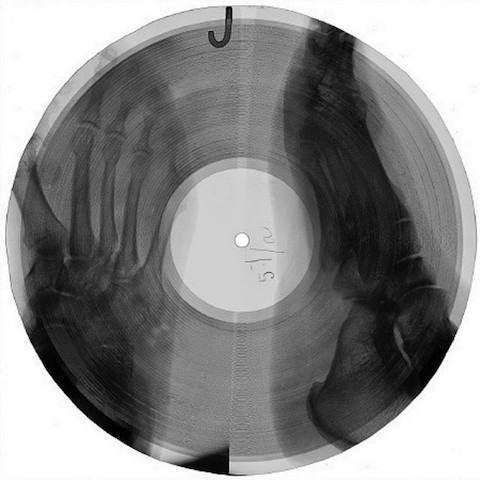
A catchy tribute to mid-century Soviet hipsters popped up a few years back in a song called “Stilyagi” by lo-fi L.A. hipsters Puro Instinct. The lyrics tell of a charismatic dude who impresses “all the girls in the neighborhood” with his “magnitizdat” and guitar. Wait, his what? His magnitizdat, man! Like samizdat, or underground press, magnitizdat—from the words for “tape recorder” and “publishing”—kept Soviet youth in the know with surreptitious recordings of pop music. Stilyagi (a post-war subculture that copied its style from Hollywood movies and American jazz and rock and roll) made and distributed contraband music in the Soviet Union. But, as an NPR piece informs us, “before the availability of the tape recorder and during the 1950s, when vinyl was scarce, ingenious Russians began recording banned bootleg jazz, boogie woogie and rock ‘n’ roll on exposed X‑ray film salvaged from hospital waste bins and archives.” See one such X‑ray “record” above, and see here the fascinating process dramatized in the first scene of a 2008 Russian musical titled, of course, Stilyagi (translated into English as “Hipsters”—the word literally means “obsessed with fashion”).
These records were called roentgenizdat (X‑ray press) or, says Sergei Khrushchev (son of Nikita), “bone music.” Author Anya von Bremzen describes them as “forbidden Western music captured on the interiors of Soviet citizens”: “They would cut the X‑ray into a crude circle with manicure scissors and use a cigarette to burn a hole. You’d have Elvis on the lungs, Duke Ellington on Aunt Masha’s brain scan….” The ghoulish makeshift discs sure look cool enough, but what did they sound like? Well, as you can hear below in the Beatles samples, a bit like old Victrola phonograph records played through tiny transistor radios on a squonky AM frequency.
Dressed in fashions copied from jazz and rockabilly albums, stilyagi learned to dance at underground nightclubs to these tinny ghosts of Western pop songs, and fought off the Komsomol—super-square Leninist youth brigades—who broke up roentgenizdat rings and tried to suppress the influence of bourgeois Western pop culture. According to Artemy Troitsky, author of Back in the USSR: The True Story of Rock in Russia, these records were also called “ribs”: “The quality was awful, but the price was low—a rouble or rouble and a half. Often these records held surprises for the buyer. Let’s say, a few seconds of American rock ’n’ roll, then a mocking voice in Russian asking: ‘So, thought you’d take a listen to the latest sounds, eh?, followed by a few choice epithets addressed to fans of stylish rhythms, then silence.”
See more images of bone music records over at Laughing Squid and Wired co-founder Kevin Kelly’s blog Street Use, and above dig some historical footage of stilyagi jitterbugging through what appears to be a kind of Soviet training film about Western influence on Soviet youth culture, produced no doubt during the Khrushchev thaw when, as Russian writer Vladimir Voinovich tells NPR, things got “a little more liberal than before.”
Note: An earlier version of this post appeared on our site in 2014.
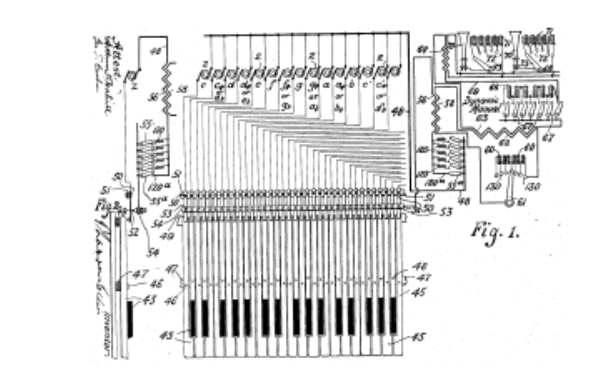
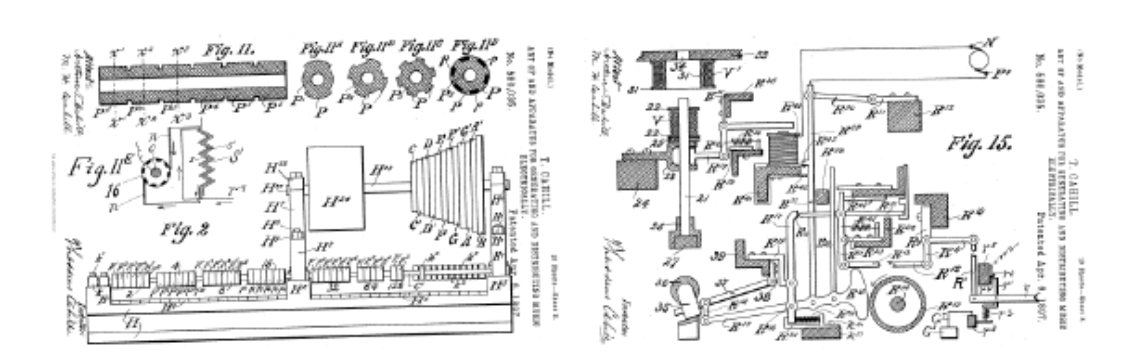
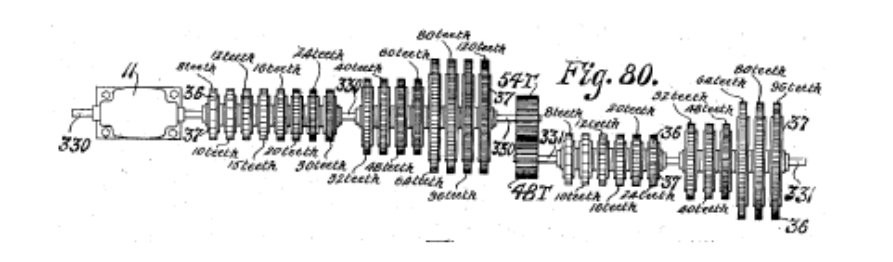
Before the New Year, we brought you footage of Russian polymathic inventor Léon Theremin demonstrating the strange instrument that bears his surname, and we noted that the Theremin was the first electronic instrument. This is not strictly true, though it is the first electronic instrument to be mass produced and widely used in original composition and performance. But like biological evolution, the history of musical instrument development is littered with dead ends, anomalies, and forgotten ancestors (such as the octobass). One such obscure oddity, the Telharmonium, appeared almost 20 years before the Theremin, and it was patented by its American inventor, Thaddeus Cahill, even earlier, in 1897. (See some of the many diagrams from the original patent below.)
Cahill, a lawyer who had previously invented devices for pianos and typewriters, created the Telharmonium—also called the Dynamaphone—to broadcast music over the telephone, making it a precursor not to the Theremin but to the later scourge of telephone hold music. “In a large way,” writes Jay Williston at Synthmuseum.com, “Cahill invented what we know of today as ‘Muzak.’”
He built the first prototype Telharmonium, the Mark I, in 1901. It weighed seven tons. The final incarnation of the instrument, the Mark III, took 50 people to build at the cost of $200,000 and was “60 feet long, weighed almost 200 tons and incorporated over 2000 electric switches…. Music was usually played by two people (4 hands) and consisted of mostly classical works by Bach, Chopin, Greig, Rossini and others.” The workings of the gargantuan machine resemble the boiler room of an industrial facility. (See several photographs here.)
Needless to say, this was a highly impractical instrument. Nevertheless, Cahill not only found willing investors for the enormous contraption, but he also staged successful demonstrations in Baltimore, then—after disassembling and moving the thing by train—in New York. By 1905, his New England Electric Music Company “made a deal with the New York Telephone Company to lay special lines so that he could transmit the signals from the Telharmonium throughout the city.” Cahill used the term “synthesizing” in his patent, which some say makes the Telharmonium the first synthesizer, though its operation was as much mechanical as electronic, using a complicated series of gears and cylinders to replicate the musical range of a piano. (See the operation explained in the video at the top.) “Raised bumps on cylinders helped create musical contour notes,” writes Popular Mechanics, “not unlike a music box, with the size of the cylinder determining the pitch.”
The huge, very loud Telharmonium Mark III ended up in the basement of the Metropolitan Opera House for a time as Cahill worked on his scheme for pumping music through the telephone lines. But this plan did not come off smoothly. “The problem was,” Popular Mechanics points out,” all cables leak off radio waves. Sending a gigantic, amplified signal on turn-of-the-20th-century phone lines was bound to cause trouble.” The Telharmonium created interference on other phone lines and even interrupted Naval radio transmissions. “Rumor has it,” the Douglas Anderson School of the Arts writes, “that a New York businessman, infuriated by the constant network interference, broke into the building where the Telharmonium was housed and destroyed it, throwing pieces of the machinery into the Hudson river below.”
The story seems unlikely, but it serves as a symbol for the instrument’s collapse. Cahill’s company folded in 1908, though the final Telharmonium supposedly remained operational until 1916. No recordings of the instrument have survived, and Thaddeus Cahill’s brother Arthur eventually sold the last prototype off for scrap in 1950 after failing to find a buyer. The entire rationale for the instrument had been supplanted by radio broadcasting. The Telharmonium may have failed to catch on, but it still had a significant impact. Its unique design inspired another important electronic instrument, the Hammond organ. And its very existence gave musical futurists a vision. The Douglas Anderson School writes:
Despite its final demise, the Telharmonium triggered the birth of electronic music—The Italian Composer and intellectual Ferruccio Busoni inspired by the machine at the height of its popularity was moved to write his “Sketch of a New Aesthetic of Music” (1907) which in turn became the clarion call and inspiration for the new generation of electronic composers such as Edgard Varèse and Luigi Russolo.
The instrument also made quite an impression on another American inventor, Mark Twain, who enthusiastically demonstrated it through the telephone during a New Year’s gathering at his home, after giving a speech about his own not inconsiderable status as an innovator and early adopter of new technologies. “Unfortunately for Thaddeus Cahill,” writes William Weir at The Hartford Courant, “Twain’s support wasn’t enough to make a success of the Telharmonium.” Learn more about the instrument’s history from this book.
Note: An earlier version of this post appeared on our site in 2016.
When asked for their favorite Sesame Street segment, many children of the 70s and 80s point to Pinball Number Count. Psychedelic animation, the Pointer Sisters, odd time signatures—what’s not to love? But for the serious Sesame Street buff, the “Jazz Numbers” series above deserves the silver medal. It’s got free jazz, Yellow Submarine-style surrealistic animation, and a vocal from Grace Slick of Jefferson Airplane. How many young parents recognized her distinctive voice, I wonder?
Also known as “Jazzy Spies,” this 1969 series of animations was devoted to the numbers 2 through 10 (there was no film for “one” as it is the loneliest number that you’ll ever do), and was an essential element in Sesame Street’s first season. Highlights include the dream-like elevator door sequence of “2,” the Jackson 5 reference in “5,” and the racing fans in “10.”
Slick got involved through her first husband, Jerry Slick, who produced the segments for San Francisco-based animation studio Imagination, Inc. Headed by animator Jeff Hale, the company also produced the Pinball segments, as well as the famous anamorphic “Typewriter Guy,” the Ringmaster, and the Detective Man. Hale, by the way, has a cameo as Augie “Ben” Doggie in the well-loved Lucas parody Hardware Wars.)
The delirious music was composed and performed by Columbia jazz artist Denny Zeitlin, who would go on to score the 1979 remake of Invasion of the Body Snatchers. Zeitlin plays both piano and clavinet; accompanying him is Bobby Natanson on drums and Mel Graves on bass. According to Zeitlin, Grace Slick overdubbed her vocals later.
This wasn’t Slick’s first encounter with Jim Henson. In 1968, she and other members of Jefferson Airplane were part of a counterculture documentary called Youth ’68, the trailer for which you can groove on here.
Sesame Street, with all its primary colors, plastic merchandise, and Elmo infestation, may have lost its edge, but these early works show its revolutionary foundations.
Note: An earlier version of this post appeared on our site in 2015.
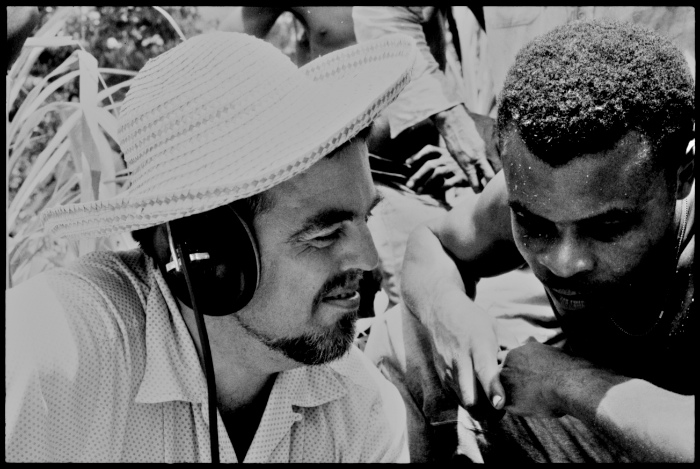
A huge treasure trove of songs and interviews recorded by the legendary folklorist Alan Lomax from the 1940s into the 1990s has been digitized and made available online for free listening. The Association for Cultural Equity, a nonprofit organization founded by Lomax in the 1980s, has posted some 20,000 recordings.
“For the first time,” Cultural Equity Executive Director Don Fleming told NPR’s Joel Rose, “everything that we’ve digitized of Alan’s field recording trips are online, on our Web site. It’s every take, all the way through. False takes, interviews, music.”
It’s an amazing resource. For a quick taste, here are a few examples from one of the best-known areas of Lomax’s research, his recordings of traditional African American culture:
“John Henry” sung by prisoners at the Mississippi State Penitentiary, Parchman Farm, in 1947.
“Come Up Horsey,” a children’s lullaby sung in 1948 by Vera Hall, whose mother was a slave.
But that’s just scratching the surface of what’s inside the enormous archive. Lomax’s work extended far beyond the Deep South, into other areas and cultures of America, the Caribbean, Europe and Asia. “He believed that all cultures should be looked at on an even playing field,” his daughter Anna Lomax Wood told NPR. “Not that they’re all alike. But they should be given the same dignity, or they had the same dignity and worth as any other.”
Note: An earlier version of this post originally appeared on our site in March 2012.
If you would like to support the mission of Open Culture, consider making a donation to our site. It’s hard to rely 100% on ads, and your contributions will help us continue providing the best free cultural and educational materials to learners everywhere. You can contribute through PayPal, Patreon, and Venmo (@openculture). Thanks!
In 1967, a young Roger Ebert drew up a top-ten-films-of-the-year list including Bonnie and Clyde, Blow-Up, The Graduate, A Man for All Seasons, and Cool Hand Luke. Later, he added a few more pictures from this cinematic bumper crop that he remembered fondly, the first of which was The Family Way. Though seldom referenced today, it was a big hit in Britain — one of several, in fact, for the twin-brother filmmakers John and Roy Boulting. Responsible for such nineteen-fifties comedies as Lucky Jim and I’m All Right Jack, the two attained in their homeland not only auteur status, but also the curious position of establishment satirists, validating the institutions of mid-century English life even as they ridiculed them.
Adapted from a stage play by Alfie author Bill Naughton, The Family Way finds its material in the trials of a pair of northern newlyweds who, having been fleeced by a crooked travel agent, end up having to spend their honeymoon at home. What’s worse, given their impecuniousness, “home” meant a room in the house of the groom’s parents.
That 1967 was a different time is also signaled by a scene in which the father-in-law bellows for his chamber pot, which his wife had hoped to keep hidden from her new daughter-in-law’s sensitive eyes. In that role is the acclaimed performer of English everyman John Mills, appearing onscreen for the first time with his daughter Hayley, who plays the bride. It marked her first real adult part, a kind of graduation from her child-actress career in pictures like The Parent Trap and That Darn Cat!
The picture also boasted a score by Paul McCartney, or at any rate by Beatles producer George Martin, who built upon what themes he could successfully importune the seemingly writer’s-blocked Beatle to bang out. Taking into account that this was happening between Revolver and Sgt. Pepper, it’s perhaps understandable that McCartney would feel his creative energies drained by other projects, but the Boulting brothers had offered a first, irresistible opportunity to compose officially outside the Lennon-McCartney dyad. Though not without the charms of Martin’s orchestral work (more of which would be heard in Yellow Submarine in 1969), The Family Way’s brief soundtrack bears few obvious marks of the McCartney musical sensibility. Present on the Beatles’ albums, of course, that sensibility has continued to develop throughout a solo career that has outlived the band by 56 years — and counting.
Based in Seoul, Colin Marshall writes and broadcasts on cities, language, and culture. He’s the author of the newsletterBooks on Cities as well as the books 한국 요약 금지 (No Summarizing Korea) and Korean Newtro.Follow him on the social network formerly known as Twitter at @colinmarshall.
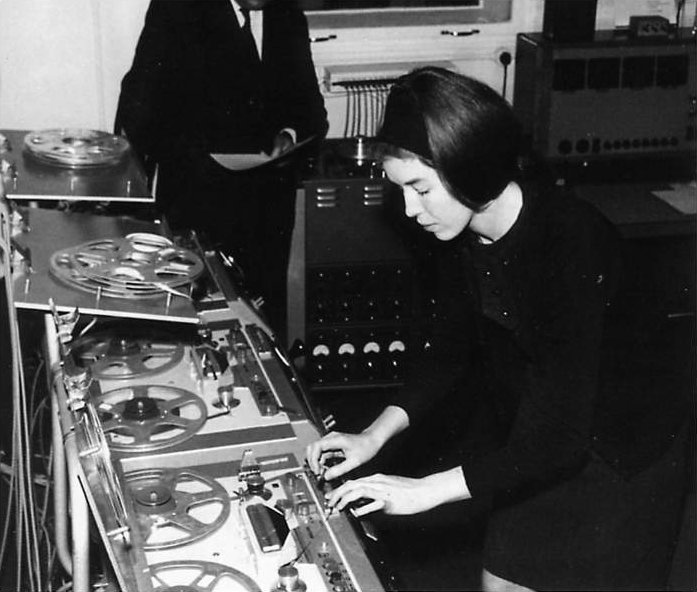
A number of years ago, in a post on the pioneering composer of the original Doctor Who theme, we wrote that “the early era of experimental electronic music belonged to Delia Derbyshire.” Derbyshire—who almost gave Paul McCartney a version of “Yesterday” with an electronic backing in place of strings—helped invent the early electronic music of the sixties through her work with the Radiophonic Workshop, the sound effects laboratory of the BBC. She went on to form one of the most influential, if largely obscure, electronic acts of the decade, White Noise. And yet, calling the early eras of electronic music hers is an exaggeration. Of course her many collaborators deserve mention, as well as musicians like Bruce Haack, Pierre Henry, Kraftwerk, Brian Eno, and so many others. But what gets almost completely left out of many histories of electronic music, as with so many other histories, is the prominent role so many women besides Derbyshire played in the development of the sounds we now hear around us all the time.
In recognition of this fact, musician, DJ, and “escaped housewife/schoolteacher” Barbara Golden devoted two episodes of her KPFA radio program “Crack o’ Dawn” to women in electronic music, once in 2010 and again in 2013. She shares each broadcast with co-host Jon Leidecker (“Wobbly”), and in each segment, the two banter in casual radio show style, offering history and context for each musician and composer. Highlighted on Ubu’s former Twitter stream, the first show, “Women in Electronic Music 1938–1982 Part 1” (above) gives Derbyshire her due, with three tracks from her, including the Doctor Who theme.
It also includes music from twenty one other composers, beginning with Clara Rockmore, a refiner and popularizer of the theremin, that weird instrument designed to simulate a high, tremulous human voice. Also featured is Wendy Carlos’s “Timesteps,” an original piece from her A Clockwork Orange score.
The second show, above, fills in several gaps in the original broadcast and “could easily be six hours” says co-host Leidecker, given the sheer amount of electronic music out there composed and recorded by women over the past seventy years. This show includes one of our host Golden’s own compositions, “Melody Sumner Carnahan,” as well as music from Laurie Anderson and musique concrete composer Doris Hays. These two broadcasts alone cover an enormous range of stylistic and technological ground, but for even more discographical history of women in electronic music, see the playlist below, compiled by “Nerdgirl” Antye Greie-Ripatti. Commissioned by Club Transmediale Berlin, the mix includes such well-known names as Yoko Ono, Bjork, and M.I.A., as well as foremothers Derbyshire and Carlos, and dozens more.
In lieu of the radio-show chatter of Golden and Leidecker, we have Greie-Ripatti’s post detailing each artist’s time period, country of origin, and contributions to electronic music history. Many of the composers represented here worked for major radio and film studios, scored feature films (like 1956’s Forbidden Planet), invented and innovated new instruments and techniques, wrote for orchestras, and passed on their knowledge as educators and producers. Greie-Ripatti’s page quotes a Danish electronic producer and performer saying “there is a lot of women in electronic music… invisible women.” Thanks to efforts like hers and Golden’s, these pioneering creators need no longer go unseen or, more importantly, unheard.
Note: An earlier version of this post appeared on our site in 2015.
We're hoping to rely on loyal readers, rather than erratic ads. Please click the Donate button and support Open Culture. You can use Paypal, Venmo, Patreon, even Crypto! We thank you!
Open Culture scours the web for the best educational media. We find the free courses and audio books you need, the language lessons & educational videos you want, and plenty of enlightenment in between.