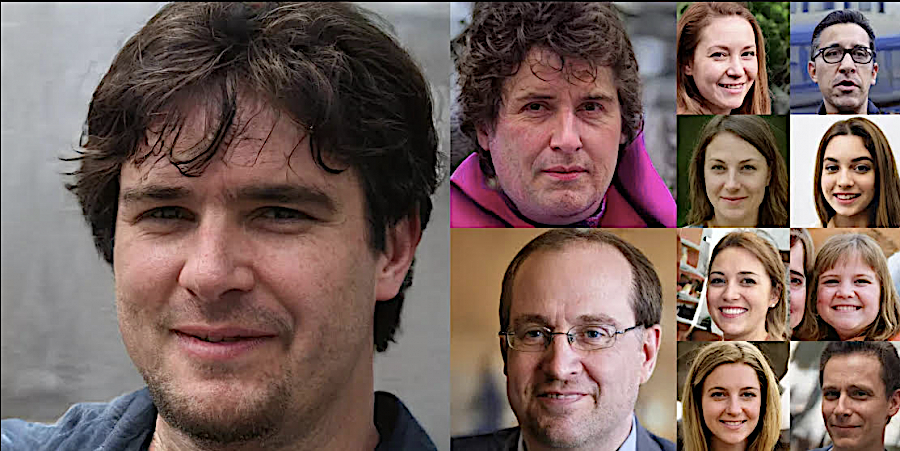
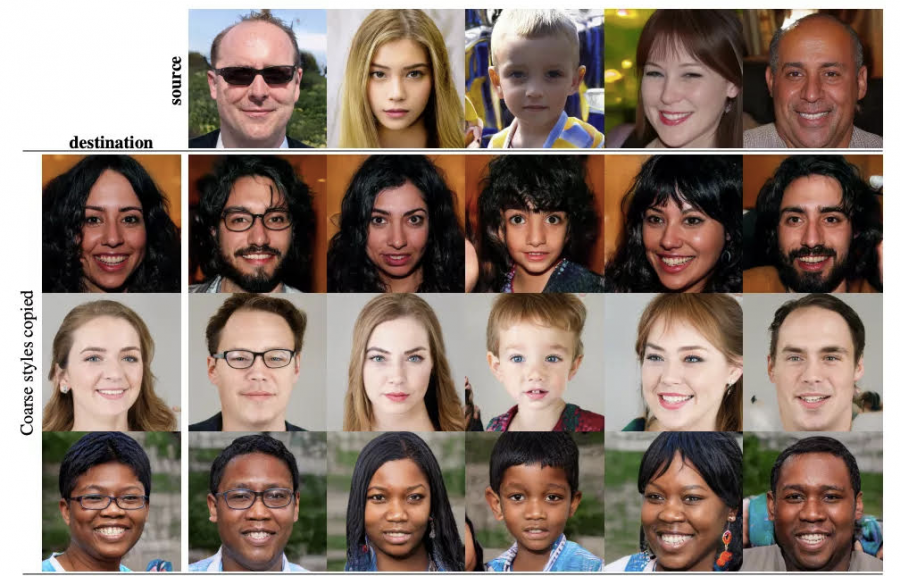
Each day in the 2010s, it seems, brings another startling development in the field of artificial intelligence — a field widely written off not all that long ago as a dead end. But now AI looks just as alive as the people you see in these photographs, despite the fact that none of them have ever lived, and it’s questionable whether we can even call the images that depict them “photographs” at all. All of them come, in fact, as products of a state-of-the-art generative adversarial network, a type of artificial intelligence algorithm that pits multiple neural networks against each other in a kind of machine-learning match.
These neural networks have, it seems, competed their way to generating images of fabricated human faces that genuine humans have trouble distinguishing from images of the real deal. Their architecture, described in a paper by the Nvidia researchers who developed it, “leads to an automatically learned, unsupervised separation of high-level attributes (e.g., pose and identity when trained on human faces) and stochastic variation in the generated images (e.g., freckles, hair), and it enables intuitive, scale-specific control of the synthesis.” What they’ve come up with, in other words, has made it not just more possible than ever to create fake faces, but made those faces more customizable than ever as well.
“Of course, the ability to create realistic AI faces raises troubling questions. (Not least of all, how long until stock photo models go out of work?)” writes James Vincent at The Verge. “Experts have been raising the alarm for the past couple of years about how AI fakery might impact society. These tools could be used for misinformation and propaganda and might erode public trust in pictorial evidence, a trend that could damage the justice system as well as politics.”
But still, “you can’t doctor any image in any way you like with the same fidelity. There are also serious constraints when it comes to expertise and time. It took Nvidia’s researchers a week training their model on eight Tesla GPUs to create these faces.”
Though “a running battle between AI fakery and image authentication for decades to come” seems inevitable, the current ability of computers to create plausible faces certainly fascinates, especially when compared to their ability just four years ago, the hazy black-and-white fruits of which appear just above. Put that against the grid of faces at the top of the post, which shows how Nvidia’s system can combine the features of the faces on one axis with the features on the other, and you’ll get a sense of the technological acceleration involved. Such a process could well be used, for example, to give you a sense of what your future children might look like. But how long until it puts convincing visions of moving, speaking, even thinking human beings before our eyes?
Based in Seoul, Colin Marshall writes and broadcasts on cities, language, and culture. His projects include the book The Stateless City: a Walk through 21st-Century Los Angeles and the video series The City in Cinema. Follow him on Twitter at @colinmarshall or on Facebook.
Their one-take performance was part of Role Call, a regular feature of the Late Late Show with James Corden. Usually, this fan favorite is an excuse for Corden and a megastar guest—Tom Hanks, Julia Roberts, Samuel L. Jackson—to bumble through the most iconic moments of their career.
These kinds of larks are more fun for being a mess, and the live studio audience screams like besotted campers at every goofy quick change and winking inside reference. Blunt and Miranda are definitely game, though one wonders if they felt a bit chagrinned that the film they are promoting, Mary Poppins Returns, is given pride of placement, while the original 1964 film starring Julie Andrews and Dick Van Dyke is strangely absent.
Alas, 1953’s Gentlemen Prefer Blondes is as far back as this skit’s memory goes, presumably because the audience has a greater likelihood of recognizing Marilyn Monroe than say, Howard Keel.
More interesting than the jokey horseplay with Into the Woods and The Muppet Movie is the choice to blithely cast white actors in roles that were written for black women (Dreamgirls, Little Shop of Horrors). I don’t think anyone would try to get away with that on Broadway these days, even in in a spoofy charitable event like Broadway Bares or Easter Bonnet… though if they did, getting Lin-Manuel Miranda on board would be a very good idea.
As to why Hamilton isn’t one of the titles below … it’s not a movie musical—yet!
As we know from conversations in subway tunnels or singing in the shower, different kinds of spaces and building materials alter the quality of a sound. It’s a subject near and dear to architects, musicians, and composers. The relationship between space and sound also centrally occupies the field of “Acoustic Archeology.” But here, an unusual problem presents itself. How can we know how music, voice, and environmental sound behaves in spaces that no longer exist?
More specifically, writes EurekAltert!, the question that faced researchers at the University of Seville was “how did words or the rain sound inside the Mosque of Cordoba in the time of Abd al-Rahman I?” The founder of an Iberian Muslim dynasty began construction on the Mosque of Cordoba in the 780s. In the hundreds of years since, it underwent several expansions and, later, major renovations after it became the Cathedral of Cordoba in the 13th century.
The architecture of the 8th century building is lost to history, and so, it would seem, is its careful sound design. “Unlike fragments of tools or shards of pottery,” Atlas Obscura’s Jessica Leigh Hester notes, “sounds don’t lodge themselves in the soil.” Archeo-acousticians do not have recourse to the material artifacts archeologists rely on in their reconstructions of the past. But, given the technological developments in reverb simulation and audio software, these scientists can nonetheless approximate the sounds of ancient spaces.
In this case, University of Seville’s Rafael Suárez and his collaborators in the research group “Architecture, Heritage and Sustainability” collected impulse responses—recordings of reverberation—from the current cathedral. “From there, they used software to reconstruct the internal architecture of the mosque during four different phases of construction and renovation.… Next, they produced auralizations, or sound files replicating what worshippers would have heard.”
To hear what late-8th century Spanish Muslims would have, “researchers used software to model how the architecture would change the same snippet of a recorded salat, or daily prayer. In the first configuration, the prayer sounds full-bodied and sonorous; in the model that reflects the mosque’s last renovation, the same prayer echoes as though it was recited deep inside a cave.” All of those renovations, in other words, destroyed the sonic engineering of the mosque.
As the authors write in a paper recently published in Applied Acoustics, “the enlargement interventions failed to take the functional aspect of the mosque and gave the highest priority to mainly the aesthetic aspect.” In the simulation of the mosque as it sounded in the 780s, sound was intelligible all over the building. Later construction added what the researchers call “acoustic shadow zones” where little can be heard but echo.
Unlike Hagia Sofia, the Byzantine cathedral-turned-mosque, which retained its basic design over the course of almost 1500 years, and thus its basic sound design, the Mosque-Cathedral of Cordoba was so altered architecturally that a “significant deterioration of the acoustic conditions” resulted, the authors claim. The mosque’s many remaining visual elements would be familiar to 8th century attendees, writes Hester, including “gilt calligraphy and intricate tiles… and hundreds of columns—made from jasper, onyx, marble, and other stones salvaged from Roman ruins.” But the “acoustic landscape” of the space would be unrecognizable.
The specific sounds of a space are essential to making “a place feel like itself.” Something to consider the next time you’re planning a major home renovation.
If you would like to sign up for Open Culture’s free email newsletter, please find it here. It’s a great way to see our new posts, all bundled in one email, each day.
If you would like to support the mission of Open Culture, consider making a donation to our site. It’s hard to rely 100% on ads, and your contributions will help us continue providing the best free cultural and educational materials to learners everywhere. You can contribute through PayPal, Patreon, and Venmo (@openculture). Thanks!
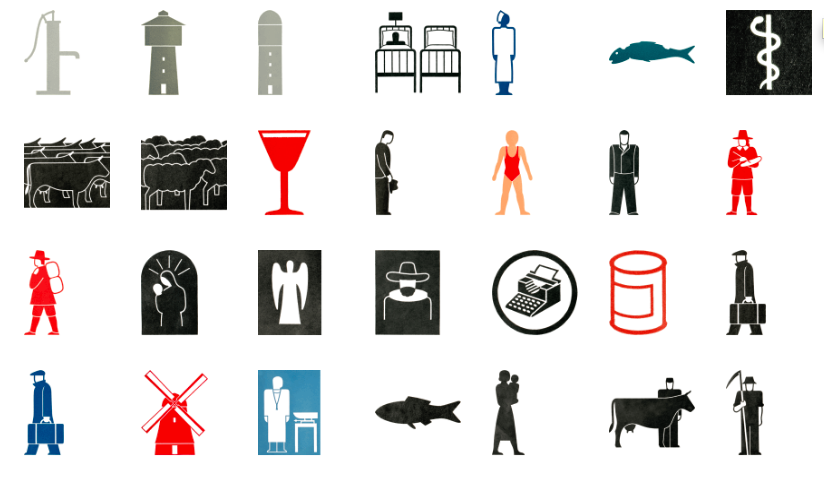
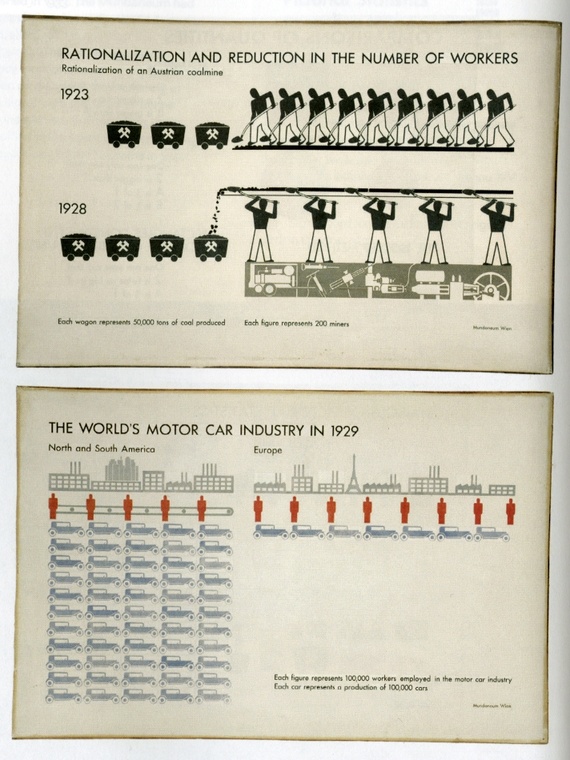
How long has mankind dreamed of an international language? The first answer that comes to mind, of course, dates that dream to the time of the Biblical story of the Tower of Babel. If you don’t happen to believe that humanity was made to speak a variety of mutually incomprehensible tongues as punishment for daring to build a tower tall enough to reach heaven, maybe you’d prefer a date somewhere around the much later development of Esperanto, the best-known language invented specifically to attain universality, in the late 19th century. But look ahead a few decades past that and you find an intriguing example of a language created to unite the world without using words at all: International System Of Typographic Picture Education, or Isotype.
“Nearly a century before infographics and data visualization became the cultural ubiquity they are today,” writes Brain Pickings’ Maria Popova, “the pioneering Austrian sociologist, philosopher of science, social reformer, and curator Otto Neurath (December 10, 1882–December 22, 1945), together with his not-yet-wife Marie, invented ISOTYPE — the visionary pictogram language that furnished the vocabulary of modern infographics.”
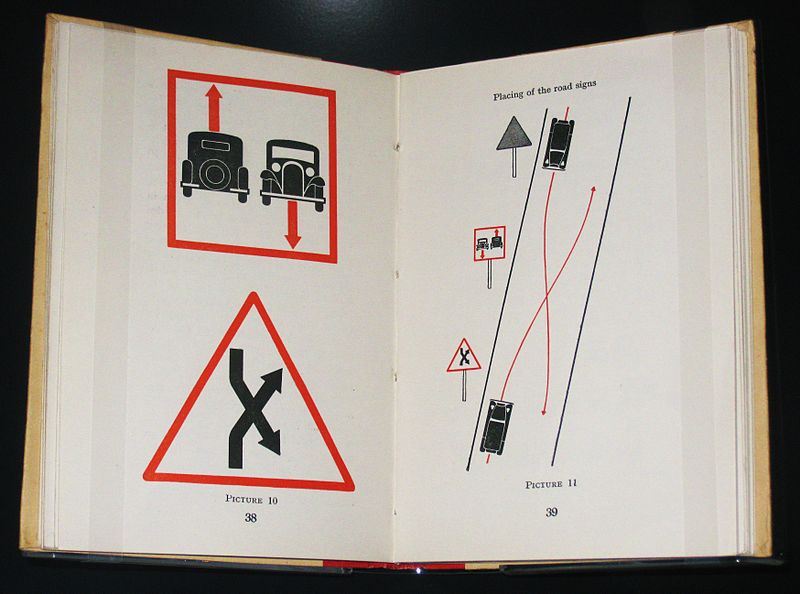
First known as the Vienna Method of Pictorial Statistics, Isotype’s initial development began in 1926 at Vienna’s Gesellschafts- und Wirtschaftsmuseum (or Social and Economic Museum), of which Neurath was the founding director. There he began to assemble something like a design studio team, with the mission of creating a set of pictorial symbols that could render dense social, scientific technological, biological, and historical information legible at a glance.
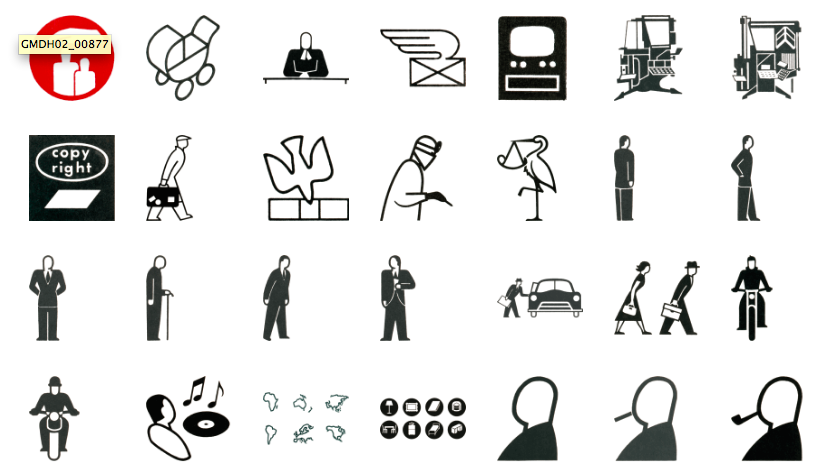
Neurath’s most important early collaborator on Isotype was surely the woodcut artist Gerd Arntz, at whose site you can see the more than 4000 pictograms he created to symbolize “key data from industry, demographics, politics and economy.” Arntz designed them all in accordance with Neurat’s belief that even then the long “virtually illiterate” proletariat “needed knowledge of the world around them. This knowledge should not be shrined in opaque scientific language, but directly illustrated in straightforward images and a clear structure, also for people who could not, or hardly, read. Another outspoken goal of this method of visual statistics was to overcome barriers of language and culture, and to be universally understood.”
By the mid-1930s, writes The Atlantic’s Steven Heller in an article on the book Isotype: Design and Contexts 1925–1971, “with the Nazi march into Austria, Neurath fled Vienna for Holland. He met his future wife Marie Reidemeister there and after the German bombing of Rotterdam the pair escaped to England, where they were interned on the Isle of Man. Following their release they established the Isotype Institute in Oxford. From this base they continued to develop their unique strategy, which influenced designers worldwide.” Today, even those who have never laid eyes on Isotype itself have extensively “read” the visual languages it has influenced: Gizmodo’s Alissa Walker points to the standardized icons created in the 70s by the U.S. Department of Transportation and the American Institute of Graphic Arts as well as today’s emoji — probably not exactly what Neurath had in mind as the language of Utopia back when he was co-founding the Vienna Circle, but nevertheless a distant cousin of Isotype in “its own adorable way.”
Based in Seoul, Colin Marshall writes and broadcasts on cities, language, and culture. His projects include the book The Stateless City: a Walk through 21st-Century Los Angeles and the video series The City in Cinema. Follow him on Twitter at @colinmarshall or on Facebook.
It’s that time of year when certain songs conspire with certain moods to hit you right in the ol’ brisket.
Thefeeling is voluptuous, and not necessarily unpleasant, provided there’s a bathroom stall or spare bedroom should you need to flee a party like Cinderella, as some old chestnut threatens to turn you into a blubbering mess.
Let the kiddies deck the halls, jingle bells, and prance about with Rudolph and Frosty. The best secular songs for grown ups are the ones with a thick current of longing just under the surface, a yearning for those who aren’t here with us, for a better future, for the way we were…
There’s got to be some hope in the balance though, some sweetness to savor as we muddle through.
(Judy Garland famously stonewalled on the first version of “Have Yourself a Merry Little Christmas” until lyricist Hugh Martin agreed to lighten things up a bit. In the end, both got what they wanted. She got her update:
Have yourself a merry little Christmas
Let your heart be light
Next year all our troubles will be out of sight
But the tension between the promise of a better tomorrow and her emotional delivery holds a place for Hughes’ appealingly dark sentiment:
As a rule, the oldies are the goodies in this department.
More recent bids by Coldplay and Taylor Swift have failed to achieve the proper mix of hope and hopelessness.
It’s a difficult balance, but singer-songwriter Ellia Bisker pulls it off beautifully, above, by turning to O. Henry’s enduring short story, “The Gift of the Magi.”
I want to give you something that I can’t afford,
Let you believe with me we’re really not so poor.
You see that package waiting underneath the tree?
It’s just a token of how much you mean to me.
(Spoiler for the handful of people unfamiliar with this tale: he does the same, thus negating the utility of both costly presents.)
In an interview with Open Culture, Bisker praised the O. Henry story’s ironic symmetry:
It’s a little like the death scene in Romeo & Juliet, but without the tragedy. The story itself still feels surprisingly fresh, despite the period details. It has more humor and sympathy to it than sentiment. It surprises you with real emotion.
The Romeo and Juliet comparison is apt. The story covers a time period so brief that the newlyweds’ feelings for each other never stray from purest wonder and admiration.
Bisker’s song starts, as it ends, with a pair of young, broke lovers who only have eyes for each other.
Let’s not forget O. Henry’s parting words:
The magi, as you know, were wise men—wonderfully wise men—who brought gifts to the Babe in the manger. They invented the art of giving Christmas presents. Being wise, their gifts were no doubt wise ones, possibly bearing the privilege of exchange in case of duplication. And here I have lamely related to you the uneventful chronicle of two foolish children in a flat who most unwisely sacrificed for each other the greatest treasures of their house. But in a last word to the wise of these days let it be said that of all who give gifts these two were the wisest. Of all who give and receive gifts, such as they are wisest. Everywhere they are wisest. They are the magi.
Enjoy this musical gift, readers. The artist has made the track free for downloading, though perhaps you could scratch up a few coins in thanks, without pawning your watch or cutting your hair.
Read O. Henry’s short story “The Gift of the Magi” here.
Here’s the gist: If you buy an All-Access pass to their 45 courses, you will receive another All-Access Pass to give to someone else at no additional charge. An All-Access pass costs $180, and lasts one year. For that fee, you–and a family member or friend–can watch courses created by Annie Leibovitz, Werner Herzog, Martin Scorsese, David Mamet, Jane Goodall, Margaret Atwood, Helen Mirren, Martin Scorsese, Herbie Hancock, Alice Waters and so many more. If you’re thinking this sounds like a pretty good holiday present, I’d have to agree.
Note: If you sign up for a MasterClass course by clicking on the affiliate links in this post, Open Culture will receive a small fee that helps support our operation.
They may not surprise the average market analyst, but the gaming industry’s figures tell a pretty compelling story. Newzoo estimates that “2.3 billion gamers across the globe will spend $137. 9 billion on games in 2018.” VentureBeat reports that mobile games account for over 50 percent of the total. Currently, “about 91 percent of the global market is digital, meaning that $125.3 billion worth of games flows through digitally connected channels as opposed to physical retail.”
That’s a lot of virtual dough floating around in virtual worlds. But this vast and rapid growth in digital gaming does not mean physical games are going away anytime soon—and that includes cards, board games, and other tabletop games, a market that has “surged as players have grown jaded with the digital screens they toil over during the work day,” wrote Joon Ian Wong in 2016.
Venture capital is flowing into board game development. Tabletop bars and cafes are popping up all over the world, encouraging people to mingle over Scrabble and Cards Against Humanity. It seems the time is just right to revive the oldest playable board game in the world. If someone hasn’t already launched a Kickstarter to bankroll a new Royal Game of Ur, I suspect we’ll see one any day now. At least four-and-a-half-thousand years old, according to British Museum Curator Irving Finkel, the Royal Game of Ur was probably invented by the Sumerians. And it seems like it might still be a blast, and a considerable challenge, to play.
“You might think it’s so old that it’s irretrievable to us, that we’ve got no idea what it was like playing, what the rules were like,” Finkel says in the video at the top, “but all sorts of evidence has come to light so that we know how this game was played.” He promises, in no uncertain terms, to wipe the floor with YouTuber Tom Scott in a Royal Game of Ur showdown, and Scott, who has never played the game before, seems at a decided disadvantage. But watch their contest to see how the game is played and whether Finkel makes good on his threat. Along the way, he liberally shares his knowledge.
For a shorter course on the Royal Game of Ur, see Finkel’s video above. It takes him a couple minutes to get around to introducing his subject, the discovery and deciphering of the “world’s oldest rule book.” A consummate ancient history detective, Finkel describes how he decoded an ancient tablet that explained a game, but which game, no one knew. So, the dedicated curator tried the rules on every mysterious ancient game he could find, till he landed on the “game of twenty squares” from Mesopotamia. “It fitted perfectly,” he says with relish. See the original board, pieces, and dice from about 2500 BC, and learn how Finkel had been searching for its rules of play since he was 9 years old.
For more of Finkel’s passionate public scholarship, see him demonstrate how to write in cuneiform and read about how his work on cuneiform tablets led to him discovering the oldest reference to the Noah’s Ark myth.
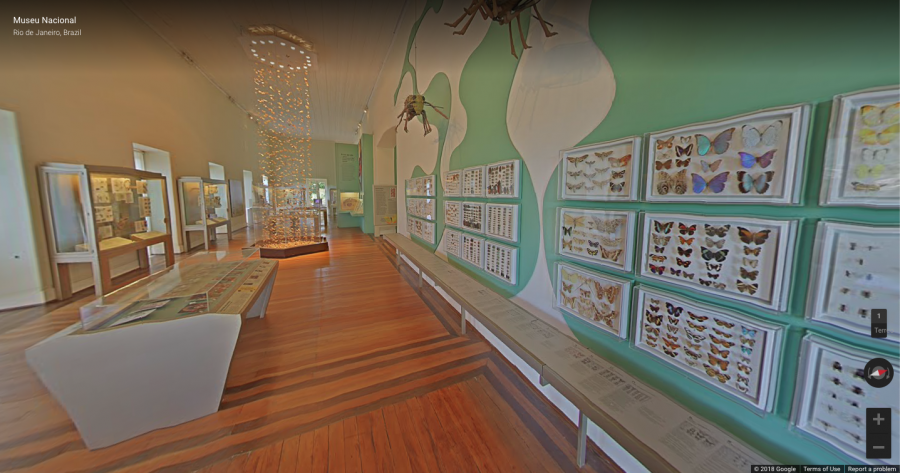
How to describe the magnitude of the loss when Brazil’s Museu Nacional caught fire in September? TheNew Yorker’s Alejandro Chacoff ventured an analogy that would resonate with readers of that magazine: “It’s as if, in New York, the American Museum of Natural History and the New School, or a part of the Columbia campus, had been built on the same spot, and then was reduced to ashes.” The 200-year-old museum lost an estimated 92.5 percent of its 20-million-item archive, one of the largest collections of natural history and anthropological artifacts in the world — but not before Google Arts & Culture digitized enough to recreate the experience of visiting the Museu Nacional virtually.
“Now for the first time ever, you can virtually step inside the museum and learn about its lost collection through Street View imagery and online exhibits.” In this way you can still experience a portion of “the incredible diversity of artifacts in Brazil’s National Museum” that “reflected centuries of Brazil’s culture and natural history, from the Amazon’s endangered butterflies to beautifully-crafted indigenous masks and decorated pottery.”
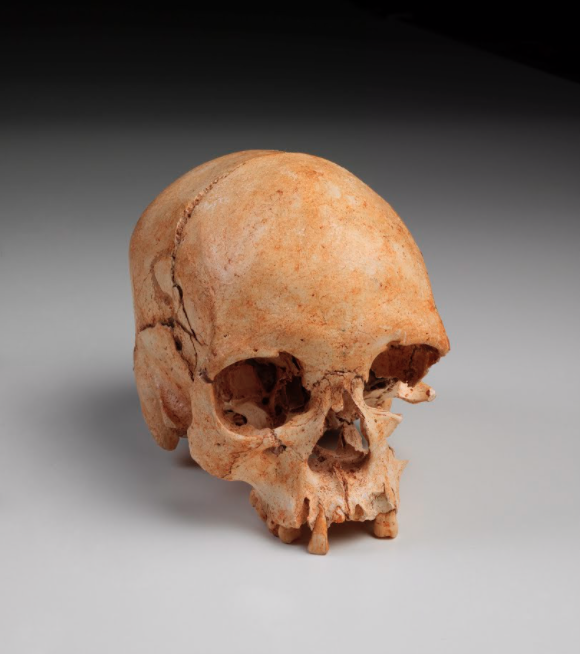
You can take a virtual tour of the highlights of the Museu Nacional as it was here, a tour that of course includes a visit with the museum’s prized possession: the 12,000-year old Luzia, the oldest skeleton found in the Americas, whom you can see just as she stood on display in museum view. Miraculously, Luzia counts as one of the artifacts mostly recovered from the aftermath of the conflagration, and the museum has announced an ambitious restoration plan that will cost R$10 million, an amount provided as emergency funds by the Brazilian Government — and an amount much greater than the Museu Nacional, which by its 200th anniversary had reached a state of not just serious neglect but near-complete abandonment, was ever able to get while still intact. Even in the case of vast repositories of a nation’s cultural heritage, you don’t know what you’ve got until it’s gone.
Based in Seoul, Colin Marshall writes and broadcasts on cities, language, and culture. His projects include the book The Stateless City: a Walk through 21st-Century Los Angeles and the video series The City in Cinema. Follow him on Twitter at @colinmarshall or on Facebook.
Look, I’ve never been a fan of Kevin Smith’s ooooooov-rah, per se, but I will never criticize his ability to spin a bloody good yarn. He’s funny, engaging, charming, and knows his pop culture. WIRED also knows this, so when on the eve of the (apparently very good) Spider-verse movie, they called on Smith to sit down and run through every Spider-man Movie and TV Show and opinionate all over that mess. (And because Sony’s contract with the Marvel superhero is up, this might be a nice demarcation line.)
I stepped on board the Spidey-train when he appeared as a character on PBS’ The Electric Company, the educational kids show that would screen after Sesame Street. As Smith points out, this Spidey was mute, a red and blue mime who only spoke in thought balloons, some of which others could literally read as they hung above his head.
Around the same time the ‘60s cartoon was also screening, copying the rogue’s gallery of villains well known from the Steve Ditko-Stan Lee comic book. Both this and the Electric Company Spideys had the best theme songs, and they still haven’t been topped. (If you’re a Gen‑X’er, you can drop the lyrics on request, anytime).
Now, before this, there had been a few live action attempts to bring the wall-crawler to the big screen but, well, they’re as cheesy and not-good as you might expect, so for the period during the ‘90s, Spider-man stayed an animated concern. The highlight of the ’94-’98 animated series, according to Smith, is the final meta episode, where Spider-man crosses over into “our” reality and meets Stan Lee, while Lee’s wife Joan played Madame Web.
Interestingly, Smith glosses over the three other animated series that have run since then because of the beginning of live-action Spider-man films made with the power and money of the modern blockbuster. (Interesting, I say, because critics are now declaring the new animated film the best of the bunch).
Smith isn’t wild about the first Sam Raimi film in 2002. He questions the decision to cover up emotive actor Willem Dafoe with a Green Goblin mask for the final battle. However, he not only likes the sequel, but calls it “one of the greatest superhero films ever made” because it never loses sight of the man behind the Spidey mask.
He chastises Sony for the needless 2012 reboot, just five years from the final film in the Raimi trilogy. His problem: Garfield’s Spider-man is great, his Peter Parker is not. The opposite is true with McGuire.
Finally, they got it right with Tom Holland’s version in Avengers: Civil War, that mix of geeky student by day, cocky quipster by night. Plus, as Smith points out, they gave him his Queens accent back. (Marvel comics, at least the first couple of years, was always entrenched in a real New York City as background.)
“The real charm of that character…is that he’s covered from head-to-toe,” Kevin says, paraphrasing Stan Lee. “You don’t know who he is or what he is. You don’t know if he’s a boy, a girl, you don’t know what he is, what race, creed, color, anything. So any kid reading that book can see themselves as the character.”
And that leads us to the current film, which Smith can tell you about himself. It follows that universality of the character and explodes it out to a bunch of alternative universe versions of all races, genders, and genus.
“We live in such a golden era (for comic book movies),” Smith declares and even in a world of Marvel burnout, you want to believe him. Maybe the new film is the way forward: more diversity, more fun, more talking animals.
Ted Mills is a freelance writer on the arts who currently hosts the artist interview-based FunkZone Podcast and is the producer of KCRW’s Curious Coast. You can also follow him on Twitter at @tedmills, read his other arts writing at tedmills.com and/or watch his films here.
Quick way to date yourself: name the first Beastie Boys album you bought (or heard). If you somehow got your hands on an original pressing of their first single “Cooky Puss”—released in 1981 when the then-foursome was a New York hardcore band—congratulations, you’re a legend. If you first bought 1986’s Licensed to Ill—their major label debut and coming-out as a crude rap-rock parody threesome (minus fired drummer Kate Schellenbach), precision-engineered to freak your parents out—congrats, you’re old.
In whatever era you discovered them—Paul’s Boutique, Check Your Head, Ill Communication… maybe even their last album, 2011’s Hot Sauce Committee Part Two—you discovered a different Beasties than the previous generation did. Over the course of their 30-year career, the trio evolved and matured, grew up and got down with new grooves to suit new audiences. That’s always been a very good thing.
As Mike D, Ad-Rock, and MCA—three personalities as distinctive as the three Stooges—got better at what they did, they transcended the misogynist, meatheaded mid-eighties incarnation they came to look back on with embarrassment and apology. “We got so caught up with making fun of that rock-star persona,” writes Adam Horowitz (Ad-Rock) in the huge new Beasties memoir, “that we became that persona. Became what we hated.”
Rob Harvilla calls these very genuine moments of self-reflection the best parts of the book. But with so many stories over so many years, so much brilliant writing, and so many guest appearances from celebrity Beastie Boy fans, that’s a tough call. “Part memoir, part photo-heavy zine, part fan-appreciation testimonial… and part sincere apology,” the book seems both fresh and made to order and a veritable buffet table of nostalgia. Or, as Amy Poehler puts it in her intro to a section on their videos: “These days, their music makes me feel young and old at the same time.”
Behind the silliness and sincerity there is mourning for third Beastie Adam Yauch (MCA), who died of cancer in 2012 and whose voice is conspicuously absent from the book. Yet the two remaining members choose not to dwell. “You brace for the heartbreaking account of Yauch’s diagnosis and death,” Harvilla writes, “but those details go undiscussed. ‘Too fucking sad to writing about’ is all Horovitz has to say.’” The prevailing atmosphere is celebratory, like any good Beastie Boys album—this one a party full of adult peers looking back, laughing, and wincing at their younger selves.
The voices on the page are so vivid you can squint and almost hear them (at one point Horovitz describes unwinding a cassette tape as “pulling 60 minutes of wet fettuccine out of a dog’s mouth”). But we don’t have to imagine what they sound like. Along with the 571-page hardbound cinderblock of a book, the band has released what Rolling Stone hails as the “audiobook of the year,” a “brilliant 13-hour radio play” in which Mike D and Ad-Rock are joined by a majorly star-studded cast of guest readers including Snoop Dogg, Kim Gordon, Steve Buscemi, Chloë Sevigny, Wanda Sykes, Jon Stewart, Ben Stiller, and Bette Midler (that’s just the very short list).
New York hip hop legends LL Cool J, Chuck D, and Rev Run (of Run DMC) show up, as does Brooklyn acting legend Rosie Perez and non-New Yorkers Exene Cervenka and Elvis Costello. (See the full cast list at Audible.) It’s not a memoir, it’s a mixtape. Hear excerpts from the audio book in the SoundCloud clips above and buy it online, or download it for free through Audible.com’s 30-day free trial program. Guaranteed, no matter what age you are, to make you feel young and old at the same time.
We're hoping to rely on loyal readers, rather than erratic ads. Please click the Donate button and support Open Culture. You can use Paypal, Venmo, Patreon, even Crypto! We thank you!
Open Culture scours the web for the best educational media. We find the free courses and audio books you need, the language lessons & educational videos you want, and plenty of enlightenment in between.