They shared a compulsion to create—some might say document—but were so intensely private, the revelations of their respective lives’ work threw everyone for a loop.
Employers and neighbors found it hard to believe they’d had it in them. (View an online gallery of her work here.)
Curators, marveling at the quantity of their output and quality of the vision, piled on superlatives.
Something tells me the prickly Ms. Maier would not have appreciated any comparisons to a man whose work featured so many representations of naked, hermaphroditic girl-warriors being bayonetted, but death makes it difficult to keep hold of the reins gripped so tightly in life.
For the foreseeable future, Maier’s legacy rests in the hands of John Maloof, the young Chicagoan who bought her negatives from an unpaid storage unit for less than $400, hoping he might find something of relevance for a neighborhood history project. He got more than he bargained for, obviously, but the years spent scanning the unknown artist’s work is beginning to pay off in exhibitions, gallery representation, and a book. Now he is nearing completion of Finding Vivian Maier, a documentary film that promises to shed more light on this fascinating tale.
Last spring, Ken Auletta wrote a profile of Stanford University in the pages of The New Yorker, which started with the question: “There are no walls between Stanford and Silicon Valley. Should there be?” It’s perhaps an unavoidable question when you consider a startling fact cited by the article. According the university itself, five thousand companies “trace their origins to Stanford ideas or to Stanford faculty and students.” The list includes tech giants like Google, Hewlett-Packard, Yahoo, Cisco Systems, Sun Microsystems, eBay, Netflix, Electronic Arts, Intuit, Silicon Graphics, LinkedIn, and E*Trade. And stay tuned, there’s more to come.
Stanford is one of America’s leading incubators, and the rearing of young entrepreneurs doesn’t take place by mere osmosis. No, Stanford students can take courses focused on entrepreneurship, which give them access to seasoned entrepreneurs and financiers. If you head over to eCorner, short for Entrepreneurship Corner (Web — iTunes — YouTube), you can watch “2000 free videos and podcasts featuring entrepreneurship and innovation thought leaders” who have paid visits to Stanford. Perhaps you’ll recognize a few of the names: Mark Zuckerberg? Larry Page? Marissa Mayer? Reid Hoffman (above)?
Or, if you go to YouTube and iTunes, you’ll gain access to entire courses dedicated to teaching students the modern art of starting startups. Two courses (both housed in our collection of 650 Free Online Courses and our collection of 150 Free Online Business Courses) warrant your attention. First, Chuck Eesley’s course, Technology Entrepreneurship (YouTube — iTunes Video) introduces students to “the process used by technology entrepreneurs to start companies. It involves taking a technology idea and finding a high-potential commercial opportunity, gathering resources such as talent and capital, figuring out how to sell and market the idea, and managing rapid growth.” The course features 28 video lectures in total.
Once you have a broad overview, you can dial into an important part of getting a new venture going — raising capital. Hence the course Entrepreneurship Through the Lens of Venture Capital (iTunes Video — YouTube), a course currently taking place at Stanford that “explores how successful startups navigate funding, managing, and scaling their new enterprise.” It features guest speakers from the VC world that fuels Silicon Valley.
It goes without saying that Stanford offers many world-class courses across other disciplines, from philosophy and physics to history and literature. You can find 68 courses from Stanford in our ever-growing collection of Free Courses Online.
Hans Rosling knows how to make a concise, powerful point. His mastery of statistics and visual aids doesn’t hurt. Behold, for instance, the Karolinska Institute Professor of International Health visualizing the health of 200 countries over 200 years with 120,000 data points. His ability to condense vast amounts of information into short bursts while providing the widest possible context for his points naturally endears him to the TED audience, which values counterintuitive intellectual impact delivered with the utmost succinctness. We previously featured a TED Talk from wherein the excitable professor explains world population growth and prosperity with props bought at IKEA. (The man comes from Sweden, after all. One must represent.) Now, on Bill Gates’ Youtube channel, you can watch Rosling’s shortest and slickest video yet: “The River of Myths.”
Opening with a visualization of 1960’s world child mortality numbers graphed against the number of children born per woman, Rosling uses his signature method of statistical-animation showmanship to explode myths about the potential of developing nations. We see that, as a country’s wealth rises, its health rises; as its health rises, its child mortality drops; and as its child mortality drops, so does its number of children born per woman, which leads to a sustainable overall population size. He then examines the separate regions of Ethiopia, formerly a developmental laggard, showing that the capital Addis Ababa ranks reproductively among the developed nations, while only remote regions lag behind. “Most people think the problems in Africa are unsolvable, but if the poorest countries can just follow the path of Ethiopia, it’s fully possible that the world will look like this by 2030.” We then see a projection of all the world’s nations clustered in the small-family, low-mortality corner of the graph. “But to ensure this happens, we must measure the progress of countries. It’s only by measuring we can cross the river of myths.” Have you heard a more powerful argument for the usefulness of statistics lately?
Colin Marshall hosts and produces Notebook on Cities and Culture and writes essays on literature, film, cities, Asia, and aesthetics. He’s at work on a book about Los Angeles, A Los Angeles Primer. Follow him on Twitter at @colinmarshall.
In some rare cases, adaptations and interpretations of a literary work can surpass the source. Despite hundreds of valiant efforts on the part of fans, filmmakers, game/toy designers, and radio producers, this has never been true of the fully-realized fantasy world in J.R.R. Tolkien’s The Hobbit and The Lord of the Rings trilogy. (not that it’s ever been anyone’s intent). As we noted in a post last week, Tolkien’s fictional world is so intricate, its sources so vast and varied, that Corey Olsen, “The Tolkien Professor,” has made it his entire life’s work to open that world up to students and curious readers, most recently with his eight-part lecture series on The Hobbit.
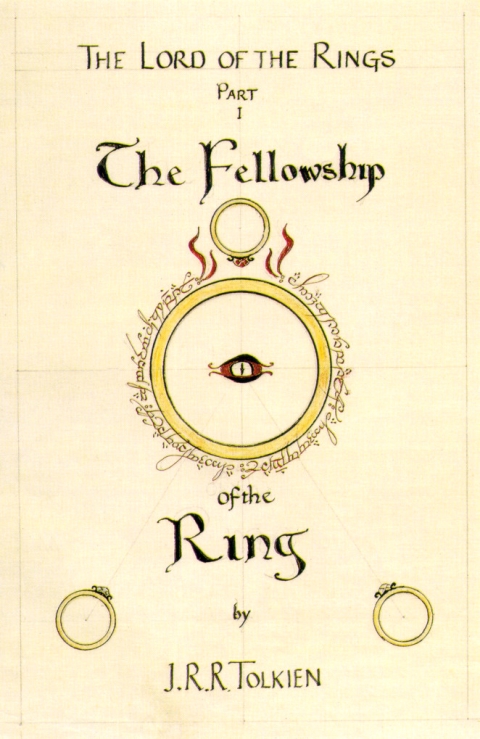
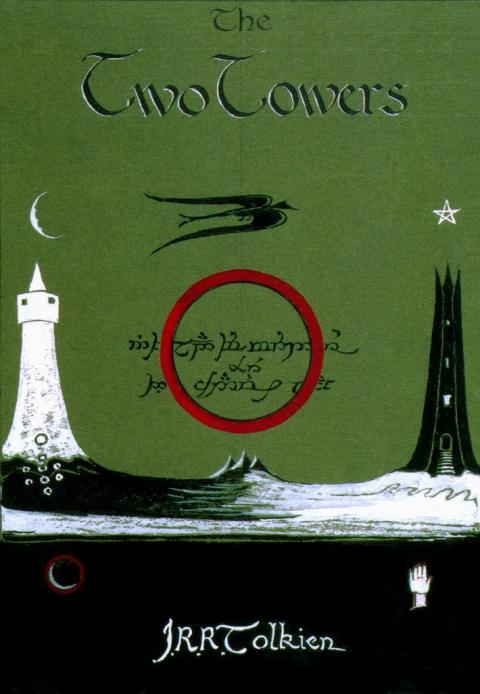
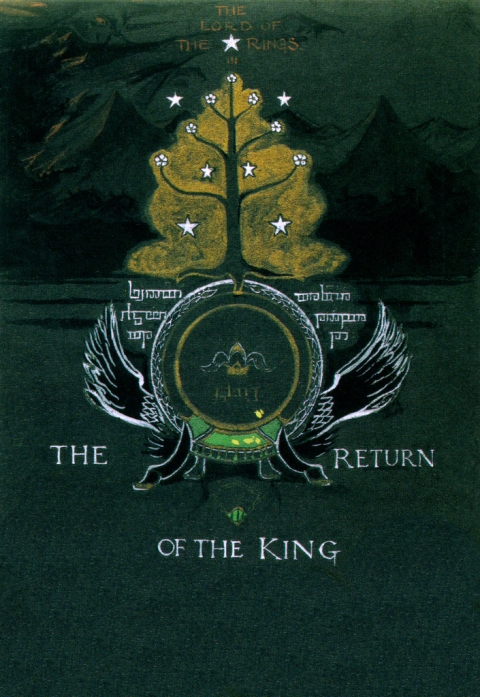
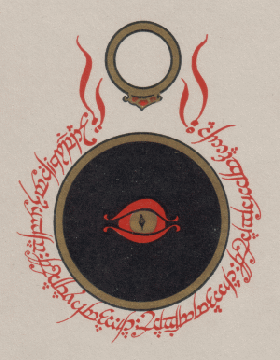
One might also add illustrators to the list of Tolkien interpreters above who have—in the almost eighty years since The Hobbit’s publication and sixty years since the first appearance of The Lord of the Rings trilogy—done their best to visualize Tolkien’s world. But perhaps no one did so better than the master himself. Long known as a visual artist as well as a literary one, Tolkien left behind over 100 illustrations for The Hobbit, one of which adorns 2011’s HarperCollins 75th anniversary edition of the book. He also created these original cover designs for each book in TheLord of the Rings trilogy.
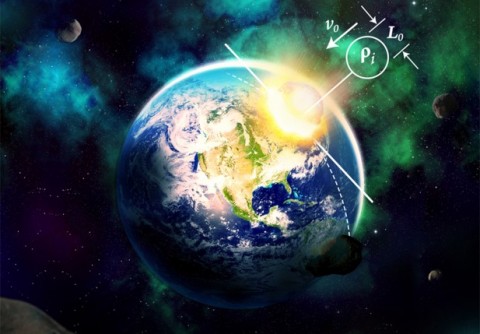
On Friday, the world had its eyes focused on the big asteroid flyby. For weeks, we knew it was coming, and we watched it buzz by with mild curiosity. But, that same day, we were all caught off guard by a ten-ton meteorite that blasted into the Siberian town of Chelyabinsk, injuring 1,200 people and causing considerable structural damage. (Watch footage here.) This abrupt and unexpected event has given governments a reason to start taking the risk of asteroid impacts a bit more seriously. And it might renew interest in a tool created by scientists at Purdue University and Imperial College London in 2010.
In a nutshell,Impact: Earth! is an interactive tool that lets anyone calculate the damage a comet or asteroid would cause if it happened to collide with our planet. You can customize the size and speed of the incoming object, and then find out if mankind survives. (Usually it does.) A grainy primer appears below. You can enter the website and start running your own scenarios right here.
Watch it anyway, for the interviewees thoughts on the state of illustration.
Professor Steven Guarnaccia of the The New School’s Illustration Program describes how illustration’s creative potential exploded once photography became the prime way of documenting celebrity appearances and other such newsworthy visuals.
Editorial Illustrator Yuko Shimisu internalizes those observations, throwing shade on any idea she feels would look better in photo form. Shimisu, like all of the artists featured in the short video, uses traditional media to make her drawings, but colors them digitally. The form may predate photography, but Shimisu implies that any practitioner unwilling to embrace the trend toward new media will find themselves going the way of the dodo, as editorial gigs migrate onto tablets and even smaller digital devices.
Meanwhile over at DC Comics, Sean Murphy has yet to discover a superpower capable of speeding up the work that goes into rendering a story in comic book format. The facial expressions, grand perspectives, and moody lighting that are his stock in trade could theoretically be captured with a shutter click, but at what cost to the overall narrative?
And then there’s the inimitable Molly Crabapple, purveyor of Victorian-flavored kink and founder of Dr. Sketchy’s Anti-Art School, whose Occupy Wall Street posters challenged the visual boundaries of activist art. Finding a personal style one can blow up into a brand is not just a choice, she implies. It’s one’s best hope of survival in a sea flooded with competitors.
- Ayun Halliday publishes her illustrated zine, The East Village Inky the old fashioned way, then promotes it across all manner of digital platforms, including @AyunHalliday.
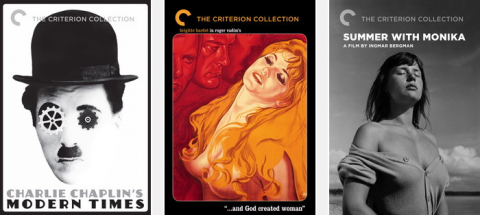
Over this Presidents’ Day weekend, Hulu is streaming all of the Criterion Collection movies for free. That’s right, free! We’re talking hundreds of films by the likes of Ingmar Bergman, Andrei Tarkovsky, Charlie Chaplin, Jean-Luc Godard, Akira Kurosawa, David Lynch, Nagisa Oshima, François Truffaut, and Orson Welles. So cancel your weekend plans, wish your friends and family well, and start packing in as many classic films as you can. We recommend getting started with Kurosawa’s Seven Samurai, Godard’sBreathless, David Lynch’s Eraserheador Bergman’s The Seventh Seal.
Unfortunately, this collection is only accessible to viewers in the United States. We usually don’t feature geo-restricted material, but this seemed too good to pass up. In the meantime, if you live outside of the U.S., we’d encourage you to visit our collection of 500 Free Movies Online, where you’re bound to find something you’ll enjoy. Or you can check out our specialized film collections by Andrei Tarkovsky, Alfred Hitchock, Charlie Chaplin and John Wayne, not to mention our collection of Film Noir Classics.
Like the idea of totalitarianism, perhaps best articulated by Hannah Arendt in her post-war Origins of Totalitarianism, George Orwell’s post-war scrutiny of repressive governments has become a staple, catch-all reference for pundits on either side of the political spectrum, particularly the concepts of doublespeak, doublethink, historical revisionism, and the hyper-intrusive Big Brother, all from the 1949 novel 1984. In fact, few adjectives seem to get deployed with more frequency in urgent political discourse of all kinds than “Orwellian.” But the name George Orwell, pen name of journalist Eric Blair, hides an enigma: Orwell identified himself explicitly as a Democratic Socialist of a particularly English bent (most notably in his essay “The Lion and the Unicorn”), but his scathing critiques of nearly every existing institution sometimes make it hard to pin him down as a partisan of anything but the kind of freedom and openness that everyone vaguely wants to advocate. That ambiguity is a strength; despite his steadfast leftist roots, Orwell would not be a partisan hack—where he saw stupidity, avarice, and brutal inhumanity, he called it out, no matter the source.
The seeming contradictions and ironies that permeate Orwell’s thought and fiction are also what keep his work perennially interesting and worth rereading and revisiting. He was a probing and unsentimental critic of the motives of propagandists of all stripes, both left and right. Beginning in late January, BBC Radio 4 launched a month-long series on Orwell, with the avowedly ironic name, “The Real George Orwell.” Part of the irony comes from the fact that Orwell (or Blair) once worked as a propagandist for the BBC during WWII, and later based the torture area in 1984, Room 101, on a meeting room he recalled from his time there. His experiences with the state broadcasting network were not pleasant in his memory. Nonetheless, his former employer honors him this month with an extensive retrospective, including readings and dramatizations of his essays and journalism, his semi-autobiographical accounts Down and Out in Paris and Londonand Homage to Catalonia, and his novels Animal Farm and 1984.
In this latest dramatization of Orwell’s most famous novel, protagonist Winston Smith is voiced by actor Christopher Eccleston, who has inhabited another key post-war character in English fiction, Dr. Who (Pippa Nixon voices Julia). In a brief discussion of what he takes away from the novel, Eccleston (above) draws out some of the reasons that 1984 appeals to so many people who might agree on almost nothing else. At the heart of the novel is the kind of humanist individualism that Orwell never abandoned and that he championed against Soviet-style state communism and hard-right imperialist authoritarianism both. Winston Smith is an embodiment of human dignity, celebrated for his struggle to “love, remember, and enjoy life,” as Eccleston says. “It’s the human story that means that we keep coming back to it and that keeps it relevant.” Listen to a brief clip of the 1984 dramatization at the top of this post, and visit BBC Radio 4’s site to hear parts one and two of the full broadcast, which is available online for the next year. When Europe and America both seem rent in two by competing and incompatible social and political visions, it’s at least some comfort to know that no one wants to live in the world Orwell foresaw. Despite his novel’s deeply pessimistic ending, Orwell’s own career of fierce resistance to oppressive regimes offers a model for action against the dystopian future he imagined.
For other free, online readings of Orwell’s work, you can visit our archives of Free Audio Books, where you’ll find
We're hoping to rely on loyal readers, rather than erratic ads. Please click the Donate button and support Open Culture. You can use Paypal, Venmo, Patreon, even Crypto! We thank you!
Open Culture scours the web for the best educational media. We find the free courses and audio books you need, the language lessons & educational videos you want, and plenty of enlightenment in between.