In 1968, Pink Floyd’s relationship with increasingly drug-addled lead singer/songwriter/guitarist Syd Barrett unraveled. Though Barrett’s departure wasn’t officially announced until April, that band had already begun, by necessity, performing and recording without him late the previous year, adding guitarist David Gilmour to the lineup to supplant Syd’s erratic performances. In February of ’68 the band appeared minus Syd on a French live-music program called Baton Rouge. Sixties music blog A Dandy in Aspic describes the show as capturing during its year-long run “some of the best British Mod/Psych bands at their peak,” including The Small Faces, The Moody Blues, and the Yardbirds, with Jimmy Page.
This Floyd footage, however, is especially significant for its portrait of the band finding its way through the trauma of its chief architect’s mental demise, with a seemingly awkward Gilmour taking over: “It still sounds great, but the band are visibly uncomfortable. Roger Waters’ dark psychedelic gem ‘Set The Controls For the Heart Of The Sun’ sounds amazing, and ‘Let there Be [More] Light’ is an indication of Pink Floyd’s new, post-Syd direction.”
In addition to those two songs from their upcoming second album A Saucerful of Secrets, the band plays two songs from their debut, Piper at the Gates of Dawn. The weird mystical chant “Astronomy Domine” doesn’t suffer at all, since keyboardist Richard Wright sang the lead vocals on the album version and does so again here. David Gilmour takes over the lead for Barrett’s “Flaming,” which is such a Syd song, with its disturbing and childlike lyrics and loopy vocal melody, that his absence becomes noticeable. But it comes off fine, if somewhat stiff, and the song remained in their set for years afterward.
For more classic psychedelic performances from the 1967–68 Baton Rouge, head over to A Dandy in Aspic.
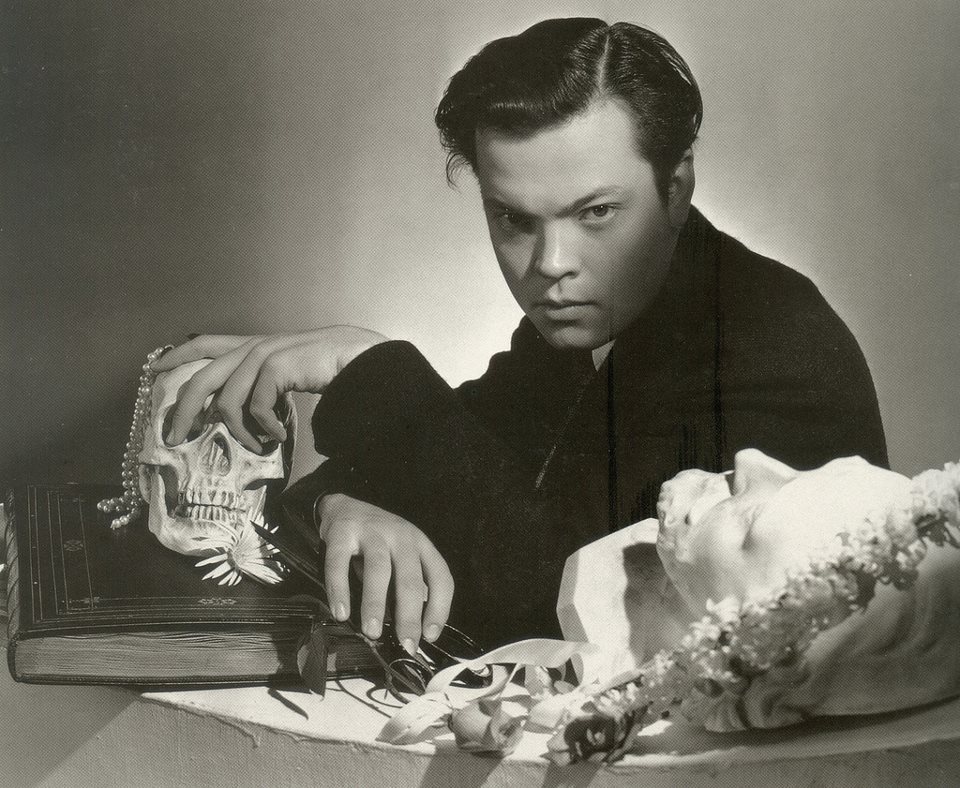
Before he directed Citizen Kane, Orson Welles was already famous. He was an enfant terrible of that new medium radio — one of his plays, an adaptation of War of the Worlds by H.G. Wells, famously terrified the nation in 1938. He was also known as a wunderkind of the stage.
During the late 1930s, Welles and his producing partner John Houseman (yes, that John Houseman) were the toast of Broadway, thanks to a string of audacious classical revivals. The most famous of these productions was a 1937 adaptation of William Shakespeare’s Julius Caesar, which gave the play an unexpected relevance. Welles dressed the cast in modern attire; soldiers were outfitted to look like Nazi black shirts. And the show was lit in a manner meant to recall a Nuremberg rally. Presented at a time when Hitler’s power was growing, the production jolted American audiences and made Welles famous. Time Magazine even put him on its cover.
Being a trailblazer in both radio and the stage, Welles adapted many of his stage productions for the wireless. The Internet Archive has posted many of these recordings online, which you can listen to for free. The selection includes performances of Hamlet, Romeo and Juliet, Richard III, Macbeth and, of course, Julius Caesar, among others. In most cases, these recordings — along with a few set photos — are the only documents left of Welles’s groundbreaking productions.
But if you want to get a sense of what Welles’s Julius Caesar actually looked like, you can check out Richard Linklater’s little-seen, critically-praised comedy Me and Orson Welles (2008). The movie stars Zac Efron as a young actor who lands a small part in the production only to find himself competing with the great director for the affections of a girl. The movie might be a trifle but experts have marveled at how close the film is to Welles’s vision. Check out the trailer below.
Jonathan Crow is a Los Angeles-based writer and filmmaker whose work has appeared in Yahoo!, The Hollywood Reporter, and other publications. You can follow him at @jonccrow.
Back in 2012, we featured a 1975 Talking Heads concert at CBGB, referencing Generation X author Douglas Coupland’s telling definition of who, exactly, constitutes that cohort: “If you liked the Talking Heads back in the day, then you’re probably X.” Simultaneously ironic and sincere, artistic and commercial, ramshackle and polished, cerebral and impulsive: the sensibilities of David Byrne’s influential new-wave band and the zeitgeist profile of Generation X share too many qualities to list. 1975, for a Gen Xer, would certainly count as “back in the day,” though perhaps a bit too far back in the day for many of them to have gained entrance to such a vibrantly scuzzy venue as CBGB. Just five years later, though, many more of them would have come of just enough age to engage with the Heads, who by that point had blown up in popularity, playing huge venues all over the world.
You may have seen the band playing Rome in 1980 when we posted that show in 2012, and today we give you another of their European gigs from that same breakout year, in Dortmund. That location, about 250 miles from Coupland’s Canadian Air Force base birthplace in Germany, in a Germany still divided, brings to mind not just the importance of themes of the late Cold War to the novelist’s work, but to Generation X itself, the last kids to grow up under the credible threat of sudden nuclear annihilation. Such an uneasy psychological and ideological environment would have an effect on the formation of anyone’s creative mind, as it must also have on that of Generation X’s predecessors, the Baby Boomers — a group in which the 1952-born Byrne falls right in the middle. The Cold War may have ended, but the Talking Heads’ music, as you’ll experience in this Dortmund concert, transcends both temporal and geographical context.
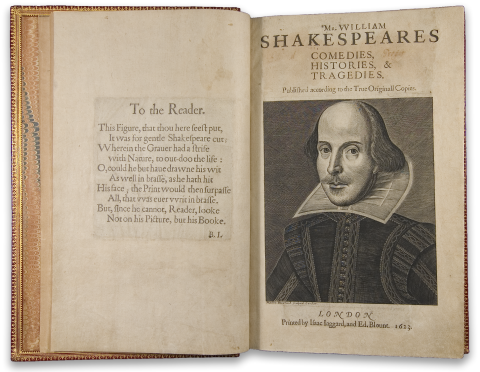
Just a few short years ago, the world of digital scholarly texts was in its primordial stages, and it is still the case that most online editions are simply basic HTML or scanned images from more or less arbitrarily chosen print editions. An example of the earliest phases of digital humanities, MIT’s web edition of the Complete Works of William Shakespeare has been online since 1993. The site’s HTML text of the plays is based on the public domain Moby Text, which—the Folger Shakespeare Library informs us—“reproduces a late-nineteenth century version of the plays,” made “long before scholars fully understood the proper grounds on which to make the thousands of decisions that Shakespeare editors face.”
The scholarly Shakespeare editorial process is far too Byzantine to get into, but suffice it to say that it matters a great deal to serious students which editions they read and the newer, often the better. And those editions can become very costly. Until recently, the Moby Text was as good as it got for a free online edition.
Other online editions of Shakespeare’s works had their own problems. Bartleby.com has digitized the 1914 Oxford Complete Works, but this is not public-domain and is also outdated for scholarly use. Another online edition from Northwestern presents copyright barriers (and seems to have gone on indefinite hiatus). In light of these difficulties, George Mason University’s Open Source Shakespeare project recently pined for more: “perhaps someday, a group of individuals will produce a modern, scholarly, free alternative to Moby Shakespeare.” Their wish has now been granted. The Folger Shakespeare Library has released all of Shakespeare’s plays as fully searchable digital texts, downloadable as pdfs, in a free, scholarly edition that makes all of its source code available as well. Taken from 2010 Folger Shakespeare Library editions edited by Barbara Mowat and Paul Werstine, the digital plays constitute an invaluable open resource.
You will still have to purchase Folger print editions for the complete “apparatus” (notes, critical essays, textual variants, etc). But the Folger promises new features in the near future. Currently, the digital text is searchable by act/scene/line, keyword, and page and line number (from the Folger print editions). Folger touts its “meticulously accurate texts” as the “#1 Shakespeare text in U.S. classrooms.” Perhaps some prickly expert will weigh in with a disparagement, but for us non-specialists, the free availability of these excellent online editions is a great gift indeed.
As you know by now, Shakespeare’s plays can always be found in our collection of Free eBooks.
These days, neuroscience seems to have a monopoly on the mind. Flip to the science section of an established newspaper or magazine, and you’ll likely see the most alluring headlines describing the latest neural findings. So, now that powerful methods of neuroimaging can delve deeper into the structure of the brain than ever before, is there anything that we don’t know about the mind? Well, yes. Apart from stating that it is a manifestation of the brain, science doesn’t offer much to explain what the mind is. In an unfortunate turn for neuroscience, no amount of brain scanning will reveal that, either.
Today, we bring you another of Talbot’s excellent philosophical primers: A Romp Through the Philosophy of Mind. The five-part lecture series begins with a discussion of René Descartes’dualism, which comprises the idea that the mind is non-physical and is therefore distinct from the body. The course then moves through an exposition of Identity Theory, according to which all of our mental states are merely manifestations of an analogous set of brain processes. Once Talbot outlines the drawbacks to each of these theories, she explains the views of several other phenomenological camps, including the epiphenomenalists, who see mental states as real but not physical, and eliminativists, who do not think that mental states are real at all. She then promptly proceeds to upend these conceptions of the mind. As with all of Talbot’s previous courses, this one is highly recommended.
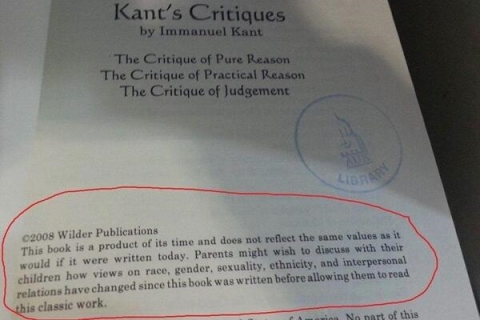
Most times when I hear someone on a tear about the dangers of “political correctness” I roll my eyes and move on. So many such complaints involve ire at being held to standards of basic human decency, say, or having to share resources, opportunities, or public spaces. But there are many exceptions, when the so-called “PC” impulse to broaden inclusivity and soften offense produces monsters of condescending paternalism. Take the above omnibus edition of “Kant’s Critiques” printed by Wilder Publications in 2008. The publisher, with either kind but painfully obtuse motives, or with an eye toward pre-empting some kind of legal blowback, has seen fit to include a disclaimer at the bottom of the title page:
This book is a product of its time and does not reflect the same values as it would if it were written today. Parents might wish to discuss with their children how views on race, gender, sexuality, ethnicity, and interpersonal relations have changed since this book was written before allowing them to read this classic work.
Where to begin? First, we must point out Wilder Publications’ strange certainty that a hypothetical Kant of today would express his ideas in tolerant and liberal language. The supposition has the effect of patronizing the dead philosopher and of absolving him of any responsibility for his blind spots and prejudices, assuming that he meant well but was simply a blinkered and unfortunate “product” of his time.
But who’s to say that Kant didn’t damn well mean his comments that offend our sensibilities today, and wouldn’t still mean them now were he somehow resurrected and forced to update his major works? Moreover, why assume that all current readers of Kant do not share his more repugnant views? Secondly, who is this edition for? Philosopher Brian Leiter, who brought this to our attention, humorously titles it “Kant’s 3 Critiques—rated PG-13.” One would hope that any young person precocious enough to read Kant would have the ability to recognize historical context and to approach critically statements that sound unethical, bigoted, or scientifically dated to her modern ears. One would hope parents buying Kant for their kids could do the same without chiding from publishers.
None of this is to say that there aren’t substantive reasons to examine and critique the prejudicial assumptions and biases of classical philosophers. A great many recent scholars have done exactly that. In her Philosophy of Science and Race, for example, Naomi Zack observes that “according to contemporary standards, both [Hume and Kant] were virulent white supremacists.” Yet she also analyzes the problems with applying “contemporary standards” to their systems of thought, which were not necessarily racist in the sense we mean so much as “racialist,” dependent on an “ontology of human races, which underlay Hume and Kant’s value judgments about what they thought were racial differences” (an ontology, it’s worth noting, that produced systemic and institutional racism). Zack respects the vast gulf that separates our judgments from those of the past while still holding the philosophers accountable for contradictions and inconsistencies in their thought that are clearly the products of willful ignorance, chauvinism, and unexamined bias. An informed historical approach allows us to see how books are not simply “products of their time” but are situated in networks of knowledge and ideology that shaped their authors’ assumptions and continue to shape our own—ideologies that persist into the present and cannot and should not be papered over or easily explained away with skittish warning labels and didactic lectures about how much things have changed. In a great many ways of course, they have. And in some significant others, they simply haven’t. To pretend otherwise for the sake of the children is disingenuous and does a grave disservice to both author and reader.
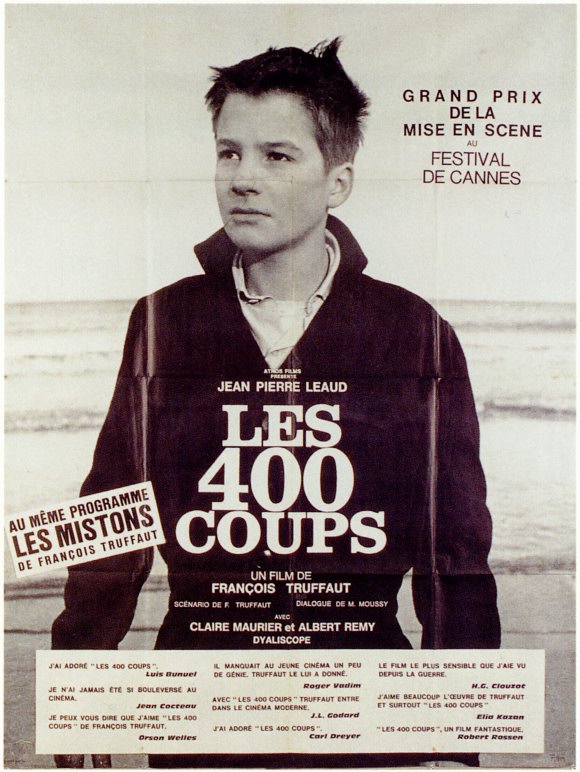
“Cinema saved my life,” confided François Truffaut. He certainly returned the favor, breathing new life into a French cinema that was gasping for air by the late 50s, plagued as it was by academism and Big Studios’ formulaic scripts. From his breakthrough first feature 400 Blows in 1959–to this day one of the best movies on childhood ever made–to his untimely death in 1984, Truffaut wrote and directed more than twenty-one movies, including such cinematic landmarks as Jules and Jim, The Story of Adele H., The Last Metro and the tender, bitter-sweet Antoine Doinel series, a semi-autobiographical account of his own life and loves. What is more, along with a wild bunch of young film critics turned directors—his New Wave friends Godard, Chabrol, Rivette and Resnais—Truffaut revolutionized the way we think, make and watch films today. (We will see how in my upcoming Stanford Continuing Studies course, When theFrench Reinvented Cinema: The New Wave Studies, which starts on March 31. If you live in the San Francisco Bay Area, please join us.)
Almost as interesting as Truffaut’s rich legacy is the narrative that led to it: How Truffaut became Truffaut against all odds. And how his unlikely background as an illegitimate child, petty thief, runaway teen and deserter built the foundations for the ruthless film critic and gifted director he would become.
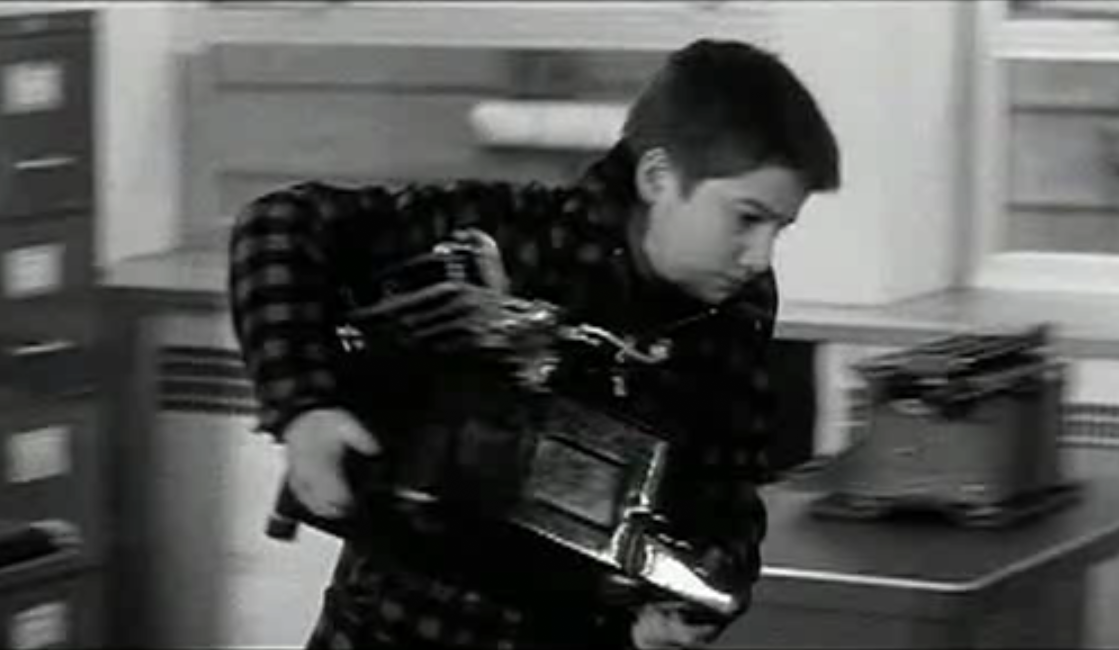
Les 400 Coups, we see a fictionalized version of the defining moments in the young François’ life through the character of Antoine Doinel: the discovery that he was born from an unknown father, the contentious relationship with a mother who considered him a burden and condescended to take him with her only when he was ten, the friendship with classmate Robert Lachenay and the endless wanderings in the streets of Paris that ensued. The film offers a glimpse of the dearth of emotional as well as material comfort at home and how Antoine makes do with it, mostly by pinching money, time and dreams of love elsewhere: Antoine “borrows” bills and objects (Truffaut, too, took and sold a typewriter from his dad’s office), steals moments of freedom in the streets, and loves vicariously through the movie theaters (in the trailer above, Antoine and his friend catch a showing of Ingmar Bergman’s Monika).
If anything, the real Truffaut did far worse than his cinematic alter ego. Like Antoine, the young François skipped schools, stole, told lies, ran away and went to the movies on the sly. He ran up debts so high—mostly to pay for his first ciné-club endeavors—that he was sent to a juvenile detention center by his father. Later, having enlisted in the Army, Truffaut deserted upon realizing he would be sent to Indochina to fight: prison was again his lot. In his cell, he received letters from the great prisoner of French letters, Jean Genêt: it was only fitting that the young Truffaut would become friends with the author of The Journal of a Thief.
But had he been a better kid, Truffaut might never have been such a great director. His so-called moral shortcomings foreshadow what would make his genius: an impulsive need to bend the rules, a talent for working at the margins and invent new spaces to free himself from formal limitations, and a fundamental urge to be true to his own vision, at the risk of infuriating the older generation. His years of truancy roaming the streets and movie theaters of Paris and his repeated experience of prison led him naturally to revolt against the confinement of the studio sets where movies were at the time entirely made. Instead, he took his camera out of the studios and into the streets. On location shooting, natural light, improvised dialogues, vivacious tracking shots of the pulse of the city — all traits that made the New Wave look refreshingly new and modern — befitted the temperament of an independent young man who had already spent too many days behind bars.
Having gotten in so much trouble for lack of money, Truffaut also ensured that financial independence would be the cornerstone of his film-making: one of the smartest moves he made as a young director was to found his own production company, the Films du Carrosse. Money meant freedom, this much he had long learnt.
But it is Truffaut’s innate sense of fiction and story telling that his younger years reveal most. Like the fictional Antoine in this clip, Truffaut seemed to have displayed a disarming mix of innocence and deception, or rather an unabashed admission that he had to invent other rules to get by and succeed, and a precocious realization that telling stories would get him further than telling the truth. “Des fois je leur dirais des choses qui seraient la vérité ils me croiraient pas alors je préfère dire des mensonges” tells Antoine in his grammatically incorrect French to the psychologist—“Sometimes if I were to tell things that would be true they would not believe me so I prefer to tell lies.” Each survival trick, each prank implied new lies to forge, and a keen understanding of his public was paramount for their success: contrary to Godard and his avant-garde deconstruction of narrative lines and meaning, Truffaut always wanted to tell good, believable stories: one could say he practiced his narrative skill by telling the tales his first audience (mother, father, teachers) wanted to hear.
One of the most memorable lines of 400 Blows is a lie so outrageous that it has to be believed. Asked by his teacher why he was not able to turn in the punitive homework he was assigned, Antoine blurts out: “It was my mother, sir.” – “Your mother, your mother… What about her?” –“She’s dead.” The teacher quickly apologizes. But this blatant lie tells another kind of truth, an emotional one that the audience is painfully aware of: Antoine’s, or should we say Truffaut’s mother is indeed “dead” to him, unable to show motherly affection. The mother’s death is less a lie than a metaphor, the subjective point of view of the child. Truffaut the director is able to allude to this deeper mourning but also to save the mother from her deadly coldness by the sheer magic of fiction. Antoine’s votive candle has almost burnt down the house, his parents are fighting, his dad threatens to send him to military school, when suddenly the mother suggests they all go… to the movies. Unexpectedly, magically, they emerge from the theater cheerful and united, in a scene of family happiness that can exist only in films. For a moment, cinema saved them all.
To learn more about Truffaut’s life and work, we recommend Stanford Continuing Studies Spring course “The French New Wave.” Laura Truffaut, François Truffaut’s daughter, will come and speak about her father’s work.
Cécile Alduy is Associate Professor of French at Stanford University. She writes regularly for The New York Times, The Atlantic, and The New Yorker.
We're hoping to rely on loyal readers, rather than erratic ads. Please click the Donate button and support Open Culture. You can use Paypal, Venmo, Patreon, even Crypto! We thank you!
Open Culture scours the web for the best educational media. We find the free courses and audio books you need, the language lessons & educational videos you want, and plenty of enlightenment in between.