In the past, we’ve told you about Werner Herzog’s Rogue Film School, which offers an unconventional crash-course in auteurship, teaching students everything from “the art of lock-picking,” to “the creation of one’s own shooting permits,” to the “athletic side of filmmaking.” As with any good curriculum, Herzog provides a required reading list, which asks students to pore over some unexpected books. When was the list time a film professor asked students to read Virgil’s Georgics, Hemingway’s “The Short Happy Life of Francis Macomber,” or J.A. Baker’s The Peregrine?
If you haven’t heard of it, Herzog considers The Peregrineone of the great masterpieces of the 20th century. First published in 1967, this classic of British nature writing has “an intensity and beauty of prose that is unprecedented, it is one of the finest pieces of prose you can ever see anywhere,” says Herzog. Earlier this year, the filmmaker paid a visit to Stanford University and had a wide-ranging conversation with Prof. Robert Harrison (host of the podcast Entitled Opinions) about what makes The Peregrinesuch a wondrous work. The event was hosted by Stanford Continuing Studies and “Another Look Book Club,” which introduces you to the best books you’ve never read.
The conversation with Herzog officially begins at the 3:00 minute mark.
If you would like to sign up for Open Culture’s free email newsletter, please find it here. It’s a great way to see our new posts, all bundled in one email, each day.
If you would like to support the mission of Open Culture, consider making a donation to our site. It’s hard to rely 100% on ads, and your contributions will help us continue providing the best free cultural and educational materials to learners everywhere. You can contribute through PayPal, Patreon, and Venmo (@openculture). Thanks!
Video games, the world has come to realize, can do good. Twenty or thirty years ago, people had a harder time accepting this, much to the frustration of daily-gaming youngsters such as myself. I remember deciding, for a school science project, to demonstrate that video games improve “hand-eye coordination,” the go-to benefit in those days to explain why they weren’t all bad. But as our understanding of video games has become more sophisticated, as have video games themselves, it’s become clear that we can engineer them to improve much more about ourselves than that.
The New Yorker’s Dan Hurley recently wrote about findings from a study called Advanced Cognitive Training for Independent and Vital Elderly (ACTIVE), which began with three thousand participants back in 1998. “The participants, who had an average age of 73.6 at the beginning of the trial, were randomly divided into four groups. The first group, which served as control, received no brain training at all. The next two were given ten hours of classroom instruction on how to improve memory or reasoning. The last group performed something called speed-of-processing training” by playing a kind of video game for ten hour-long sessions spread over five weeks.
A decade into the study, some of the participants received extra training. 14 percent of the group who received no training met the criteria for dementia, 12.1 percent did in the group who received speed-of-processing training, and only 8.2 percent did in the group who received all possible training. “In all, the researchers calculated, those who completed at least some of these booster sessions were forty-eight-per-cent less likely to be diagnosed with dementia after ten years than their peers in the control group.”
Intriguing findings, and ones that have set off a good deal of media coverage. What sort of video game did ACTIVE use to get these results? The Wall Street Journal’s Sumathi Reddy reports that “the exercise used in the study was developed by researchers but acquired by Posit Science, of San Francisco, in 2007,” who have gone on to market a version of it called Double Decision. In it, the player “must identify an object at the center of their gaze and simultaneously identify an object in the periphery,” like cars, signs, and other objects on a variety of landscapes. “As players get correct answers, the presentation time speeds up, distractors are introduced and the targets become more difficult to differentiate.”
You can see that game in action, and learn a little more about the study, in the Wall Street Journal video above. Effective brain-training video games remain in their infancy (and a few of the articles about ACTIVE’s findings fail to mention Lumos Labs’ $2 million payment to the government to settle charges that the company falsely claimed that their games could stave off dementia) but if the ones that work can harness the addictive power of an Angry Birds or a Candy Crush, we must prepare ourselves for a sharp generation of senior citizens indeed.
Malcolm Gladwell’s Revisionist History podcast kicked off this summer and in his very first episode, he took on the question of how women have broken into male-dominated fields, and the many reasons that so often hasn’t happened. Having set this tone, Gladwell asks in a more recent inquiry—a three-part series spanning Episodes 4 through 7—a similar question about what we might call meritocracy in education, a value fundamental to liberal democracy, however that’s interpreted. As Gladwell puts it in “Carlos Doesn’t Remember,” “This is what civilized societies are supposed to do: to provide opportunities for people to make the most of their ability. So that if you’re born poor, you can move up. If you work hard, you can improve your life.”
Over some sentimental, homespun orchestration, Gladwell points out that Americans have told ourselves that this is our birthright, “that every kid can become president.” We have seen ourselves this way despite the fact that at the country’s origin, higher offices were solely the property of propertied men, a small minority even then. Lest we forget, for all their good intentions, Ben Franklin’s Poor Richard’s Almanack and later collection, “The Way to Wealth,” were written as satires, “relentlessly scathing social and political commentary,” writes Jill Lepore, that mock wishful thinking and exaggerated ambition even as they offer helpful hints for organized, diligent living. Americans, the more cynical of us might think, have always believed impossible things, and the myth of meritocracy is one of them.
But Gladwell, skimming past the cultural history, wants to genuinely ask the question, “is it true? Is the system geared to serve the poor smart kid, or the rich smart kid?” Apart from our beliefs and political ideologies, what can we really say about what he calls, in economics terms, “the rate of capitalization” in the U.S.? This number, Gladwell explains, measures “the percentage of people in any group who are able to reach their potential.” Better than “its GDP, or its growth rate, or its per-capita income,” a society’s capitalization rate, he says, allows us to judge “how successful and just” a country is—and in the case of the U.S. in particular, how much it lives up to its ideals.
The first episode in the series (Episode 4 of the podcast, stream it above) introduces us to Gladwell’s first subject, Carlos, a very bright high school student in Los Angeles, and Eric Eisner, a retired entertainment lawyer who devotes his time to scouting out talented kids from low income families and helping them get into private schools. Eisner did exactly that for Carlos, finding him a place in an upscale private Brentwood school in the fifth grade. Early in Gladwell’s interview with Carlos, the question of what James Heckman at Boston Review identifies as the “non-cognitive characteristics” that inhibit social success comes up. These are as often “physical and mental health” and the soft skills of social interaction as they are access to something as seemingly mundane as a pair of tennis shoes that fit.
Carlos, a “really, really gifted kid,” Gladwell reiterates, cannot make it into and through the complicated social system of private school without Eisner, who bought him new tennis shoes, and who provides other material and social forms of support for the students he mentors. Students like Carlos, Gladwell argues, need not only mentors, but patrons in the mold of an ancient Roman patrician: “not just any advocate: a high-powered guy with lots of connections, who can get you in and watch over you.” The key to class mobility, in other words, lies with the arbitrary noblesse oblige of those who have already made it, generally with some considerable advantages of their own. The remainder of the episode explores the obvious and non-obvious problems with this modern-day patronage system.
In “Food Fight,” the next part of the mini-series on “capitalization,” Gladwell and his colleagues open the door on the world of prestigious liberal arts colleges’ dining services, starting at Bowdoin College in Maine, a place where the food services are “in a whole different class.” Bowdoin’s excellent food, Gladwell argues, represents a “moral problem.” To help us understand, he makes a direct comparison with Bowdoin’s elite competitor, Vassar College, whose student dining is more in line with what most of us experienced at college; in one student’s understated phrase, there’s “room for improvement.” What the food comparison illustrates is this: when many elite institutions doubled their financial aid budgets a decade or so ago to increase enrollment of low-income students, other budget lines, so Vassar’s president claims, took such a hit that food, facilities, and other services suffered.
Vassar’s current president transformed the student body from primarily full-tuition-paying students to primarily students “who pay very little.” The egalitarian move means the college must lean too heavily on its endowment and on the paying students. Gladwell doesn’t delve into what we’ve also been hearing about for at least the last decade: as institutions like Vassar accept and fund increasing numbers of low-income students, other schools charged legally with providing for the public good, like the University of California system, have raised tuition to levels unaffordable to thousands of prospective students.
Colleges across the country may have raised tuition rates to their current astronomical levels in part to better fund poorer applicants, but they have also faced stiff criticism for spending huge amounts on athletics, building projects, and exorbitant administrative salaries. The food comparison presents us with an either/or scenario, but the moral problem inhabits a much grayer reality than Gladwell acknowledges. Likewise, in the story of Carlos, we come to understand why smart kids from poor neighborhoods face so many impediments once they arrive at elite institutions. But we don’t hear about why so many poor kids fail to achieve at all due to what what Heckman calls “the principle source of inequality today”—children born into poverty begin life at a severe disadvantage from the very start, leading to social divisions of the “skilled and unskilled” even in early childhood.
We do get a broader picture in the final episode in the series, “My Little Hundred Millions,” in which Gladwell looks into another moral problem: In the story of Henry Rowan, who in the early ‘90s donated $100 million to a tiny university in New Jersey, we see a stark contrast to the way most philanthropists operate, almost as a rule making their generous gifts to elite, already wealthy schools like Harvard, Stanford, and Yale. This system of philanthropy perpetuates inequality in higher education and keeps elite institutions elite, even as—in places like Vassar—it gives them the reserve capital they need to fund lower-income students. Like any complex institutional system with a long, tangled history of exclusion and privilege, higher education in the U.S. offers us a very good model for studying inequality.
To hear Gladwell’s full assessment of meritocracy or “capitalization,” you’ll need to listen to the full series as it builds on each example to make its larger point. Each episode’s webpage also includes links to reference documents and featured books so that you can continue the investigation on your own, correcting for the podcast’s blind spots and biases. What Gladwell’s series does well, as do many of his pop sociological bestsellers, is give us concrete examples that run up against many of our abstract preconceptions. It’s an interesting approach—structuring an extended look at exceptionalism and its problems around three exceptional cases. But it is these cases, with all their complications and complexity, that often get lost in over-generalized discussions about higher education and the myths and realities of social mobility.
Philip K. Dick died in 1982. His distinctive, some say visionary brand of psychological sci-fi literature, however, has lived on, proving its endurance in part by taking new forms. Blade Runner, Ridley Scott’s hugely influential adaptation of Dick’s Do Androids Dream of Electric Sheep?, premiered just three months after the author’s departure. More films followed over the years, including Paul Verhoeven’s Total Recall (an adaptation of “We Can Remember It for You Wholesale”), Steven Spielberg’s Minority Report, Richard Linklater’s A Scanner Darkly, and many others.
Dick’s work has also provided the basis for radio dramas, television shows (most recently Netflix’s The Man in the High Castle, with an ambitious anthology series coming to Channel 4 this spring), and stage productions.
Typically, these adaptations use the stories and novels in which Dick wrote the setting, plot, and characters with relative straightforwardness. Other, later works found him plunging as deep into philosophy and autobiography as into science fiction. The change happened around the time he saw a mysterious pink light and met God in 1974, or claimed to, and it produced a final set of novels known as the VALIS trilogy.
The fractured tale of an authorial alter-ego named Horselover Fat, VALIS (short for “Vast Active Living Intelligence System”), the first book in the trilogy, involves an alien space probe, Watergate, the Messiah, lasers, and a range of references to religions like Christianity, Gnosticism, Buddhism, Gnosticism, Zoroastrianism, and the Red Cross Brotherhood; philosophy from the ancient Greeks to Plato, Pascal, and Schopenhauer; and cultural figures like Handel, Wagner, Goethe, and Frank Zappa. It would take an ambitious mind indeed to adapt such a thing: specifically, it took the mind of Tod Machover, composer and director of MIT’s Media Lab, who turned it into an opera in 1987.
“We live in a world that is becoming in fact more and more fragmented, more and more complex,” says Machover on the relevance of VALIS at an interview at the Philip K. Dick Fan Site. “You don’t have to have a pink light experience to realize that there is too much information to not only be aware of but to make any kind of sense out of.” He describes this “incredible feeling of the world being not only too complex for any one person to make sense out of but also dangerously complex, to the point where people will not only not understand each other but end up hating each other and being absolutely crushed under the burden of just trying to make sense with how much there is to know.”
In his VALIS opera, which premiered at Paris’ Centre Georges Pompidou with installations created by video artist Catherine Ikam, Machover tried to get that feeling artistically across, and you can hear it free on Spotify. (If you don’t have Spotify’s software, you can download it here. There’s a Youtube version right above.) Back then in the 80s, he says, it “seemed like through our media and communications there’d be a kind of facile way of connecting people, a sort of passivity and turning on your cable TV and seeing what’s going on today in Tokyo or in Europe and you sort of feel like you can take all this stuff in. But in fact I think what we’re seeing now is exactly what Dick predicted, which is that it ain’t that easy.” And it sure hasn’t got any easier.
Years ago, we featured a wonderful clip showing Bruce Lee, only 24 years old, auditioning for a part in the 1960s TV show, “The Green Hornet.” In the clip, Lee puts on a remarkable display of his martial arts skills, all while explaining the philosophy that guides his moves. The actor, who studied philosophy in college, looks at the camera and explains the relationship between kung fu and a glass of water. He says: “water is the softest substance in the world,… but yet it can penetrate the hardest rock or anything, granite, you name it. So, every kung fu man is trying to do that,… to be soft like water, and flexible and adapt itself to the opponent.”
That’s a good prompt to tell you about the brand new podcast that explores the philosophy of Bruce Lee, who died in 1973. Launched by his daughter Shannon Lee, each episode promises to “dig deep into Bruce’s philosophy to provide guidance and action on cultivating your truest self.” As the podcast moves along, it will help you find wisdom in Lee’s pronouncements, like: “Empty your mind, be formless, shapeless like water. Now you put water into a cup, it becomes the cup, you put water into a bottle, it becomes the bottle, you put it in a teapot, it becomes the teapot. Now water can flow or it can crash. Be water, my friend.” By now, you’re starting to see, Lee had a thing for water.
You can get the podcast via iTunes and Stitcher. Below, stream one of the first episodes that delves into his philosophy.
Poetry, however? I’m not ungrateful to have some smuggled into my day by a commercial carrier whose agenda is somehow less suspect. Would that we lived in a world where the poetry of Ted Hughes or Emily Dickinson might be seen as having the power to sell viewers on a particular brand of pizza or automobile.
It almost seems we do, given the response to “The Human Family,” a new Apple spot showcasing the iPhone’s camera capabilities with a slideshow of portraits submitted by users the world round. The images—already captivating—are made more so by the unmistakeable voice of the late Maya Angelou, whose poem, “The Human Family,” supplies both title and inspiration.
It’s very stirring, as befits an ad debuting during the Olympics’ opening ceremony. (I weep that the Super Bowl failed to make the Dr. Angelou commercial parodies of yore a reality.)
The one-minute spot shaves a bit off the poem, but perhaps it is okay to leave a bit behind as a reward for viewers moved to look it up on their own.
The complete text is here. Below, find a non-Apple-sponsored video that matches the same narration to a slideshow featuring the author at various stages of life. The reading will be added to our collection, 1,000 Free Audio Books: Download Great Books for Free.
Ayun Halliday is an author, illustrator, theater maker and Chief Primatologist of the East Village Inky zine. Her latest script, Fawnbook, is available in a digital edition from Indie Theater Now. Follow her @AyunHalliday.
They’ll never be worth as much as the alleged box of first edition Superman comics left in my father’s room when he shipped out to sea, allegedly given to the dump by his mother, though she forever denied it; but those overstuffed boxes full of cheap mixtapes from the late 80s and 90s in my closet have to be worth something, right? If only to the internet… the Internet Archive, a more specific place, and yes, it’s the one that hosts the Wayback Machine, preserver of webpages no one updates or, really, visits anymore.
But this is not a sad story about what happened to Web 1.0! But a happy one about where your mixtapes will go, because they are needed. Just as a recent generation decided to bypass the sixties and go back to the sources of Hendrix and CSNY so future hipsters of today ignore oughties retreads and return to the world just before the internet. They go full antiquarian with it, with authentic period costumes and period-era equipment, which means they often sound terrible. They need cassettes to get it right.
The cassette has already made its way back in a big way, reintroducing the sound of early synthpop, industrial music, DIY indie rock, and a genre called “tape experimentation” that encompasses anything from avant-garde musique concrète to the latest production of spliced together cassette tape. The sound of decaying tape—a soup of hiss and muffled, warped, out-of-tune copies of songs—birthed dark, sludgy metal and perfectly captured the soundtracks of horror movies. And, imperfectly, the sound of everything else. These were “the days when the audio cassette was the standard method of music sharing… generally the mid-eighties through early-nineties,” points out The Noise-Arch Archive, which hosts just such a collection, on just such a (digitized) medium. 30 gigs of tape hiss.
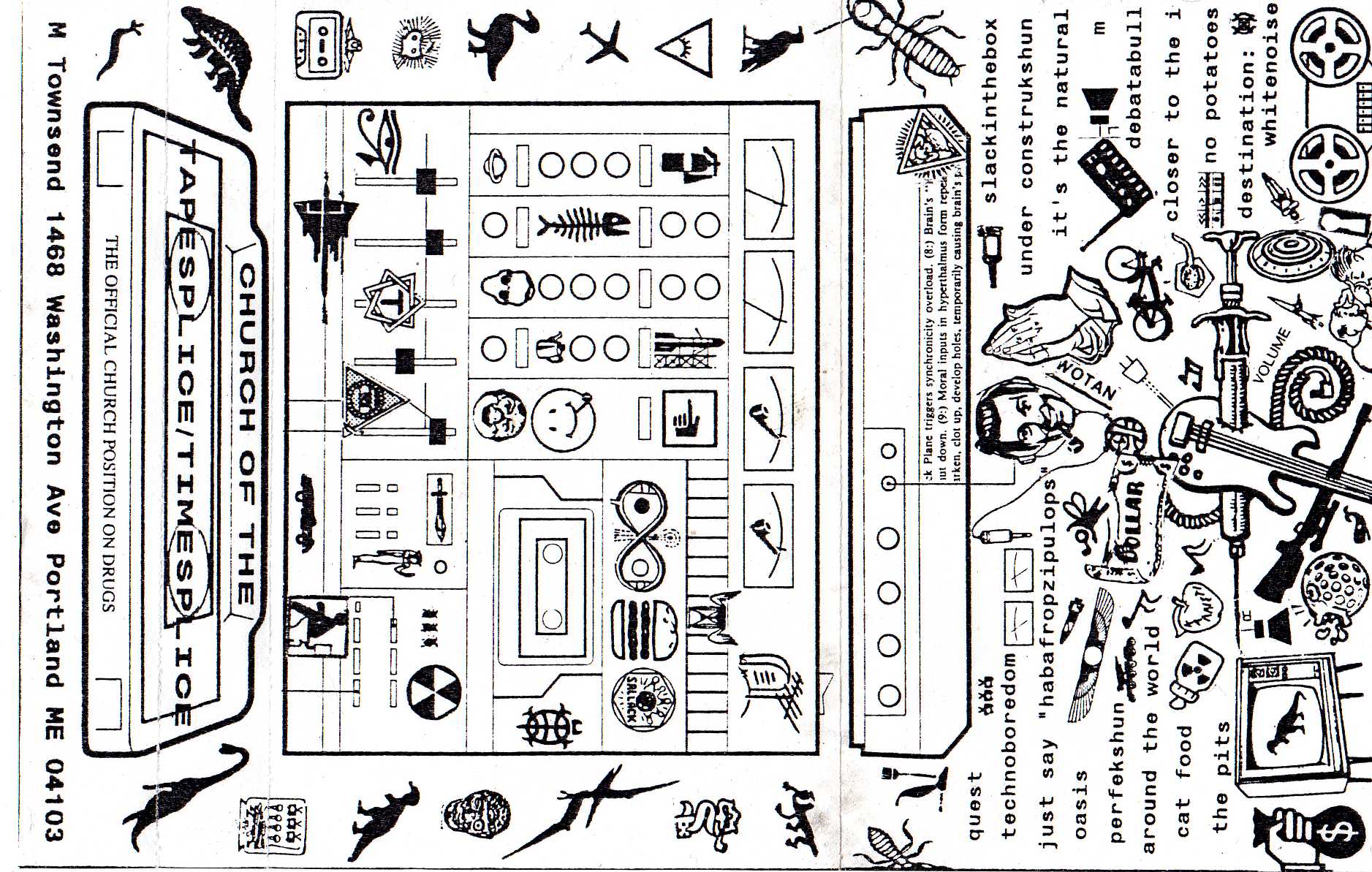
One needs a reliable guide like, say, Tom Waits, to understand how weird depression-era music was. This archive makes significant headway in conveying the same information about the Bush (the first) and Clinton (the first) years. One need only listen to Church of the Tapeslice / Timesplice at the top, as much as that’s possible, to get a flavor of how. It’s a mélange of Frank Zappa-like sound collage, Residents-like sardonic absurdity, Devo-like black humor, and free-form-the-DJ-is-really-stoned-level goofiness you’ve heard at least once late night on your college radio station. But they aren’t all this off-putting, and they aren’t all this approachable either.
Psychomania, further up, lives up to its name. It opens innocently enough, with some sort of nondescriptly tribal ditty, lilting, if unsettling. Then the mix shifts into full giallo mode, the loud, punishing synths and descending harmonies of doom that comprise the scores of “Spaghetti Slashers.” Expect the obscure of the obscure in every tape in this collection. “Much of this material defies category,” Noise-Arch advises, “and has therefore not been given one.” Much of it sounds like something you might recognize, only a few uncanny removes from your point of reference.
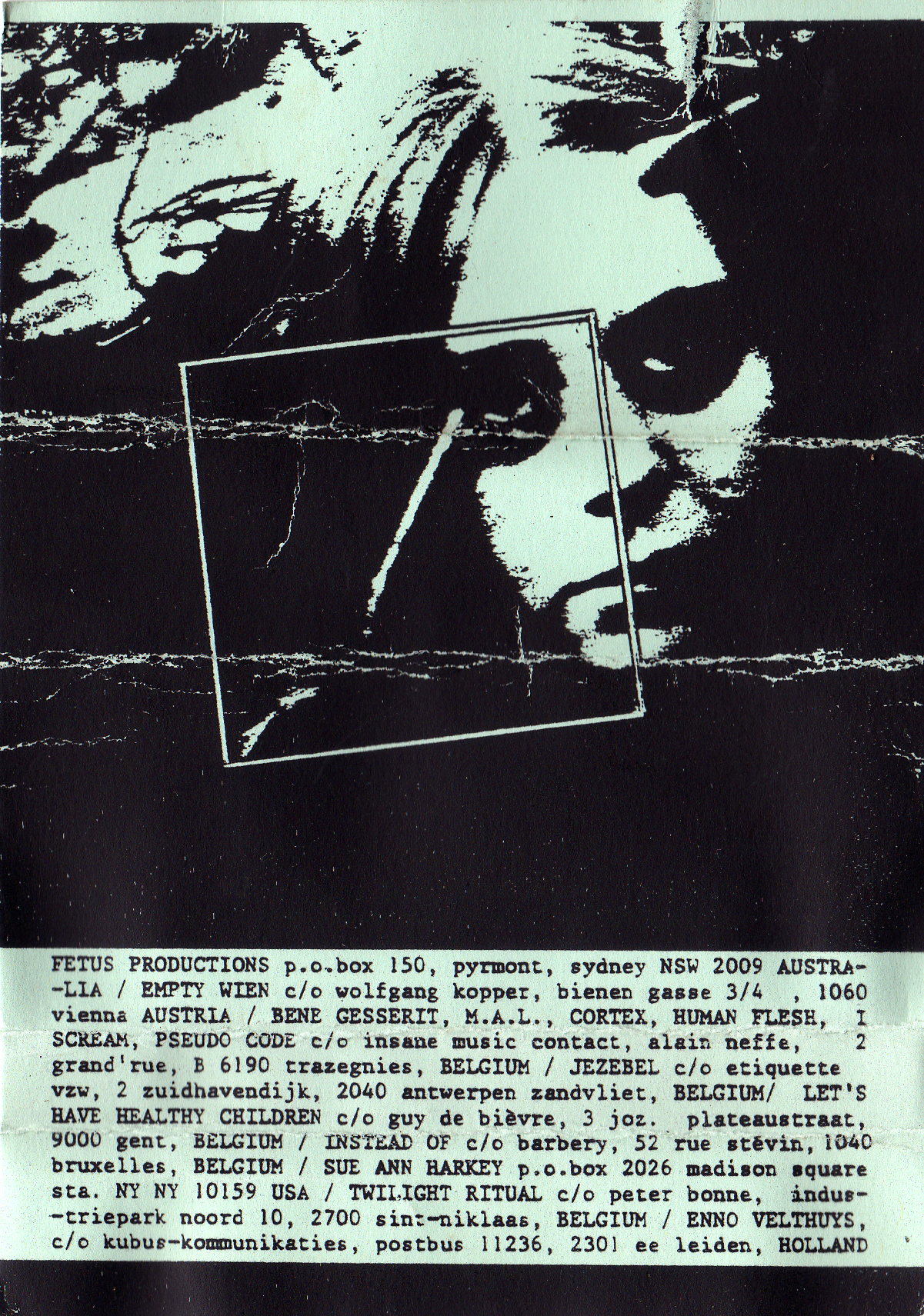
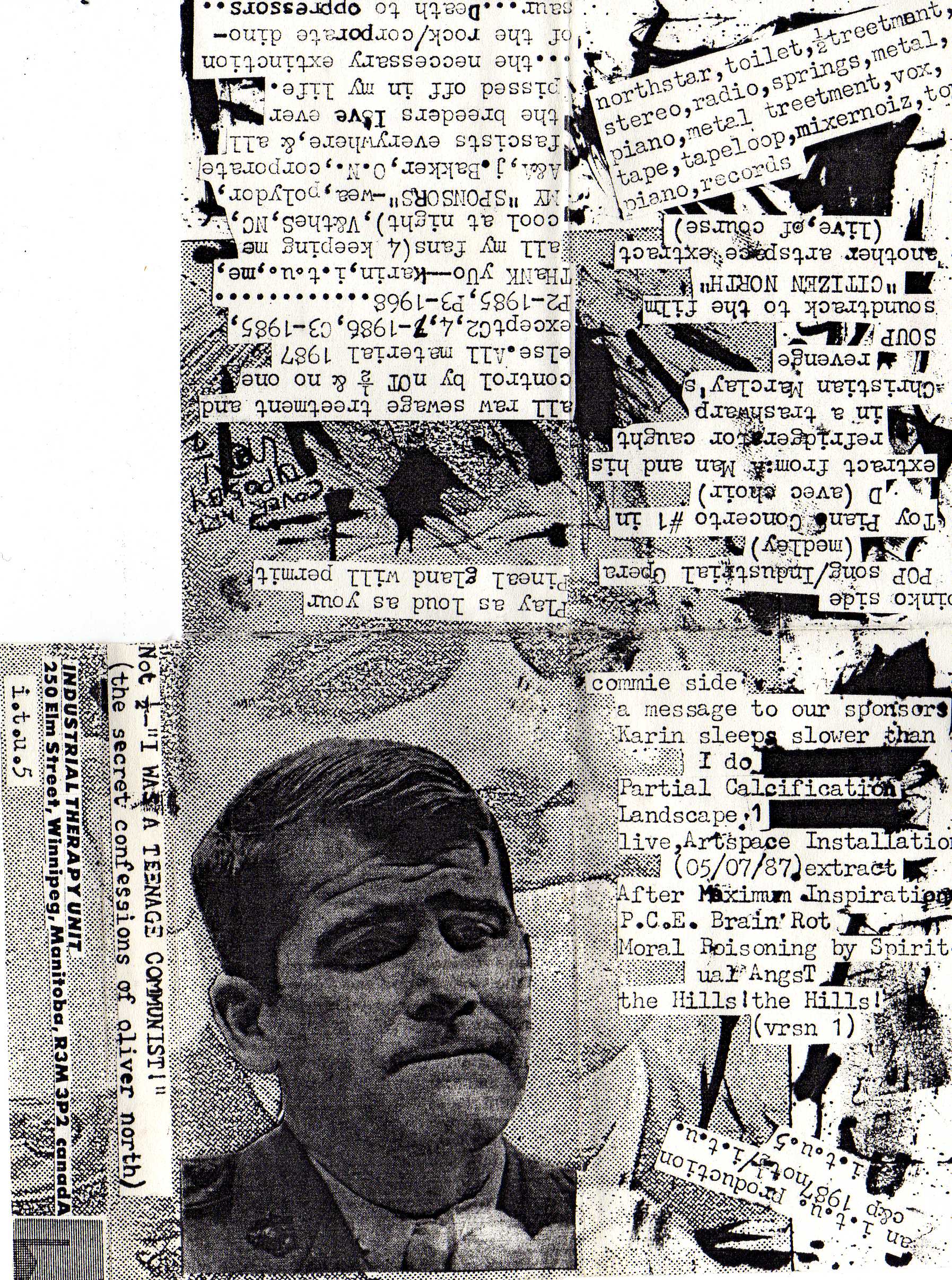
The collection above—its barely legible cover describes a compilation from “Fetus Productions” in Australia—opens with some really off-kilter electro-lounge music and progresses into a full-on synthpop opera. None of this music, obviously, should be missed. Nor the music stored in important archives currently occupying my closet. I’ll never sell it. Because who wants a bunch of worn-out crappy plastic tapes? It’s what’s on them that we need to preserve. Even the hard-to-love slacker nonsense of I Was a Teenage Communist (The Secret Confessions of Oliver North). Enter The Noise-Arch Archivehere.
At 3:33 one morning in February 2005, Hunter S. Thompson rang up Bill Murray. “I’ve invented a new sport,” declared the writer to the actor. “It’s called Shotgun Golf. We will rule the world with this thing.” How do you play it? Why, you “shoot your opponent’s high-flying golf ball out of the air with a finely-tuned 12-gauge shotgun, thus preventing him (your opponent) from lofting a 9‑iron approach shot onto a distant ‘green’ and making a ‘hole in one.’ ”
Murray, a known night owl and avid golfer in touch with his own Thompsonian side at least since portraying him in 1980’s Where the Buffalo Roam, seemed pleased enough with the idea. Alas, Shotgun Golf never had the chance to become America’s new national pastime; Thompson’s explanation of it came in the very last column he wrote before his death at the age of 67. Given the, shall we say, colorful life he lived and the drug-and-drink regimen that fueled it to the end, making it to late middle age counts as one of his accomplishments in itself.
We’ll never know what exact cocktail of substances inspired Thompson to come up with Shotgun Golf in the first place, but it came at the end of a long personal history of mixing drugs and clubs. Esquire recently ran an excerpt from The Accidental Life, its former editor Terry McDonell’s new memoir, about a session of “acid golf” with George Plimpton and the man who wrote Fear and Loathing in Las Vegas. No sooner did they arrive at the Aspen Golf Club (and goose sanctuary) than Thompson brought out the essential pre-game supplement: “ ‘Here,’ Hunter said, holding out three white tabs of blotter paper with an unfamiliar red symbol on them. ‘Eat these.’ ”
Before long, McDonnell feels himself “peacefully soaring.” Then the session, which also involves a fair bit of drinking, comes down to a high-stakes putt: “We were all in for $1,000, Hunter said.” Thompson, despite painstaking minutes spent lining it up, “missed the putt by about a foot and, charging after it, let out a howl as he winged his putter into the pond. The geese started honking and Hunter ran back to the cart, pulled the 12-gauge from his golf bag and fired over the geese, and they lifted off the pond like a sparkling cloud of gray and white feathers.”
“It occurred to me as I watched the glitter blend into the fading sky,’ writes McDonnell, “that having a story to tell about acid golf with Hunter and George was probably good for my career.” You can watch a video on that story at the top of the post. And what, finally, have we learned from it? In the company of Hunter S. Thompson, even plain old acid golf called for a shotgun.
We're hoping to rely on loyal readers, rather than erratic ads. Please click the Donate button and support Open Culture. You can use Paypal, Venmo, Patreon, even Crypto! We thank you!
Open Culture scours the web for the best educational media. We find the free courses and audio books you need, the language lessons & educational videos you want, and plenty of enlightenment in between.