A quick fyi: Dan Kopf, an economics reporter, has a tip that seemed worth passing along. Over at Quartz, he writes:
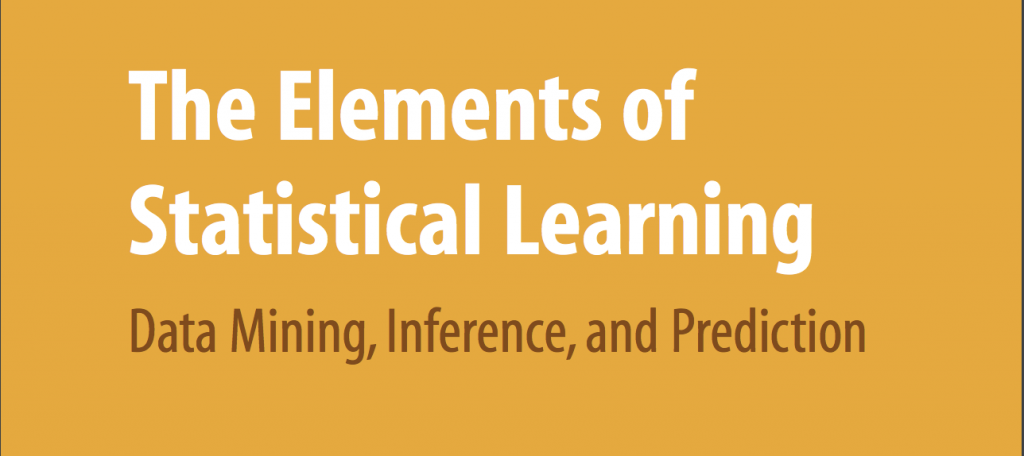
As a former data scientist, there is no question I get asked more than, “What is the best way to learn statistics?” I always give the same answer: Read An Introduction to Statistical Learning. Then, if you finish that and want more, read The Elements of Statistical Learning. These two books, written by statistics professors at Stanford University, the University of Washington, and the University Southern California, are the most intuitive and relevant books I’ve found on how to do statistics with modern technology… You can download them for free.
If you would like to sign up for Open Culture’s free email newsletter, please find it here. It’s a great way to see our new posts, all bundled in one email, each day.
If you would like to support the mission of Open Culture, consider making a donation to our site. It’s hard to rely 100% on ads, and your contributions will help us continue providing the best free cultural and educational materials to learners everywhere. You can contribute through PayPal, Patreon, and Venmo (@openculture). Thanks!
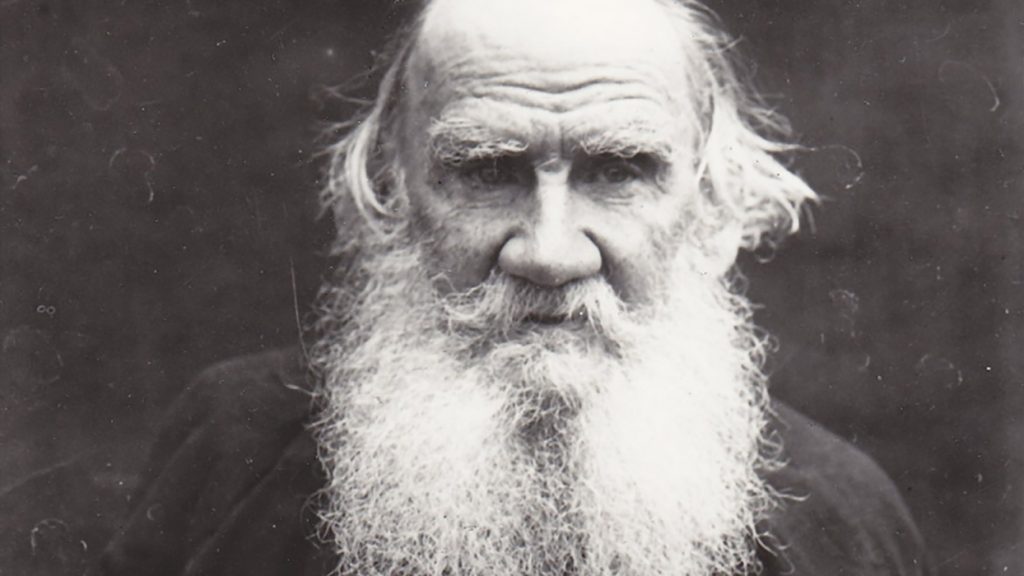
War and Peace, Anna Karenina, The Death of Ivan Ilyich —many of us have felt the influence, to the good or the ill of our own reading and writing, of Leo Tolstoy. But whose influence did Leo Tolstoy feel the most? As luck would have it, we can give you chapter and verse on this, since the novelist drew up just such a list in 1891, which would have put him at age 63.
A Russian publisher had asked 2,000 professors, scholars, artists, and men of letters, public figures, and other luminaries to name the books important to them, and Tolstoy responded with this list divided into five ages of man, with their actual degree of influence (“enormous,” “v. great,” or merely “great”) noted.
[Theodore] Parker. Discourse on religious subject — Great
[Frederick William] Robertson’s sermons — Great
Feuerbach (I forget the title; work on Christianity) [“The Essence of Christianity”] — Great
Pascal’s Pensées — Enormous
Epictetus — Enormous
Confucius and Mencius — V. great
On the Buddha. Well-known Frenchman (I forget) [“Lalita Vistara”] — Enormous
Lao-Tzu. Julien [S. Julien, French translator] — Enormous
The writer at the Valley Advocate, a Tolstoy aficionado, came across the list by sheer happenstance. “On my way to work, I found something just for me in a box of cast-off books on a sidewalk,” they write: a biography of Tolstoy with “something cooler inside”: a “yellowed and fragile New York Times Book Review clipping” from 1978 containing the full list as Tolstoy wrote it. “Gold,” in other words, “for this wannabe Tolstoy scholar.” If you, too count yourself among the ranks of wannabe Tolstoy scholars — or indeed credentialed Tolstoy scholars — you’ll no doubt find more than a few intriguing selections here. And if you simply admire Tolstoy, well, get to reading: learn not how to make the same things your idols made, I often say, but to think how they thought. Not that any of us have time to write War and Peace these days anyway, though with luck, we do still have time to read it — along withThe Thousand and One Nights, David Copperfield, The Odyssey, and so on. Many of these works you can find in our collection, 800 Free eBooks for iPad, Kindle & Other Devices.
Looking for free, professionally-read audio books from Audible.com? Here’s a great, no-strings-attached deal. If you start a 30 day free trial with Audible.com, you can download two free audio books of your choice. Get more details on the offer here.
Note: An earlier version of this post originally appeared on our site in July, 2014.
The more things change, the more the talking points stay the same. Just swap teachers for airplane passengers, and watch a silly sitcom punchline morph into actual GOP policy.
Could it be a case of authorial oversight that all subsequent rules are exclusively concerned with such practical matters as dress and fight duration?
Because doing so might diminish Fight Club’s street cred just a bitsy…
Filmmaker (and popular audiobook narrator) Emily Janice Card has a good deal of fun in Jane Austen’s Fight Club, above, marrying Palahniuk’s tropes to the social mores of England’s Regency period.
“No corsets, no hat pins and no crying,” Tyler Durden stand-in Lizzie instructs the eager young ladies in her circle. Soon, they’re proudly sporting bruises beneath their bonnets and stray blood spots on their tea dresses.
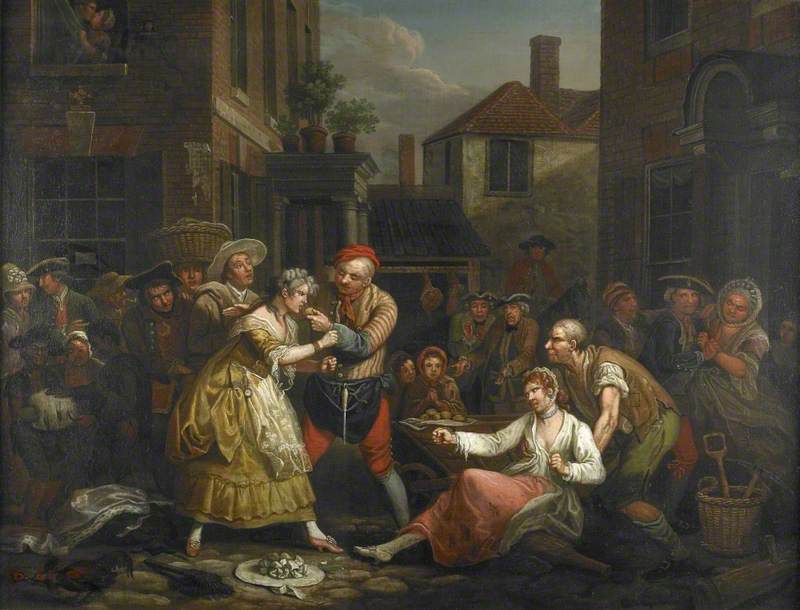
While young women of the fictional Bennet sisters’ social class refrained from brutal fisticuffs, there’s ample evidence of female combatants from the proletarian ranks. They fought for money, and occasionally to settle a disagreement, training hard for weeks in advance.
Their bouts drew spectators to the amphitheater owned by boxing promoter James Figg, and the marvelously named Hockley in the Hole, a seedy establishment whose other attractions included bearbaiting, bullbaiting, and fighting with broadswords and cudgels.
The female fist fighters challenged each other with paid notices in local papers, like this one from “championess and ass-driver” Ann Field of Stoke Newington:
Whereas I, Ann Field, of Stoke Newington, ass-driver, well known for my abilities, in boxing in my own defense wherever it happened in my way, having been affronted by Mrs. Stokes, styled the European Championess, do fairly invite her to a trial of her best skill in Boxing for 10 pounds, fair rise and fall; and question not but to give her such proofs of my judgment that shall oblige her to acknowledge me Championess of the Stage, to the satisfaction of all my friends.
Mrs. Stokes promptly announced her readiness to come out of retirement:
I, Elizabeth Stokes, of the City of London, have not fought in this way since I fought the famous boxing- woman of Billingsgate 29 minutes, and gained a complete victory (which is six years ago); but as the famous Stoke Newington ass-woman dares me to fight her for the 10 pounds, I do assure her I will not fail meeting her for the said sum, and doubt not that the blows which I shall present her with will be more difficult for her to digest than any she ever gave her asses.
Rather than keeping mum on Fight Club, these female pugilists shared Muhammad Ali’s flare for drumming up interest with irresistibly cocky wordplay.
In a chapter devoted to public entertainments, sports and amusements, Alexander Andrews, author of The Eighteenth Century or Illustrations of the Manners and Customs of Our Grandfathers,documents how the Merry Wives of Windsor, a crew comprised of “six old women belonging to Windsor town” took out an ad seeking “any six old women in the universe to outscold them.”
On June 22nd, 1768, a woman called Bruising Peg “beat her antagonist in a terrible manner” to win a new chemise, valued at half a guinea.
In 1722, Hannah Hyfield of Newgate Market, resolved to give her challenger, Elizabeth Wilkinson, “more blows than words,” promising to deliver “a good thumping.” Both parties agreed to hold a half-crown in their fists for the duration of the fight. William B. Boulton, author of 1901’s Amusements of Old London, speculates that this was a practical measure to minimize scratching and hair-pulling.
This is not an easy post to write. I am going to talk about something personal. Yes, it’s time to discuss underrated albums, a term that can mean so many things to so many people that we might as well talk about underrated dreams. But dreams can be shared, at least in pop culture and the subcultural caverns beneath it. And people can share opinions about an underrated album, especially in the disparate communities of the internet, where devotees can find each other easily.
When I was younger this was not so easy. One might discover an album at a local indie record shop and buy it just for the cover, having no idea what lay within. There were no songs on YouTube, Spotify, or iTunes. (My generation’s walking to school in the snow, uphill both ways.) One made chance discoveries at live shows and in the pages of print magazines. In such primitive conditions, it was easy to find records that you and only you loved, from start to finish, sometimes believing you must be the only person who had ever heard them.
As Richard Metzger puts it at Dangerous Minds, in writing about an underrated EP from a highly underrated band, “In the pre-Internet days, record collection was more than merely a hobby. It was almost like… a way of life.”
I take this little nostalgic trip to say that for me, underrated albums tend to fold into the category of underrated artists. Discovering them wasn’t a matter of cred—not at first. It was a secretive and private act, a tiny adolescent rebellion against the bad taste of friends and family. Given such musical solipsism, I find it hard to gauge what makes an album underrated. You’ll find lists aplenty, and they are odysseys of discovery for the adventurous. Lists filled with lesser-known records from very well-known artists. Lists made of picture galleries. Lists quoting such high-cred stars as Kurt Cobain, Björk, and Arcade Fire.
As for myself, I could go on for days, but humbly offer here a few eclectic albums that—start to finish—have captivated me over the years for various reasons. At the top, hear “Which Witch,” from TK Webb’s criminally underrated 2006 Phantom Parade, an album of plaintive laments that sounds like a truck stop ashtray—hypnotic roadhouse country blues played by the Velvet Underground with vocals parked somewhere between Tom Waits and Captain Beefheart.
Below it, hear a short excerpt from what is very likely the strangest live album ever recorded: Wire’s 1981 Document & Eyewitness. It’s hard to imagine listening to it without the liner notes in hand, but the overdubbed conversation on “Everything’s Going to Be Nice” will give you a taste of what the concert was like. The band, writes Pitchfork, “had pushed their art-student tendencies to the breaking point, turning what was expected to be a pogo-fueled punk show into a Dadaist, performance-art spectacle complete with Morris-dancing bells and a live goose.”
This track represents a brief interlude in the midst of recordings that capture the sound of a band taking itself apart onstage before a bewildered audience clamoring for the hits (or, rather, the hit, “I2XU” from their classic debut Pink Flag.)
In the Spotify playlist above, in addition to these two albums, hear former Screaming Trees singer Mark Lanegan’s Bubble Gum, English rockabilly revivalist Holly Golightly & Dan Melchoir’s Desperate Little Town, Afro-Turkish singer Esmeray’s 2013 collection of hits En lyileriyle Esmeray (hits in her native land, maybe, but sadly not well known in the English-speaking world), post-rock pioneers Bark Psychosis’s 1994 Hex; the alternatively hypnotic and hysterical Canadian indie rockers Frog Eyes’ 2002 debut The Bloody Hand; Pissed Jeans’ mostly terrifying Hope for Men; Gillian Welch’s trad folk/country Soul Journey (don’t miss closer “Wrecking Ball”); and the Staple Singers underrated early albums Uncloudy Day & Will the Circle Be Unbroken.
Depending on my mood, these are albums I listen to straight through—and think, while doing so, everyone should hear this. But of course the list is biased. Like telling people about your dreams, telling people about your favorite, underrated albums can never approach the experience of listening to them yourself. Nonetheless, reader, a personal question: what would you put on your list? What albums do you want fellow OC readers to put on their radar? Tell us in the comments below. And if we get enough good replies, who knows, maybe we’ll pull together a big meta playlist we all could share.
People come to know the world the way they come to map it—through their perceptions of how its elements are connected and of how they should move among them. This is precisely what the series is attempting by situating the map at the heart of cultural life and revealing its relationship to society, science, and religion…. It is trying to define a new set of relationships between maps and the physical world that involve more than geometric correspondence. It is in essence a new map of human attempts to chart the world.
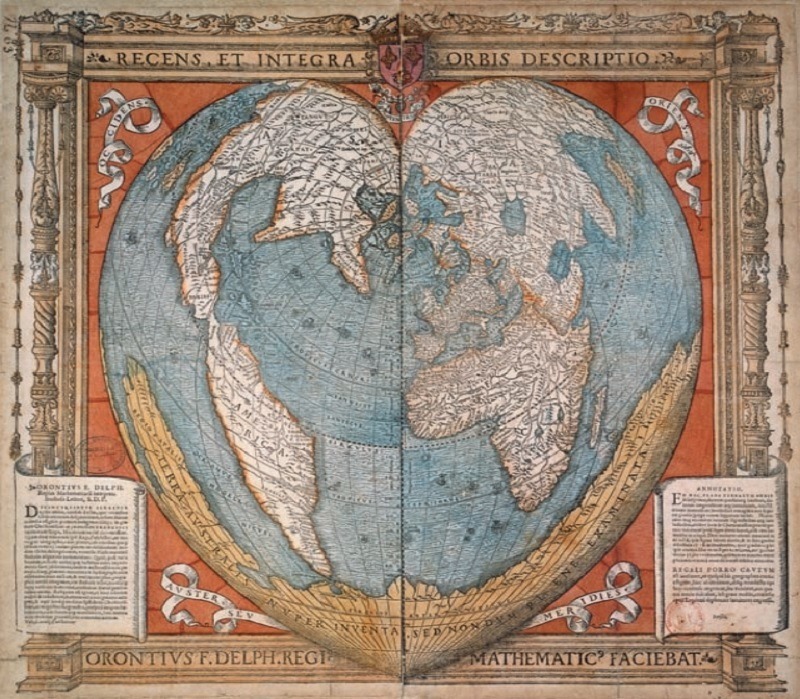
If you head over to this page, then look in the upper left, you will see links to three volumes (available in a free PDF format). My suggestion would be to look at the gallery of color illustrations for each book, links to which you’ll find below. The image above, appearing in Vol. 2, dates back to 1534. It was created by Oronce Fine, the first chair of mathematics in the Collège Royal (aka the Collège de France), and it features the world mapped in the shape of a heart. Pretty great.
Note: An earlier version of this post appeared on our site in August, 2015.
If you would like to sign up for Open Culture’s free email newsletter, please find it here. It’s a great way to see our new posts, all bundled in one email, each day.
If you would like to support the mission of Open Culture, consider making a donation to our site. It’s hard to rely 100% on ads, and your contributions will help us continue providing the best free cultural and educational materials to learners everywhere. You can contribute through PayPal, Patreon, and Venmo (@openculture). Thanks!
You can’t understand human culture in the 21st century without understanding American culture, and as anyone who’s spent time in most any major U.S. city knows, you certainly can’t understand American culture without understanding Latino culture. I write this while traveling in Los Angeles, a city that makes that point with particularly impressive force, but just a few moments with an overview of Latino art will underscore the vitality it has provided America, and thus the world. You could do little better for such an overview than the Google Cultural Institute’s brand new Latino Cultures in the U.S.project, a sizable free digital archive of Latino art and artifacts of Latino history.
Forbes’ Veronica Villafañe quotes Google and Youtube Head of Hispanic Communications Jesús García as describing the archive as “a labor of love for many Googlers and partner institutions. It was a project that was more than a year in the making and took a small army to help digitize the 2,500 new artworks and curate 69 new exhibits.”
As a whole it offers “over 4,300 archives and artworks — including Diego Rivera murals — related to the Latino experience in the U.S., multimedia exhibits in English and Spanish and virtual tours of historic sites, as well as profiles of key Latino figures, such as Cesar Chavez, Dolores Huerta and Supreme Court Justice Sonia Sotomayor.”
Google Head of Latino Community Engagement Laura Marquez notes that it also allows you to “visit some of the most vibrant neighborhoods in the U.S. — the homes to and centers of Latino culture— by way of historic photographs or unmissable locations on Google Street View, all from your phone.” You’ll also find “ultra-high resolution images of iconic Latino murals, such as Diego Rivera’s Detroit Industryfrom the Detroit Institute of Arts.” Using the formidable exploratory platform of Google Earth, the project has also created a whole Latino Murals in the U.S. section, from Rivera’s work in Detroit to José Clemente Orozco’s Prometheus in California to the Miami Artisans’ Freedom Tower mural at Miami Dade College.
Based in Seoul, Colin Marshall writes and broadcasts on cities and culture. His projects include the book The Stateless City: a Walk through 21st-Century Los Angeles and the video series The City in Cinema. Follow him on Twitter at @colinmarshall or on Facebook.
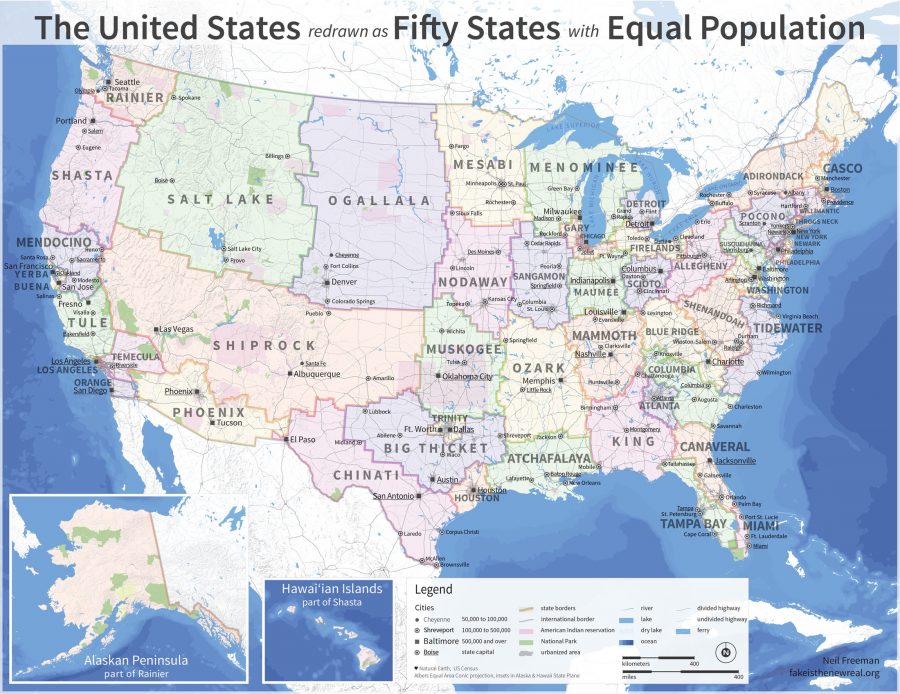
In the U.S., recent electoral events with which we’re all quite familiar have prompted one particular radical re-evaluation of the political system, among many others: we find everyone from high-profile Constitutional scholars to anonymous commenters engaged in debates about the necessity, or democratic legitimacy, of the Electoral College. While the debate may not be new, it has reached an urgent intensity, and happens to occur at a time when everything seems up for grabs. When Neil Freeman proposed redrawing state borders on his presciently-named design site Fake is the New Real back in 2012, he created the map above (view it in a larger format here) to evenly distribute the country’s population. He did so with the disclaimer, “this is an art project, not a serious proposal.”
The idea might get a more serious reception these days. Nonetheless, the inertia of tradition hasn’t lessened any. Not only is it totally unlikely that states would ever be redrawn and renamed, but the Electoral College is also a founding institution, emerging at the first Constitutional Convention when James Madison first proposed it in 1787. Since then, PBS’s Kamala Kelkar wrote on November 6th, 2016, “the Electoral College system has cost four candidates the race after they received the popular vote.” Two days later that number went up to five.
Still, whether one deems it necessary, superfluous, or deeply pernicious, it’s hardly controversial to note that this electing body comes from an era so unlike our own as to be unrecognizable. A time when, as some founders argued, writes Akhil Reed Amar at Time, “ordinary Americans across a vast continent [lacked] sufficient information to choose directly and intelligently among leading presidential candidates.” This might still be the case for various reasons. But putting aside manufactured filter bubbles and vast disinformation campaigns, most Americans now have instant access, if they want it, to more information than they know what to do with.
When we look at the primary sources, we find the actual reason for the Electoral College: slavery. Madison, notes Kelkar, “now known as the ‘Father of the Constitution,’” was a slaveholding Virginian who worried vocally that Northern states would have a decided advantage, since upwards of 40% of the population in Southern states consisted of enslaved people, who, of course, would not be casting votes. Madison’s proposition included the infamous and dehumanizing “three-fifths compromise,” which historian Paul Finkelman argues enabled Thomas Jefferson to win over John Adams in 1800.
Despite this history, most people are taught that the system arose solely to “balance the interests,” Amar writes, “of high-population and low-population states.” This sounds like a politically neutral intention. But Freeman doesn’t question the legitimacy of the Electoral College, calling it “a time-honored, logical system” that he thinks should be preserved. And yet, he writes, “it’s obvious that reforms are needed.”
“The fundamental problem of the electoral college,” Freeman writes, “is that the states of the United States are too disparate in size and influence. The largest state is 66 times as populous as the smallest and has 18 times as many electoral votes. This increases the chance for Electoral College results that don’t match the popular vote.” This is hardly the only issue. But is Freeman’s proposal a more stable solution to major flaws in U.S. national elections than simply scrapping the Electoral College altogether? He makes the following argument, in a series of bullet-pointed advantages. His map:
Preserves the historic structure and function of the Electoral College.
Ends the over-representation of small states and under-representation of large states in presidential voting and in the US Senate by eliminating small and large states.
Political boundaries more closely follow economic patterns, since many states are more centered on one or two metro areas.
Ends varying representation in the House. Currently, the population of House districts ranges from 528,000 to 924,000. After this reform, every House seat would represent districts of the same size. (Since the current size of the House isn’t divisible by 50, the numbers of seats should be increased to 450 or 500.)
States could be redistricted after each census — just like House seats are distributed now.
Freeman based the map–featuring new states like “Mesabi,” “Ogallala,” “Big Thicket,” “Chinati,” and “King”–on data from the 2010 Census, which, incidentally, actually did change the distribution of electors in 2012. The Census “records a population of 308,745,538 for the United States,” he notes, “which this map divides into 50 states, each with a population of about 6,175,000.”
He does seem to downplay the disadvantages, listing only two concerns about duplicated county names and a “shift in state laws and procedures.” Freeman doesn’t mention the high likelihood of civil war or widespread social unrest if such a massive redistribution of the country’s state populations were ever attempted. Given the examples of pitched legal battle fought daily over congressional redistricting of gerrymandered states, it’s also probable nothing like this plan would ever make it through the courts. Considered as an “art project” or thought experiment in civics, however, who knows? It just might work….
We're hoping to rely on loyal readers, rather than erratic ads. Please click the Donate button and support Open Culture. You can use Paypal, Venmo, Patreon, even Crypto! We thank you!
Open Culture scours the web for the best educational media. We find the free courses and audio books you need, the language lessons & educational videos you want, and plenty of enlightenment in between.