What happens when a male android loves a female android VERY much, and they nurse human embryos together on a distant planet after fleeing from war-torn Earth? Why the female android flies and makes a bunch of people explode with her eyes, that’s what happens! …In the first episode of this bonkers HBO Max series by Aaron Guzikowski (with notable assistance from Ridley Scott of Alien and Blade Runner fame).
Your hosts Brian Hirt, Erica Spyres, and Mark Linsenmayer reflect on how much we’re supposed to understand, what if any character we’re supposed to identify with, whether the imagery is just TOO heavy-handed, and how this show compares with related sci-fi like Westworld or post-apocalyptic shows like The Walking Dead. Beware: Spoilers abound in this one, so you might want to watch the show, or just let us reveal its weirdness to you.
Brian Eno may not have invented ambient music, but he did give it a name. What better to call an album like his 1978 Music for Airports, whose slowly shifting pieces forego not just melody but all then-accepted methods of composition and performance? The result, as its title suggests, is meant not to occupy the intention of the listener but to color the atmosphere of a space. This marked one evolutionary step for an idea Eno first essayed in 1975’s Discreet Music, issued on his own label Obscure Records in an era when much of the music people listened to was anything but discreet. Recording technology first made ambient music possible; by the mid-1980s, video technology had developed to the point that it could possess a visual dimension as well.
Just as Eno’s ambient music wasn’t made for listening, Eno’s “video paintings,” as he called them, weren’t made for viewing. 1981’s Mistaken Memories of Medieval Manhattan, previously featured here on Open Culture, captures the urban landscape outside from Eno’s New York window — ironically, with a portrait orientation, so that any TV displaying it had to be turned on its side.
Thursday Afternoon, the next in the series, looks not to the built environment but that other traditional subject of painting, the female form: specifically that of Eno’s friend, photographer Christine Alicino. Here video making possible something truly new, with no artistic connection to, as Eno put it, “Sting’s new rock video” or “boring, grimy ‘Video Art.’ ”
But just like a Hollywood movie, Thursday Afternoon had an eponymous soundtrack album. Released in 1985, it cut the 80-minute video painting’s ambient score down to an unbroken track of nearly 61 minutes, a length made possible by the recently introduced Compact Disc. “Played” on an acoustic piano and synthesizers, the music shifts subtly in texture throughout the hour, creating a sonic environment that many have found highly congenial for working, thinking, and relaxing. I myself have listened to it hundreds of times over the past twenty years, and in the form of a Youtube video painting made by fan Jonathan Jolly, it’s racked up more than four million views. The color-treated time-lapse footage of passing clouds fits right in with the spirit of the music, and it certainly seems to do the trick for the video’s commenters, grateful as they are for reduced anxieties, recovered memories, increased focus, and even altered consciousness.
Based in Seoul, Colin Marshall writes and broadcasts on cities, language, and culture. His projects include the Substack newsletterBooks on Cities, the book The Stateless City: a Walk through 21st-Century Los Angeles and the video series The City in Cinema. Follow him on Twitter at @colinmarshall, on Facebook, or on Instagram.
Experimental director and animator Paul Bush’s 2015 short film The Five-Minute Museum, above, is the dizzying antidote to standing, footsore, in front of a vitrine crowded with Ancient Greek amphoras or exquisitely crafted pocket watches and wondering, not about history, culture or the nature of time, but whether you can justify spending $15 for an underwhelming cheese and tomato sandwich in the museum cafe.
It’s a breakneck stop motion journey through the history of civilization via six museum collections—three in London and three in Switzerland.
Presented primarily as stills that flash by at a rate of 24 per second, Bush groups like objects together, “thereby allowing the triumphs of human endeavor to be seen even in far corners of the land, by the bedridden, the infirm and the lazy.”
His sense of humor asserts itself the minute an assortment of ancient shards appear to render themselves into not just a state of wholeness, but an entire up close society in close-up. It doesn’t take long for these vessels’ clashing of warriors to give way to a composite portrait of idle youth, whose flirtations are stoked by a number of manic pipers in rapid succession, and Andy Cowton’s original music and sound design.
It’s a shock when Bush slows down and pulls back to show the source objects in their museum cases, quiet as a tomb, the sort of display most visitors blow past en route to something sexier, like a dinosaur or a blockbuster exhibit requiring timed entry tickets.
Other highlights include a lively assortments of guns, hats, chairs, and plastic toys.
If you start feeling overwhelmed by the visual intensity, don’t worry. Bush builds in a bit of a breather once you hit the clocks, the bulk of which presumably hail from the Beyer Clock and Watch Museum in Zurich.
The ingenious animated short was 10 years in the making, a fact the artist modestly downplays:
It’s very simple. Simple story, a simple technique and that’s what I like. Poetry should be a little bit stupid. This is what Pushkin says, and I try and make my films a little bit stupid as well.
The history books say that there were three Japanese filmmakers to emerge in the 1950s – Kenji Mizoguchi, Yasujiro Ozu and Akira Kurosawa. Never mind that Mizoguchi and Ozu made many of their best movies in the 1930s. Never mind that masterful, innovative directors like Mikio Naruse and Keisuke Kinoshita have been unfairly overshadowed by the brilliance of these three greats.
Mizoguchi was an early modernist who by the end of his career made meditative movies about how women suffer at the hands of men. His masterpieces like Ugetsu and Sansho Dayu feel like Buddhist scroll paintings come to life. Ozu, “the most Japanese” of all filmmakers, made quietly moving dramas about families, like Tokyo Story, but did so in a way that discarded such Hollywood principles as continuity editing and the 180 degree rule. Ozu was a quiet radical.
Compared to Ozu and Mizoguchi, Kurosawa’s movies are noisy, masculine and vital. Unlike Ozu, he didn’t challenge Hollywood film form but improved on it. Born roughly a decade after the other two filmmakers, Kurosawa spent his youth watching Western movies, absorbing the lessons of his cinematic heroes like John Ford, Howard Hawks and Frank Capra. At his creative height, in the 1950s and 60s, Kurosawa produced masterpiece after masterpiece. Hollywood would remake or reference Kurosawa constantly in the years that followed but few of those films had Kurosawa’s inventiveness.
Tony Zhou, who has made a career of dissecting movies in his excellent video series Every Frame a Picture,argues that the key to Kurosawa is movement. “A Kurosawa movie moves like no one else’s,” Zhou notes in his video. “Each one is a master class in different types of motion and also ways to combine them.”
Kurosawa had an innate understanding that there is inherent drama in the wind blowing in the trees. Like Andrei Tarkovsky and later Terrence Malick, he liked to place human drama squarely in the realm of nature. The rain falls, a fire rages and that movement makes an image compelling. He understood that graphic considerations outweighed psychological ones – he simplified and exaggerated a character’s movement with the frame to make character traits and emotions easy to register for the audience. His camera movements were clear, motivated and fluid. Zhou compares Seven Samurai with The Avengers. You might have thought that The Avengers was uninspired and soulless but after watching Zhou’s video, you’ll understand why – aside from the silly plot and characters – the movie was uninspired and soulless. The piece should be required viewing for filmmakers everywhere. You can watch it above.
And below you can see another video Zhou did on Kurosawa, focusing on his 1960 movie The Bad Sleep Well.
Note: This post originally appeared on our site in 2015.
Jonathan Crow is a Los Angeles-based writer and filmmaker whose work has appeared in Yahoo!, The Hollywood Reporter, and other publications. You can follow him at @jonccrow. And check out his blog Veeptopus, featuring lots of pictures of badgers and even more pictures of vice presidents with octopuses on their heads. The Veeptopus store is here.
Australian singer-songwriter Peter Milton Walsh started The Apartments in the late ’70s, and our interview begins with a snippet of the opening track from, “Help” from his 1979 Return of the Hypnotist EP. He also around this time played with the Go Betweens and other groups, and released The Apartments’ first LP, The Evening Visits…and Stays for Years, in 1985, a heart-wrenching affair which made it onto the New Music Express “albums of the year” list. This led to some singles, one of which–“The Shyest Time”–made it onto the soundtrack of the 1987 John Hughes film Some Kind of Wonderful.
The band had all the moody jangling of early REM, the Smiths, and The Psychedelic Furs, with a unique front man, strong melodies, and the mood of the moment? So why (presumably) have you not heard of this group? Their 1993 album drift (the first full album since their debut) was apparently a big hit in France, but none of their work sold particularly well in the English-speaking world. As Peter reveals on this episode of Nakedly Examined Music, he didn’t much like high-pressure studio recording, resulting in whole eras of his songwriting left largely undocumented.
Personal tragedy also derailed his career from the late ’90s until the late ’00s when he returned to live performing and eventually released a couple of really devastating albums, including 2015’s No Song, No Spell, No Madrigal and the newly released In and Out of the Light.
On each episode of the Nakedly Examined Music Podcast, host Mark Linsenmayer plays four of an artist’s songs in full and discusses them with the songwriter at length. Here Mark and Peter discuss the structure and recording of two songs off the new album: “What’s Beauty to Do?” and “Where You Used to Be.” They then look back to the middle of The Apartments’ ’90s output with “Sunset Hotel” from Fête Foraine (1996), a song capturing his observations of a group of heroin addicts. Finally you’ll hear “Looking for Another Town” from that 2015 come-back album.
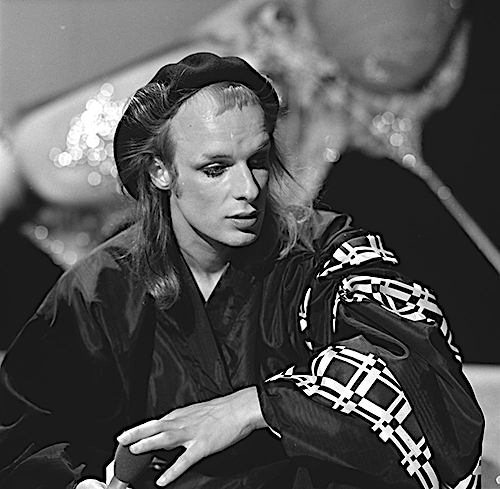
We’ve seen bits and pieces of the 1973 mini-docEno over the years, as it is such a rare and wonderful glimpse into the very beginnings of Brian Eno’s career, and being the go-to footage for any doc about the man. Over the course of the film, we see Eno assembling/recording “The Paw-Paw Negro Blowtorch”, the second track on his debut album Here Come the Warm Jets. Right from the beginning, we see that Eno was true to his word and using the recording studio as an instrument. With Derek Chandler by his side engineering, we see Eno layering one sound after another, removing others, much like a painter. If you know the track, you notice it take form and shape, but there are things that would later be “painted over,” like a sitar solo (!) where the wigged out oscillator solo now sits. Thefilm opens with Eno playing an arpeggiated bass line on a piano that also doesn’t make it into the song. (The bass instead is supplied by Busta Jones, seen playing a two note riff with a lot of feeling.) Chris Spedding stops by to play “something purely Duane Eddy” on his guitar, asking Eno “you’ll treat it later?” “Probably,” says Eno. (More like definitely).
“I have attempted to replace the element of skill considered necessary in music with the element of judgement,” Eno says early in the film, and a listen to the finished track reveals that judgement. And what do you know–the sitar *is* there, as are the piano lines, like a space in the canvas where the original sketch can be seen.
We also get an amazing, extended glimpse at Eno’s notebooks, which have popped up in various books on Eno, including More Dark Than Shark and Visual Music. From the profane to the profound, from drawings of genitals to detailed analog system diagrams, it’s all here, and as far as we know the notebooks, which he started at 14, continue to this day.
Thefilm also makes the case for a later Eno theory, that of the “scenius,” which he once described thus: “‘Scenius stands for the intelligence and the intuition of a whole cultural scene. It is the communal form of the concept of the genius.’”
For Eno in 1973, the scenius is the Portobello Road area where he can browse thrift stores, run into friends, and check in on designer/girlfriend Carol McNicoll, who made all Eno’s glam outfits. And he also talks about how Robert Fripp just stopped by on his way home one night and recorded side one of their team-up album No Pussyfooting.
All in all a terrific look into the beginning of an artistic legacy, and a film that desperately needs a pristine new transfer. (And no, you will never convince me that the Portsmouth Sinfonia is any good.)
Ted Mills is a freelance writer on the arts who currently hosts the Notes from the Shed podcast and is the producer of KCRW’s Curious Coast. You can also follow him on Twitter at @tedmills, and/or watch his films here.
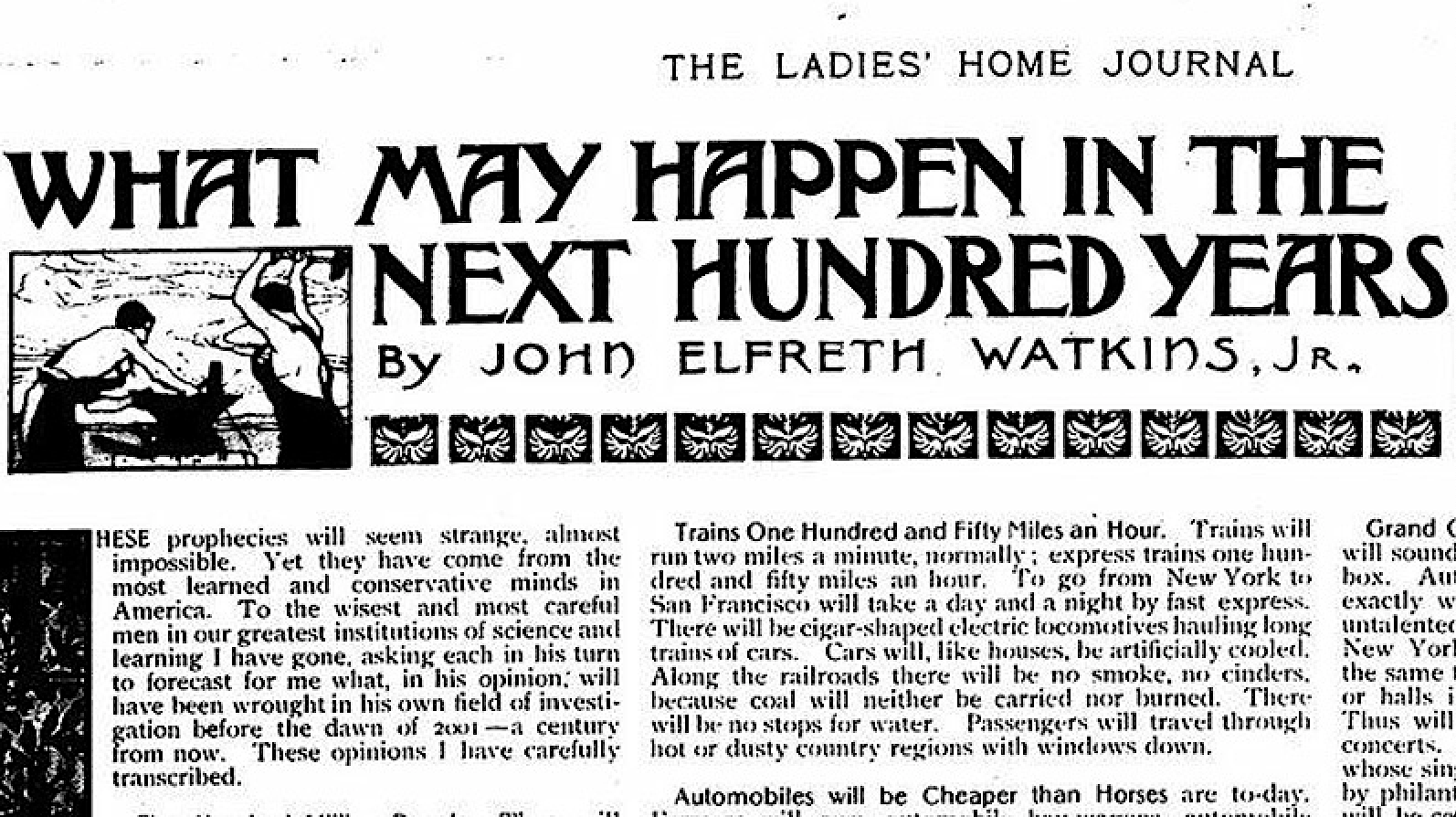
Just shy of 120 years ago, “the wisest and most careful men in our greatest institutions of science and learning” told America what would change by the far-flung dawn of 2001. C, X and Q gone from the alphabet; “Air-Ships” in the skies, strictly for military purposes (passenger traffic being handled by “fast electric ships”); strawberries as large as apples; university education “free to every man and woman”: these are just a few of the details of life in the coming 21st century. We for whom the year 2001 is now firmly in the past will get a laugh out of all this. But as with any set of predictions, amid the misses come partial hits. We don’t get our “hot and cold air from spigots,” but we do get it from air-conditioning and heating systems. We don’t send photographs across the world by telegraph, but the device we all keep in our pockets does the job well enough.
Written by a civil engineer named John Elfreth Watkins, Jr. (presumably the son of Smithsonian Curator of Mechanical Technology John Elfreth Watkins, Sr.), “What May Happen in the Next Hundred Years” ran in the December 1900 issue of that renowned futurological organ Ladies’ Home Journal. You can hear it read aloud, and see it accompanied by historical film clips, in the Voices of the Past video above.
A few years ago the piece came back into circulation on the internet (which goes unmentioned by its experts, more concerned as they were with proliferation of telephone lines and pneumatic tubes) and its predictions were put to the test. At the Saturday Evening Post, Jeff Nilsson gives Watkins (once a Post contributor himself) points for less outlandish prophecies, such as a rise in humanity’s life expectancy and average height.
Watkins describes his sources as “the most learned and conservative minds in America.” In some areas they were too conservative: they foresee “Trains One Hundred and Fifty Miles an Hour,” but as Nilsson notes, today’s “high-speed trains are traveling over 300 mph. Just not in the United States.” Americans did lose their streetcars as predicted, but not due to their replacement by subways and moving sidewalks — and what would these experts make of the streetcar’s 21st-century renaissance? When Watkins writes that “grand opera will be telephoned to private homes,” we may think of the Met’s current COVID-prompted streaming, a scenario that would have occurred to few in a world yet to experience even the Spanish flu pandemic of 1918. But then, the future’s defining quality has always been its very unknowability: consider how much has come to pass since we last posted about these predictions here on Open Culture — not least the end of Ladies Home Journal itself.
Based in Seoul, Colin Marshall writes and broadcasts on cities, language, and culture. His projects include the Substack newsletterBooks on Cities, the book The Stateless City: a Walk through 21st-Century Los Angeles and the video series The City in Cinema. Follow him on Twitter at @colinmarshall, on Facebook, or on Instagram.
There is no rock and roll without the blues, as we know, but the relationship between the two is not so straightforward as a one-to-one influence. Blues forms, scales, and melodies are interwoven and interlaced throughout rock in a complex way well represented by the complexity of a circuit board, such as one powering an early guitar amplifier that doubled as a blues harp amp. To understand the relationship, we must understand the blues as a multifaceted phenomenon; at various times in rock history, artists have gravitated more toward acoustic Delta blues, or Memphis blues, or Chicago electric blues, or R&B, all of which themselves have continued to evolve and change.
The influence is persistent and ongoing even in periods after the 70s when radio became largely segregated, and artists moved away from strictly blues forms and explored the seemingly non-blues textures of soft rock, prog, and synth-pop—all genres that have still incorporated the blues in one way or another. As rock and roll expanded, spread out in new, non-blues directions, rock conventions themselves became a drag on the forward movement of the form. But the blues always returns.
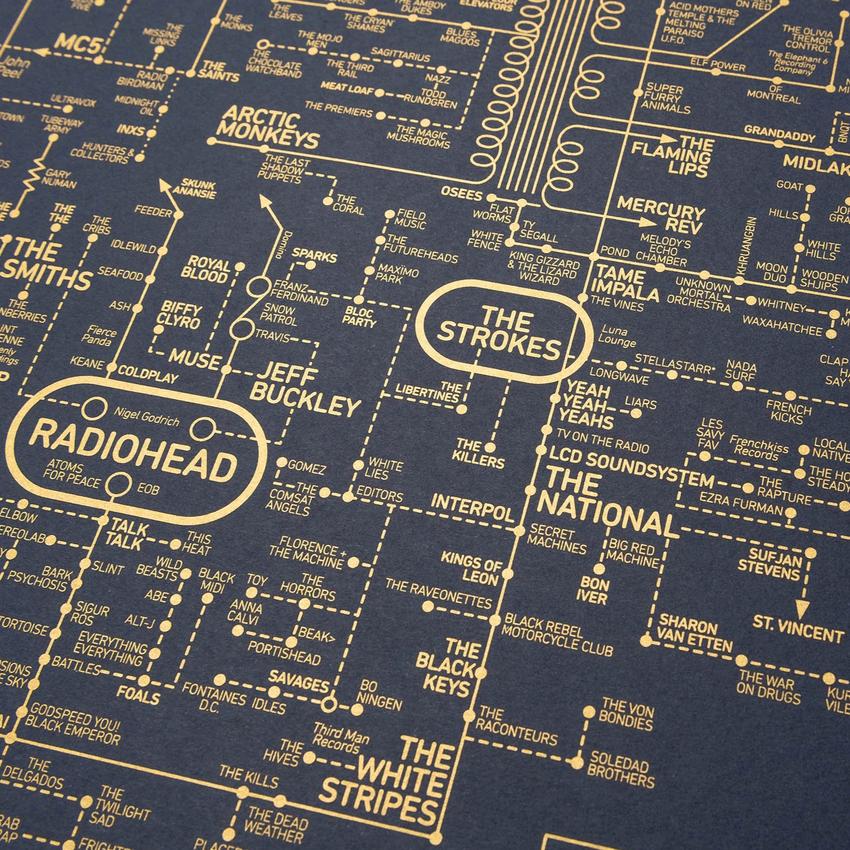
Radiohead ditched rock altogether and sit comfortably next to post-rock bands like Talk Talk, Bark Psychosis, and Godspeed You! Black Emperor. At the same time, the garage rock revivalism of The Strokes and The White Stripes made sure guitars and 12 bars stayed relevant, as they have, decade after decade, in the raw forms of punk and hardcore or in spaced-out psychedelia. The noisiest noise rock or the harshest and most extreme metal may never be that far away from Bessie Smith, Sister Rosetta Tharpe, Robert Johnson, or Lead Belly.
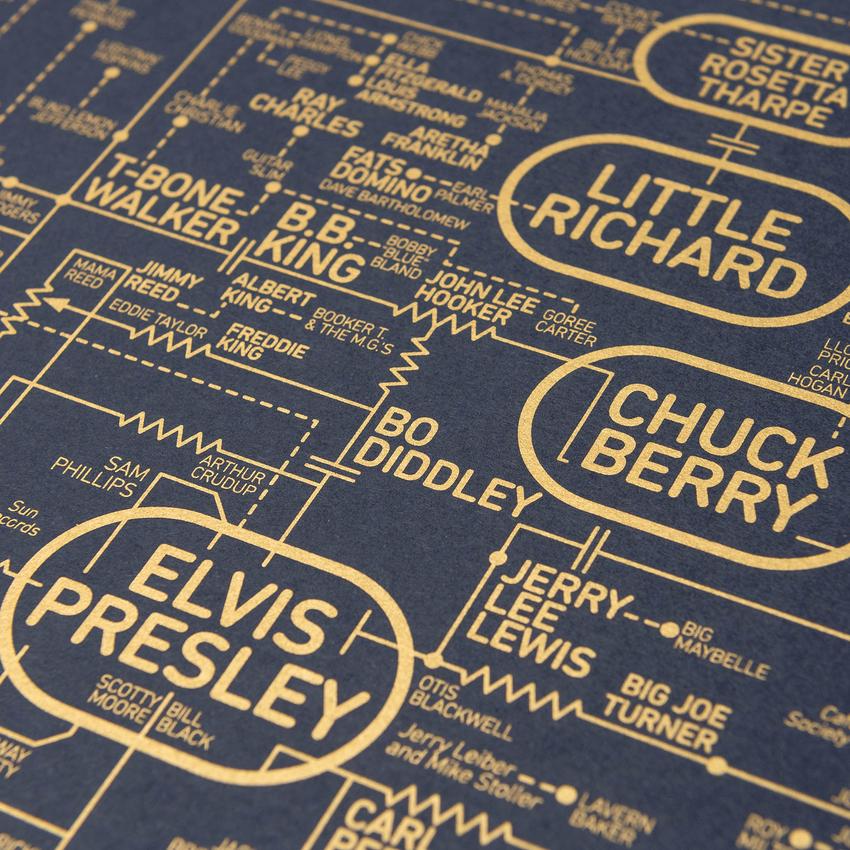
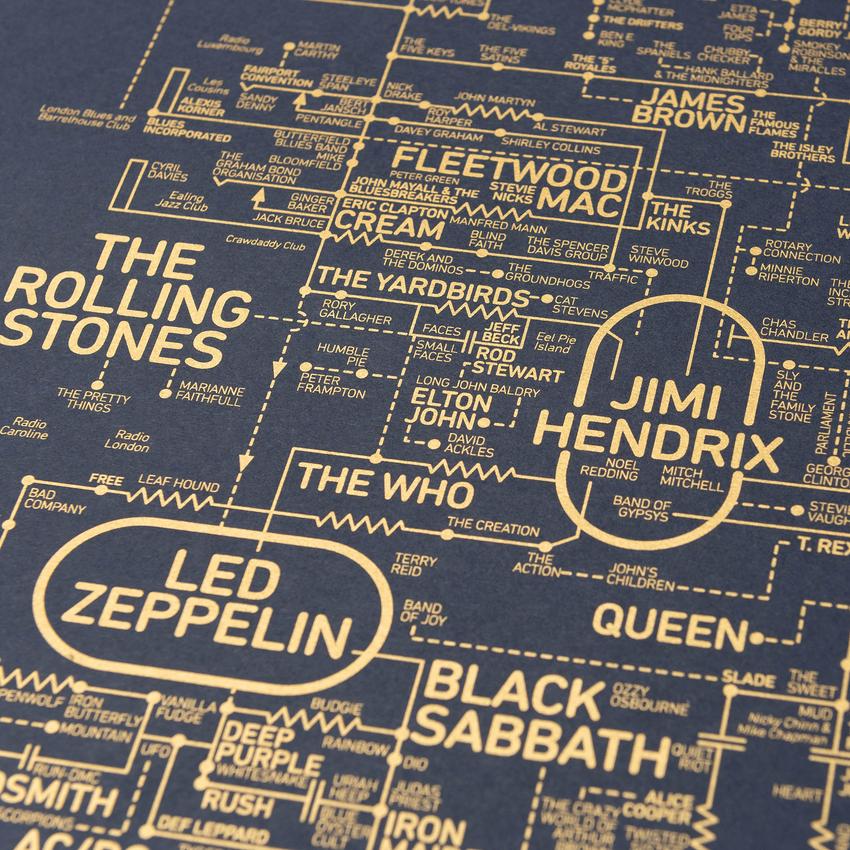
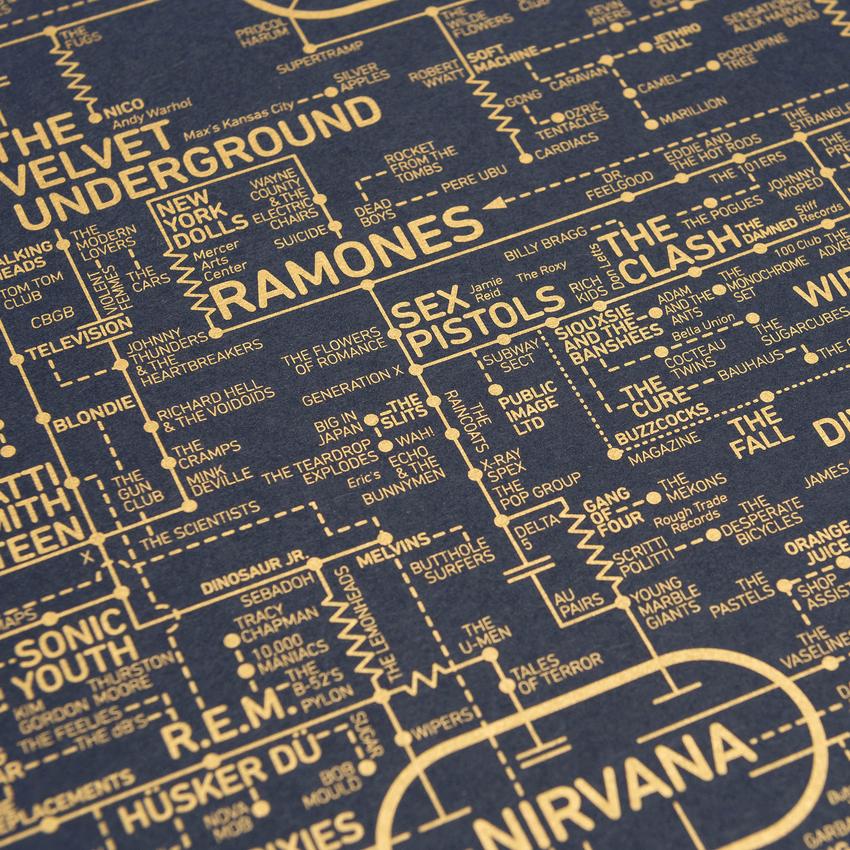
You’ll find this rock and roll circuit board in design house Dorothy’s Rock and Roll Love Blueprint, a history of rock in guitar amp schematic form (ostensibly), showcasing “1400 musicians, artists, songwriters and producers who have been pivotal to the evolution of the sprawling genre that is rock music.”
Like Dorothy’s other schematic pop music histories—alternative music on a transistor radio circuit and hip hop mapped on a turntable diagram—this one organizes its genres, artists, and periods around a series of transistors, capacitors, and valves with big names inside them like Bob Dylan and The Beatles, radiating influence, like electricity, outward.
In many cases, it’s hard to say why some bands and artists get more emphasis than others. Are The Byrds really more influential than The Beach Boys or David Bowie? While it might be possible to quantify such things—and any good technician would insist on getting the values right (or our amp might explode), the Rock and Roll Love Blueprint is a fun visual metaphor that should encourage interest in cultural figures old and new rather than scorching debates about whose name should be a few millimeters larger and to the left.
We begin with W.H. Handy, the father of the blues, and end, on the right side, with the guitar rock of Wolf Alice and The 1975. In-between, the blueprint seems to hit on just about every major or minor-but-influential figure you might name. See the full blueprint, in zoomable high-resolution, and order prints for yourself at Dorothy.
We're hoping to rely on loyal readers, rather than erratic ads. Please click the Donate button and support Open Culture. You can use Paypal, Venmo, Patreon, even Crypto! We thank you!
Open Culture scours the web for the best educational media. We find the free courses and audio books you need, the language lessons & educational videos you want, and plenty of enlightenment in between.