Note: The orchestra plans to post a new video every Sunday on their YouTube channel, and a full (pay-per-view) concert every month available on their website.
If you would like to sign up for Open Culture’s free email newsletter, please find it here. It’s a great way to see our new posts, all bundled in one email, each day.
If you would like to support the mission of Open Culture, consider making a donation to our site. It’s hard to rely 100% on ads, and your contributions will help us continue providing the best free cultural and educational materials to learners everywhere. You can contribute through PayPal, Patreon, and Venmo (@openculture). Thanks!
It’s a little miraculous that so much European art and architecture survives, given how often the continent has erupted into wars that burned down nearly everything else. The Ghent Altarpiece, or Adoration of the Lamb, may be the most famous case in point. It is also, by far, the most stolen work of art in history, the victim of 13 different crimes over the past 600 years. Completed in 1432 by Flemish painter Jan van Eyck, and considered one of the world’s greatest treasures, the huge, multi-paneled painting (a polyptych) has weathered it all.
The altarpiece has “almost been destroyed in a fire,” Noah Charney writes at The Guardian, “was nearly burned by rioting Calvinists, it’s been forged, pillaged, dismembered, censored, stolen by Napoleon, hunted in the first world war, sold by a renegade cleric, then stolen repeatedly during the second world war…. Göring wanted it for his private collection, Hitler as the centrepiece of his citywide super-museum.”
In the short TED-Ed lesson above, Charney, author of the book Stealing the Mystic Lamb: The True Story of the World’s Most Coveted Masterpiece, sketches the history of the final theft in 1934 by the Nazis of a lower panel that has never been recovered. “This may sound very silly,” Charney tells NPR, “but in fact, the Nazis and Hitler in particular were absolutely convinced that the occult and the supernatural was real.” They thought of the Ghent altarpiece as a map to the relics of Christ’s crucifixion.
The case of the missing panel remains open to this day “and new leads are followed all the time,” Charney writes. It is a story full of “many bizarre twists,” and just one of many in the altarpiece’s long history. But why? What is it about the Ghent Altarpiece, besides occult fascination, that has drawn so much unwanted attention? Eleven feet high by 15 feet wide and made up of 24 panels (originally), the work “redefined art and became instantly famous,” notes New Statesman’s Michael Prodger. In his masterpiece, Jan van Eyck, who took over for his older brother Hubert, “created a series of firsts in art.”
The Ghent altarpiece is “the first realistic interior, the first genuine landscape, the first proper cityscape, the first tangible nudes, the first lifelike Renaissance portraits. [Van Eyck took oil paint to unprecedented levels of sophistication—with glazes and transparent layers giving depth and undreamed of effects of light—to match his preternatural powers of observation.” In the video series above and below by art historians Beth Harris and Steven Zucker, you can learn much more about the qualities that have made the Ghent Altarpiece irresistible.
During the early days of the pandemic, the Talking Sopranos podcast (previously discussed on OC here) got underway. Hosted by Michael Imperioli (Christopher Moltisanti) and Steve Schirripa (Bobby Bacala), the podcast revisits every episode of HBO’s groundbreaking TV series. It starts naturally with the 1999 pilot and then moves forward sequentially. And each installment features a guest (usually an actor, writer, or director who contributed to the show), followed by a scene-by-scene breakdown of a complete Sopranos episode. (They covered the celebrated “Pine Barrens” episode a few weeks back.) Past guests have included Edie Falco, Aida Turturro, Steve Buscemi, Lorraine Bracco and more.
Now almost halfway through the entire series, Imperioli and Schirripa spent 90 minutes this week with Sopranos’ creator David Chase. In a rare interview (watch above), Chase talks about his creative ambitions for the show, the real people (friends and acquaintances) he modeled characters on, his sometimes friction-filled relationship with James Gandolfini, and the upcoming Sopranos film.
If you would like to sign up for Open Culture’s free email newsletter, please find it here. It’s a great way to see our new posts, all bundled in one email, each day.
If you would like to support the mission of Open Culture, consider making a donation to our site. It’s hard to rely 100% on ads, and your contributions will help us continue providing the best free cultural and educational materials to learners everywhere. You can contribute through PayPal, Patreon, and Venmo (@openculture). Thanks!
More than a few of us have a reading goal for 2021: a book a week, say. Some of us may have had the idea planted in our heads long ago by Carl Sagan, in his capacity as creator and host of the PBS series Cosmos: A Personal Voyage. “If I were to read a book a week for my entire adult lifetime,” he says in the clip above, “I would have read maybe a few thousand books. No more.” This is part of a longer monologue set in a library, a background that provides Sagan an ideal visual reference for how many volumes that is. Even seen as a portion of just the shelf space he stands by, it doesn’t look like a terribly impressive amount. Indeed, it makes up “only tenth of a percent or so of the total number of books in the library.”
The trick, Sagan adds, “is to know which books to read.” He himself got started addressing this question rather early, having drawn up an ambitious reading list previously featured here on Open Culture while still an undergraduate at the University of Chicago.
Sagan included (see the list here) everything from the Bible and Plato’s Republic to André Gide’s The Immoralist and Aldous Huxley’s Young Archimedes to Communication Circuit Fundamentals and Thermodynamics: An Advanced Treatment — those last being course readings, but impressive ones nevertheless. Though Sagan lived an abbreviated life, dying at the age of 62, we can rest assured that he nevertheless got his few thousand books in. Can we do the same?
To gear up for your reading year to come, consider watching this short documentary on the world’s most beautiful bookstores, which recommends daily reading habits that add up to surprisingly many books over a lifetime. But if you choose your books without discernment, as Sagan implies, it doesn’t matter how many you read. Before drawing up your own reading list, have a look at the ones other serious readers, writers, and thinkers have used before: Charles Darwin, for instance, or the many names in our personal reading-list roundup including Neil DeGrasse Tyson, Jorge Luis Borges, Patti Smith, Bill Gates, and David Bowie. Mark Twain also composed a reading list for kids and adults alike, but whatever we take from it, we should enter the new year with one of his famous aphorisms in mind: “The man who does not read good books has no advantage over the man who can’t read them.”
Based in Seoul, Colin Marshall writes and broadcasts on cities, language, and culture. His projects include the Substack newsletterBooks on Cities, the book The Stateless City: a Walk through 21st-Century Los Angeles and the video series The City in Cinema. Follow him on Twitter at @colinmarshall, on Facebook, or on Instagram.
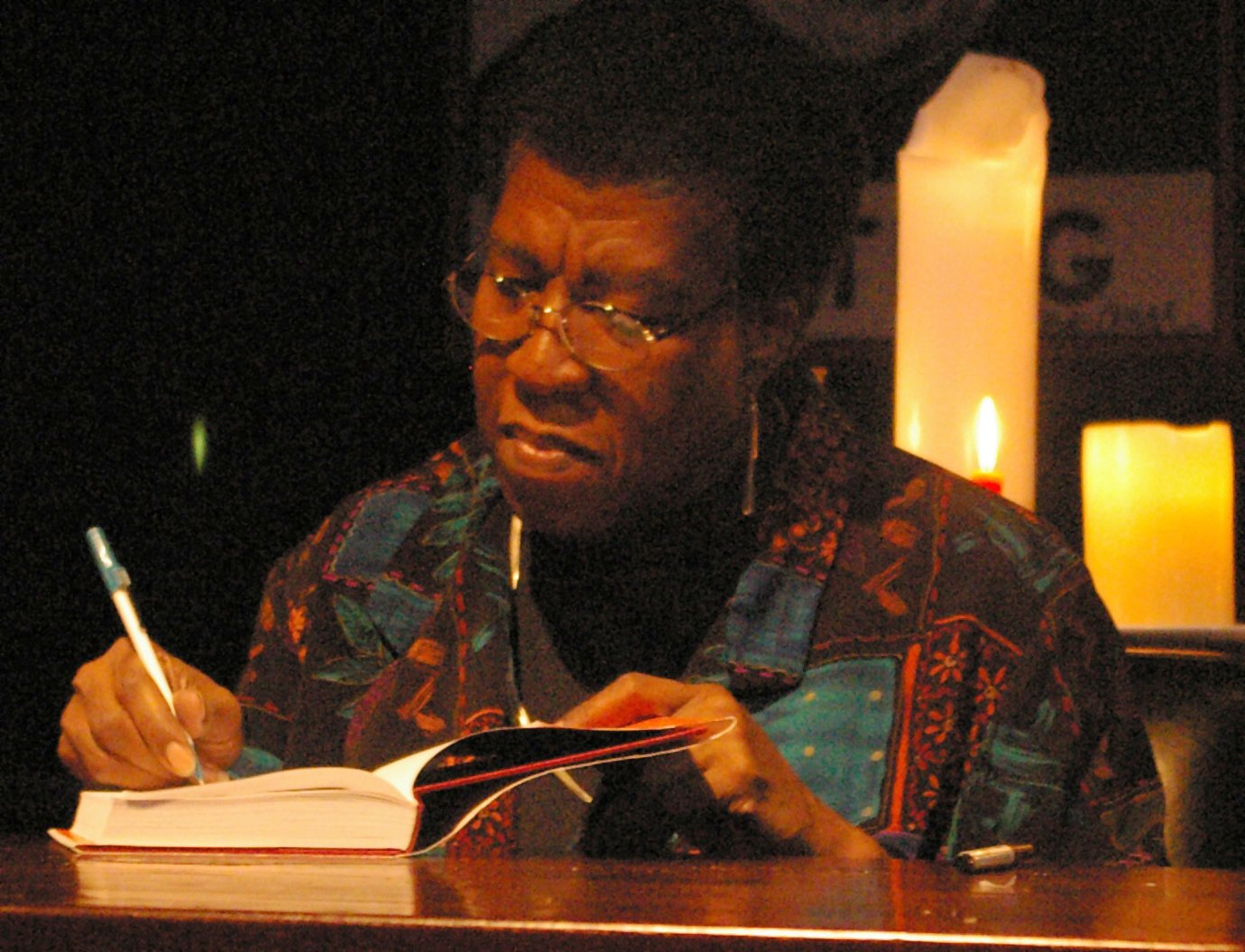
If you, like me, often turn to science fiction to get more clarity about the present, past, and future, then you know you’re in good company with multiple-award-winning sci-fi author Octavia Butler. The novelist cast her gaze over it all, looking into the dark corners of American life and human behavior and drawing out stories that feel both shockingly new and familiar and true.
Sometimes Butler’s truths are hard to hear, especially when we’re living in the midst of a time she foresaw with such seeming accuracy thirty years ago in her Parable novels, two books meant to be the first parts of a trilogy about America’s greed, cruelty, and racism swallowing up its good intentions and inflated self-image.
Parable of the Sower and Parable of the Talents are, as Butler described them, “novels that take place in a near future of increasing drug addiction and illiteracy, marked by the popularity of prisons and the unpopularity of public schools, the vast and growing gap between the rich and everyone else, and the whole nasty family of problems brought on by global warming.”
These problems include the return of debt slavery, a particularly nasty strain of Christian nationalism, and a vague but devastating environmental collapse from which there is no return. But these are also novels about hope: about survival and adaptation and empathy. Butler may have invented the plots of her post-apocalyptic future, but “I didn’t make up the problems,” she once told a student.
Science fiction writers aren’t clairvoyant, they’re just better at making observations and speculations. “All I did was look around at the problems we’re neglecting now and give them about 30 years to grow into full-fledged disasters,” said Butler. A perspective that doesn’t also include the whole of human history is bound to miss the mark, she suggested:
Writing novels about the future doesn’t give me any special ability to foretell the future. But it does encourage me to use our past and present behaviors as guides to the kind of world we seem to be creating. The past, for example, is filled with repeating cycles of strength and weakness, wisdom and stupidity, empire and ashes. To study history is to study humanity. And to try to foretell the future without studying history is like trying to learn to read without bothering to learn the alphabet.
Butler goes on to discuss her method for predicting the future—so to speak—which anyone can learn to do with enough study and insight (that’s the hard part). Thom Dunn at Boing Boing has helpfully broken down her essay’s main points into four concise rules:
Learn from the past
Respect the law of consequences
Be aware of your perspective
Count on the surprises
You can read the full essay here and get to work on your own forecasting abilities. But in order to fully understand Butler’s project, it is essential never to despair. “The one thing that I and my main characters never do when contemplating the future is give up hope,” she writes. In answer to her student’s anguished question, if things are going to get so bad “what’s the answer?” Butler sagely replied, “there isn’t one…. There’s no magic bullet. Instead there are thousands of answers—at least. You can be one of them if you choose to be.”
Walk into a forest. Stand perfectly still. Close your eyes. What do you hear? The sounds of birds, the rustling leaves, yes, yes…. But what’s that? And that? The forest is full of sounds you can’t identify! Curious sounds, far-away sounds, soothing sounds, sounds that are not the churning anxious wheels inside your head when you try to relax….
Experiencing ourselves around trees has several demonstrable benefits, as the science of forest bathing has taught us. Many of these have to do with visual, olfactory, and tactile pleasures. But we must not neglect the natural acoustic system all around us: an immersive experience in full 360-degree sound. Trees’ “vibratory energies reveal humanity’s many connections with forests,” writes David George Haskell at Scientific American.
Forests “are full of song.”
That’s all very well for people who can go outside. But if you’re locked down in a major city, say, or the office, or an ill-advised holiday gathering, and you feel cortisol levels rising, we’ve got you covered. Back in September, we featured Sounds of the Forest, a crowdsourced audio archive gathering sounds from forests all over the world. Now, these clips are streaming at Tree.fm, an online radio station for tree songs in stereo.
Streams rill, frogs hoot, birds caw and squawk in chorus. And then there are the trees, each species possessed of its own voice, Haskell writes:
Gusts of wind sonify plant diversity. Oak’s voice is coarse-grained, throaty; maple’s is sandy and light. These differences have their origins in plant evolution and adaptation. Drought-resistant oak leaves are thicker, tougher than the water-hungry maple. The different sounds of trees on a dry mountain ridge and in a moist forested hollow speak to the particularities of the ecology of each place. Ponderosa pine sings sweetly in the winds of California, its long needles were, John Muir wrote, “finest music” and a “free, wing-like hum”. But in Colorado, pines have evolved shorter, stiffer needles to cope with heavy loads of snow and ice. There, the trees wail as their wiry needles harrow the wind.
Tree.fm “is a tool that gives you instant access to the sounds of the world’s forests,” Beth Skwarecki writes at Lifehacker. Many of those sounds, like the forests that produced them, are endangered, not only from the usual suspects but also the noise pollution of highways and housing developments. Listen to forest songs on repeat or hit “listen to a random forest” and be “transported to Madagascar to listen to some lemurs, or to Ghana to hear some peacefully rushing water, or to Russia, where a bird I’ve never heard of puts on a vocal performance.” This is good medicine. Discover the forest songs that best soothe your nervous system or delight ears at Tree.fm.
Does removing gatekeepers mean a more distributed comic landscape, or does it inevitably end with a small number of comics dominating the world? The Internet means that people can and do judge comics based on very short clips, but also makes it easy to follow the activities of someone you discover that you like.
Tiffany comes not from stand-up but from music theater, and is active in creating character-based comedy and novelty songs for Instagram, YouTube, etc. She joins your hosts Erica Spyres, Mark Linsenmayer, and Brian Hirt to explore the types of short-form humor and viewing habits that grow out of video created for TikTok, Snapchat, and other platforms. What’s the creator’s relation to the audience? Social media blurs the line between constructed bits and extemporized commentary. It’s often reacting to current events, yet stays posted long after. “Going viral” is not typically the result of mere organic sharing or chance, and some comics (and their consultants) have really studied the medium to find out what appeals and how to get the word out.
If you would like to sign up for Open Culture’s free email newsletter, please find it here. It’s a great way to see our new posts, all bundled in one email, each day.
If you would like to support the mission of Open Culture, consider making a donation to our site. It’s hard to rely 100% on ads, and your contributions will help us continue providing the best free cultural and educational materials to learners everywhere. You can contribute through PayPal, Patreon, and Venmo (@openculture). Thanks!
We're hoping to rely on loyal readers, rather than erratic ads. Please click the Donate button and support Open Culture. You can use Paypal, Venmo, Patreon, even Crypto! We thank you!
Open Culture scours the web for the best educational media. We find the free courses and audio books you need, the language lessons & educational videos you want, and plenty of enlightenment in between.