Explaining the Pandemic to My Past Self: A Dark, Comedic Reflection on the Last Few Months

What would hap­pen if I tried to explain what’s hap­pen­ing now to the Jan­u­ary 2020 ver­sion of myself? That’s the ques­tion that Julie Nolke asked and answered in ear­ly April.

Now she’s back with a sequel where she tries to explain the events of June to her April self.

If you would like to sign up for Open Culture’s free email newslet­ter, please find it here. It’s a great way to see our new posts, all bun­dled in one email, each day.

If you would like to sup­port the mis­sion of Open Cul­ture, con­sid­er mak­ing a dona­tion to our site. It’s hard to rely 100% on ads, and your con­tri­bu­tions will help us con­tin­ue pro­vid­ing the best free cul­tur­al and edu­ca­tion­al mate­ri­als to learn­ers every­where. You can con­tribute through Pay­Pal, Patre­on, and Ven­mo (@openculture). Thanks!

Tom Morello Responds to Angry Fans Who Suddenly Realize That Rage Against the Machine’s Music Is Political: “What Music of Mine DIDN’T Contain Political BS?”

I, Danc­ing Bear,” a song by an obscure folk artist who goes by the name Bir­d­engine, begins thus:

There are some things that I just do not care to know

It’s a love­ly lit­tle tune, if maudlin and macabre are your thing, a song one might almost call anti-polit­i­cal. It is the art of solip­sism, denial, an inward­ness that dances over the abyss of pure self, navel gaz­ing for its own sake. It is Kaf­ka-esque, pathet­ic, and hys­ter­i­cal. I love it.

My appre­ci­a­tion for this weird, out­sider New Roman­ti­cism does not entail a belief that art and cul­ture should be “apo­lit­i­cal,” what­ev­er that is.

Or that artists, writ­ers, musi­cians, actors, ath­letes, or whomev­er should shut up about pol­i­tics and stick to what they do best, talk about them­selves.

The idea that artists should avoid pol­i­tics seems so per­va­sive that fans of some of the most bla­tant­ly polit­i­cal, rad­i­cal artists have nev­er noticed the pol­i­tics, because, I guess, they just couldn’t be there.
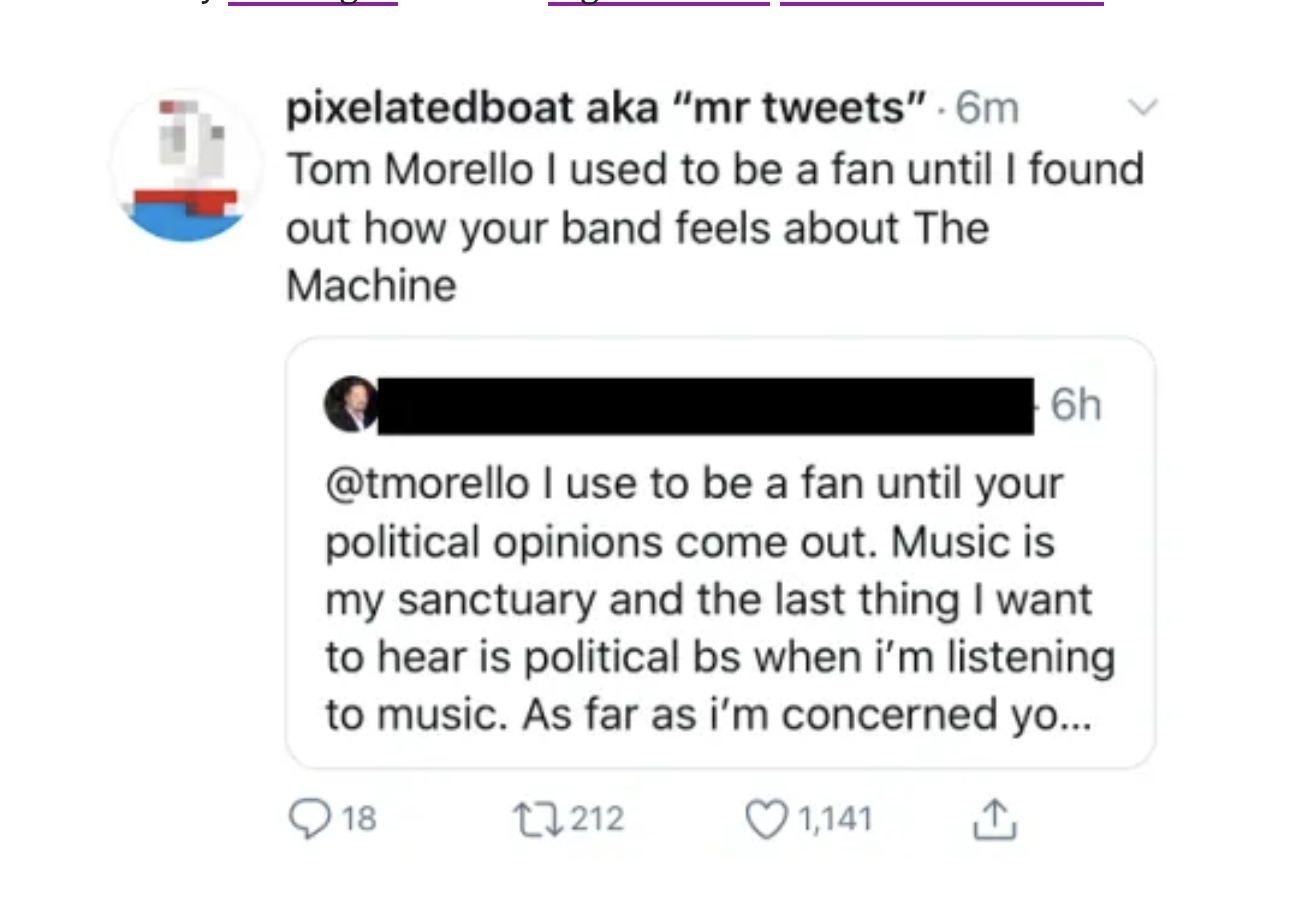
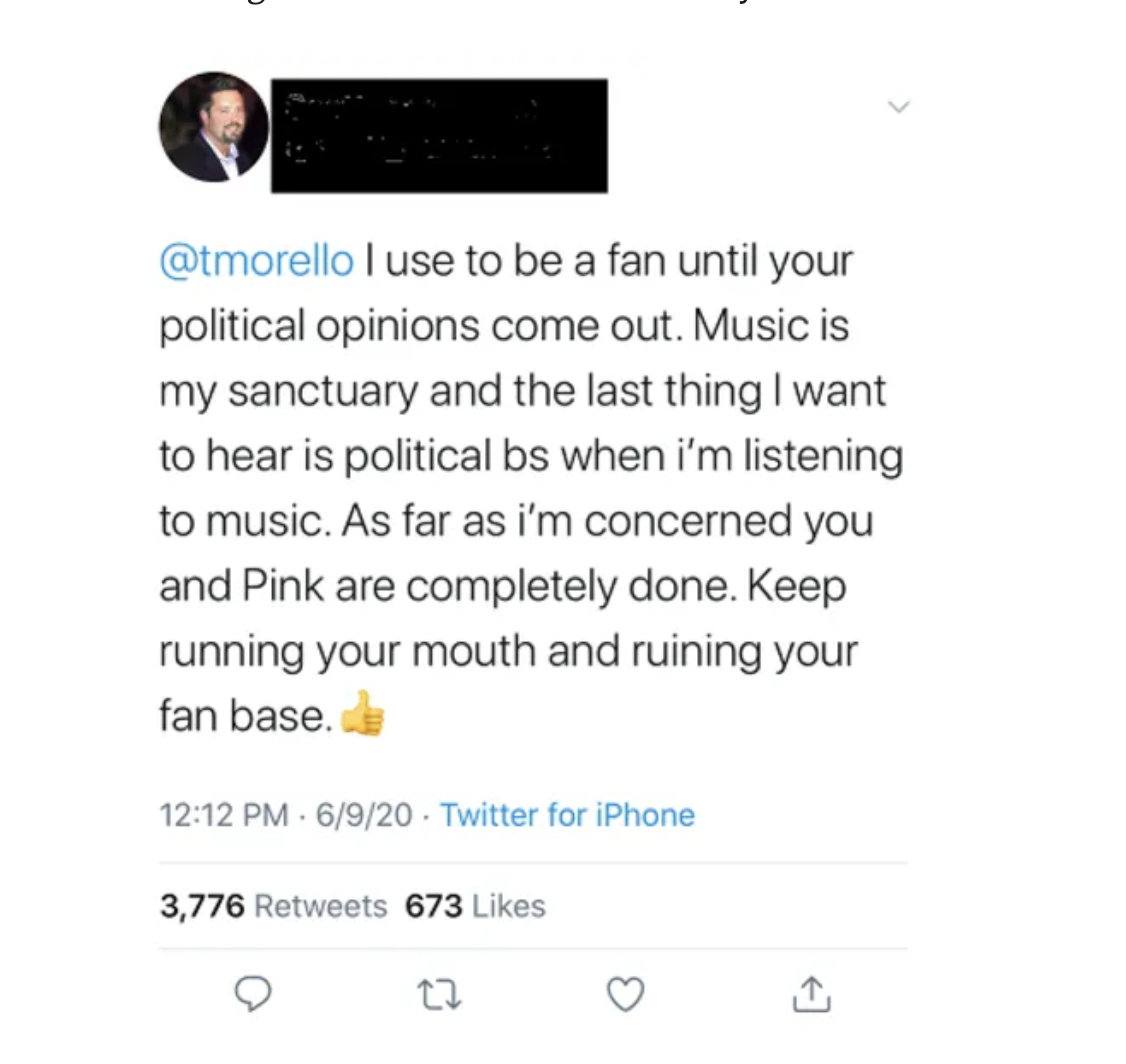
One such fan just got dunked on, as they say, a whole bunch on Twit­ter when he raged against Tom Morel­lo for the “polit­i­cal bs.”

That’s Tom Morel­lo of Rage Against the Machine, whose debut 1992 album informed us that the police and the Klan work hand in hand, and that cops are the “cho­sen whites” for state-sanc­tioned mur­der. That Rage Against the Machine, who raged against the same Machine on every album: “Bam, here’s the plan; Moth­er­fuck Uncle Sam.”

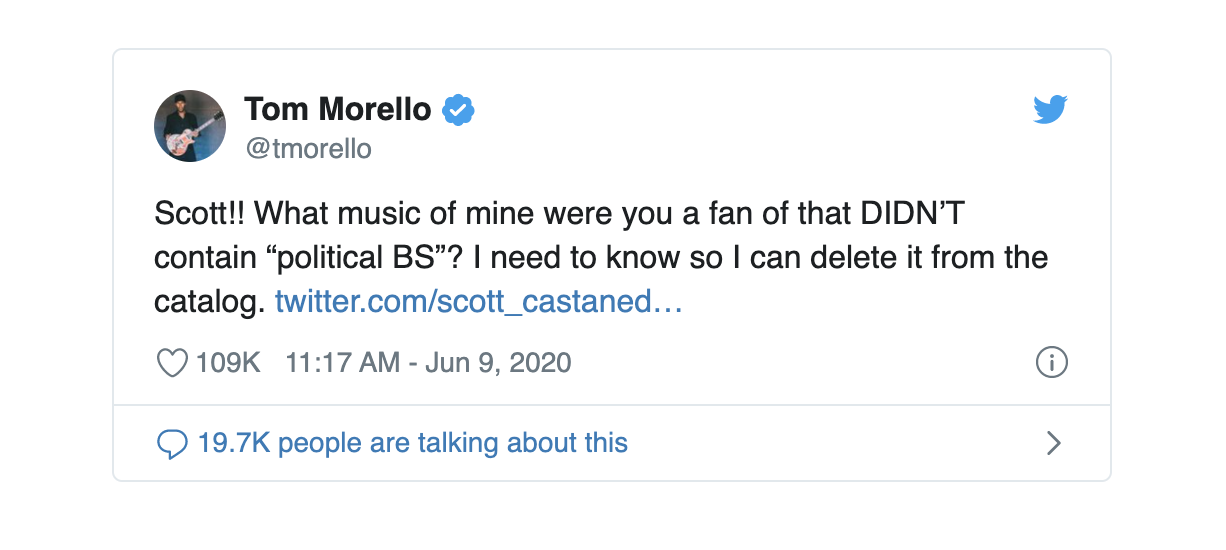
The poor sod was burned so bad­ly he delet­ed his account, but the laughs at his expense kept com­ing. Even Morel­lo respond­ed.

Why? Because the dis­grun­tled for­mer fan is not just one lone crank who didn’t get it. Many peo­ple over the years have expressed out­rage at find­ing out there’s so much pol­i­tics in their cul­ture, even in a band like Rage that could not have been less sub­tle. Many, like for­mer lever-puller of the Machine, Paul Ryan, seem to have cyn­i­cal­ly missed the point and turned them into work­out music. Morel­lo’s had to point this out a lot. (Dit­to Spring­steen.)

This uncrit­i­cal con­sump­tion of cul­ture with­out a thought about icky polit­i­cal issues is maybe one rea­son we have a sep­a­rate polit­i­cal class, paid hand­some­ly to do the dirty work while the rest of us go shop­ping. It’s a recipe for mass igno­rance and fas­cism.

You might think me crazy if I told you that the CIA is part­ly respon­si­ble for our expec­ta­tion that art and cul­ture should be apo­lit­i­cal. The Agency did, after all, fol­low the lead of the New Crit­ics, who exclud­ed all out­side polit­i­cal and social con­sid­er­a­tions from art (so they said).

Influ­en­tial lit­er­ary edi­tors and writ­ing pro­gram direc­tors on the Agency pay­roll made sure to fall in line, pro­mot­ing a cer­tain kind of writ­ing that focused on the indi­vid­ual and ele­vat­ed psy­cho­log­i­cal con­flict over social con­cerns. This influ­ence, writes The Chron­i­cle of High­er Edu­ca­tion, “flat­tened lit­er­a­ture” and set the bound­aries for what was cul­tur­al­ly accept­able. (Still, CIA-fund­ed jour­nals like The Paris Review pub­lished dozens of “polit­i­cal” writ­ers like Richard Wright, Gabriel Gar­cia Mar­quez, and James Bald­win.)

Then there’s the whole busi­ness of Hol­ly­wood film as a source of Pen­ta­gon-fund­ed pro­pa­gan­da, sold as innocu­ous, apo­lit­i­cal enter­tain­ment….

When it comes to jour­nal­ism, an ide­al of objec­tiv­i­ty, like Emerson’s inno­cent, dis­em­bod­ied trans­par­ent eye, became a stan­dard only in the 20th cen­tu­ry, osten­si­bly to weed out polit­i­cal bias. But that ide­al serves the inter­ests of pow­er more often than not. If media rep­re­sents exist­ing pow­er rela­tion­ships with­out ques­tion­ing their legit­i­ma­cy, it can claim objec­tiv­i­ty and bal­ance; if it chal­lenges pow­er, it becomes too “polit­i­cal.”

The adjec­tive is weaponized against art and cul­ture that makes cer­tain peo­ple who have pow­er uncom­fort­able. Say­ing “I don’t like polit­i­cal bs in my cul­ture” is say­ing “I don’t care to know the pol­i­tics are there.”

If, after decades of pump­ing “Killing in the Name,” you final­ly noticed them, then all that’s hap­pened is you’ve final­ly noticed. Cul­ture has always includ­ed the polit­i­cal, whether those pol­i­tics are shaped by mon­archs or state agen­cies or shout­ed in rap met­al songs (just ask Ice‑T) and fought over on Twit­ter. Maybe now it’s just get­ting hard­er to look away.

Relat­ed Con­tent:

The Pol­i­tics & Phi­los­o­phy of the Bauhaus Design Move­ment: A Short Intro­duc­tion

Hear a 4 Hour Playlist of Great Protest Songs: Bob Dylan, Nina Simone, Bob Mar­ley, Pub­lic Ene­my, Bil­ly Bragg & More

Love the Art, Hate the Artist: How to Approach the Art of Dis­graced Artists

Josh Jones is a writer and musi­cian based in Durham, NC. Fol­low him at @jdmagness

Why James Baldwin’s Writing Stays Powerful: An Artfully Animated Introduction to the Author of Notes of a Native Son

Every writer hopes to be sur­vived by his work. In the case of James Bald­win, the 32 years since his death seem only to have increased the rel­e­vance of the writ­ing he left behind. Con­sist­ing of nov­els, essays, and even a chil­dren’s book, Bald­win’s body of work offers dif­fer­ent points of entry to dif­fer­ent read­ers. Many begin with with Go Tell it on the Moun­tain, the semi-auto­bi­o­graph­i­cal debut nov­el in which he mounts a cri­tique of the Pen­te­costal Church. Oth­ers may find their gate­way in Bald­win’s fic­tion­al treat­ment of desire and love under adverse cir­cum­stances: among men in Paris in Gio­van­ni’s Room, for exam­ple, or teenagers in Mem­phis in If Beale Street Could Talk. But unlike most nov­el­ists, Bald­win’s name con­tin­ues to draw just as many acco­lades — if not more of them — for his non­fic­tion.

Those look­ing to read Bald­win’s essays would do well to start with his first col­lec­tion of them, 1955’s Notes of a Native Son. In assem­bling pieces he orig­i­nal­ly pub­lished in mag­a­zines like Harper’s and the Par­ti­san Review, the book reflects the impor­tance to the young Bald­win of what would become the major themes of his career, like race and expa­tri­ate life.

Though res­i­dent at dif­fer­ent times in Turkey, Switzer­land, and (right up until his dying day) France, he nev­er took his eyes off his home­land of the Unit­ed States of Amer­i­ca for long. Nor, in fact, did the Unit­ed States of Amer­i­ca take its eyes off him. “Over the course of the 1960s,” says Ford­ham Uni­ver­si­ty polit­i­cal sci­ence pro­fes­sor Christi­na Greer in the ani­mat­ed TED-Ed intro­duc­tion to Bald­win above, “the FBI amassed almost 2,000 doc­u­ments” as they inves­ti­gat­ed his back­ground and activ­i­ties.

That the U.S. gov­ern­ment saw Bald­win as so polit­i­cal­ly dan­ger­ous is rea­son enough to read his books. But as one of Amer­i­ca’s most promi­nent men of let­ters, he could hard­ly be writ­ten off as a sim­ple fire­brand. Though known for his inci­sive views of white and black Amer­i­ca, he believed that every­one, what­ev­er their race, “was inex­tri­ca­bly enmeshed in the same social fab­ric,” that “peo­ple are trapped in his­to­ry, and his­to­ry is trapped in them.” As he found recep­tive audi­ences for his argu­ments in print and on tele­vi­sion, “his fac­ul­ty with words led the FBI to view him as a threat.” But that very fac­ul­ty with words — insep­a­ra­ble, as in all the great­est essay­ists, from the astute­ness of the per­cep­tions they express — has assured him a still-grow­ing read­er­ship in the 21st cen­tu­ry. Con­tend­ing with the most volatile social and polit­i­cal issues of his time cer­tain­ly did­n’t low­er Bald­win’s pro­file, but any giv­en page of his prose sug­gests that what­ev­er he’d cho­sen to write about, we’d still be read­ing him today.

Relat­ed Con­tent:

Great Cul­tur­al Icons Talk Civ­il Rights: James Bald­win, Mar­lon Bran­do, Har­ry Bela­fonte & Sid­ney Poiti­er (1963)

James Bald­win Bests William F. Buck­ley in 1965 Debate at Cam­bridge Uni­ver­si­ty

James Baldwin’s One & Only, Delight­ful­ly Illus­trat­ed Children’s Book, Lit­tle Man Lit­tle Man: A Sto­ry of Child­hood (1976)

James Bald­win: Wit­ty, Fiery in Berke­ley, 1979

Chris Rock Reads James Baldwin’s Still Time­ly Let­ter on Race in Amer­i­ca: “We Can Make What Amer­i­ca Must Become”

Based in Seoul, Col­in Mar­shall writes and broad­casts on cities, lan­guage, and cul­ture. His projects include the book The State­less City: a Walk through 21st-Cen­tu­ry Los Ange­les and the video series The City in Cin­e­ma. Fol­low him on Twit­ter at @colinmarshall, on Face­book, or on Insta­gram.

David Lynch Posts His Nightmarish Sitcom Rabbits Online–the Show That Psychologists Use to Induce a Sense of Existential Crisis in Research Subjects

If recent world events feel to you like an exis­ten­tial cri­sis, you may find your­self brows­ing Youtube for calm­ing view­ing mate­r­i­al. But there’s also some­thing to be said for fight­ing fire with fire, so why not plunge straight into the dread and pan­ic with David Lynch’s sit­com Rab­bits? Set “in a name­less city del­uged by a con­tin­u­ous rain” where a fam­i­ly of three humanoid rab­bits live “with a fear­ful mys­tery,” the eight-episode web series has, as we’ve pre­vi­ous­ly men­tioned here on Open Cul­turebeen used by Uni­ver­si­ty of British Colum­bia psy­chol­o­gists to induce a sense of exis­ten­tial cri­sis in research sub­jects. Hav­ing orig­i­nal­ly shot it on a set in his back­yard in 2002 (and incor­po­rat­ed pieces of it into his 2006 fea­ture Inland Empire), Lynch has just begun mak­ing Rab­bits avail­able again on Youtube.

The first episode of Rab­bits went up yes­ter­day on David Lynch The­ater, the offi­cial Youtube chan­nel of the man who direct­ed Eraser­headBlue Vel­vetMul­hol­land Dri­ve, and oth­er such pieces of Lynchi­an cin­e­ma. Though he has­n’t made a fea­ture film in quite some time, he’s kept busy, as his fre­quent uploads have doc­u­ment­ed: take his 2015 ani­mat­ed short Fire (Pozar), which we fea­tured last month, or his dai­ly Los Ange­les weath­er reports.

More recent­ly, Lynch has been post­ing short videos called “What Is David Work­ing on Today?” These offer just what their title promis­es: a look at such art projects as and craft projects as “a drain spout for the bot­tom of my wood­en sink,” the “swing-out uri­nal” installed, and most recent­ly “the incred­i­ble check­ing stick.”

This might at first sound dispir­it­ing­ly nor­mal — at least until you get to how the check­ing stick is sup­posed to work — but those who have long enjoyed Lynch’s films know that nor­mal­i­ty is what gives them pow­er. David Fos­ter Wal­lace described the “Lynchi­an” as “a par­tic­u­lar kind of irony where the very macabre and the very mun­dane com­bine in such a way as to reveal the for­mer’s per­pet­u­al con­tain­ment with­in the lat­ter.” There is, of course, noth­ing macabre (and often noth­ing mun­dane) about the wood­en objects Lynch builds and repairs in his work­shop these days. But Rab­bits, too, was also one of his home­made projects, and its “sto­ry of mod­ern life,” as Lynch called it on Twit­ter, still makes for a har­row­ing­ly mun­dane view­ing expe­ri­ence.

Relat­ed Con­tent:

David Lynch Made a Dis­turb­ing Web Sit­com Called “Rab­bits”: It’s Now Used by Psy­chol­o­gists to Induce a Sense of Exis­ten­tial Cri­sis in Research Sub­jects

David Lynch Cre­ates Dai­ly Weath­er Reports for Los Ange­les: How the Film­mak­er Pass­es Time in Quar­an­tine

David Lynch Releas­es an Ani­mat­ed Film Online: Watch Fire (Pozar)

What Makes a David Lynch Film Lynchi­an: A Video Essay

Based in Seoul, Col­in Mar­shall writes and broad­casts on cities, lan­guage, and cul­ture. His projects include the book The State­less City: a Walk through 21st-Cen­tu­ry Los Ange­les and the video series The City in Cin­e­ma. Fol­low him on Twit­ter at @colinmarshall, on Face­book, or on Insta­gram.

Daniel Radcliffe Writes a Thoughtful Response to J.K. Rowling’s Statements about Trans Women

Image by Gage Skid­more, via Wiki­me­dia Com­mons

There are many more impor­tant things hap­pen­ing in the world than the tweets of Har­ry Pot­ter author J.K. Rowl­ing, but the tweets of J.K. Rowl­ing are nonethe­less wor­thy of atten­tion, for the sake of fans of the series, many of whom are young and do not under­stand why their par­ents might sud­den­ly be angry with her, or who are very angry with her them­selves. As you have prob­a­bly heard, Rowl­ing has dou­bled and tripled down on state­ments oth­ers have repeat­ed­ly told her are trans­pho­bic, igno­rant, and offen­sive.

What­ev­er you think of her tweets (and if you agree with her, you’re prob­a­bly only read­ing this post to dis­agree with me), they sig­nal a fail­ure of empa­thy and humil­i­ty on Rowling’s part. She could just say noth­ing and try to lis­ten and learn more. Empa­thy does not require that we whol­ly under­stand another’s lived expe­ri­ence. Only that we can imag­ine feel­ing the feel­ings some­one has about it—feelings of mar­gin­al­iza­tion, dis­ap­point­ment, fear, desire for recog­ni­tion and respect, what­ev­er; and that we trust they know more about who they are than we do.

Rowl­ing is nei­ther a trans woman, nor a doc­tor, nor an expert on gen­der iden­ti­ty, a fact that Daniel Rad­cliffe, Har­ry Pot­ter him­self, points out in his response to her:

Trans­gen­der women are women. Any state­ment to the con­trary eras­es the iden­ti­ty and dig­ni­ty of trans­gen­der peo­ple and goes against all advice giv­en by pro­fes­sion­al health care asso­ci­a­tions who have far more exper­tise on this sub­ject mat­ter than either Jo or I. Accord­ing to The Trevor Project, 78% of trans­gen­der and non­bi­na­ry youth report­ed being the sub­ject of dis­crim­i­na­tion due to their gen­der iden­ti­ty. It’s clear that we need to do more to sup­port trans­gen­der and non­bi­na­ry peo­ple, not inval­i­date their iden­ti­ties, and not cause fur­ther harm.

While the author has qual­i­fied her dog­mat­ic state­ments by express­ing sup­port for the trans com­mu­ni­ty and say­ing she has many trans friends, this doesn’t explain why she feels the need to offer unin­formed opin­ions about peo­ple who face very real harm from such rhetoric: who are rou­tine­ly vic­tims of vio­lent hate crimes and are far more like­ly to live in pover­ty and face employ­ment dis­crim­i­na­tion.

Radcliffe’s thought­ful, kind response will get more clicks if it’s sold as “Har­ry Pot­ter Claps Back at J.K. Rowl­ing” or “Har­ry Pot­ter DESTROYS J.K. Rowl­ing” or “Har­ry Pot­ter Bites the Hand that Fed Him” or some­thing, but he wants to make it clear “that is real­ly not what this is about, nor is it what’s impor­tant right now” and that he would­n’t be where he is with­out her. He clos­es with a love­ly mes­sage to the series’ fans, one that might apply to any of our trou­bled rela­tion­ships with an artist and their work:

To all the peo­ple who now feel that their expe­ri­ence of the books has been tar­nished or dimin­ished, I am deeply sor­ry for the pain these com­ments have caused you. I real­ly hope that you don’t entire­ly lose what was valu­able in these sto­ries to you. If these books taught you that love is the strongest force in the uni­verse, capa­ble of over­com­ing any­thing; if they taught you that strength is found in diver­si­ty, and that dog­mat­ic ideas of pure­ness lead to the oppres­sion of vul­ner­a­ble groups; if you believe that a par­tic­u­lar char­ac­ter is trans, non­bi­na­ry, or gen­der flu­id, or that they are gay or bisex­u­al; if you found any­thing in these sto­ries that res­onat­ed with you and helped you at any time in your life — then that is between you and the book that you read, and it is sacred. And in my opin­ion nobody can touch that. It means to you what it means to you and I hope that these com­ments will not taint that too much.

The state­ment was post­ed at the Trevor Project, an orga­ni­za­tion pro­vid­ing “cri­sis inter­ven­tion and sui­cide pre­ven­tion ser­vices to les­bian, gay, bisex­u­al, trans­gen­der, queer & ques­tion­ing (LGBTQ) young peo­ple under 25.” Learn more about resources for young peo­ple who might need men­tal health sup­port at their site.

Update: You can read Rowl­ing’s response, post­ed today here.

Relat­ed Con­tent:

J.K. Rowl­ing Defends Don­ald Trump’s Right to Be “Offen­sive and Big­ot­ed”

J.K. Rowl­ing Is Pub­lish­ing Her New Children’s Nov­el Free Online, One Chap­ter Per Day

Har­ry Pot­ter Final­ly Gets Trans­lat­ed Into Scots: Hear & Read Pas­sages from Har­ry Pot­ter and the Philosopher’s Stane

Josh Jones is a writer and musi­cian based in Durham, NC. Fol­low him at @jdmagness

Is This the Most Accurate Fan Cover of the Beatles Ever? Hear a Faithful Recreation of the Abbey Road Medley

I once thought I might be from the last gen­er­a­tion to have spent a good part of their youth in front of a pair of speak­ers, play­ing their par­ents’ Bea­t­les records until they mem­o­rized every note. Abbey Road was a spe­cial favorite in our house. I must have heard the out­ro med­ley a hun­dred thou­sand times or more. Now that reis­sue vinyl is every­where, or some­thing resem­bling the orig­i­nal records, there are loads of peo­ple who can say the same thing—and loads more who have streamed Abbey Road on repeat until it’s seared into their mem­o­ries.

I ask those peo­ple now, young and old and mid­dle-aged, whose famil­iar­i­ty with Paul McCartney’s voice on “Gold­en Slumbers/Carry that Weight/The End” comes from this kind of obses­sive lis­ten­ing: do you think the cov­er ver­sion above post­ed on YouTube by Andy­Boy 63 sounds exact­ly like the record­ing made at EMI Stu­dios (renamed Abbey Road after the album) in 1969? Answer before lis­ten­ing to the orig­i­nal “Gold­en Slum­bers,” below. A fair num­ber of YouTube com­menters say they mis­took this for the album ver­sion or an out­take.

DUDE I THOUGHT I WAS LISTENING TO THE REAL THING I DIDNT REALIZE IT WAS A COVER!!! YOU SOUND JUST LIKE PAULIE

By far the most accu­rate cov­er ever of any song.

I thought this was the Bea­t­les for about three min­utes.… I knew it was­n’t Abbey Road but thought it was some track off the anthol­o­gy. This is good enough to make me think it’s actu­al­ly the Bea­t­les!

It sounds to me like a cov­er ver­sion that approx­i­mates the tim­bre of dynam­ics of the orig­i­nal, impres­sive­ly so, but is also clear­ly not The Bea­t­les.

We can hear the dif­fer­ences between Sir Paul’s voice and piano and Andy’s record­ing in the first few phras­es, but it’s not as if Andy has set out to deceive lis­ten­ers, mark­ing the songs as cov­ers in the descrip­tion. His inten­tion is to pay trib­ute. “As a child,” he writes on his YouTube chan­nel, “I always want­ed to learn to play gui­tar, bass, drums and piano so that I could play and sing my favourite Bea­t­les songs.” You’ll find sev­er­al more, includ­ing “Sgt. Pepper’s Lone­ly Hearts Club Band/With a Lit­tle Help from My Friends,” just above. Again, it sounds to me like a faith­ful­ly earnest cov­er cre­at­ed as a labor of love. And again, for many rea­sons, not the Bea­t­les. (His cov­er of “Help!” on the oth­er hand is scar­i­ly good. I think he does a bet­ter Lennon impres­sion.)

You’ve got to hand it to Andy for tak­ing his fan­dom to this lev­el of imi­ta­tion. The sin­cer­est form of flat­tery may not pro­duce the best cov­er ver­sion, but it is an excel­lent way to show off one’s musi­cian­ship. Still, no one does McCart­ney bet­ter than McCart­ney (see him play him­self below).

Oth­er artists play­ing his songs might sound best doing it as them­selves. But as an exer­cise in stu­dious recre­ation of Bea­t­les arrange­ments, Andy­Boy 63’s proves he’s even more of a fan than those who can hum every bar of Abbey Road with­out miss­ing a note. While we war­ble “Here Comes the Sun” in the show­er, he’s sin­gle-hand­ed­ly, per­sua­sive­ly rere­cord­ed some of The Bea­t­les’ most famous songs. He’s also cov­ered Lennon’s solo hits and songs by Bud­dy Hol­ly and Elvis, as well as releas­ing orig­i­nal music. Check it out here.

And for an absolute­ly fab ver­sion of the Abbey Road med­ley, watch the Fab Faux’s pret­ty impec­ca­ble ver­sion right below.

Relat­ed Con­tent:

Paul McCartney’s Con­cep­tu­al Draw­ings For the Abbey Road Cov­er and Mag­i­cal Mys­tery Tour Film

Bea­t­les Trib­ute Band “The Fab Faux” Per­forms Live an Amaz­ing­ly Exact Repli­ca of the Orig­i­nal Abbey Road Med­ley

Hear 100 Amaz­ing Cov­er Ver­sions of Bea­t­les Songs

209 Bea­t­les Songs in 209 Days: Mem­phis Musi­cian Cov­ers The Bea­t­les’ Song­book

The Band Every­one Thought Was The Bea­t­les: Revis­it the Klaatu Con­spir­a­cy of 1976

Josh Jones is a writer and musi­cian based in Durham, NC. Fol­low him at @jdmagness

Are There Limits for a Sitcom Premise? A Pretty Much Pop Culture Podcast (#47) Discussion and Quiz

Sit­coms pro­vide a form of escapism that does­n’t take one to a mag­i­cal world of pos­si­bil­i­ty, but instead to a basi­cal­ly unchang­ing, cozy envi­ron­ment with relat­able char­ac­ters engaged in low-stakes con­flicts.

So what are the lim­its on the type of premise that can ground a sit­com? While most of the longest last­ing sit­coms have sim­ple set-ups involv­ing friends or co-work­ers, stream­ing has led to more seri­al­iza­tion and hence wider plot pos­si­bil­i­ties.

Does this mean that the era of sit­coms has come to an end? Or has the genre just broad­ened to admit entries like Ricky Ger­vais’ After Life and Derek, Har­mon & Roi­land’s Rick & Morty, Greg Daniels’ Upload and Space Force, and Arman­do Ian­nuc­ci’s Avenue 5?

In this low-stakes, feel-good dis­cus­sion, Mark, Eri­ca, and Bri­an also touch on the Parks & Recre­ation reunion spe­cial, Curb Your Enthu­si­asm, It’s Always Sun­ny in Philadel­phia, Com­mu­ni­ty, Mod­ern Fam­i­ly, Red Oaks, The Simp­sons, Last Man on Earth, WOOPS!, the stain of Chuck Lorre, and more. Plus a quiz to guess which weird sit­com premis­es are real and which Mark made up.

Incor­po­rate these arti­cles into your sit­u­a­tion:

If you enjoy this dis­cus­sion, check out our pre­vi­ous episodes on Friends and The Good Place.

Learn more at prettymuchpop.com. This episode includes bonus dis­cus­sion that you can only hear by sup­port­ing the pod­cast at patreon.com/prettymuchpop. This pod­cast is part of the Par­tial­ly Exam­ined Life pod­cast net­work.

Pret­ty Much Pop: A Cul­ture Pod­cast is the first pod­cast curat­ed by Open Cul­ture. Browse all Pret­ty Much Pop posts or start with the first episode.

Al Jaffee, Iconic Mad Magazine Cartoonist, Retires at Age 99 … and Leaves Behind Advice About Living the Creative Life

Apart from Alfred E. Neu­man, there is no Al more close­ly iden­ti­fied with Mad mag­a­zine than Al Jaf­fee. Born in 1921, he was around for more than 30 years before the launch of that satir­i­cal mag­a­zine turned Amer­i­can cul­tur­al phe­nom­e­non — and now, at age 99, he’s on track to out­live it. Just this week, the longest-work­ing car­toon­ist in his­to­ry and inven­tor of the Fold-In announced his retire­ment, and “to mark his farewell,” writes the Wash­ing­ton Post’s Michael Cav­na, “Mad’s ‘Usu­al Gang of Idiots’ will salute Jaf­fee with a trib­ute issue next week. It will be the magazine’s final reg­u­lar issue to offer new mate­r­i­al, includ­ing Jaffee’s final Fold-In, 65 years after he made his Mad debut.”

Over these past six and a half decades, Jaf­fee has drawn praise for his wit and ver­sa­til­i­ty. But all through­out his career, he’s also man­aged to com­bine those qual­i­ties with seem­ing­ly unstop­pable pro­duc­tiv­i­ty. “I am essen­tial­ly a com­mer­cial artist,” Jaf­fee says in this brief two-part inter­view from OnCre­ativ­i­ty. “I will not try to save time, ever, on my work by going through it quick­ly and just get­ting it done. I have to be as sat­is­fied with it as the per­son who’s going to buy it from me.”

When an assign­ment comes in, he con­tin­ues, “I will not deliv­er it until I am sat­is­fied that I would buy it.” This requires a clear under­stand­ing of the clien­t’s needs — “you are there to solve their prob­lems,” he empha­sizes — as well as the will­ing­ness to turn down not-quite-suit­able jobs.

Of course Jaf­fee said all this in his younger days, back when he was only 96. Per­haps it isn’t sur­pris­ing that a man in his hun­dredth year would decide to step back from his worka­day sched­ule (his Fold-Ins alone num­ber near­ly 500) and focus on the projects from which com­mer­cial exi­gen­cies might have dis­tract­ed him. “I do fine art for my own amuse­ment,” he say in this inter­view. “We should all feel free to amuse our­selves that way and just hang every­thing we do up on the refrig­er­a­tor.” But he also express­es the wish to “cre­ate a cou­ple more things before I kick the buck­et.” This after, as he puts it to Cav­na, “liv­ing the life I want­ed all along, which was to make peo­ple think and laugh.” Now Jaf­fee’s younger read­ers have the chance to think hard and laugh hard­er as they catch up on era upon era of his past work — not that, strict­ly speak­ing, he has any old­er read­ers.

Relat­ed Con­tent:

Al Jaf­fee, the Longest Work­ing Car­toon­ist in His­to­ry, Shows How He Invent­ed the Icon­ic “Folds-Ins” for Mad Mag­a­zine

Every Cov­er of Mad Mag­a­zine, from 1952 to the Present: Behold 553 Cov­ers from the Satir­i­cal Pub­li­ca­tion

A Gallery of Mad Magazine’s Rol­lick­ing Fake Adver­tise­ments from the 1960s

When Mad Mag­a­zine Ruf­fled the Feath­ers of the FBI, Not Once But Three Times

Watch Mad Magazine’s Edgy, Nev­er-Aired TV Spe­cial (1974)

Based in Seoul, Col­in Mar­shall writes and broad­casts on cities, lan­guage, and cul­ture. His projects include the book The State­less City: a Walk through 21st-Cen­tu­ry Los Ange­les and the video series The City in Cin­e­ma. Fol­low him on Twit­ter at @colinmarshall, on Face­book, or on Insta­gram.

« Go BackMore in this category... »
Quantcast