Michelangelo Entered a Competition to Put a Missing Arm Back on Laocoön and His Sons — and Lost

Not many ancient stat­ues are as well-known as Lao­coön and His Sons. Mas­ter­ful­ly sculpt­ed some time between the first cen­tu­ry BC and the first cen­tu­ry AD, it depicts the epony­mous Tro­jan priest in an ago­niz­ing strug­gle with the ser­pents that will kill one or both of his sons. The details of the tale vary depend­ing on the teller: Vir­gil describes Lao­coön as a priest of Posei­don who dared to attempt expos­ing the famous Tro­jan Horse ruse, and Sopho­cles describes him as a priest of Apol­lo who vio­lat­ed his vow of celiba­cy. Whichev­er ver­sion of the sto­ry he heard, the sculp­tor clear­ly drew from it pow­er­ful enough inspi­ra­tion to impress Pliny the Elder, in whose Nat­ur­al His­to­ry the piece fig­ures.

Even among the more artis­ti­cal­ly sophis­ti­cat­ed behold­ers of the Renais­sance, Lao­coön and His Sons proved a cap­ti­vat­ing piece of work. Unearthed from a Roman vine­yard in 1506, it looked to have weath­ered the inter­ven­ing mil­len­ni­um and half with much less wear and tear than most large arti­facts from antiq­ui­ty — though Lao­coön him­self was, con­spic­u­ous­ly, miss­ing an arm. Com­mis­sioned by Pope Julius II, Vat­i­can archi­tect Dona­to Bra­mante “held a con­test to see who could come up with the best ver­sion of the arm restora­tion,” writes Kaushik Pato­wary at Amus­ing Plan­et. “Michelan­ge­lo sug­gest­ed that Laocoön’s miss­ing arm should be bent back as if the Tro­jan priest was try­ing to rip the ser­pent off his back.”

Michelan­ge­lo was­n’t the only Renais­sance man in com­pe­ti­tion: “Raphael, who was a dis­tant rel­a­tive of Bra­mante, favored an extend­ed arm. In the end, Jacopo Sanso­vi­no was declared the win­ner, whose ver­sion with an out­stretched arm aligned with Raphael’s own vision of how the stat­ue should look.” Lao­coön was thus even­tu­al­ly restored with his arm out­streched, and kept that way until, “in a strange twist of fate, an antique back­ward-bent arm was dis­cov­ered in a Roman work­shop in 1906, a few hun­dred meters from where the stat­ue group had been found four hun­dred years ear­li­er.” Posi­tioned just as Michelan­ge­lo had sug­gest­ed, this dis­em­bod­ied mar­ble limb turned out unmis­tak­ably to have come from Lao­coön and His Sons — but about three and a half cen­turies too late, alas, for Michelan­ge­lo to lord it over Raphael.

Relat­ed Con­tent:

A Creepy 19th Cen­tu­ry Re-Cre­ation of the Famous Ancient Roman Stat­ue, Lao­coön and His Sons

Michelangelo’s David: The Fas­ci­nat­ing Sto­ry Behind the Renais­sance Mar­ble Cre­ation

New Video Shows What May Be Michelangelo’s Lost & Now Found Bronze Sculp­tures

3D Scans of 7,500 Famous Sculp­tures, Stat­ues & Art­works: Down­load & 3D Print Rodin’s Thinker, Michelangelo’s David & More

Based in Seoul, Col­in Mar­shall writes and broad­casts on cities, lan­guage, and cul­ture. His projects include the Sub­stack newslet­ter Books on Cities, the book The State­less City: a Walk through 21st-Cen­tu­ry Los Ange­les and the video series The City in Cin­e­ma. Fol­low him on Twit­ter at @colinmarshall or on Face­book.

Why Leonardo da Vinci’s Greatest Painting is Not the Mona Lisa

Despite cre­at­ing two of the most famous paint­ings in the his­to­ry of West­ern art, The Last Sup­per and the Mona Lisa, Leonar­do da Vin­ci did not par­tic­u­lar­ly think of him­self as a painter. Sig­mund Freud may have devot­ed sev­er­al hun­dred words to show­ing that the Renais­sance man par excel­lence rarely fin­ished an art­work because of infan­tile psy­cho­sex­u­al con­flicts, but it seems more fit­ting to look at Leonardo’s approach to paint­ing as of a piece with his approach to every­thing: He was sim­ply far more inter­est­ed in process than prod­uct. Even when the prod­uct was a mas­ter­piece-in-the-mak­ing, and Leonar­do’s patrons await­ed, the artist’s rest­less mind was ready to move on before he fin­ished a com­mis­sion.

Such was the case with the Mona Lisa, which Leonar­do nev­er deliv­ered to his client and instead brought with him to France. This paint­ing, in all its unfin­ished mys­tery, may be Leonardo’s best-known work, but it is not — as Evan Puschak, a.k.a. The Nerd­writer, argues above — his best.

That hon­or should be reserved for a paint­ing Leonar­do began in the same year as the Mona Lisa, 1503: The Vir­gin and Child with St. Anne, which he worked on for sev­en years, nev­er deliv­ered to his client (most like­ly the King of France), and left unfin­ished at the time of his death in 1519.
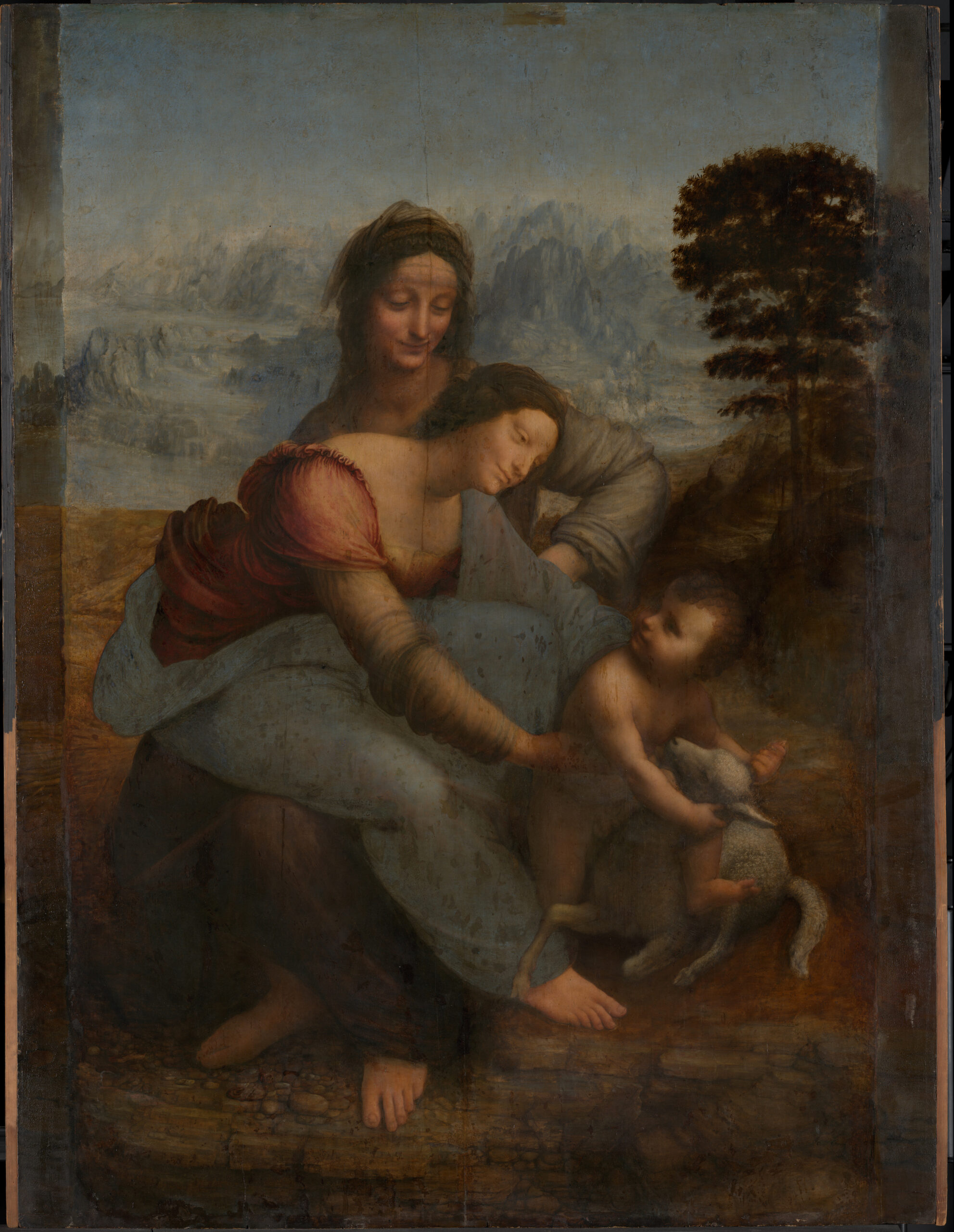
The paint­ing depicts a group­ing of three fig­ures: the infant Christ, wrestling a lamb, his moth­er, attempt­ing to pull him away, and her moth­er, the apoc­ryphal St. Anne, form­ing the sta­ble base and apex of the tri­ad. Behind her head tow­ers a dense moun­tain range, a sym­bol of deep eco­log­i­cal time, says Puschak, just as the lamb in the fore­ground sym­bol­izes the Pas­sion to come. This tran­si­tion from a pre-his­toric past (one far more ancient than the Bib­li­cal sto­ries) to a redeemed future does not ter­mi­nate with the lamb, says Puschak, but with us, the view­er.

The pyra­mi­dal com­po­si­tion recalls Leonardo’s The Vir­gin of the Rocks from 1483. Such group­ings were com­mon in ear­ly Renais­sance paint­ings, but The Vir­gin and Child with St. Anne rep­re­sent­ed a mas­ter­ful refine­ment of the com­po­si­tion and of Leonar­do’s famed sfu­ma­to tech­nique. As Art­dai­ly notes:

In Flo­rence, where it was con­ceived, the Saint Anne quick­ly drew con­sid­er­able atten­tion and can be seen as a water­shed moment in the evo­lu­tion of artis­tic lan­guage, inspir­ing many dis­ci­ples and col­leagues who sought to emu­late Leonar­do’s style and tech­nique in this work. Flo­ren­tines were fas­ci­nat­ed by the var­i­ous car­toons exe­cut­ed by Leonar­do and by the paint­ed work, even in its rough out­lines.

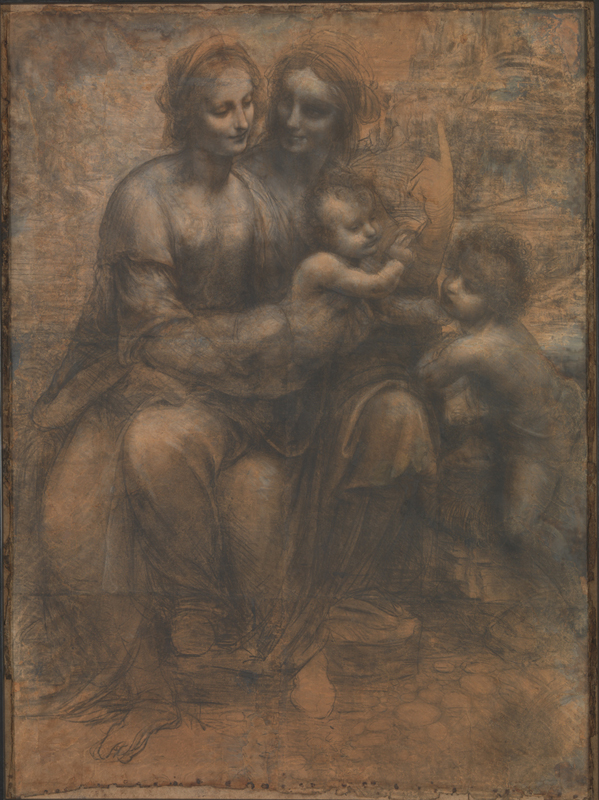
One prepara­to­ry work, the so-called “Burling­ton House Car­toon” (below), shows “the full expres­sion of Leonar­do’s first vision of the Saint Anne theme upon being award­ed the com­mis­sion.”

Image via the Nation­al Gallery

The work also shows the con­tin­ued devel­op­ment of a theme that absorbed the artist through­out his life, expressed in ear­li­er works such as The Vir­gin and Child with Cat and The Vir­gin of the Rocks. “These Vir­gin and Child com­po­si­tions tes­ti­fy to Leonar­do’s ques­tion to ren­der in the most com­pelling man­ner the ten­der­ness of the rela­tion­ship between Jesus and the Vir­gin Mary,” and thus, between moth­er and son. Most of Freud’s obser­va­tions in his Leonar­do essay are non­sense, based on a mis­trans­la­tion into Ger­man of the word “vul­ture” for a word that actu­al­ly means “kite” (an error he lat­er found par­tic­u­lar­ly embar­rass­ing). But his dis­cus­sion of Leonar­do’s child­hood and his best, unfin­ished paint­ing may strike us with par­tic­u­lar poignan­cy.

[T]he smile which is play­ing on the lips of both women, although unmis­tak­ably the same as in the pic­ture of Mona Lisa, has lost its sin­is­ter and mys­te­ri­ous char­ac­ter; it express­es a calm bliss­ful­ness.… Leonardo’s child­hood was pre­cise­ly as remark­able as this pic­ture. He has had two moth­ers, the first his true moth­er, Cate­ri­na, from whom he was torn away between the age of three and five years, and a young ten­der step-moth­er, Don­na Albiera, his father’s wife. By con­nect­ing this fact of his child­hood… and con­dens­ing them into a uni­form fusion, the com­po­si­tion of Saint Anne, Mary and the Child, formed itself in him.

Per­haps Freud was right, and The Vir­gin and Child with St. Anne was tru­ly Leonar­do’s most per­son­al work, the apoth­e­o­sis of a quest to inte­grate his per­son­al­i­ty through art. What­ev­er the case, we can say, along the psy­cho­an­a­lyst, that “on becom­ing some­what engrossed in this pic­ture it sud­den­ly dawns upon the spec­ta­tor that only Leonar­do could have paint­ed this pic­ture.”

On a side note, Nerd­writer, the cre­ator of the video above, has a new book com­ing out, Escape into Mean­ing: Essays on Super­man, Pub­lic Bench­es, and Oth­er Obses­sions. You can pre-order it now.

Relat­ed Con­tent:

Leonar­do da Vinci’s Note­books Get Dig­i­tized: Where to Read the Renais­sance Man’s Man­u­scripts Online

Leonar­do Da Vinci’s To-Do List from 1490: The Plan of a Renais­sance Man

How Leonar­do da Vin­ci Made His Mag­nif­i­cent Draw­ings Using Only a Met­al Sty­lus, Pen & Ink, and Chalk

Josh Jones is a writer and musi­cian based in Durham, NC. Fol­low him at @jdmagness

The Nine Greatest Films You’ve Never Seen

Whether we know it or not, we have all absorbed a cin­e­mat­ic vocab­u­lary and set of film his­tor­i­cal ref­er­ences through the film and tele­vi­sion we’ve watched through­out our lives. We can leave it to the film­mak­ers, crit­ics, and cinephiles to mem­o­rize glos­saries of tech­niques. It’s enough that we under­stand what’s hap­pen­ing on screen because hun­dreds of visu­al nar­ra­tives have been con­struct­ed in more or less the same way. This lan­guage did not come out of a pri­mor­dial soup but took shape over the last 120 years or so: from the Lumière Broth­ers and Georges Méliès to Wes Ander­son and Denis Vil­leneuve and so on — each stage along the way absorb­ing influ­ences and ideas from the most inno­v­a­tive films.

Take, for exam­ple, My Din­ner with Andre, an intense­ly philo­soph­i­cal film that con­sists of only two main char­ac­ters, one set­ting, and no real plot to speak of. Instead, the film exploits the tech­niques of shot/reverse shot to their fullest, cre­at­ing extra­or­di­nary inti­ma­cy between two char­ac­ters, and the view­er, with the cam­era. Louis Malle’s 1981 film became a stan­dard for filmed exis­ten­tial con­ver­sa­tions. Yet behind it stands an even more icon­ic con­ver­sa­tion, one lit­er­al­ly con­cerned with life and Death. Ing­mar Bergman’s The Sev­enth Seal is a cin­e­mat­ic ref­er­ence for count­less movies, and a film that undoubt­ed­ly expand­ed the ways film­mak­ers could tell sto­ries.

But there is anoth­er film we should see, says the Cin­e­mat­ic Car­tog­ra­phy above, if we want to know where else the philo­soph­i­cal con­ver­sa­tion in film might go: Hun­gar­i­an direc­tor Zoltán Fábri’s 1976 The Fifth Seal, a grim moral­i­ty play set in Nazi-occu­pied Hun­gary in which four friends in a bar pro­pose a thought exper­i­ment that becomes ter­ri­fy­ing­ly real. The film cuts between the con­ver­sa­tion on screen and scenes of Hierony­mus Bosch’s The Gar­den of Earth­ly Delights. “All through the film,” one crit­ic writes, “an intel­li­gent view­er will note the char­ac­ters in the film con­stant­ly reassess their philo­soph­i­cal stance or points of view, accord­ing to cir­cum­stances.”

The entire move­ment of the film turns on a sin­gle ques­tion, a stark restate­ment of the Hegelian master/slave dialec­tic. Rather than a philo­soph­i­cal con­ver­sa­tion between two sta­ble points of view, The Fifth Seal shows us per­spec­tives that shift accord­ing to the char­ac­ters’ self-per­cep­tions, our per­cep­tions of them,  and the influ­ence of Bosch on what we see, adding lay­ers of dra­mat­ic irony and extra-diegetic ten­sion. Influ­en­tial in its own way, if The Fifth Seal had been as wide­ly seen as The Sev­enth Seal, we might have seen cin­e­ma take a dif­fer­ent turn in the last few decades. Such is the case with all nine films dis­cussed. See them list­ed below, learn about them in brief in “The Great­est Films You Don’t Know,” above, and imag­ine the direc­tions cin­e­ma might go if it took more cues from these under­val­ued clas­sics.

0:00 Intro­duc­tion (Ash­es and Snow, A Time to Live A Time to Die, Strangers In Good Com­pa­ny, Borom Sarat, Dead Man’s Let­ter’s, Killer of Sheep, Napoleon, Still Life)
1:50 The Fifth Seal — Az ötödik pec­sét (Dir: Zoltán Fábri)
7:29 The House Is Black — خانه سیاه است (Dir: For­ough Far­rokhzad)
9:57 Tie Xi Qu: West of The Tracks — 铁西区 (Dir: Wang Bing)
14:12 As I Was Mov­ing Ahead Occa­sion­al­ly I Saw Brief Glimpses of Beau­ty (Dir: Jonas Mekas)
18:37 The Enclosed Val­ley — La val­lée close (Dir: Jean-Claude Rousseau)
19:37 Pas­toral: To Die in the Coun­try — 田園に死す (Dir: Shūji Ter­aya­ma)
23:44 Pun­ish­ment Park (Dir: Peter Watkins)
28:03 The Cre­ma­tor — Spalo­vač mrtvol (Dir: Juraj Herz) 30:28 O Pagador de Promes­sas (Dir: Ansel­mo Duarte)
31:39 Con­clu­sion (Lucifer Ris­ing, An Ele­phant Sit­ting Still, Mar­ke­ta Lazaro­va, White Noise, Plat­form, The Burmese Harp)

If you would like to sign up for Open Culture’s free email newslet­ter, please find it here. It’s a great way to see our new posts, all bun­dled in one email, each day.

If you would like to sup­port the mis­sion of Open Cul­ture, con­sid­er mak­ing a dona­tion to our site. It’s hard to rely 100% on ads, and your con­tri­bu­tions will help us con­tin­ue pro­vid­ing the best free cul­tur­al and edu­ca­tion­al mate­ri­als to learn­ers every­where. You can con­tribute through Pay­Pal, Patre­on, and Ven­mo (@openculture). Thanks!

Relat­ed Con­tent: 

Mar­tin Scors­ese Cre­ates a List of 39 Essen­tial For­eign Films for a Young Film­mak­er

100 Years of Cin­e­ma: New Doc­u­men­tary Series Explores the His­to­ry of Cin­e­ma by Ana­lyz­ing One Film Per Year, Start­ing in 1915

Take a 16-Week Crash Course on the His­to­ry of Movies: From the First Mov­ing Pic­tures to the Rise of Mul­ti­plex­es & Net­flix

Josh Jones is a writer and musi­cian based in Durham, NC. Fol­low him at @jdmagness

The Awe-Inspiring But Tragic Story of Africa’s Festival In The Desert (2001–2012)

“Mali’s gifts to the world of music are lav­ish and leg­endary,” Nenad Georgievs­ki writes at All About Jazz, though the world knew lit­tle about Malian music until Amer­i­can musi­cians began part­ner­ing with play­ers from West Africa. In the 1980s, Ste­vie Won­der began tour­ing with Amadou and Mari­am, help­ing to pop­u­lar­ize their form of Malian blues. In 1994, Ry Cood­er record­ed and released Talk­ing Tim­buk­tu with Malian gui­tarist Ali Far­ka Touré, whose “desert blues… was uncon­cerned with bound­aries,” freely mix­ing lan­guages and instru­men­ta­tion with play­ing that drew com­par­isons to John Lee Hook­er.

While audi­ences around the world encoun­tered West African music as “world music” on the fes­ti­val cir­cuit, fans on the con­ti­nent knew it as home­grown tra­di­tion­al sounds and con­tem­po­rary African rock and pop. In 2001 they got the chance to gath­er for the first annu­al “Fes­ti­val in the Desert” (Fes­ti­val au désert) in Tin Essako, a rur­al vil­lage miles from the high­way, as the Band­splain­ing video above tells it. This brief explain­er of the Festival’s impact and its trag­ic end in 2012 begins with ref­er­ences to Bono. But his role in the sto­ry is rather small.

More cen­tral are the Tuareg, or Kel Tamashek, nomadic peo­ple of Berber ori­gin spread across sev­er­al West African coun­tries whose musi­cians have refined the sound of desert rock and turned it into rebel music. The sound was born in strug­gle, notes World of Music, in refugee camps and bat­tle­grounds. The band Tinari­wen — who formed in 1979 and have become “glob­al musi­cal nomads” since the first Fes­ti­val —  met in “mil­i­tary camps set up in Libya by Colonel Ghaddafi to train young Tamashek men how to fight. Dur­ing the [Tuareg] rebel­lion Tinari­wen became the pied pipers of the rebel move­ment, and their songs gal­va­nized the young dis­pos­sessed Tamashek youth.” Then they turned to seek­ing peace at the Fes­ti­val in 2001.

Put togeth­er by Tuareg orga­niz­er Man­ny Ansar, the Fes­ti­val was “based on a cen­turies-old tra­di­tion,” notes Pea­cePrints, “a meet­ing where the Tuareg tribes of the region meet once a year to play and share music.” By con­trast, the mod­ern Fes­ti­val includ­ed eth­nic and trib­al groups from all over the coun­try, and the world, and “focused on bridg­ing the gap between tra­di­tion and moder­ni­ty and also between local cus­tom and inter­na­tion­al come­to­geth­er.” It was the only fes­ti­val of its kind in Africa and attract­ed thou­sands of African atten­dees and a few hun­dred vis­i­tors each year.

Trag­i­cal­ly, the fes­ti­val came to an end in 2012 when Tuareg rebels took con­trol of North­ern Mali, renam­ing it Aza­wad, and were over­run by Islam­ic sep­a­ratist groups. The coun­try was placed under Shari­ah Law, and Ansar was exiled to Burk­i­na Faso for a time. Out­side of his own coun­try, he con­tin­ued to pro­mote peace by co-found­ing a trav­el­ing fes­ti­val called Car­a­van cul­turelle pour la paix.

The artists rep­re­sent­ed at Fes­ti­val in the Desert tell sto­ries of the fusion of tra­di­tion and moder­ni­ty, of bru­tal con­flict and the hope for peace through the shar­ing and fus­ing of cul­tures. Mali may be one of the poor­est coun­tries in the world when it comes to mate­r­i­al resources, but it is one of the most musi­cal­ly rich. “Mali has many peo­ple, liv­ing in their dis­tricts,” say one musi­cian in the trail­er above for the doc­u­men­tary film The Last Song Before the War, “but every­one comes togeth­er in this fes­ti­val.”

Or, at least, they did until 2012. The film­mak­ers unwit­ting­ly cap­tured the very last Fes­ti­val in the Desert before it was shut down by mil­i­tants who “ruined the mate­r­i­al, plun­dered the stage, burned instru­ments,” says Ansar. “I had to go on.… It was no longer a ques­tion of fes­tiv­i­ty, but about the sur­vival of a cul­ture.” See his state­ment at the time in the “Fes­ti­val in the Desert — In Exile” video fur­ther up. For a total­ly dif­fer­ent view of the Fes­ti­val, read for­mer MTV exec Tom Fre­ston’s account of trav­el­ing there with Jim­my Buf­fett, Chris Black­well (founder of Island Records), and a hand­ful of oth­er indus­try big­wigs scout­ing the next West African sen­sa­tion.

Relat­ed Con­tent: 

An Intro­duc­tion to the Life & Music of Fela Kuti: Rad­i­cal Niger­ian Band­leader, Polit­i­cal Hero, and Cre­ator of Afrobeat

Zam­rock: An Intro­duc­tion to Zambia’s 1970s Rich & Psy­che­del­ic Rock Scene

David Byrne Cre­ates a Playlist of Cre­ative Music From Africa & the Caribbean—or What One Name­less Pres­i­dent Has Called “Shit­hole Coun­tries”

Josh Jones is a writer and musi­cian based in Durham, NC. Fol­low him at @jdmagness

Watch Wes Anderson’s Animated Music Video for The French Dispatch, Featuring a Track by Jarvis Cocker

The French Dis­patch came out near­ly two weeks ago, after hav­ing been pushed back more than a year by COVID-19. But delay­ing the release of a Wes Ander­son movie sure­ly counts among the least regret­table harms of the pan­dem­ic, which has caused mil­lions of deaths world­wide. Among the lives lost was that of Daniel Bevilac­qua, known in France as the chan­son singer Christophe. Set in that coun­try — and more specif­i­cal­ly, the fic­tion­al city of Ennui-sur-Blasé — in the 1960s, The French Dis­patch fea­tures a rein­ter­pre­ta­tion of Christophe’s 1965 hit “Aline” that now plays as some­thing of a trib­ute to the late pop-cul­tur­al icon. Sung by Pulp front­man Jarvis Cock­er, it comes accom­pa­nied by the Ander­son-direct­ed ani­mat­ed music video above.

Cock­er has worked with Ander­son before. In the direc­tor’s 2009 stop-motion adap­ta­tion of Roald Dahl’s The Fan­tas­tic Mr. Fox he pro­vid­ed the voice of a singing farmer named Petey; in The French Dis­patch he does the same for a pop star called Tip-Top, and has even record­ed a full-length album in char­ac­ter.

Released on the very same day as The French Dis­patch, Chan­sons d’En­nui Tip-Top con­tains a dozen cov­ers of songs orig­i­nal­ly pop­u­lar­ized by the likes of Serge Gains­bourg, Brigitte Bar­dot, Jacques Dutronc, and Françoise Hardy. (Atten­tive cinephiles, the core audi­ence for all things Ander­son, will also note the pres­ence on the track list of Claude Channes’ “Mao Mao,” first heard in Jean-Luc Godard­’s La Chi­noise.)

Chan­sons d’En­nui Tip-Top exudes the retro-mind­ed Cock­er’s love of 1960s French pop music, just as The French Dis­patch exudes Ander­son­’s love of… well, every­thing Ander­son loves, much of which appears in the “Aline” music video. Its metic­u­lous­ly hand-drawn look comes from Javi Aznarez, who’d orig­i­nal­ly been hired to apply his art to the sets of the film itself. Fol­low­ing Tip-Top as he dances through an elab­o­rate two-dimen­sion­al ren­di­tion of Ennui-sur-Blasé, it intro­duces not only the set­ting (in a stark cut­away man­ner rem­i­nis­cent of The Life Aquat­ic) but all the major char­ac­ters and the actors who play them. Owen Wil­son, Anjel­i­ca Hus­ton, Edward Nor­ton, Bill Mur­ray: the gang, it seems, is all here — “here” being a cer­tain idea of post­war France best real­ized, per­haps, by imag­i­na­tions like Ander­son and Cock­er’s.

Relat­ed Con­tent:

Wes Ander­son Releas­es the Offi­cial Trail­er for His New Film, The French Dis­patch: Watch It Online

Watch the New Trail­er for Wes Anderson’s Stop-Motion Film Isle of Dogs, Inspired by Aki­ra Kuro­sawa

Wes Anderson’s Ani­mat­ed Books

Wes Anderson’s Shorts Films & Com­mer­cials: A Playlist of 8 Short Ander­son­ian Works

Based in Seoul, Col­in Mar­shall writes and broad­casts on cities, lan­guage, and cul­ture. His projects include the Sub­stack newslet­ter Books on Cities, the book The State­less City: a Walk through 21st-Cen­tu­ry Los Ange­les and the video series The City in Cin­e­ma. Fol­low him on Twit­ter at @colinmarshall or on Face­book.

9‑Year-Old Henry Thomas Delivers a Remarkable Screen Test for E.T.

I can guar­an­tee almost every day I get some­one going, ‘Hey, you’re the guy from E.T.’, usu­al­ly fol­lowed by, ‘What are you doing now?’ And not a day has gone by when some­one hasn’t shout­ed ‘E.T. phone home’ at me.” —  Actor Hen­ry Thomas

Should I ever bump into Hen­ry Thomas, I may exclaim, “Okay, kid, you got the job,” just like direc­tor Steven Spiel­berg does at the end of the remark­able screen test, above.

Thomas, now — brace your­self — 50, was just 9 when Spiel­berg flew him in from Texas to audi­tion for the role of Elliot in E.T. the Extra-Ter­res­tri­al on the strength of his sin­gle screen cred­it, play­ing Sis­sy Spacek’s son in Raggedy Man.

Before we go fur­ther, a cau­tion­ary tale.

Anoth­er young­ster had the part of Elliot all sewn up until screen­writer Melis­sa Math­i­son host­ed a Dun­geons and Drag­on game to get a feel for the chem­istry between the film’s child actors.

“In about three min­utes it became very clear that nobody liked this lit­tle boy,” cast­ing direc­tor Mar­ci Liroff recalls. Ouch.

That would be a heavy bur­den to car­ry through life, know­ing that youth­ful bossi­ness cost you the role of a life­time.

Enter Hen­ry Thomas.

Spielberg’s long­time col­lab­o­ra­tor, pro­duc­er Kath­leen Kennedy, recalled that he was no great shakes read­ing from pre­pared sides of the script, but then came an improv with leg­endary cast­ing direc­tor Mike Fen­ton.

If only every aspi­rant method actor shared Thomas’ knack for emo­tion­al recall. Dur­ing the improv, as the pres­sure to give up the beloved alien crea­ture hid­den in his clos­et mount­ed, he drew on mem­o­ries of his pet ­chi­huahua, Urso, who had been killed by a neighbour’s dog in front of him.

“Poor Urso, it may have won me the role but it was a sad price to pay,” Thomas told The Mir­ror some 30 years lat­er.

His per­for­mance reduced every adult in the room to tears.

It was also remark­able for its sub­tle­ty. As Spiel­berg remarked in a 1982 inter­view with Pre­miere mag­a­zine:

He’s a very con­trolled, method­i­cal per­former who mea­sures what he does and feels what he does and yet broad­casts it in a total­ly sub­tle way. His per­for­mance is so con­trolled, unlike most kid per­form­ers, who seem to be giv­ing you 150 per­cent on every shot. Henry’s per­for­mance is just a bread crumb at a time, but he takes you in a won­der­ful direc­tion to a very, very rous­ing cathar­sis. He’s just a “once in a life­time” kid.

The direc­tor likened Thomas’ tears in the final moments of E.T. to the arrival of the moth­er ship in Close Encoun­ters of the Third Kind — “a super-colos­sal spe­cial effect” root­ed in human emo­tion.

By then, Thomas no longer need­ed an assist from Urso:

I couldn’t stop cry­ing because I worked with E.T. every day and he was real to me.

The con­nec­tion was not imme­di­ate. Thomas’ laugh­ing response to his first gan­der at the alien reas­sured Spiel­berg that the child actor could han­dle com­e­dy but Thomas, a huge Raiders of the Lost Ark fan, had been hop­ing for some­thing a bit more swash­buck­ling. As he told Esquire’s Paul Schrodt:

When I saw this alien with the weird feet and the tele­scop­ic neck, I was like, ‘What the hell is this? Where is my lightsaber?’ But I guess I got a fly­ing ­bicy­cle, so I can’t com­plain.

It’s was­n’t exact­ly a Hol­ly­wood end­ing, per­haps because Thomas didn’t stay in Hol­ly­wood, but rather returned to school in San Anto­nio, where he fell prey to kids who resent­ed the overnight sen­sa­tion in their midst.

On the oth­er hand, he has worked steadi­ly as an actor since leav­ing home at 17, and abid­ed by his res­o­lu­tion to avoid drugs and oth­er pit­falls that plague some oth­er child stars. (“I nev­er want­ed to give any­one the sat­is­fac­tion of get­ting that pic­ture of me rob­bing a liquor store.”)

In his inter­view with The Mir­ror, tongue firm­ly in cheek, he spec­u­lat­ed about pos­si­ble E.T. sequels and admit­ted that he’d hate to see some­one oth­er than him­self play­ing Elliott:

It could be like an inter­galac­tic ­reunion with Elliott and E.T. at a beach resort… I don’t think Spiel­berg will touch it, although I’d love to see Elliott and E.T. ­sit­ting at the end of the bar: “How’s it been for you man?” “Good, man, anoth­er beer?”

A few years lat­er, the stars did indeed reunite for a hol­i­day advert that owes a large debt to Peter Pan, and puts its thumb on the scale with a clip of Bing Cros­by croon­ing “White Christ­mas.”

As if Hen­ry Thomas needs help mak­ing us cry.

Relat­ed Con­tent: 

Watch the Orig­i­nal Audi­tion Tapes for Break­ing Bad Before the Final Sea­son Debuts

Audrey Hepburn’s Mov­ing Screen Test for Roman Hol­i­day (1953)

Bruce Lee Audi­tions for The Green Hor­net (1964)

Ayun Hal­l­i­day is the Chief Pri­maol­o­gist of the East Vil­lage Inky zine and author, most recent­ly, of Cre­ative, Not Famous: The Small Pota­to Man­i­festo.  Fol­low her @AyunHalliday.

Behold 84 Great Novels Reinterpreted as Modernist Postage Stamps

Ali John­son and Jim Quail of Liv­er­pool-based design stu­dio Dorothy had a hit with their music-based graph­icswhich recast sem­i­nal alter­na­tivepsy­che­del­icelec­tron­ic, and post-punk albums as over­sized postage stamps.

Now, they’ve turned their atten­tion and knack for high­ly con­densed visu­al respons­es to the realms of lit­er­a­ture.

Their Mod­ern Clas­sics col­lec­tion, above, syn­the­sizes 42 titles into some­thing emblem­at­ic and essen­tial.

How many have you read?

How many would you be able to iden­ti­fy based on image alone?

It’s easy to grasp why the hori­zon fig­ures promi­nent­ly in On The RoadThe Grapes of Wrath, and The Road.

And under­stand­ably, the eyes have it when it comes to 1984A Clock­work Orange, and Slaugh­ter­house-Five.

Else­where, the visu­al rep­re­sen­ta­tions cre­ate con­nec­tions that may take read­ers by sur­prise.

(Stay tuned for a mas­ter’s the­sis that teas­es out the­mat­ic par­al­lels between The Col­or Purple’s quilts and Hold­en Caulfield’s red hunt­ing hat in The Catch­er in the Rye.)

Accord­ing to John­son, she and Quail, avid read­ers both, fell out sev­er­al times over which titles to include (and, by exten­sion, exclude).

Eng­lish teach­ers at mid­dle and high school lev­el will rejoice at the num­ber of syl­labus favorites that made the cut.

Poten­tial stamp-themed cre­ative assign­ments abound.

The conch may be an obvi­ous choice for Lord of the Flies, but what of The Great Gats­by’s green light?

Why not the eyes of Doc­tor T. J. Eck­le­burg?

swim­ming pool?

Or one of those beau­ti­ful shirts?

Dis­cuss!

Then make your own stamp!

Stu­dents are far less like­ly to be con­ver­sant in the 42 ear­li­er works com­pris­ing Dorothy’s lit­er­ary Clas­sics stamps, though musi­cal and movie adap­ta­tions of Lit­tle WomenDrac­u­la, and Les Mis­er­ables should pro­vide a toe­hold.

Our igno­rance is such, we may need to reread Tess of the d’Urbervilles and Jane Eyre … or at least Google the sig­nif­i­cance of a spoon and all those orange and red tri­an­gles.

(Back in our pre-dig­i­tal youth, Cliff’s Notes were the pre­ferred Philis­tine option…)

Dorothy’s stamp prints of Clas­sics and Mod­ern Clas­sics are avail­able for pur­chase on their web­site.

Relat­ed Con­tent: 

Good Movies as Old Books: 100 Films Reimag­ined as Vin­tage Book Cov­ers

157 Ani­mat­ed Min­i­mal­ist Mid-Cen­tu­ry Book Cov­ers

Clas­sic Songs Re-Imag­ined as Vin­tage Book Cov­ers Dur­ing Our Trou­bled Times: “Under Pres­sure,” “It’s the End of the World as We Know It,” “Shel­ter from the Storm” & More

Ayun Hal­l­i­day is the Chief Pri­maol­o­gist of the East Vil­lage Inky zine and author, most recent­ly, of Cre­ative, Not Famous: The Small Pota­to Man­i­festo.  Fol­low her @AyunHalliday.

Hear Brian Eno’s Contribution to the Soundtrack of David Lynch’s Dune (1984)

Though released just a few weeks ago, Denis Vil­leneu­ve’s Dune seems already to have gar­nered more crit­i­cal acclaim than David Lynch’s 1984 adap­ta­tion of the same mate­r­i­al. This com­par­i­son is, of course, unfair: Lynch was work­ing under dif­fer­ent con­di­tions in a dif­fer­ent time, not to men­tion with a marked­ly dif­fer­ent cin­e­mat­ic sen­si­bil­i­ty. And in fact, Lynch’s ver­sion of the ambi­tious, saga-launch­ing nov­el by Frank Her­bert does have its fans, or at least view­ers will­ing to praise cer­tain of its aspects. Lovers of 1980s music, for exam­ple, val­ue its score com­posed by the vir­tu­osic rock band Toto — with the excep­tion, that is, of a track from Bri­an Eno, Roger Eno, and Daniel Lanois.

Bri­an Eno in par­tic­u­lar is cred­it­ed with pop­u­lar­iz­ing ambi­ent music, and “Prophe­cy Theme,” heard on the Dune sound­track album as well as in the film itself, con­jures up an atmos­phere as effec­tive­ly as any oth­er piece of his work in the genre. “David flew me to Los Ange­les to see Dune,” Eno recalls in New York Times inter­view about his recent­ly released com­pi­la­tion Bri­an Eno (Film Music, 1976–2020), which includes the track.

It wasn’t fin­ished then. And I don’t know whether his inten­tion or his hope was that I would do the whole sound­track, but I didn’t want to, any­way. It was a huge project, and I just didn’t feel like doing it. But I did feel like mak­ing one piece for it, so that’s what I did.”

Dune was indeed a for­mi­da­ble under­tak­ing, and one that ulti­mate­ly proved too big for Lynch. Some fans would argue, even after the suc­cess­ful first install­ment from Vil­leneuve, that it’s too big for any film­mak­er. But the world Her­bert cre­at­ed, one both sweep­ing and uncom­mon­ly detailed, has inspired many a cre­ator to pro­duce impres­sive work for projects both real­ized and unre­al­ized. Per­haps it counts as a missed oppor­tu­ni­ty that the lat­est Dune film, with its appar­ent clean-slate approach to pre­vi­ous attempts at adap­ta­tion, did­n’t com­mis­sion a score from Eno, whose sig­na­ture son­ic tex­tures could nice­ly have com­pli­ment­ed Vil­leneu­ve’s instinct for the sub­lime. But then, a stu­dio can’t go far wrong with Hans Zim­mer either.

Relat­ed Con­tent:

Hear Hans Zimmer’s Exper­i­men­tal Score for the New Dune Film

Bri­an Eno Once Com­posed Music for Win­dows 95; Now He Lets You Cre­ate Music with an iPad App

The Glos­sary Uni­ver­sal Stu­dios Gave Out to the First Audi­ences of David Lynch’s Dune (1984)

The Dune Col­or­ing & Activ­i­ty Books: When David Lynch’s 1984 Film Cre­at­ed Count­less Hours of Pecu­liar Fun for Kids

A Side-by-Side, Shot-by-Shot Com­par­i­son of Denis Villeneuve’s 2020 Dune and David Lynch’s 1984 Dune

Bri­an Eno Reveals His Favorite Film Sound­tracks

Based in Seoul, Col­in Mar­shall writes and broad­casts on cities, lan­guage, and cul­ture. His projects include the Sub­stack newslet­ter Books on Cities, the book The State­less City: a Walk through 21st-Cen­tu­ry Los Ange­les and the video series The City in Cin­e­ma. Fol­low him on Twit­ter at @colinmarshall or on Face­book.

« Go BackMore in this category... »
Quantcast