The Devil, the Beast, Beelzebub, Lucifer, Satan: whichever name we happen to call him, we know full well who the guy is — or at least, we think we do. In fact, the images and evocations of that embodiment of (or perhaps metaphor for) sin, deceit, and temptation that many of us have encountered in popular culture have little, if anything, to do with Biblical scripture. Here to explain Satan’s real textual origins is Religion for Breakfast creator Andrew Mark Henry, who in the video above goes all the way back to the ancient Israelites and the Hebrew Bible — in which “the notion of a singular, supreme evil entity and opponent to God is completely absent.”
Henry mentions that the Hebrew term śāṭān, which means “adversary or accuser,” does appear early in the Bible, but it “simply refers to human adversaries.” Only in later texts, like the Book of Job, does the word take on the meaning of a “divine job title, kind of like a prosecutor” or “legal adversary in a divine court.”
We’re still far from the current Christian concept of Satan, which may eventually have arisen, according to some scholars, out of centuries of cultural exchange between Christianity and Zoroastrianism. The ancient Middle Eastern religion proposes a perfectly good divine being Ahura Mazda “locked in battle with a wholly evil being named Angra Mainyu.” This encounter between civilizations would explain something about the emergence of the now widely acknowledged idea of “a cosmic struggle between good and evil.”
As one ancient text is layered atop another, “an evil leader of fallen angels or evil spirit in general becomes a recurring character,” and in the New Testament, “the chief adversary of God” is called by the name Satan — or by the Greek word diábolos, which gave us Devil and all its related words. In reference to the origins of Satan, the Book of Isaiah offers the line “How you are fallen from heaven, O Day Star, Son of Dawn!” The term “Day Star,” which refers to the planet Venus, was rendered in the Latin Vulgate translation as Lucifer, which has become another common name for this ever-more-charged figure. Whether we fear him, condemn him, deny his existence, or even — depending on our musical genres of choice — imagine that we worship him, our culture does, in some sense or another, seem to need him.
Based in Seoul, Colin Marshall writes and broadcasts on cities, language, and culture. His projects include the Substack newsletterBooks on Cities and the book The Stateless City: a Walk through 21st-Century Los Angeles. Follow him on the social network formerly known as Twitter at @colinmarshall.
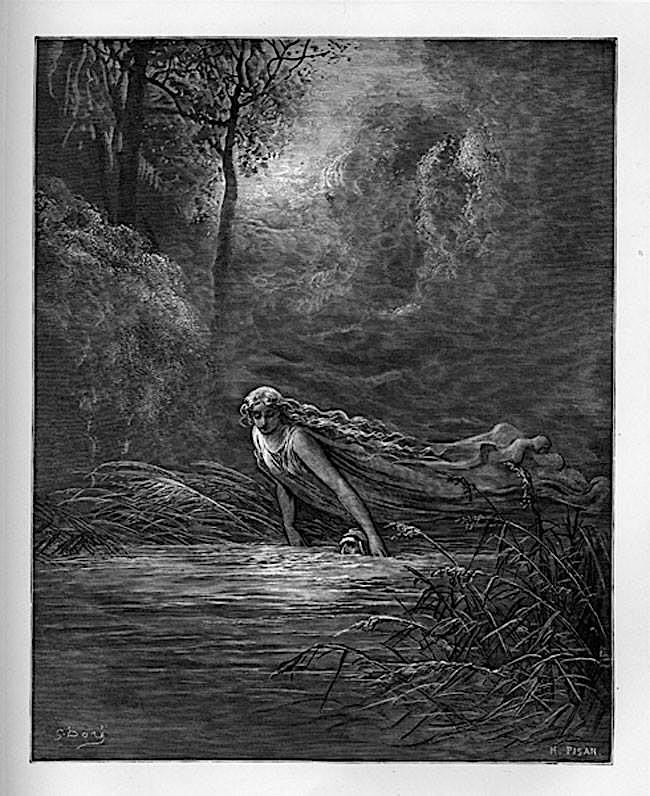
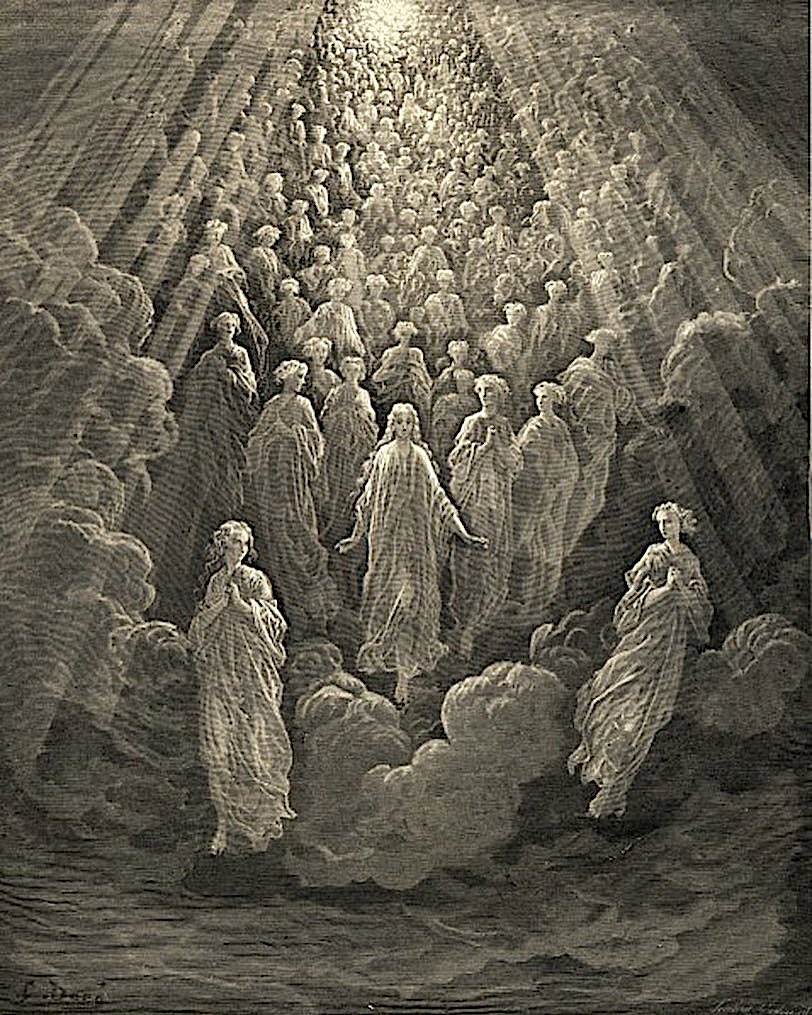
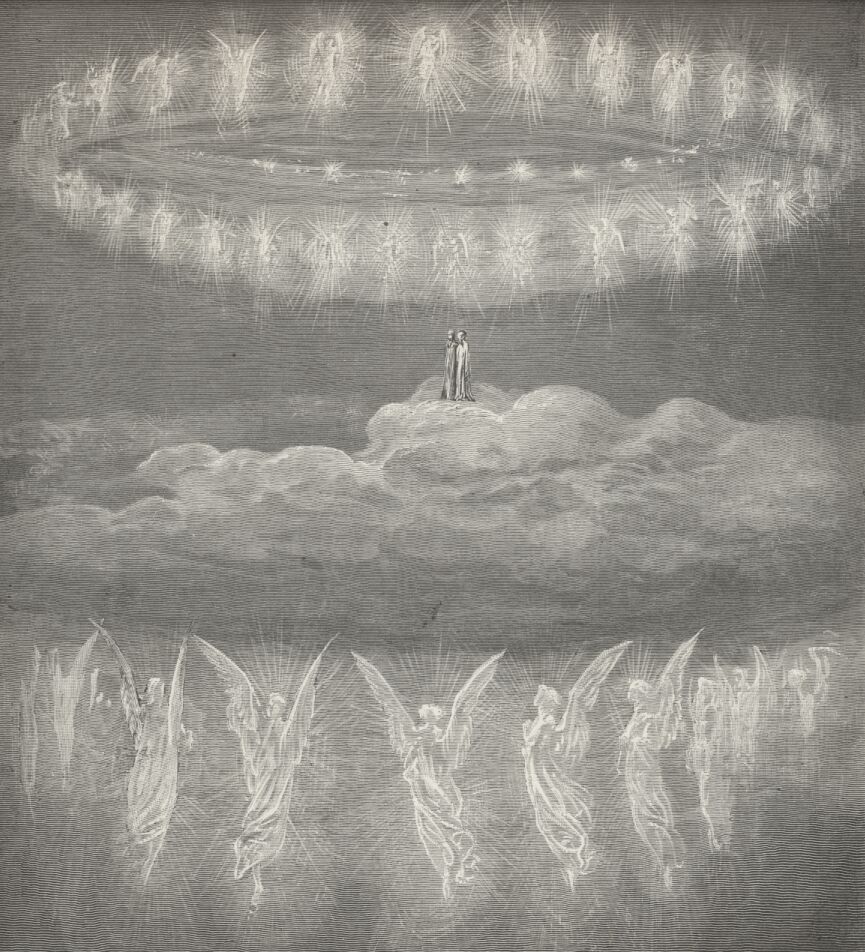
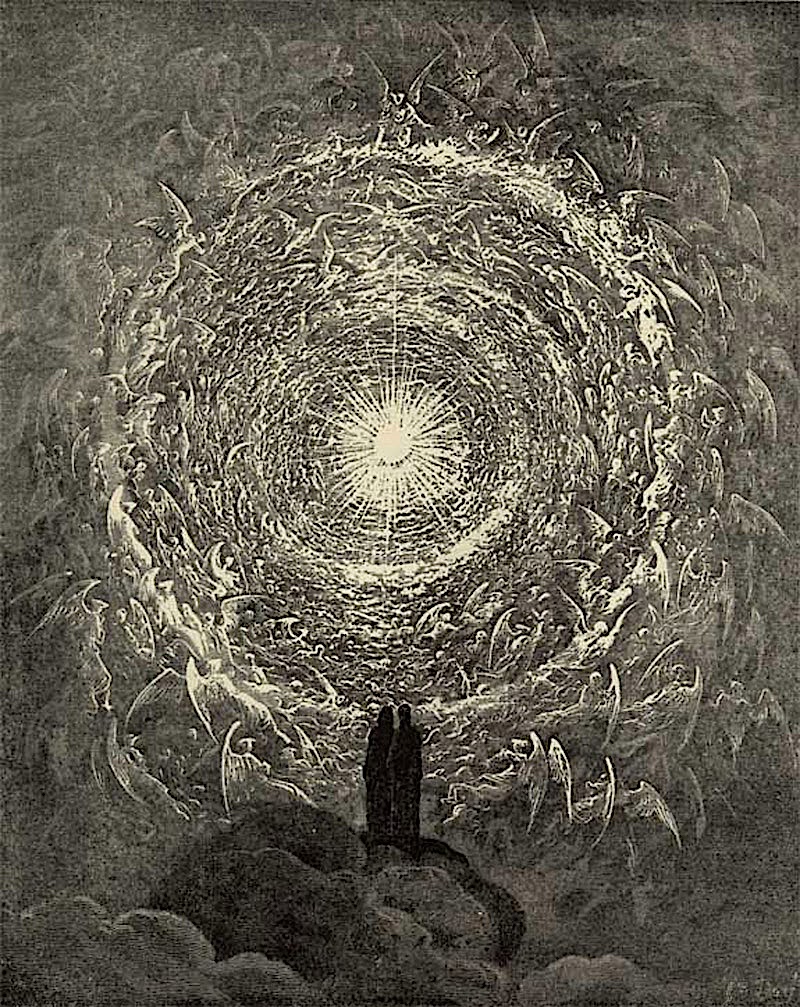
Many artists have attempted to illustrate Dante Alighieri’s epic poem the Divine Comedy, but none have made such an indelible stamp on our collective imagination as the Frenchman Gustave Doré.
Doré was 23 years old in 1855, when he first decided to create a series of engravings for a deluxe edition of Dante’s classic. He was already the highest-paid illustrator in France, with popular editions of Rabelais and Balzac under his belt, but Doré was unable to convince his publisher, Louis Hachette, to finance such an ambitious and expensive project. The young artist decided to pay the publishing costs for the first book himself. When the illustrated Inferno came out in 1861, it sold out fast. Hachette summoned Doré back to his office with a telegram: “Success! Come quickly! I am an ass!”
Hachette published Purgatorio and Paradiso as a single volume in 1868. Since then, Doré’s Divine Comedy has appeared in hundreds of editions. Although he went on to illustrate a great many other literary works, from the Bible to Edgar Allan Poe’s “The Raven,” Doré is perhaps best remembered for his depictions of Dante. At The World of Dante, art historian Aida Audeh writes:
Characterized by an eclectic mix of Michelangelesque nudes, northern traditions of sublime landscape, and elements of popular culture, Doré’s Dante illustrations were considered among his crowning achievements — a perfect match of the artist’s skill and the poet’s vivid visual imagination. As one critic wrote in 1861 upon publication of the illustrated Inferno: “we are inclined to believe that the conception and the interpretation come from the same source, that Dante and Gustave Doré are communicating by occult and solemn conversations the secret of this Hell plowed by their souls, traveled, explored by them in every sense.”
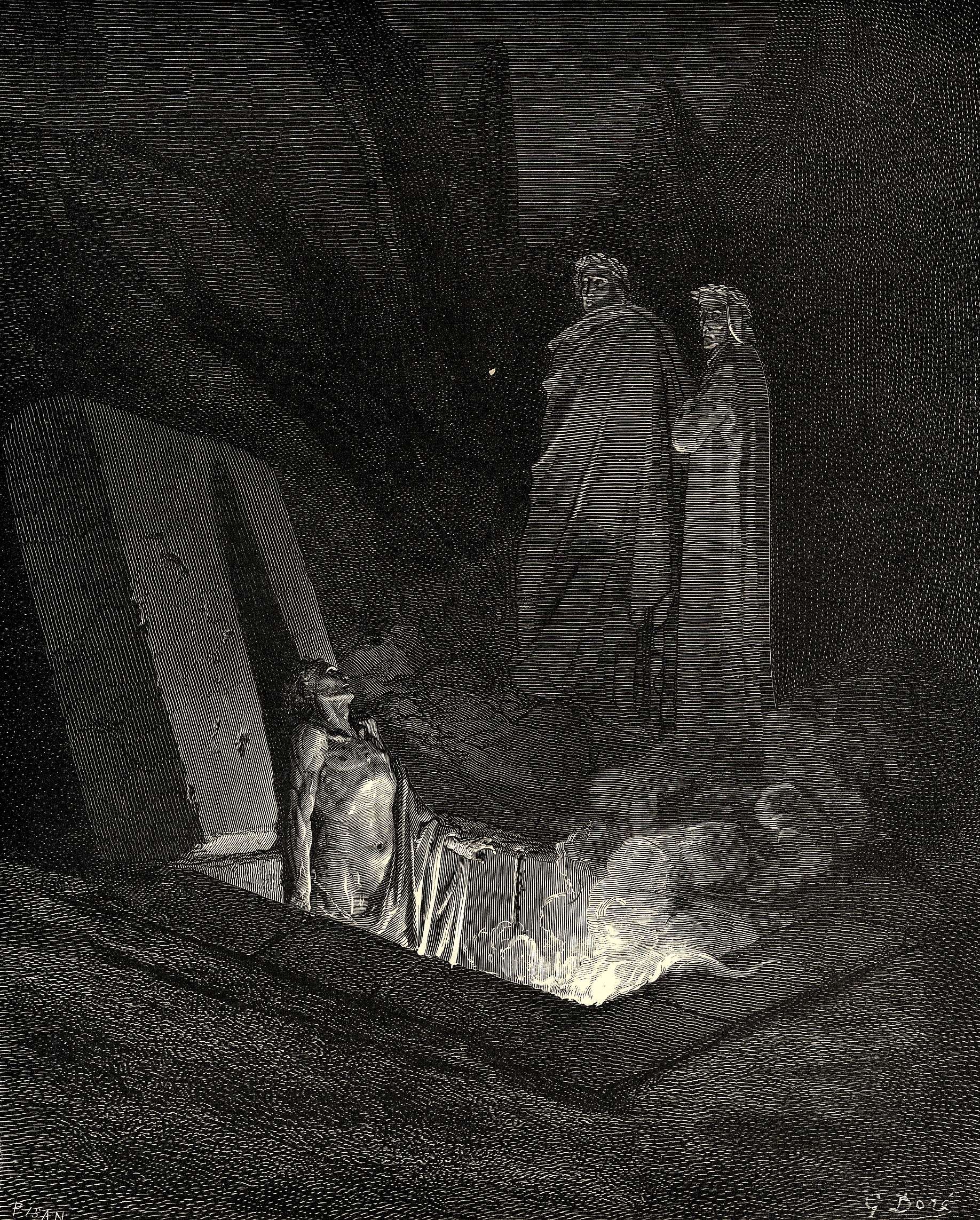
The scene above is from Canto X of the Inferno. Dante and his guide, Virgil, are passing through the Sixth Circle of Hell, in a place reserved for the souls of heretics, when they look down and see the imposing figure of Farinata degli Uberti, a Tuscan nobleman who had agreed with Epicurus that the soul dies with the body, rising up from an open grave. In the translation by John Ciardi, Dante writes:
My eyes were fixed on him already. Erect, he rose above the flame, great chest, great brow; he seemed to hold all Hell in disrespect
Inferno, Canto XVI:
As Dante and Virgil prepare to leave Circle Seven, they are met by the fearsome figure of Geryon, Monster of Fraud.Virgil arranges for Geryon to fly them down to Circle Eight. He climbs onto the monster’s back and instructs Dante to do the same.
Then he called out: “Now, Geryon, we are ready: bear well in mind that his is living weight and make your circles wide and your flight steady.”
As a small ship slides from a beaching or its pier, backward, backward — so that monster slipped back from the rim. And when he had drawn clear
he swung about, and stretching out his tail he worked it like an eel, and with his paws he gathered in the air, while I turned pale.
Inferno, Canto XXXIV:
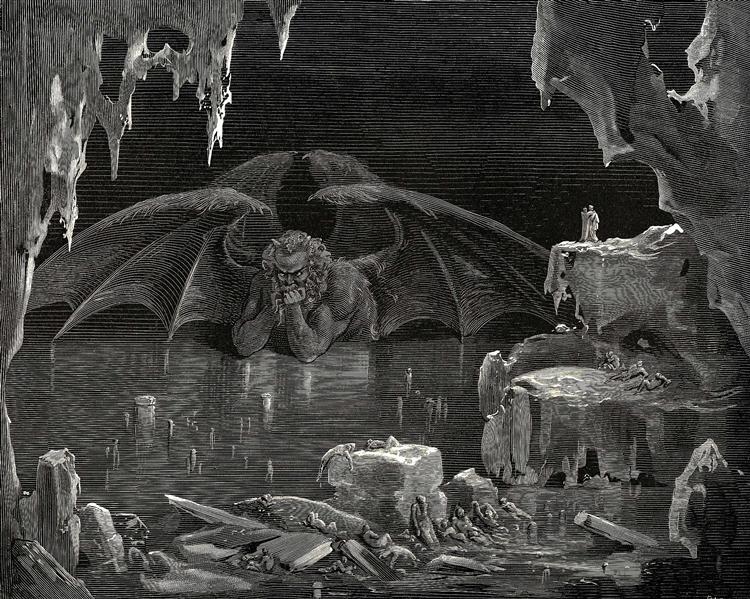
In the Ninth Circle of Hell, at the very center of the Earth, Dante and Virgil encounter the gigantic figure of Satan. As Ciardi writes in his commentary:
He is fixed into the ice at the center to which flow all the rivers of guilt; and as he beats his great wings as if to escape, their icy wind only freezes him more surely into the polluted ice. In a grotesque parody of the Trinity, he has three faces, each a different color, and in each mouth he clamps a sinner whom he rips eternally with his teeth. Judas Iscariot is in the central mouth: Brutus and Cassius in the mouths on either side.
Purgatorio, Canto II:
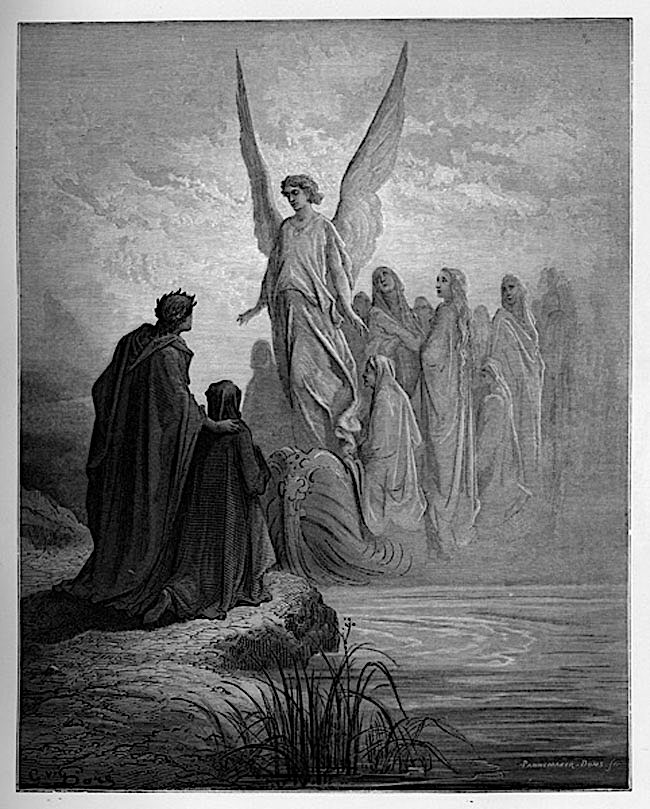
At dawn on Easter Sunday, Dante and Virgil have just emerged from Hell when they witness The Angel Boatman speeding a new group of souls to the shore of Purgatory.
Then as that bird of heaven closed the distance between us, he grew brighter and yet brighter until I could no longer bear the radiance,
and bowed my head. He steered straight for the shore, his ship so light and swift it drew no water; it did not seem to sail so much as soar.
Astern stood the great pilot of the Lord, so fair his blessedness seemed written on him; and more than a hundred souls were seated forward,
singing as if they raised a single voice
in exitu Israel de Aegypto. Verse after verse they made the air rejoice.
The angel made the sign of the cross, and they cast themselves, at his signal, to the shore. Then, swiftly as he had come, he went away.
Purgatorio, Canto IV:
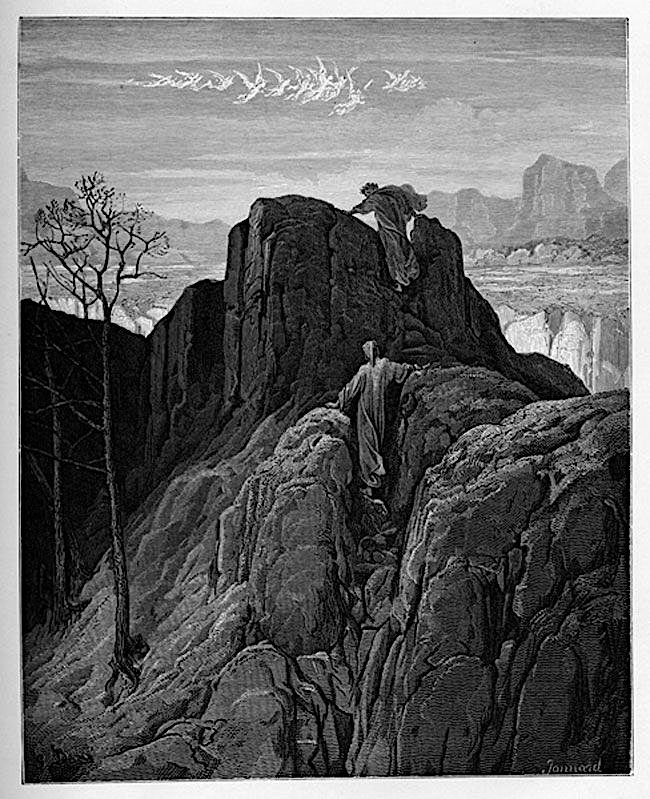
The poets begin their laborious climb up the Mount of Purgatory. Partway up the steep path, Dante cries out to Virgil that he needs to rest.
The climb had sapped my last strength when I cried: “Sweet Father, turn to me: unless you pause I shall be left here on the mountainside!”
He pointed to a ledge a little ahead that wound around the whole face of the slope. “Pull yourself that much higher, my son,” he said.
His words so spurred me that I forced myself to push on after him on hands and knees until at last my feet were on that shelf.
Purgatorio, Canto XXXI:
Having ascended at last to the Garden of Eden, Dante is immersed in the waters of the Lethe, the river of forgetfulness, and helped across by the maiden Matilda. He drinks from the water, which wipes away all memory of sin.
She had drawn me into the stream up to my throat, and pulling me behind her, she sped on over the water, light as any boat.
Nearing the sacred bank, I heard her say in tones so sweet I cannot call them back, much less describe them here: “Asperges me.”
Then the sweet lady took my head between her open arms, and embracing me, she dipped me and made me drink the waters that make clean.
Paradiso, Canto V:
In the Second Heaven, the Sphere of Mercury, Dante sees a multitude of glowing souls. In the translation by Allen Mandelbaum, he writes:
As in a fish pool that is calm and clear, the fish draw close to anything that nears from outside, it seems to be their fare, such were the far more than a thousand splendors I saw approaching us, and each declared: “Here now is one who will increase our loves.” And even as each shade approached, one saw, because of the bright radiance it set forth, the joyousness with which that shade was filled.
Paradiso, Canto XXVIII:
Upon reaching the Ninth Heaven, the Primum Mobile, Dante and his guide Beatrice look upon the sparkling circles of the heavenly host. (The Christian Beatrice, who personifies Divine Love, took over for the pagan Virgil, who personifies Reason, as Dante’s guide when he reached the summit of Purgatory.)
And when I turned and my own eyes were met By what appears within that sphere whenever one looks intently at its revolution, I saw a point that sent forth so acute a light, that anyone who faced the force with which it blazed would have to shut his eyes, and any star that, seen from the earth, would seem to be the smallest, set beside that point, as star conjoined with star, would seem a moon. Around that point a ring of fire wheeled, a ring perhaps as far from that point as a halo from the star that colors it when mist that forms the halo is most thick. It wheeled so quickly that it would outstrip the motion that most swiftly girds the world.
Paradiso, Canto XXXI:
In the Empyrean, the highest heaven, Dante is shown the dwelling place of God. It appears in the form of an enormous rose, the petals of which house the souls of the faithful. Around the center, angels fly like bees carrying the nectar of divine love.
So, in the shape of that white Rose, the holy legion has shown to me — the host that Christ, with His own blood, had taken as His bride. The other host, which, flying, sees and sings the glory of the One who draws its love, and that goodness which granted it such glory, just like a swarm of bees that, at one moment, enters the flowers and, at another, turns back to that labor which yields such sweet savor, descended into that vast flower graced with many petals, then again rose up to the eternal dwelling of its love.
If you would like to support the mission of Open Culture, consider making a donation to our site. It’s hard to rely 100% on ads, and your contributions will help us continue providing the best free cultural and educational materials to learners everywhere. You can contribute through PayPal, Patreon, and Venmo (@openculture). Thanks!
Note: An earlier version of this post appeared on our site in October 2013.
No pop music can have inspired more scrutiny than that of the Beatles. Of course, intense and sustained attention has been paid to every aspect of the band’s existence — and, in the case of Paul McCartney, his purported non-existence as well. The theory that he actually died in the nineteen-sixties and was thereafter secretly played by a double has demonstrated such pop-cultural staying power that even those who barely know the Beatles’ music make reference to it. The phrase “Turn me on, dead man” now floats free of its origin, an act of creative listening applied to “Revolution 9” played backwards.
The idea, as explained in the Vinyl Rewind video above, is that “after an argument during a Beatles recording session on November 9th, 1966, Paul McCartney sped off in his car, only to be decapitated in an auto accident when he lost control of his vehicle. The U.K. security service MI5 advised the band to find a replacement, for they feared that if the news of Paul’s death got out, mass hysteria would spread among Beatles fans, leading to civil unrest and, possibly, mass suicide.” The hunt for a Paul lookalike turned up “a Scottish orphan named William Shears Campbell, also known as Billy Shears.”
That name will sound familiar to even casual Beatles listeners, announced as it is so prominently, and so early, on Sgt. Pepper’s Lonely Hearts Club Band. The album’s cover, too, proved to be a fount of imagery suggesting that the rumor of Paul’s death, which had been referenced in an official Beatles publication in 1967 specifically to dispel it, was actually true. A couple of years later, a Detroit radio DJ and a University of Michigan student-journalist got the story into wide circulation. No one clue — the recurring shoelessness of Paul or his impersonator, the death-of-Oswald lines from King Lear incorporated into “I Am the Walrus,” the car wreck described in “A Day in the Life,” the license-plate of the VW on Abbey Road’s cover — was dispositive, but eventually, they added up.
They added up if you were expressly looking for evidence of Paul’s death and substitution: engaging in pareidolia, in other words, the tendency to perceive meaningful patterns in random noise, or in this case a range of minor, non-orchestrated details across pieces of media. Given the Beatles’ personalities, nobody would put it past them to make cheeky hidden references to exactly what they weren’t supposed to talk about, but anyone familiar with the music business would also suspect that Capitol Records had no interest in putting a stop to a false rumor that was generating a profit. It’s certainly a stretch to imagine that someone who just happens to look like Paul McCartney would also be willing and able to carry on the man’s solo career for decade after decade. But then, the history of popular music is full of lucky men, and maybe — just maybe — Billy Shears was among the luckiest.
Based in Seoul, Colin Marshall writes and broadcasts on cities, language, and culture. His projects include the Substack newsletterBooks on Cities and the book The Stateless City: a Walk through 21st-Century Los Angeles. Follow him on the social network formerly known as Twitter at @colinmarshall.
There isn’t much place for dodecahedra in modern life, at least in those modern lives with tabletop role-playing. In the ancient Roman Empire, however, those shapes seem to have been practically household objects — not that we know what the household would have done with them. Thus far, well over 100 similarly designed copper-alloy second-to-fourth-century artifacts labeled “Roman dodecahedra” have been discovered: the first was unearthed in 1739, and the most recent just two years ago. With their complex structure, knobbed corners, and (in some cases) surface designs, their construction would have required a skilled metalworker. Perhaps they were the result of professional examination, premised on the idea that a man who can make a proper dodecahedron can make anything.
That’s one theory, if only one of many. In the video above, Joe Scott goes over a variety of them, explaining why amateurs and experts alike have proposed that the Roman dodecahedron was everything from a military rangefinder to a sundial calendar to a decoder to a measuring device to a coin validator to a ritualistic amulet to a “Roman fidget spinner.”
One particularly compelling explanation holds that it was an aid for a chain-making technique called “Viking knitting,” which would at least make sense given that all extant examples have come from northern Europe. Yes, no Roman dodecahedron has ever been found in Rome, or even in the whole of Italy, and that’s far from the most confusing fact about these still-mysterious objects.
The proposition that the Roman dodecahedron was a knitting aid, especially if it was used for making chain, is undercut by the lack of wear on all known examples. Military or technical applications are also made somewhat implausible by the absence of numerals or other markings. While some Roman dodecahedra have been dug up from army camps, many more came from the tombs of upper-class women, suggesting that they had more value as a status symbol than a practical tool. Most bewildering of all is the fact that no texts or images from the period make any reference to the things, which Scott takes as evidence for their being so common as not to merit discussion — much like, say, the icebox doors or telephone shelves built into nineteenth and early twentieth-century houses. At this point, can we really rule out the notion that the Romans made them as a prank on the far-future inheritors of their civilization?
Based in Seoul, Colin Marshall writes and broadcasts on cities, language, and culture. His projects include the Substack newsletterBooks on Cities and the book The Stateless City: a Walk through 21st-Century Los Angeles. Follow him on the social network formerly known as Twitter at @colinmarshall.
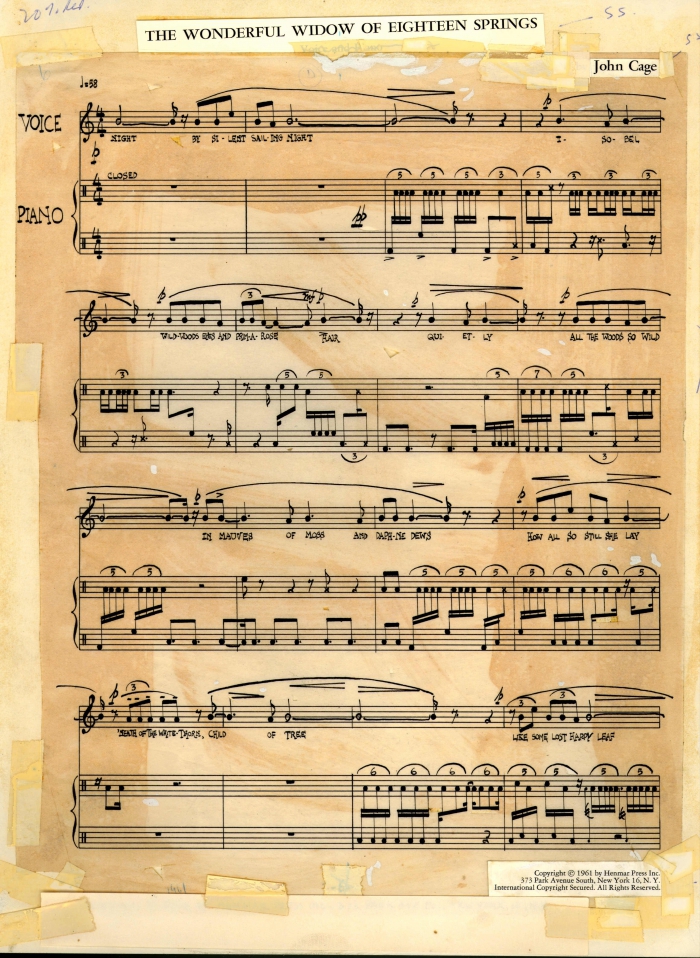
In 1942, John Cage composed a short piece of music adapted from the text of James Joyce’s Finnegans Wake. Titled “The Wonderful Widow of Eighteen Springs,” the piece was originally commissioned and performed by amateur soprano and socialite Justine Fairbank, and while we don’t have a recording of her performance, we do have Cage’s sheet music (see first page above, or view the entire book here). It is—as one might expect—an unusual piece. It sounds like song, yet isn’t. As the Library of Congress description of the piece has it:
This essentially rhythmic speech set against a patterned percussive accompaniment cannot be considered a song in the usual sense. Cage, however, is such an innovator that one often loses sight of the fact that if one does not expect conventional sounds, his music is often very well constructed. Here, for example, the composer weaves a hypnotically compelling pattern of rhythmic tension and relaxation, akin to certain non-Western music, which is very appropriate for Joyce’s moody prose.
Cage’s own instructions “for the singer” state: “sing without vibrato, as in folk-singing. Make any transposition necessary in order to employ a low and comfortable range.”
This flexible arrangement allows anyone to pick up the piece, and so we have, directly below, an unlikely interpreter of Cage’s experimental art, the late Ramones singer Joey Ramone. Ramone’s interpretation of the piece is enthralling simply as a piece of recorded music. But it’s also a fascinating piece of cultural history, representing a confluence of the foremost figures in early twentieth century modernist literature, mid-century avant-garde music, and late century punk rock.
The recording comes from a whole album of Cage interpretations by New York punk and new- and no-wave art-rockers, including David Byrne, Arto Lindsay, John Zorn, Debbie Harry, and Lou Reed. The album, entitled Caged/Uncaged—A Rock/Experimental Homage to John Cage, was recorded in Italy in 1993 and produced by John Cale. You can listen to tracks at Ubuweb.
It’s more than just a tribute record; it’s a serious engagement with the music of a composer whose work—like the fluid prose-poetry of Finnegans Wake—seems infinitely malleable and adaptable to the present. Forty years after composing the song Joey Ramone performs, Cage said, “we live, in a very deep sense, in the time of Finnegans Wake.” Perhaps we still live in the time of Joyce, and also of John Cage.
Note: An earlier version of this post appeared on our site in 2013.
Browse the ever-vaster selection of self-help books, videos, podcasts, and social-media accounts on offer today, and you’ll find no shortage of prescriptions for how to live. Much of what the gurus of the twenty-twenties have to say sounds awfully similar, and almost as much may seem contradictory. As in so many fields of human endeavor, the best strategy could be to look to the classics first, and as rules for living go, few have stood more of a test of time than the 21 principles of Dokkōdō, or “The Path of Aloneness,” written by the seventeenth-century swordsman Miyamoto Musashi, who’s said to have fought 62 duels and won them all.
Whatever the actual number was, Miyamoto clearly knew something that most of his opponents didn’t — and for that matter, something that most of us today probably don’t either. It was at the very end of his 60-year-long life, about which you can learn more from the videos from Pursuit of Wonder above and Einzelgänger below, that this most famous of all samurai condensed his wisdom into the principles of Dokkōdō, which are as follows:
Accept everything just the way it is.
Do not seek pleasure for its own sake.
Do not, under any circumstances, depend on a partial feeling.
Think lightly of yourself and deeply of the world.
Be detached from desire your whole life long.
Do not regret what you have done.
Never be jealous.
Never let yourself be saddened by a separation.
Resentment and complaint are appropriate neither for oneself nor others.
Do not let yourself be guided by the feeling of lust or love.
In all things have no preferences.
Be indifferent to where you live.
Do not pursue the taste of good food.
Do not hold on to possessions you no longer need.
Do not act following customary beliefs.
Do not collect weapons or practice with weapons beyond what is useful.
Do not fear death.
Do not seek to possess either goods or fiefs for your old age.
Respect Buddha and the gods without counting on their help.
You may abandon your own body but you must preserve your honor.
Never stray from the Way.
The reference to Buddha in principle #19 may not come as a surprise, given how rich this list is with apparently Buddhist themes: relinquishment of desire, release of attachments, acceptance of the inevitable. There are also resonances with contemporary texts on the art of living produced by civilizations well outside Asia: Spanish Jesuit priest Baltasar Gracían’s Oráculo Manual y Arte de Prudencia (or The Art of Worldly Wisdom), for instance, which was first published just two years after the principles of Dokkōdō.
You might also sense much in common between Miyamoto’s worldview and that of the Stoics, who were laying down their own precepts fifteen or sixteen centuries earlier. Each in his own way, Epictetus, Marcus Aurelius, and Seneca reached a form of the same understanding that Miyamoto did: that we must first, as he himself puts it, “accept everything just the way it is.” We may devote our lives to satisfying our preferences, but both the Stoics and the samurai knew that, as Pursuit of Wonder’s narrator puts it, “it is our ability to shift with a world that regularly opposes our preferences that enhances the quality of our experience.” Among Miyamoto’s distinctive contributions is his emphasis on focus: that is, “clear intent, devoted attention, emotional control, perceptiveness, and a kind of mental emptiness and adaptability”: all qualities that, having just last week become a father of two, I’d surely do well to start cultivating in myself.
Based in Seoul, Colin Marshall writes and broadcasts on cities, language, and culture. His projects include the Substack newsletterBooks on Cities and the book The Stateless City: a Walk through 21st-Century Los Angeles. Follow him on the social network formerly known as Twitter at @colinmarshall.
Between 1985 and 1988, a teenager by the name of Sohrab Habibion was attending punk and post-punk shows around the Washington, DC area. What set him apart was the bulky video camera he’d bring to the show and let roll, documenting entire gigs in all their low-rez, lo-fi glory. Just a kid trying to document a great night out. Habibion might not have known at the time what an important time capsule he was creating, but these 60 or so tapes have now been digitized and uploaded to YouTube, thanks to Roswell Films and the DC Public Library’s Punk Archive.
“Please keep in mind that I was a teenager when I shot these shows,” Habibion writes, “and had zero proficiency with the equipment. And, as you might imagine, nobody was doing anything with the lights or the sound to make things any better. What you get here is what was recorded on my Betamax and probably best appreciated with a bit of generosity as a viewer.”
Highlights include the above full concert by Fugazi on December 28, 1987, a year before their first e.p. and playing songs that would turn up on their 1990’s classic debut Repeater; Descendents in 1987 at the height of their career; The Lemonheads when they were a punk band and not a power pop group; the insane and hilarious GWAR from 1988, the year of their debut; and another hometown punk band, Dain Bramage, which featured Dave Grohl on drums, long before he played with Nirvana and the Foo Fighters (see below).
Habibion went on to his own musical career: first as the frontman for post-hardcore band Edsel, and currently as part of the band SAVAK.
Habibion’s tape archive makes one wonder: who else is out there sitting on a trove of historic recordings? And where is that person’s equivalent of the DC Library? Who would help fund such a project? And who would see the worth of such recordings? Not only are Habibion’s tapes about the bands themselves, but they tell a separate history of music venues come and gone, of a time and place that will never come again. Watch the shows here.
Note: An earlier version of this post appeared on our site in 2022.
Ted Mills is a freelance writer on the arts who currently hosts the Notes from the Shed podcast and is the producer of KCRW’s Curious Coast. You can also follow him on Twitter at @tedmills, and/or watch his films here.
You could say that we live in the age of artificial intelligence, although it feels truer about no aspect of our lives than it does of advertising. “If you want to sell something to people today, you call it AI,” says Yuval Noah Harari in the new Big Think video above, even if the product has only the vaguest technological association with that label. To determine whether something should actually be called artificially intelligent, ask whether it can “learn and change by itself and come up with decisions and ideas that we don’t anticipate,” indeed can’t anticipate. That AI-enabled waffle iron being pitched to you probably doesn’t make the cut, but you may already be interacting with numerous systems that do.
As the author of the global bestseller Sapiens and other books concerned with the long arc of human civilization, Harari has given a good deal of thought to how technology and society interact. “In the twentieth century, the rise of mass media and mass information technology, like the telegraph and radio and television” formed “the basis for large-scale democratic systems,” but also for “large-scale totalitarian systems.”
Unlike in the ancient world, governments could at least begin to “micromanage the social and economic and cultural lives of every individual in the country.” Even the vast surveillance apparatus and bureaucracy of the Soviet Union “could not surveil everybody all the time.” Alas, Harari anticipates, things will be different in the AI age.
Human-operated organic networks are being displaced by AI-operated inorganic ones, which “are always on, and therefore they might force us to be always on, always being watched, always being monitored.” As they gain dominance, “the whole of life is becoming like one long job interview.” At the same time, even if you were already feeling inundated by information before, you’ve more than likely felt the waters rise around you due to the infinite production capacities of AI. One individual-level strategy Harari recommends to counteract the flood is going on an “information diet,” restricting the flow of that “food of the mind,” which only sometimes has anything to do with the truth. If we binge on “all this junk information, full of greed and hate and fear, we will have sick minds; perhaps a period of abstinence can restore a certain degree of mental health. You might consider spending the rest of the day taking in as little new information as possible — just as soon as you finish catching up on Open Culture, of course.
Based in Seoul, Colin Marshall writes and broadcasts on cities, language, and culture. His projects include the Substack newsletterBooks on Cities and the book The Stateless City: a Walk through 21st-Century Los Angeles. Follow him on the social network formerly known as Twitter at @colinmarshall.
We're hoping to rely on loyal readers, rather than erratic ads. Please click the Donate button and support Open Culture. You can use Paypal, Venmo, Patreon, even Crypto! We thank you!
Open Culture scours the web for the best educational media. We find the free courses and audio books you need, the language lessons & educational videos you want, and plenty of enlightenment in between.