During the 1970s and beyond, Brand founded CoEvolution Quarterly, a successor to the Whole Earth Catalog; the WELL (“Whole Earth ‘Lectronic Link”), “a prototypical, wide-ranging online community for intelligent, informed participants the world over;” and eventually The Long Now Foundation, whose work we’ve highlighted here before. When not creating new institutions, he has poured his creative energies into books and films.
Above you can watch How Buildings Learn, Brand’s six-part BBC TV series from 1997, which comes complete with music by Brian Eno. Based on his illustrated book sharing the same title, the TV series offers a critique of modernist approaches to architecture (think Buckminster Fuller, Frank Gehry, and Le Corbusier) and instead argues for “an organic kind of building, based on four walls, which is easy to change and expand and grow as the ideal form of building.”
Brand made the series available on his YouTube channel, with these words: “Anybody is welcome to use anything from this series in any way they like… Hack away. Do credit the BBC, who put considerable time and talent into the project.” And he added the noteworthy footnote: “this was one of the first television productions made entirely in digital—shot digital, edited digital.”
Find the first three parts above, and the remaining parts below:
Among Beatles connoisseurs, it’s fair game to claim anything from Rubber Soul to Abbey Road as one’s favorite album. But even within that span of the catalog, a hierarchy of acclaim exists, and that hierarchy has been rearranged over the decades. The ecstatic reception of Sgt. Pepper’s Lonely Hearts Club Band lasted at least a decade. By the turn of the nineteen-eighties, its immediate predecessor Revolver had joined it at the top spot of critical regard; twenty years after that, Abbey Road had displaced Sgt. Pepper. Now, a full 60 years after it first came out, Revolver is the single Beatles album held in the highest esteem — which, naturally, makes it a serious contender for the greatest album ever recorded.
In his new video above, music YouTuber David Hartley explains what makes Revolver so beloved by recounting the history of its production. As in his previous Beatles videos, he draws on the library of studio outtakes that make audible the evolution of each song, as well as on contemporary interviews with the Beatles and their collaborators.
Among his most illuminating sources is engineer Geoff Emerick’s memoir Here, There, and Everywhere — titled, incidentally after one of the songs on this very album, the challenge of whose recording he took on at just twenty years old. In the event, his youth proved an asset, granting him as it did the willingness not just to execute the Beatles’ “far-out” sonic ideas, but also to violate EMI Studios’ policies against experimental use of its hardware in the process.
Indeed, if it was possible in 1966, it seems to have been tried in the making of Revolver. As Hartley reveals, “I’m Only Sleeping” once featured a vibraphone, “Yellow Submarine” once began with a spoken-word intro, and “And Your Bird Can Sing” once kept getting interrupted by uncontrollable and quite possibly substance-induced laughter. Neither these nor any of the album’s other now-familiar, much-scrutinized songs took straight paths to their final forms. Into a runtime of only 35 minutes, the Beatles managed to put everything from “a children’s singalong song” to “a song complaining about all the money they were paying in taxes” to “a song about loneliness” to “a song about laziness” — while also transmitting the “great feeling of joy” for which their oeuvre is known. Revolver’s place in the canon of albums is secure, but will it still be considered the band’s best work on its 70th anniversary? Tomorrow, as they say, never knows.
Based in Seoul, Colin Marshall writes and broadcasts on cities, language, and culture. He’s the author of the newsletterBooks on Cities as well as the books 한국 요약 금지 (No Summarizing Korea) and Korean Newtro.Follow him on the social network formerly known as Twitter at @colinmarshall.
Like many American stories, the story of the National Parks begins with pillage, death, deep cultural misunderstanding, and venture capitalism. According to Ken Burns’ film series The National Parks: America’s Best Idea, we can date the idea back to 1851, with the “discovery” of Yosemite by a marauding armed battalion that entered the land “searching for Indians, intent on driving the natives from their homelands and onto reservations.” The Mariposa Battalion, led by Captain James D. Savage, set fire to the Indians’ homes and storehouses after they had retreated to the mountains, “in order to starve them into submission.”
One member of the battalion, a doctor named Lafayette Bunnell, found himself entranced by the scenery amidst this destruction. “As I looked, a peculiar exalted sensation seemed to fill my whole being,” he wrote in his later accounts, “and I found myself in tears with emotion.” He named the place “Yosemite,” thinking it was the name of the Indian tribe the soldiers sought to force out or eradicate. The word, it turned out “meant something entirely different,” referring to people who should be feared: “It means, ‘they are killers.’”
In 1855, a failed English gold prospector turned the place into a tourist attraction, and people flooded West to see it, prompting New York worthies like Horace Greeley and Frederick Law Olmsted to lobby for its federal protection. In 1864, Abraham Lincoln deeded Yosemite Valley and the Mariposa Grove, with its giant sequoias, to the state of California. Ever since then, National Parks have been threatened—if not by the occasional political candidate and his billionaire backers hoping to privatize the land, then by oil and gas drilling, and by fire, rising seas, or other effects of climate change. Though the U.S. emptied many of the parks of their inhabitants, it is ironically only the actions of the federal government that prevent the process begun by the Mariposa Battalion from reaching its conclusion in the total despoliation of these landscapes. It is these landscapes that have most come to symbolize the national character, whether as background in Frederic Remington’s paintings of the Indian Wars or in the photographs of Ansel Adams, who began and sustained his career in Yosemite Valley. “Yosemite National Park,” writes the National Park Service’s website, “was Adams’ chief inspiration.”
Adams first became interested in visiting the National Park when he read In the Heart of the Sierras by James Hutchings—that failed English gold prospector. Thereafter, Adams photographed National Parks almost ritually, and in 1941, the National Park Service commissioned Adams to create a photo mural for the Department of the Interior Building in DC. The theme, the National Archives tells us, was to be “nature as exemplified and protected in the U.S. National Parks. The project was halted because of World War II and never resumed.” It must have felt like an especially sacred duty for Adams, who traveled the country photographing the Grand Canyon, Grand Teton, Kings Canyon, Mesa Verde, Rocky Mountain, Yellowstone, Yosemite, Carlsbad Caverns, Glacier, and Zion National Parks; Death Valley, Saguaro, and Canyon de Chelly National Monuments,” and other locations like the Boulder (now Hoover) Dam and desert vistas in New Mexico.
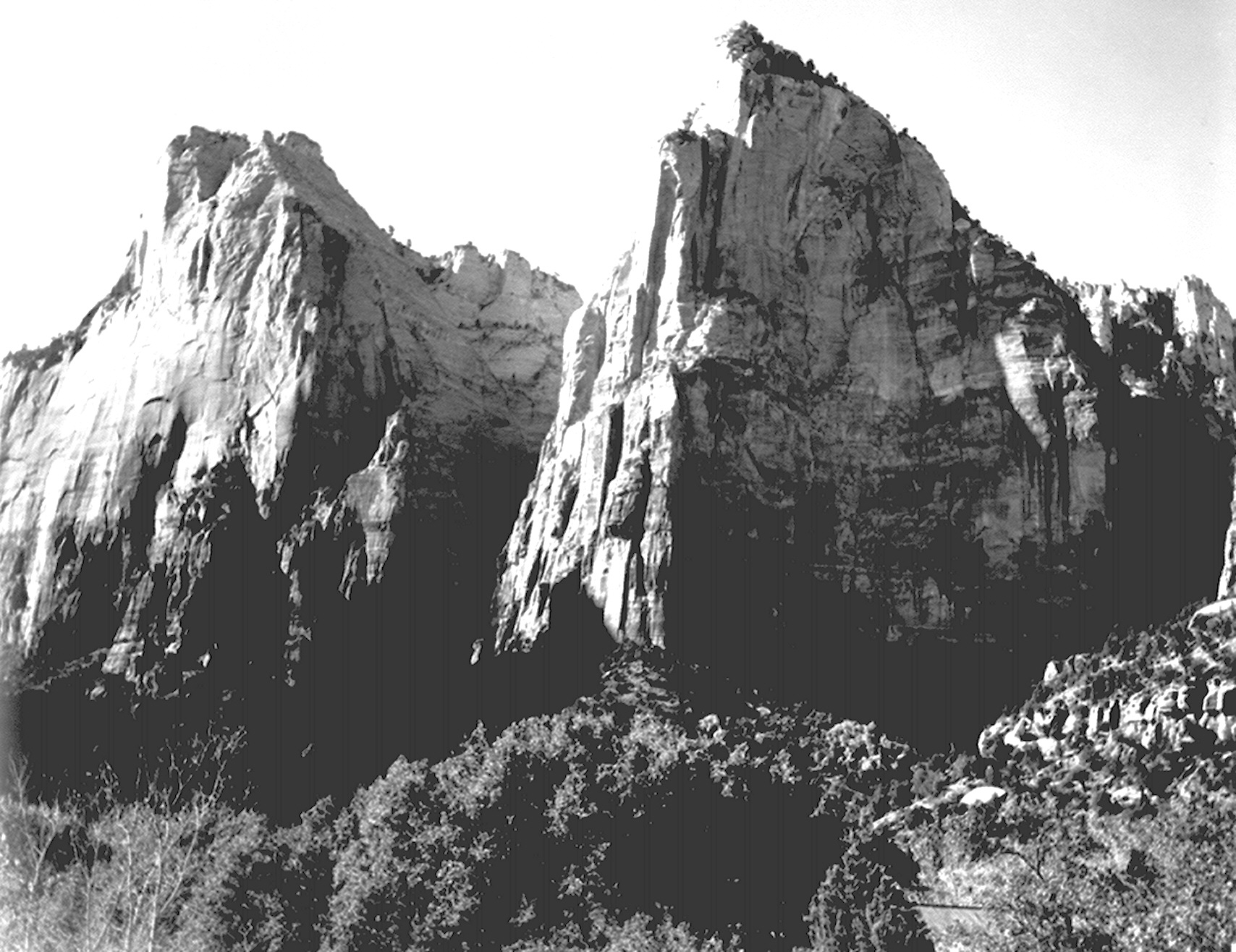
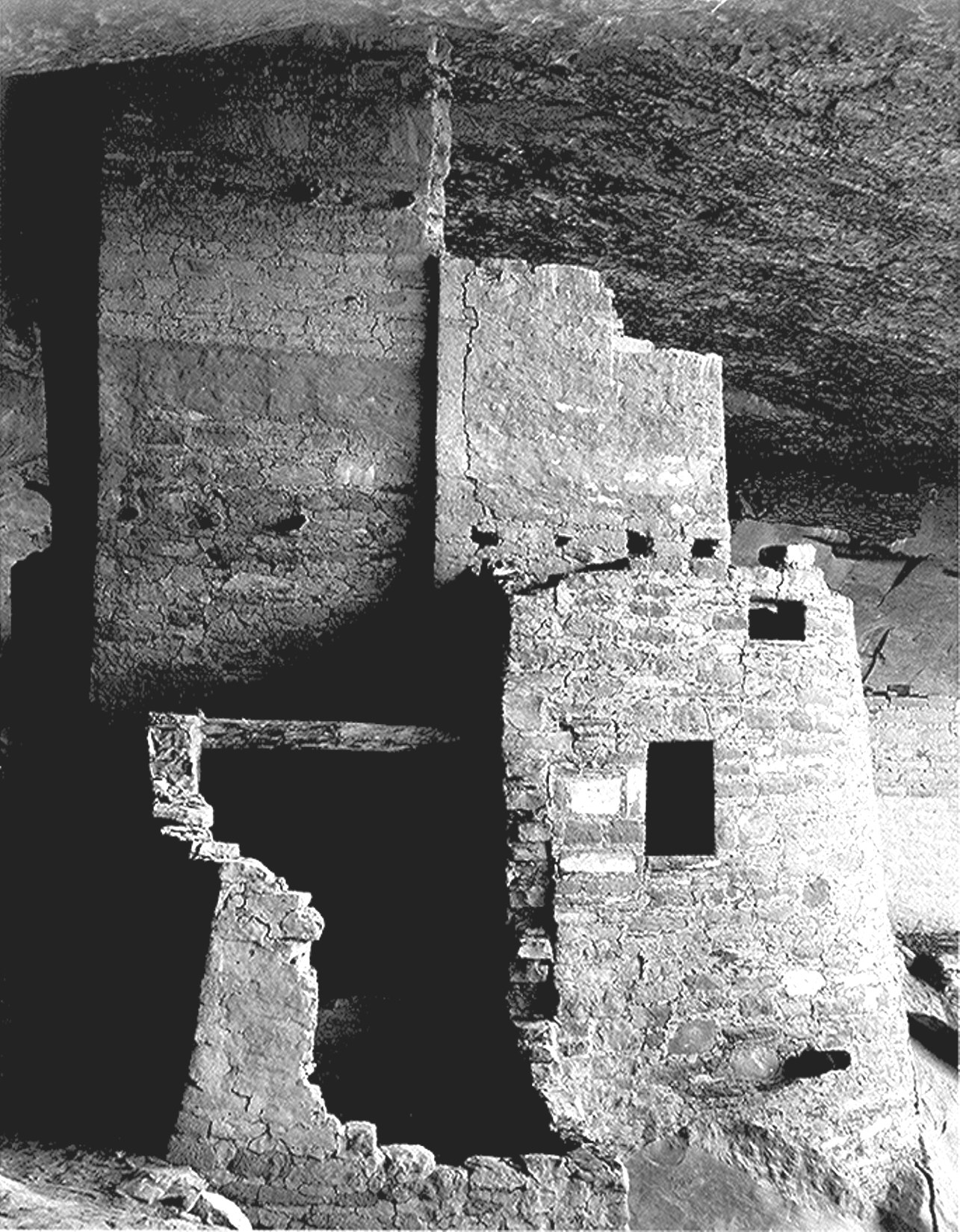
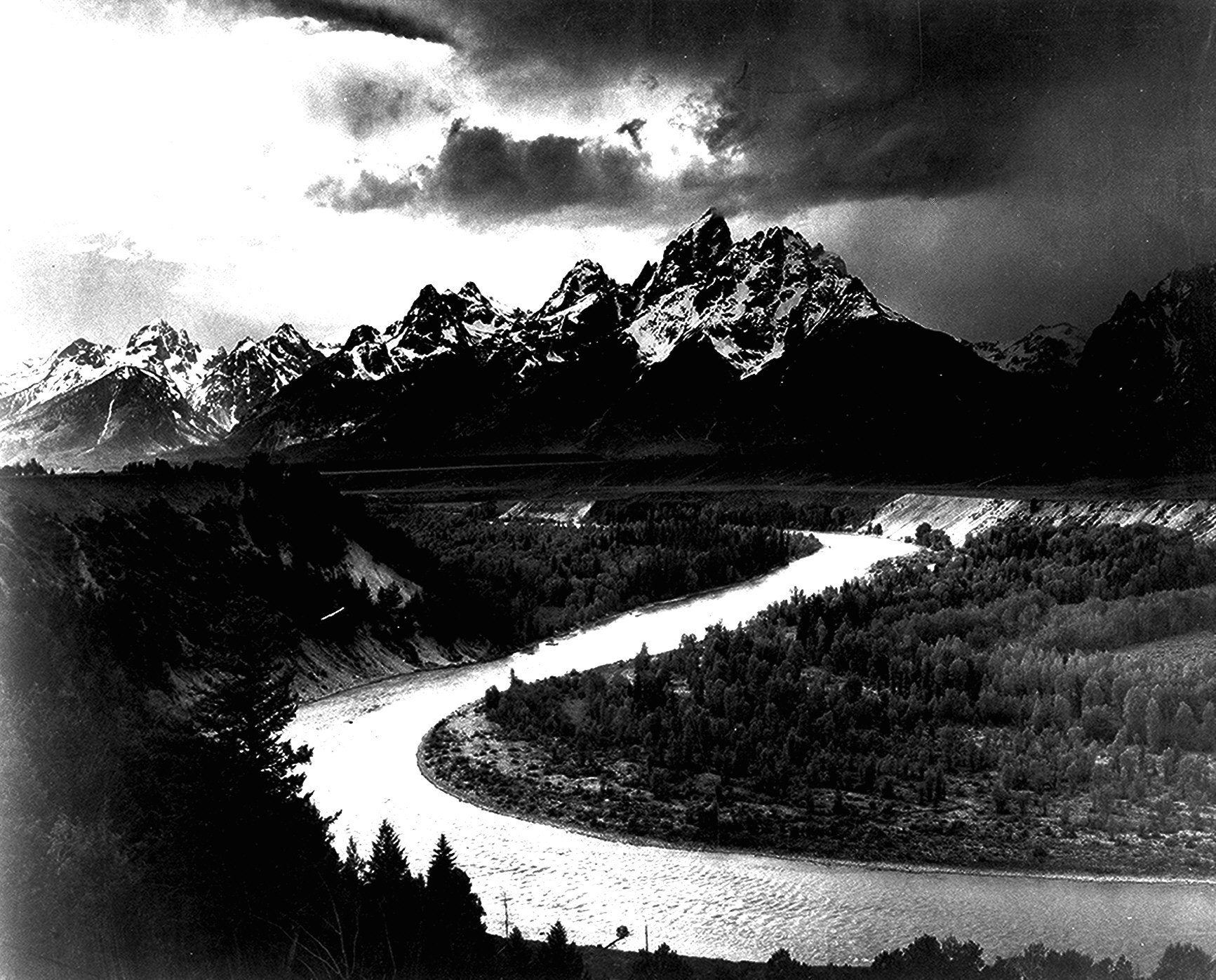
The photographs you see here are among the 226 taken by Adams for the project. They are now housed at the National Archives, and you can freely view them online or order prints at their site. At the top, we see a snow-covered tree from an apple orchard below Half Dome, Yosemite, where Adams had his first photographic “visualization” in 1927. Below it, the “Court of the Patriarchs” in Zion National Park, Utah. Further down, we have a breathtaking vision of the serpentine Grand Canyon, and just above, one of the few manmade structures, “Cliff Palace” at Mesa Verde National Park in Colorado. And here can you see a photograph of the Snake River in Grand Teton National Park.
The mural project may have been abandoned, but Adams never stopped photographing the parks, or advocating for their protection and, in fact, the protection of “the entire environment,” as he told a Playboy interviewer in 1983. “Only two and a half percent of the land in this country is protected,” said Adams then: “Not only are we being fought in trying to extend that two and a half percent to include other important or fragile areas but we are having to fight to protect that small two and a half percent. It is horrifying that we have to fight our own Government to save our environment.”
Alfred Hitchcock’s The Birds was nominated for an Academy Award for Best Special Effects, though viewers raised on more recent Hollywood spectacles would hardly find its mechanized and optically printed avian attackers convincing. Still, the picture as a whole has retained its eerie, ominous power over the last six decades, and a decent amount of the credit for that goes to an aspect that hasn’t dated at all: its non-musical “score” by the early electronic composer Oskar Sala. Many of the threatening bird calls on the soundtrack were actually played by Sala on a device called the Mixtur-Trautonium, a pre-synthesizer orchestral electronic instrument of which he wasn’t just the undisputed master, but the only player in existence.
After his acceptance into the Berlin Conservatory in 1929, Sala came into contact with the Trautonium, which had recently been invented by one Dr. Friedrich Trautwein. Inspired to more deeply understand the principles behind the nascent technology of electronic music, and to further it, he went on to study physics at the University of Berlin in the mid-nineteen-thirties.
This positioned him well to develop new models of Trautonium, a series that culminated in 1948 with the Mixtur-Trautonium, which, unlike Trautwein’s monophonic original, could sound multiple voices at once. The instrument proved versatile, and indeed commercial: any German who grew up in the nineteen-fifties will remember its sounds from television advertisements.
The chance to work on The Birds, by far Sala’s most widely heard soundtrack work, “presented itself when a former classmate of Sala who worked at Universal Studios in Hollywood heard that Hitchcock wanted synthetically produced bird sounds for his next movie,” says Google Arts & Culture. “Hitchcock, who deliberately wanted to avoid creating traditional movie music, even flew to Sala’s recording studio in Berlin where he was impressed by the sounds made by the Trautonium, which ultimately produced all the movie’s sound effects.” In collaboration with fellow pioneering electronic composer Remi Gassmann, Sala produced a veritable storm of not just avian shrieks and cackles, but also the harsh swirl of the elements and the creaks and groans of failing man-made infrastructure. Or at least that’s what moviegoers may imagine hearing in a soundtrack that often verges on the otherworldly, even the abstract — and Hitchcock knew that the imagination is the place from which real fear arises.
Based in Seoul, Colin Marshall writes and broadcasts on cities, language, and culture. He’s the author of the newsletterBooks on Cities as well as the books 한국 요약 금지 (No Summarizing Korea) and Korean Newtro.Follow him on the social network formerly known as Twitter at @colinmarshall.
When Pink Floyd recorded “Money” in 1972, Roger Waters spliced into the opening moments the sounds of cash registers, tearing paper, and jingling coins. Half a century later, the German drummer Sina Doering and her band performed those sounds live, using a bowl of loose change, a toy register, a money counter, and a sheet of paper torn on the beat. And they did it all live at Abbey Road Studios, the same place where Pink Floyd recorded Dark Side of the Moon (on which “Money” appears). Watch it above, and enjoy.
Cast your mind back to the distant year 2021 and recall, if you will, its music, its fashions, the obsessions of its youth. This probably won’t be a difficult task, since in most respects — the dampening effects of the pandemic notwithstanding — none of those aspects of popular culture seem any different today. Yet roughly the same time span separated Scott McKenzie’s “San Francisco (Be Sure to Wear Flowers in Your Hair)” and David Bowie’s “Starman.” 1967 was the year of the Summer of Love; by 1972, according to most reckonings, the cultural era known as the Sixties was, if not quite over, then at least clearly in its final days. The hippies were on their way down, and glam rockers had arisen to take their place with a vengeance.
In less than half an hour, the new video from Bandsplaining tells the whole story of glam rock, “the gender-bending proto-punk movement that was hated by the press and criminally underplayed in the U.S.” It begins in the 1970s, a time when the market for long-playing records was robust, but singles had fallen behind as a youth-oriented pop-cultural form.
Into that vacuum stepped T. Rex, a onetime avant-garde folk duo reinvented as a straight-ahead rock band bent on reviving that genre as it rowdily was before the Beatles came along. When they hit it big, other acts imitated not just their bluesy sound, but the androgynous, brazenly fabrication-forward image of frontman Marc Bolan. Practically overnight, the name of the game changed from earnest self-expression to outlandish self-creation.
Other bands reshaped by this glam rock movement, as it was soon dubbed in the British media, included Slade, The Sweet, and Mott the Hoople. “My brother’s back at home with his Beatles and his Stones,” sang that last outfit in their breakout hit. “We never got it off on that revolution stuff.” That song, “All the Young Dudes,” had been written by the single most defining glam-rock figure: David Bowie, who himself shot to prominence in the thoroughly anti-Sixties guise of Ziggy Stardust, the bisexual, synthetics-clad rocker from outer space who swaggered as if already famous across the universe. Within a few years, Bowie’s antenna for the zeitgeist would have him retiring Ziggy Stardust and ditching glam rock, a genre whose flame burned as brilliantly — and indeed garishly — as it did briefly. But in pop music, its characteristic lack of sociopolitical ideals, obsession with fame, and casual relationship with reality were here to stay.
Based in Seoul, Colin Marshall writes and broadcasts on cities, language, and culture. He’s the author of the newsletterBooks on Cities as well as the books 한국 요약 금지 (No Summarizing Korea) and Korean Newtro.Follow him on the social network formerly known as Twitter at @colinmarshall.
Recall, if you will, the first time you read Book 2 of Homer’s Iliad. The section likely to have given you the most trouble — unless, of course, you’re blessed with an obsessive interest in ancient naval warfare — is the much-remarked-upon Catalogue of Ships, a rundown of not just the contingents of the Achaean army sailing to Troy, but also the ships they’re doing it in. However evocative Homer’s poetry, more than a few modern readers may face a certain difficulty imagining ancient Greek vessels for themselves. Fortunately for them, the YouTube channel Deconstructed recently put out the video above, which uses 3D imagery to explain the workings of an entire trireme, part by historically accurate part.
And what is a trireme? Two and a half millennia ago, says the video’s narrator, it was “the most powerful warship in the Mediterranean.” This despite the fact that it had “no engine, no cannons, and no heavy armor”: just “a narrow wooden hull, a bronze ram, and 170 men rowing in perfect rhythm.”
Welcome to ancient Greece, where raw, synchronized manpower could win a major war. Named for the “three superimposed tiers of one-man oars on each side of the vessel,” the trireme “pushed the technological limits of the ancient world, with every part of its design optimized for speed and maneuverability.” So swift was its acceleration, regardless of wind conditions, that a single strike of its bronze ram could prove decisive.
Among the most effective maneuvers for a fleet of triremes were the diekplous, in which the ships “rode through gaps in the enemy formation, then turned to attack the exposed sterns of opposing ships,” and the periplous, in which they sailed “around the enemy line to attack from the side or rear.” Not that Homer had reason to sing of such tactics, at least as performed by triremes, which were only put into use in the seventh century BC. That was five or six hundred years after the notional period of the legendary Trojan War, which, as the Iliad tells us, involved triaconters and penteconters, ships propelled by a mere 30 to 50 oarsmen as against the 170 stacked into the trireme. Even in those days, as Homer’s contemporary listeners would have felt, technology was marching on — with the technology of war at the forefront.
Based in Seoul, Colin Marshall writes and broadcasts on cities, language, and culture. He’s the author of the newsletterBooks on Cities as well as the books 한국 요약 금지 (No Summarizing Korea) and Korean Newtro.Follow him on the social network formerly known as Twitter at @colinmarshall.
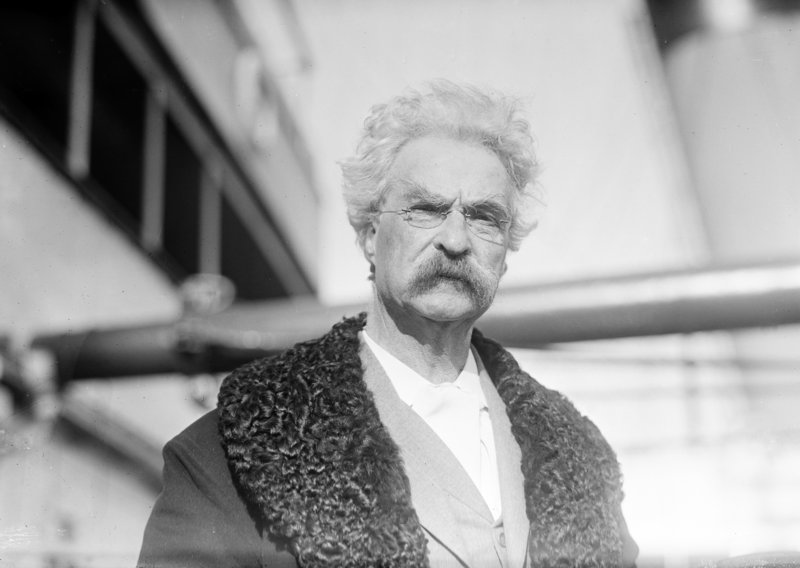
Most people know that Mark Twain wrote about Jim and Huckleberry Finn navigating down the Mississippi. Less well known is that he occasionally dabbled in the burgeoning genre of science fiction. His 1898 short story “The Great Dark” is about a ship that sails across a drop of water on a microscope slide. His novel A Connecticut Yankee in King Arthur’s Court is one of the first to explore time travel. And, in a short story called “From The ‘London Times’ in 1904,” Twain predicted the internet. In 1898. Read it here.
Set six years into the future, the story starts off as a crime mystery. Clayton, a quick-tempered army officer, is accused of murdering Szczepanik, the inventor of a new and promising device called the telelectroscope. The tale’s unnamed narrator describes it like this:
As soon as the Paris contract released the telelectroscope, it was delivered to public use, and was soon connected with the telephonic systems of the whole world. The improved ‘limitless-distance’ telephone was presently introduced and the daily doings of the globe made visible to everybody, and audibly discussable too, by witnesses separated by any number of leagues.
That sounds a lot like social media. Mark Twain dreamed up X and YouTube during the William McKinley administration.
Facing the hangman’s noose, Clayton asks for, and receives, a telelectroscope for his cell. As the narrator describes Clayton’s telelectroscopic revelry, it sounds uncannily like a bored cubicle dweller surfing the web at work.
…day by day, and night by night, he called up one corner of the globe after another, and looked upon its life, and studied its strange sights, and spoke with its people, and realized that by grace of this marvelous instrument he was almost as free as the birds of the air, although a prisoner under locks and bars. He seldom spoke, and I never interrupted him when he was absorbed in this amusement. I sat in his parlor and read, and smoked, and the nights were very quiet and reposefully sociable, and I found them pleasant. Now and then I would hear him say ‘Give me Yedo;’ next, ‘Give me Hong-Kong;’ next, ‘Give me Melbourne.’ And I smoked on, and read in comfort, while he wandered about the remote underworld, where the sun was shining in the sky, and the people were at their daily work.
The story itself is an admittedly minor work by the master of American fiction. In its last third, the story abruptly turns into a surprisingly sour satire about the sad state of our legal system. As Clayton is getting marched to the gallows, the narrator spots the guy Clayton supposedly murdered on the telelectroscope screen, standing in a crowd for the coronation of the new “Czar” of China. Even though no crime took place, Clayton is still sentenced to hang.
“From The ‘London Times’ in 1904” contains two long-running themes in Twain’s work and life. One is the absurdity of the courts – see, for example “The Facts in the Great Landslide Case.”
And the other is a fascination with technology. In spite of his folksy image, he was, as they say now, an early adopter. He was the first in his neighborhood to get a telephone. He may or may not have been the first major author to use a typewriter to write a novel. He lost his shirt investing in a Victorian-era startup hawking an exceedingly complex printing press called the Paige Compositor. And he allowed himself to be filmed by Thomas Edison in 1909, a year before his death.
One wonders what he would have thought of his telelectroscope in action.
Note: The character Szczepanik mentioned above was clearly named after a Polish inventor, Jan Szczepanik, who talked about creating a “telectroscope,” in the late 19th century. However, if you read a report in The New York Times in 1898, it becomes apparent that Szczepanik’s “telectroscope” wasn’t as visionary as what Twain had in mind.
We're hoping to rely on loyal readers, rather than erratic ads. Please click the Donate button and support Open Culture. You can use Paypal, Venmo, Patreon, even Crypto! We thank you!
Open Culture scours the web for the best educational media. We find the free courses and audio books you need, the language lessons & educational videos you want, and plenty of enlightenment in between.






#/media/File:Pink_Floyd_Their_Mortal_Remains_-_2017-10-13_-_Andy_Mabbett_-_34.jpg)