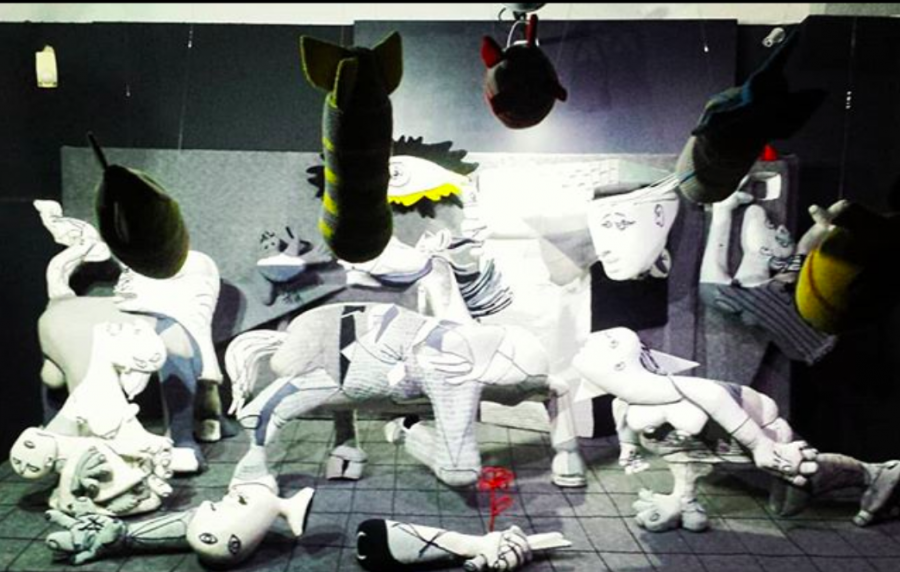
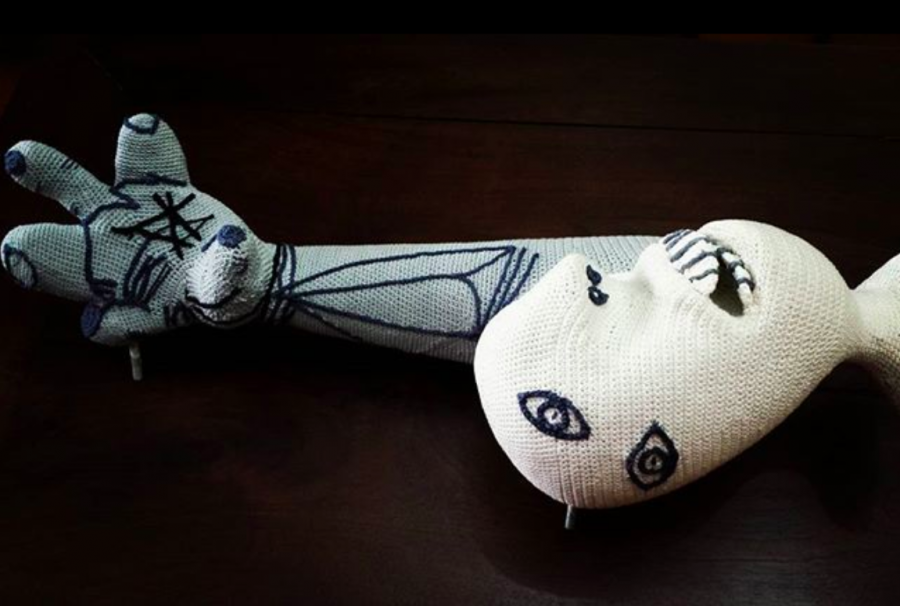
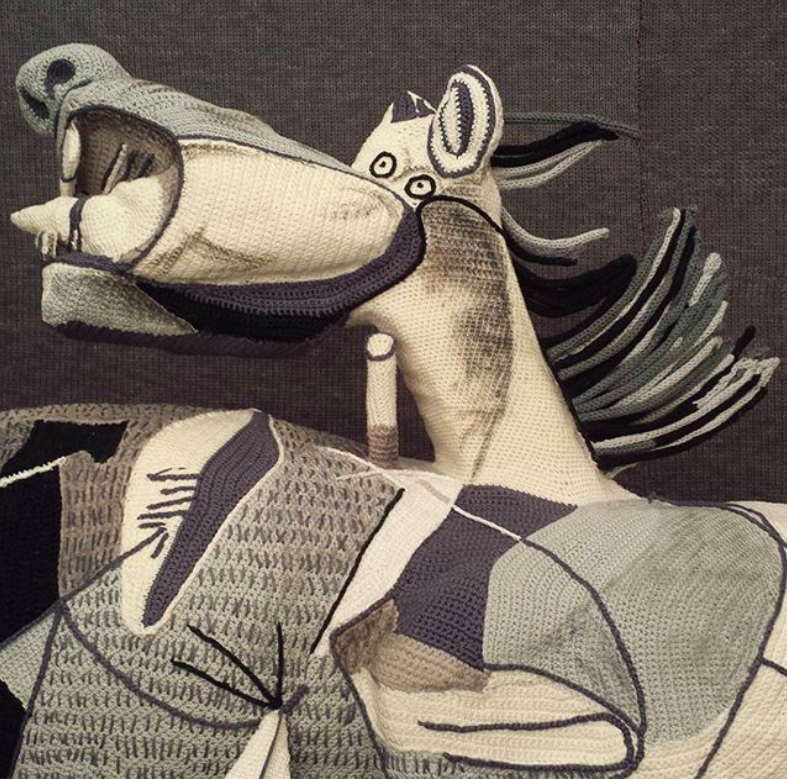
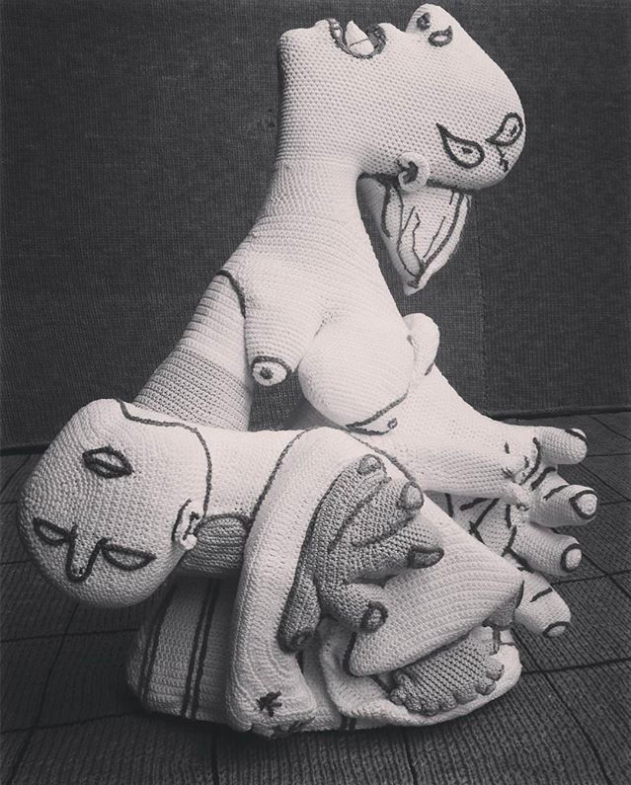
Softness is perhaps not the first quality that springs to mind when one imagines recreating the chaos and anguish of Picasso’s Guernica in a 3‑dimensional representation.
Though how else to describe the primary medium of the urban knitting group Sul filo dell’arte?
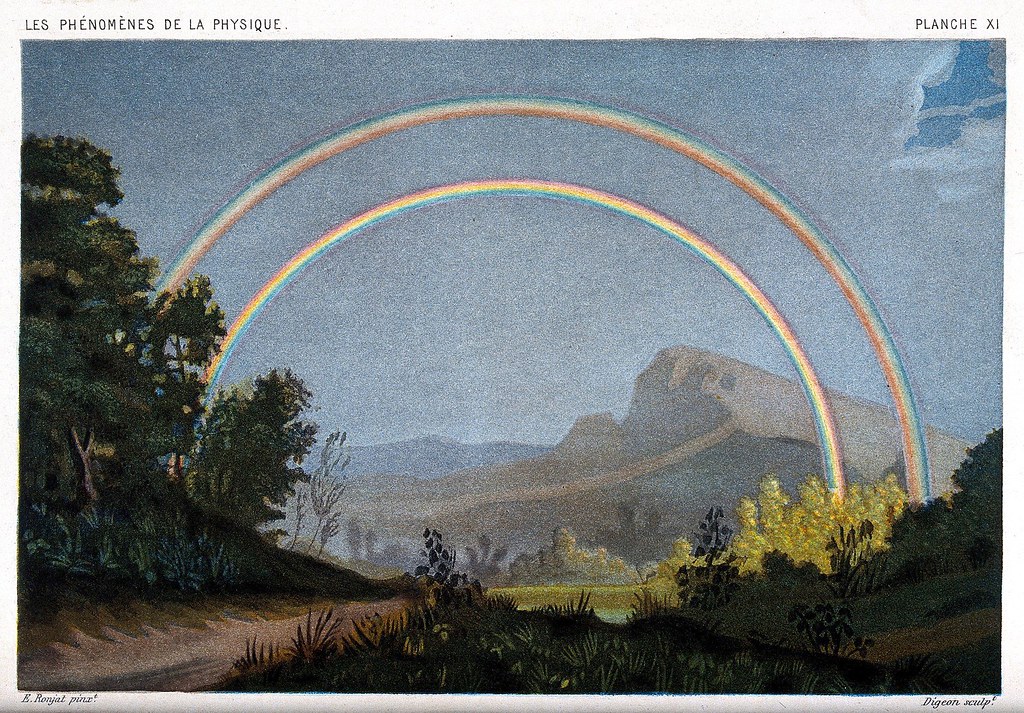
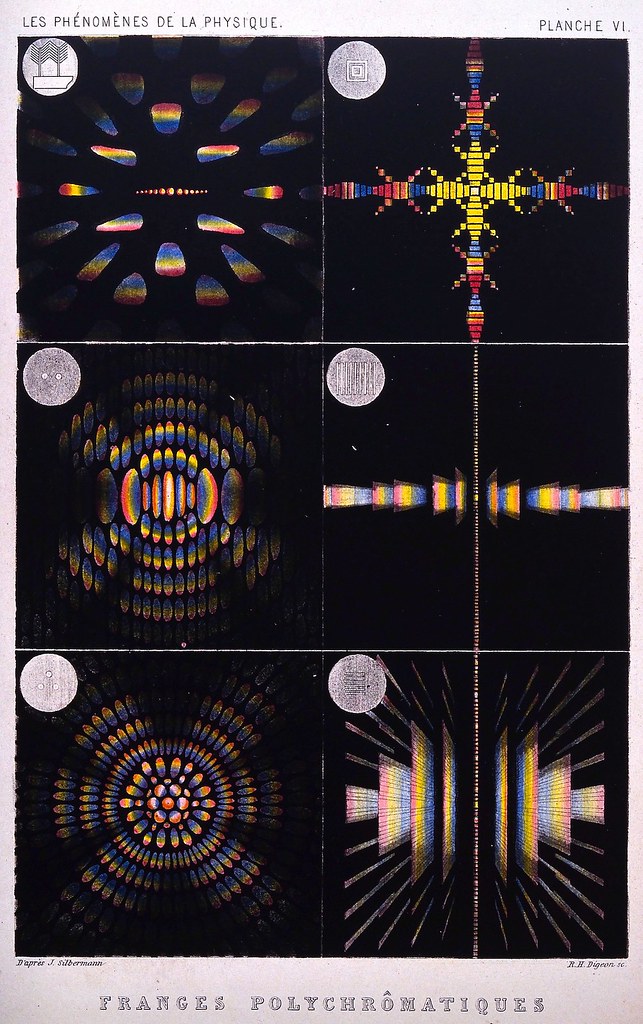
The science of optics and the fine art of science illustration arose together in Europe, from the early black-and-white color wheel drawn by Isaac Newton in 1704 to the brilliantly hand-colored charts and diagrams of Goethe in 1810. Goethe’s illustrations are more renowned than Newton’s, but both inspired a considerable number of scientific artists in the 19th century. It would take a science writer, the French journalist and mathematician Amédée Guillemin, to fully grasp the potential of illustration as a means of conveying the mind-bending properties of light and color to the general public.
Guillemin published the hugely popular textbook Les phénomènes de la physique in 1868, eventually expanding it into a five-volume physics encyclopedia. (View and download a scanned copy at the Wellcome Collection.) He realized that in order to make abstract theories “comprehensible” to lay readers, Maria Popova writes at Brain Pickings, “he had to make their elegant abstract mathematics tangible and captivating for the eye. He had to make physics beautiful.” Guillemin commissioned artists to make 31 colored lithographs, 80 black-and-white plates, and 2,012 illustrated diagrams of the physical phenomena he described.
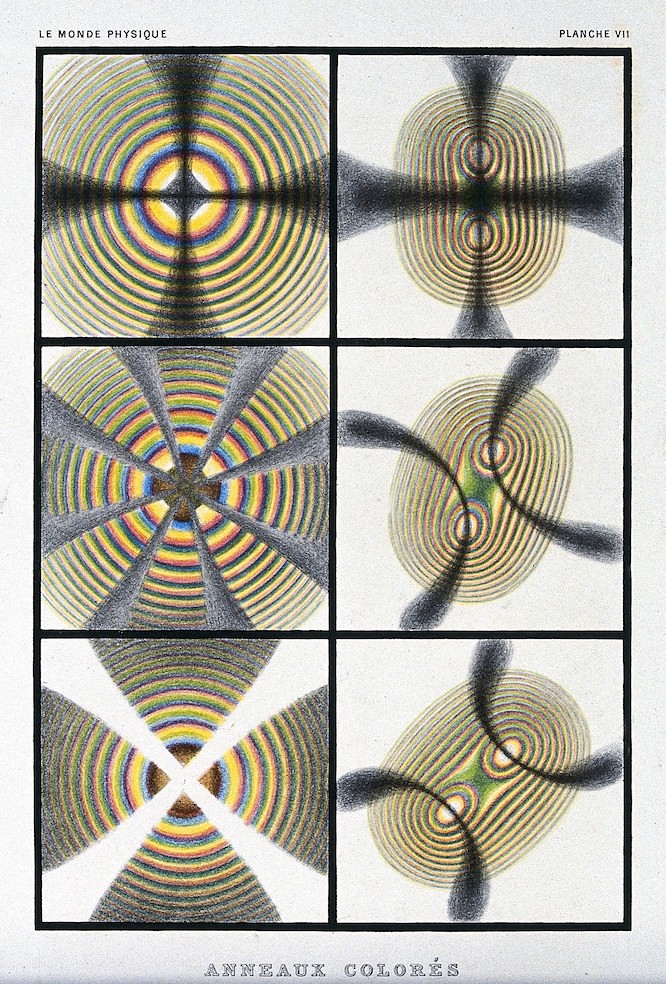
The most “psychedelic-looking illustrations,” notes the Public Domain Review, are by Parisian intaglio printer and engraver René Henri Digeon and “based on images made by the physicist J. Silbermann showing how light waves look when they pass through various objects, ranging from a bird’s feather to crystals mounted and turned in tourmaline tongs.”
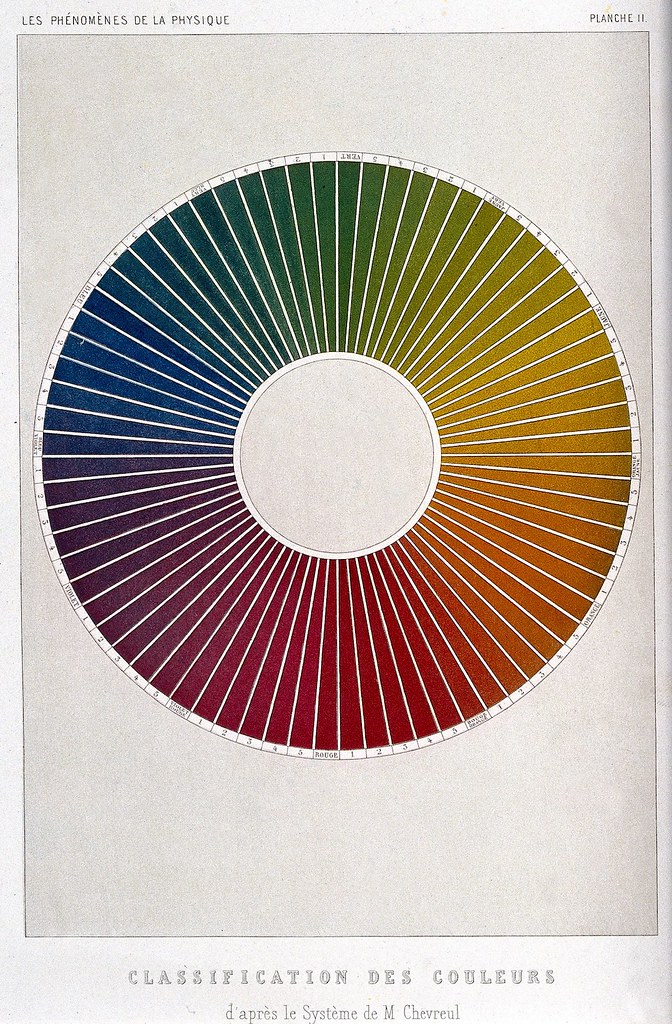
Digeon also illustrated the “spectra of various light sources, solar, stellar, metallic, gaseous, electric,” above, and created a color wheel, further down, based on a classification system of French chemist Michel Eugène Chevreul.
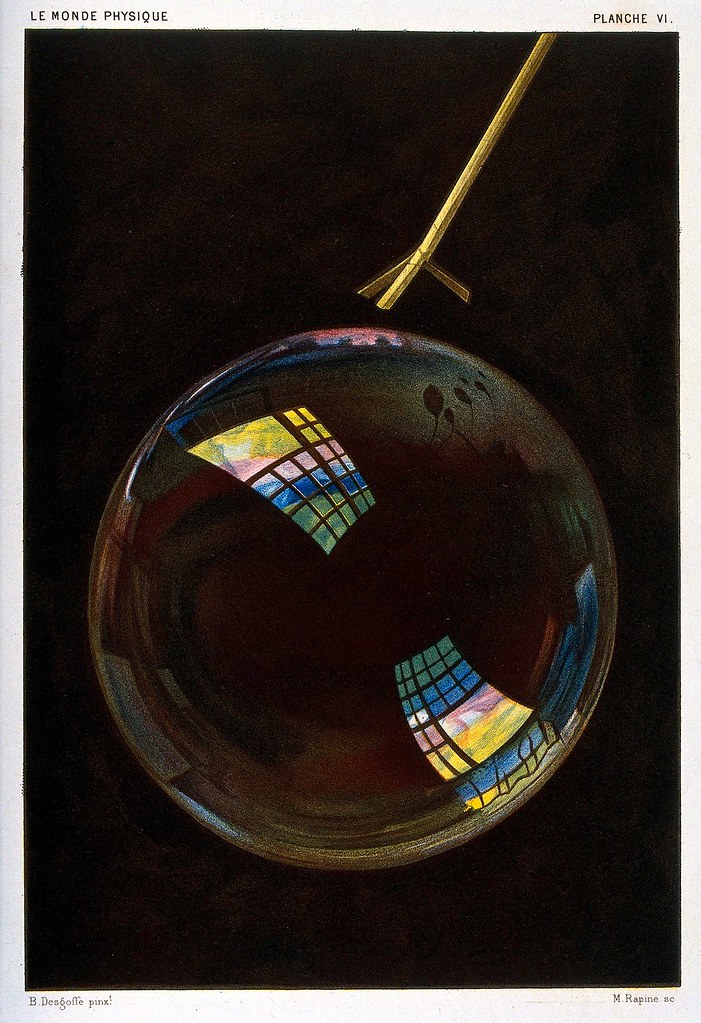
Many of Digeon’s images “were used to explain the phenomenon of birefringence, or double refraction,” the Public Domain Review writes (hence the double rainbow). In addition to his striking plates, this section of the book also includes the image of the soap bubble above, by artist M. Rapine, based on a painting by Alexandre-Blaise Desgoffe.
[The artists’] subjects were not chosen haphazardly. Newton was famously interested in the iridescence of soap bubbles. His observations of their refractive capacities helped him develop the undulatory theory of light. But he was no stranger to feathers either. In the Opticks (1704), he noted with wonder that, “by looking on the Sun through a Feather or black Ribband held close to the Eye, several Rain-bows will appear.”
In turn, Guillemin’s lavishly illustrated encyclopedia continues to influence scientific illustrations of light and color spectra. “In order thus to place itself in communion with Nature,” he wrote, “our intelligence draws from two springs, both bright and pure, and equally fruitful—Art and Science.” See more art from the book at Brain Pickings and the Public Domain Review.
Before surrealism became Merriam Webster’s word of the year in 2016 for its useful description of reality, it applied to art that incorporates the bizarre juxtapositions of dream logic. We know it from the films of David Lynch and paintings of Salvador Dalí. We may not, however, know it from the poetry of Andre Breton, “but the movement actually began in literature,” points out the Scottish National Gallery introductory video above. Breton, influenced by Freud and Rimbaud, railed against mediocrity, positivism, the ‘realistic attitude,” and the “reign of logic” in his 1924 “Manifesto of Surrealism.”
If this sounds somewhat familiar, it’s because Surrealism was “built on the ashes of Dada.” The first group of artists who worked under the term Surrealism included Tristan Tzara, who had penned the “Dada Manifesto” only six years earlier. Where Tzara had claimed that “Dada means nothing,” Breton declared Surrealism in favor of dream states, symbolism, and “the marvelous.”
He also defined the term—a word he took from the Symbolist poet Guillaume Apollinaire—“once and for all.”
SURREALISM, n. Psychic automatism in its pure state, by which one proposes to express — verbally, by means of the written word, or in any other manner — the actual functioning of thought. Dictated by the thought, in the absence of any control exercised by reason, exempt from any aesthetic or moral concern.
The artists and writers who coalesced around Breton represented a hodgepodge of styles, from the pure abstraction of Joan Miro to the hyperrealist fantasies of Dali and playful symbolist conundrums of Magritte and art pranks of Marcel Duchamp.
As artists, theirs was foremost an aesthetic radicalism invested in Freudian examinations of the psyche through the imagery of the unconscious. “But when [the movement] emerged in Europe,” notes the PBS Art Assignment video above, “during the tenuous, turbulent years following World War I and leading up to World War II, Surrealism positioned itself not as an escape from life, but as a revolutionary force within it.”
Breton joined the French Communist Party in 1927, was tossed out in 1933, and in 1934 delivered a speech, which became a pamphlet entitled “What is Surrealism?” Here Breton redefined Surrealism as an anti-fascist position, “a living movement, that is to say a movement undergoing a constant process of becoming…. surrealism has brought together and is still bringing together diverse temperaments individually obeying or resisting a variety of bents.”
Here he alludes to previous political turmoil in the Surrealist ranks: “The fact that certain of the first participants in surrealist activity have thrown in the sponge and have been discarded has brought about the retiring from circulation of some ways of thinking.” The reference is partly to Dali, whom Breton expelled from the Surrealist group that same year for “the glorification of Hitlerian fascism.”
As World War II began, many Surrealists fled Europe for the United States. Breton traveled the Caribbean, settled in New York, and developed a friendship with Martinican poet, writer, and statesman Aime Cesaire. He met Trotsky, Frida Kahlo, and Diego Rivera in Mexico, and participated in the burgeoning Surrealist movement in the U.S. and Latin America.
The influence of Breton and his Surrealist literary peers on mid-century fiction and poetry in the decolonizing global south was significant. Breton “insisted art be created for revolution not profit”—points out the video above, “Surrealism: The Big Ideas.” Dali, on the other hand,“wasn’t really into all that.” The painter retreated to the U.S. in 1940 with his wife Gala, spending his time on both coasts and becoming a popular sensation. America “offered Dali endless opportunities for his talents.”
Dali “introduced Surrealism to the general public, and made it fun!… America loved it, and him. They made Dali a celebrity,” and he helped popularize a Surrealist aesthetic in Hollywood film and Madison Avenue advertising. But to really understand the movement, we must not look only to its visual vocabulary and its influence on pop culture, but also to the poetry, philosophy, and politics of its founder.
Clutch imaginary pearls, rest the back of your hand on your forehead, look wan and stricken, begin to wilt, and most people will recognize the symptoms of your sarcasm, aimed at some pejoratively feminized qualities we’ve seen characters embody in movies. The “literary swoon” as Iaian Bamforth writes at the British Journal of General Practice, dates back much further than film, to the early years of the modern novel itself, and it was once a male domain.
“Somewhere around the time of the French Revolution (or perhaps a little before it) feelings were let loose on the world.” Rationalism went out vogue and passion was in—lots of it, though not all at once. It took some decades before the discovery of emotion reached the climax of Romanticism and denouement of Victorian sentimentality:
Back in 1761, readers had swooned when they encountered the ‘true voice of feeling’ in Jean-Jacques Rousseau’s novel La Nouvelle Héloïse; by the end of the decade, all of Europe was being sentimental in the manner made fashionable a few years later by Laurence Sterne in his A Sentimental Journey. Then there was Goethe’s novella, The Sorrows of Young Werther (1774), which made its author a celebrity.
It’s impossible to overstate how popular Goethe’s book became among the aristocratic young men of Europe. Napoleon “reputedly carried a copy of the novel with him on his military campaign.” Its swooning hero, whom we might be tempted to diagnose with any number of personality and mood disorders, develops a disturbing and debilitating obsession with an engaged woman and finally commits suicide. The novel supposedly inspired many copycats and “the media’s first moral panic.”
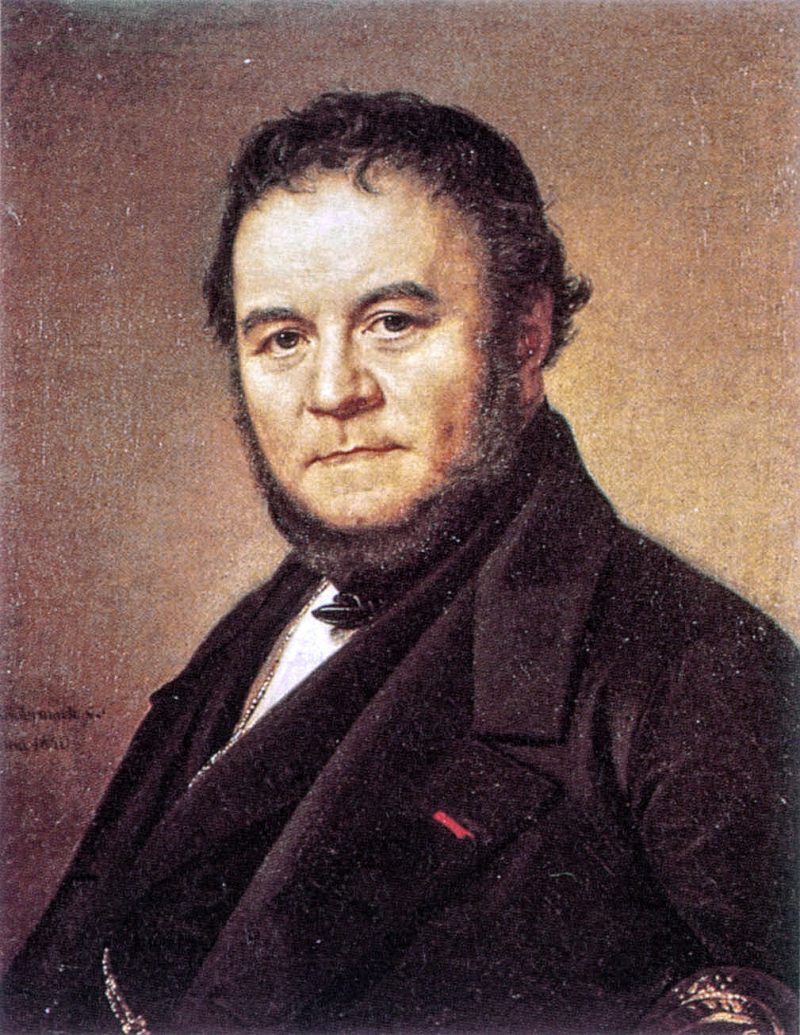
If we can feel such exaltation, disquiet, and fear when in the grip of romantic passion, or when faced with nature’s implacable behemoths, as in Kant’s Sublime, so too may we be overcome by art. Napoleonic novelist Stendhal suggested as much in a dramatic account of such an experience. Stendhal, the pen name of Marie-Henri Beyle, was no inexperienced dreamer. He had traveled and fought extensively with the Grand Army (including that fateful march through Russia, and back) and had held several government offices abroad. His realist fiction didn’t always comport with the more lyrical tenor of the times.
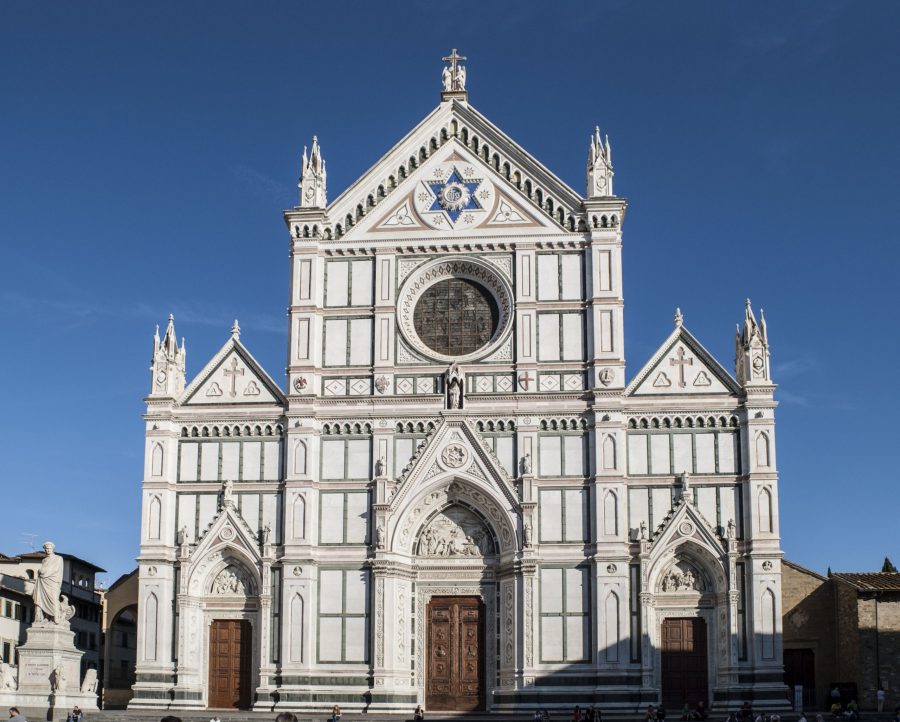
Photo of the Basilica of Santa Croce by Diana Ringo, via Wikimedia Commons
But he was also of the generation of young men who read Werther while touring Europe, contemplating the varieties of emotion. He had held a similarly unrequited obsession for an unavailable woman, and once wrote that “in Italy… people are still driven to despair by love.” During a visit to the Basilica of Santa Croce in 1817, he “found a monk to let him into the chapel,” writes Bamforth, “where he could sit on a genuflecting stool, tilt his head back and take in the prospect of Volterrano’s fresco of the Sibyls without interruption.” As Stendhal described the scene:
I was already in a kind of ecstasy by the idea of being in Florence, and the proximity of the great men whose tombs I had just seen. Absorbed in contemplating sublime beauty, I saw it close-up—I touched it, so to speak. I had reached that point of emotion where the heavenly sensations of the fine arts meet passionate feeling. As I emerged from Santa Croce, I had palpitations (what they call an attack of the nerves in Berlin); the life went out of me, and I walked in fear of falling.
With the recording of this experience, Stendhal “brought the literary swoon into tourism,” Bamforth remarks. Such passages became far more commonplace in travelogues, not least those involving the city of Florence. So many cases similar to Stendhal’s have been reported in the city that the condition acquired the name Stendhal syndrome in the late seventies from Dr. Graziella Magherini, chief of psychiatry at the Santa Maria Nuova Hospital. It presents as an acute state of exhilarated anxiety that causes people to feel faint, or to collapse, in the presence of art.
Magherini and her assistants compiled studies of 107 different cases in 1989. Since then, Santa Maria Nuova has continued to treat tourists for the syndrome with some regularity. “Dr. Magherini insists,” writes The New York Times, that “certain men and women are susceptible to swooning in the presence of great art, especially when far from home.” Stendhal didn’t invent the phenomenon, of course. And it need not be solely caused by sufferers’ love of the 15th century.
The stresses of travel can sometimes be enough to make anyone faint, though further research may rule out other factors. The effect, however, does not seem to occur with nearly as much frequency in other major cities with other major cultural treasures. “It is surely the sheer concentration of great art in Florence that causes such issues,” claims Jonathan Jones at The Guardian. Trying to take it all in while navigating unfamiliar streets and crowds.… “More cynically, some might say the long queues do add a layer of stress on the heart.”
There’s also no discounting the effect of expectation. “It is among religious travelers that Stendhal’s syndrome seems to have found its most florid expression,” notes Bamforth. Stendhal admitted that his “ecstasy” began with an awareness of his “proximity of the great men whose tombs I had just seen.” Without his prior education, the effect might have disappeared entirely. The story of the Renaissance, in his time and ours, has impressed upon us such a reverence for its artists, statesmen, and engineers, that sensitive visitors may feel they can hardly stand in the actual presence of Florence’s abundant treasures.
Perhaps Stendhal syndrome should be regarded as akin to a spiritual experience. A study of religious travelers to Jerusalem found that “otherwise normal patients tended to have ‘an idealistic subconscious image of Jerusalem’” before they succumbed to Stendhal syndrome. Carl Jung described his own such feelings about Pompeii and Rome, which he could never bring himself to visit because he lived in such awe of its historical aura. Those primed to have symptoms tend also to have a sentimental nature, a word that once meant great depth of feeling rather than a callow or mawkish nature.
We might all expect great art to overwhelm us, but Stendhal syndrome is rare and rarified. The experience of many more travelers accords with Mark Twain’s 1869 The Innocents Abroad, or The New Pilgrim’s Progress, a fictionalized memoir “lampooning the grandiose travel accounts of his contemporaries,” notes Bamforth. It became “one of the best-selling travel books ever” and gave its author’s name to what one researcher calls Mark Twain Malaise, “a cynical mood which overcomes travelers and leaves them totally unimpressed with anything UNESCO has on its universal heritage list.” Sentimentalists might wish these weary tourists would stay home and let them swoon in peace.
Though born in the late 19th century and partially shaped by a few sojourns to Europe, Edward Hopper was an artist fundamentally of early 20th-century America. He took life in that time and place as his subject, but he also once said that “an artist paints to reveal himself through what he sees in his subject,” meaning that he in some sense embodied early 20th-century America. Royal Academy of the Arts Artistic Director Tim Marlow quotes that line in the 60-second introduction to Hopper above, then points to a common thread in the painter’s “enigmatic works”: a “profound contemplation of the world around us” that turns each of his paintings into one captured “moment of stillness in a frantic world.”
Much of Hopper’s work came out of the Great Depression, “a period of great uncertainty and anxiety, but also a time of deep national self-imagination about the very idea of American-ness.” To look at the figures who inhabit Hopper’s thoroughly American settings — a gas station, a hotel room, inside a train car, an all-night diner — self-reflection would seem to be their main pastime.
“A woman sits alone drinking a cup of coffee,” says the School of Life’s head of Art and Architecture Hanna Roxburgh of Hopper’s 1927 Automat in the video above. “She seems slightly self-conscious and a little afraid. Perhaps she’s not used to sitting alone in a public space. Something seems to have gone wrong. The view is invited to invent stories for her of betrayal or loss.”
Loneliness, isolation, even despair: these words tend to come up in discussion of the moods of Hopper’s characters, as well as of his paintings themselves. In the in-depth exploration above, Colin Wingfield focuses on a single emotion expressed in Hopper’s work: alienation. A product of the “machine age” in late 19th- and early 20th century America, Hopper expressed an uneasy view of the ways in which accelerating industrialization and automation were altering the lives lived around him into unrecognizability. This view would turn out to have an enormous cultural resonance, as detailed in Edward Hopper and the Blank Canvas, the hourlong documentary below.
Touching on the Hopper influences seen in the work of directors like Alfred Hitchcock and Terrence Malick as well as television shows like Mad Men and The Simpsons, Edward Hopper and the Blank Canvas also brings in cultural figures like the German filmmaker Wim Wenders, an avowed Hopper enthusiast with much to say about the painter’s vision in America. More creators from the world of cinema appear in the video below to offer their personal perspectives on Hopper’s considerable influence on their art form — an art form that had considerable influence on Hopper, an avid moviegoer since he first watched a motion picture in Paris in 1909.
No single painting of Hopper’s has had as much influence on film as 1942’s Nighthawks, by far the painter’s best-known work. How exactly he achieved his own cinematic effects in a still image, such as the “storyboarding” technique with which he developed its composition, is a subject we’ve featured before here on Open Culture. In the video essay “Nighthawks: Look Through the Window,” Evan Puschak — better known as the Nerdwriter — seeks out the sources of the painting’s enduring power, from its “clean, smooth, and almost too real” aesthetic to its rigorous composition to its host of visual elements meant to both compel and unsettle the viewer.
Hopper explains his way of working in his own words in the short video from the Walker Art Center below. “It’s a long process of gestation in the mind and a rising emotion,” he says, followed by “drawings, quite often many drawings”: “various small sketches, sketches of the thing that i wish to do, also sketches of details in the picture.” As for the themes of “loneliness, isolation, modern man and his man-made environment” so often ascribed to the final products, “those are the words of critics. It may be true and it may not be true. It’s how the viewer looks at the pictures, what he sees in them.”
Based in Seoul, Colin Marshall writes and broadcasts on cities, language, and culture. His projects include the book The Stateless City: a Walk through 21st-Century Los Angeles and the video series The City in Cinema. Follow him on Twitter at @colinmarshall or on Facebook.
Andrew Wyeth died a decade ago, but his status as a beloved American painter was assured long before. He painted his best-known work Christina’s World in 1948, a time in American painting when images of immediately recognizable fields, farmhouses, and middle-aged women were not, to put it mildly, in vogue. But Christina’s World has survived right alongside, say, Jackson Pollock’s drip paintings from the very same year. How it has done so — and what way of seeing enabled Wyeth to paint it with such confidence in the first place — constitutes the subject of this new video essay by Evan Puschak, better known as the Nerdwriter (whose investigations into Picasso, Rembrandt, Van Gogh, Hopper and others we’ve previously featured here on Open Culture).
“Being realistic and dramatic, Christina’s World more easily fits the shape of our memories, our dreams, our fears and cravings,” says Pucshak. “In other words, it resembles a story.” Not only does the painting’s combination of the familiar and the unknown fire up our imagination, getting us to generate narratives to apply to it, it also guides our vision, taking us on a journey from woman to house to barn and back again. But for all its appearance of pastoral reverie, it also has a certain darkness about it, hinted at by the colors, which are muted, reflecting the particular austerity of New England landscapes, a common image in early American art and thought,” as well as the body of Christina herself, lifted from the earth only by “thin and contorted arms.”
The real Christina, as is now common art-historical knowledge, suffered from a disease of the nervous system that robbed her of her ability to walk; her preference of crawling rather than using a wheelchair meant that she navigated her world in a much different manner than most of us do. But even as Wyeth shows us one variety of little-acknowledged human limitation, he also shows us another variety of little-acknowledged human ability. Puschak suggests that Wyeth was “looking for a secret in nature,” and in the search became the transcendentalist writer Ralph Waldo Emerson’s “transparent eye-ball,” which contains nothing yet sees everything.
“He sees in the nature around him, even in the barren landscapes of new England, something profoundly real,” says Puschak. “As an artist, he helps us to see it too.” He also reminds us 21st century urbanites, who dwell as much in the digital realm as the physical one, of the “piece of us in the land, in the trees, in the sky, and a sense of wholeness waits for us when we can remember not to forget it.” The idea may sound as unfashionable as realism looked in Wyeth’s day, but to the artist’s own mind, he was never a realist at all. “My people, my objects breathe in a different way,” he once said. “There’s another core — an excitement that’s definitely abstract. My God, when you really begin to peer into something, a simple object, and realize the profound meaning of that thing — if you have an emotion about it, there’s no end.”
Based in Seoul, Colin Marshall writes and broadcasts on cities, language, and culture. His projects include the book The Stateless City: a Walk through 21st-Century Los Angeles and the video series The City in Cinema. Follow him on Twitter at @colinmarshall or on Facebook.
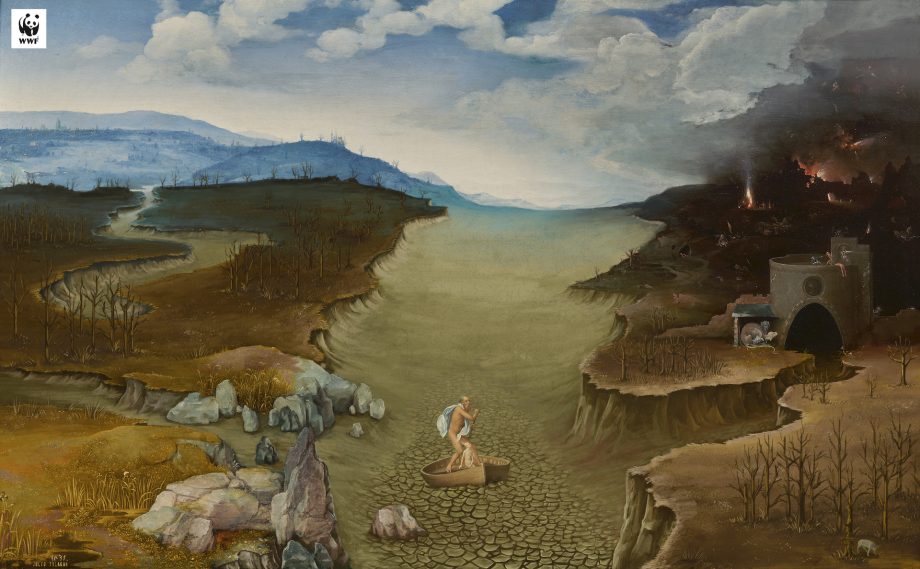
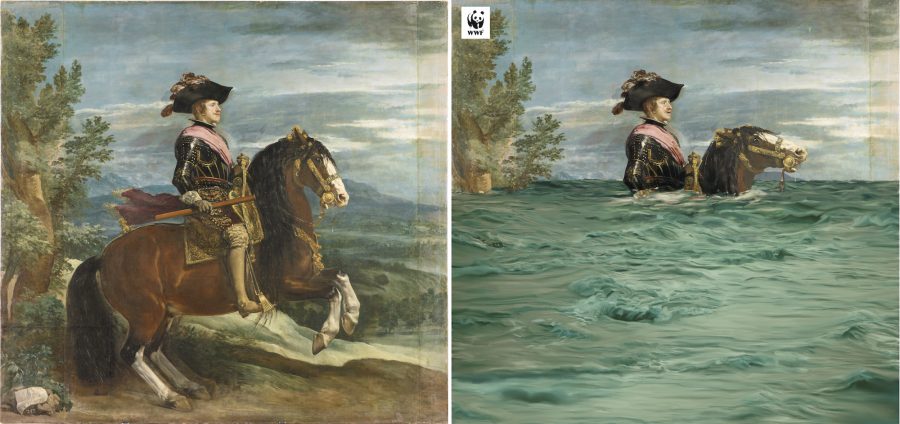
A catastrophic series of chain reactions, including but not limited to:
–Sea level rise
–Change in land and ocean ecosystems
–Increased intensity and frequency of weather extremes
–Temperature extremes on land
–Drought due to precipitation deficits
–Species loss and extinction
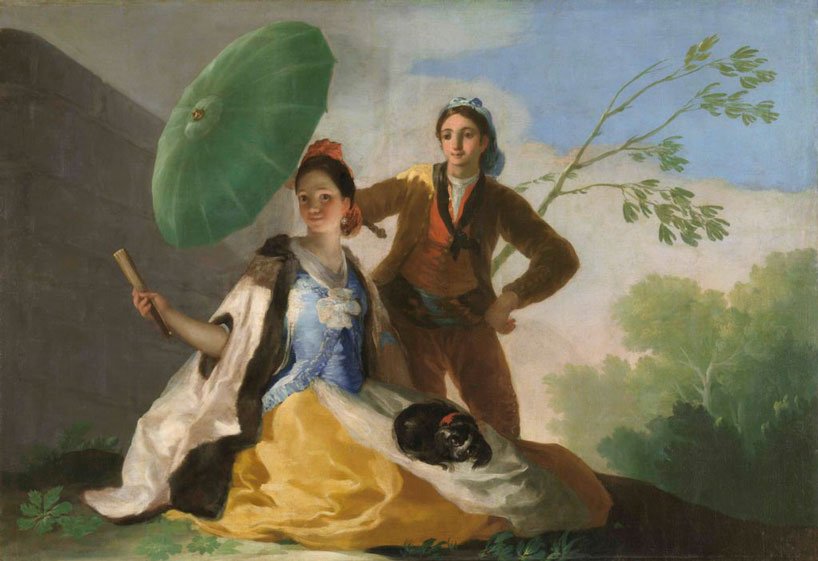
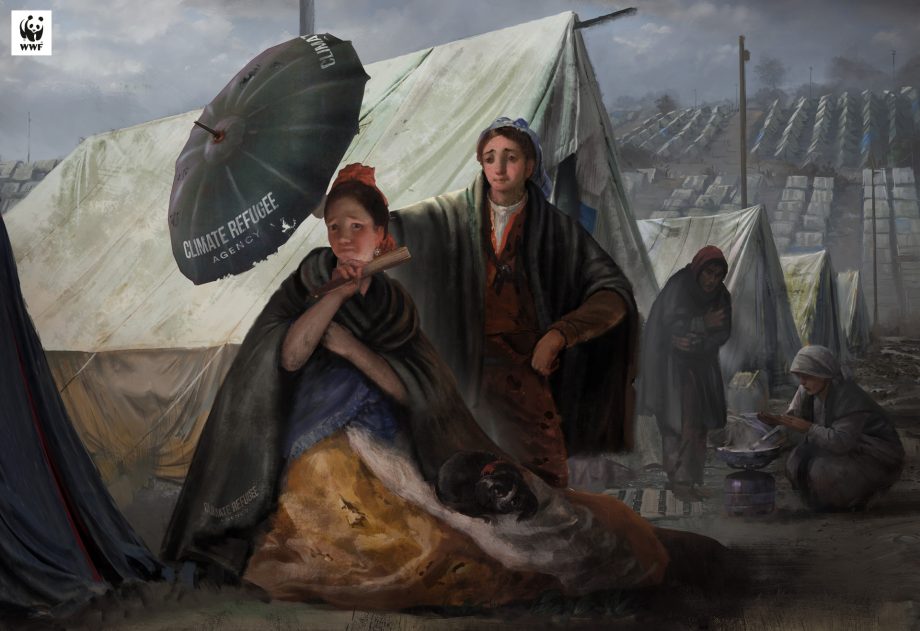
The Parasol that supplies the title for Francisco de Goya’s El Quitasol of 1777 becomes a tattered umbrella barely sheltering miserable, crowded refugees in the sodden, makeshift camp of Pedro Veloso’s reimagining.
And the Niños en la Playa captured relaxing on the beach in 1909 by Joaquín Sorolla now compete for space with dead fish, as observed by artist Conspiracy 110 years further along.
None of the original works are currently on display.
It would be a public service if they were, alongside their drastically retouched twins and perhaps Hieronymus Bosch’s The Garden of Earthly Delights, to further unnerve viewers about the sort of hell we’ll soon be facing if we, too, don’t make some major alterations.
For now the works in the +1.5ºC Lo Cambia Todo (+1.5ºC Changes Everything) project are making an impact on giant billboards in Madrid, as well as online.
The standard “anyone could do that” response to abstract art generally falls apart when the person who says it tries their hand at making something like a Kandinsky or Miró. Not only were these artists highly trained in techniques and materials, but both possessed their own specific theories of abstract art—the role of line, color, shape, negative space, etc., along with grander ideas about the role of art itself. Few of us walk around with such considered opinions and the ability to turn them into artworks. The abstraction begins in the mind before it reaches the canvas.
For his appearance on the Museum of Modern Art and BBC web series The Way I See It, Steve Martin chose two obscure American abstract artists who perfectly illustrate the relationship between the theory and practice of abstraction.
“I don’t generally care about theories,” Martin says. “They kind of get in the way of looking at the picture. But I think the result of working from a theory can be fantastic.” We may not need to know that these two artists, Morgan Russell and Stanton Macdonald Wright, painted in accordance with a theory they called Synchromism, but it certainly helps.
“The resulting paintings, called Synchromies,” explains The Art Story, “used the color scale in the way notes might be arranged in a musical piece. As the two artists wrote, ‘Synchromism simply means ‘with color’ as symphony means ‘with sound’.…” And as composer and pianist Jason Moran demonstrates in his The Way I See It episode, above, Piet Mondrian went even further in this direction with his Broadway Boogie Woogie, which represents, in its arrangement of colored squares, the very essence of the musical form from which it takes its title. Moran can even play the painting like a musical score.
The kind of abstraction Martin and Moran gravitate toward turns sound into visual pleasure and stimulates the thinking mind. Commenting on one of his selections, Martin says, “I think of this as an intellectual painting.” When it came time for John Waters to make his choice, he went for the gut (and the unconscious), with “a giant, two-paneled painting of a hammer,” he says, “a very butch painting by a heterosexual woman. I love the idea of how scary it is and how powerful.” It’s an image, he says, that reminds him of personal trauma—though nothing so gruesome as one might think.
Waters seeks a kind of catharsis from art by looking at work that scares him. Lee Lozano’s untitled 1963 painting, he says, is “threatening…. All the art I like makes me angry at first…. That’s part of its job, to make you angry.” Paintings of this size have traditionally been “reserved for lofty subjects,” notes the MoMA. “In this painting—and in others, of wrenches, clamps, and screwdrivers—Lozano weds the mundane with the grand.” As Waters delightedly points out, her work, like his own, deals a heavy blow, pun intended, to canons of taste.
We're hoping to rely on loyal readers, rather than erratic ads. Please click the Donate button and support Open Culture. You can use Paypal, Venmo, Patreon, even Crypto! We thank you!
Open Culture scours the web for the best educational media. We find the free courses and audio books you need, the language lessons & educational videos you want, and plenty of enlightenment in between.





_-_Facade.jpg)