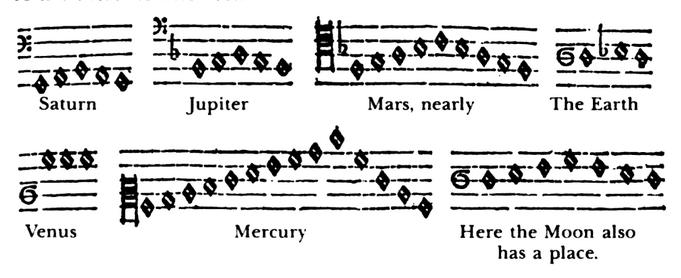
Johannes Kepler determined just how the planets of our solar system make their way around the sun. He published his innovative work on the subject from 1609 to 1619, and in the final year of that decade he also came up with a theory that each planet sings a song, and each in a different voice at that. Mars is a tenor, Mercury is a soprano, and Earth, as the BBC show QI (or Quite Interesting) recently tweeted, “is an alto that sings two notes Mi and Fa, which Kepler read as ‘Miseriam & Famem’, ‘misery and famine’ ” — two phenomena not unknown on Earth in Kepler’s time, even though the scientific revolution had already started to change the way people lived.
Not all of the best minds of the scientific revolution thought purely in terms of calculation. The blog ThatsMaths describes Kepler’s mission as explaining the solar system “in terms of divine harmony,” finding “a system of the world that was mathematically correct and harmonically pleasing.” Truly divine harmony could presumably find its expression in music, an idea that led Kepler to explain “planetary motions in terms of harmonic relationships, a scheme that he called the ‘song of the Earth.’ ”
According to this scheme, “each planet emits a tone that varies in pitch as its distance from the Sun varies from perihelion to aphelion and back” — that is, from the nearest they get to the sun to the farthest they get from the sun and back — “producing a continuous glissando of intermediate tones, a ‘whistling produced by friction with the heavenly light.’ ”
Kepler named the combined result “the music of the spheres,” but what does it sound like? Switzerland-based cornettist Bruce Dickey wants to give us a sense of it with Nature’s Whispering Secret, “a project for a CD recording exploring the ideas about music and cosmology of Johannes Kepler.” Demanding the musicianship of not just Dickey but composer Calliope Tsoupaki, singer Hana Blažíková, and a group of singers and instrumentalists from across Europe and America as well, all “among the most distinguished musicians performing 16th-century polyphonic music today.” The Indiegogo campaign for this ambitious tribute to Kepler’s ideas at the intersection of science and aesthetics, which involves an album as well as a series of live performances into the year 2020, is on its very last day, so if you’d like to hear the music of the spheres for yourself, consider making a contribution.
Based in Seoul, Colin Marshall writes and broadcasts on cities, language, and culture. His projects include the book The Stateless City: a Walk through 21st-Century Los Angeles and the video series The City in Cinema. Follow him on Twitter at @colinmarshall, on Facebook, or on Instagram.
What triggered the worst impulses of the Internet last week?
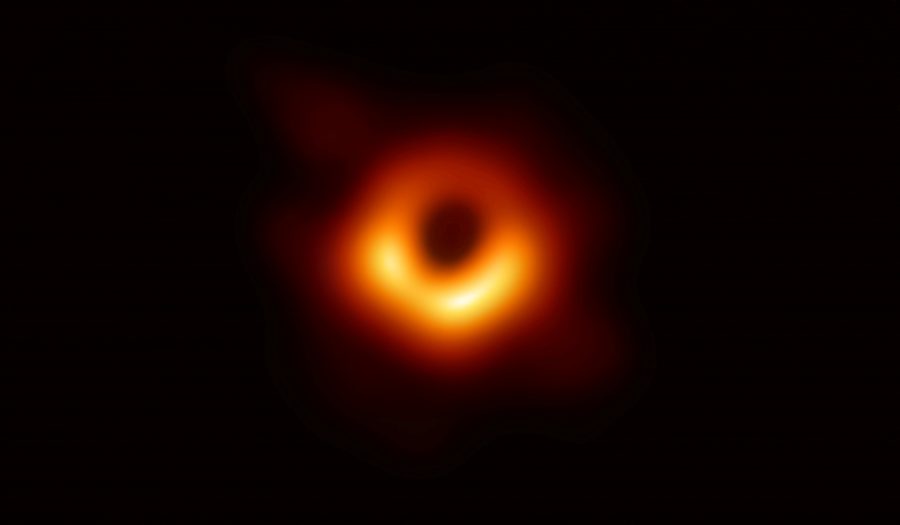
The world’s first photo of a black hole, which proved the presence of troll life here on earth, and confirms that female scientists, through no fault of their own, have a much longer way to go, baby.
If you want a taste, sort the comments on the two year old TED Talk, above, so they’re ordered “newest first.”
Katie Bouman, soon-to-be assistant professor of computing and mathematical sciences at the California Institute of Technology, was a PhD candidate at MIT two years ago, when she taped the talk, but she could’ve passed for a nervous high schooler competing in the National Science Bowl finals, in clothes borrowed from Aunt Judy, who works at the bank.
The focus of her studies were the ways in which emerging computational methods could help expand the boundaries of interdisciplinary imaging.
Prior to last week, I’m not sure how well I could have parsed the focus of her work had she not taken the time to help less STEM-inclined viewers such as myself wrap our heads around her highly technical, then-wholly-theoretical subject.
What I know about black holes could still fit in a thimble, and in truth, my excitement about one being photographed for the first time pales in comparison to my excitement about Game of Thrones returning to the airwaves.
I’ve always been very one-sided about science and when I was younger I concentrated almost all my effort on it. I didn’t have time to learn and I didn’t have much patience with what’s called the humanities, even though in the university there were humanities that you had to take. I tried my best to avoid somehow learning anything and working at it. It was only afterwards, when I got older, that I got more relaxed, that I’ve spread out a little bit. I’ve learned to draw and I read a little bit, but I’m really still a very one-sided person and I don’t know a great deal. I have a limited intelligence and I use it in a particular direction.
I’m pretty sure my lack of passion for science is not tied to my gender. Some of my best friends are guys who feel the same. (Some of them don’t like team sports either.)
But I couldn’t help but experience a wee thrill that this young woman, a science nerd who admittedly could’ve used a few theater nerd tips regarding relaxation and public speaking, realized her dream—an honest to goodness photo of a black hole just like the one she talked about in her TED Talk, “How to take a picture of a black hole.”
Bouman and the 200+ colleagues she acknowledges and thanks at every opportunity, achieved their goal, not with an earth-sized camera but rather a network of linked telescopes, much as she had described two years earlier, when she invoked disco balls, Mick Jagger, oranges, selfies, and a jigsaw puzzle in an effort to help people like me understand.
Look at that sucker (or, more accurately, its shadow!) That thing’s 500 million trillion kilometers from Earth!
I’ll bet a lot of elementary science teachers, be they male, female, or non-binary, are going to make science fun by having their students draw pictures of the picture of the black hole.
If we could go back (or forward) in time, I can almost guarantee that mine would be among the best because while I didn’t “get” science (or gym), I was a total art star with the crayons.
Then, crafty as Lord Petyr Baelish when presentation time rolled around, I would partner with a girl like Katie Bouman, who could explain the science with winning vigor. She genuinely seems to embrace the idea that it “takes a village,” and that one’s fellow villagers should be credited whenever possible.
(How did I draw the black hole, you ask? Honestly, it’s not that much harder than drawing a doughnut. Now back to Katie!)
Alas, her professional warmth failed to register with legions of Internet trolls who began sliming her shortly after a colleague at MIT shared a beaming snapshot of her, taken, presumably, with a regular old phone as the black hole made its debut. That pic cemented her accidental status as the face of this project.
Note to the trolls—it wasn’t a dang selfie.
“I’m so glad that everyone is as excited as we are and people are finding our story inspirational,’’ Bouman toldThe New York Times. “However, the spotlight should be on the team and no individual person. Focusing on one person like this helps no one, including me.”
Although Bouman was a junior team member, she and other grad students made major contributions. She directed the verification of images, the selection of imaging parameters, and authored an imaging algorithm that researchers used in the creation of three scripted code pipelines from which the instantly-famous picture was cobbled together.
One of the insights Katie brought to our imaging group is that there are natural images. Just think about the photos you take with your camera phone—they have certain properties.… If you know what one pixel is, you have a good guess as to what the pixel is next to it.
Part of the reason that some posters found Bouman immediately suspicious had to do with her gender. Famously, a number of prominent men like disgraced former CERN physicist Alessandro Strumia have argued that women aren’t being discriminated against in science — they simply don’t like it, or don’t have the aptitude for it. That argument fortifies a notion that women don’t belong in science, or can’t really be doing the work. So women like Bouman must be fakes, this warped line of thinking goes…
Even I, whose 7th grade science teacher tempered a bad grade on my report card by saying my interest in theater would likely serve me much better than anything I might eek from her class, know that just as many girls and women excel at science, technology, engineering, and math as excel in the arts. (Sometimes they excel at both!)
(And power to every little boy with his sights set on nursing, teaching, or ballet!)
(How many black holes have the haters photographed recently?)
Griggs continues:
Saying that she was part of a larger team doesn’t diminish her work, or minimize her involvement in what is already a history-making project. Highlighting the achievements of a brilliant, enthusiastic scientist does not diminish the contributions of the other 214 people who worked on the project, either. But what it is doing is showing a different model for a scientist than the one most of us grew up with. That might mean a lot to some kids — maybe kids who look like her — making them excited about studying the wonders of the Universe.
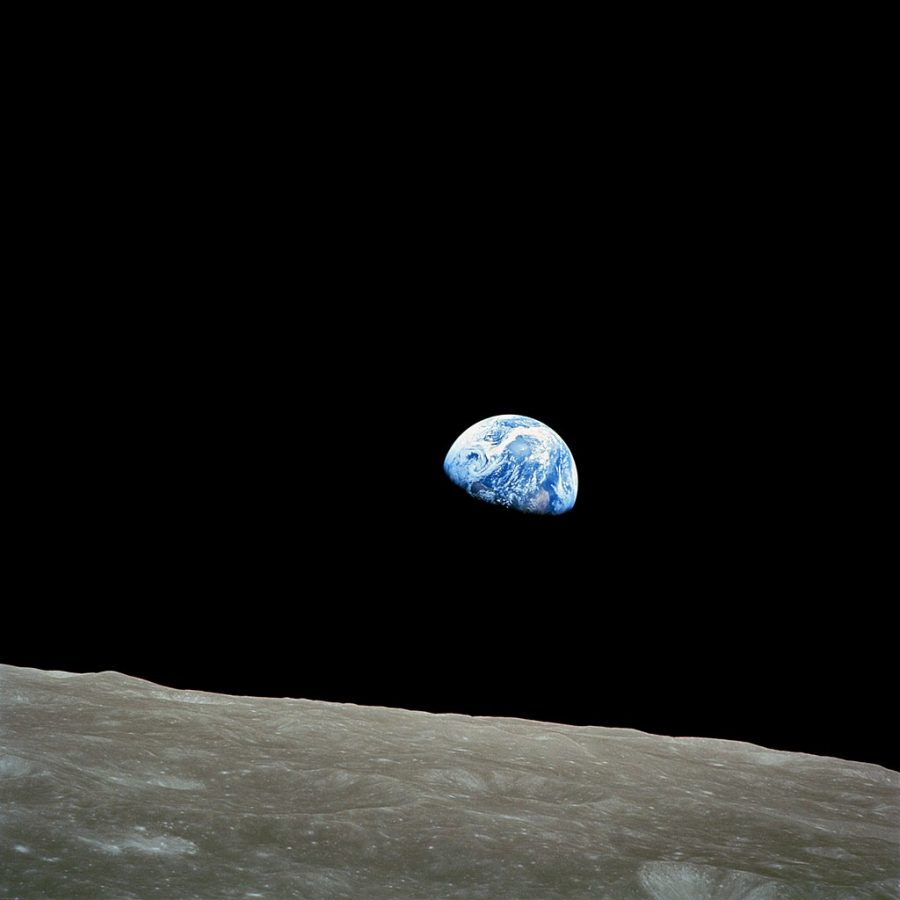
Just a little over fifty years ago, we didn’t know what Earth looked like from space. Or rather, we had a decent idea what it looked like, but no clear color images of the sight existed. 2001: A Space Odyssey presented a particularly striking vision of Earth from space in the spring of 1968, but it used visual effects and imagination (both to a still-impressive degree) to do so. Only on Christmas Eve of that year would Earth be genuinely photographed from that kind of distance, captured with a Hasselblad by Bill Anders, lunar module pilot of NASA’s Apollo 8 mission.
“Two days later, the film was processed,” writes The Washington Post’s Christian Davenport, “and NASA released photo number 68-H-1401 to the public with a news release that said: “This view of the rising earth greeted the Apollo 8 astronauts as they came from behind the moon after the lunar orbit insertion burn.”
The image, called Earthrise, went “as viral as anything could in 1968, a time that saw all sorts of photographs leave their mark on the national consciousness, most of them scars.” Life magazine ran it with lines from U.S. poet laureate James Dickey: “Behold/ The blue planet steeped in its dream/ Of reality.”
It’s often said of iconic photographs that they make their viewers see their subjects in a new way, an effect Earthrise must exemplify more clearly than any other picture. “The vast loneliness is awe-inspiring,” said Apollo 8 command module pilot Jim Lovell at the time, “and it makes you realize just what you have back there on Earth.” At the recent celebration of the mission’s 50th anniversary at the Washington National Cathedral, Anders remembered, “As I looked down at the Earth, which is about the size of your fist at arm’s length, I’m thinking this is not a very big place. Why can’t we get along?”
You can download Earthrise from NASA’s web site and learn more about the taking of the photo from the video above, made for its 45th anniversary. Using all available data on the mission, including audio recordings of the astronauts themselves, the video precisely re-creates the circumstances under which Anders shot Earthrise, forever preserving a view made possible by a roll of the spacecraft executed by Apollo 8 commander Frank Borman. To what extent their photographic achievement has convinced us all to get along remains debatable, but has humanity, since the day after Christmas 1968, ever thought about its blue planet in quite the same way as before?
Based in Seoul, Colin Marshall writes and broadcasts on cities, language, and culture. His projects include the book The Stateless City: a Walk through 21st-Century Los Angeles and the video series The City in Cinema. Follow him on Twitter at @colinmarshall or on Facebook.
Predicting the state of the world in 2014 after a visit to the 1964 World’s Fair, Isaac Asimov wrote that “only unmanned ships will have landed on Mars, though a manned expedition will be in the works and in the 2014 Futurama will show a model of an elaborate Martian colony.” While we haven’t seen a Futurama show in some time (other than the one created by Matt Groening), he was certainly right about those unmanned ships, the latest of which, four years after the one about which he prophesied, has just picked up the first sounds ever recorded on the Red Planet. You can hear it, preferably with the use of a subwoofer or a pair of capably bass-reproducing headphones, in the video above.
“That’s the sound of winds blowing across NASA’s InSight lander on Mars, the first sounds recorded from the red planet,” writes the New York Times’ Kenneth Chang. “It’s all the more remarkable because InSight — which landed last week — does not have a microphone.”
Instead it picked up this rumble, which NASA describes as “caused by vibrations from the wind, estimated to be blowing between 10 to 15 mph (5 to 7 meters a second),” with its seismometer and air pressure sensor right there on Mars’ Elysium Planitia where it landed. “The winds were consistent with the direction of dust devil streaks in the landing area, which were observed from orbit.”
Science fiction enthusiasts will note that InSight’s recording of Martian wind, especially in the more easily audible pitched-up versions included in the video, sounds not unlike the way certain films and television shows have long imagined the sonic ambience of Mars. NASA didn’t launch InSight to test the theories implicitly presented by Hollywood sound designers — rather, to collect data on the formation of Mars and other rocky planets, as well as to check for the presence of liquid water — but they will equip the next Martian landers they send out in 2020 with proper microphones, and not just one but two of them. Among other scientific tasks, writes Big Think’s Stephen Johnson, those microphones will be equipped to “listen to what happens when the craft fires a laser at rocks on the surface.” Back here on Earth, one question looms above all others: which musician will be the first to sample all this?
Based in Seoul, Colin Marshall writes and broadcasts on cities, language, and culture. His projects include the book The Stateless City: a Walk through 21st-Century Los Angeles and the video series The City in Cinema. Follow him on Twitter at @colinmarshall or on Facebook.
No one, presently, sees the Moon rotate like this. That’s because the Earth’s moon is tidally locked to the Earth, showing us only one side. Given modern digital technology, however, combined with many detailed images returned by the Lunar Reconnaissance Orbiter (LRO), a high resolution virtual Moon rotation movie has now been composed. The above time-lapse video starts with the standard Earth view of the Moon. Quickly, though, Mare Orientale, a large crater with a dark center that is difficult to see from the Earth, rotates into view just below the equator. From an entire lunar month condensed into 24 seconds, the video clearly shows that the Earth side of the Moon contains an abundance of dark lunar maria, while the lunar far side is dominated by bright lunar highlands.
If you would like to support the mission of Open Culture, consider making a donation to our site. It’s hard to rely 100% on ads, and your contributions will help us continue providing the best free cultural and educational materials to learners everywhere. You can contribute through PayPal, Patreon, and Venmo (@openculture). Thanks!
Dedicated teachers often go well beyond the call of duty, sacrificing large amounts of free time for the betterment of their classrooms and their pupils.
Any teacher who’s ever paid for supplies out of their own pocket, then spent the weekend constructing an elaborate bulletin board display, will appreciate the herculean efforts of Sarah Ellen Harding Baker.
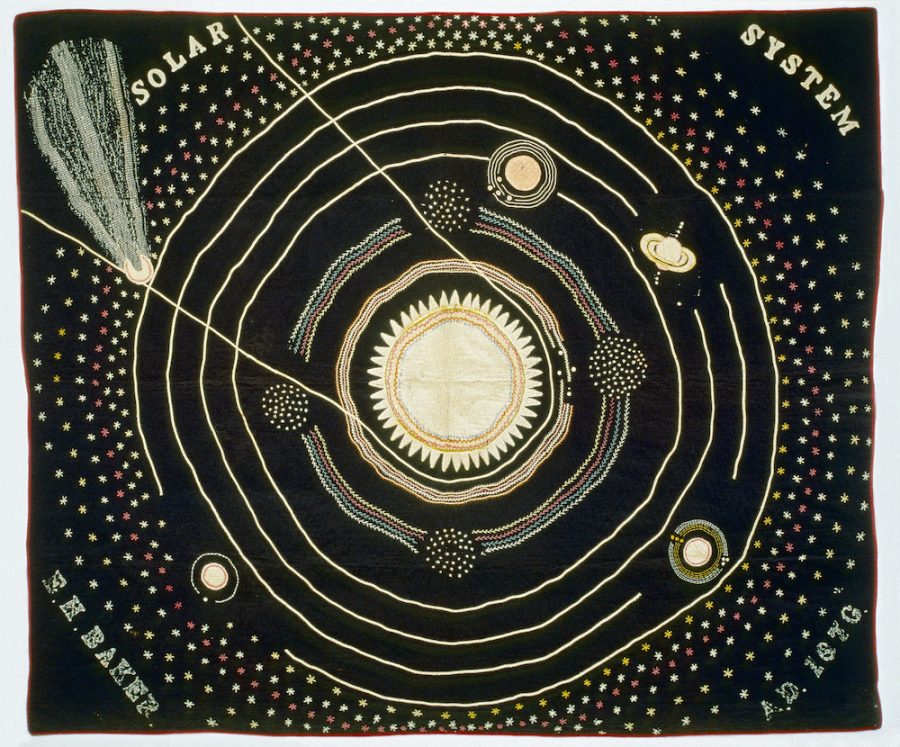
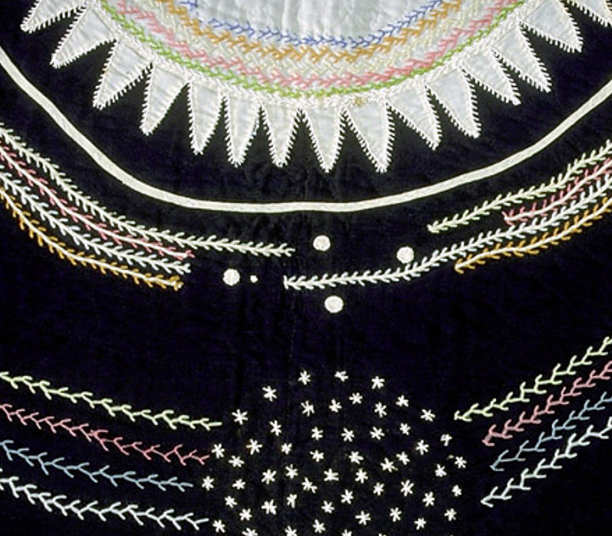
Baker, a teacher and astronomer in Cedar County, Iowa, is rumored to have spent 7 years embroidering a beautiful appliquéd quilt to use as a visual aid in lectures.
Finished in 1876, the quilt is large enough that even a near-sighted student could see its planets and moons from the back row.
Orbits are indicated with silken threads against a black background.
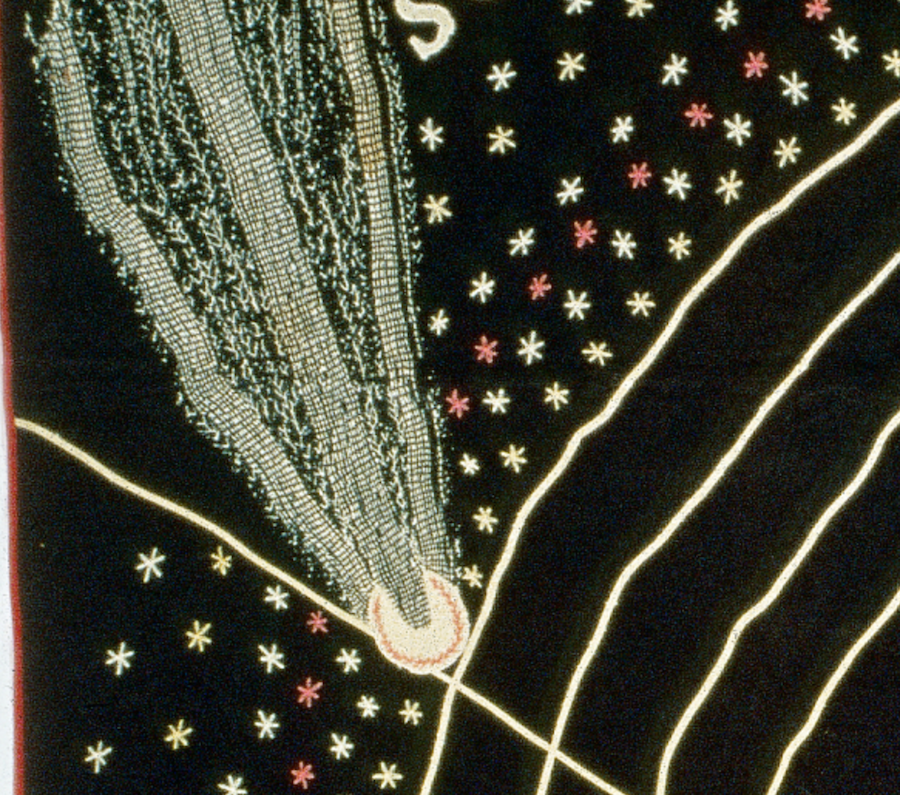
A comet in the upper left is thought to be Halley’s Comet, whose last appearance would have been in 1835, 12 years before Baker’s birth.
The Smithsonian National Museum of American History, where Baker’s quilt is housed, notes that astronomy was deemed an acceptable interest for 19th-century women, which may explain the number of celestial-themed quilts that date to the period.
Baker got just ten years out of her quilt before succumbing to tuberculosis at the age of 39, the mother of 7 children, 5 of whom survived her.
How did it all begin? Is there a god? Can we predict the future? Is there other intelligent life in the universe? For decades, many of us turned to Stephen Hawking for answers to those questions, or at least supremely intelligent suggestions as to where the answers might lie. But the celebrated astrophysicist’s death earlier this year — after an astonishingly long life and career, given the challenges he faced — took that option away. It turns out, though, that we haven’t actually heard the last of him: his last book, Brief Answers to the Big Questions (whose trailer you can watch just above), came out just this week.
“The book is quintessential Hawking,” writes physics professor Marcelo Gleiser at NPR. “He starts by addressing the questions in physics and cosmology that he dedicated his intellectual life to answer, using easy-to-follow arguments and drawing from everyday images and thought experiments.” Hawking’s answers to the big questions figure into his view of not just the world but all existence: he believes, writes Gleiser, “that humanity’s evolutionary mission is to spread through the galaxy as a sort of cosmic gardener, sowing life along the way. He believes, even if not without worry, that we will develop a positive relationship with intelligent machines and that, together, we will redesign the current fate of the world and of our species.”
In parallel with his career as a public figure and writer of popular explanatory books, which began with 1988’s A Brief History of Time, Hawking performed scientific research on black holes. The Guardian’s science editor Ian Sample describes it as a “career-long effort to understand what happens to information when objects fall into black holes,” capped off by a posthumously published paper titled “Black Hole Entropy and Soft Hair.” “Toss an object into a black hole and the black hole’s temperature ought to change,” writes Sample. “So too will a property called entropy, a measure of an object’s internal disorder, which rises the hotter it gets.” In the paper Hawking and his collaborators show that “a black hole’s entropy may be recorded by photons that surround the black hole’s event horizon, the point at which light cannot escape the intense gravitational pull. They call this sheen of photons ‘soft hair’.”
If that sounds tricky to understand, all of us who have appreciated Hawking’s writing know that we can at least go back to his books to get a grip on black holes and the questions about them that get scientists most curious. Much remains for future astrophysicists to work on about that “information paradox,” to do with where, exactly, everything that seemingly gets sucked into a black hole actually goes. “We don’t know that Hawking entropy accounts for everything you could possibly throw at a black hole, so this is really a step along the way,” Hawking’s collaborator Malcolm J. Perry tells Sample. “We think it’s a pretty good step, but there is a lot more work to be done.” As Hawking surely knew, the big questions — in physics or any other realm of existence — never quite get fully answered.
Based in Seoul, Colin Marshall writes and broadcasts on cities, language, and culture. His projects include the book The Stateless City: a Walk through 21st-Century Los Angeles and the video series The City in Cinema. Follow him on Twitter at @colinmarshall or on Facebook.
The next time some non-crafty type disparages your hobby as a frumpy pursuit, show them software engineer Sarah Spencer’s “Stargazing.”
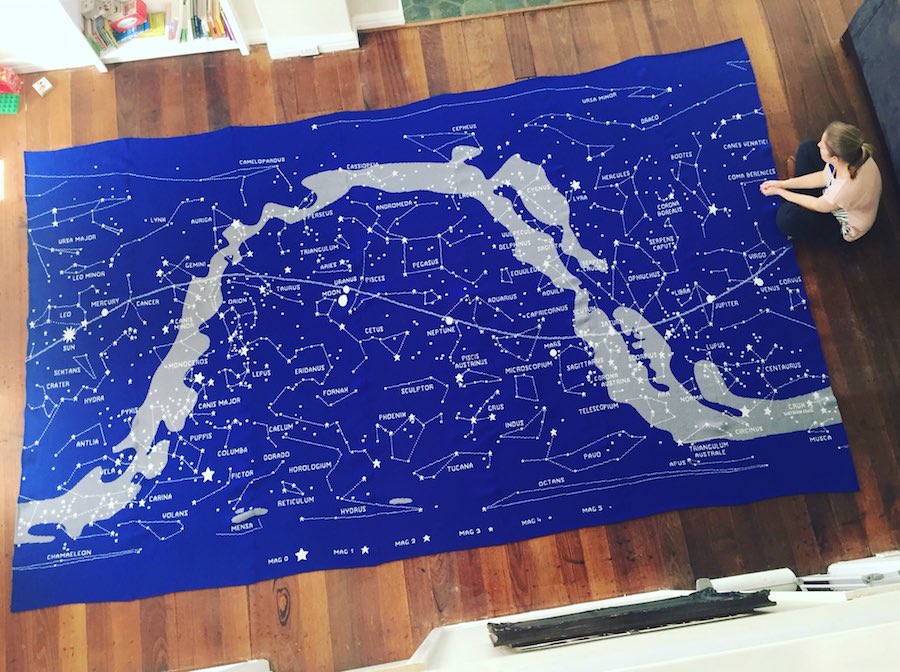
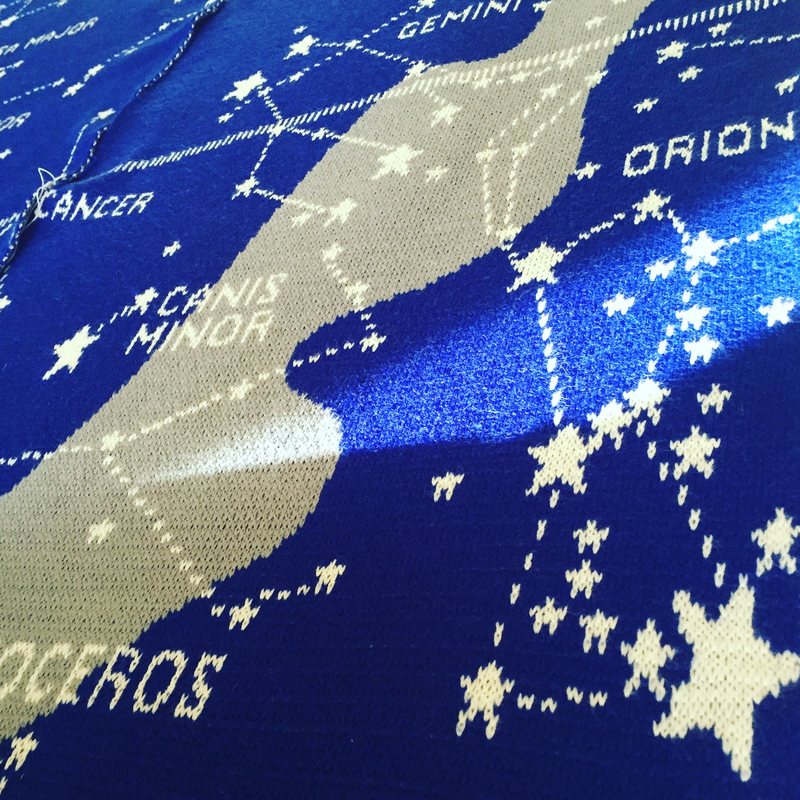
The 9’x 15’ knitted tapestry is an accurate equatorial star map featuring all 88 constellations as viewed by the naked eye, including the Milky Way and the Southern Cross, the best known star group in Spencer’s native Australia.
The project ate up 33 pounds of Australian wool in three shades, including the same ultramarine blue sported by a number of accomplished Australian women whose portraits are on display as part of the 2018 Archibald Prize.
While “Stargazing” is machine knit, its creation took longer than most hand-knitted projects.
What started as a lark, hacking and programming a 40-year-old, secondhand Empisal knitting machine, grew into something much larger when Spencer developed a computer algorithm that allowed one tri-colored knit stitch per pixel.
Years later, she was ready to start knitting her star map, a reflection of her interest in STEM—science, technology, engineering, and mathematics.
“Stargazing” is actually comprised of seven panels, each the result of dusk-to-dawn labor on the part of the hacked machine. Stitching them together required many more human hours.
The piece was unveiled at the UK’s tech-and-arts festival, Electromagnetic Field, on August 31. Spencer had calibrated the placement of the tapestry’s planets to correspond with their celestial counterparts’ locations that night.
For now, the tapestry is one-of-a-kind, but given its industrial origins, it’s not hard to foresee a future in which couples can cuddle under astronomically correct afghans, while gazing up at the stars.
We're hoping to rely on loyal readers, rather than erratic ads. Please click the Donate button and support Open Culture. You can use Paypal, Venmo, Patreon, even Crypto! We thank you!
Open Culture scours the web for the best educational media. We find the free courses and audio books you need, the language lessons & educational videos you want, and plenty of enlightenment in between.